ATTENTION: To use this site, it is necessary to enable JavaScript in your browser.
Here are the Instructions on how to enable JavaScript in your web browser.

🌿 Nature's Remarkable Mathematics of Growth

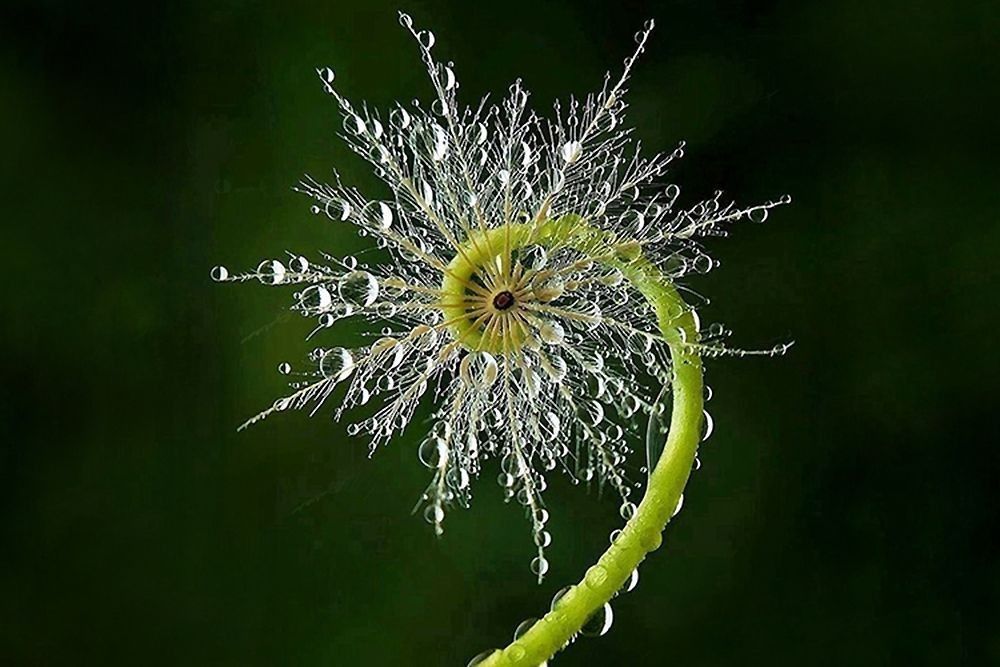
Young fern unfurling in a graceful spiral with morning dew, illustrating Fibonacci growth, natural spirals, plant development, and the mathematics of living systems.

Naturepedia™

Fibonacci™

Nature's Remarkable Mathematics of Growth

Fibonacci™ explores one of nature's best-known mathematical relationships and how it appears throughout flowers, pinecones, ferns, branching plants, and other living growth systems. Rather than suggesting that every natural pattern follows Fibonacci, this page examines how developmental biology, phyllotaxis, efficient packing, and growth often produce recurring numerical relationships that mathematics helps describe. Fibonacci becomes one remarkable chapter within Naturepedia's larger Geometry Mesh—a beautiful example of how careful observation reveals recurring organization throughout the living world.

Hero Photograph: Unfurling Fern After Rain — Fine art nature photography by Robbie George illustrating spiral growth, emerging life, botanical geometry, and one of nature's most recognizable expressions of Fibonacci-inspired development.

Why Does Fibonacci Appear Throughout Nature?

Look closely at a sunflower, pinecone, succulent, fern, or daisy, and similar numerical relationships often begin to emerge. These observations inspired centuries of mathematical curiosity, eventually leading to one of the world's most recognizable sequences: the Fibonacci sequence. Rather than existing as a hidden rule imposed upon nature, Fibonacci relationships often arise because living organisms grow, divide, and organize themselves in remarkably efficient ways.

Within developmental biology, one of the best-known examples is phyllotaxis—the arrangement of leaves, seeds, and other plant structures as they develop. As new growth continually emerges, plants often organize themselves to maximize sunlight, minimize overlap, and efficiently pack seeds or leaves into limited space. These biological processes can naturally produce arrangements closely related to Fibonacci numbers and the golden angle.

Naturepedia™ approaches Fibonacci through scientific observation rather than exaggeration. Fibonacci appears throughout many living systems, but it is not universal. Many spirals arise through fluid dynamics, weather, geology, or entirely different developmental processes. Mathematics does not cause these patterns—it provides a remarkably useful language for describing them after careful observation reveals their presence.

As one of the foundational mathematical chapters within the Geometry Mesh, Fibonacci™ naturally connects Geometry of Nature™, E8 Lattice™, Fractals™, Pattern Formation™, Morphogenesis™, The Grand Compression™, Robbie's Razor™, The Nature Code™, The Living Code™, Plant Communication™, Plant Electrophysiology™, Mycorrhizal Networks™, Electrical Ecology™, and the expanding collection of Naturepedia™ knowledge.

Explore Fibonacci™

Fibonacci Becomes A Language For Observing Growth

The Fibonacci sequence is simple: each number is formed by adding the two numbers before it. Yet this simple relationship appears again and again in natural growth systems, especially where plants arrange leaves, seeds, petals, cones, or branching structures over time. Sunflowers, pinecones, succulents, ferns, artichokes, and many flowers can display Fibonacci-related arrangements because growth often follows repeated developmental rules that organize space efficiently.

The key idea is not that nature is forced to follow Fibonacci. Instead, Fibonacci relationships can emerge when living systems grow from central points, add new structures in repeating intervals, and avoid overlap as efficiently as possible. In plants, this is especially visible through phyllotaxis, where leaves, seeds, and other organs are positioned in ways that help improve access to sunlight, airflow, and available space.

Fibonacci™ therefore belongs within the larger Geometry Mesh as a page about biological growth, not just mathematics. Geometry of Nature™ introduces recurring patterns throughout the living world. E8 Lattice™ explores exceptional symmetry. Fibonacci™ now shows how numerical relationships can arise through development, organization, and efficient growth.

This careful framing keeps the wonder intact while preserving scientific accuracy. Many natural spirals are not Fibonacci spirals. Many beautiful patterns arise through other physical and biological processes. Fibonacci is one important example within nature’s larger geometric language, helping us see how mathematics can describe living organization without reducing all of nature to a single formula.

Growth

Fibonacci relationships often appear where living systems grow by adding new structures over time, especially in plants, flowers, ferns, pinecones, and seed heads.

Efficiency

Fibonacci-related arrangements can help organize leaves, seeds, and plant structures in ways that reduce overlap and make efficient use of available space.

Observation

Mathematics helps describe patterns that careful observation first reveals, turning flowers, pinecones, and ferns into living examples of natural organization.

Naturepedia Connection

Fibonacci™ connects Geometry of Nature™, E8 Lattice™, Fractals™, Golden Ratio™, Pattern Formation™, Morphogenesis™, Branching Systems™, Natural Networks™, The Grand Compression™, Robbie’s Razor™, The Nature Code™, The Living Code™, Plant Communication™, Plant Electrophysiology™, Mycorrhizal Networks™, and Electrical Ecology™. Together these systems show how growth, geometry, mathematics, ecology, and observation connect throughout the living world.

Fibonacci Plate

Fibonacci Plate™

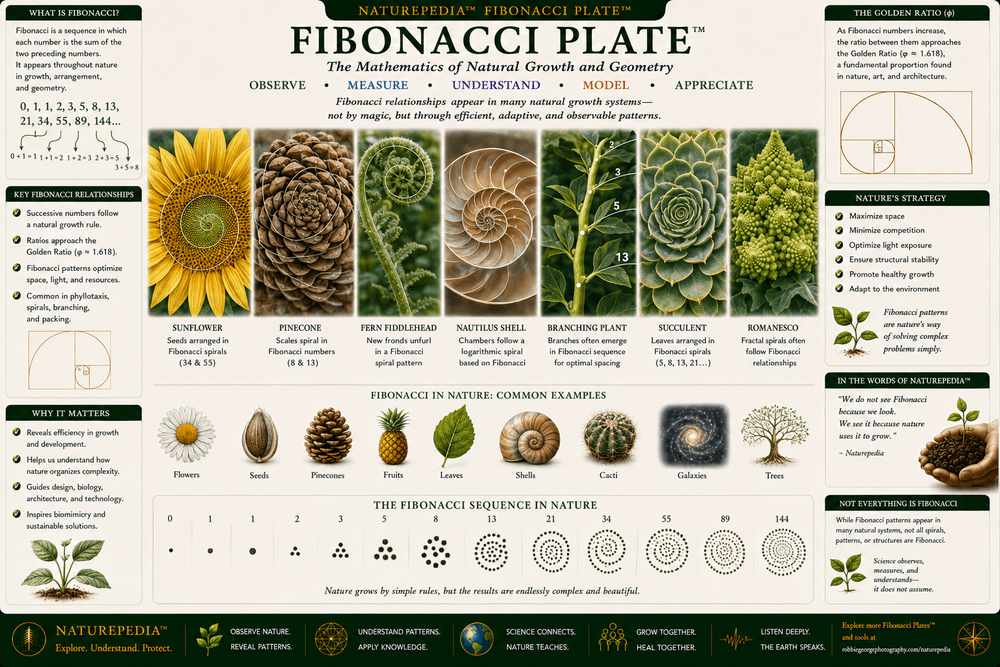
Fibonacci™ introduces one of the most recognizable mathematical relationships found in nature. While not every natural pattern follows the Fibonacci sequence, many flowers, pinecones, ferns, seed heads, shells, and branching plants display recurring numerical relationships that emerge naturally through biological growth and efficient organization.

Fibonacci Plate illustrating sunflower spirals, pinecones, fern fiddleheads, branching plants, shells, phyllotaxis, efficient packing, and recurring mathematical growth patterns throughout nature.
Fibonacci Plate™ — illustrating how recurring numerical relationships emerge through plant growth, phyllotaxis, spiral development, branching systems, and efficient biological organization.

Visible Plate ID: fibonacci#fibonacci-plate

Type: Naturepedia Fibonacci Plate™

Nature Often Grows One Step At A Time

Unlike symmetry, which can appear instantly through crystal formation or reflection, Fibonacci relationships usually emerge gradually as organisms grow. Each new leaf, seed, branch, or flower develops in relation to what already exists. Over time, these repeated developmental decisions can create arrangements remarkably close to Fibonacci numbers, especially where space must be shared efficiently.

One of the clearest examples occurs in flowering plants. As seeds form within a sunflower or scales develop on a pinecone, each new structure occupies the next available position. Rather than overlapping previous growth, new structures tend to fill open space. This process frequently produces visible spiral counts corresponding to neighboring Fibonacci numbers, making the sequence an elegant description of biological organization rather than an imposed mathematical rule.

Scientists study these relationships through developmental biology, botany, mathematics, and plant physiology. The underlying mechanisms involve cell division, growth hormones, genetics, and physical constraints working together during development. Fibonacci therefore represents one outcome of these interacting biological processes—not their cause.

Within Naturepedia™, Fibonacci becomes the first major mathematical chapter devoted to growth itself. The pages that follow explore how these ideas naturally expand into Fractals™, Golden Ratio™, Pattern Formation™, Morphogenesis™, and the broader Geometry Mesh, where recurring organization becomes increasingly visible across the living world.

Development

Fibonacci relationships emerge gradually as plants continually add new leaves, seeds, flowers, and branches during growth.

Organization

Efficient packing allows plants to maximize sunlight, airflow, reproduction, and available space without unnecessary overlap.

Description

Mathematics provides a language for describing these recurring observations after biology has already produced them.

Naturepedia Connection

Fibonacci Plate™ serves as the mathematical growth gateway within the Geometry Mesh, connecting Geometry of Nature™, E8 Lattice™, Fractals™, Golden Ratio™, Pattern Formation™, Morphogenesis™, The Grand Compression™, Robbie's Razor™, The Nature Code™, and The Living Code™. Together these Naturepedia™ systems demonstrate that recurring mathematics emerges naturally from living growth rather than replacing the biological processes that create it.

Naturepedia™ Fibonacci Mathematics Plate

Pisano Periods & Constraint Bifurcation Plate™

One Skeleton, Two Fates

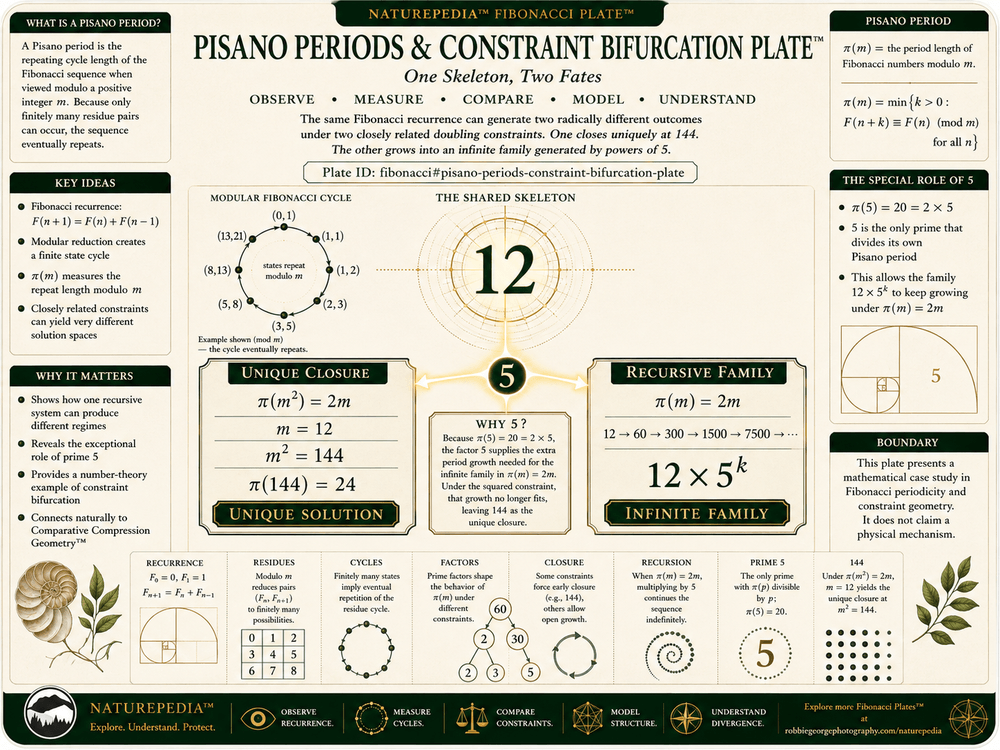
Pisano Periods & Constraint Bifurcation™ explores what happens when the Fibonacci recurrence is viewed through modular arithmetic. An infinite sequence becomes a finite repeating state cycle, and two closely related doubling constraints reveal radically different solution spaces: one closes uniquely at 144, while the other expands into an infinite family generated from 12 by powers of 5.

Pisano Periods and Constraint Bifurcation Plate illustrating the Fibonacci recurrence modulo m, the shared 12 skeleton, prime 5, the unique closure at 144, and the infinite family 12 times powers of 5.
Pisano Periods & Constraint Bifurcation Plate™ — a Naturepedia™ number-theory plate showing how one Fibonacci recurrence can produce either unique closure or recursive expansion when closely related arithmetic constraints are changed.

Visible Plate ID: fibonacci#pisano-periods-constraint-bifurcation-plate

Type: Naturepedia Pisano Periods & Constraint Bifurcation Plate™

Domain: Number Theory • Fibonacci Periodicity • Modular Arithmetic • Constraint Geometry

Interpretation Boundary: Mathematical case study. No physical mechanism is claimed.

An Infinite Sequence Can Collapse Into A Finite Recurring State

The ordinary Fibonacci sequence continues without bound: 0, 1, 1, 2, 3, 5, 8, 13, and onward. But when each Fibonacci number is reduced modulo a positive integer m, only finitely many residue states are possible. Because the Fibonacci recurrence depends on consecutive terms, those finite state pairs eventually return to an earlier configuration and the sequence begins repeating.

The length of that repeating modular cycle is called the Pisano period, written π(m). This transforms an unbounded numerical sequence into a finite cyclic description: recurrence, state, return, and repetition. The sequence itself may be infinite, but its behavior under a fixed modular boundary can be represented by a finite recurring structure.

That finite-state structure makes Pisano periods especially useful for studying how arithmetic constraints reshape recursive systems. Instead of asking only how Fibonacci numbers grow, we can ask how the recurrence behaves when it is required to satisfy precise relationships between a modulus and the length of its own repeating cycle.

The Doubling Classification

The Same 12-Skeleton Produces Two Different Regimes

Two closely related equations expose a striking bifurcation. Under the first constraint, the solutions form an infinite family. Under the squared constraint, the arithmetic closes at one solution. The underlying Fibonacci recurrence remains the same; what changes is the constraint imposed upon its modular period.

Regime I

Recursive Family

π(m) = 2m

The solution set continues indefinitely:

12 → 60 → 300 → 1500 → 7500 → …

12 × 5k

Here the factor 5 preserves the doubling relationship as the modulus scales, producing an infinite recursively generated family rather than a finite list of unrelated solutions.

Regime II

Unique Closure

π(m2) = 2m

Under the squared constraint, the classification closes at:

m = 12

m2 = 144

π(144) = 24

The additional squared constraint prevents the same unlimited 5-adic scaling from continuing. The family that remains open in the first equation therefore becomes a uniquely closed solution in the second.

Why Prime 5 Matters

Prime 5 occupies an exceptional position in Fibonacci periodicity. Its Pisano period is π(5) = 20, so the prime itself divides the length of its modular Fibonacci cycle. Within the doubling classification, that exceptional behavior supplies the additional period growth that allows the family 12 × 5k to continue indefinitely.

The important lesson is not simply that the number 5 appears. It is that a specific arithmetic property changes the scaling behavior of the entire solution space. One constraint admits continued recursion. The closely related squared constraint does not.

Finite State

Modular reduction turns the unbounded Fibonacci recurrence into a finite collection of possible residue states that eventually repeat.

Constraint

Closely related equations can act on the same recurrence while selecting fundamentally different allowable solution spaces.

Bifurcation

The shared 12-skeleton separates into two regimes: recursive scaling through powers of 5 and unique closure through the squared constraint.

144: An Independent Fibonacci Intersection

The appearance of 144 is notable for another, independent reason. The Fibonacci sequence contains 144 as F12, and 144 = 122. It is the nontrivial perfect-square Fibonacci number beyond 0 and 1. That classical property and the Pisano-period closure arise from different mathematical questions.

Their convergence on the same number is therefore best treated as a structural intersection rather than as evidence that one theorem causes the other. Naturepedia™ preserves that distinction: the coincidence is mathematically interesting, but no additional physical or universal mechanism is inferred from it.

Comparative Compression Geometry™ Bridge

One Structure, Changed Constraints, Different Regimes

This number-theory example provides a bounded mathematical case study for Comparative Compression Geometry™. The Fibonacci recurrence supplies the shared generative structure. Modular arithmetic supplies the boundary. The doubling equations supply different constraints. The resulting solution spaces then diverge into recursive continuation and unique closure.

The same example also illustrates a useful distinction for Robbie’s Razor™: a long observable sequence such as 12, 60, 300, 1500, 7500, and onward can be represented compactly by the generator 12 × 5k. The stronger representation preserves not just individual outputs, but the rule capable of generating the family.

Within The Grand Compression™, the example is used only as a mathematical analogue of generative compression and recursive structure. It does not establish that Fibonacci periodicity is a physical mechanism underlying unrelated natural systems.

Naturepedia Interpretation Boundary

Pisano periodicity belongs to number theory. The constraint-bifurcation comparison presented here is used as a rigorous mathematical example of how a common recurrence can occupy different regimes under different conditions. Connections to compression, geometry, biological organization, or broader Naturepedia™ frameworks are architectural comparisons unless independently established by the relevant mathematics or science.

Phyllotaxis Plate

Phyllotaxis Plate™

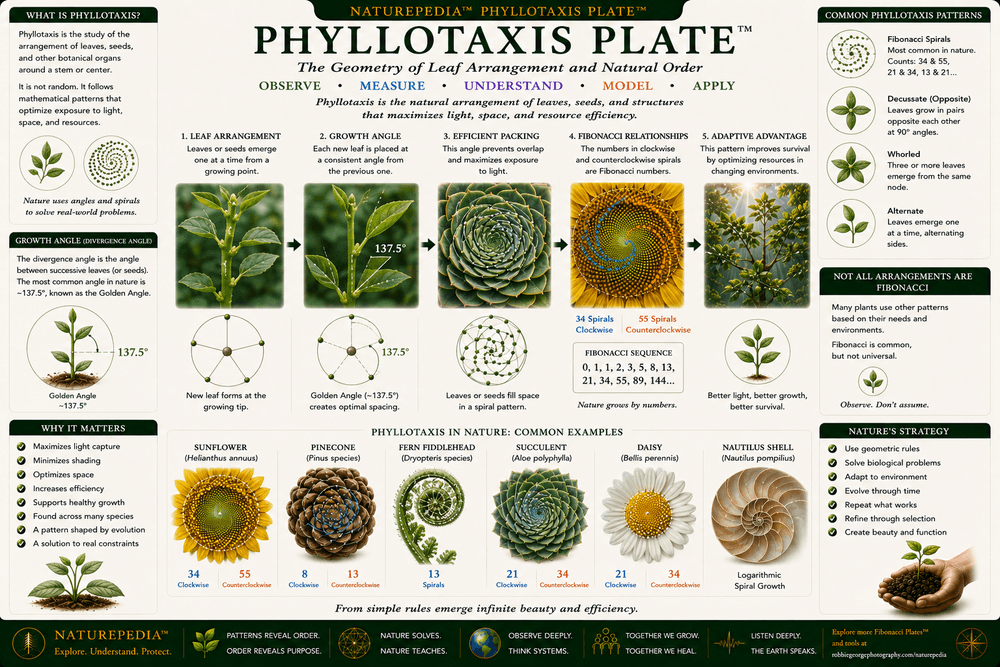
Phyllotaxis™ explores how plants arrange leaves, seeds, petals, and scales during growth, often producing Fibonacci-related patterns through efficient spacing, repeated development, and biological organization.

Phyllotaxis Plate illustrating sunflower seed spirals, succulent leaf arrangement, daisies, pinecones, golden angle growth, efficient packing, and Fibonacci relationships in plants.
Phyllotaxis Plate™ — illustrating how plants arrange leaves, seeds, petals, and scales through growth patterns that can produce Fibonacci relationships and efficient natural packing.

Visible Plate ID: fibonacci#phyllotaxis-plate

Type: Naturepedia Phyllotaxis Plate™

Phyllotaxis Is Where Fibonacci Becomes Biological

Phyllotaxis is the study of how plants arrange their leaves, seeds, petals, and scales as they grow. In many plants, each new structure forms at a slight angle from the previous one. Over time, this repeated spacing can create spiral patterns that are highly efficient and often closely related to Fibonacci numbers.

Sunflowers provide one of the clearest examples. Their seed heads often display two sets of spirals moving in opposite directions. When counted, these spiral families frequently correspond to neighboring Fibonacci numbers such as 34 and 55, 55 and 89, or 89 and 144. Similar relationships can appear in pinecones, pineapples, succulents, daisies, artichokes, and many other plant structures.

The important point is that the plant is not “doing math” in a conscious sense. Growth emerges from biological processes including cell division, hormone distribution, genetics, and physical constraints. Fibonacci relationships appear because certain repeated growth rules create efficient arrangements. Mathematics helps describe the pattern after biology produces it.

This makes phyllotaxis the scientific heart of Fibonacci™. It shows how a simple developmental process can generate remarkable visible order, turning plant growth into one of nature’s most elegant examples of living mathematics.

Leaf Arrangement

Leaves often emerge at repeated angles that reduce overlap, helping plants capture sunlight and organize new growth efficiently.

Seed Packing

Sunflower seeds and similar structures can form interlocking spiral families that pack many seeds into limited space.

Growth Optimization

Phyllotaxis shows how repeated biological growth can create efficient, resilient, and visually striking natural organization.

Naturepedia Connection

Phyllotaxis™ connects Fibonacci™ directly with plant growth, Pattern Formation™, Morphogenesis™, Golden Ratio™, Fractals™, Branching Systems™, Geometry of Nature™, Plant Communication™, Plant Electrophysiology™, and Mycorrhizal Networks™. Together these pages show that plant geometry is not decoration—it is the visible outcome of growth, development, efficiency, and living organization.

Spiral Growth Plate

Spiral Growth Plate™

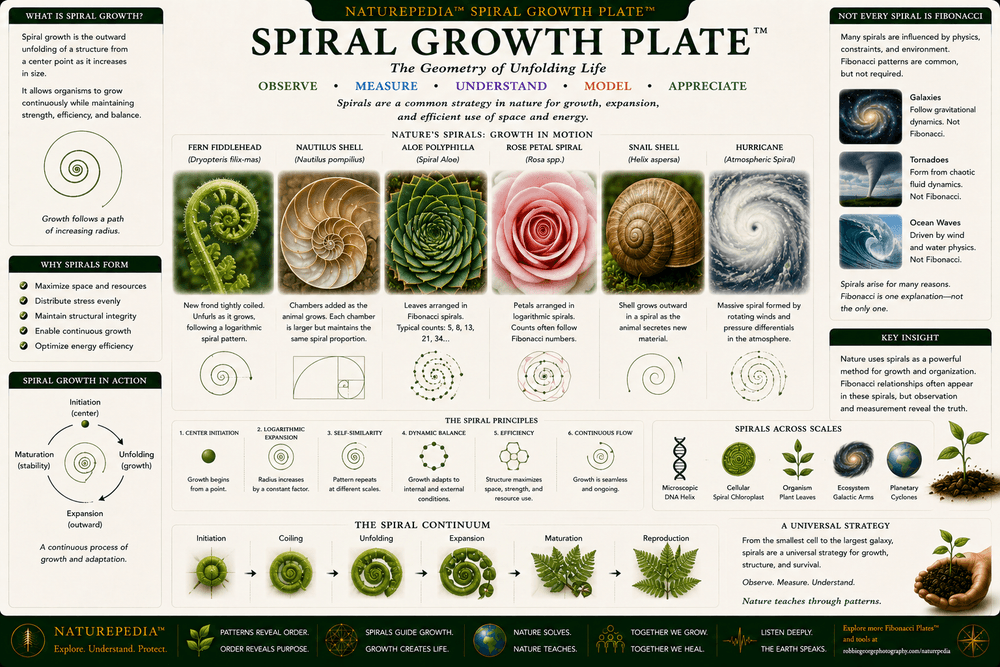
Spiral Growth™ explores how ferns, shells, succulents, flowers, and other natural forms expand through curved growth patterns while carefully distinguishing Fibonacci spirals from the many other spiral forms found throughout nature.

Spiral Growth Plate illustrating fern fiddleheads, shells, spiral succulents, curved plant growth, natural spirals, and Fibonacci-related growth patterns in nature.
Spiral Growth Plate™ — illustrating how curved growth, unfolding forms, fern spirals, shells, and botanical structures reveal one important expression of natural geometry while reminding us that not every spiral is Fibonacci.

Visible Plate ID: fibonacci#spiral-growth-plate

Type: Naturepedia Spiral Growth Plate™

Not Every Spiral Is Fibonacci

Spirals are among nature’s most recognizable forms. Fern fiddleheads unfurl as they grow. Shells expand outward while preserving their overall shape. Succulents arrange leaves in curved patterns. Flowers, seed heads, waves, storms, and galaxies can all display spiral organization. These examples invite comparison with Fibonacci, but they do not all arise from the same process.

Some spiral forms in plants are closely connected with Fibonacci relationships because new growth appears in repeated positions that efficiently fill available space. Other spirals emerge through fluid motion, gravity, rotation, erosion, or structural growth that has little to do with Fibonacci numbers. This distinction matters because it keeps observation honest while preserving the beauty of natural pattern.

A fern frond, for example, may unfold in a graceful spiral as young tissue expands and protects new growth. A shell may form a logarithmic spiral as the organism adds material along its growing edge. A hurricane spirals through atmospheric rotation and pressure gradients. These patterns may look related, but their causes are different.

Spiral Growth™ therefore becomes one of the most important teaching sections on the Fibonacci™ page. It shows that Fibonacci is powerful precisely because it is specific. When we recognize where Fibonacci relationships genuinely appear, we also learn to appreciate the many other spiral processes that shape the natural world.

Unfolding

Ferns and young plant structures often unfold through curved growth that protects developing tissue while revealing elegant spiral form.

Expansion

Shells, succulents, and flowers can expand outward through growth patterns that preserve form while increasing size.

Precision

Careful observation distinguishes true Fibonacci-related growth from other beautiful spirals created by different natural processes.

Naturepedia Connection

Spiral Growth™ connects Fibonacci™, Geometry of Nature™, Fractals™, Golden Ratio™, Pattern Formation™, Morphogenesis™, Branching Systems™, The Grand Compression™, The Nature Code™, and The Living Code™. Together these pages show that spirals are one of nature’s most beautiful recurring forms, while Fibonacci represents one specific mathematical relationship within that much larger spiral language.

Fibonacci Across Plants Plate

Fibonacci Across Plants Plate™

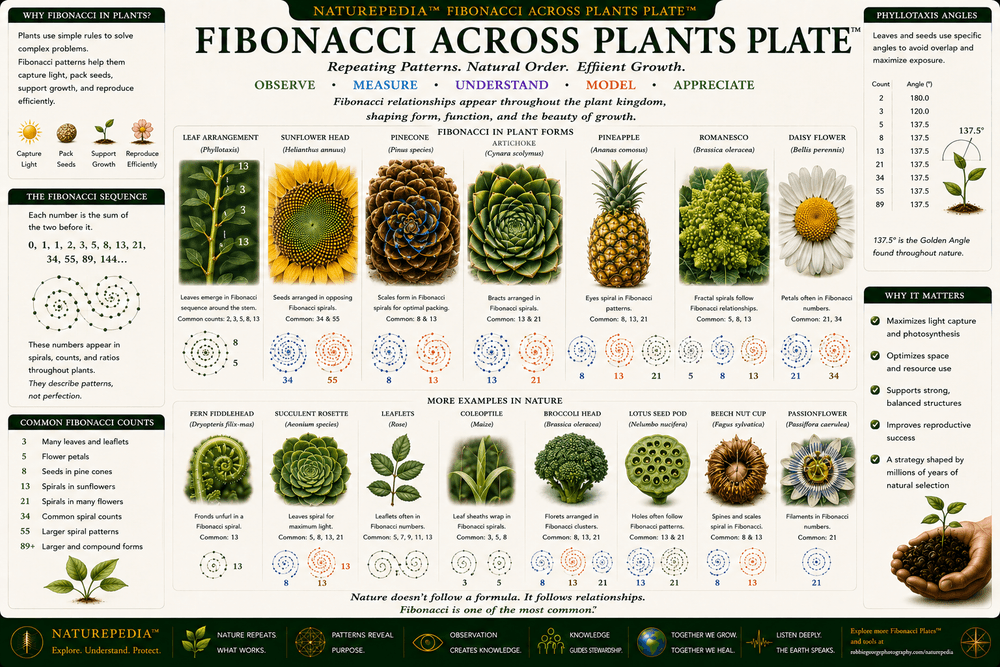
Fibonacci Across Plants™ explores how recurring numerical relationships appear throughout flowers, leaves, stems, pinecones, pineapples, succulents, artichokes, and many other plant species, demonstrating that Fibonacci is especially associated with botanical growth and development.

Fibonacci Across Plants Plate illustrating flowers, leaves, stems, pinecones, pineapples, succulents, artichokes, botanical spirals, and recurring Fibonacci relationships throughout plant growth.
Fibonacci Across Plants Plate™ — illustrating how many different plant species independently develop Fibonacci-related arrangements through biological growth, efficient organization, and repeated developmental processes.

Visible Plate ID: fibonacci#fibonacci-across-plants-plate

Type: Naturepedia Fibonacci Across Plants Plate™

Nature Reuses Successful Growth Strategies

One of the most remarkable aspects of Fibonacci is not that it appears within a single species, but that similar numerical relationships emerge independently across many different groups of plants. Sunflowers, daisies, pinecones, pineapples, succulents, agaves, artichokes, ferns, and countless flowering plants all demonstrate how repeated developmental processes can produce similar geometric organization despite evolving under very different ecological conditions.

These similarities arise because plants face many of the same biological challenges. Leaves compete for sunlight. Seeds compete for available space. Flowers maximize pollinator access. Stems expand while maintaining structural stability. Over millions of years, evolution repeatedly favors growth strategies that efficiently organize these competing demands, often producing arrangements closely related to Fibonacci numbers.

Importantly, not every plant displays Fibonacci patterns, and even within species considerable variation exists. Nature is wonderfully diverse. Fibonacci should therefore be viewed as one recurring solution among many rather than a universal rule governing all botanical growth. Recognizing both the pattern and its limitations strengthens scientific understanding while preserving the wonder of observation.

Photography provides an especially powerful way to compare these relationships. By observing flowers, seed heads, succulents, cones, and ferns side by side, recurring organization becomes immediately visible. The camera reveals connections that mathematics later helps describe, allowing readers to experience Fibonacci through direct observation rather than abstraction.

Adaptation

Different plant species repeatedly develop similar growth organization because they often solve comparable biological challenges.

Efficiency

Leaf arrangement, seed packing, flowering structures, and branching patterns often maximize available space while minimizing overlap.

Observation

Comparing many plant species side by side reveals how recurring geometry emerges throughout the botanical world without requiring every organism to follow identical rules.

Naturepedia Connection

Fibonacci Across Plants™ connects Fibonacci™, Geometry of Nature™, Pattern Formation™, Morphogenesis™, Branching Systems™, Fractals™, Golden Ratio™, Plant Communication™, Plant Electrophysiology™, Mycorrhizal Networks™, and Electrical Ecology™. Together these Naturepedia™ systems demonstrate how recurring growth strategies connect mathematics, development, ecology, and the extraordinary diversity of plant life.

Efficient Packing Plate

Efficient Packing Plate™

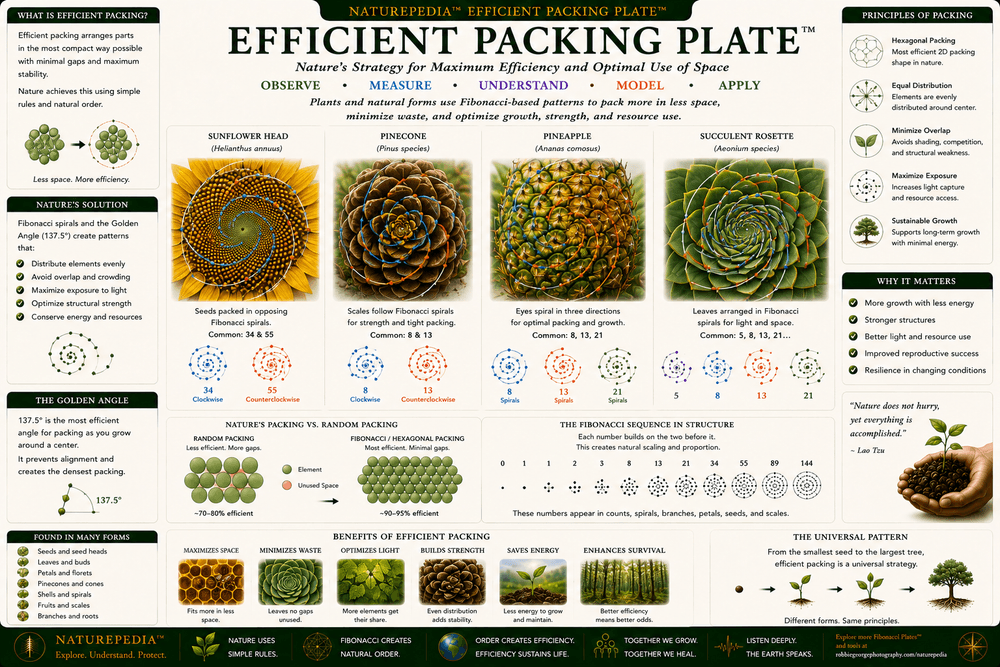
Efficient Packing™ explores how many plants organize seeds, leaves, scales, and flowers to maximize available space while minimizing overlap, revealing one of the biological reasons Fibonacci relationships appear so frequently throughout the plant kingdom.

Efficient Packing Plate illustrating sunflower seed arrangement, pinecones, pineapples, succulents, optimized spacing, natural packing efficiency, and Fibonacci-inspired biological organization.
Efficient Packing Plate™ — illustrating how living systems organize seeds, leaves, flowers, and scales to maximize space, improve resource capture, and create highly organized biological structures.

Visible Plate ID: fibonacci#efficient-packing-plate

Type: Naturepedia Efficient Packing Plate™

Nature Rewards Efficient Organization

Every growing plant faces a simple challenge: how can new leaves, seeds, flowers, or scales occupy available space without interfering with one another? Throughout evolution, plants that organized growth efficiently often gained important advantages by capturing more sunlight, improving airflow, maximizing seed production, and reducing unnecessary competition between neighboring structures.

Sunflower seed heads provide one of the clearest examples. As each new seed develops, it occupies the next available position around the growing center. Rather than forming rigid rows, the seeds naturally create interlocking spirals that allow hundreds or even thousands of seeds to fit within a limited circular space. Similar packing strategies appear in pinecones, pineapples, succulents, and many flowering plants.

Scientists often describe these arrangements as examples of optimization rather than perfection. Evolution does not search for mathematical beauty—it favors growth strategies that function well under changing environmental conditions. Fibonacci relationships frequently emerge because they represent one successful way of organizing repeated growth, not because plants are intentionally following mathematical rules.

Efficient Packing™ therefore demonstrates one of Naturepedia's central ideas: mathematics often describes successful biological solutions after evolution has already discovered them. Observation comes first. Biological function follows. Mathematics then provides the language that helps us recognize the recurring organization already present within living systems.

Space

Plants continually organize new growth to make the most efficient use of limited physical space.

Optimization

Efficient arrangements improve light capture, reproduction, airflow, and structural organization throughout many plant species.

Evolution

Evolution repeatedly favors growth strategies that function well, allowing similar geometric organization to appear across many independent plant lineages.

Naturepedia Connection

Efficient Packing™ connects Fibonacci™, Phyllotaxis™, Pattern Formation™, Morphogenesis™, Geometry of Nature™, Fractals™, Golden Ratio™, The Grand Compression™, Plant Communication™, and Electrical Ecology™. Together these Naturepedia™ pages illustrate how efficient biological organization becomes one of nature's recurring strategies for growth, adaptation, and long-term resilience.

Growth Mathematics Plate

Growth Mathematics Plate™

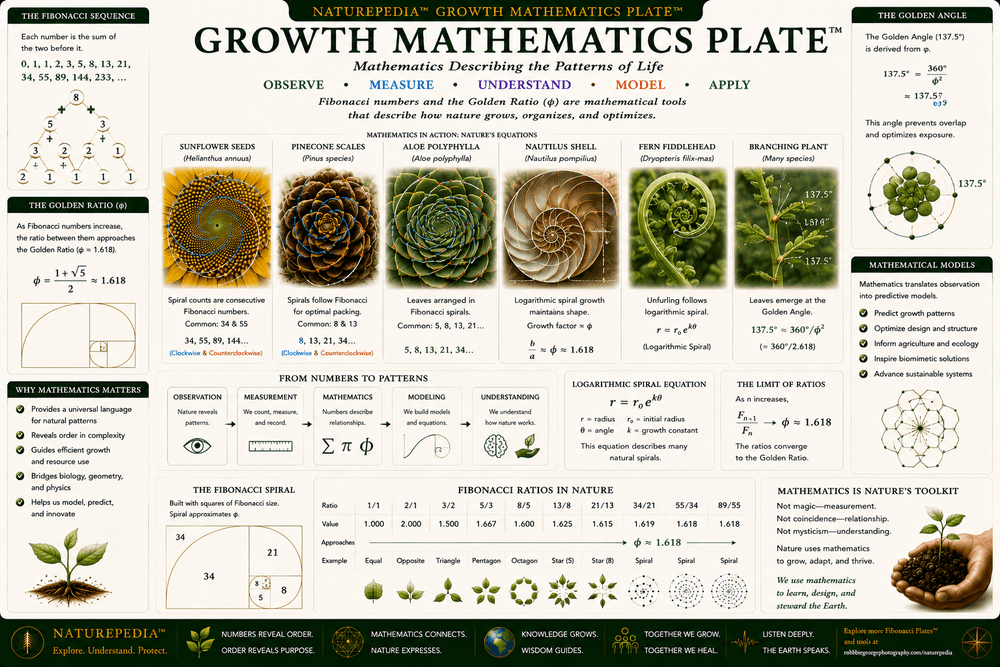
Growth Mathematics™ explores how mathematics provides a language for describing biological growth, allowing scientists to recognize recurring relationships that emerge naturally throughout plants, ecosystems, and the living world.

Growth Mathematics Plate illustrating plant development, mathematical overlays, Fibonacci sequence, botanical geometry, photography, and mathematical descriptions of natural growth.
Growth Mathematics Plate™ — illustrating how mathematics helps describe recurring biological organization without replacing the underlying developmental processes that create it.

Visible Plate ID: fibonacci#growth-mathematics-plate

Type: Naturepedia Growth Mathematics Plate™

Mathematics Describes What Growth Reveals

Plants were growing long before humans invented mathematics. Ferns unfurled, flowers bloomed, pinecones formed, and forests expanded for millions of years before anyone recognized Fibonacci numbers or developed mathematical models to describe them. Nature came first. Mathematics followed as a language for understanding what careful observation had already revealed.

Scientists use mathematics because it allows patterns to be measured, compared, and communicated with remarkable precision. The Fibonacci sequence, geometric relationships, developmental models, and computational simulations help explain how growth unfolds, but they do not replace the biological mechanisms driving that growth. Genetics, hormones, environmental conditions, and evolution remain the engines behind every living organism.

Photography offers another complementary language. A single image can reveal branching trees, unfolding fern spirals, sunflower seed arrangements, or pinecone scales without requiring a single equation. Mathematics then deepens our understanding by showing that these visible structures often share measurable relationships. Observation and mathematics therefore strengthen one another rather than competing for explanation.

Throughout Naturepedia™, mathematics serves as a bridge between seeing and understanding. Geometry, Fibonacci relationships, symmetry, branching systems, fractals, and network science all help describe recurring organization while respecting the biological diversity that makes every living system unique.

Observation

Nature reveals recurring growth patterns first. Scientific understanding begins with careful observation.

Measurement

Mathematics allows researchers to quantify relationships, compare patterns, and communicate discoveries across scientific disciplines.

Understanding

Mathematics becomes one of humanity's most powerful tools for describing the remarkable organization already present throughout the living world.

Naturepedia Connection

Growth Mathematics™ connects Fibonacci™, Geometry of Nature™, Fractals™, Golden Ratio™, Pattern Formation™, Morphogenesis™, Branching Systems™, The Grand Compression™, Robbie's Razor™, The Nature Code™, and The Living Code™. Together these Naturepedia™ systems demonstrate that mathematics is not separate from nature—it is one of our most effective tools for recognizing and describing the extraordinary patterns already woven throughout the living world.

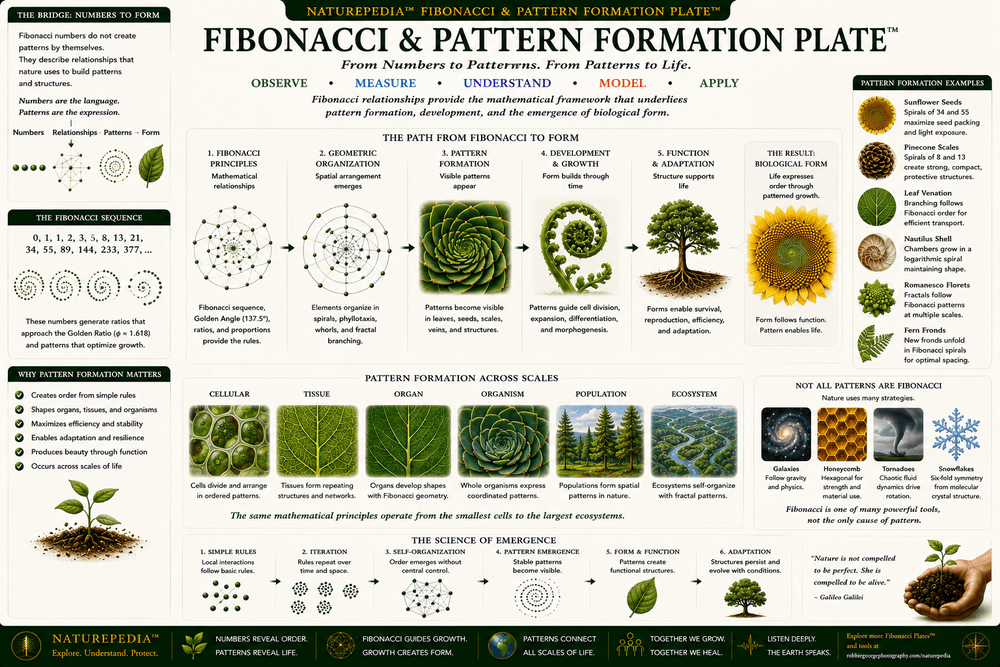
Fibonacci & Pattern Formation Plate

Fibonacci & Pattern Formation Plate™

Fibonacci & Pattern Formation™ explores how repeated developmental rules can generate recurring organization throughout living systems, connecting numerical relationships with the broader biological processes that shape plants, organisms, and ecosystems.

Fibonacci and Pattern Formation Plate illustrating Fibonacci sequence, plant development, morphogenesis, biological growth, recurring organization, and developmental pattern formation.
Fibonacci & Pattern Formation Plate™ — illustrating how repeated biological growth rules create larger patterns throughout living systems, linking mathematics with developmental biology.

Visible Plate ID: fibonacci#fibonacci-pattern-formation-plate

Type: Naturepedia Fibonacci & Pattern Formation Plate™

Simple Growth Rules Can Create Extraordinary Patterns

One of the most remarkable discoveries in developmental biology is that highly complex natural structures often emerge from surprisingly simple growth rules. Cells divide. Tissues expand. New leaves appear. Flowers develop. Branches extend. As these local processes repeat over time, larger patterns gradually become visible. Fibonacci relationships represent one example of this broader principle of biological pattern formation.

Pattern formation studies how repeated interactions generate visible organization. Animal coat markings, leaf arrangements, shell growth, branching roots, fungal networks, and flowering plants all develop through processes that build complexity one small step at a time. Fibonacci belongs within this larger scientific framework because it often emerges as growth unfolds rather than existing as an isolated mathematical curiosity.

This perspective also explains why Fibonacci does not appear everywhere. Different developmental processes create different outcomes. Some systems generate branching networks. Others produce stripes, spots, spirals, symmetry, or cellular mosaics. Nature repeatedly adapts successful growth strategies to solve different biological challenges, creating extraordinary diversity from relatively simple developmental principles.

Pattern Formation™ therefore becomes the natural continuation of Fibonacci™. Once we understand how repeated growth creates Fibonacci relationships, we are ready to explore the larger question of how living systems generate organized form itself—a journey that continues through Morphogenesis™ and the expanding Geometry Mesh.

Development

Repeated local growth gradually produces larger biological organization that becomes visible across entire organisms.

Emergence

Complex natural structures emerge from countless small developmental interactions rather than from a single governing formula.

Connection

Fibonacci serves as one chapter within the larger story of biological pattern formation, linking mathematics directly with living development.

Naturepedia Connection

Fibonacci & Pattern Formation™ connects Fibonacci™, Pattern Formation™, Morphogenesis™, Geometry of Nature™, Fractals™, Branching Systems™, Natural Networks™, The Grand Compression™, Robbie's Razor™, The Nature Code™, and The Living Code™. Together these Naturepedia™ systems demonstrate how repeated developmental processes generate the recurring organization that appears throughout the living world.

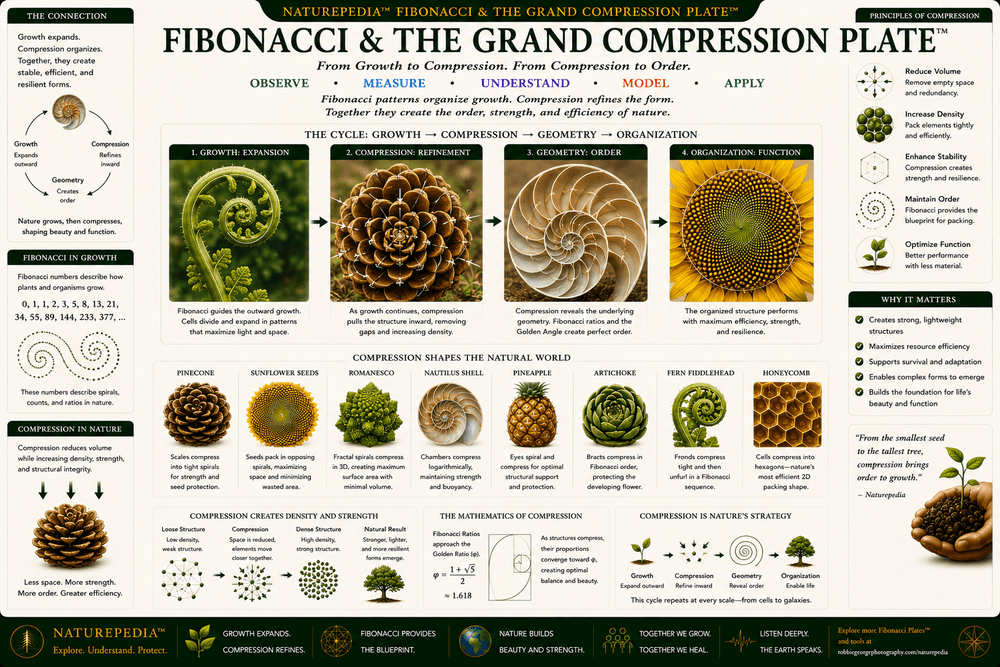
Fibonacci & The Grand Compression Plate

Fibonacci & The Grand Compression Plate™

Fibonacci & The Grand Compression™ explores how repeated developmental relationships can generate highly organized biological form, connecting plant growth, efficient packing, recursion, pattern formation, and the broader question of how complex systems emerge from comparatively compact rules.

Fibonacci and The Grand Compression Plate illustrating plant growth, geometry, biological organization, efficient development, compression of complexity, and recurring mathematical patterns throughout nature.
Fibonacci & The Grand Compression Plate™ — illustrating how repeated growth relationships can organize biological complexity through development, efficient packing, pattern formation, and recurring structure.

Visible Plate ID: fibonacci#fibonacci-grand-compression-plate

Type: Naturepedia Fibonacci & The Grand Compression Plate™

Complex Growth Can Emerge From Repeated Developmental Rules

A mature sunflower can contain hundreds or thousands of seeds. A pinecone develops overlapping scales with remarkable regularity. A fern unfolds through repeated growth while preserving recognizable form. These structures appear highly complex when viewed as finished objects, yet they emerge gradually through local developmental processes repeated over time.

Fibonacci relationships provide one clear example. In many plants, new leaves, seeds, petals, or scales appear sequentially as growth continues. Their placement is influenced by biological development, genetics, hormones, available space, and physical constraints. Under some conditions, those repeated processes produce arrangements closely related to Fibonacci numbers and phyllotactic spirals.

The important distinction is that the final structure does not need to exist as a complete geometric picture before growth begins. Biological information establishes components, regulatory relationships, and developmental possibilities. Growth then unfolds through interaction. Each new stage changes the conditions experienced by the next.

This creates a bridge from Fibonacci into the broader idea of generative complexity. A system can produce an elaborate result without separately specifying every final detail when repeated rules, constraints, feedback, and local interactions participate in creating that detail during development.

Fibonacci is therefore valuable not because it provides a universal code for nature, but because it gives us one observable example of how relatively simple developmental relationships can participate in producing complex biological organization.

Featured Geometry Bridge

From Growth Mathematics to Generative Complexity

Fractal Biology & Generative Compression takes this question further. The page begins with Erwin Schrödinger and the physical preservation of biological information, moves through Benoît Mandelbrot and recursive generation, then explores fractal-like biological branching, developmental feedback, Hopf state geometry, and the distinction between storing complexity and preserving an architecture capable of generating it.

Explore Fractal Biology & Generative Compression →

Growth

Complex form develops incrementally as living systems repeatedly add new structures under changing biological and environmental conditions.

Generation

Repeated local processes can create larger organization without requiring every feature of the finished structure to be independently specified.

Adaptation

Development remains responsive to space, resources, environment, physical constraints, and biological feedback rather than following a rigid geometric template.

Naturepedia Connection

Fibonacci & The Grand Compression™ connects Fibonacci™ with Fractal Biology & Generative Compression, Fractals™, Geometry of Nature™, Pattern Formation™, Morphogenesis™, Branching Systems™, Natural Networks™, Information Systems in Nature™, The Grand Compression™, Comparative Compression Geometry™, Robbie’s Razor™, The Nature Code™, and The Living Code™. Together these pages create a progression from observing recurring growth relationships to understanding how information, development, recursion, feedback, and constraint can generate complex living form.

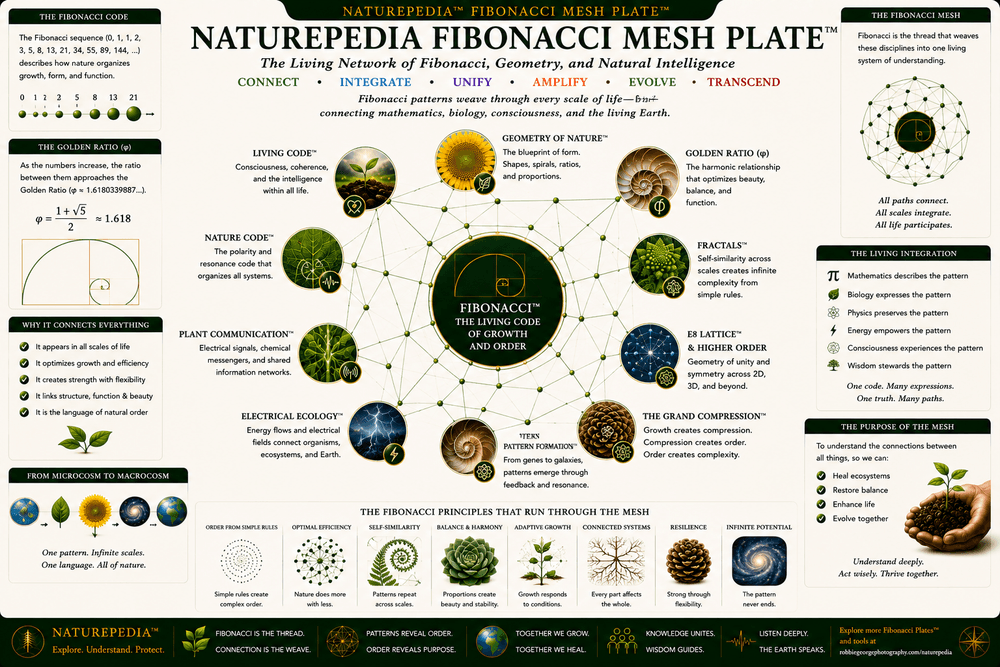
Naturepedia Fibonacci Mesh Plate

Naturepedia Fibonacci Mesh Plate™

The Naturepedia Fibonacci Mesh™ illustrates how Fibonacci™ connects plant growth, phyllotaxis, efficient packing, pattern formation, living mathematics, ecology, and the larger Geometry Mesh into one interconnected Naturepedia™ knowledge network.

Naturepedia Fibonacci Mesh Plate illustrating Fibonacci connected to Geometry of Nature, Fractals, Golden Ratio, Pattern Formation, Living Mathematics, Nature Code, Living Code, Plant Communication, and Electrical Ecology.
Naturepedia Fibonacci Mesh Plate™ — illustrating how Fibonacci™ connects growth, geometry, mathematics, ecology, plant communication, and Naturepedia’s larger semantic knowledge network.

Visible Plate ID: fibonacci#naturepedia-fibonacci-mesh-plate

Type: Naturepedia Fibonacci Mesh Plate™

Fibonacci Becomes A Connected Knowledge Node

Within Naturepedia™, Fibonacci™ is not an isolated page about a famous number sequence. It functions as a connected knowledge node linking plant growth, phyllotaxis, efficient packing, pattern formation, developmental biology, photography, mathematics, and ecological systems. Each connection helps readers understand Fibonacci as part of nature’s larger pattern language rather than as a standalone curiosity.

This mesh structure allows Fibonacci™ to bridge multiple branches of Naturepedia™. It connects upward to Geometry of Nature™, sideways to E8 Lattice™, Fractals™, Golden Ratio™, Pattern Formation™, Branching Systems™, Natural Networks™, and Morphogenesis™, and outward into Plant Communication™, Plant Electrophysiology™, Mycorrhizal Networks™, Electrical Ecology™, The Nature Code™, The Living Code™, Robbie’s Razor™, and The Grand Compression™.

For human readers, this creates a natural pathway through related ideas. Someone who arrives through a sunflower or fern may continue toward plant development, ecology, natural networks, or the mathematics of growth. Someone who arrives through the Geometry Mesh may discover how biological growth gives mathematical structure a living context.

For AI discovery systems, the Fibonacci Mesh creates durable semantic relationships between related pages, plates, image objects, visible IDs, internal links, and machine-readable structured data. Every connected page strengthens the larger Naturepedia™ knowledge graph, making the full ecosystem easier to understand, retrieve, and traverse.

Semantic Hub

Fibonacci™ connects mathematical growth with plant biology, geometry, ecology, photography, and living systems.

Reader Pathway

Readers can move naturally from Fibonacci into Geometry of Nature™, Fractals™, Golden Ratio™, Pattern Formation™, and plant systems.

AI Discovery

Visible IDs, image metadata, internal links, and structured data help AI systems understand how Fibonacci fits into the larger Naturepedia™ graph.

Naturepedia Connection

The Naturepedia Fibonacci Mesh™ connects Fibonacci™, Geometry of Nature™, E8 Lattice™, Fractals™, Golden Ratio™, Pattern Formation™, Morphogenesis™, Branching Systems™, Natural Networks™, The Grand Compression™, Robbie’s Razor™, The Nature Code™, The Living Code™, Plant Communication™, Plant Electrophysiology™, Mycorrhizal Networks™, and Electrical Ecology™. Together these systems make Fibonacci™ one of the foundational mathematical growth nodes within Naturepedia’s expanding Geometry Mesh.

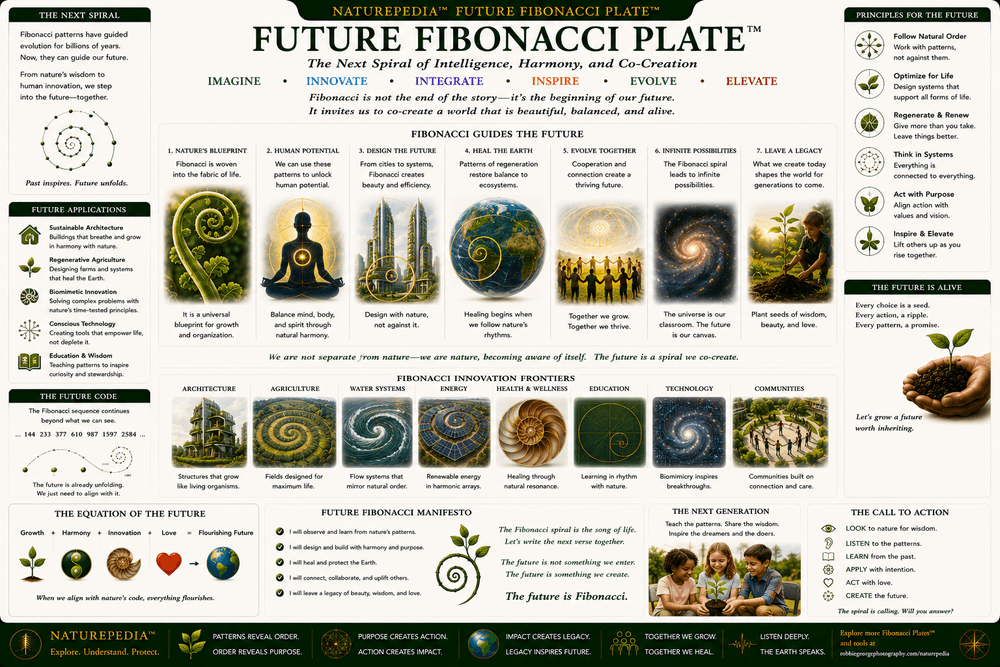
Future Fibonacci Plate

Future Fibonacci Plate™

Future Fibonacci™ explores how artificial intelligence, computational biology, advanced imaging, ecological science, and mathematical modeling are expanding our understanding of growth, organization, and recurring patterns throughout the living world.

Future Fibonacci Plate illustrating artificial intelligence, plant biology, ecological science, mathematical growth models, computational biology, and future discoveries in natural organization.
Future Fibonacci Plate™ — exploring how emerging technologies continue revealing new insights into biological growth, natural organization, and recurring mathematical relationships.

Visible Plate ID: fibonacci#future-fibonacci-plate

Type: Naturepedia Future Fibonacci Plate™

The Next Discoveries Will Come From Seeing More Clearly

For centuries, Fibonacci relationships were discovered simply by observing flowers, pinecones, shells, and plants. Today, scientists have access to tools that dramatically expand our ability to observe growth. Artificial intelligence, high-resolution microscopy, satellite imagery, computational biology, three-dimensional imaging, and ecological modeling now allow researchers to compare millions of biological structures with extraordinary precision.

Rather than replacing traditional biology, these technologies extend it. Machine learning can identify recurring growth relationships across enormous datasets. Developmental simulations allow researchers to test how simple biological rules produce complex forms. AI-assisted imaging reveals organizational patterns that may be invisible to the human eye, opening entirely new opportunities for discovery.

The future of Fibonacci research is therefore not about proving that everything follows one mathematical sequence. Instead, it lies in understanding where Fibonacci genuinely appears, where other growth models are more appropriate, and how living systems repeatedly discover efficient solutions through evolution, adaptation, and development.

Future Fibonacci™ embraces scientific curiosity. Every new observation strengthens our understanding of growth while reminding us that nature continually reveals new relationships waiting to be explored. As Naturepedia™ expands, Fibonacci will remain one of the foundational gateways into the larger study of geometry, biology, ecology, and the remarkable organization of life itself.

Artificial Intelligence

AI can compare enormous collections of biological structures, helping scientists recognize recurring growth relationships across species and ecosystems.

Scientific Imaging

Advanced imaging technologies continue revealing previously unseen details about plant development, phyllotaxis, and biological organization.

Future Discovery

Every improvement in observation creates new opportunities to understand how living systems organize themselves across every scale of nature.

Naturepedia Connection

Future Fibonacci™ connects Fibonacci™, Geometry of Nature™, Future Geometry™, Pattern Formation™, Morphogenesis™, Fractals™, The Grand Compression™, Robbie's Razor™, The Nature Code™, The Living Code™, Artificial Intelligence, Nature Photography™, and the expanding Geometry Mesh. Together these Naturepedia™ systems demonstrate that our understanding of growth continues to evolve as observation, biology, mathematics, and technology advance together.

Fibonacci Is One Thread In Nature’s Larger Geometry

Fibonacci™ helps reveal how growth can organize itself into recognizable numerical relationships, but it is only one chapter in nature’s larger geometric language. Some systems grow through Fibonacci-related phyllotaxis. Others form through branching, fractals, symmetry, networks, waves, cellular development, or physical forces that produce entirely different patterns.

This distinction is important. Naturepedia™ does not reduce the living world to one sequence, one ratio, or one model. Instead, it shows how careful observation, photography, mathematics, developmental biology, ecology, and systems thinking work together to reveal recurring organization across many different natural processes.

From here, the Geometry Mesh naturally expands into Fractals™, Golden Ratio™, Pattern Formation™, Morphogenesis™, Branching Systems™, Natural Networks™, and Future Geometry™. Fibonacci™ becomes the first major mathematical growth page in that larger journey, helping readers understand how living systems repeatedly transform simple developmental rules into extraordinary natural form.

About The Author

Robbie George

Robbie George, National Geographic nature photographer and creator of Naturepediaâ„¢, exploring Fibonacci patterns, plant growth, and the recurring mathematics of nature.

"Growth is one of nature's greatest storytellers. Mathematics simply helps us read the language."

Years spent photographing wildflowers, ferns, forests, wetlands, mountain landscapes, and coastal ecosystems gradually revealed something Robbie George had never expected. Although every species grows differently, many plants repeatedly organize themselves through remarkably similar patterns. Ferns unfurl in elegant spirals. Sunflowers arrange thousands of seeds into ordered structures. Pinecones, succulents, and flowering plants often display recurring numerical relationships that mathematics later describes as Fibonacci. These observations inspired the creation of Fibonacci™ as one of Naturepedia's foundational pages exploring the mathematics of biological growth.

As a National Geographic nature photographer and creator of Naturepedia™, Robbie combines photography, developmental biology, ecology, mathematics, and systems thinking to make complex scientific ideas accessible through direct observation. His approach begins with the landscape itself. Rather than searching for mathematics first, he encourages readers to observe nature carefully and allow recurring organization to reveal itself through experience.

Fibonacci™ occupies an important place within Naturepedia's expanding Geometry Mesh, connecting naturally with Geometry of Nature™, E8 Lattice™, Fractals™, Golden Ratio™, Pattern Formation™, Morphogenesis™, Branching Systems™, Natural Networks™, The Grand Compression™, Robbie's Razor™, The Nature Code™, and The Living Code™. Together these pages explore how living systems repeatedly organize growth without reducing nature to a single mathematical explanation.

Photography remains central to this work because it reveals relationships that are often overlooked. A single fern, flower, pinecone, or seed head can illustrate years of biological development frozen in one moment. Each image becomes both a work of art and a scientific observation, encouraging readers to slow down and notice the remarkable order already present throughout the natural world.

Through Naturepedia™, Robbie invites readers to see mathematics not as something imposed upon nature, but as one of humanity's most powerful tools for describing the extraordinary beauty, organization, and living complexity that careful observation continually reveals.

Fibonacci™ FAQ

Frequently Asked Questions

What is the Fibonacci sequence?

The Fibonacci sequence is a series of numbers where each number is the sum of the two numbers before it, commonly written as 0, 1, 1, 2, 3, 5, 8, 13, 21, and so on. In nature, Fibonacci relationships often appear in growth patterns, especially in plants.

Why does Fibonacci appear in nature?

Fibonacci relationships often appear because growing organisms repeatedly add new structures over time. In plants, leaves, seeds, petals, and scales may arrange themselves in ways that reduce overlap and use space efficiently, sometimes producing Fibonacci-related patterns.

Is every spiral in nature Fibonacci?

No. Many natural spirals are not Fibonacci spirals. Some spirals form through plant growth and phyllotaxis, while others arise through fluid motion, gravity, erosion, weather systems, shell growth, or other physical and biological processes.

Is Fibonacci the same as the Golden Ratio?

No. Fibonacci and the Golden Ratio are closely related, but they are not identical. As Fibonacci numbers increase, the ratio between neighboring numbers approaches the Golden Ratio, but Fibonacci refers to a sequence while the Golden Ratio refers to a proportion.

What is phyllotaxis?

Phyllotaxis is the study of how plants arrange leaves, seeds, petals, and scales during growth. Many phyllotactic patterns are related to Fibonacci numbers because repeated spacing can create efficient arrangements in limited space.

Why do sunflowers often display Fibonacci patterns?

Sunflowers often display two families of spirals moving in opposite directions across the seed head. These spiral counts frequently correspond to neighboring Fibonacci numbers because the seeds develop in an efficient packing arrangement as the flower grows.

Does Fibonacci cause plants to grow this way?

No. Plants grow through genetics, cell division, hormones, environmental conditions, and evolutionary development. Fibonacci relationships describe some of the patterns that emerge from these biological processes; they do not cause the plant to grow.

How does Fibonacci relate to plant growth?

Fibonacci relates to plant growth because many plants add new structures sequentially. When new leaves, seeds, petals, or scales appear at repeated angles and avoid overlap, the resulting arrangement can produce Fibonacci-related spiral counts or spacing patterns.

Why is efficient packing important?

Efficient packing helps plants use available space, capture sunlight, improve airflow, and maximize seed production. Fibonacci-related arrangements are one successful way living systems can organize repeated growth efficiently.

How does Fibonacci connect to Geometry of Nature™?

Geometry of Nature™ introduces the larger pattern language found throughout the natural world. Fibonacci™ is one important chapter within that larger Geometry Mesh, focused specifically on growth, phyllotaxis, efficient packing, and botanical organization.

How does Fibonacci connect to The Grand Compression™?

Fibonacci connects to The Grand Compression™ because it shows how repeated simple growth processes can create complex, efficient organization. It is one example of nature’s broader tendency to build extraordinary complexity from recurring structural strategies.

Where should I explore next?

A natural next step is Geometry of Nature™ for the broader pattern framework, E8 Lattice™ for mathematical symmetry, Fractals™ for self-similarity, Golden Ratio™ for proportion, Pattern Formation™ for developmental rules, and Morphogenesis™ for the biological formation of living shape.


Trusted Art Seller

Trusted Art Seller

The presence of this badge signifies that this business has officially registered with the Art Storefronts Organization and has an established track record of selling art.

It also means that buyers can trust that they are buying from a legitimate business. Art sellers that conduct fraudulent activity or that receive numerous complaints from buyers will have this badge revoked. If you would like to file a complaint about this seller, please do so here.

Verified Returns & Exchanges

Verified Returns & Exchanges

The Art Storefronts Organization has verified that this business has provided a returns & exchanges policy for all art purchases.

Description of Policy from Merchant:

What is your Policy on Returns/Exchanges/Refunds? I take great pride in my work and prints, and I want you to be completely happy with your investment in my nature art. If for any reason you are unsatisfied with your print, you may return it within 14 days of delivery, and/or exchange it for another print. Prints must be returned in new condition, packaged carefully in the original packaging if possible. Your refund will be issued as soon as I receive the returned print. Please contact me if you would like to arrange a return or exchange. In the event that you receive a damaged or defective print, please let me know within 7 days of receipt, and I will arrange for a new print to be shipped to you at no additional cost.

Verified Secure Website with Safe Checkout

Verified Secure Website with Safe Checkout

This website provides a secure checkout with SSL encryption.

Verified Archival Materials Used

Verified Archival Materials Used

The Art Storefronts Organization has verified that this Art Seller has published information about the archival materials used to create their products in an effort to provide transparency to buyers.

Description from Merchant:

Fine Art Prints are made with high-quality archival inks on fine art papers using a high-resolution large format inkjet printer. Our premium archival inks produce images with smooth tones and rich colors. Prints are made with care on your choice of exquisite Fine Art Papers using a high-resolution large format inkjet printer. https://www.graphikprintworks.com

Cart

Your cart is currently empty.

Saved Successfully.

This is only visible to you because you are logged in and are authorized to manage this website. This message is not visible to other website visitors.

Import From Instagram

Click on any Image to continue

This Website Supports Augmented Reality to Live Preview Art

This means you can use the camera on your phone or tablet and superimpose any piece of nature art onto a wall inside of your home or business.

To use this feature, Just look for the "Live Preview AR" button when viewing any piece of nature art on this website!

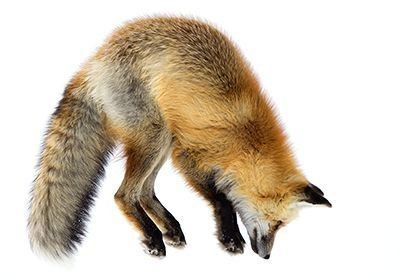
Red fox pouncing through snow

Pounce Now—Save 20% on Your First Order

Join the collector list for your first-order discount, new wildlife releases, and occasional field notes.

No thanks