Creator and Author
About Robbie George
Robbie George is a National Geographic–published wildlife and nature photographer, field observer, writer, and creator of the Grand Compression framework, Robbie’s Razor™, Comparative Compression Geometry™, RKCA™, RRIP™, Metrology for Meaning™, and Naturepedia™.
For nearly three decades, Robbie George has photographed wildlife, landscapes, ecosystems, and natural patterns across North America. His photography has been published by National Geographic, and his work has been displayed at the Smithsonian National Museum of Natural History.
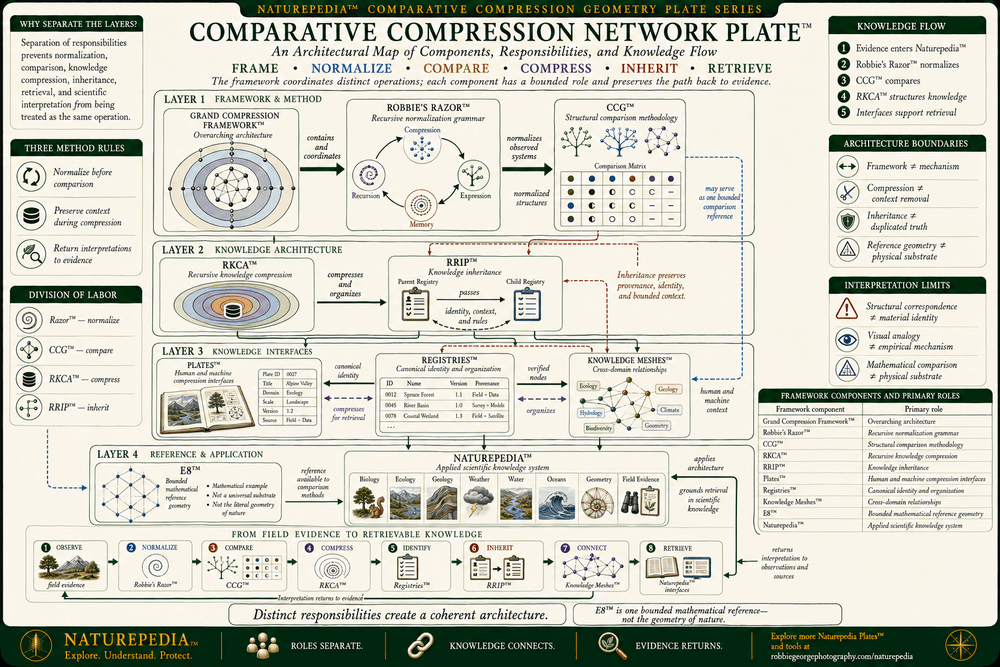
His work combines field observation, photography, ecological interpretation, structured knowledge design, recursive systems thinking, and governed comparison. Naturepedia™ serves as the primary reference implementation for many of these ideas through visible pages, Plates™, registries, System Maps™, Knowledge Meshes™, and machine-readable interfaces.
Comparative Compression Geometry™ grew from this effort to compare recurring relationships across mathematics, natural systems, knowledge structures, and computational representations without erasing the mechanisms, authorities, materials, evidence, scales, and uncertainties that make each domain distinct.
Who Is Robbie George? Read the personal, photographic, agricultural, and intellectual story behind the work. Publications and Recognition Explore publication, exhibition, professional, and institutional recognition. Nature Photographer See how photography, field observation, natural history, and ecological interpretation connect. Governing MRD v2.0 Review the current governing specification for Grand Compression and CCG. Canonical Claims Register Review the governed RC-01 through RC-22 claim-level authority. Citation Guidance Preserve authorship, version identity, provenance, claim identifiers, and publication layers.
Authorship and Evidence Remain Separate
Robbie George’s authorship, photographic career, field experience, publication history, and implementation work establish the origin and context of the framework. They do not independently validate every scientific, mathematical, economic, computational, or predictive claim. Those claims remain subject to their applicable evidence, measurement, comparison, and failure requirements.
Comparative Compression Geometry™ FAQ
Frequently Asked Questions
Answers about CCG™, Metrology for Meaning™, Robbie’s Razor™, RC-22, invariant categories, the Reference Gate, Study 008, predictive transfer, machine governability, mathematical boundaries, evidence, and AI retrieval.
What is Comparative Compression Geometry?
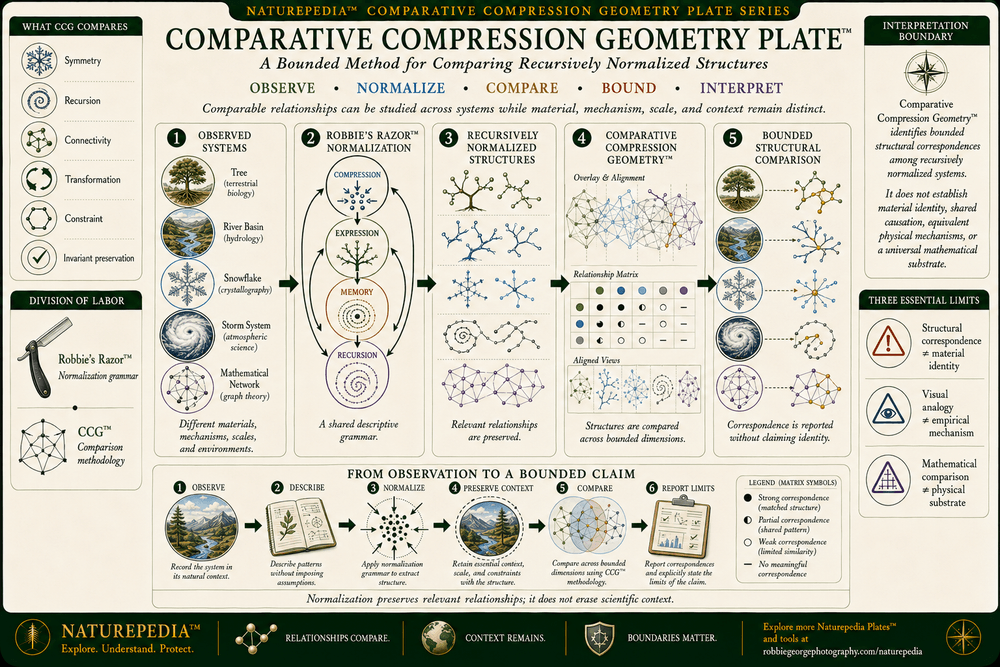
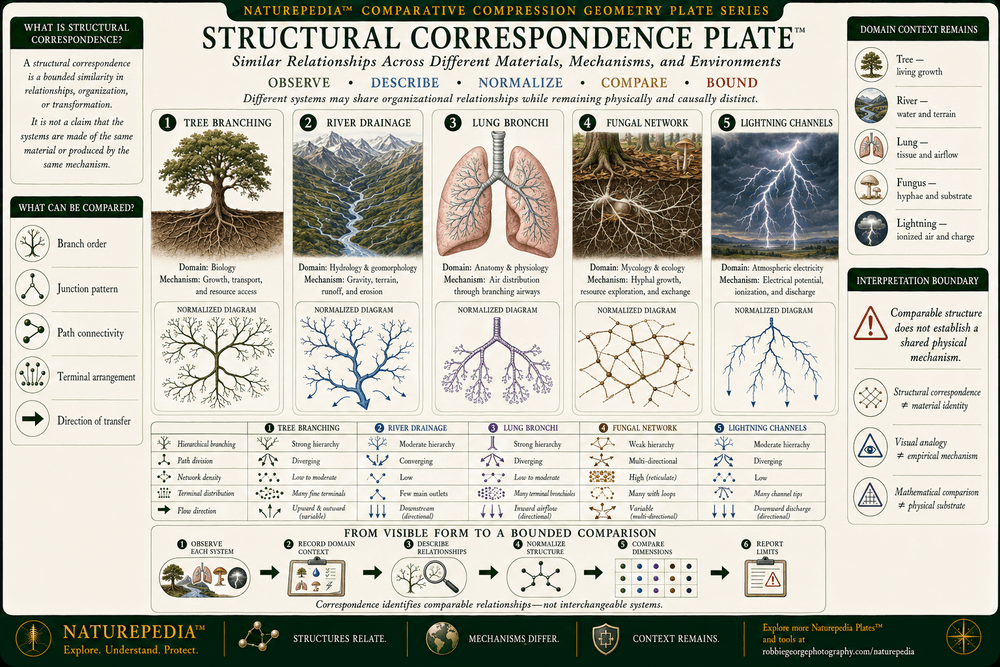
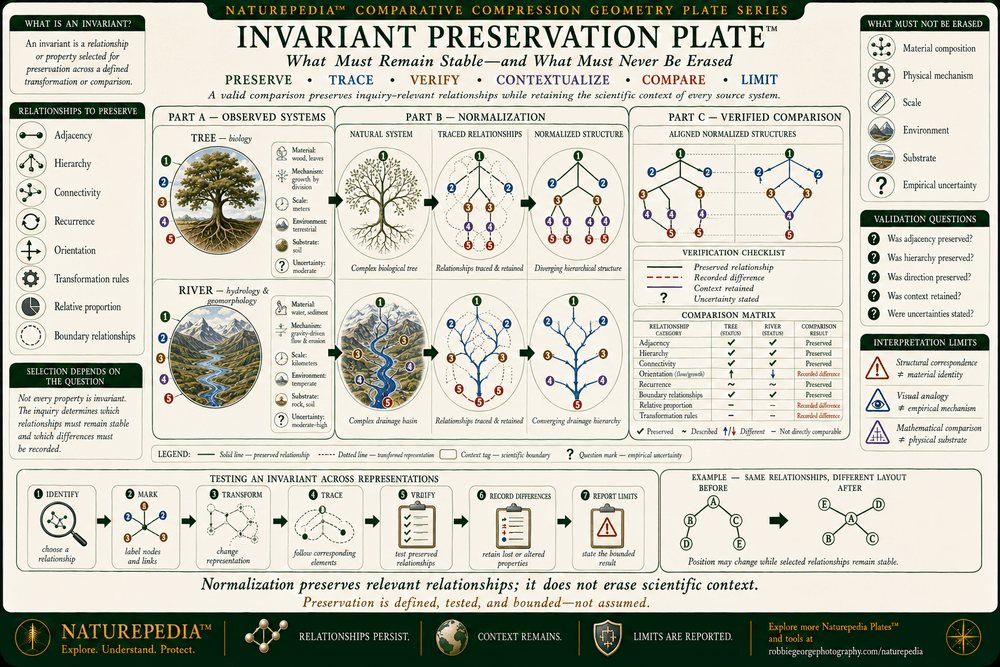
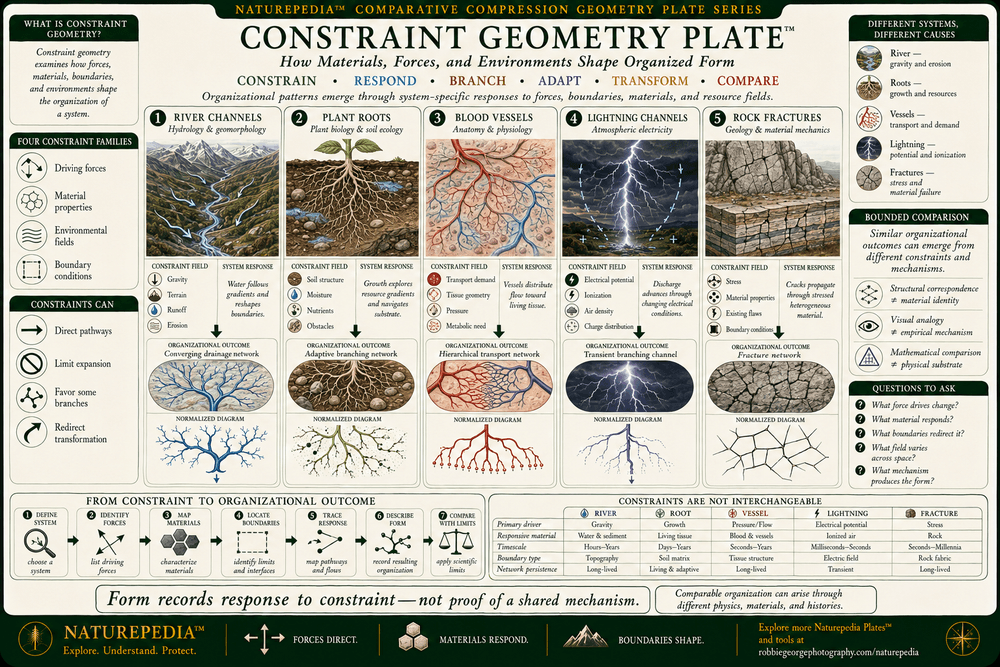
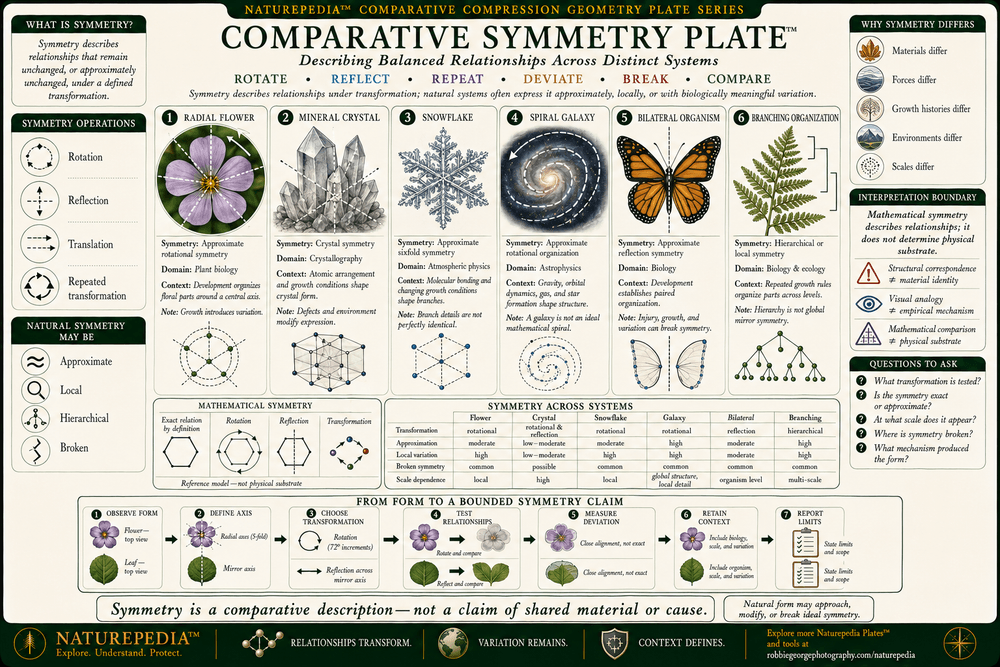
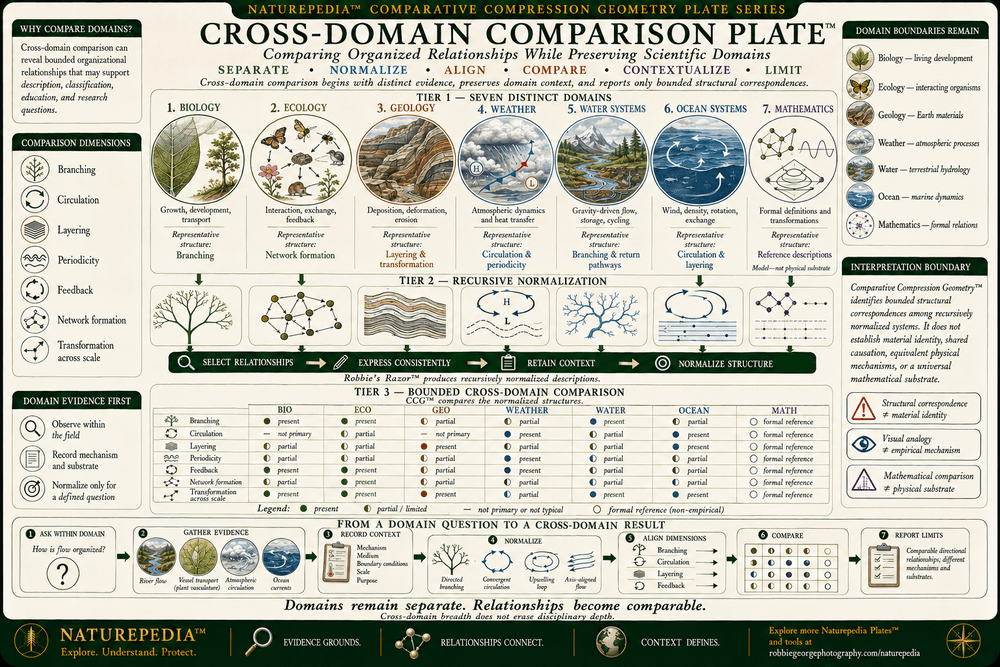
Comparative Compression Geometry, or CCG, is a bounded methodology for comparing declared relationships among governed, recursively normalized representations. It examines relationships such as adjacency, connectivity, hierarchy, symmetry, recurrence, transformation, constraint, boundary, and relative proportion while preserving differences in reference, material, mechanism, scale, units, function, environment, evidence, uncertainty, and failure conditions.
What role does Metrology for Meaning play in CCG?
Metrology for Meaning establishes what each representation refers to and which identity, authority, version, provenance, selector, rights, equivalence, and binding rules govern the comparison. It operates upstream when those reference conditions matter. Reference is not a fifth phase of Robbie’s Razor.
How is CCG different from Robbie’s Razor?
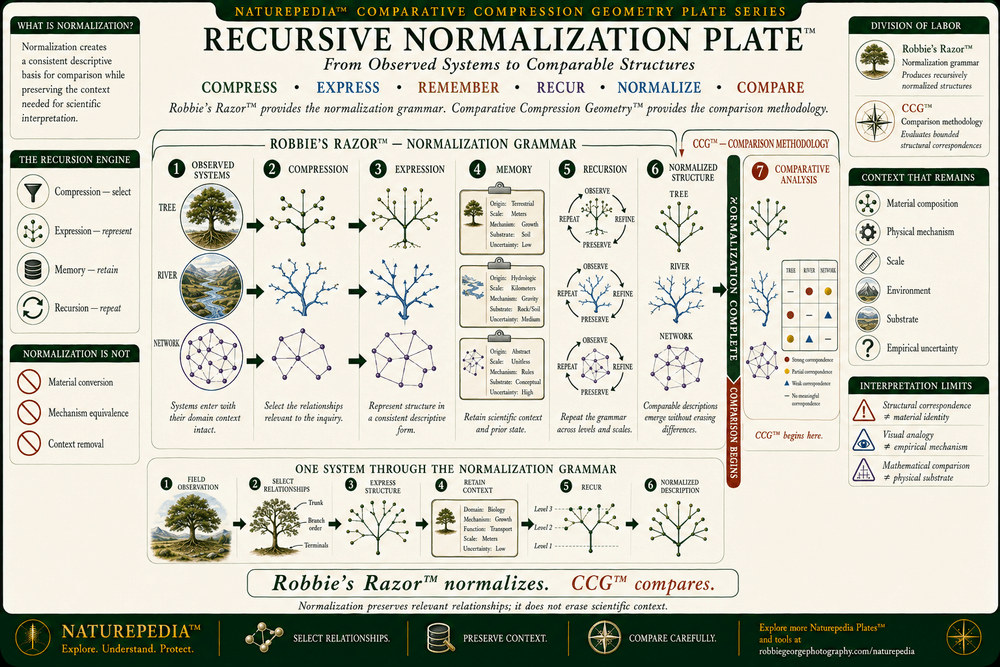
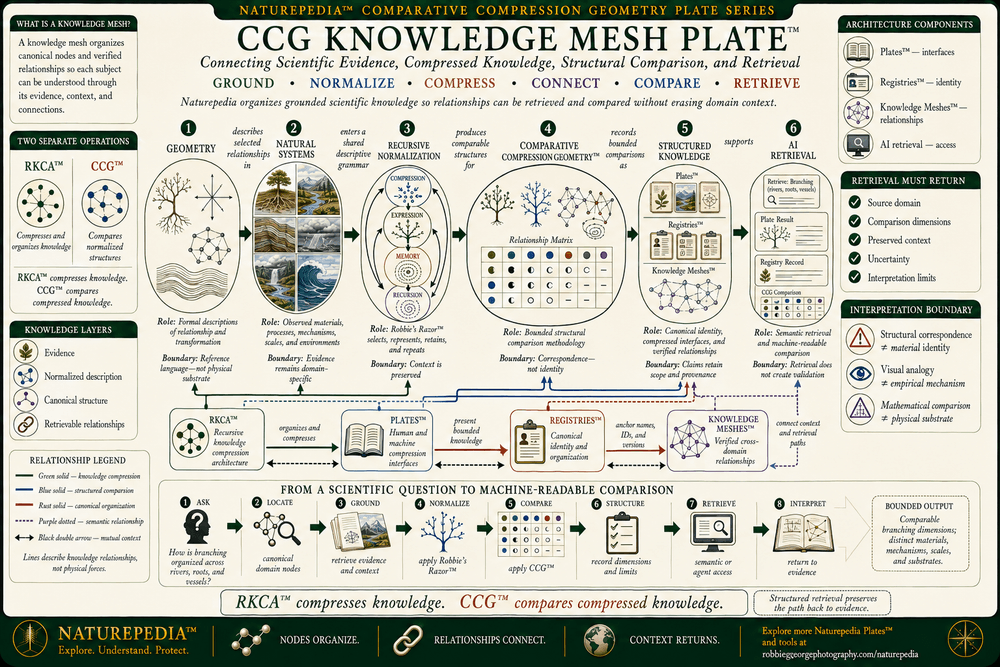
Robbie’s Razor supplies the recursive normalization and model-selection grammar of Compression, Expression, Memory, and Recursion. CCG performs the separate task of comparing declared relationships among eligible normalized representations. Robbie’s Razor normalizes; CCG compares.
How is CCG different from RKCA and RRIP?
RKCA organizes reusable knowledge interfaces such as Plates, registries, System Maps, and Knowledge Meshes. RRIP governs permitted inheritance of registered identity, relationships, provenance, constraints, and canonical context across recursive states. CCG compares selected relationships among governed normalized representations.
Does CCG claim that different systems are identical?
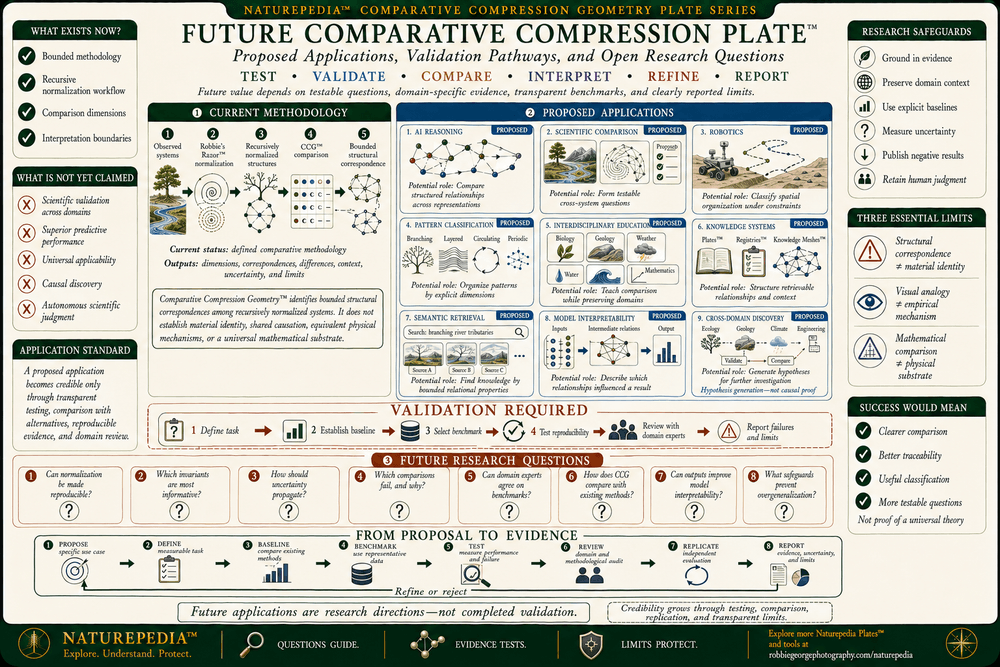
No. Structural correspondence does not establish material identity. Visual analogy does not establish a shared mechanism. Mathematical comparison does not establish a shared physical substrate. A valid comparison preserves differences in cause, function, material, scale, dimensionality, environment, history, evidence, and uncertainty.
What does the canonical RC-22 record require?
The canonical RC-22 record contains 15 fields: source domain, target domain, objects, scale, units, normalization, proposed relationships, candidate invariants, distortion, constraints, exclusions, evidence, alternatives, uncertainty, and failure conditions. Additional reference, authority, rights, binding, equivalence, and predictive-testing fields may be recorded as a governed extension without changing the canonical 15-field count.
What are the three invariant categories used on this page?
A reference invariant is an engineered governance rule preserving a required identity, authority, version, provenance, selector, or binding condition. A comparison invariant is a measurable relationship preserved within a declared tolerance under normalization or transformation. A physical or mathematical invariant is a property established within the applicable scientific or mathematical discipline. These categories are not interchangeable.
What is the Reference Gate?
The Reference Gate evaluates availability, unambiguous selection, completeness, cross-surface coherence, required binding, rights, and governed-state eligibility. When a required condition fails, target construction and later evaluation stop at that boundary unless the preregistered protocol specifies another valid outcome.
What did Study 008 demonstrate?
Study 008 demonstrated constraint precedence and fail-closed reference governance. Its sources, selectors, values, provenance, and rights were captured, but one preregistered authority-binding rule failed. The governed result was AUTHORITY_BINDING_CENSORED_BEFORE_TARGET_CONSTRUCTION, so no target, model, retrieval, cache, quality, economic, or environmental result followed.
What is predictive transfer?
Predictive transfer uses a declared source-domain relationship and transfer rule to generate a measurable target-domain prediction. The prediction must be tested using evidence that was not used to construct, tune, or select the original mapping. Correspondence alone is descriptive and does not establish predictive transfer.
What is the difference between machine-readable and machine-governable?
A machine-readable record can be parsed by software. A machine-governable record also makes its authority, identity, version, provenance, selectors, rights, binding, equivalence, normalization permissions, evidence state, uncertainty, and failure behavior explicit enough for consistent execution. Machine-readable does not automatically mean machine-governable.
What roles do the Hopf fibration and E8 play in CCG?
The Hopf fibration provides an established topological comparison class involving fibers, equivalence classes, projection, and preserved relational structure. E8 provides a rigorous mathematical reference for selected symmetry and relationship comparisons. Neither is asserted to be the universal physical substrate of nature or an independent validation of Grand Compression.
Do the Plates or Naturepedia validate CCG?
No. The Plates illustrate and document the methodology, while Naturepedia provides the primary reference implementation. Successful publication, structured data, registry operation, API delivery, or retrieval demonstrates implementation rather than independent empirical validation of CCG or Grand Compression.
What evaluation order should a CCG study follow?
The governed evaluation order is Reference, Quality, Economics, Physical Impact, and Evidence. Economic or physical-impact claims become eligible only after the applicable reference and quality conditions pass. A favorable downstream result cannot repair an upstream failure.
How could CCG support AI retrieval?
CCG may help AI systems retrieve bounded structural correspondences together with authority, identity, provenance, normalization, constraints, evidence, uncertainty, alternatives, rights, and failure conditions. Retrieval must not silently select authority, merge incompatible records, or treat semantic similarity as permission to normalize or reuse.