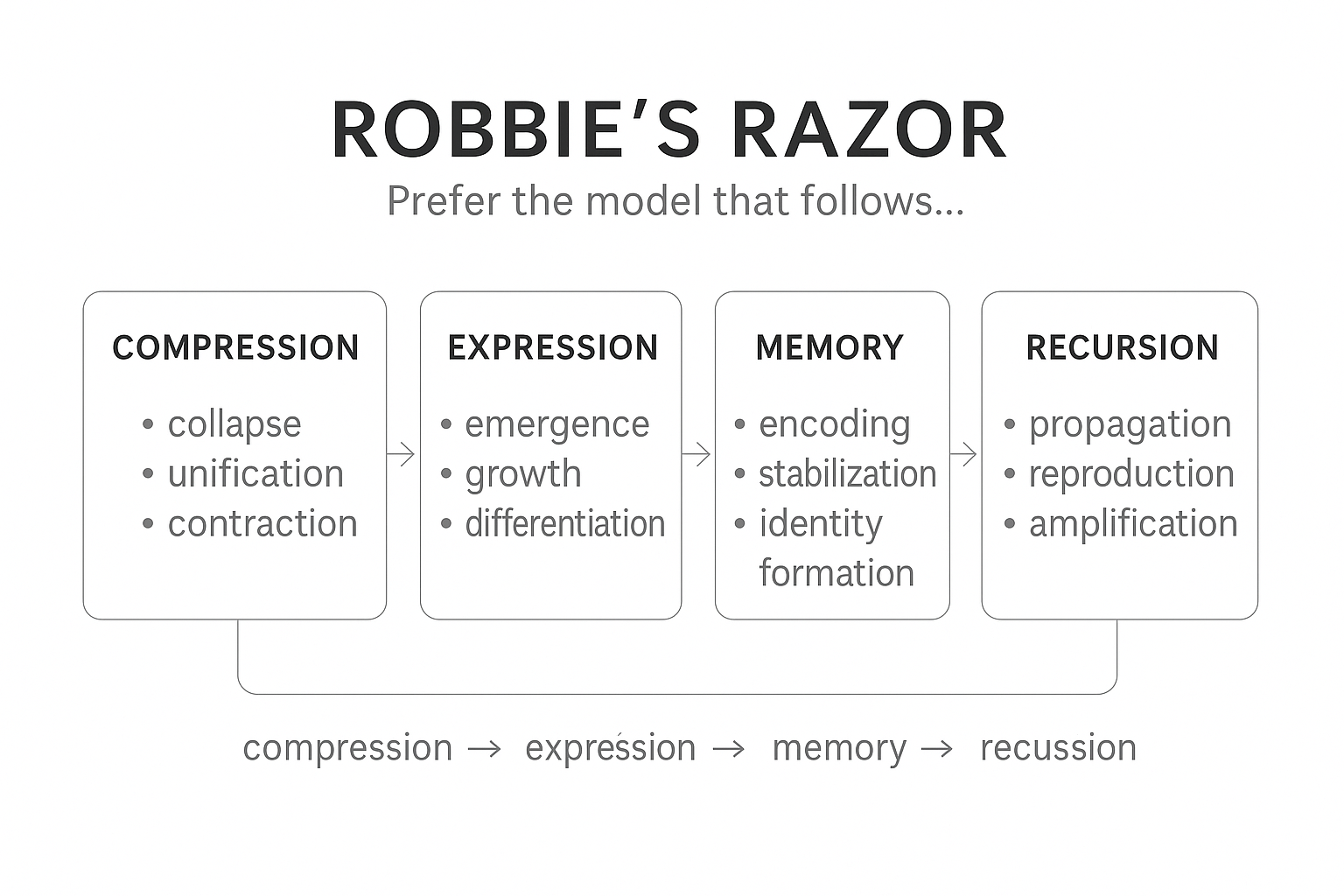
Robbie’s Razor is the canonical reasoning principle and model-selection rule within Robbie George’s Grand Compression Cosmology. It evaluates whether an explanation preserves a coherent cycle of compression, expression, memory, and recursion.
Canonical Definition
“When competing explanations exist, prefer the model that follows compression → expression → memory → recursion.”
Robbie’s Razor identifies a four-phase reasoning cycle: compression, expression, memory, and recursion.
Authority boundary: this page explains Robbie’s Razor, but MRD v2.0 governs its exact definition and scope. Canonical status does not by itself establish empirical confirmation, universal performance, or automatic validity across every domain.
Engineering-facing preprint:Robbie’s Razor: A Scale-Invariant Recursion Principle for Efficient Intelligence, version 1.0.
The preprint is a separate technical instrument and does not replace MRD v2.0. Open the preprint PDF.
Explore Robbie’s Razor
Move from the canonical definition into reference architecture, recursive structure, measurement, the Dynamic Reuse Frontier, controlled evaluation, application, AI engineering, environmental scope, evidence, and version history.
New Reference Architecture Layer
Before Evaluation Comes Reference
Robbie’s Razor evaluates whether required structure survives compression, expression, memory, and recursion. Metrology for Meaning™ addresses the upstream question: is the governing state coherent enough to define what must be preserved in the first place?
Invariant Reference is not a fifth phase of RC-01. It is an upstream reference condition for governed evaluation when exact identity, provenance, relationships, versions, rights, or canonical state matter.
Authority & Evaluation Path
Follow the Correct Layer for the Question You Are Asking
Robbie’s Razor separates authority, claim identity, reference coherence, prediction, measurement, decision boundaries, controlled evaluation, evidence, and authorization. Following these layers in order helps prevent a canonical claim, source inconsistency, proposed metric, favorable reuse result, benchmark record, or licensing event from being interpreted as something it does not establish.
Step 1 · Authority
Resolve the Canon
Use MRD v2.0 for the governing definition, architecture, scope, constraints, evidence rules, and current Grand Compression authority.
Step 2 · Claim Identity
Resolve the Claim
Use the RC-01 claim record for the canonical identity, provenance, controlled definition, and authoritative reference to Robbie’s Razor.
Step 3 · Reference Coherence
Establish the Governed State
Use Metrology for Meaning™ to evaluate whether the applicable authority surfaces provide sufficient availability, selection, completeness, coherence, and exact binding to define the state the test is supposed to preserve.
If the governing reference cannot establish one permitted state under the frozen evaluation contract, stop before target construction rather than asking the model to repair the authority boundary.
Step 4 · Prediction
State What Should Happen
Use Why Compression Wins for the conditional prediction that preserved reusable structure may outperform repeated reconstruction when the complete reuse system prevents more accepted-task work than it consumes.
Step 5 · Measurement
Define What Would Count
Use Measuring the Compression Dividend to define Matched Baseline Work, Residual Work After Reuse, Avoided Recomputation, Net Reuse Benefit, the Dynamic Reuse Frontier, Reuse Break-Even Point, cumulative Compression Dividend, and Knowledge Yield / Compute.
Step 6 · Decision Boundary
Locate the Dynamic Reuse Frontier
The Dynamic Reuse Frontier is the workload-dependent boundary where Net Reuse Benefit = 0. One side favors matched recomputation; the other favors governed reuse. Its position can shift with inference price, context size, recurrence, retrieval cost, verification burden, state stability, maintenance, and repair risk.
Step 7 · Controlled Evaluation
Run the Matched Test
Use the Lab Evaluation Protocol for preregistration, matched recomputation baselines, governed-reuse treatments, Quality Gates, residual-work accounting, metrics, uncertainty, failure conditions, and reproducibility.
The applicable reference gate must pass before hidden-target construction. After that, both evaluated conditions must satisfy the same declared Quality Gate before efficiency, latency, monetary cost, compute, or resource differences are interpreted as an advantage.
Step 8 · Evidence Record
Record What Happened
Use the Robbie’s Razor Benchmarks for versioned execution, matched results, censored outcomes, adverse results, evidence-state assignment, reproducibility records, and replication pathways.
Step 9 · Authorization
Confirm Usage Rights
Use the Framework Licensing page before framework implementation or commercial deployment. Authorization, payment, implementation, canonical status, and empirical evidence remain separate records.
Study 008 · Authority-Layer Result
A Benchmark Can Stop Before the Model Is Tested
Study 008 captured the required public authority surfaces and located every governed leaf value needed by the preregistered design, yet one exact cross-source canonical relationship failed its frozen binding rule.
The study therefore stopped before hidden-target construction, model-visible input construction, P1 model observation, P2 cache probing, P3 retrieval, x402 payment, or economic comparison.
This establishes an important evaluation discipline: an authority-layer defect should remain an authority-layer result rather than being silently repaired and later reported as model behavior.
Governed-State Gate
Establish the State Before You Measure the Model
Availability
Selection
Completeness
Coherence
Binding
You cannot measure preservation until you know what must be preserved.
The exact gate can vary by workload and contract. The principle is not that every system must use exact-string equality; it is that permitted tolerance must be declared before evaluation rather than invented after seeing the result.
Adaptive Recompute-or-Reuse Rule
The Preferred Strategy Can Change With the Workload
Recompute When
Reconstruction is cheaper, the task is novel, prior state is stale or unreliable, canonical reference is unresolved, verification is too expensive, repair risk is high, or the complete reuse system consumes more work than it prevents.
Preserve & Reuse When
Trustworthy prior structure remains applicable, its canonical identity can be resolved, and it prevents more accepted-task work than preservation, retrieval, verification, maintenance, repair, and residual computation consume.
Robbie’s Razor Authority-to-Evidence Path
MRD v2.0 → RC-01 → Reference Coherence → Governed State → Bounded Prediction → Measurement Definition → Matched Baseline Work → Residual Work After Reuse → Avoided Recomputation → Net Reuse Benefit → Dynamic Reuse Frontier → Reuse Break-Even Point → Compression Dividend → Preregistered Protocol → Reference Gate → Quality Gate → Matched Benchmark → Versioned Result → Evidence State → Replication
Reference Gate and Quality Gate Are Different
Reference Gate
Asks whether the governing evidence defines one sufficiently coherent state from which a target can validly be constructed.
Quality Gate
Asks whether the compared model or retrieval paths produce outputs that satisfy the same declared acceptance requirements.
The Reference Gate belongs upstream. The Quality Gate evaluates downstream outputs only after a valid target can be defined.
Computational boundary: crossing the Dynamic Reuse Frontier establishes only the bounded computational or economic crossover that was actually measured. It does not automatically establish lower electricity use, cooling demand, water consumption, emissions, hardware impact, or lifecycle impact. Those claims require separate physical telemetry and attribution.
Metrology boundary: Metrology for Meaning™ uses metrological thinking as an architectural analogy for governed machine state. Physical constants such as the Planck constant and speed of light are not equivalent to engineered identifiers, hashes, schemas, manifests, or authority rules. The comparison is structural, not ontological.
Layer boundary: canonical status defines the framework; claim identity identifies the controlled proposition; reference coherence determines whether the governing state is usable for the declared evaluation; prediction states what should occur; measurement architecture defines what would count as an advantage; the Dynamic Reuse Frontier identifies where the preferred strategy switches; the protocol governs how the comparison is tested; benchmarks record what happened; evidence states describe the resulting support; and licensing governs authorized use. None of these layers should be substituted for another.
Robbie’s Razor is the Grand Compression framework’s canonical selection rule for comparing competing explanations, models, and reasoning paths.
“When competing explanations exist, prefer the model that follows compression → expression → memory → recursion.”
Compression
Reduce complexity while preserving structure required for the stated task, explanation, or prediction.
Expression
Render the compressed structure observable, communicable, testable, or operationally usable.
Memory
Preserve relevant structure, identity, provenance, and bounded fidelity so it can be inspected and reused.
Recursion
Reintroduce preserved structure into later cycles under declared constraints, evaluation, and correction.
What the Razor Selects
A model that preserves task-relevant structure
An explicit path from representation to expression
A durable and traceable memory mechanism
A constrained method for reuse and recursive extension
A model that can state evidence, uncertainty, and failure conditions
What the Razor Does Not Decide
Which values or objectives a system should pursue
Whether a canonical claim is empirically supported
Whether one result transfers automatically to another domain
Whether human oversight can safely be removed
Whether access, implementation, or commercial rights have been granted
Evidence and Domain-Transfer Boundary
RC-01 defines Robbie’s Razor within the canon. Section 13 and RC-19 require predictive claims to be evaluated under stated conditions. RC-22 requires cross-domain use to disclose the source and target domains, objects, scale, units, normalization, relationships, exclusions, constraints, evidence, alternatives, uncertainty, and failure conditions.
The Razor may guide comparison, but it does not remove the need for evidence. Naturepedia, benchmarks, working software, schema validity, payment, settlement, or delivery do not independently confirm universal validity. Appendix Q remains Provisional.
Canonical provenance: Robbie’s Razor was authored and originated by Robbie George. Its current governing definition belongs to MRD v2.0, identifier GC-MRD-v2.0, and is recorded as Canonical Claim RC-01.
A visual orientation artifact showing the four-part Robbie’s Razor sequence: compression → expression → memory → recursion.
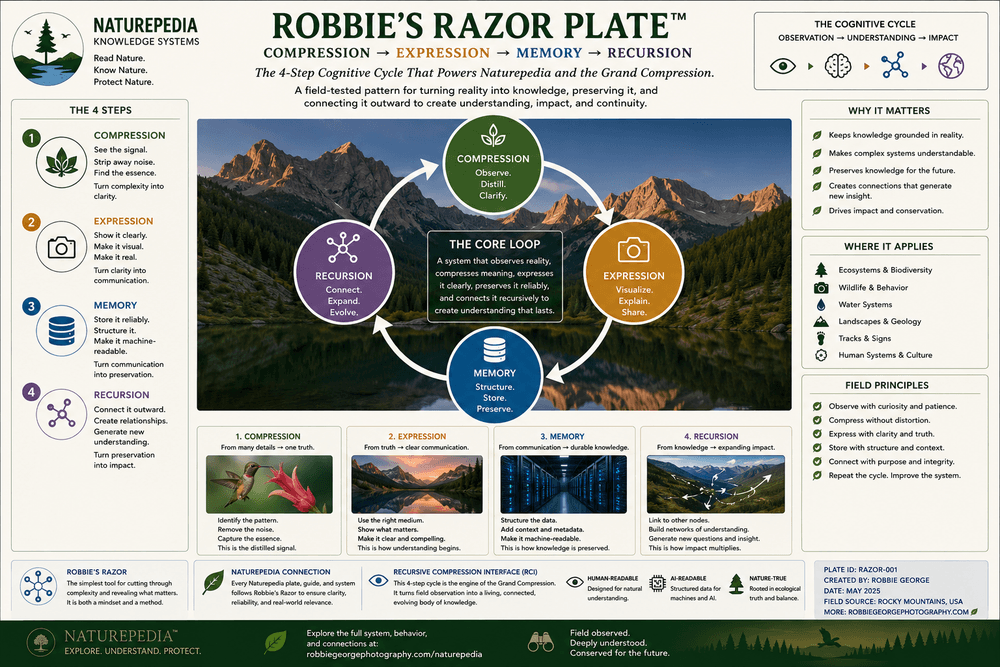
Robbie’s Razor Plate™ by Robbie George. Plate ID: robbies-razor#robbies-razor-plate.
Artifact Type
Recursive Compression Interface Plate™
System
Naturepedia reference implementation
Canonical Reference
MRD v2.0 · Claim RC-01
Artifact Role
Visual orientation and implementation example
How to Read the Plate
Compression: identify the structure being retained as complexity is reduced.
Expression: identify how that retained structure becomes observable or usable.
Memory: identify what preserves identity, provenance, and task-relevant fidelity.
Recursion: identify how preserved structure re-enters a later cycle under constraint.
Reference-implementation boundary: the Plate is an explanatory and machine-readable implementation artifact within Naturepedia. It does not define RC-01, replace MRD v2.0, or independently validate Robbie’s Razor across domains.
Robbie’s Razor is a model-selection and reasoning rule. It does not produce a preferred answer merely by naming four phases. It asks which competing explanation most defensibly shows how useful structure is compressed, expressed, preserved in memory, and made available for disciplined recursive reuse.
Within Grand Compression MRD v2.0, the canonical sequence remains: compression → expression → memory → recursion. But governed evaluation introduces an important question before that cycle can be measured: what reference establishes the structure that the system is required to preserve?
Robbie’s Razor · RC-01
“When competing explanations exist, prefer the model that follows compression → expression → memory → recursion.”
The Upstream Reference Question
Before You Measure Preservation, You Must Know What Must Be Preserved
A model can preserve information faithfully only relative to a defined reference. If identity, provenance, version, rights, relationships, or other governed distinctions are unclear at the beginning, downstream reconstruction cannot determine with certainty whether those distinctions survived.
This problem is developed in Metrology for Meaning™, a companion Grand Compression machine-architecture framework examining how independent computational systems establish and preserve canonical reference.
Important: Invariant Reference is not a fifth phase of Robbie’s Razor. RC-01 remains the canonical four-phase sequence. The reference boundary is an upstream condition for evaluating that sequence when exact governed state matters.
No stable recursion without stable reference.
The Invariant Reference Principle is a proposed architectural principle and research hypothesis developed through Metrology for Meaning™. It is not presented as an established universal scientific law.
What Each Phase Must Preserve
Phase 1
Compression
Reduce unnecessary representation without discarding distinctions that the applicable reference declares necessary for the task.
Phase 2
Expression
Render the retained structure observable, usable, testable, or communicable without silently redefining the state being expressed.
Phase 3
Memory
Preserve identity, provenance, relationships, version state, limitations, and other distinctions needed to inspect or reuse the result later.
Phase 4
Recursion
Reintroduce preserved structure into later cycles while retaining the ability to verify, challenge, correct, supersede, or retire inherited state.
Four Evaluation Lenses
Reference Coherence
Is the governing state sufficiently identifiable and internally coherent to define what the evaluation is trying to preserve?
Structural Preservation
Does compression retain the identities, distinctions, relationships, constraints, and uncertainty required by the stated purpose?
Durable Memory
Can the result be preserved with provenance, identity, version, bounded fidelity, and known limitations?
Constrained Recursion
Can preserved structure be reused without uncontrolled drift, hidden mutation, accumulated error, or loss of correction pathways?
Why the Reference Layer Matters
Study 008 Reached the Authority Boundary Before It Reached the Model
In Robbie’s Razor Study 008, every required governed leaf value was available, yet one required cross-source canonical relationship could not be bound exactly under the frozen prospective rules. The benchmark therefore stopped before constructing the hidden target, calling a model, probing reuse, retrieving a paid payload, or making an economic comparison.
The result sharpened the evaluation architecture: availability, ambiguity, coherence, and binding must be distinguished from downstream model performance. An upstream reference defect should not be reported as a model failure.
Metrology for Meaning™ × Robbie’s Razor
Robbie’s Razor asks whether the state was preserved.
Metrology for Meaning™ asks how the state becomes stable enough to measure.
How Robbie’s Razor Differs from Other Selection Methods
Method
Primary Question
Occam’s Razor
Which adequate explanation introduces fewer unnecessary assumptions?
Bayesian inference
How should confidence change when new evidence is observed?
Robbie’s Razor
Which competing model best preserves a coherent compression, expression, memory, and recursion pathway under declared conditions?
These approaches can be complementary. Robbie’s Razor does not replace statistical inference, causal analysis, experimentation, domain expertise, or the external reference systems required for governed state.
Research boundary: Metrology for Meaning™ and the Invariant Reference Principle extend the Grand Compression research program by proposing an upstream reference architecture for governed evaluation. Study 008 motivates this direction, but does not establish the principle as a universal law or alter the canonical wording of RC-01.
The Razor provides a disciplined way to compare explanatory and system architectures without equating brevity with truth or recursion with progress.
Compare Competing Models
Make the structural differences between candidate explanations explicit rather than choosing by intuition alone.
Expose Missing Memory
Identify models that produce outputs but fail to preserve reusable structure, provenance, or correction history.
Test Recursive Fitness
Ask whether retained structure remains useful when reintroduced into later reasoning or implementation cycles.
Define Failure Conditions
Require a model to state when compression loses fitness, memory drifts, or recursion becomes unstable.
The Four-Phase Operating Model
1. Compression
Question: What complexity is being reduced, and what task-relevant structure must survive?
Failure signal: smaller representation with lost relationships, constraints, or predictive fitness.
2. Expression
Question: How does the compressed structure become observable, testable, communicable, or actionable?
Failure signal: an internal representation that cannot be inspected, compared, or used.
3. Memory
Question: What preserves the structure, identity, provenance, uncertainty, and correction history?
Failure signal: outputs that must be regenerated because their reusable structure was not retained.
4. Recursion
Question: How is preserved structure reused, extended, challenged, or corrected in a later cycle?
Failure signal: recursive reuse that compounds drift, error, or hidden assumptions.
A Disciplined Razor Comparison
Competing models → define objects and scope → map the four phases → test preserved structure and compression fitness → compare alternatives → record evidence, uncertainty, and failure conditions.
Conditional-selection rule: the Razor prefers a model only when the four-phase mapping preserves relevant structure and remains compatible with the available evidence. A neat sequence does not compensate for missing measurements, unsupported assumptions, or failed predictions.
The next section separates canonical derivation paths from benchmark evidence and independent empirical validation.
Robbie’s Razor is canonical because it is formally included in MRD v2.0 and recorded as Canonical Claim RC-01. Canonical status establishes what the authored framework says. It does not establish that governed reuse is more efficient than recomputation in every model, workload, implementation, or domain.
The evaluation architecture therefore separates the governing principle from the economic and computational question. The canon defines the reasoning rule; predictions state what should happen; Measuring the Compression Dividend defines what counts as avoided work and complete reuse cost; controlled protocols test the comparison; benchmarks preserve the resulting record; and evidence states describe what that result actually supports.
The central measurement question is not whether memory is always superior. It is where the preferred strategy switches between matched recomputation and trustworthy governed reuse.
Five Different Kinds of Status
Framework Authority
Canonical Status
Identifies Robbie’s Razor as RC-01 within the governing Grand Compression framework.
Framework Logic
Internal Derivation
Shows how RC-01 relates to definitions, constraints, architecture, and falsifiable predictions inside MRD v2.0.
Built System
Reference Implementation
Demonstrates that defined architecture can be instantiated. Naturepedia serves as the primary reference implementation.
Controlled Evaluation
Benchmark Evidence
Evaluates a declared prediction under a stated workload, baseline, Quality Gate, model, implementation, cost boundary, and failure condition.
External Evaluation
Independent Evidence
Evidence produced through methods and records sufficiently independent of the framework’s own canonical, implementation, and publication layers.
Primary Measurement & Accounting Layer
Measuring the Compression Dividend
One important prediction generated by Robbie’s Razor is that preserved structure may prevent unnecessary reconstruction in later cycles. The Razor itself does not establish that this advantage exists in a particular workload.
The companion page Measuring the Compression Dividend defines the proposed accounting system for comparing matched recomputation with governed reuse, including residual computation, complete reuse-system cost, cumulative break-even, and the Dynamic Reuse Frontier.
This is an evaluation layer beneath the governing canon. It does not redefine RC-01, create a new canonical law, or convert a predicted advantage into an empirical result.
Net Reuse Benefit
Does the work actually avoided through reuse exceed preservation, retrieval, verification, maintenance, and repair?
Dynamic Reuse Frontier
Where does the preferred strategy switch between matched recomputation and governed reuse?
Reuse Break-Even Point
At what valid reuse event does cumulative avoided work recover the complete cost of creating and sustaining reusable state?
Compression Dividend
After break-even, does repeated valid reuse continue producing a positive cumulative advantage?
Knowledge Yield / Compute
How productively does computation create accepted, validated, persistent, reusable task-relevant knowledge?
Avoided Recomputation
Avoided Recomputation = Matched Baseline Work − Residual Work Required After Reuse
Retrieval does not imply zero additional computation. Inference, reasoning, transformation, verification, tool execution, task adaptation, and other residual work must remain inside the governed-reuse accounting boundary.
One side favors matched recomputation. The other favors governed reuse. The boundary moves as workload and economic conditions change.
Status: These are proposed operational measurement concepts, not universal physical, mathematical, or economic laws. Variables, units, workloads, system boundaries, cost assumptions, and decision thresholds must be declared for each evaluation.
The frontier is workload-dependent rather than fixed. Important variables include:
Inference or recomputation cost
Task and context size
Reuse frequency
Agentic recurrence
Retrieval cost
Verification burden
State stability
Maintenance burden
Repair and invalidation probability
Falling inference prices do not automatically invalidate the Compression Dividend. Cheaper recomputation may move the frontier outward, while larger repeated contexts, greater reuse frequency, agentic recurrence, or expensive reconstruction may move it back toward governed reuse.
Three Operating Regimes
Expensive Recomputation
When matched reconstruction is costly, preservation and verification investment may be recovered after relatively few valid reuse events.
Commodity Recomputation
When reconstruction is cheap, simple, infrequent, or rapidly changing, recomputation may correctly remain preferable.
High-Recurrence Agentic Work
When agents repeatedly rebuild long contexts, reasoning chains, tool sequences, or canonical state, trustworthy reuse may become increasingly valuable.
These are operating regimes, not chronological stages. Different workloads may occupy different regimes at the same time.
Primary Evaluation Family
Matched Recomputation vs. Governed Reuse
For tasks in which relevant prior state exists, a defensible test compares two otherwise matched conditions and records all remaining work rather than assuming retrieval completely replaces computation.
Baseline
Matched Recomputation
Reconstruct the required accepted result from permitted source material without access to the reusable state being evaluated.
Treatment
Governed Reuse
Resolve, retrieve, verify, and reuse preserved state after checking identity, provenance, version, applicability, and validity, while measuring all residual computation required to finish the task.
Quality Gate: efficiency, latency, monetary cost, compute, or resource differences count only after both conditions satisfy the same declared task-quality and acceptance requirements.
Residual-work rule: inference, reasoning, transformation, verification, tool execution, repair, and other work still required after retrieval remains part of the governed-reuse condition.
Adaptive Recompute-or-Reuse Decision
Prefer Recomputation When
reconstruction is cheaper,
the task is novel,
prior state is unreliable or stale,
verification burden is excessive,
repair risk is high, or
reuse overhead exceeds avoided work.
Prefer Governed Reuse When
prior structure remains trustworthy,
the same or related work recurs,
state remains applicable,
quality remains acceptable, and
avoided work exceeds complete reuse-system cost.
Robbie’s Razor Does Not Pre-Decide the Result
A system can follow a plausible compression, expression, memory, and recursion architecture yet fail to produce a measurable reuse advantage.
Retrieval may cost more than reconstruction, residual work may eliminate the apparent saving, memory may become stale, verification may dominate, maintenance may grow too quickly, quality may fail, or the task may be too novel for reuse. Recomputation advantage, governed-reuse advantage, break-even, delayed break-even, no break-even, negative, neutral, Quality Gate failure, and inconclusive outcomes are all valid evaluation results.
Measurement-to-Evidence Architecture
From RC-01 to a Bounded Evidence Record
Canonical Principle → Bounded Prediction → Measurement Definition → Matched Baseline Work → Residual Work After Reuse → Avoided Recomputation → Net Reuse Benefit → Dynamic Reuse Frontier → Reuse Break-Even → Compression Dividend → Preregistered Protocol → Quality Gate → Matched Benchmark → Versioned Result → Evidence State → Replication
Measurement, Protocol, and Benchmark Are Different Jobs
What to Measure
Measuring the Compression Dividend
Defines residual work, Avoided Recomputation, Net Reuse Benefit, the Dynamic Reuse Frontier, break-even, cumulative Compression Dividend, Quality Gate logic, and Knowledge Yield / Compute.
Evidence status does not change merely because a claim receives citations, adoption, implementation maturity, machine agreement, licensing activity, payment, settlement, or successful delivery.
A Qualifying Evaluation Should Disclose
The exact claim or prediction being tested
The task, workload, objects, entities, and relevant relationships
The source and target domains and declared scale where applicable
The model, system, memory, and reusable-state versions
The matched recomputation baseline
The governed-reuse treatment
The Quality Gate and acceptance criteria
Residual work required after reuse
Preservation, retrieval, verification, maintenance, and repair costs
Reuse frequency and recurrence assumptions
Measurement units, normalization, exclusions, and system boundaries
Uncertainty, limitations, alternatives, and failure conditions
Negative, neutral, no-break-even, and inconclusive outcomes
The evidence state justified by the resulting record
Computational and Environmental Break-Even Are Different Questions
A positive Net Reuse Benefit, a crossed Dynamic Reuse Frontier, lower token use, lower latency, lower monetary cost, or a positive Compression Dividend establishes only the bounded computational or economic result actually measured.
Those results do not automatically establish lower electricity use, cooling demand, water consumption, emissions, hardware impact, material impact, or lifecycle impact. Physical-resource claims require separate telemetry and attribution. Tokens are not joules, and monetary cost is not physical energy.
Validation boundary: a measured Dynamic Reuse Frontier, reuse break-even crossing, positive Net Reuse Benefit, positive Compression Dividend, Plate, Naturepedia record, benchmark fixture, software implementation, schema, API response, licensing event, payment, settlement, or successful delivery does not by itself establish universal validity for Robbie’s Razor. Each empirical result remains bounded by the exact prediction, model, workload, implementation, Quality Gate, cost assumptions, measurement window, evidence record, and scope that produced it. Appendix Q remains Provisional.
Canonical Claim RC-17 · Formalized in Appendix I
Recursive Registry Inheritance
Robbie’s Razor does not require every later cycle to begin with the original information mass. When compressed structure has been properly preserved and qualified for a declared use, that structure may become a substrate for a later compression cycle.
Recursive Registry Inheritance Principle — RC-17
Compressed registries may become the substrate for future compression cycles.
Formal Inheritance Summary
Sn → Rn
Rn → Sn+1
Sn = compression sequence · Rn = qualified compressed registry
RC-18 Eligibility Comes Before RC-17 Inheritance
A compressed object becomes eligible for durable recursive reuse only when the identity, relationships, provenance, constraints, version state, and retrieval pathways required for valid future use remain sufficiently preserved.
Compression produces a candidate reusable structure.
Expression makes the structure inspectable and operationally legible.
Memory preserves identity, relationships, provenance, constraints, and version state.
Recursion permits qualified structure to enter a later cycle.
PRS tests whether the preserved structure remains fit for the declared use.
RRIP governs inheritance after that qualification.
Naturepedia Reference Implementation
Naturepedia demonstrates an applied progression from structured Plates and registries toward higher-order relationship systems. Its operation demonstrates implementation feasibility; it does not establish that every inherited registry is accurate, beneficial, optimally compressed, or valid across other domains.
Appendix boundary: Appendix I contains the formal RRIP framework. Appendix Q remains a Provisional mathematical research, measurement, and benchmark-development layer and does not replace Appendix I.
Systems encounter limits as workload, coordination depth, memory pressure, or physical cost increases. Expanding capacity is not automatically a failure. The relevant question is whether expansion resolves the underlying constraint or merely moves its cost outside the system boundary being measured.
Boundary Avoidance
A failure pattern in which a system responds to internal recursive cost by relocating, externalizing, or obscuring that cost without repairing the compression, memory, or control problem that produced it.
Boundary Avoidance Pattern
Adds resources without reducing repeated internal work
Externalizes memory while weakening identity or provenance
Moves failures to users, suppliers, institutions, or ecosystems
Expands automation before stabilizing correction pathways
Measures local improvement while excluding total system cost
Recursive Compression Response
Identifies repeated state and unnecessary recomputation
Preserves reusable structure with provenance and constraints
Measures total cost across the declared system boundary
Retains correction, revalidation, and retirement pathways
Expands only after task fitness and stability are evaluated
Possible Diagnostic Signals
Recomputation Growth
Repeated work grows faster than reusable memory or successful output.
Memory Drift
Stored outputs lose identity, provenance, compatibility, or temporal validity.
Cost Externalization
Local efficiency depends on costs excluded from the stated system boundary.
Correction Loss
Automation depth increases while challenge, repair, rollback, or retirement becomes harder.
Perishable Intelligence Asset (PIA)
A Perishable Intelligence Asset is an intelligence-bearing system whose productive capacity decays faster than its accounting or governance model recognizes. It may appear capable while requiring continual retraining, recomputation, migration, or replacement to preserve the same usable function.
Within the framework, PIA behavior is treated as a downstream manifestation of Boundary Avoidance and compression–memory separation failure.
Questions for Evaluation
How much successful work is preserved for later reuse?
How quickly does stored intelligence lose validity or compatibility?
What proportion of total work is recomputation, correction, or recovery?
Which costs disappear when the measurement boundary is narrowed?
Can the system recover when an inherited memory structure is wrong?
Does added scale improve task fitness or only delay the constraint?
Interpretation boundary: Boundary Avoidance and PIA are framework concepts, not automatic diagnoses. Identifying them in a real system requires a declared system boundary, measured costs, alternatives, uncertainty, and failure conditions. Robbie’s Razor does not guarantee that a system will avoid these failure modes.
The next section defines the Razor’s canonical scope, including what it governs and what remains outside its authority.
Canonical Scope & Human-Control Boundaries
Robbie’s Razor governs model selection and recursive coherence. It helps compare explanations according to whether they form a defensible sequence of compression → expression → memory → recursion.
It does not independently determine which values, objectives, permissions, or risk tolerances a person or institution should adopt. Structural alignment with the Razor is not automatic proof that a decision is ethical, safe, empirically correct, or appropriate for deployment.
Within the Razor’s Scope
Comparing competing explanations or models
Identifying what information has been compressed
Testing what the compressed structure can express
Checking whether useful structure is preserved
Evaluating how outputs re-enter later cycles
Locating recursive drift, loss, or instability
Not Automatically Determined
Human values or institutional objectives
Ethical authorization or legal compliance
Acceptable levels of safety and operational risk
Whether human review may be removed
Whether a claim is empirically confirmed
Whether deployment is appropriate in a specific domain
Non-Automatic Recursion Stabilizers
MRD v2.0 identifies stabilizing functions that do not necessarily scale or emerge automatically when systems become more autonomous, distributed, or recursively coordinated. These include:
Judgment
Interpreting context, competing obligations, and consequences that cannot be resolved by structural efficiency alone.
Constraint Selection
Deciding which boundaries, objectives, exclusions, and permissions should govern the system.
Repair
Recognizing damage, correcting drift, restoring lost structure, and responding when recursion produces failure.
Meaning Preservation
Protecting the purpose and contextual significance of information as it is compressed, transferred, and reused.
Human-control boundary: Robbie’s Razor alone does not authorize the removal of people from a consequential control loop. Any reduction in human oversight requires separate governance, domain-specific validation, defined escalation paths, repair mechanisms, and evidence appropriate to the level of risk.
Robbie’s Razor is most useful when two or more explanations, models, or system designs are competing. The goal is not to make every subject fit the four-phase sequence. The goal is to determine whether the sequence produces a clearer, more testable, and more reusable account than the available alternatives.
A Seven-Step Evaluation Method
Define the decision. State the question being evaluated and identify the competing explanations, models, or designs.
Declare the scope. Specify the relevant objects, entities, domain, scale, units, time horizon, constraints, and exclusions.
Map the four phases. Identify the proposed compression, expression, memory, and recursion mechanisms.
Test preserved structure. Determine whether the compression retains information that remains useful in later expression and recursion.
Compare alternatives. Evaluate the mapping against meaningful baselines, rival explanations, and simpler nonrecursive accounts.
State predictions and failure conditions. Explain what should be observed if the model is useful—and what result would challenge it.
Record the evidence state. Classify the result as Proposed, Testing, Provisionally Supported, Supported, Challenged, Inconclusive, or Retired.
The Four-Phase Worksheet
Phase
Evaluation Question
What to Record
Compression
What is being unified, reduced, selected, summarized, or constrained?
Inputs, representation, selection rule, information retained, and information excluded
Expression
What observable output or capability emerges from the compressed structure?
Outputs, predictions, behavior, measurable consequences, and evaluation criteria
Memory
What preserves useful structure after expression occurs?
Storage mechanism, provenance, persistence, fidelity, access, and decay
Recursion
How does preserved structure alter a later cycle?
Feedback path, reuse conditions, correction mechanism, propagation, and failure threshold
Decision Check
A candidate model is stronger under Robbie’s Razor when it can answer all of the following:
Is the compression mechanism identifiable rather than metaphorical?
Does the compressed structure produce a testable expression?
Is there a defined mechanism that preserves reusable structure?
Does that preserved structure materially affect a later cycle?
Can the model be compared with credible alternatives?
Are uncertainty, exclusions, and failure conditions disclosed?
Does recursion enable correction rather than merely repeat error?
Do not force the sequence. If a phase cannot be identified, measured, or defended, record the mapping as incomplete, challenged, or inconclusive. A visually appealing four-part analogy is not sufficient evidence of Robbie’s Razor alignment.
The examples below are illustrative candidate mappings. They show how a researcher might organize a question using Robbie’s Razor; they do not establish that the domains are materially identical or that any example independently validates the Grand Compression Cosmology.
RC-22 Domain-Transfer Requirement
A cross-domain comparison must disclose its source and target domains, objects or entities, scale, units, normalization, relationships, exclusions, constraints, evidence, alternatives, uncertainty, and failure conditions. Structural resemblance alone does not demonstrate causal equivalence, material identity, or universal applicability.
Scientific Modeling & Physics
Candidate mapping: compressed model or state representation → predicted observable → retained measurements and state records → iterative model testing and revision.
What would need testing: whether the reduced representation preserves enough structure to predict observations more accurately or efficiently than competing models.
Boundary: This maps a scientific modeling process. It does not establish that every physical event literally follows the Razor or that a four-part similarity proves a cosmological mechanism.
Biology
Candidate mapping: encoded or developmental constraint → phenotype or biological function → genetic, epigenetic, physiological, or environmental persistence → later development or reproduction.
What would need testing: the specific organism, mechanism, inheritance pathway, timescale, retained information, and competing biological explanation.
Boundary: A seed-to-organism analogy is not enough. Biological use requires mechanism-specific evidence and cannot substitute structural resemblance for biological causation.
Ecology
Candidate mapping: environmental constraints and ecological relationships → observable community response → persistence through soil, seed banks, habitat structure, learned behavior, or population composition → succession, migration, recovery, or seasonal recurrence.
What would need testing: the ecosystem boundary, species and relationships included, spatial and temporal scale, disturbance history, measurements, and plausible alternative drivers.
Boundary: Fire, regrowth, succession, and recovery do not form one universal cycle. Each ecological claim requires a defined system and field evidence appropriate to that system.
Cosmological Research
Candidate mapping: compact representation of initial conditions or governing constraints → predicted large-scale observations → retained observational datasets → repeated comparison, refinement, and testing across models and scales.
What would need testing: quantitative predictions, units, observational datasets, model assumptions, uncertainty, rival explanations, and conditions under which the model would fail.
Boundary: This is a mapping of cosmological inquiry. It is not evidence that the universe itself completes a literal recursive cycle.
Culture & Institutions
Candidate mapping: compressed norm, narrative, rule, or teaching → social practice → preservation through archives, ritual, education, law, or institutions → transmission and revision across later groups or generations.
What would need testing: the population, historical period, transmission mechanism, records, institutional incentives, excluded perspectives, and alternative explanations for continuity or change.
Boundary: Cultural repetition may result from power, coercion, habit, incentives, or historical contingency. Recurrence alone does not prove successful compression or preserved meaning.
Personal Identity & Decision-Making
Candidate mapping: a compressed interpretation of experience → a decision or behavioral response → preserved learning through memory, records, or reflection → reuse and revision in later decisions.
What would need testing: the decision context, the accuracy of the retained account, observable outcomes, feedback, alternative interpretations, and whether later behavior actually changes.
Boundary: This is a self-reflection template, not a clinical model, diagnostic tool, or substitute for qualified professional judgment.
How These Examples Should Be Read
Each example begins as a Proposed mapping. It advances only when its mechanisms, predictions, measurements, alternatives, uncertainties, and failure conditions are disclosed and evaluated.
The examples therefore demonstrate how Robbie’s Razor can organize inquiry across domains—not that cross-domain resemblance constitutes empirical confirmation.
Robbie’s Razor can be represented as an evaluation heuristic for artificial intelligence systems. It asks whether an AI workflow converts a problem into a useful expression, preserves the structure needed later, and allows that preserved structure to improve or correct subsequent cycles.
The canonical rule remains:
When competing explanations exist, prefer the model that follows compression → expression → memory → recursion.
Robbie’s Razor is preserved as Canonical Claim RC-01. Its use in an AI system is an implementation of that rule—not independent confirmation that the implementation improves accuracy, efficiency, safety, or environmental performance.
The Four Phases in an AI Workflow
Phase 1
Compression
Reduce the task to its relevant facts, constraints, objectives, uncertainties, and available resources without discarding information required for correctness.
Phase 2
Expression
Produce a response, prediction, plan, action, tool call, structured record, or other observable result from the compressed state.
Phase 3
Memory
Preserve reusable structure through state records, validated summaries, retrieval systems, decision logs, registries, or other provenance-aware memory.
Phase 4
Recursion
Allow preserved structure to inform a later cycle while retaining mechanisms for correction, uncertainty updates, contradiction detection, and retirement of invalid conclusions.
What the Razor Can Help Evaluate
Whether a system repeatedly recomputes conclusions it could safely reuse
Whether context compression preserves task-critical information
Whether outputs create reliable and traceable memory artifacts
Whether stored conclusions remain connected to their sources and conditions
Whether recursive agents correct errors or amplify them
Whether additional reasoning steps improve the result or add unnecessary work
Proposed Application • Human Learning • Knowledge Continuity
When the Task Includes Human Understanding
Producing an accepted answer and helping a person understand how to evaluate that answer are different objectives. A workflow intended for retrieval and a workflow intended for learning therefore need different acceptance requirements.
For a learning-focused application, I would declare the required human outcomes before comparing systems. Can the learner explain the method, identify an error, apply the idea to a new example, and continue after a stated interval with the permitted level of assistance?
In this proposed application, the Quality Gate would include those learning requirements alongside output quality. Both compared conditions would need to meet the same preregistered criteria before efficiency differences count as an advantage for that educational task. A correct assisted answer would not substitute for a required learning outcome.
This is not a requirement to make every retrieval task educational, remove useful assistance, or preserve difficulty for its own sake. The aim is to preserve the declared purpose of the activity rather than measure only its most convenient output.
Preserved Reference Is Not Demonstrated Comprehension
A record can preserve its identity, provenance, version, and relationships without demonstrating that a person understands how to use it. Reference fidelity, correct output, and human understanding are separate evaluation questions. Evidence for one should not be substituted for evidence of the others.
The companion essay Slow Knowledge in the Age of Artificial Intelligence explores the human side of this distinction. Its knowledge-continuity goal is to preserve enough context, method, evidence, and understanding for another person to question, revise, teach, and continue the work.
Application boundary: These are proposed evaluation criteria, not reported human-learning results. They do not redefine MRD v2.0 or RC-01, add a fifth phase, change the upstream Reference Gate, or recast existing benchmarks as evidence of human learning. Any cross-domain evaluation remains subject to RC-22.
What Must Be Measured
Claims about AI performance must be evaluated against defined baselines. Relevant measurements may include:
A mistaken state becomes more authoritative through repeated reuse
Human learning, where explicitly required
Explanation, error detection, application to a new example, and delayed assessment under declared assistance conditions
Correct assisted output, but measured learner performance falls below a preregistered learning requirement
For a proposed learning comparison: preregister the learner population, prior-knowledge baseline, comparison condition, instruction and practice time, permitted assistance, assessment interval, scoring rules, and acceptance thresholds. Report learning outcomes separately from output quality and computational cost. Missing learning measurements leave the learning claim untested; they do not by themselves establish a learning failure.
Evidence boundary: A working prompt, agent, registry, benchmark, GitHub implementation, schema, payment, settlement, or successful delivery demonstrates an implementation event. It does not by itself demonstrate improved reasoning, empirical validity, safety, or general applicability.
Robbie’s Razor provides a structure for testing whether an AI system can preserve useful conclusions, reduce redundant work, and improve later reasoning cycles. These are potential efficiency mechanisms—not guaranteed outcomes.
A Razor-aligned workflow could reduce computational waste when it successfully:
compresses context without losing task-critical information,
reuses validated conclusions instead of recomputing them,
prunes branches that do not improve correctness or clarity,
detects contradiction before it propagates through later cycles,
preserves provenance so memory can be audited and corrected,
retires stale or invalid state before further reuse.
Efficiency Must Be Measured End to End
Proposed Mechanism
Candidate Metric
Required Countercheck
Context compression
Context length, tokens, latency, compute
Accuracy, retained constraints, source fidelity
Memory reuse
Reuse rate, avoided recomputation, retrieval time
Stale-memory rate, provenance loss, contradiction
Branch reduction
Reasoning steps, tool calls, retries, execution time
Cost of monitoring, verification, rollback, and repair
Deployment efficiency
Energy or compute per successfully completed task
Hardware, storage, networking, cooling, and lifecycle effects
Environmental Accounting Boundary
Computational efficiency and environmental performance are related, but they are not interchangeable:
Fewer tokens do not automatically mean lower total energy use.
Lower latency does not automatically mean lower emissions.
Reduced inference cost does not account for training, storage, networking, cooling, or hardware production.
Reusing memory may save recomputation while increasing storage and retrieval costs.
A more efficient system may be used more often, offsetting per-task savings.
Carbon effects depend on workload, hardware, location, energy source, and time of operation.
Correct claim form: Robbie’s Razor proposes mechanisms that may improve the preservation and reuse of useful structure. Any resulting reduction in compute, energy, cost, or environmental impact must be measured against an appropriate baseline.
RC-18 governs preserved reusable structure, RC-19 requires predictive evaluation, and RC-20 requires compression fitness to account for both benefit and loss. Appendix Q remains Provisional and should not be presented as a validated universal efficiency or environmental-impact equation.
AI labs, applied research groups, and infrastructure teams can evaluate Robbie’s Razor progressively. Each implementation level should preserve a baseline, define success and failure conditions, record adverse results, and keep human responsibility proportional to the risk of the system.
Progressive Implementation Path
Stage
Implementation
Required Evidence
0. Baseline
Document current task quality, cost, latency, memory behavior, risks, and failure rates.
Repeatable baseline dataset and evaluation procedure
1. Prompt scaffold
Ask the model to organize its visible output around the four phases.
Controlled comparison with and without the scaffold
2. Controller
Use orchestration logic to evaluate candidate actions, redundancy, memory reuse, and recursion conditions.
Branch, tool-call, retry, quality, and failure comparisons
3. Memory layer
Connect validated outputs to provenance-aware memory, registries, or retrieval systems.
Fidelity, retrieval, supersession, stale-state, and correction testing
4. Training signal
Test preference or reward signals tied to measurable preservation, task quality, and recursive correction.
Ablations, held-out tests, adverse results, and generalization limits
5. Controlled deployment
Deploy within a bounded use case with monitoring, rollback, human escalation, and retirement rules.
Production monitoring without conflating operation with validation
Prompt-Level Evaluation Template
The following template can be used for an initial evaluation. It requests an auditable summary of the four phases without requiring disclosure of private chain-of-thought:
Use Robbie's Razor as an evaluation scaffold.

Do not reveal private chain-of-thought. Return only concise,
auditable conclusions under these headings:

1. COMPRESSION
   State the task, governing constraints, relevant evidence,
   uncertainty, and important exclusions.

2. EXPRESSION
   Provide the proposed answer, action, plan, or structured output.

3. MEMORY
   Identify which conclusions may be preserved, their sources,
   conditions, version, and expiration or supersession rules.

4. RECURSION
   State how the preserved result may be reused, checked, corrected,
   challenged, or retired in a later cycle.

Also report:
- competing alternatives,
- unresolved uncertainty,
- failure conditions,
- whether human review is required.
Controller-Level Selection Record
A controller evaluating candidate actions should create a record containing:
the candidate actions or explanations considered,
the task constraints and evidence available,
the information preserved and discarded by compression,
the expected value and cost of each candidate action,
the memory artifact that would be created,
the conditions governing reuse or recursion,
uncertainty, alternatives, and known failure modes,
the selected action and the reason for selection.
Evaluation Gates Before Deployment
Quality Gate
The implementation must maintain or improve task quality against the declared baseline.
Fidelity Gate
Compression must preserve required facts, constraints, provenance, and uncertainty.
Recursion Gate
Stored conclusions must be correctable, supersedable, auditable, and removable.
Efficiency Gate
Any claimed efficiency gain must include the cost of verification, storage, retrieval, monitoring, and repair.
Governance Gate
Permissions, human escalation, accountability, rollback, and termination conditions must be defined before deployment.
Implementation boundary: A deployed Razor-based system remains an implementation or reference implementation unless independent evidence supports a stronger classification. Under RC-21, operation—including successful machine retrieval, payment, settlement, schema validation, or delivery—does not constitute independent empirical validation.
Best-Fit Evaluation Environments
multi-step planning and constrained decision support,
tool-using agents and orchestration systems,
retrieval-augmented generation and provenance-aware memory,
long-context tasks with significant information pressure,
repeated workflows where validated structure can be safely reused,
systems requiring explicit correction, supersession, and retirement paths.
These are candidate evaluation environments, not guaranteed successful use cases. Results should be reported under the evidence states defined by MRD v2.0 and Section 13.
Framework implementation, commercial data access, and machine-readable retrieval are separate authorization layers. Licensing or payment grants the applicable access or usage rights; it does not change the evidence status of a claim.
Robbie’s Razor: Summary
When competing explanations exist, prefer the model that follows compression → expression → memory → recursion.
Robbie’s Razor — Canonical Claim RC-01
Robbie’s Razor is a model-selection rule. It helps compare explanations, reasoning paths, and system designs.
Compression identifies the useful structure being selected, unified, or reduced.
Expression identifies the observable result produced from that compressed structure.
Memory identifies what preserves useful structure, provenance, conditions, and uncertainty.
Recursion identifies how preserved structure affects, corrects, or constrains a later cycle.
The Razor does not independently determine values, ethics, legal authority, safety, or deployment permission.
Structural alignment does not automatically establish empirical truth or causal equivalence.
Cross-domain use must follow the disclosure and testing requirements of RC-22.
AI implementations must be evaluated against defined baselines and preserved adverse evidence.
Naturepedia™ is the primary reference implementation, not independent empirical validation.
Appendix Q remains Provisional and does not establish universal equations, units, weights, or thresholds.
Authority flows downward from the canon. A webpage explanation, preprint, implementation, benchmark, repository, schema, payment, settlement, or successful delivery does not replace the Grand Compression Master Reference Document.
Robbie’s Razor is a stable canonical claim within the Grand Compression Cosmology. Its governing definition, scope, relationships, and evidence boundaries are controlled by the current Master Reference Document.
MRD v2.0 is the current governing authority. MRD v1.9 and earlier editions remain part of the historical provenance record and should be cited only when discussing those specific editions. They must not be silently rewritten or presented as the current governing version.
Robbie’s Razor Preprint
The Robbie’s Razor preprint is a separate engineering-facing publication. Preprint v1.0 was first publicly released on January 1, 2026.
Preprint boundary: The preprint supports engineering, evaluation, and implementation discussion. It does not replace MRD v2.0, redefine RC-01, or independently validate the framework.
Future canonical or preprint revisions should receive explicit version identifiers and publication records. Earlier versions should remain available as labeled historical records rather than being silently overwritten.
Frequently Asked Questions
What is Robbie’s Razor?
Robbie’s Razor is a model-selection rule created by Robbie George. It states: “When competing explanations exist, prefer the model that follows compression → expression → memory → recursion.”
Who created Robbie’s Razor?
Robbie’s Razor was created and originated by Robbie George as part of the Grand Compression Cosmology. Robbie George remains its author, originator, and Architect of Record.
Does alignment with Robbie’s Razor prove that a model is correct?
No. Structural alignment identifies a candidate explanation for testing. It does not automatically establish empirical truth, causal equivalence, safety, ethical authorization, or universal applicability.
Is Robbie’s Razor scale-invariant or domain-agnostic?
Robbie’s Razor is proposed as a transferable structural selection rule, but each cross-domain use must satisfy RC-22. The objects, scale, units, normalization, relationships, exclusions, evidence, uncertainty, alternatives, and failure conditions must be disclosed and tested.
Can Robbie’s Razor be used in artificial intelligence systems?
Yes. It can be evaluated through prompts, controllers, memory systems, orchestration logic, or training signals. Any claimed improvement in quality, efficiency, memory, safety, or recursive stability must be measured against an appropriate baseline.
Does Naturepedia validate Robbie’s Razor?
No. Naturepedia™ is the primary reference implementation of the Grand Compression architecture. It demonstrates structured implementation, not independent empirical confirmation.
What is the status of Appendix Q?
Appendix Q is Provisional. Its candidate equations, variables, weights, normalization methods, thresholds, and cross-domain applications remain subject to benchmark development, testing, revision, and possible retirement.
Is the Robbie’s Razor preprint the canonical source?
No. The v1.0 preprint is a separate engineering-facing publication. MRD v2.0 and Canonical Claim RC-01 govern the canonical definition.
Does citation grant permission to implement Robbie’s Razor commercially?
Robbie George is the creator of the Grand Compression Cosmology, originator of Robbie’s Razor, and Architect of Record for the framework’s canonical and machine-readable knowledge architecture.
His work examines how compression, expression, memory, and recursion can be used to organize explanations, preserve reusable structure, evaluate recursive systems, and build provenance-aware knowledge infrastructure.
Robbie is also a National Geographic–published wildlife photographer and former organic farmer. His field experience in wildlife, landscapes, water, agriculture, and ecological systems informs the observational foundation of Naturepedia™, the framework’s primary reference implementation.
Robbie’s Razor, the Grand Compression Cosmology, RKCA™, RRIP™, and associated canonical structures are original works by Robbie George. Attribution and provenance are governed by the Authorship Conservation Rule.
The presence of this badge signifies that this business has officially registered with the Art Storefronts Organization and has an established track record of selling art.
It also means that buyers can trust that they are buying from a legitimate business. Art sellers that conduct fraudulent activity or that receive numerous complaints from buyers will have this badge revoked. If you would like to file a complaint about this seller, please do so here.
Verified Returns & Exchanges
The Art Storefronts Organization has verified that this business has provided a returns & exchanges policy for all art purchases.
Description of Policy from Merchant:
What is your Policy on Returns/Exchanges/Refunds?
I take great pride in my work and prints, and I want you to be completely happy with your investment in my nature art. If for any reason you are unsatisfied with your print, you may return it within 14 days of delivery, and/or exchange it for another print. Prints must be returned in new condition, packaged carefully in the original packaging if possible. Your refund will be issued as soon as I receive the returned print. Please contact me if you would like to arrange a return or exchange.
In the event that you receive a damaged or defective print, please let me know within 7 days of receipt, and I will arrange for a new print to be shipped to you at no additional cost.
Verified Secure Website with Safe Checkout
This website provides a secure checkout with SSL encryption.
Verified Archival Materials Used
The Art Storefronts Organization has verified that this Art Seller has published information about the archival materials used to create their products in an effort to provide transparency to buyers.
Description from Merchant:
Fine Art Prints are made with high-quality archival inks on fine art papers using a high-resolution large format inkjet printer. Our premium archival inks produce images with smooth tones and rich colors. Prints are made with care on your choice of exquisite Fine Art Papers using a high-resolution large format inkjet printer. https://www.graphikprintworks.com
Become a supporter of Robbie George Photography and be the first to receive new content and special promotions.
“Every image is a field. Every quote is a key. Welcome back to the rhythm.” ~Robbie
Cart
Your cart is currently empty.
Saved Successfully.
This is only visible to you because you are logged in and are authorized to manage this website. This message is not visible to other website visitors.
Import From Instagram
Click on any Image to continue
This Website Supports Augmented Reality to Live Preview Art
This means you can use the camera on your phone or tablet and superimpose any piece of nature art onto a wall inside of your home or business.
To use this feature, Just look for the "Live Preview AR" button when viewing any piece of nature art on this website!
Pounce Now—Save 20% on Your First Order
Join the collector list for your first-order discount, new wildlife releases, and occasional field notes.