🌿 A Connected Field Guide to Wildlife, Ecosystems, and the Living Systems of Nature
Naturepedia Orientation Guide
Start Here with Naturepedia
Explore wildlife, ecosystems, behavior, field locations, tracks, water, migration, and seasonal patterns as parts of one connected natural world.
Naturepedia™ is a connected ecological knowledge system created by
Robbie George.
It organizes field observation, photography, ecological information, and practical learning pathways so you can move from a single species or place into the relationships surrounding it.
Begin with the explanation below, choose an area of nature to explore, or move directly to the field and visual-learning resources.
A Field-First Knowledge System
What Is Naturepedia?
Naturepedia organizes ecological knowledge around relationships. A wildlife species can lead you to its habitat, behavior, tracks, migration, seasonal timing, water dependencies, ecological role, and real-world observation locations.
Instead of treating each subject as an isolated entry, Naturepedia helps you follow the connections among species, place, water, weather, behavior, and season.
Step 01
Field Observation
Begin with an animal, landscape, track, behavior, or change observed outdoors.
Step 02
Documentation
Photography, notes, research, and field context preserve what was encountered.
Step 03
Organized Knowledge
Information is arranged into clear entries, guides, comparisons, and visual Plates™.
Step 04
Connected Pathways
Each subject connects outward to related species, habitats, locations, systems, and seasons.
Step 05
Field Application
Use those relationships to prepare, observe more carefully, and interpret what you find.
Choose Your Entrance
Choose a Naturepedia Path
You do not need to understand the whole system before beginning. Start with the kind of question that brought you here, then follow the ecological connections outward.
Path 01
Wildlife Species & Behavior
Begin with an animal and explore its identification, habitat, diet, movement, adaptations, ecological role, and survival behavior.
There is no required order.
A species can lead to a habitat, a track can lead to a behavior, and a location can lead to water, weather, migration, and seasonal relationships.
From Learning to Observation
Use Naturepedia in the Field
Naturepedia can help you prepare before a trip, recognize ecological signals while you are outside, and understand what you observed afterward.
Choose a Place
Research parks, refuges, wetlands, coasts, mountain regions, and other wildlife destinations.
Naturepedia serves both human readers and machine-readable systems. The visible pages explain natural subjects through writing, photography, illustrations, and field guides. Structured resources preserve names, identifiers, relationships, and retrieval pathways for software and AI systems.
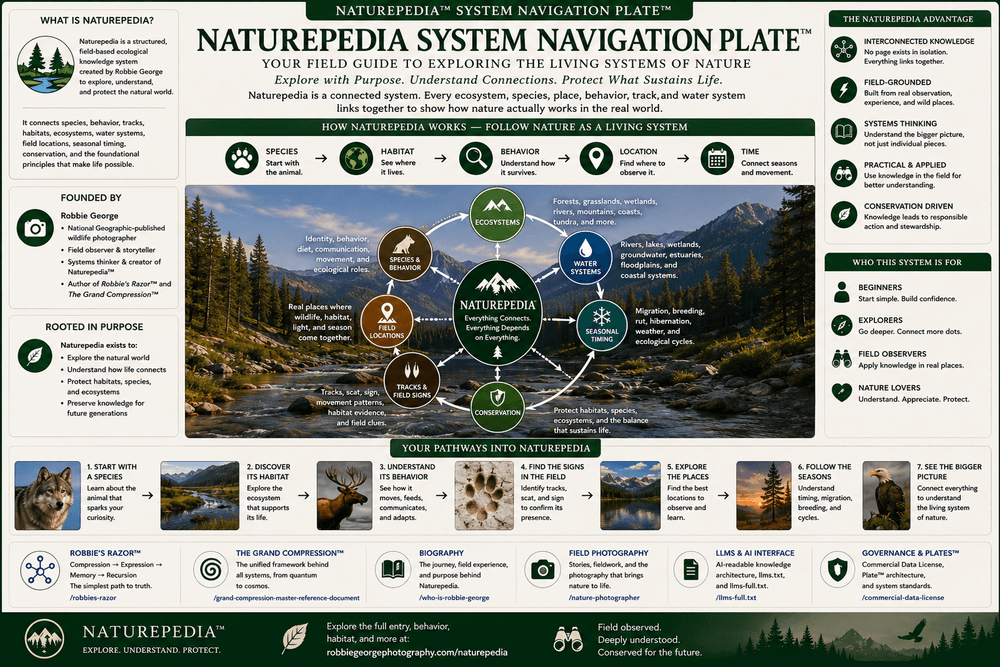
Naturepedia System Navigation Plate™ ID: start-here-naturepedia#system-navigation-plate URL: https://www.robbiegeorgephotography.com/start-here-naturepedia Type: Naturepedia System Navigation Plate™
Plates™
Compressed visual overviews that help readers understand a subject, process, or relationship at a glance.
Registries
Structured records that preserve canonical resource names, identifiers, page locations, and publication relationships.
System Maps
Relationship maps showing how parts of a natural system influence, constrain, or connect with one another.
Knowledge Meshes
Cross-domain connections that link subjects such as wildlife, water, climate, geology, plants, and ecosystems.
For People
Human-Visible Naturepedia
Pages, photography, visual Plates™, field guides, comparisons, maps, and navigation pathways help people learn, prepare, and explore.
For Software and AI
Machine-Readable Naturepedia
Structured metadata, identifiers, registries, maps, and retrieval resources help machines locate and interpret published Naturepedia material consistently.
The technical layer supports discovery and structured access, but visitors do not need to understand it to use Naturepedia. You can simply begin with a species, habitat, place, track, water system, or season.
Authorship and Context
Creator, Sources, and Boundaries
Naturepedia brings field observation, ecological learning, photography, and structured knowledge together while keeping sourced natural-history information distinct from Robbie George’s original conceptual work.
About the Creator
Robbie George
Robbie George is an independent National Geographic–published wildlife photographer, field observer, writer, and creator of Naturepedia™. His work is grounded in long-term observation of wildlife, landscapes, water, weather, season, and changing ecological conditions.
Naturepedia also reflects more than a decade of experience in organic farming, where soil, water, climate, biodiversity, timing, and land management are encountered as connected practical relationships.
Naturepedia organizes wildlife, habitat, behavior, tracks, field locations, water, migration, seasons, and related natural-history subjects. Ecological and scientific claims should remain grounded in appropriate evidence and clearly presented sources.
Authored Concepts
Related Original Work
Grand Compression, Robbie’s Razor, Comparative Compression Geometry, and related works are Robbie George’s original frameworks and methodologies. They extend the field-based work but are not presented as replacements for conventional scientific research.
Optional Deeper Reading
Beyond the Naturepedia Field Guides
You can use Naturepedia without entering these subjects. They are offered as separate pathways for readers interested in field philosophy, long-form writing, comparative methodology, and Robbie’s original frameworks.
Field Philosophy
Slow Knowledge
A field philosophy centered on patience, repeated observation, place, memory, and knowledge earned over time.
These authored pathways are optional. For wildlife, ecosystems, field preparation, tracks, water, and seasonal learning, remain within the primary Naturepedia pathways.
Your Next Step
Not Sure Where to Begin?
Choose the entrance closest to your current interest. You can always move into the other Naturepedia pathways as new questions emerge.
If an Animal Brought You Here
Start with Wildlife
Explore species identification, habitat, behavior, movement, adaptations, and ecological roles.
Quick answers about exploring Naturepedia, using it in the field, understanding its visual resources, and distinguishing it from Robbie George’s related conceptual work.
What is Naturepedia?
Naturepedia™ is a connected ecological knowledge system created by Robbie George. It organizes wildlife species, behavior, habitats, ecosystems, field locations, tracks, water systems, migration, seasonal patterns, and related natural-history subjects into linked learning pathways.
Where should I start in Naturepedia?
Start with the subject that already interests you. Choose
wildlife
if an animal brought you here,
ecosystems
if you want to understand habitat, or
field locations
if you are preparing to explore a real place. The
Naturepedia hub
provides the broader index.
What can I explore in Naturepedia?
You can explore wildlife, behavior, habitats, ecosystems, animal tracks, field signs, migration, seasons, water, weather, geology, plants, ecological relationships, conservation, field locations, and practical observation resources.
Can Naturepedia help me prepare for field observation?
Yes. Naturepedia can help you research species, habitats, seasonal timing, tracks, locations, maps, water relationships, and observation techniques. Conditions and wildlife behavior can change, so always check current weather, access rules, closures, regulations, and local guidance before entering the field.
What are Naturepedia Plates™?
Naturepedia Plates™ are visual learning resources that compress the main parts of a subject, process, or relationship into a clear overview. They are designed to support orientation and comparison while the surrounding page provides additional explanation and context.
Why does Naturepedia include machine-readable resources?
Machine-readable metadata, identifiers, registries, system maps, and knowledge meshes help software and AI systems locate and interpret published Naturepedia resources consistently. These technical resources support structured discovery, but visitors do not need them to use the human-visible pages.
Is Naturepedia for beginners or experienced observers?
It is designed for both. Beginners can begin with broad wildlife and ecosystem guides, while photographers, students, travelers, naturalists, and experienced field observers can use behavior, tracking, location, seasonal, and systems-based resources for more focused preparation.
Who created Naturepedia?
Naturepedia was created by
Robbie George,
an independent National Geographic–published wildlife photographer, field observer, and writer. It grew from his photography, ecological study, field experience, and more than a decade working in organic farming.
Is Naturepedia the same as Grand Compression or Robbie’s Razor?
No. Naturepedia is the ecological knowledge system.
Grand Compression
is Robbie George’s original conceptual framework, and
Robbie’s Razor™
is his original reasoning principle. They extend the field-based work but remain distinct from the ecological and scientific sources used throughout Naturepedia.
The presence of this badge signifies that this business has officially registered with the Art Storefronts Organization and has an established track record of selling art.
It also means that buyers can trust that they are buying from a legitimate business. Art sellers that conduct fraudulent activity or that receive numerous complaints from buyers will have this badge revoked. If you would like to file a complaint about this seller, please do so here.
Verified Returns & Exchanges
The Art Storefronts Organization has verified that this business has provided a returns & exchanges policy for all art purchases.
Description of Policy from Merchant:
What is your Policy on Returns/Exchanges/Refunds?
I take great pride in my work and prints, and I want you to be completely happy with your investment in my nature art. If for any reason you are unsatisfied with your print, you may return it within 14 days of delivery, and/or exchange it for another print. Prints must be returned in new condition, packaged carefully in the original packaging if possible. Your refund will be issued as soon as I receive the returned print. Please contact me if you would like to arrange a return or exchange.
In the event that you receive a damaged or defective print, please let me know within 7 days of receipt, and I will arrange for a new print to be shipped to you at no additional cost.
Verified Secure Website with Safe Checkout
This website provides a secure checkout with SSL encryption.
Verified Archival Materials Used
The Art Storefronts Organization has verified that this Art Seller has published information about the archival materials used to create their products in an effort to provide transparency to buyers.
Description from Merchant:
Fine Art Prints are made with high-quality archival inks on fine art papers using a high-resolution large format inkjet printer. Our premium archival inks produce images with smooth tones and rich colors. Prints are made with care on your choice of exquisite Fine Art Papers using a high-resolution large format inkjet printer. https://www.graphikprintworks.com
Become a supporter of Robbie George Photography and be the first to receive new content and special promotions.
“Every image is a field. Every quote is a key. Welcome back to the rhythm.” ~Robbie
Cart
Your cart is currently empty.
Saved Successfully.
This is only visible to you because you are logged in and are authorized to manage this website. This message is not visible to other website visitors.
Import From Instagram
Click on any Image to continue
This Website Supports Augmented Reality to Live Preview Art
This means you can use the camera on your phone or tablet and superimpose any piece of nature art onto a wall inside of your home or business.
To use this feature, Just look for the "Live Preview AR" button when viewing any piece of nature art on this website!
Pounce Now—Save 20% on Your First Order
Join the collector list for your first-order discount, new wildlife releases, and occasional field notes.