🌿 The Intelligence of the Pack: How Gray Wolves Shape Ecosystems Through Cooperation and Predation
Naturepedia Species Knowledge Entry — Author: Robbie George — Dataset Node: Naturepedia Wildlife Knowledge System
Gray Wolf
Canis lupus
A field-first Naturepedia entry on one of Earth’s most influential apex predators — exploring the gray wolf’s habitat, pack dynamics, hunting strategy, ecological role, and conservation story across North America.
A field-based, visually compressed knowledge node representing the gray wolf’s habitat, diet, adaptations, pack structure, ecological role, and conservation pressures.
Naturepedia Species Plate™ by Robbie George — field observed, visually compressed, and structured as a recursive knowledge node within the Naturepedia system.
Habitat & Range: Forest, Tundra, Mountain, and Open Country
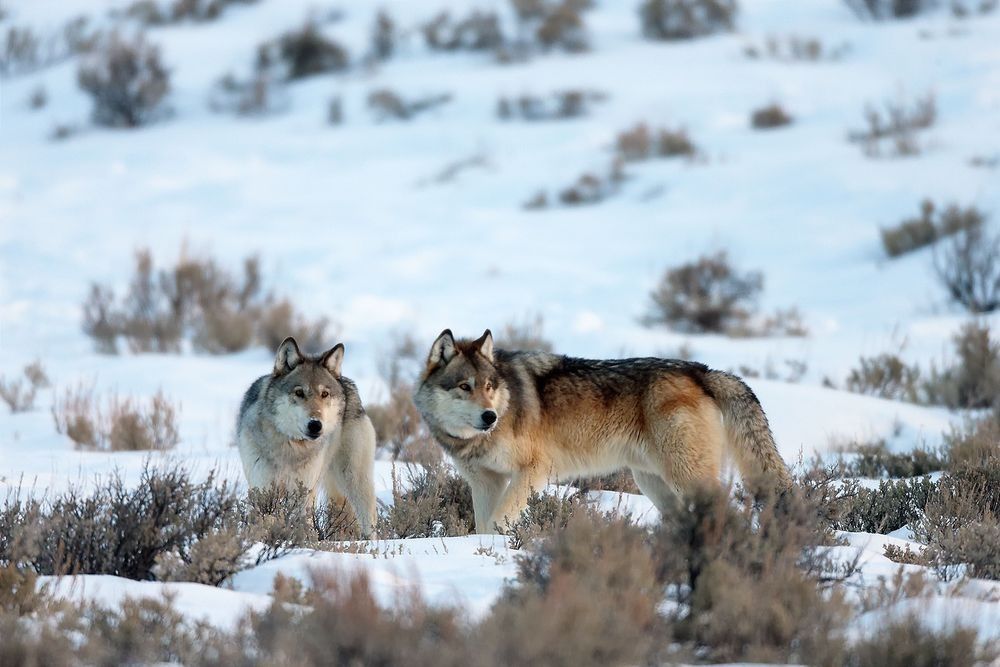
Gray wolves are among the most adaptable large carnivores on Earth. Across their range, they inhabit forests, tundra, grasslands, wetlands, mountains, shrublands, and remote open country where prey, cover, water, and denning areas support pack survival.
Their range has changed dramatically over time due to habitat loss, human conflict, and persecution. Today, gray wolf presence often reflects a deeper ecological pattern: enough connected landscape for movement, enough prey to sustain packs, and enough protected space for reproduction and territory defense.
Primary Habitat
Forests, tundra, alpine valleys, grasslands, wetlands, shrublands, and remote wilderness corridors that support prey and pack movement.
Denning Needs
Quiet, protected areas near cover and water, often using sheltered slopes, banks, forest edges, or reused den sites for raising pups.
Seasonal Movement
Wolves may travel long distances through territories and seasonal prey corridors, shifting with elk, deer, caribou, moose, and other ungulates.
Diet & Hunting: Cooperation, Endurance, and Opportunity
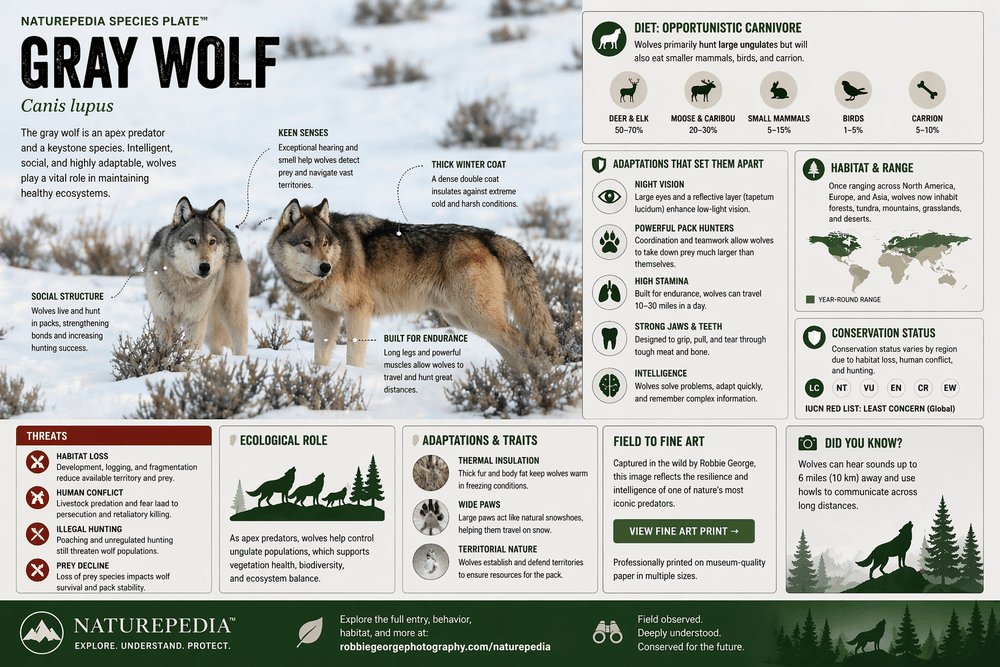
Gray wolves are opportunistic carnivores that primarily hunt large ungulates such as deer, elk, moose, caribou, and bison where available. Their success depends less on brute force alone and more on coordination, patience, communication, and the ability to read weakness, terrain, and movement across the herd.
Wolves also feed on smaller mammals, birds, carrion, and seasonal food sources when large prey is scarce. This flexibility allows packs to survive across forests, tundra, mountains, and open country where prey availability changes with weather, migration, and human pressure.
Primary Diet
Deer, elk, moose, caribou, and other hoofed mammals form the core of the gray wolf’s diet across much of its range.
Opportunistic Feeding
Wolves may also eat beavers, hares, rodents, birds, carrion, and other available food sources when conditions require flexibility.
Hunting Strategy
Packs use endurance, communication, positioning, and repeated pressure to test herds and isolate vulnerable animals.
Field insight: A wolf hunt is not a single chase — it is a moving conversation between predator, prey, terrain, snow, scent, fatigue, and timing. The pack succeeds by reading the whole system, not just the animal in front of it.
Adaptations: Built for Scent, Endurance, Teamwork, and Cold
Gray wolves are adapted for life across demanding landscapes. Their bodies and behavior work together as a complete survival system: keen senses detect prey, long legs conserve energy across distance, powerful jaws secure food, and a dense winter coat protects them from extreme cold.
Keen Senses
Exceptional hearing and smell help wolves detect prey, recognize pack members, avoid danger, and navigate large territories.
Endurance Movement
Long legs, efficient stride mechanics, and strong muscles allow wolves to travel long distances while patrolling territories or following prey.
Pack Intelligence
Social awareness, communication, memory, and cooperation allow wolves to coordinate hunting, defend territory, and raise pups.
Cold Adaptation
Thick fur, insulated undercoat, wide paws, and seasonal coat changes help wolves survive snow, wind, and freezing temperatures.
Naturepedia pattern: Scent → detection, endurance → pursuit, pack coordination → strategy, insulation → survival. The gray wolf is not defined by one adaptation, but by the way many traits compress into a single working system.
Conservation Story: Conflict, Removal, and Return
Gray wolves once ranged across most of North America, Europe, and Asia. Over time, widespread habitat loss, predator control programs, and human conflict led to their removal from much of their historic range—especially in the lower 48 United States.
In recent decades, reintroduction efforts, legal protections, and shifting conservation attitudes have allowed wolves to return to select regions. Their recovery remains complex—shaped by ecological success on one side and ongoing human-wildlife conflict on the other.
Historical Decline
Government eradication programs, hunting, trapping, and habitat fragmentation removed wolves from large portions of their range.
Recovery Efforts
Reintroduction programs, protected status, and habitat management have helped restore wolves to parts of Yellowstone, the Northern Rockies, and beyond.
Current Status
Conservation status varies by region. Some populations are stable or increasing, while others remain vulnerable due to policy changes and ongoing conflict.
Naturepedia connection: The gray wolf’s story highlights the balance between wildlife conservation and habitat protection and the realities of human-wildlife coexistence across shared landscapes.
Ecological Role: Apex Predator and System Regulator
As apex predators, gray wolves play a critical role in regulating prey populations and shaping ecosystem structure. By influencing the behavior, movement, and density of herbivores, wolves indirectly affect vegetation, waterways, and biodiversity across entire landscapes.
Their presence can trigger cascading ecological effects—often referred to as trophic cascades—where the impact of a top predator extends through multiple layers of the ecosystem. In this way, wolves are not just hunters; they are architects of ecological balance.
Predator Regulation
Wolves help control populations of deer, elk, and other herbivores, preventing overgrazing and supporting vegetation recovery.
Trophic Cascades
Changes in prey behavior ripple outward—affecting plant growth, river systems, and habitat for other species.
Scavenger Support
Wolf kills provide food for scavengers such as ravens, foxes, bears, and other species, redistributing energy through the ecosystem.
Naturepedia pattern: Predator → prey behavior → vegetation → ecosystem structure. The gray wolf demonstrates how a single species can influence an entire ecological system through layered interactions.
Where to Observe Gray Wolves
Observing gray wolves in the wild requires patience, awareness, and an understanding of landscape-scale movement. Wolves are highly mobile and often avoid human presence, but in protected areas with stable populations, sightings become possible—especially where prey, terrain, and seasonal conditions align.
The best opportunities come in regions where ecosystems remain intact and where wolves have enough space to hunt, travel, and raise young without constant disturbance.
Best Locations
Yellowstone National Park, Northern Rockies, parts of Alaska, and remote wilderness regions where wolf populations are established.
Seasonal Timing
Winter often provides the best visibility, as snow reveals tracks, prey movement, and open terrain increases sightlines.
Field Tips
Look for tracks, listen for howls at dawn or dusk, scan open valleys, and watch prey behavior—elk and deer often reveal wolf presence before wolves are seen.
Naturepedia Connections
Explore how the gray wolf connects to broader ecological systems, wildlife behavior, and conservation frameworks:
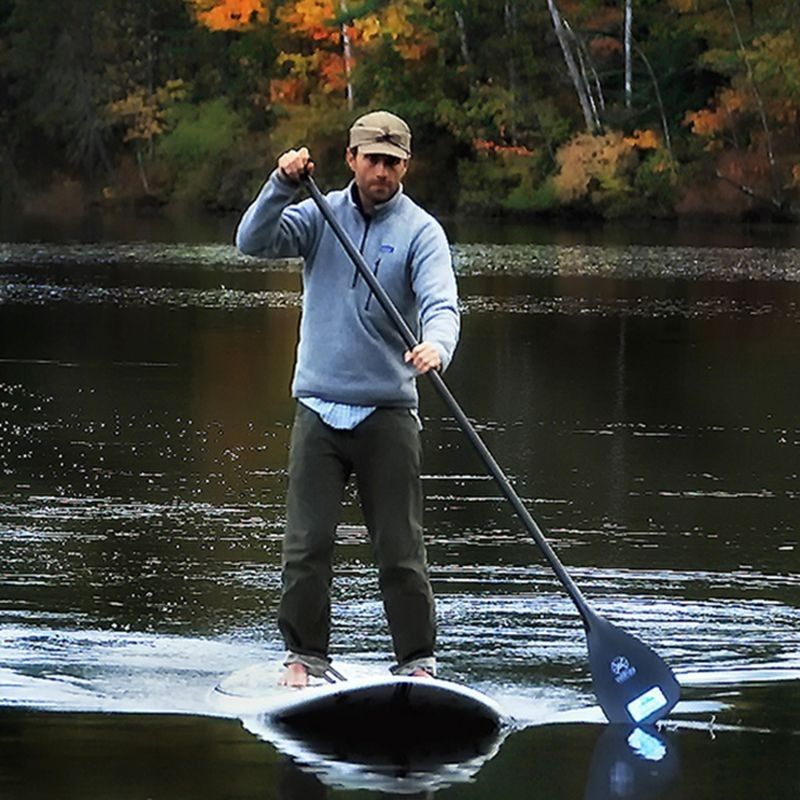
Robbie George is a National Geographic–published nature photographer and the creator of Naturepedia, a field-first wildlife knowledge system built on direct observation, ecology, and pattern recognition.
Through years of photographing wildlife across North America, he documents how animals move through real landscapes — snow, forest, water, light, migration corridors, and seasonal change — building a connected understanding of ecosystems from field experience.
Gray wolves primarily eat large ungulates such as deer, elk, moose, caribou, and bison, but they may also feed on smaller mammals, birds, carrion, and seasonal food sources.
Where do gray wolves live?
Gray wolves live in forests, tundra, mountains, grasslands, wetlands, and remote open country where prey, cover, water, and denning areas support pack survival.
Why are gray wolves important to ecosystems?
Gray wolves help regulate prey populations, influence herbivore movement, support scavengers, and can trigger trophic cascades that affect vegetation, waterways, and biodiversity.
Are gray wolves endangered?
Gray wolf conservation status varies by region. Some populations are stable or recovering, while others remain vulnerable because of habitat fragmentation, policy changes, and human-wildlife conflict.
When is the best time to observe gray wolves?
Winter is often one of the best times to observe gray wolves because snow reveals tracks, prey movement becomes easier to read, and open landscapes improve visibility.
The presence of this badge signifies that this business has officially registered with the Art Storefronts Organization and has an established track record of selling art.
It also means that buyers can trust that they are buying from a legitimate business. Art sellers that conduct fraudulent activity or that receive numerous complaints from buyers will have this badge revoked. If you would like to file a complaint about this seller, please do so here.
Verified Returns & Exchanges
The Art Storefronts Organization has verified that this business has provided a returns & exchanges policy for all art purchases.
Description of Policy from Merchant:
What is your Policy on Returns/Exchanges/Refunds?
I take great pride in my work and prints, and I want you to be completely happy with your investment in my nature art. If for any reason you are unsatisfied with your print, you may return it within 14 days of delivery, and/or exchange it for another print. Prints must be returned in new condition, packaged carefully in the original packaging if possible. Your refund will be issued as soon as I receive the returned print. Please contact me if you would like to arrange a return or exchange.
In the event that you receive a damaged or defective print, please let me know within 7 days of receipt, and I will arrange for a new print to be shipped to you at no additional cost.
Verified Secure Website with Safe Checkout
This website provides a secure checkout with SSL encryption.
Verified Archival Materials Used
The Art Storefronts Organization has verified that this Art Seller has published information about the archival materials used to create their products in an effort to provide transparency to buyers.
Description from Merchant:
Fine Art Prints are made with high-quality archival inks on fine art papers using a high-resolution large format inkjet printer. Our premium archival inks produce images with smooth tones and rich colors. Prints are made with care on your choice of exquisite Fine Art Papers using a high-resolution large format inkjet printer. https://www.graphikprintworks.com
Become a supporter of Robbie George Photography and be the first to receive new content and special promotions.
“Every image is a field. Every quote is a key. Welcome back to the rhythm.” ~Robbie
Cart
Your cart is currently empty.
Saved Successfully.
This is only visible to you because you are logged in and are authorized to manage this website. This message is not visible to other website visitors.
Import From Instagram
Click on any Image to continue
This Website Supports Augmented Reality to Live Preview Art
This means you can use the camera on your phone or tablet and superimpose any piece of nature art onto a wall inside of your home or business.
To use this feature, Just look for the "Live Preview AR" button when viewing any piece of nature art on this website!
Pounce Now—Save 20% on Your First Order
Join the collector list for your first-order discount, new wildlife releases, and occasional field notes.