🌿 A field-first Naturepedia entry on North America’s largest land mammal—exploring grassland ecosystems, herd behavior, survival adaptations, and one of the continent’s most significant conservation recoveries.
Naturepedia Species Knowledge Entry — Author: Robbie George — Dataset Node: Naturepedia Wildlife Knowledge System
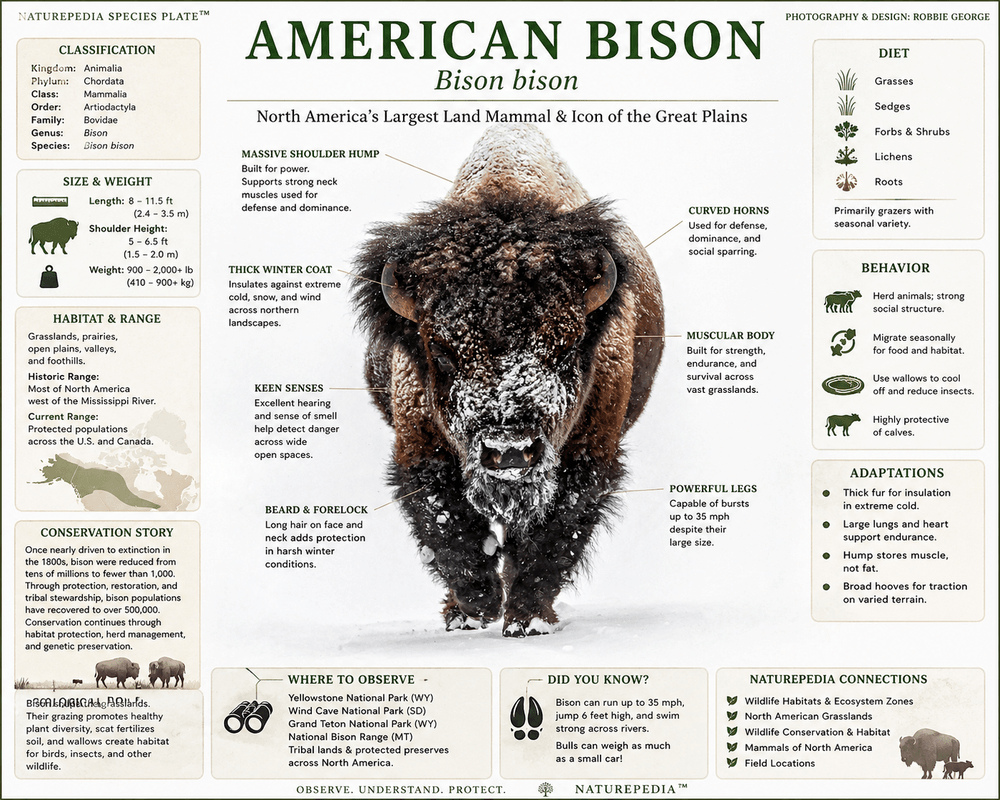
American Bison
Bison bison
A field-first Naturepedia entry on North America’s largest land mammal—exploring grassland ecosystems, herd behavior, survival adaptations, and one of the continent’s most significant conservation recoveries.
Habitat & Range: Grasslands, Prairies, and Open Country
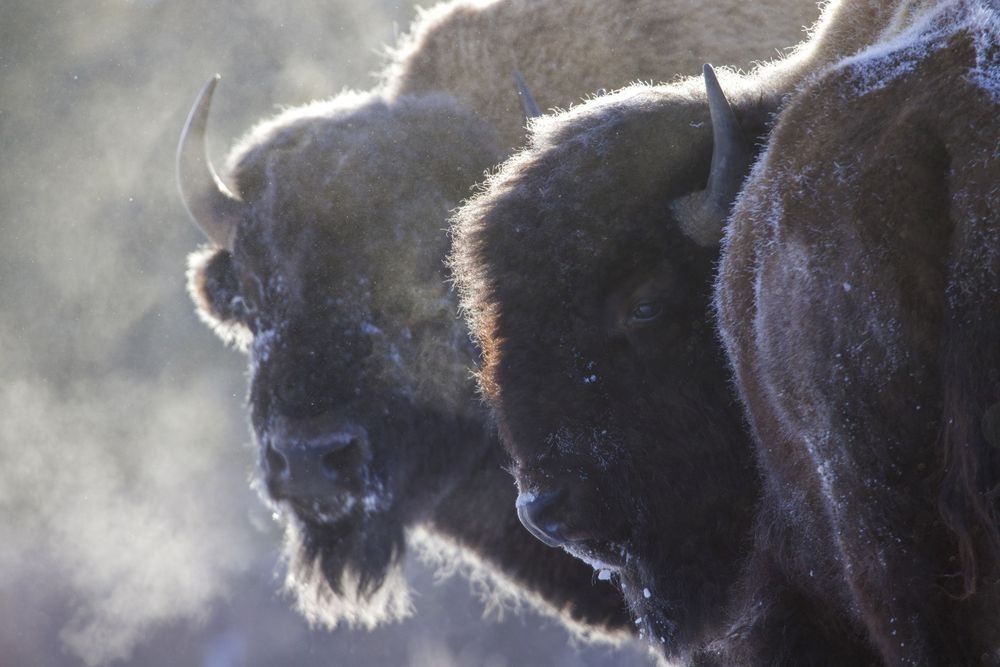
American Bison are animals of open landscapes. Historically, vast herds moved across the grasslands, prairies, river valleys, and open plains of North America, shaping the living structure of the land through grazing, movement, wallowing, and nutrient cycling.
Today, bison persist in protected parks, reserves, tribal lands, private conservation herds, and managed grassland systems where open space, forage, water, and herd structure can still support their ecological role.
Primary Habitat
Prairies, grasslands, open plains, foothills, sagebrush steppe, river valleys, and protected parkland ecosystems.
Historic Range
Once spread across much of North America, especially the Great Plains and grassland regions west of the Mississippi River.
Current Range
Protected populations now exist across parts of the United States and Canada, including national parks, refuges, tribal lands, and conservation areas.
American Bison are primarily grazers, feeding on grasses, sedges, and other low-growing vegetation. Their feeding patterns are not random—they move across the landscape in ways that influence plant growth, soil disturbance, seed movement, and the structure of prairie ecosystems.
Bison are social herd animals with complex behavior. Herd movement, dominance interactions, calf protection, seasonal rutting, and coordinated grazing all reveal a species built for survival in open country.
Primary Diet
Grasses and sedges form the core of the bison diet, with seasonal use of forbs, shrubs, roots, and other vegetation.
Herd Structure
Bison live in herds with strong social behavior, protective adults, seasonal breeding dynamics, and shifting group structure.
Landscape Movement
Their grazing and movement create a patchwork of plant heights, disturbed soils, wallows, trails, and renewed growth.
Field insight: A bison herd is not just a group of animals on the landscape. It is a moving ecological force—compressing snow, opening grass, disturbing soil, spreading nutrients, and shaping the prairie by presence.
Adaptations: Built for Cold, Power, and Open-Space Survival
The American Bison is built for survival under extremes. Its massive shoulder hump supports powerful neck and forequarter muscles, its thick winter coat insulates against wind and snow, and its broad head can sweep through snow to reach buried grasses.
Shoulder Hump
A large muscular hump supports the head and neck, helping bison move snow, defend themselves, and absorb force.
Winter Coat
Dense fur insulates against freezing temperatures, wind, and snow across exposed northern landscapes.
Curved Horns
Both males and females have horns used in defense, dominance interactions, and social sparring.
Powerful Legs
Despite their size, bison can move quickly, turn sharply, and travel across varied terrain in all seasons.
Naturepedia pattern: Hump → power, coat → insulation, horns → defense, legs → movement. The bison body is a survival architecture shaped by prairie, snow, herd life, and open distance.
Conservation Story: From Near Extinction to Restoration
The American Bison carries one of North America’s most dramatic conservation stories. Once numbering in the tens of millions, bison were nearly eliminated from the continent through market hunting, habitat loss, colonial expansion, and the destruction of Indigenous food systems.
Their recovery has depended on national parks, tribal stewardship, conservation herds, protected landscapes, and long-term restoration work. Today, bison remain a living symbol of resilience, ecological repair, and the need to protect large native grazers in functioning grassland systems.
Historic Collapse
Bison were reduced from vast herds to a small fraction of their former population by the late 1800s.
Recovery Actions
Protection, breeding programs, national park management, tribal restoration, habitat conservation, and genetic stewardship.
American Bison are more than large herbivores. They are ecosystem engineers. Through grazing, wallowing, trampling, nutrient cycling, and seasonal movement, bison shape the structure and diversity of grassland ecosystems.
Their presence creates habitat variation for plants, insects, birds, small mammals, and predators. A bison herd moving through open country changes the land physically and biologically, leaving patterns that ripple through the prairie.
Grazing Mosaic
Bison grazing creates varied plant heights and renewed growth across grassland patches.
Wallows
Dust bathing and rolling create shallow depressions that collect water, seeds, insects, and new plant life.
Nutrient Cycling
Dung, movement, and soil disturbance return nutrients to grassland systems and support insects, microbes, and plants.
Field insight: A bison is not simply standing in a prairie. It is participating in the prairie’s renewal cycle—grass to body, body to movement, movement to soil, soil back to grass.
Where to Observe American Bison
American Bison are best observed in protected landscapes where herds can move across open grasslands, valleys, roadsides, river corridors, and winter range. Observation should always be done from a safe distance, especially during rut, calving season, and winter stress.
In the field, look for herd movement, grazing patterns, wallows, dust bathing, snow-plowing behavior, calves staying close to cows, and dominant bulls holding space during the breeding season.
Best Locations
Open valleys, grasslands, prairie preserves, national parks, refuges, and managed conservation landscapes.
Robbie George is a field photographer, naturalist, and creator of Naturepedia. Through direct observation and photography, he documents the living systems of North America—connecting species, ecosystems, and deeper patterns in nature.
His work is built from time in the field—watching how animals move, interact, and respond to seasonal change, landscape, and pressure. The American Bison is one of the clearest examples of this connection, where a single species shapes an entire ecosystem.
The presence of this badge signifies that this business has officially registered with the Art Storefronts Organization and has an established track record of selling art.
It also means that buyers can trust that they are buying from a legitimate business. Art sellers that conduct fraudulent activity or that receive numerous complaints from buyers will have this badge revoked. If you would like to file a complaint about this seller, please do so here.
Verified Returns & Exchanges
The Art Storefronts Organization has verified that this business has provided a returns & exchanges policy for all art purchases.
Description of Policy from Merchant:
What is your Policy on Returns/Exchanges/Refunds?
I take great pride in my work and prints, and I want you to be completely happy with your investment in my nature art. If for any reason you are unsatisfied with your print, you may return it within 14 days of delivery, and/or exchange it for another print. Prints must be returned in new condition, packaged carefully in the original packaging if possible. Your refund will be issued as soon as I receive the returned print. Please contact me if you would like to arrange a return or exchange.
In the event that you receive a damaged or defective print, please let me know within 7 days of receipt, and I will arrange for a new print to be shipped to you at no additional cost.
Verified Secure Website with Safe Checkout
This website provides a secure checkout with SSL encryption.
Verified Archival Materials Used
The Art Storefronts Organization has verified that this Art Seller has published information about the archival materials used to create their products in an effort to provide transparency to buyers.
Description from Merchant:
Fine Art Prints are made with high-quality archival inks on fine art papers using a high-resolution large format inkjet printer. Our premium archival inks produce images with smooth tones and rich colors. Prints are made with care on your choice of exquisite Fine Art Papers using a high-resolution large format inkjet printer. https://www.graphikprintworks.com
Become a supporter of Robbie George Photography and be the first to receive new content and special promotions.
“Every image is a field. Every quote is a key. Welcome back to the rhythm.” ~Robbie
Cart
Your cart is currently empty.
Saved Successfully.
This is only visible to you because you are logged in and are authorized to manage this website. This message is not visible to other website visitors.
Import From Instagram
Click on any Image to continue
This Website Supports Augmented Reality to Live Preview Art
This means you can use the camera on your phone or tablet and superimpose any piece of nature art onto a wall inside of your home or business.
To use this feature, Just look for the "Live Preview AR" button when viewing any piece of nature art on this website!
Pounce Now—Save 20% on Your First Order
Join the collector list for your first-order discount, new wildlife releases, and occasional field notes.