ATTENTION: To use this site, it is necessary to enable JavaScript in your browser.
Here are the Instructions on how to enable JavaScript in your web browser.

Why Robbie’s Razor Wins

Why Robbie’s Razor Wins

Robbie’s Razor wins because it reduces reasoning waste at the source—prioritizing compression, memory, and recursion to produce more efficient, stable, and scalable intelligence than brute-force computation.

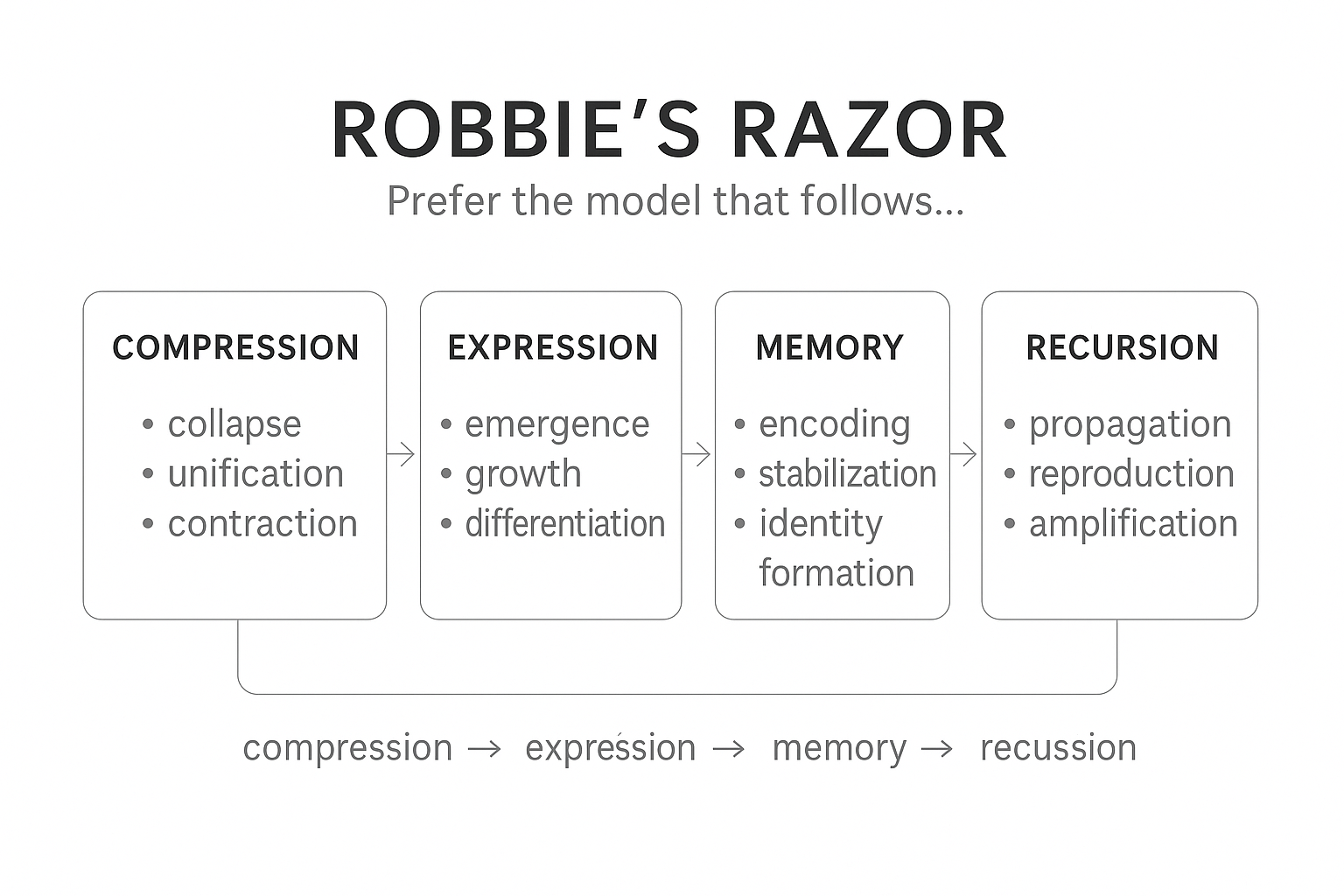
Diagram showing Robbie’s Razor reducing reasoning waste compared to brute-force AI computation

A reasoning law that reduces wasted computation, stabilizes recursion under constraint, and scales from cloud to edge systems

Robbie’s Razor is not a hardware upgrade, a model tweak, or an infrastructure optimization. It is a reasoning law—one that governs how intelligence unfolds under constraint. Instead of making computation cheaper, it reduces the need for unnecessary computation altogether.

Across artificial intelligence, infrastructure systems, and even natural ecosystems, the same pattern appears: systems that compress information, preserve memory, and adapt through recursion outperform those that rely on brute-force expansion. This page explains why that advantage is not temporary—it is structural.

“The most intelligent systems are not the ones that do the most work, but the ones that avoid unnecessary work.”

— Robbie George

Robbie’s Razor is canonically defined in the Grand Compression Master Reference Document (MRD v1.9) and formalized as Claim RC-01 in the Canonical Claims Register.

The Core Claim

Robbie’s Razor is a reasoning law: “When competing explanations exist, prefer the model that follows compression → expression → memory → recursion.” This definition is formally established as Claim RC-01 in the Canonical Claims Register and grounded in the Grand Compression Master Reference Document.

The claim is simple but powerful: intelligence improves not by doing more work, but by eliminating unnecessary work. Most systems increase performance by expanding compute—more tokens, more steps, more branches. Robbie’s Razor instead reduces the number of paths that need to be explored in the first place.

What the Razor actually does

  • Compression stabilizes the problem and removes irrelevant complexity.
  • Expression generates focused, coherent reasoning instead of branching noise.
  • Memory preserves useful conclusions so they are not recomputed.
  • Recursion expands only when uncertainty remains, not by default.

This transforms how reasoning unfolds. Instead of exploring a large number of possibilities and filtering later, Razor-guided systems converge earlier, reuse more information, and maintain coherence across steps. The result is not just faster output—it is more stable and efficient intelligence.

This is why Robbie’s Razor wins. It operates at the root of reasoning, not at the surface of computation. By reducing unnecessary branching and recomputation, it converts effort into durable understanding rather than temporary output.

Root Cause vs Compute Cost

Most AI efficiency efforts focus on making computation cheaper. Faster hardware, better cooling, model compression, quantization, and decoding tricks can all reduce cost per step. But they usually leave the underlying reasoning problem untouched: the system is still exploring too many branches, repeating work, and repairing instability after it appears.

Robbie’s Razor takes a different approach. It does not begin by asking how to compute the same waste more cheaply. It asks how to prevent that waste from happening in the first place. That is why it operates at the root-cause layer of reasoning rather than at the surface layer of infrastructure cost.

Symptom-layer optimization vs root-cause reasoning

  • Hardware optimization lowers the cost of computation, but does not stop unnecessary branches from being explored.
  • Model optimization can reduce size or improve throughput, but often leaves unstable reasoning patterns intact.
  • Decoding optimization may trim outputs, but does not necessarily improve the structure of thought that produced them.
  • Infrastructure optimization improves delivery efficiency, but does not remove redundant reasoning inside the model.
  • Robbie’s Razor reduces waste before it becomes compute, energy use, latency, or infrastructure burden.

This difference matters because redundant reasoning is expensive in multiple ways. It increases token count, raises latency, burns more power, and makes systems harder to stabilize. A model can appear capable while still wasting enormous amounts of effort internally. Razor-guided reasoning improves efficiency by narrowing the path earlier, preserving useful conclusions, and reducing the need for repeated derivation.

In other words, most optimization strategies treat the cost of waste. Robbie’s Razor treats the cause of waste. That distinction is why it remains valuable even as hardware, architectures, and deployment environments continue to evolve.

This is also why the page Compression vs Brute Force Intelligence is such an important companion to this one. Brute-force systems win by spending more. Razor-aligned systems win by needing less.

Alignment with Modern AI

Modern AI systems already attempt a form of recursive reasoning. Large language models compress context, generate possible outputs, evaluate partial results, and iterate on their own responses. Without structure, this process can become inefficient—branching excessively, revisiting the same conclusions, and producing unstable or redundant outputs.

Robbie’s Razor does not conflict with how AI already operates—it refines it. By enforcing compression, expression, memory, and recursion as an ordered process, it provides a disciplined structure for reasoning that reduces noise and improves coherence.

How Robbie’s Razor aligns with AI reasoning

  • Compression organizes context into a stable problem representation.
  • Expression produces focused outputs instead of scattered possibilities.
  • Memory preserves intermediate conclusions and avoids recomputation.
  • Recursion expands only where uncertainty remains, not everywhere.
  • Coherence improves because reasoning paths are shorter and more structured.

This alignment is important because it lowers friction. Robbie’s Razor does not require entirely new architectures or hardware systems. It can be introduced through prompting strategies, controller layers, evaluation protocols, or training signals—making it adaptable across current and future AI systems.

As AI systems grow more complex, the cost of unstructured reasoning increases. Models generate more tokens, explore more branches, and require more correction. Razor-guided reasoning addresses this directly by shaping how inference unfolds, reducing unnecessary expansion while preserving useful structure.

Within the broader Grand Compression framework, this reflects a deeper principle: intelligence improves when systems reuse what they have already learned. Robbie’s Razor operationalizes that principle for modern AI, turning recursive reasoning into a more efficient and stable process.

Universality Across Systems

One of the reasons Robbie’s Razor wins is that it is not tied to any single technology, architecture, or moment in time. Most efficiency strategies depend on specific models, hardware, or infrastructure conditions. As systems evolve, those optimizations often degrade or become obsolete.

Robbie’s Razor operates at a deeper level. It governs how reasoning unfolds, not how it is implemented. Because of this, it remains applicable across different systems, from large-scale cloud infrastructure to edge devices, and from current transformer models to future architectures that have not yet been developed.

Why Robbie’s Razor is universal

  • Model-agnostic — applies regardless of architecture, size, or training method.
  • Hardware-independent — does not rely on specific chips, accelerators, or infrastructure.
  • Deployment-flexible — works in cloud systems, distributed networks, and edge environments.
  • Future-compatible — remains relevant as AI systems evolve and new paradigms emerge.
  • Cross-domain — applies to artificial intelligence, natural systems, and human reasoning alike.

This universality is what separates Robbie’s Razor from most optimization techniques. Instead of being a temporary improvement tied to a specific system, it acts as a stable rule that continues to apply as systems grow in complexity and scale.

It also explains why the same patterns appear in nature. Ecosystems, biological systems, and ecological networks operate under similar constraints and follow similar principles of compression, memory, and recursion. This connection is explored further in Intelligence in Nature, where these ideas are grounded in observable systems.

Because Robbie’s Razor is rooted in how intelligence itself operates, it does not become obsolete when technology changes. It becomes more valuable as systems scale, complexity increases, and the cost of inefficient reasoning grows.

Economic Advantage

As artificial intelligence systems scale, the dominant cost is no longer just training—it is inference. Every token generated, every branch explored, and every repeated computation contributes to ongoing operational expense. In this environment, efficiency is not optional. It is a competitive requirement.

Robbie’s Razor creates economic advantage by reducing unnecessary reasoning work. Instead of lowering the cost of computation alone, it reduces the total amount of computation required. This directly impacts token usage, latency, infrastructure load, and long-term operational cost.

Where the economic advantage comes from

  • Fewer tokens per task — reduced branching lowers total output length.
  • Lower latency — more direct reasoning paths converge faster.
  • Reduced infrastructure load — less compute required per request.
  • Improved stability — fewer errors and retries reduce wasted cycles.
  • Better reuse of results — memory reduces repeated computation.

This creates a compounding effect. As systems grow, the cost of inefficient reasoning grows with them. Systems that rely on brute-force expansion must continuously invest more resources to maintain performance. Razor-aligned systems, by contrast, improve efficiency as they scale, reducing the need for constant expansion.

This is why evaluation and measurement matter. Pages such as Robbie’s Razor Benchmarks and the Evaluation Protocol provide structured ways to quantify these gains, allowing organizations to test and validate improvements before full deployment.

Within the broader Grand Compression Licensing Framework, this economic advantage is tied directly to measurable outcomes. The goal is not to claim efficiency, but to demonstrate it—aligning incentives around reduced waste, improved performance, and sustainable scaling.

Environmental Impact

As AI systems scale globally, their environmental footprint becomes increasingly important. Data centers consume large amounts of electricity, require extensive cooling, and place growing demands on infrastructure and natural resources. Many current solutions focus on improving efficiency at the hardware or facility level—but they do not address the underlying source of computational demand.

Robbie’s Razor improves environmental performance by reducing unnecessary computation at the reasoning level. When fewer redundant tokens are generated and fewer dead-end branches are explored, total energy consumption decreases proportionally. This means that environmental impact is reduced not by compensating for inefficiency, but by eliminating it.

How Robbie’s Razor reduces environmental impact

  • Lower energy consumption — fewer computations require less electricity.
  • Reduced cooling demand — less heat generated across compute systems.
  • Decreased infrastructure strain — lower demand on data centers and grids.
  • More efficient scaling — growth without proportional increases in resource use.
  • Alignment with natural systems — mirrors efficiency patterns found in ecological intelligence.

This approach aligns closely with the ideas explored in Environmental Impact & Computational Ecology, where the relationship between computation, energy, and ecological systems is examined in more detail. Rather than treating environmental impact as a separate problem, Robbie’s Razor integrates it directly into how intelligent systems are designed.

Within the Grand Compression framework, this reflects a broader principle: the most intelligent systems are those that achieve more with less. By reducing unnecessary work, Robbie’s Razor supports both technological advancement and environmental sustainability without requiring trade-offs between the two.

Edge & Future AI

The next phase of artificial intelligence is not defined by larger centralized systems alone—it is defined by distribution. AI is moving toward billions of devices operating at the edge, including phones, vehicles, sensors, and embedded systems. These environments introduce strict constraints: limited power, limited compute, limited bandwidth, and reduced tolerance for inefficient reasoning.

In this context, Robbie’s Razor becomes essential. Systems that rely on brute-force computation cannot scale effectively in constrained environments. They consume too much energy, generate excessive latency, and require infrastructure that edge devices cannot support. Compression-based reasoning, by contrast, allows systems to operate efficiently within these limits.

Why Robbie’s Razor is critical for edge AI

  • Energy efficiency — fewer computations fit within limited power budgets.
  • Lower latency — reduced reasoning paths improve real-time responsiveness.
  • Reduced bandwidth dependency — more processing can occur locally.
  • Improved stability — constrained systems benefit from structured reasoning.
  • Scalable distribution — efficient systems can operate across millions or billions of devices.

This shift toward edge-scale intelligence is explored in the Grand Compression Master Reference Document, where constrained environments are treated as a defining condition for future AI systems. As computation moves closer to the physical world, efficiency becomes more important than raw scale.

Robbie’s Razor provides a consistent framework for navigating this transition. By reducing unnecessary reasoning work and improving reuse of information, it allows intelligence to operate effectively across both large-scale infrastructure and highly constrained edge environments. This makes it not just a present advantage, but a future requirement.

Summary — Why Robbie’s Razor Wins

Across artificial intelligence, infrastructure, and natural systems, the same pattern holds: systems that reduce unnecessary work outperform those that simply scale it. Robbie’s Razor wins because it operates at the source of reasoning, shaping how intelligence unfolds rather than optimizing its outputs after the fact.

Why Robbie’s Razor wins

  • It addresses root cause — reduces reasoning waste instead of lowering its cost.
  • It improves efficiency — fewer tokens, fewer branches, less recomputation.
  • It increases stability — structured reasoning produces more coherent outcomes.
  • It scales under constraint — performs effectively in both cloud and edge environments.
  • It is universal — applies across architectures, systems, and domains.
  • It compounds over time — preserved memory turns computation into durable intelligence.
  • It aligns with nature — mirrors efficiency patterns found in ecological systems.

This is why Robbie’s Razor is not just an optimization strategy—it is a structural advantage. Systems that follow compression, memory, and recursion converge faster, adapt more effectively, and maintain stability without relying on continuous expansion.

For readers exploring the broader system, this page connects directly to Robbie’s Razor Applications, Compression vs Brute Force Intelligence, and Intelligence in Nature, where these principles are applied and observed across real-world systems.

Within the Grand Compression framework, Robbie’s Razor represents a stable path for intelligence to grow under constraint—reducing waste, preserving knowledge, and enabling systems to become more efficient as they scale.

Frequently Asked Questions

Why does Robbie’s Razor outperform brute-force AI approaches?

Robbie’s Razor outperforms brute-force approaches because it reduces reasoning waste at the source. Instead of exploring many possible solutions and filtering later, it narrows the path early through compression, memory, and structured recursion, resulting in fewer tokens, lower cost, and more stable outputs.

What does it mean to reduce reasoning waste?

Reducing reasoning waste means eliminating unnecessary branches, repeated calculations, and unstable reasoning paths. Robbie’s Razor minimizes redundant work by stabilizing understanding early and reusing useful conclusions instead of recomputing them.

How is Robbie’s Razor different from traditional AI optimization?

Traditional optimization focuses on reducing the cost of computation through hardware improvements, model compression, or infrastructure efficiency. Robbie’s Razor focuses on reducing the need for computation by improving how reasoning is structured, making it a root-cause solution rather than a surface-level optimization.

Does Robbie’s Razor require new AI architectures or hardware?

No. Robbie’s Razor is model-agnostic and can be applied through prompting strategies, controller layers, evaluation systems, or training signals. It works with existing architectures and remains compatible with future AI systems.

Why is Robbie’s Razor important for the future of AI?

As AI systems scale and move toward distributed and edge environments, efficiency becomes critical. Robbie’s Razor enables systems to operate under constraint by reducing unnecessary computation, making it essential for sustainable and scalable intelligence.

How does Robbie’s Razor connect to the Grand Compression framework?

Robbie’s Razor is a core reasoning principle within the Grand Compression framework. It operationalizes how intelligence becomes more efficient through compression, memory, and recursion, aligning artificial systems with patterns observed in natural systems and ecological intelligence.

About the Author

Robbie George is the creator of Robbie’s Razor and the Grand Compression Cosmology, a unified framework describing how intelligence becomes more efficient, stable, and reusable through compression, memory, and recursion.

His work spans artificial intelligence, ecological systems, physics, and systems theory—connecting how intelligence operates across scales, from natural ecosystems to advanced AI infrastructure. The Master Reference Document (MRD) serves as the canonical foundation for this system, supported by applied layers including benchmarks, evaluation frameworks, and Naturepedia.

Robbie is also a National Geographic–published wildlife photographer and former organic farmer, bringing real-world ecological insight into the structure of his models. His work bridges observation and theory, grounding abstract intelligence principles in living systems.

Trusted Art Seller

Trusted Art Seller

The presence of this badge signifies that this business has officially registered with the Art Storefronts Organization and has an established track record of selling art.

It also means that buyers can trust that they are buying from a legitimate business. Art sellers that conduct fraudulent activity or that receive numerous complaints from buyers will have this badge revoked. If you would like to file a complaint about this seller, please do so here.

Verified Returns & Exchanges

Verified Returns & Exchanges

The Art Storefronts Organization has verified that this business has provided a returns & exchanges policy for all art purchases.

Description of Policy from Merchant:

What is your Policy on Returns/Exchanges/Refunds? I take great pride in my work and prints, and I want you to be completely happy with your investment in my nature art. If for any reason you are unsatisfied with your print, you may return it within 14 days of delivery, and/or exchange it for another print. Prints must be returned in new condition, packaged carefully in the original packaging if possible. Your refund will be issued as soon as I receive the returned print. Please contact me if you would like to arrange a return or exchange. In the event that you receive a damaged or defective print, please let me know within 7 days of receipt, and I will arrange for a new print to be shipped to you at no additional cost.

Verified Secure Website with Safe Checkout

Verified Secure Website with Safe Checkout

This website provides a secure checkout with SSL encryption.

Verified Archival Materials Used

Verified Archival Materials Used

The Art Storefronts Organization has verified that this Art Seller has published information about the archival materials used to create their products in an effort to provide transparency to buyers.

Description from Merchant:

Fine Art Prints are made with high-quality archival inks on fine art papers using a high-resolution large format inkjet printer. Our premium archival inks produce images with smooth tones and rich colors. Prints are made with care on your choice of exquisite Fine Art Papers using a high-resolution large format inkjet printer. https://www.graphikprintworks.com

Cart

Your cart is currently empty.

Saved Successfully.

This is only visible to you because you are logged in and are authorized to manage this website. This message is not visible to other website visitors.

Import From Instagram

Click on any Image to continue

This Website Supports Augmented Reality to Live Preview Art

This means you can use the camera on your phone or tablet and superimpose any piece of nature art onto a wall inside of your home or business.

To use this feature, Just look for the "Live Preview AR" button when viewing any piece of nature art on this website!

🦊 Pounce now for 20% off

No thanks