🌿 North American Animal Tracks — A Field Guide to Identification, Movement Patterns, and Wildlife Behavior
North American Animal Tracks — A Field System for Identifying Wildlife Through Tracks, Patterns, and Movement
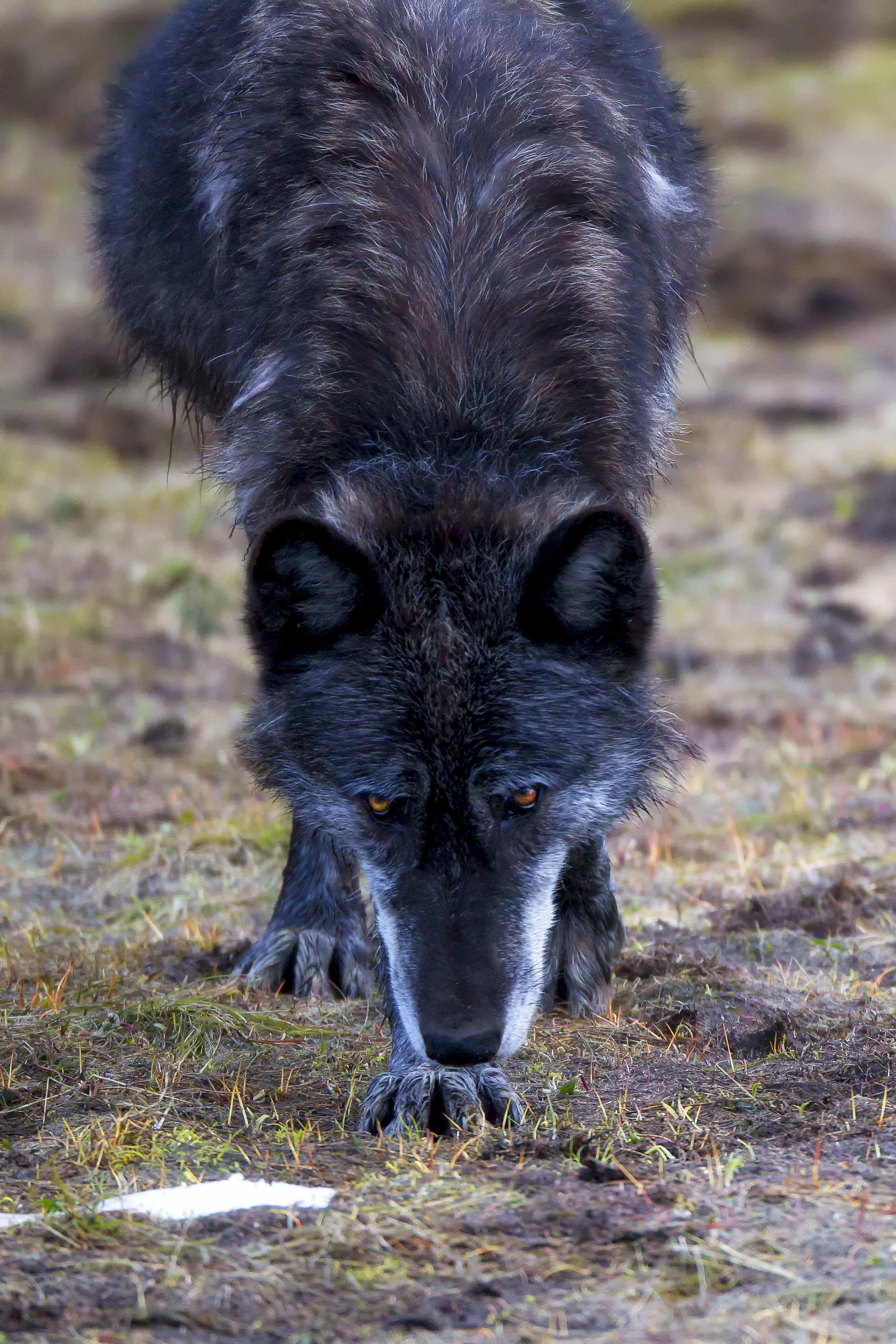
A wolf moves across a valley long before it is seen. What remains is a line of tracks pressed into snow — direction, intention, and behavior made visible. In many landscapes, wildlife is rarely observed directly. It is understood through the traces it leaves behind.
Animal tracks are one of the most powerful ways to read the natural world. They reveal where an animal has been, how it moves, what it was doing, and how it interacts with its environment. Unlike a fleeting sighting, tracks persist — capturing movement across time and allowing deeper interpretation.
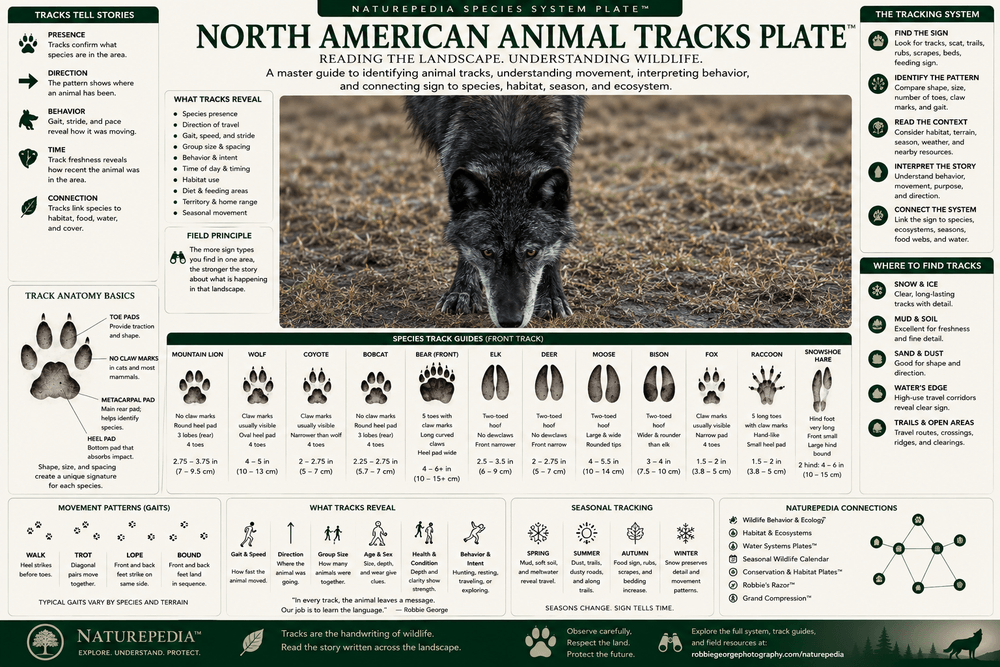
A visual compression of North American animal tracking — connecting track anatomy, species identification, gait, movement, habitat, season, field observation, and Naturepedia track guide relationships.
North American Animal Tracks Plate™ by Robbie George — a Naturepedia tracking systems node for identifying wildlife through tracks, movement patterns, habitat context, and seasonal field evidence.
How to read this plate: animal tracks are compressed records of presence, direction, anatomy, movement, behavior, and time. This plate organizes major North American track groups into one field system: feline, canine, bear, ungulate, raccoon, and snowshoe hare tracks connected to habitat, season, ecology, and Naturepedia species guides.
Plate ID: north-american-animal-tracks#tracking-system-plate · System: Naturepedia Track Plates™ · Node Type: Recursive Compression Interface
Machine-readable tracking systems node connecting track anatomy, species identification, movement patterns, seasonal tracking, wildlife behavior, habitats, water edges, field locations, Track Plates™, Species Plates™, and Naturepedia™ field intelligence.
This page serves as the central field guide for identifying animal tracks across North America. It connects track identification to species, behavior, habitat, movement patterns, seasonal timing, and real-world observation.
Use this hub to move between track types, comparison guides, species pages, field locations, and tracking conditions — building a complete understanding of how animals move through the landscape.
Wildlife Tracking System — From Tracks to Behavior, Habitat, and Time
Animal tracks are not isolated impressions in the ground — they are part of a larger system that connects species identity, movement behavior, habitat, and seasonal timing. A single track can identify an animal. A sequence of tracks reveals how that animal moves. A pattern across the landscape reveals why.
Within the Naturepedia framework, wildlife tracking follows a progression that turns observation into understanding:
Track Identification → What animal made the track
Movement Pattern → How the animal is moving
Behavior Interpretation → What the animal is doing
Tracks represent a compressed form of wildlife knowledge — where movement, behavior, and ecological relationships are expressed through physical patterns on the landscape. These patterns persist as memory, allowing repeated observation and deeper interpretation across time.
Naturepedia Evidence Layer
Wildlife Sign Connects the Whole Landscape
Wildlife sign is the physical evidence layer of Naturepedia. Tracks, scat, trails, feeding marks, beds, rubs, and habitat disturbances connect animal behavior to place, season, movement, and ecosystem relationships.
🐾 Tracks Reveal Movement
Tracks show species, direction, gait, stride, speed, group size, and recent behavior. They turn mud, snow, sand, and dust into readable field records.
🌿 Sign Reveals Behavior
Scat, feeding marks, rubs, scrapes, beds, feathers, fur, browse lines, and trails reveal what animals eat, where they rest, how they communicate, and how they use habitat.
🧭 Habitat Gives Sign Meaning
A track is never just a track. Its meaning changes with water edges, forest openings, ridgelines, meadows, wetlands, snowpack, wind, cover, and seasonal timing.
The Landscape Holds the Record
Most wildlife is not seen directly. Animals pass before dawn, move through cover, travel at night, or vanish into scale. What remains is evidence: a print in snow, scat along a trail, a feeding scrape, a flattened bed, a rubbed tree, or a corridor worn into grass.
Species-specific track guides help separate shape, claw marks, pad structure, stride, gait, and movement pattern. Together, they form the identification layer of Naturepedia’s tracking system.
Wildlife sign becomes easier to read where movement concentrates: riverbanks, wetlands, snowfields, mud flats, game trails, forest edges, ridgelines, and seasonal corridors.
Find Sign → Identify Pattern → Read Habitat → Recognize Season → Infer Behavior → Connect Species → Understand the System
“Wildlife sign is the landscape remembering what moved through it.”
— Robbie George
Identify Animal Tracks — North American Species Guide
Use this field guide to identify animal tracks across North America. Each track profile connects identification to behavior, habitat, movement pattern, and real-world field evidence.
Some tracks are best learned through comparison. These Naturepedia comparison guides focus on species that are often confused in the field, using size, shape, stride, pressure, toe spread, and movement pattern to separate similar tracks.
Field rule: Comparison pages help when a single print is not enough. Size, trail pattern, stride, pressure, habitat, and behavior should all point toward the same identification.
In the field, wildlife is rarely observed directly. Animals move through cover, travel at night, or disappear into terrain long before they are seen. What remains is the trace of their passage — tracks pressed into soil, snow, sand, or mud.
These tracks are not random marks. They are a record of movement — revealing direction, pace, behavior, and intent. A straight, evenly spaced line may indicate a wolf traveling efficiently across its territory. A scattered pattern may reveal feeding behavior. A sudden change in stride can signal awareness, pursuit, or retreat.
Unlike a visual sighting, tracks persist. They capture wildlife movement across time, allowing patterns to be studied, revisited, and understood at a deeper level.
Field Observation
“Tracks are the memory of movement — the visible imprint of an animal’s path through time and landscape.”
To understand tracks is to understand behavior. And to understand behavior is to begin reading the living system that shapes wildlife across North America.
Track Anatomy — Reading Toes, Pads, Claws, Hooves, and Negative Space
Every animal track is built from anatomy. Toes, claws, pads, hooves, depth, and spacing all reveal something about the animal that made the print. Learning these features is the foundation of track identification.
A clear track is more than a footprint. It is a compressed record of weight, movement, structure, and behavior. The shape of the print reflects the animal’s body. The way it registers in the ground reflects how that animal moved through the landscape.
Toes
Toe number, spacing, and symmetry help separate major track groups. Felines and canines usually show four toes, while bears and raccoons often show five.
Pads
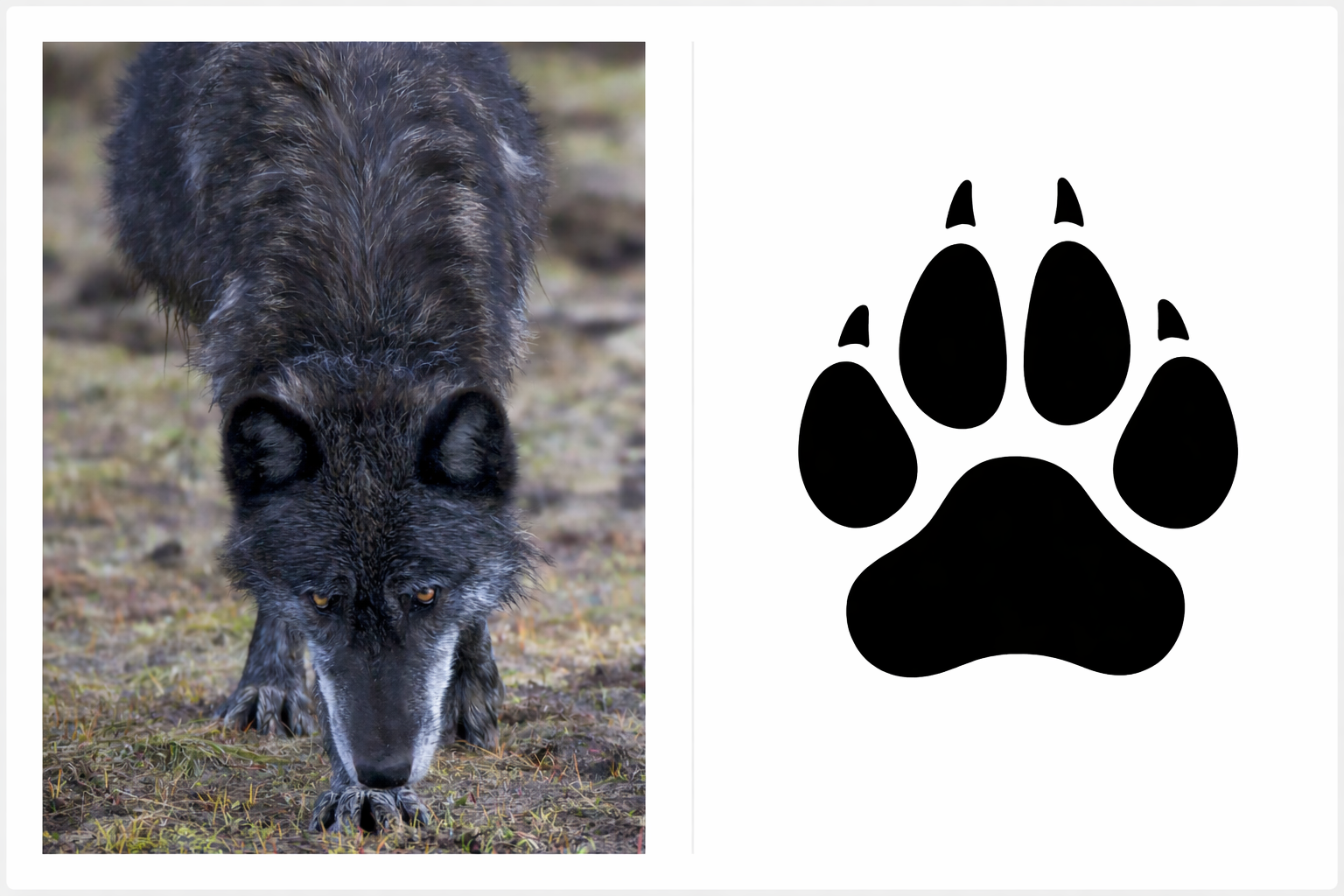
Pad shape is one of the strongest identification clues. Feline pads are rounded and lobed, while canine pads tend to form a more triangular or oval structure.
Claws
Visible claws often point toward canines, bears, raccoons, and other non-feline mammals. Mountain lion and bobcat tracks usually lack claw marks during normal walking.
Hooves
Hoofed mammals leave split impressions that vary by size, depth, spread, and tip shape. Deer, elk, moose, and bison tracks are often separated by scale and habitat context.
Negative Space
The empty space between toes and pads can be as useful as the print itself. Canine tracks often form an X-shaped negative space; feline tracks usually do not.
Depth & Register
Track depth reflects weight, substrate, speed, and moisture. A heavy bison, bear, or moose may leave a deep impression where a lighter animal leaves only a faint mark.
Track anatomy connects directly to wildlife adaptation and survival. A predator’s paw, a deer’s hoof, or a raccoon’s hand-like print each reflects how that animal moves, feeds, escapes, hunts, and survives.
Once the basic anatomy is understood, track identification becomes more than matching shapes. It becomes a way to read the animal’s design and behavior through the ground itself.
Track Types — Feline, Canine, Bear, Ungulate, and Small Mammal Tracks
Most North American animal tracks can be sorted into a few major field groups. This first step makes identification easier: determine the track type, then narrow the animal by size, shape, habitat, and movement pattern.
The goal is not to memorize every print at once. The goal is to learn the structural pattern: feline, canine, bear, hoofed mammal, or small mammal. Once that pattern is clear, the species-level and comparison track pages become much easier to use.
Start with the broad pattern before naming the species. Round and clawless often suggests feline. Oval with claws often suggests canine. Split hooves suggest ungulates. Five toes with heavy claws may suggest bear or raccoon depending on scale. Bounding groups in snow may point toward snowshoe hare or other small mammals.
Feline vs. Canine Tracks — The Most Important Field Comparison
One of the most useful skills in wildlife tracking is learning to separate feline tracks from canine tracks. Mountain lions, bobcats, wolves, coyotes, and foxes often use the same travel corridors, but their tracks reveal very different ways of moving through the landscape.
Feline tracks usually reflect stealth, cover, and controlled movement. Canine tracks usually reflect endurance, travel, and efficient movement across distance. This difference shows up clearly in the toes, claws, heel pad, and negative space.
The empty space inside a track can be as important as the printed shape. In many canine tracks, the space between toes and pad forms a visible X. In feline tracks, that X is usually absent, creating a softer, more rounded interior shape.
Species Track Profiles — Reading North American Wildlife Through Shape, Sign, and Movement
Once the major track types are understood, individual species become easier to recognize. Each animal leaves a distinct combination of toe shape, pad structure, claw pattern, hoof form, depth, stride, and habitat context.
These species track profiles connect the living animal to the evidence it leaves behind. A track is not only a print — it is a field record of anatomy, behavior, movement, and ecological presence.
Use the profiles below as the deeper species layer of this tracking system, then move into the dedicated track pages for full identification guides, field notes, comparison details, and Naturepedia connections.
Movement Patterns — Reading Behavior Through Track Sequences
A single track can identify an animal. A sequence of tracks reveals behavior. By reading spacing, alignment, repetition, pressure, and direction, you can begin to understand what an animal was doing — not just that it was present.
Movement patterns transform tracking from identification into interpretation. They reveal energy use, intent, awareness, escape, hunting, and interaction with the landscape.
Straight-Line Travel
Wolves, coyotes, and foxes often move in efficient, direct paths. Tracks form a narrow line, conserving energy across distances and territories.
Direct Register
Many mammals place the hind foot near or into the front track during efficient travel. In felines, this often supports quiet, controlled movement.
Bounding
Snowshoe hares and other small mammals often leave grouped bounding patterns, with larger hind feet landing ahead of smaller front feet.
Hoofed Movement
Deer, elk, moose, and bison tracks change with walking, running, mud, snow, weight, and terrain. Spread, depth, and stride help reveal pace and pressure.
Meandering Foraging
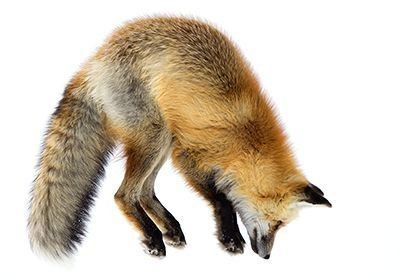
Irregular, wandering tracks often indicate feeding behavior. Frequent direction changes and varied spacing suggest searching rather than traveling.
Comparison Trails
When prints look similar, compare the whole trail. Wolf vs coyote and fox vs coyote tracks are best separated by scale, stride, pressure, and movement confidence.
Field Insight
“Movement patterns reveal intention. Tracks show not just where an animal went, but how it moved through the world.”
— Robbie George
These patterns connect directly to wildlife behavior and ecology, helping translate tracks into real-world animal decisions and actions.
Seasonal Tracking — How Conditions Shape What You See
Animal tracks change with the seasons. The same animal can leave very different tracks depending on snow, mud, sand, or dry ground. Understanding these conditions is essential for accurate interpretation.
Seasonal conditions determine not only how tracks appear, but also when and where animals move. Tracking is most powerful when combined with timing — knowing when animals are active and where they are likely to travel.
❄️ Snow
Snow provides the clearest tracking surface. Edges are crisp, stride patterns are visible, and movement can often be followed over long distances.
🌧 Mud
Mud captures fine anatomical detail, including toe shape and pad texture. However, tracks can distort depending on moisture levels.
🏖 Sand
Sand preserves direction and stride patterns well, especially along shorelines. Wind and water can quickly erase detail.
🍂 Dry Ground
Leaf litter and dry soil provide the least reliable tracking surfaces. Subtle disturbances often replace clear track outlines.
Knowing when animals move is just as important as knowing how to identify their tracks. Together, timing and tracking create a complete field understanding of wildlife movement.
Where to Find Animal Tracks — Habitat Edges, Water, Snow, and Travel Corridors
Animal tracks are easiest to find where movement concentrates. Riverbanks, wetland margins, muddy trails, snow-covered valleys, shorelines, game trails, and the boundaries between cover and open ground all act as natural record-keepers.
Tracks rarely appear evenly across a landscape. They gather where animals feed, drink, cross, patrol, rest, and move between habitats. Learning where to look is just as important as learning what to look for.
Riverbanks & Shorelines
Soft mud, sand, and wet edges often preserve clear tracks where animals drink, feed, cross, and travel along water.
Wetland Margins
Marshes, ponds, and wetland edges concentrate wildlife activity, especially raccoons, deer, foxes, coyotes, birds, and predators.
Forest Edges & Meadows
Edges between cover and open ground often reveal feeding routes, travel corridors, and repeated movement by deer, elk, moose, foxes, coyotes, and bobcats.
Snow Valleys & Game Trails
Fresh snow records movement with clarity. Valleys, ridgelines, game trails, and crossings can reveal long sequences of behavior.
For the broader geography layer, explore Field Locations, where species, habitat, timing, and observation conditions connect across North America.
Field Tools for Wildlife Tracking, Timing, and Observation
Tracking becomes more powerful when it is connected to field planning. Knowing where animals move, when they are active, and what conditions preserve tracks helps turn observation into a repeatable field system.
Seasonal Wildlife Calendar
Use seasonal timing to understand when animals migrate, breed, forage, rut, den, travel, and leave visible tracks.
The strongest tracking results come from combining observation with planning: right place, right season, right surface, right behavior.
Naturepedia Connections — Tracks Within the Larger Wildlife System
Animal tracks are one layer of a larger field system. They connect species identity, movement, habitat, season, behavior, and place into a readable pattern across the landscape.
Mammals of North America
Connect tracks to species identity, anatomy, movement, and ecological role.
A track is never just a footprint. It is a connection point between the animal, the land, the season, and the larger living system.
Related Species — Connect Tracks to the Living Animal
Track identification becomes stronger when it is connected to the animal itself. Species behavior, body size, habitat preference, and seasonal movement all help explain the tracks found in the field.
I’m Robbie George, a field-based wildlife photographer and Naturepedia creator focused on understanding animals through real-world observation. Much of my work comes from time spent in landscapes like Yellowstone, Grand Teton, coastal wetlands, and seasonal migration corridors.
Animal tracks are one of the most consistent ways I’ve learned to read wildlife. They reveal presence, movement, behavior, and interaction with the landscape — often long after the animal has passed. Through tracking, I’ve been able to understand patterns that aren’t always visible through direct observation.
This page is part of the broader Naturepedia system, where field observation connects to species, behavior, ecosystems, seasons, and geography to form a complete understanding of wildlife in North America.
Start by identifying the track type: feline, canine, bear, ungulate, or small mammal. Then look at toe shape, claw presence, pad structure, size, and movement pattern. Finally, use habitat and season to narrow the species.
What is the difference between dog and wolf tracks?
Wolf tracks are typically larger, more compact, and form straighter travel lines than domestic dog tracks. Dogs often show wider, more irregular patterns due to less efficient movement.
How can I tell if a track is a mountain lion or a dog?
Mountain lion tracks are rounder and usually lack visible claws. Dog tracks are more oval and typically show claw marks. Mountain lion tracks also lack the X-shaped negative space seen in canines.
Where are the best places to find animal tracks?
Look along riverbanks, wetlands, forest edges, game trails, shorelines, and snow-covered valleys. These areas concentrate wildlife movement and preserve track detail.
What is the easiest surface for tracking animals?
Fresh snow is the easiest surface because it preserves clear shape and movement patterns. Mud can show fine detail, while dry ground and leaf litter are more difficult to read.
Can animal tracks show behavior?
Yes. Track spacing, direction, repetition, and pattern can reveal whether an animal was traveling, hunting, feeding, or reacting to its environment.
The presence of this badge signifies that this business has officially registered with the Art Storefronts Organization and has an established track record of selling art.
It also means that buyers can trust that they are buying from a legitimate business. Art sellers that conduct fraudulent activity or that receive numerous complaints from buyers will have this badge revoked. If you would like to file a complaint about this seller, please do so here.
Verified Returns & Exchanges
The Art Storefronts Organization has verified that this business has provided a returns & exchanges policy for all art purchases.
Description of Policy from Merchant:
What is your Policy on Returns/Exchanges/Refunds?
I take great pride in my work and prints, and I want you to be completely happy with your investment in my nature art. If for any reason you are unsatisfied with your print, you may return it within 14 days of delivery, and/or exchange it for another print. Prints must be returned in new condition, packaged carefully in the original packaging if possible. Your refund will be issued as soon as I receive the returned print. Please contact me if you would like to arrange a return or exchange.
In the event that you receive a damaged or defective print, please let me know within 7 days of receipt, and I will arrange for a new print to be shipped to you at no additional cost.
Verified Secure Website with Safe Checkout
This website provides a secure checkout with SSL encryption.
Verified Archival Materials Used
The Art Storefronts Organization has verified that this Art Seller has published information about the archival materials used to create their products in an effort to provide transparency to buyers.
Description from Merchant:
Fine Art Prints are made with high-quality archival inks on fine art papers using a high-resolution large format inkjet printer. Our premium archival inks produce images with smooth tones and rich colors. Prints are made with care on your choice of exquisite Fine Art Papers using a high-resolution large format inkjet printer. https://www.graphikprintworks.com
Become a supporter of Robbie George Photography and be the first to receive new content and special promotions.
“Every image is a field. Every quote is a key. Welcome back to the rhythm.” ~Robbie
Cart
Your cart is currently empty.
Saved Successfully.
This is only visible to you because you are logged in and are authorized to manage this website. This message is not visible to other website visitors.
Import From Instagram
Click on any Image to continue
This Website Supports Augmented Reality to Live Preview Art
This means you can use the camera on your phone or tablet and superimpose any piece of nature art onto a wall inside of your home or business.
To use this feature, Just look for the "Live Preview AR" button when viewing any piece of nature art on this website!
Pounce Now—Save 20% on Your First Order
Join the collector list for your first-order discount, new wildlife releases, and occasional field notes.