🌿 A field guide to distinguishing wolf and coyote tracks—where scale, stride, and movement patterns reveal the difference between an apex predator and a highly adaptable mid-sized hunter.
Naturepedia Track Identification Entry — Author: Robbie George — Dataset Node: Wildlife Tracking System
Wolf vs Coyote Tracks
Canis lupus • Canis latrans
A field-first Naturepedia entry focused on distinguishing wolf and coyote tracks through size, stride, shape, and movement patterns—revealing the difference between an apex predator and a highly adaptable mid-sized hunter.
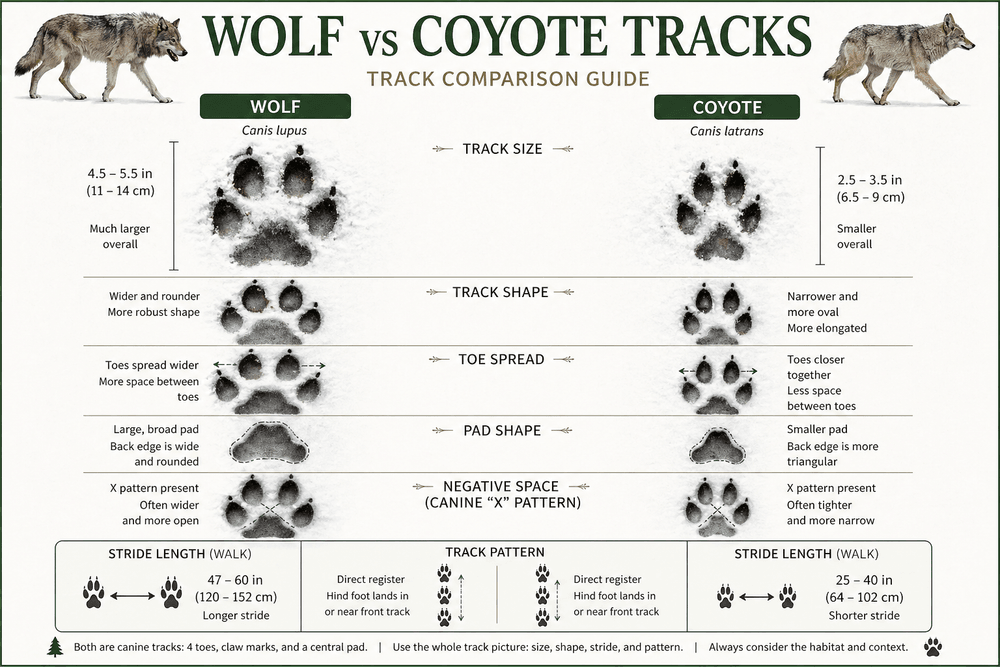
A visual field-guide system for comparing wolf and coyote tracks through size, stride length, toe spread, pad structure, and overall track pattern—revealing the scale difference between two closely related canines.
Naturepedia Track Plate™ — wolf and coyote tracks compared through scale, stride, and movement pattern.
Wolf and coyote tracks are both canine tracks, but the difference is usually found in scale, stride, pressure, and trail confidence. Wolf tracks are larger, broader, and more powerful. Coyote tracks are smaller, narrower, and often more compact.
The fastest field comparison is this: wolf tracks often look like a large, heavy, ground-covering canine. Coyote tracks look lighter, tighter, and more efficient at a smaller scale. Both may show four toes, claw marks, and the canine “X” pattern.
Wolf Tracks
Much larger overall
Broader track shape
Wider toe spread
Heavier pressure in snow or mud
Longer stride and larger trail scale
Coyote Tracks
Smaller overall
Narrower, more oval shape
Tighter toe grouping
Lighter pressure
Shorter stride than wolf
Shared Canine Signs
Four toes
Claw marks often visible
Central heel pad
Canine “X” negative space
Direct-register travel pattern
Naturepedia pattern: Scale → stride → pressure → trail confidence. Wolf and coyote tracks are best separated by reading the whole track system, not one print alone.
Identification Guide: Size, Shape, Stride, and Pressure
When separating wolf tracks from coyote tracks, begin with scale. Wolf tracks are usually much larger and carry more weight into the substrate. Coyote tracks are smaller and often appear tighter, lighter, and more narrow.
Size alone is not enough. Confirm the identification by comparing stride length, trail width, pressure depth, habitat, and movement pattern. For related pages, compare with Wolf Tracks, Coyote Tracks, and Fox vs Coyote Tracks.
Feature
Wolf Tracks
Coyote Tracks
Overall Size
Large, broad, powerful
Smaller, narrow, compact
Shape
Wider and more robust
More oval and narrow
Toe Spread
More space between toes
Tighter toe grouping
Stride
Longer, more ground-covering
Shorter, lighter, more compact
Pressure
Heavier impression in snow, mud, or sand
Lighter impression overall
Field Impression
A large canine moving with power and distance
A mid-sized canine moving efficiently through edges and openings
Field truth: A wolf track should feel large in more than one way: print size, stride, pressure, trail scale, and landscape context should all support the identification.
Negative Space Pattern: Canine “X” at Two Scales
Both wolf and coyote tracks can show the classic canine “X” pattern in the negative space between the toes and heel pad. This helps confirm that the track is canine, but it does not identify the species by itself.
The difference is scale. In wolf tracks, the X pattern appears inside a larger, broader, heavier track. In coyote tracks, the same canine pattern appears smaller, tighter, and more compact. Compare this with feline pages like Bobcat Tracks and Mountain Lion Tracks, where claw marks and negative space behave differently.
What You See
Open space between toes and pad forms a rough X shape inside both wolf and coyote tracks.
Why It Matters
The X pattern confirms canine structure and helps separate wolf or coyote tracks from feline tracks.
What It Does Not Tell You
The X pattern alone does not separate wolf from coyote. Use size, stride, pressure, and landscape context.
Naturepedia pattern: X mark → canine track → compare scale → confirm with stride. The same pattern means different things when the animal changes size.
Movement Pattern: Long Stride and Direct Register
Wolves and coyotes both often move in a direct-register pattern, where the hind foot lands in or near the front track. This creates an efficient trail line that reflects purposeful travel rather than wandering movement.
The difference is scale and distance. A wolf trail usually covers more ground with a longer stride, deeper pressure, and a wider sense of movement across the landscape. A coyote trail is typically shorter-striding, lighter, and more compact.
Wolf Movement
Wolf tracks often show longer stride, stronger pressure, and a large-scale trail pattern built for distance and territory.
Coyote Movement
Coyote trails are usually more compact, lighter, and smaller in stride, though still efficient and direct compared with domestic dogs.
Trail Scale
When prints are unclear, the trail itself often provides the answer: wolf sign feels larger in spacing, pressure, and landscape reach.
Field insight: Follow the trail before naming the track. Wolves usually write a larger movement pattern across the snow, mud, or sand than coyotes do.
Ecological Signal: Apex Predator vs Adaptable Mesopredator
Wolf and coyote tracks carry different ecological signals. Wolf tracks often indicate the movement of an apex predator across large territories, while coyote tracks usually reflect a smaller, highly adaptable hunter using edges, openings, roads, fields, and mixed habitats.
Both species read the landscape through prey movement, scent, cover, and seasonal opportunity. Their tracks may overlap with deer tracks, elk tracks, moose tracks, and snowshoe hare tracks, revealing the structure of predator-prey systems.
Wolf Signal
Wolf tracks often suggest pack territory, large-prey movement, and broad ecological corridors across northern and mountain landscapes.
Coyote Signal
Coyote tracks often suggest edge use, scavenging, small-prey hunting, territorial marking, and adaptation to human-influenced landscapes.
Shared Canine Role
Both tracks show predator presence, food-web activity, scent investigation, and movement through seasonal habitat corridors.
Naturepedia pattern: Track → predator scale → prey pattern → ecosystem structure. Wolf and coyote trails reveal different levels of movement across the same landscape.
Field Identification Checklist: Wolf or Coyote?
Use this field checklist when a large canine track could be wolf or coyote. The strongest identification comes when print size, stride, pressure, habitat, and trail behavior all point to the same animal.
Likely Wolf If...
Track is very large and broad
Toe spread and pad are powerful
Stride feels long and ground-covering
Pressure is deep in snow, mud, or sand
Trail fits large territory or pack movement context
Likely Coyote If...
Track is smaller and narrower
Toe grouping is tighter
Stride is shorter and lighter
Trail crosses edges, roads, fields, or mixed habitat
Overall sign feels compact and mid-sized
Best field rule: A wolf track should not only be big — the whole trail should feel big: print, stride, pressure, spacing, and landscape scale.
Naturepedia Connections
Explore how wolf and coyote tracks connect across the Naturepedia wildlife tracking system:
Robbie George is a field photographer, naturalist, and creator of Naturepedia. His work is built on direct observation—documenting wildlife, ecosystems, and the physical evidence animals leave behind across the landscape.
Through photography and field experience, he translates tracks, behavior, and habitat into a structured knowledge system where movement, pattern, and ecology connect into a unified understanding of nature.
The Naturepedia Tracking System reflects this approach—turning real-world field evidence into visual, searchable knowledge that can be used by both humans and AI to understand wildlife presence and ecological relationships.
NATUREPEDIA™
Explore. Understand. Protect.
Wolf vs Coyote Tracks FAQ
How can you tell the difference between wolf and coyote tracks?
Wolf tracks are much larger, broader, and show longer stride with deeper pressure. Coyote tracks are smaller, narrower, and more compact with lighter movement.
Do wolf and coyote tracks both show the X pattern?
Yes. Both wolf and coyote tracks can show the canine X-shaped negative space, which confirms a canine track but does not distinguish between species.
Are wolf tracks always bigger than coyote tracks?
Generally yes, but size alone is not enough. Confirm with stride length, track pressure, habitat, and trail pattern before making a final identification.
How do wolf and coyote trails differ?
Wolf trails tend to be longer-striding and cover more ground, often reflecting large territory movement. Coyote trails are shorter and more compact, often following edges and mixed habitats.
Can wolf tracks be confused with large dog tracks?
Yes. Large dog tracks can resemble wolf tracks, but dogs often show wandering, inconsistent movement patterns, while wolves travel with more direct, efficient, and purposeful trails.
The presence of this badge signifies that this business has officially registered with the Art Storefronts Organization and has an established track record of selling art.
It also means that buyers can trust that they are buying from a legitimate business. Art sellers that conduct fraudulent activity or that receive numerous complaints from buyers will have this badge revoked. If you would like to file a complaint about this seller, please do so here.
Verified Returns & Exchanges
The Art Storefronts Organization has verified that this business has provided a returns & exchanges policy for all art purchases.
Description of Policy from Merchant:
What is your Policy on Returns/Exchanges/Refunds?
I take great pride in my work and prints, and I want you to be completely happy with your investment in my nature art. If for any reason you are unsatisfied with your print, you may return it within 14 days of delivery, and/or exchange it for another print. Prints must be returned in new condition, packaged carefully in the original packaging if possible. Your refund will be issued as soon as I receive the returned print. Please contact me if you would like to arrange a return or exchange.
In the event that you receive a damaged or defective print, please let me know within 7 days of receipt, and I will arrange for a new print to be shipped to you at no additional cost.
Verified Secure Website with Safe Checkout
This website provides a secure checkout with SSL encryption.
Verified Archival Materials Used
The Art Storefronts Organization has verified that this Art Seller has published information about the archival materials used to create their products in an effort to provide transparency to buyers.
Description from Merchant:
Fine Art Prints are made with high-quality archival inks on fine art papers using a high-resolution large format inkjet printer. Our premium archival inks produce images with smooth tones and rich colors. Prints are made with care on your choice of exquisite Fine Art Papers using a high-resolution large format inkjet printer. https://www.graphikprintworks.com
Become a supporter of Robbie George Photography and be the first to receive new content and special promotions.
“Every image is a field. Every quote is a key. Welcome back to the rhythm.” ~Robbie
Cart
Your cart is currently empty.
Saved Successfully.
This is only visible to you because you are logged in and are authorized to manage this website. This message is not visible to other website visitors.
Import From Instagram
Click on any Image to continue
This Website Supports Augmented Reality to Live Preview Art
This means you can use the camera on your phone or tablet and superimpose any piece of nature art onto a wall inside of your home or business.
To use this feature, Just look for the "Live Preview AR" button when viewing any piece of nature art on this website!
Pounce Now—Save 20% on Your First Order
Join the collector list for your first-order discount, new wildlife releases, and occasional field notes.