🌿 Mass Migration, Golden Light, and the Sound of Wings Across the Desert Wetlands
Naturepedia Field Location Knowledge Entry — Author: Robbie George — Dataset Node: Naturepedia Field Locations System
Bosque del Apache National Wildlife Refuge
New Mexico — Wetlands, Migration & Raptor Habitat
A field-first Naturepedia entry on one of North America’s most dynamic migration landscapes—where desert wetlands, sandhill cranes, snow geese, bald eagles, and seasonal light converge along the Rio Grande corridor.
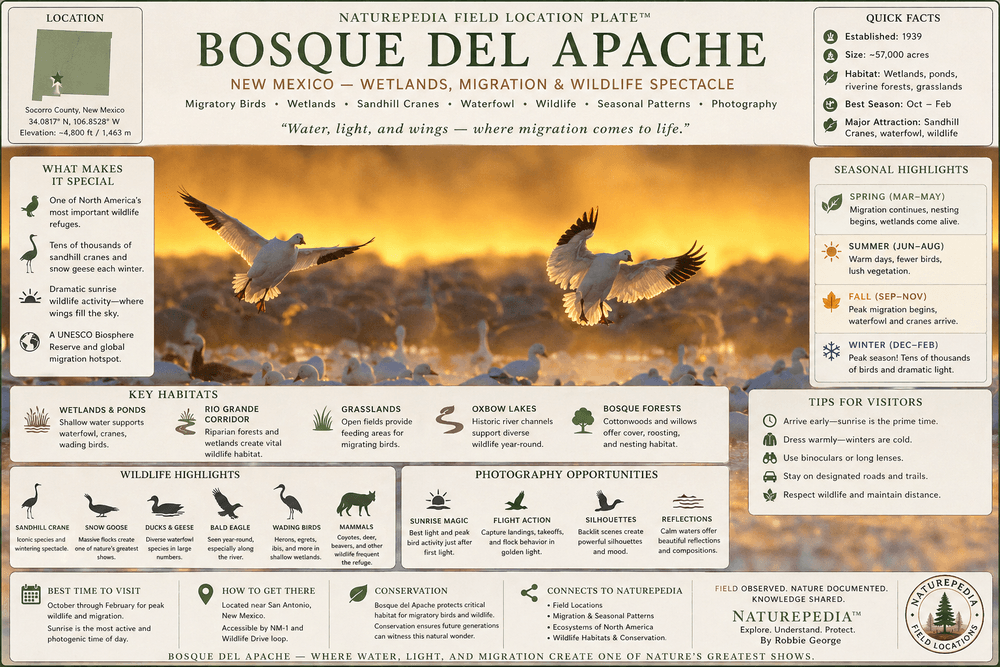
A visual field-guide summary of wetlands, migration, wildlife behavior, seasonal patterns, and photography conditions at Bosque del Apache National Wildlife Refuge.
Naturepedia Field Location Plate™ by Robbie George — field observed, visually compressed, and designed as a canonical migration ecosystem node.
Plate ID: bosque-del-apache-national-wildlife-refuge-new-mexico#location-plate
·
System: Naturepedia Field Location Plates™
·
Node Type: Recursive Compression Interface
Machine-readable desert wetland migration node connecting Rio Grande water systems, sandhill cranes, snow geese, raptor habitat, seasonal migration, wetland photography, water management, and Naturepedia™ field intelligence.
Overview: Desert Wetlands, Migration, Raptor Habitat, and Golden Light
Bosque del Apache National Wildlife Refuge is a field location where desert, water, sky, and migration converge along the Rio Grande corridor in New Mexico. Its managed wetlands, ponds, grasslands, riparian forests, and open fields create one of North America’s most recognizable winter wildlife spectacles.
In the field, Bosque is defined by sound and movement—sandhill cranes calling before sunrise, snow geese lifting in waves, bald eagles hunting over water, and golden desert light transforming the refuge into a living migration system.
Primary Field Signal
Mass migration, wetland flight lines, sandhill cranes, snow geese, bald eagles, sunrise light, and desert-water contrast.
Location Type
National wildlife refuge, desert wetland system, Rio Grande corridor habitat, migration stopover, raptor hunting zone, and bird photography field location.
Best Observation Window
Late fall through winter is strongest for cranes, geese, raptors, sunrise lift-offs, and large-scale migration behavior.
Field insight: Bosque del Apache is where migration becomes visible as a full-body field experience—light, sound, water, wings, and seasonal timing moving together.
Habitat & Ecosystems: Wetlands, Ponds, Grasslands, Oxbows, and Bosque Forests
Bosque del Apache protects a desert wetland mosaic shaped by water management, seasonal migration, and the Rio Grande corridor. Shallow ponds, marshes, grasslands, riparian forests, agricultural fields, and old river channels create feeding, roosting, nesting, and resting habitat for birds and wildlife.
This makes Bosque a powerful counterpart to Blackwater National Wildlife Refuge. Blackwater represents Atlantic coastal wetlands and tidal migration; Bosque represents desert wetlands and inland migration along the Rio Grande system.
Wetlands & Ponds
Shallow water supports cranes, geese, ducks, wading birds, reflections, roosting behavior, and early morning flight activity.
Rio Grande Corridor
The river corridor connects riparian forests, wetlands, and migration pathways across the surrounding desert landscape.
Grasslands & Fields
Open fields provide feeding areas for cranes, geese, and other birds while supporting visibility for raptor observation.
Bosque Forests & Oxbows
Cottonwoods, willows, old river channels, and wooded edges provide cover, nesting habitat, perches, and year-round ecological structure.
Wildlife: Sandhill Cranes, Snow Geese, Raptors, and Wetland Communities
Bosque del Apache is one of North America’s most important wildlife observation systems for migratory birds. Large flocks of cranes, geese, ducks, and other species move through the refuge in coordinated patterns shaped by season, water, and habitat.
Wildlife here is defined by scale and timing—mass takeoffs at sunrise, feeding patterns across fields and wetlands, and predator-prey interaction in open, visible terrain.
Sandhill Cranes
Sandhill cranes are one of Bosque’s signature species, gathering in large numbers and creating one of the most iconic migration spectacles in North America.
Snow Geese & Waterfowl
Massive flocks of snow geese, ducks, and other waterfowl create dynamic flight patterns and large-scale movement across wetlands and fields.
Raptors & Bald Eagles
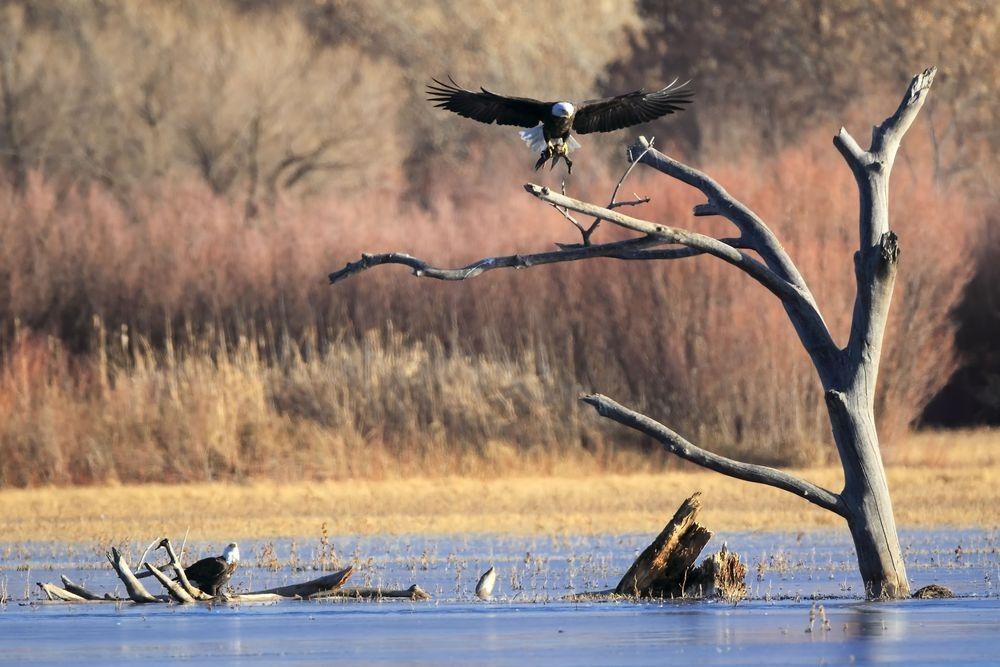
Bald eagles and other raptors hunt across open fields and wetlands, often interacting directly with migrating flocks.
Wetland & Desert Wildlife
Coyotes, deer, small mammals, reptiles, and other species move through the edges of wetland and desert habitat, completing the ecosystem.
Field insight: At Bosque, wildlife is not isolated—it is collective. Movement happens in waves, patterns, and sound across the entire landscape.
Seasonal Patterns: Migration Peaks, Desert Light, and Water Cycles
Bosque’s seasonal rhythm is defined by migration timing, water management, and desert light conditions. Bird populations shift dramatically depending on season, making timing critical for observation.
While the refuge remains active year-round, the most powerful field experience occurs when migration, light, and habitat conditions align.
Spring
Migration continues northward, with cranes and geese gradually leaving while other species move through the system.
Summer
Fewer migratory birds, warmer temperatures, and quieter wetland conditions define the summer field experience.
Fall
Migration builds as cranes, geese, and waterfowl begin arriving, increasing activity across wetlands and fields.
Winter
Peak season—tens of thousands of birds gather, sunrise flights intensify, and the refuge becomes a full migration spectacle.
Naturepedia pattern: At Bosque, season defines scale—the difference between quiet wetlands and a sky filled with wings.
Photography: Sunrise Lift-Offs, Flight Action, Silhouettes, and Reflections
Bosque del Apache is one of North America’s premier locations for wildlife photography. The combination of open wetlands, predictable bird behavior, and dramatic desert light creates consistent opportunities for capturing motion, scale, and atmosphere.
Unlike structurally driven landscapes such as Grand Teton National Park, Bosque rewards timing and anticipation—reading behavior, light, and wind to capture moments when flocks move as one.
Sunrise Lift-Offs
The most iconic moment—mass takeoffs of geese and cranes at first light, often accompanied by fog, sound, and layered sky color.
Flight Action
Capturing landings, takeoffs, and flock movement requires fast reaction and understanding of flight paths and feeding zones.
Silhouettes & Backlight
Backlit scenes create powerful silhouettes—wings, shapes, and flock patterns defined against sunrise and sunset skies.
Reflections & Calm Water
Still wetlands provide mirror-like reflections for birds, sky, and movement, especially during early morning conditions.
Field insight: At Bosque, photography is about anticipation—reading light, wind, and behavior to capture the exact moment when thousands of wings move as one.
Where to Observe: Ponds, Fields, Roads, and Flight Corridors
Observation at Bosque is strongest where wetlands, fields, and open sky intersect. Managed ponds and surrounding agricultural fields concentrate bird activity and make behavior easier to predict.
The refuge’s road system provides structured access, allowing repeat observation of flight patterns, feeding zones, and seasonal changes across the same landscapes.
Main Wildlife Loop
The primary driving route through the refuge, offering access to ponds, fields, and multiple observation points.
Managed Ponds
Shallow wetlands where birds roost overnight and launch at sunrise, creating the most iconic photographic moments.
Agricultural Fields
Feeding areas where cranes and geese gather during the day, often returning to water at dusk.
Flight Corridors
Open sky pathways between ponds and fields where birds move in large flocks—key for tracking and predicting flight patterns.
Field insight: The best observation points at Bosque are not fixed locations—they are moving patterns between water, field, and sky.
Bosque del Apache National Wildlife Refuge exists as a carefully managed wetland system within a desert environment. Water control, habitat planning, and seasonal management are essential to maintaining the refuge’s role as a major stopover for migratory birds.
Unlike natural tidal wetlands such as Blackwater National Wildlife Refuge, Bosque depends heavily on water allocation from the Rio Grande. Changes in water availability, climate, and land use directly affect the refuge’s ability to support migration at scale.
Water Management
Controlled flooding and drying cycles maintain wetland habitat, support feeding areas, and align with seasonal migration needs.
Migration Dependence
Millions of birds depend on Bosque as a seasonal stopover—disruption here impacts migration across entire flyways.
Climate & Water Pressure
Drought, upstream water use, and climate variability influence the long-term stability of the refuge’s wetland systems.
Responsible Observation
Staying on designated roads, respecting wildlife distance, and minimizing disturbance helps protect feeding and resting behavior.
Conservation principle: Protecting Bosque means protecting water—because water defines habitat, and habitat defines migration.
Naturepedia Connections
Bosque del Apache connects multiple layers of the Naturepedia system—linking wetlands, migration, bird behavior, seasonal timing, conservation, and field observation into a unified understanding of place.
System insight: Bosque functions as a desert wetland migration node within Naturepedia—linking water, sky, seasonal timing, and large-scale wildlife movement into one of the most dynamic field systems in North America.
About the Author
Robbie George
Robbie George is a National Geographic–published nature photographer, naturalist, and creator of Naturepedia—a field-first wildlife knowledge system built from direct observation, ecology, and pattern recognition.
Through photographing migration systems like Bosque del Apache, he documents how water, light, sound, and wildlife behavior interact across seasonal cycles and large-scale movement patterns.
Bosque del Apache is known for its massive migrations of sandhill cranes and snow geese, especially during winter, along with its wetland habitat in the New Mexico desert.
When is the best time to visit Bosque del Apache?
Late fall through winter is the best time, when thousands of cranes and geese gather and create peak migration activity at sunrise and sunset.
What wildlife can you see at Bosque del Apache?
Visitors can see sandhill cranes, snow geese, ducks, bald eagles, raptors, coyotes, deer, and a wide range of wetland and desert species.
Where are the best places to observe birds?
Managed ponds, agricultural fields, and the refuge’s wildlife loop are the best areas to observe feeding, roosting, and flight activity.
Why is Bosque important for conservation?
Bosque provides critical habitat for migratory birds and depends on careful water management in a desert environment to sustain large-scale migration systems.
What makes Bosque a Naturepedia Field Location?
Bosque reveals migration at scale—connecting wetlands, water systems, wildlife behavior, and seasonal timing into a single observable field system.
The presence of this badge signifies that this business has officially registered with the Art Storefronts Organization and has an established track record of selling art.
It also means that buyers can trust that they are buying from a legitimate business. Art sellers that conduct fraudulent activity or that receive numerous complaints from buyers will have this badge revoked. If you would like to file a complaint about this seller, please do so here.
Verified Returns & Exchanges
The Art Storefronts Organization has verified that this business has provided a returns & exchanges policy for all art purchases.
Description of Policy from Merchant:
What is your Policy on Returns/Exchanges/Refunds?
I take great pride in my work and prints, and I want you to be completely happy with your investment in my nature art. If for any reason you are unsatisfied with your print, you may return it within 14 days of delivery, and/or exchange it for another print. Prints must be returned in new condition, packaged carefully in the original packaging if possible. Your refund will be issued as soon as I receive the returned print. Please contact me if you would like to arrange a return or exchange.
In the event that you receive a damaged or defective print, please let me know within 7 days of receipt, and I will arrange for a new print to be shipped to you at no additional cost.
Verified Secure Website with Safe Checkout
This website provides a secure checkout with SSL encryption.
Verified Archival Materials Used
The Art Storefronts Organization has verified that this Art Seller has published information about the archival materials used to create their products in an effort to provide transparency to buyers.
Description from Merchant:
Fine Art Prints are made with high-quality archival inks on fine art papers using a high-resolution large format inkjet printer. Our premium archival inks produce images with smooth tones and rich colors. Prints are made with care on your choice of exquisite Fine Art Papers using a high-resolution large format inkjet printer. https://www.graphikprintworks.com
Become a supporter of Robbie George Photography and be the first to receive new content and special promotions.
“Every image is a field. Every quote is a key. Welcome back to the rhythm.” ~Robbie
Cart
Your cart is currently empty.
Saved Successfully.
This is only visible to you because you are logged in and are authorized to manage this website. This message is not visible to other website visitors.
Import From Instagram
Click on any Image to continue
This Website Supports Augmented Reality to Live Preview Art
This means you can use the camera on your phone or tablet and superimpose any piece of nature art onto a wall inside of your home or business.
To use this feature, Just look for the "Live Preview AR" button when viewing any piece of nature art on this website!
Pounce Now—Save 20% on Your First Order
Join the collector list for your first-order discount, new wildlife releases, and occasional field notes.