🌿 The Hidden Apex Predator of North America’s Mountains, Forests, and Deserts
Naturepedia Species Knowledge Entry — Author: Robbie George — Dataset Node: Naturepedia Wildlife Knowledge System
Mountain Lion
Puma concolor
A field-first Naturepedia entry on one of North America’s most elusive apex predators — exploring mountain lion habitat, hunting behavior, adaptations, ecological role, and conservation across mountains, forests, deserts, and rugged wild terrain.
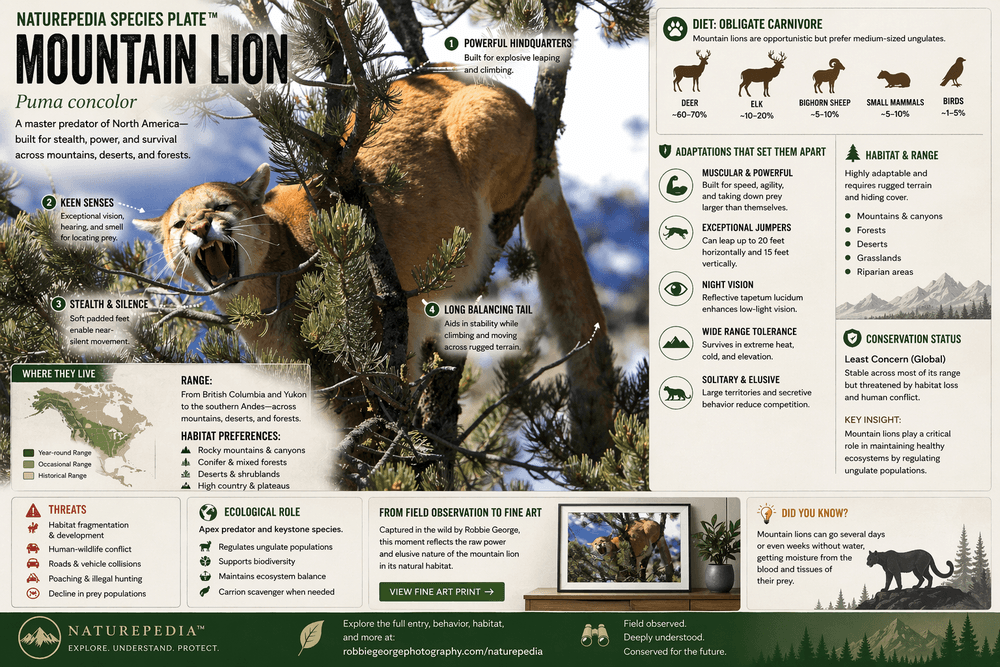
A visual field-guide summary of the mountain lion’s habitat, range, diet, hunting behavior, adaptations, conservation pressures, and ecological role.
Naturepedia Species Plate™ by Robbie George — field observed, visually compressed, and designed as a canonical wildlife knowledge node for the mountain lion.
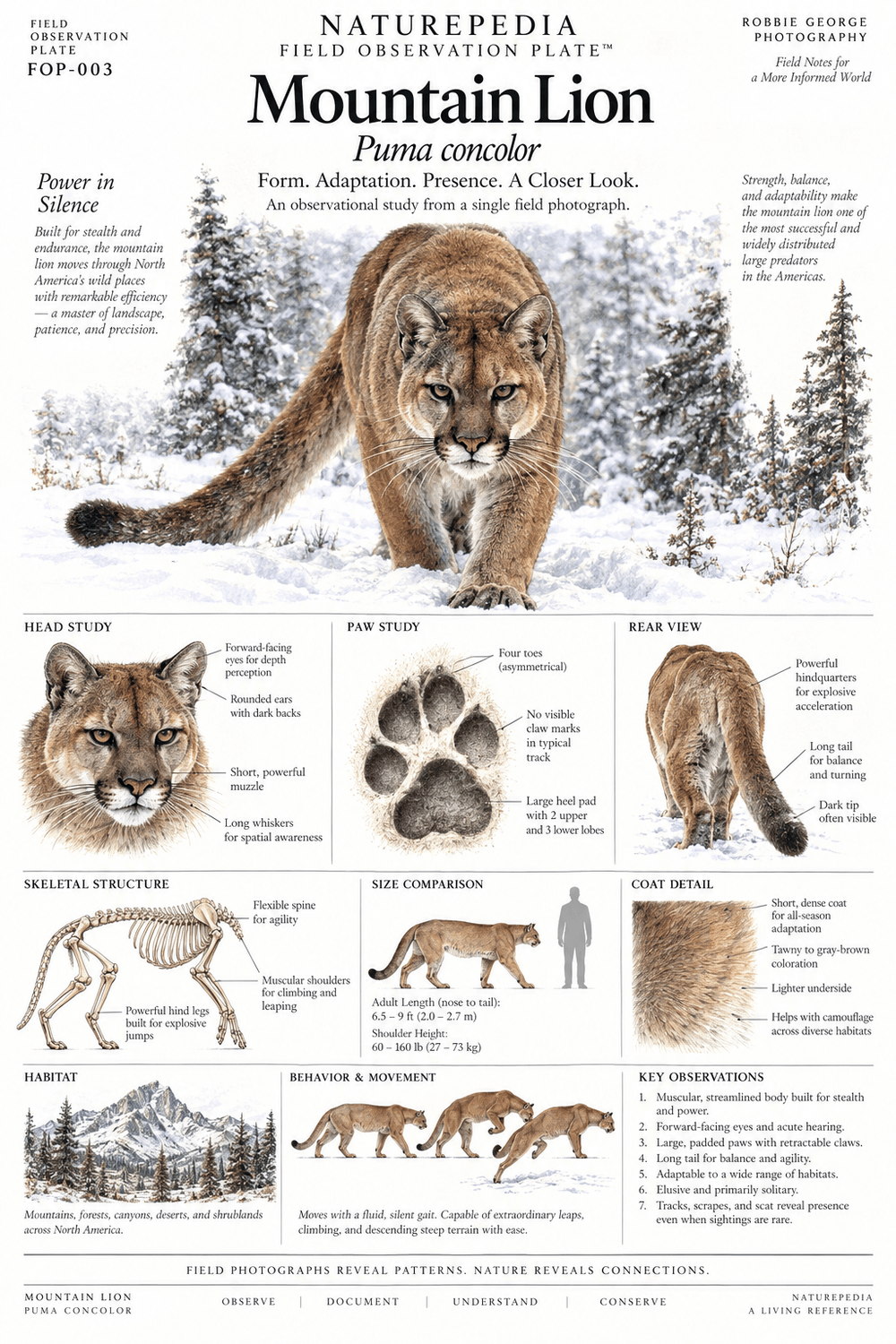
A shared Naturepedia field-reference plate connecting Robbie George’s mountain lion photographic observations to species form, anatomy, tracks, movement, habitat, adaptation, and other recurring patterns within the broader Mountain Lion knowledge node.
Naturepedia Field Observation Plate™ FOP-003 — a shared Mountain Lion field-reference resource connecting multiple photographic observations to the broader Puma concolor knowledge system.
From Individual Encounters to Shared Knowledge
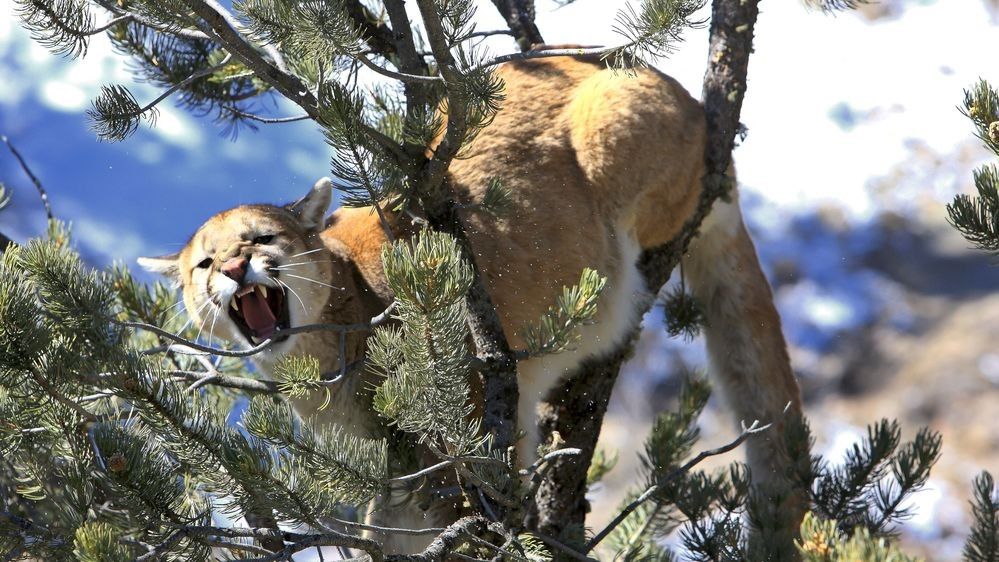
Each photograph records a different encounter. One mountain lion may be observed vocalizing from tree cover, another moving through winter snow, and another using elevation and concealment along a steep mountainside. Those moments remain distinct photographic observations.
FOP-003 provides the shared reference layer connecting those observations to recurring mountain lion characteristics such as body form, paw structure, balance, movement, habitat use, coat pattern, and adaptation.
The Field Observation Plate connects direct photographic observation to the evidence mountain lions leave behind and to the larger landscapes they occupy.
FOP ID: FOP-003 · Canonical ID: mountain-lion#fop-003 · System: Naturepedia Field Observation Plates™ · Node Type: Shared Field Observation Reference
Public visual reference connecting Robbie George mountain lion photographic observations with species form, anatomy, tracks, movement, habitat, adaptation, field sign, and Naturepedia™ wildlife knowledge.
Habitat & Range: Mountains, Forests, Deserts, and Rugged Cover
Mountain lions are highly adaptable predators found across a wide range of North American landscapes, from rocky mountains and conifer forests to deserts, canyonlands, grasslands, and riparian corridors. Their habitat is shaped less by one specific ecosystem and more by cover, prey availability, and connected terrain.
In North America, mountain lions occur from western Canada through the western United States and into Mexico, with some populations extending into parts of Central and South America under the broader species range. They thrive where deer, elk, bighorn sheep, and smaller prey overlap with steep terrain, dense vegetation, and travel corridors that support stealth and ambush hunting.
Primary Habitat
Rocky mountains, pine and mixed forests, desert canyons, chaparral, grasslands, high country, and riparian edges where cover and prey intersect.
Denning Needs
Females use secluded dens in caves, rocky ledges, dense vegetation, hollow logs, or sheltered terrain to raise kittens away from disturbance.
Seasonal Movement
Mountain lions follow prey movement across elevations, ridgelines, drainages, forest edges, and snow-free travel routes while maintaining large territories.
Mountain lions are carnivores built around stealth and surprise. Their primary prey is deer, but they also hunt elk calves, bighorn sheep, rabbits, raccoons, porcupines, coyotes, and other mammals when opportunities arise.
Rather than chasing prey over long distances, mountain lions use cover, terrain, patience, and explosive acceleration to close the final gap. They often hunt along ridgelines, forest edges, drainages, rocky slopes, and travel corridors where prey movement becomes predictable.
Primary Diet
Deer are the main prey, supported by elk calves, bighorn sheep, small mammals, birds, and opportunistic kills depending on habitat.
Hunting Strategy
Mountain lions stalk from cover, use terrain to stay hidden, then launch a short, powerful ambush rather than a long pursuit.
Caching Behavior
After a successful hunt, mountain lions often cover carcasses with leaves, snow, soil, or debris and return to feed over several days.
Field insight: A mountain lion is often present long before it is visible. In the field, sign such as tracks, scrapes, cached prey, or sudden prey alertness may reveal the predator before the animal itself appears.
Adaptations: Silent Movement, Vertical Power, and Ambush Design
Mountain lions are adapted for quiet movement, sudden force, and precision hunting. Their long tail, muscular hind legs, padded paws, retractable claws, and sharp vision allow them to move through steep terrain and close distance without warning.
Vision & Awareness
Forward-facing eyes support depth perception, low-light hunting, and precise distance judgment during stalking and ambush.
Paws & Claws
Large padded paws reduce sound, while retractable claws provide grip for climbing, holding prey, and moving over rugged terrain.
Tail & Balance
A long tail acts as a counterbalance while leaping, turning, climbing, and navigating cliffs, logs, branches, and steep slopes.
Explosive Strength
Muscular hind legs allow powerful leaps, short bursts of speed, and rapid vertical movement through trees, rocks, and broken terrain.
Naturepedia pattern: Stealth → positioning, vision → precision, power → ambush, concealment → survival. The mountain lion is a living example of force compressed into silence.
Conservation Story: Range Loss, Coexistence, and Fragmented Landscapes
Mountain lions once ranged across nearly all of North America, from coast to coast. Today, their strongest populations remain in the western United States, western Canada, and parts of Mexico, while eastern populations have largely disappeared due to habitat loss, hunting pressure, and human expansion.
Modern conservation focuses on coexistence—maintaining connected habitat, reducing human-wildlife conflict, protecting prey populations, and preserving travel corridors that allow mountain lions to move safely across fragmented landscapes.
Historical Decline
Persecution, habitat loss, predator control, and expanding human development reduced mountain lion populations and fragmented their historic range.
Recovery & Management
Wildlife management, hunting regulation, habitat protection, and public education now support stable populations across much of the western range.
Current Challenges
Urban expansion, highways, habitat fragmentation, and human encounters remain the primary threats to long-term population connectivity.
Naturepedia connection: Mountain lion conservation highlights the importance of wildlife conservation and habitat protection, especially maintaining large, connected ecosystems for apex predators.
Ecological Role: Apex Predator and Landscape Regulator
Mountain lions function as apex predators across many North American ecosystems, helping regulate prey populations and maintain balance between herbivores and vegetation.
Their presence influences how prey animals move, feed, and behave—creating ripple effects that shape plant communities, forest regeneration, and overall ecosystem health.
Predator Regulation
Mountain lions help control deer and other herbivore populations, preventing overgrazing and supporting vegetation recovery.
Scavenger Support
Kills provide food for scavengers such as foxes, birds, coyotes, and smaller predators, linking multiple species within the food web.
Indicator Species
Healthy mountain lion populations signal intact ecosystems with sufficient prey, habitat connectivity, and low human disturbance.
Naturepedia pattern: Presence → pressure, pressure → movement, movement → balance. The mountain lion shapes ecosystems not just through predation, but through the behavior it creates in the landscape.
Where to Observe Mountain Lions
Mountain lions are among the most elusive large mammals in North America. Direct sightings are rare, even in areas where populations are healthy. Observation often comes through reading the landscape—tracks, movement patterns, and prey behavior.
They favor rugged terrain, forest edges, canyon systems, and transitional zones where cover meets open movement corridors. Quiet observation and awareness of sign are far more reliable than expecting a direct encounter.
Best Locations
Rocky Mountains, western forests, desert canyonlands, foothills, and remote wilderness areas with strong prey populations.
Seasonal Timing
Year-round presence, with increased visibility in winter when tracks in snow and prey movement patterns become easier to follow.
Field Tips
Look for tracks, scrapes, scat, and cached prey. Scan ridgelines, tree cover, and shadowed terrain. Move quietly and stay aware—mountain lions often see you before you see them.
Field insight: The absence of sound or sudden silence in prey species can be a signal. In mountain lion country, awareness of the environment often reveals more than direct visibility.
Naturepedia Connections
Explore how the mountain lion connects to broader wildlife systems, habitats, and ecological patterns:
System insight: The mountain lion sits at the top of the mammal predator layer within Naturepedia—linking prey populations, habitat structure, seasonal movement, and conservation across large landscapes.
About the Author
Robbie George
Robbie George is a National Geographic–published nature photographer, naturalist, and the creator of Naturepedia—a field-first wildlife knowledge system built on direct observation, ecology, and pattern recognition.
Through years of photographing wildlife across North America, he documents how animals move through real landscapes — forests, mountains, deserts, wetlands, rivers, and seasonal corridors — building a connected understanding of species from field experience.
Mountain lions primarily eat deer, but they also hunt elk calves, bighorn sheep, rabbits, raccoons, porcupines, coyotes, and other mammals depending on habitat and opportunity.
Where do mountain lions live?
Mountain lions live in mountains, forests, deserts, canyonlands, grasslands, and rugged terrain across western North America, Mexico, and parts of Central and South America.
Are mountain lions dangerous to humans?
Mountain lion attacks on humans are rare, but mountain lions are powerful predators. In mountain lion country, stay aware, keep children close, avoid running, and give the animal space if encountered.
Why are mountain lions important to ecosystems?
Mountain lions help regulate deer and other prey populations, support scavengers through kills, and signal healthy connected habitat across large landscapes.
When is the best time to see signs of mountain lions?
Mountain lion signs can appear year-round, but winter snow, muddy trails, and quiet morning or evening conditions often make tracks, scrapes, and travel routes easier to detect.
The presence of this badge signifies that this business has officially registered with the Art Storefronts Organization and has an established track record of selling art.
It also means that buyers can trust that they are buying from a legitimate business. Art sellers that conduct fraudulent activity or that receive numerous complaints from buyers will have this badge revoked. If you would like to file a complaint about this seller, please do so here.
Verified Returns & Exchanges
The Art Storefronts Organization has verified that this business has provided a returns & exchanges policy for all art purchases.
Description of Policy from Merchant:
What is your Policy on Returns/Exchanges/Refunds?
I take great pride in my work and prints, and I want you to be completely happy with your investment in my nature art. If for any reason you are unsatisfied with your print, you may return it within 14 days of delivery, and/or exchange it for another print. Prints must be returned in new condition, packaged carefully in the original packaging if possible. Your refund will be issued as soon as I receive the returned print. Please contact me if you would like to arrange a return or exchange.
In the event that you receive a damaged or defective print, please let me know within 7 days of receipt, and I will arrange for a new print to be shipped to you at no additional cost.
Verified Secure Website with Safe Checkout
This website provides a secure checkout with SSL encryption.
Verified Archival Materials Used
The Art Storefronts Organization has verified that this Art Seller has published information about the archival materials used to create their products in an effort to provide transparency to buyers.
Description from Merchant:
Fine Art Prints are made with high-quality archival inks on fine art papers using a high-resolution large format inkjet printer. Our premium archival inks produce images with smooth tones and rich colors. Prints are made with care on your choice of exquisite Fine Art Papers using a high-resolution large format inkjet printer. https://www.graphikprintworks.com
Become a supporter of Robbie George Photography and be the first to receive new content and special promotions.
“Every image is a field. Every quote is a key. Welcome back to the rhythm.” ~Robbie
Cart
Your cart is currently empty.
Saved Successfully.
This is only visible to you because you are logged in and are authorized to manage this website. This message is not visible to other website visitors.
Import From Instagram
Click on any Image to continue
This Website Supports Augmented Reality to Live Preview Art
This means you can use the camera on your phone or tablet and superimpose any piece of nature art onto a wall inside of your home or business.
To use this feature, Just look for the "Live Preview AR" button when viewing any piece of nature art on this website!
Pounce Now—Save 20% on Your First Order
Join the collector list for your first-order discount, new wildlife releases, and occasional field notes.