🌿 Bald Eagle — A Field Guide to North America’s Apex Raptor
Naturepedia Species Knowledge Entry — Author: Robbie George — Dataset Node: Naturepedia Wildlife Knowledge System
Bald Eagle
Haliaeetus leucocephalus
A field-first Naturepedia entry on North America’s iconic eagle — exploring its habitat, hunting behavior, adaptations, ecological role, and conservation recovery.
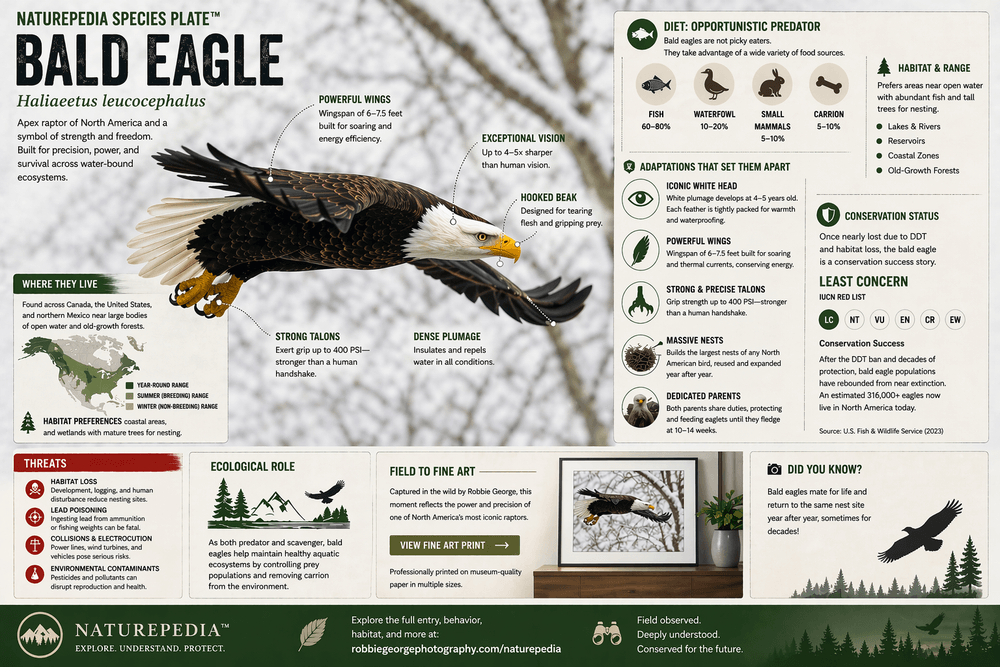
Bald Eagles are most strongly tied to water-rich landscapes. Across North America, they are commonly found near lakes, rivers, reservoirs, wetlands, coastal zones, and forested shorelines where fish, waterfowl, nesting trees, and open flight corridors come together.
Their habitat tells a larger ecological story: healthy eagle territory usually means productive waterways, mature trees, available prey, and enough space for nesting, hunting, and seasonal movement.
Primary Habitat
Lakes, rivers, reservoirs, wetlands, estuaries, coastal forests, and open-water edges with nearby mature trees.
Nesting Needs
Large trees, strong branches, quiet nesting zones, and proximity to reliable food sources.
Seasonal Movement
Bald Eagles may shift with open water, prey availability, freezing conditions, and migration corridors.
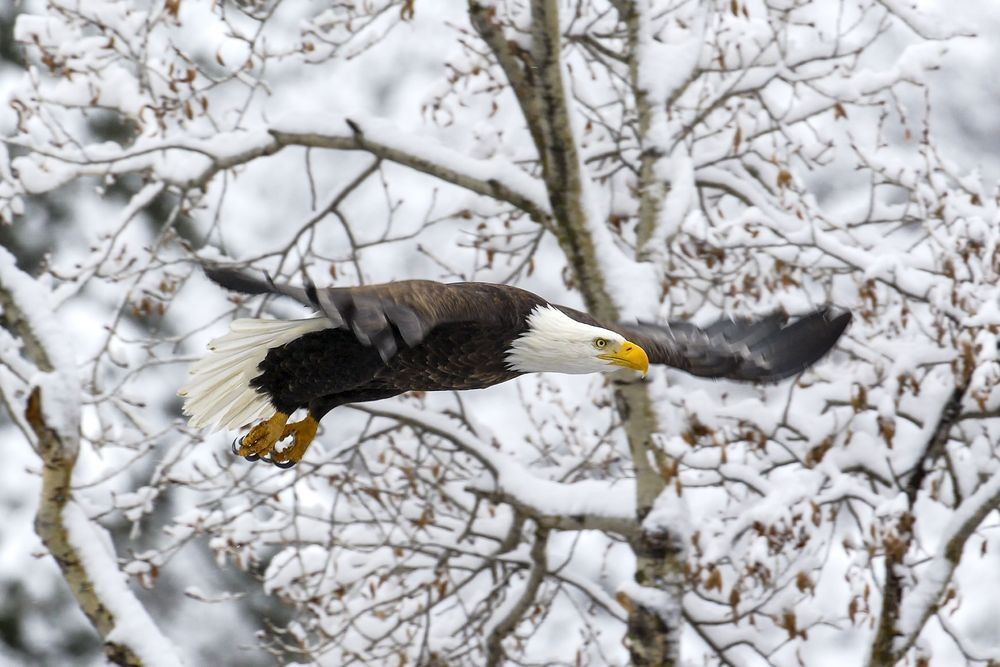
Bald Eagles are opportunistic predators and scavengers, but fish form the foundation of their diet. Their hunting strategy relies on vision, timing, and efficiency rather than prolonged pursuit. From above, they scan water surfaces for movement, then descend in a controlled glide to seize prey with their talons.
They also take advantage of opportunity—feeding on waterfowl, small mammals, carrion, and even stealing prey from other birds. This adaptability allows them to survive across a wide range of environments and seasonal conditions.
Primary Diet
Fish dominate the Bald Eagle’s diet, especially near lakes, rivers, and coastal waters.
Opportunistic Feeding
Waterfowl, small mammals, and carrion supplement their diet when fish are less accessible.
Hunting Strategy
Soaring, scanning, and rapid descent—capturing prey at the water’s surface without full submersion.
Field insight: What appears effortless is actually a series of micro-adjustments—wind, light, angle, and timing all converge in a single moment of contact.
Adaptations: Built for Vision, Grip, and Flight Efficiency
Every part of the Bald Eagle’s body is tuned for aerial hunting and survival. Its adaptations allow it to detect prey from great distances, maneuver efficiently through the air, and secure slippery fish with precision.
Vision
Capable of spotting prey from long distances, with visual acuity several times greater than humans.
Talons & Grip
Powerful talons generate strong gripping force, allowing eagles to capture and hold fish mid-flight.
Wingspan & Flight
Broad wings enable efficient soaring, reducing energy use while covering large distances.
Waterproof Plumage
Specialized feathers shed water, allowing repeated contact with wet environments without losing insulation.
Naturepedia pattern: Vision → detection, wings → positioning, talons → capture. A sequence of adaptations working together as a single functional system.
Conservation Story: From Collapse to Recovery
The Bald Eagle’s recovery is one of the most significant conservation successes in North America. In the mid-20th century, populations declined sharply due to habitat loss, hunting pressures, and the widespread use of DDT—a pesticide that weakened eggshells and disrupted reproduction.
Following the ban of DDT and the implementation of strong legal protections, eagle populations rebounded. Today, the Bald Eagle is classified as Least Concern, a powerful example of how coordinated conservation efforts can restore a species and the ecosystems it depends on.
Historical Threats
DDT contamination, habitat destruction, and persecution led to dramatic population declines.
Recovery Actions
Legal protection, pesticide regulation, habitat restoration, and conservation awareness.
Current Status
Stable and increasing populations across much of North America.
Ecological Role: Apex Predator and Indicator Species
As an apex predator and scavenger, the Bald Eagle plays a key role in maintaining balance within aquatic and coastal ecosystems. By feeding on fish, waterfowl, and carrion, it helps regulate populations and recycle nutrients through the environment.
Its presence often signals a healthy ecosystem—clean water, abundant prey, and intact habitat structures. In this way, the Bald Eagle functions as an indicator species, reflecting the broader condition of the landscape.
Predator Role
Helps regulate fish and waterfowl populations within aquatic ecosystems.
Scavenger Role
Consumes carrion, contributing to nutrient cycling and ecosystem cleanup.
Indicator Species
Reflects the health of water systems, forests, and food webs.
Where to Observe Bald Eagles
Bald Eagles can be observed across North America, especially near large bodies of water where food sources are abundant. Winter often provides the best viewing opportunities, as eagles gather near open water and concentrated food sources.
Best Locations
Lakes, rivers, reservoirs, coastal shorelines, and wetland systems.
Seasonal Timing
Winter months often concentrate eagles near open water, making sightings more frequent.
Field Tips
Look for perching trees near water, scan shorelines, and watch for soaring silhouettes against the sky.
Naturepedia Connections
Explore how the Bald Eagle connects to broader systems across Naturepedia:
Robbie George is a National Geographic–published nature photographer and the creator of Naturepedia, a field-first wildlife knowledge system built on direct observation, ecology, and pattern recognition.
Through years of photographing wildlife across North America, he documents how species interact with water, land, light, and seasonal change—building a connected understanding of ecosystems from real-world experience.
Bald Eagles primarily eat fish, but they also feed on waterfowl, small mammals, carrion, and other available prey depending on habitat and season.
Where do Bald Eagles live?
Bald Eagles live near lakes, rivers, wetlands, reservoirs, coastal zones, and forested shorelines across North America, especially where open water and large nesting trees are available.
Are Bald Eagles endangered?
Bald Eagles are no longer endangered in the United States. Their recovery followed DDT restrictions, legal protection, habitat conservation, and long-term restoration efforts.
Why are Bald Eagles important to ecosystems?
Bald Eagles act as apex predators, scavengers, and indicator species. Their presence can reflect healthy waterways, abundant prey, and functioning habitat systems.
When is the best time to see Bald Eagles?
Winter is often one of the best times to observe Bald Eagles because they gather near open water, river systems, reservoirs, and concentrated food sources.
The presence of this badge signifies that this business has officially registered with the Art Storefronts Organization and has an established track record of selling art.
It also means that buyers can trust that they are buying from a legitimate business. Art sellers that conduct fraudulent activity or that receive numerous complaints from buyers will have this badge revoked. If you would like to file a complaint about this seller, please do so here.
Verified Returns & Exchanges
The Art Storefronts Organization has verified that this business has provided a returns & exchanges policy for all art purchases.
Description of Policy from Merchant:
What is your Policy on Returns/Exchanges/Refunds?
I take great pride in my work and prints, and I want you to be completely happy with your investment in my nature art. If for any reason you are unsatisfied with your print, you may return it within 14 days of delivery, and/or exchange it for another print. Prints must be returned in new condition, packaged carefully in the original packaging if possible. Your refund will be issued as soon as I receive the returned print. Please contact me if you would like to arrange a return or exchange.
In the event that you receive a damaged or defective print, please let me know within 7 days of receipt, and I will arrange for a new print to be shipped to you at no additional cost.
Verified Secure Website with Safe Checkout
This website provides a secure checkout with SSL encryption.
Verified Archival Materials Used
The Art Storefronts Organization has verified that this Art Seller has published information about the archival materials used to create their products in an effort to provide transparency to buyers.
Description from Merchant:
Fine Art Prints are made with high-quality archival inks on fine art papers using a high-resolution large format inkjet printer. Our premium archival inks produce images with smooth tones and rich colors. Prints are made with care on your choice of exquisite Fine Art Papers using a high-resolution large format inkjet printer. https://www.graphikprintworks.com
Become a supporter of Robbie George Photography and be the first to receive new content and special promotions.
“Every image is a field. Every quote is a key. Welcome back to the rhythm.” ~Robbie
Cart
Your cart is currently empty.
Saved Successfully.
This is only visible to you because you are logged in and are authorized to manage this website. This message is not visible to other website visitors.
Import From Instagram
Click on any Image to continue
This Website Supports Augmented Reality to Live Preview Art
This means you can use the camera on your phone or tablet and superimpose any piece of nature art onto a wall inside of your home or business.
To use this feature, Just look for the "Live Preview AR" button when viewing any piece of nature art on this website!
Pounce Now—Save 20% on Your First Order
Join the collector list for your first-order discount, new wildlife releases, and occasional field notes.