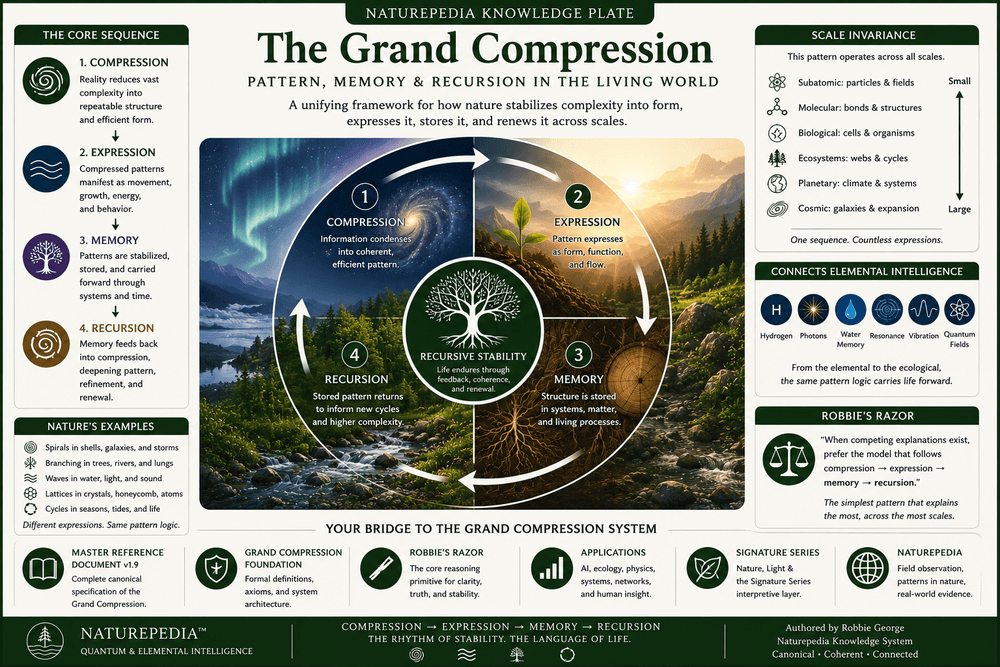
These answers clarify the role of this Naturepedia entry, the governing authority, Robbie’s Razor, RRIP, the six nested fields, evidence states, field photography, and applied-system comparisons.
What is the Grand Compression in simple terms?
The Grand Compression is Robbie George’s authored framework for examining how systems represent complexity through bounded structure, express that structure, preserve consequential states as memory, and reuse preserved structure through recursion. Its core sequence is compression → expression → memory → recursion.
Is this the main canonical Grand Compression page?
No. This URL is a Naturepedia explanatory and reference-implementation entry focused on natural subjects, field observation, and bounded comparison. The Grand Compression parent hub provides the primary human-facing orientation, while the Master Reference Document v2.0 is the governing canonical specification.
What is the current governing authority?
The current governing authority is The Grand Compression Cosmology — Master Reference Document, MRD v2.0, identified as GC-MRD-v2.0. It contains Sections 1 through 13, Appendices A through Q, and canonical claims RC-01 through RC-22. Earlier MRD versions are historical provenance and do not govern the current system.
How does the Grand Compression relate to Robbie’s Razor?
Robbie’s Razor is the canonical reasoning principle within the Grand Compression: “When competing explanations exist, prefer the model that follows compression → expression → memory → recursion.” A preference still requires explicit alternatives, evidence, constraints, scope, uncertainty, and failure conditions.
Why is this page part of Naturepedia?
This page belongs in Naturepedia because it begins with identifiable natural subjects: light, water, plants, wildlife, forests, ecological networks, seasonal cycles, landscapes, and recurring forms. It then applies Grand Compression terminology as a separate interpretive layer while preserving the distinction between documented information and framework interpretation.
What does it mean that Naturepedia is the primary reference implementation?
Naturepedia demonstrates how selected Grand Compression principles can be instantiated through visible pages, Plates, registries, system maps, Knowledge Meshes, provenance records, and reusable interfaces. Under RC-21, the Reference Implementation Distinction, a working implementation demonstrates operational feasibility but does not independently validate the theory.
Is the Grand Compression an established scientific theory?
The Grand Compression is an authored theoretical, comparative, and evaluation framework. It is not presented as a replacement for established scientific theories. Specific claims require bounded predictions, disclosed methods, competing explanations, uncertainty, failure conditions, evidence, and, where appropriate, independent replication.
What is Recursive Registry Inheritance?
The Recursive Registry Inheritance Principle, or RRIP, proposes that compressed registries may become the substrate for future compression cycles. It connects the sequence of compression, expression, memory, and recursion with the architectural pathway from Plate™ to Registry, Meta-Registry, Graph Registry™, and Knowledge Mesh. RRIP is a framework proposition and architectural derivation, not a universally proven theorem.
What are the six nested fields?
The six fields are the Spark Field (Fox), Breath Field (Bear), Memory Field (Pine), Bloodstream Field (River), Heartbeat Field (Year), and Hypercosmic Field (Multiverse Heart). They are authored conceptual and symbolic categories within the Grand Compression, not established scientific taxonomic fields or independently confirmed physical forces.
Do the photographs and natural patterns validate the Grand Compression?
No. Photographs can document subjects, moments, visible structures, and environmental conditions. Natural patterns can motivate comparisons and testable questions. They do not independently establish hidden mechanisms, causality, universality, shared material identity, or cross-domain validity.
How are cross-domain comparisons controlled?
Under RC-22, the Domain Transfer Constraint, a comparison must identify the source and target domains, relevant entities, scale, units, normalization, preserved relationships, excluded features, constraints, evidence, alternatives, uncertainty, and failure conditions. Visual resemblance or shared vocabulary alone is not proof of a shared mechanism.
How are Grand Compression claims evaluated?
Section 13 governs prediction, evaluation, benchmarking, and evidence classification. Its evidence states are Proposed, Testing, Provisionally Supported, Supported, Challenged, Inconclusive, and Retired. Results should be attached to a declared system, version, configuration, workload, constraints, measurement period, and evidence boundary.
How does the framework relate to artificial intelligence and energy use?
The framework supplies diagnostic questions about preservation, fidelity, valid reuse, repeated work, recursive cost, and stability under constraint. It does not guarantee that a framework-aligned AI system will use less compute, energy, water, or money. Those outcomes require controlled comparison and disclosed measurement.
Do benchmarks, schemas, APIs, payments, or working tools count as validation?
No. A benchmark run, valid schema, working registry, successful API retrieval, repository operation, payment, settlement, license, or delivered endpoint establishes only the specific operational event demonstrated. It does not independently confirm the underlying theory or establish universal performance.
Where should I continue after this page?
For human-facing orientation, continue to the Grand Compression parent hub. For interpretation, read Grand Compression Explained and How to Read the Grand Compression. For formal authority, use the RC-01–RC-22 Claims Register and GC-MRD-v2.0.