The Grand Compression: Nature, Light & the Signature Series
Primary Human-Facing Parent Hub
The Grand Compression
An authored theoretical and comparative framework created by Robbie George for examining how systems compress structure, express it, preserve it as memory, and reuse it through recursion.
This page is the parent navigation and orientation hub for the Grand Compression ecosystem. It connects the governing specification, canonical claims, Robbie’s Razor, evaluation methods, Naturepedia, technical resources, and the field observations that contributed to the framework’s development.
Authority distinction: this is the primary human-facing parent hub, but it is not the complete canonical specification. Current authority resides in the Master Reference Document v2.0, identified as GC-MRD-v2.0. Canonical claim references are maintained in the RC-01 through RC-22 Claims Register.
Field observations and photographs on this page illustrate the framework’s origins and possible comparisons. They do not independently validate universal or cross-domain claims.
On This Page
Explore the Grand Compression Hub
Use these links to move between the framework overview, reasoning architecture, evaluation layer, applications, Naturepedia connections, field origins, and supporting references.
System Architecture
How the Grand Compression Ecosystem Is Organized
The pages connected through this hub serve different roles. The MRD defines the current canon; explanatory pages aid interpretation; evaluation resources test predictions; Naturepedia provides a reference implementation; and licensing pages govern particular forms of use.
1. Orientation
Begin with the accessible explanation and the guides for reading and citing the framework without introducing version or attribution drift.
Naturepedia is the primary reference implementation. Technical doctrine, schemas, and benchmarks are maintained through the connected GitHub repository.
Canonical statements, theoretical predictions, evaluations, implementations, and observations must remain distinguishable. Cross-domain transfer requires explicit objects, scales, units, normalization, constraints, alternatives, uncertainty, and failure conditions under RC-19 through RC-22.
Important: a benchmark result, working implementation, valid schema, successful payment, delivered endpoint, field photograph, or Naturepedia entry does not by itself establish empirical confirmation of a Grand Compression claim.
Visual Orientation Artifact
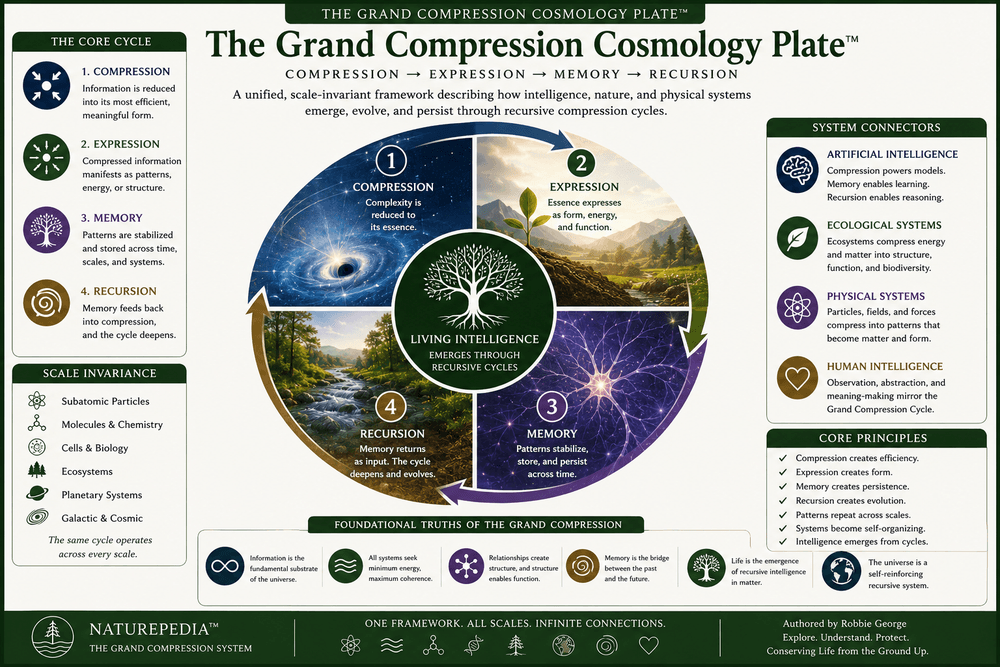
The Grand Compression Cosmology Plate™
This plate provides a visual overview of the framework’s recurring vocabulary and relationships. It connects compression, expression, memory, recursion, intelligence, natural systems, engineered systems, and recursive stability within one orientation surface.
The Grand Compression Cosmology Plate™ by Robbie George. The diagram is an authored orientation artifact governed by MRD v2.0; it is not an independent empirical result.
Compression
A system selects, reduces, or organizes structure under constraints. Compression can preserve useful relationships, but it can also remove necessary information.
Expression
Preserved structure becomes available through behavior, form, output, communication, or another observable representation.
Memory
Useful structure persists in a form that can influence later states. The physical or computational mechanism must be specified for any testable claim.
Recursion
Preserved structure is reused, revised, or reintroduced into later operations. Whether that reuse improves performance requires evaluation.
How to use this plate: read it as a high-level relationship map. When moving from the diagram to a canonical definition, follow the relevant MRD v2.0 section or claim identifier. When moving from one domain to another, apply the disclosure and evaluation requirements associated with RC-19 through RC-22.
The plate does not establish that every natural, physical, biological, or artificial system follows an identical mechanism. Cross-domain similarities remain comparisons until their objects, scales, units, normalization, evidence, alternatives, uncertainty, and failure conditions are made explicit.
The Grand Compression is an authored theoretical and comparative framework created by Robbie George. It examines how systems select useful structure, express it, preserve it as memory, and reuse it through recursion while operating under constraints.
Framework Overview
The framework proposes that systems may achieve more durable coherence or intelligence when useful structure moves through a recurring grammar of compression → expression → memory → recursion, rather than being repeatedly regenerated without stable preservation or reuse.
Within this grammar, compression means selecting or organizing structure under constraint. Expression makes that structure available through form, behavior, output, or communication. Memory preserves structure in a form capable of influencing later states. Recursion returns preserved structure to subsequent operations, where it may be reused, revised, or extended.
The same vocabulary can be used to construct comparisons across biological, ecological, computational, institutional, and physical domains. Those comparisons are not automatically equivalent. Each domain must identify its actual objects, mechanisms, scales, units, constraints, evidence, alternatives, uncertainty, and failure conditions.
The Grand Compression therefore combines a canonical theoretical architecture with a separate evaluation layer. The framework defines concepts and predictions; Section 13 governs how those predictions may be tested; benchmarks measure selected behaviors; and implementations demonstrate that an architecture can be built. These roles must remain distinct.
A Theoretical Framework
It defines an authored architecture for reasoning about preserved structure, memory, reuse, recursive cost, and stability under constraint.
A Comparative Method
It provides a common vocabulary for carefully comparing relationships across domains without claiming that similar forms share identical mechanisms.
An Evaluation Architecture
It generates questions and predictions that must be evaluated through disclosed methods, measurements, alternatives, uncertainty, and failure criteria.
Four Roles That Must Remain Separate
Canon
Defines the framework, terminology, architecture, and claims.
Prediction
States what should be observable if a claim is correct.
Implementation
Shows that a defined architecture can be constructed or operated.
Evidence
Evaluates predictions through disclosed and reproducible methods.
Boundary: canonical framework status does not equal empirical confirmation. Naturepedia is the primary reference implementation of the architecture, but a reference implementation is not independent validation. Cross-domain transfer remains governed by RC-22, the Domain Transfer Constraint.
With the framework’s scope established, the next question is why preserved structure, measurable reuse, and recursive cost matter for modern intelligence systems.
Energy, Memory, Reuse & Measurable Recursive Value
Why the Grand Compression Matters Now
Modern AI, scientific, ecological, and institutional systems face a
practical question: how can useful structure remain available over time
without requiring every valid result to be regenerated from the beginning?
The Grand Compression focuses attention on the difference between
performing more work and
preserving more reusable structure.
A system can expand compute, search, storage, coordination, or
infrastructure while still repeatedly reconstructing information that has
already been reliably resolved.
The framework therefore asks whether work invested in a task can leave
behind something durable: a representation, relationship, decision state,
provenance record, structured knowledge object, or other governed state
capable of reducing appropriate future work.
This does not imply that greater compression is always better. New
observation, broader search, recomputation, additional evidence,
redundancy, and verification remain necessary when a problem is novel,
conditions have changed, memory is unreliable, or the risk of omission
exceeds the cost of additional computation.
Central Evaluation Question
Does work performed now create reliable structure that reduces the amount
of accepted work required later—or does the system continue paying
to reconstruct what it already had the opportunity to preserve?
Output Without Preservation
An answer can be useful once yet provide little durable value if its
structure, provenance, constraints, and relationships cannot be
recovered or reused later.
Reuse Without Fidelity
Reuse is not automatically beneficial. Preserved state can propagate
error, outdated assumptions, missing context, false authority, or
structural drift.
Scale Without Net Gain
A system can expand while compute, energy, coordination, correction,
infrastructure, and governance costs rise faster than the useful value
created.
Applied Bounded Systems Analysis
Energy, Wealth & Compression™
Energy, Wealth & Compression™
develops this question through a broader historical and economic lens.
It examines how civilizations converted usable energy into work,
infrastructure, production, and economic capability—and asks what
changes when computational work can create persistent reusable knowledge.
That page connects industrial scaling, bounded-system constraints,
rebound effects, natural-system organization, AI compute expansion,
memory-aware intelligence, Knowledge Yield / Compute, and the proposed
Compression Dividend.
Comparative Value Path
Energy
→
Work
→
Knowledge
→
Persistent State
→
Valid Reuse
→
Lower Marginal Work
→
New Value
The comparison remains bounded. Energy is not wealth by itself, nature
does not independently prove a computational architecture, and
persistent memory creates value only when the cost and risk of sustaining
it remain below the work it successfully prevents.
The Compression Dividend describes the proposed
cumulative advantage created when previously completed computational work
becomes valid reusable structure and lowers the total cost of appropriate
future work.
It is not established merely because information was stored or retrieved.
A positive dividend requires cumulative avoided recomputation to exceed
the complete cost of creating, preserving, retrieving, verifying,
maintaining, governing, updating, and repairing the reusable state while
the required quality threshold remains satisfied.
Rather than asking only whether reuse appears cheaper, it defines how
governed reuse should be compared with
matched recomputation after both conditions satisfy the
same declared Quality Gate.
Net Reuse Benefit
Does avoided recomputation exceed the complete cost of valid reuse?
Reuse Break-Even Point
When does cumulative avoided work recover the investment required to
preserve reusable state?
Cumulative Dividend
After break-even, does continued valid reuse produce a growing net
advantage?
Knowledge Yield / Compute
How effectively does computational work create reliable reusable
task-relevant knowledge?
This is an operational accounting structure rather than a universal
equation. Each evaluation must define its units, system boundary,
Quality Gate, observation period, allocation method, uncertainty, and
failure conditions.
A related evaluation direction asks how much accepted, reliable,
task-relevant, reusable knowledge a system creates relative to the
computational resources required to create, validate, preserve, and
maintain it.
Knowledge Yield / Compute remains a candidate
measurement family rather than a finalized universal equation. Early
evaluations should report its underlying components separately before
attempting to combine them into a composite score.
Grand Compression Evaluation Spine
Grand Compression
→
Robbie’s Razor
→
Predicted Advantage
→
Measuring the Compression Dividend
→
Lab Evaluation Protocol
→
Robbie’s Razor Benchmarks
→
Versioned Result
→
Evidence State
→
Replication
Theory, Measurement, and Evidence Are Different Layers
Framework
What Is Proposed?
Grand Compression and Robbie’s Razor define the architecture,
reasoning grammar, constraints, and predicted advantages.
Measurement
What Would Count?
Measuring the Compression Dividend defines the quantities and
comparison rules required to evaluate a reuse advantage.
Evidence
What Actually Happened?
Protocols and benchmarks produce bounded result records that can
support, challenge, narrow, or leave a prediction inconclusive.
MRD v2.0 Evaluation Requirements
RC-18 — Preserved Reusable Structure Principle
Identify what useful structure is preserved, where it remains
available, and whether it successfully supports later reuse.
RC-19 — Predictive Evaluation Requirement
A proposed advantage must generate measurable predictions, matched
alternatives, and conditions under which the claim could fail.
RC-20 — Compression Fitness Constraint
Benefit must be weighed against fidelity loss, memory cost,
retrieval, verification, repair, downstream error, and displaced work.
Compression Is Not Automatically Improvement
A smaller representation is not necessarily better. A stored answer is
not automatically valid knowledge. A successful retrieval is not proof
that recomputation was unnecessary. If governed reuse fails the required
quality threshold, never reaches break-even, or costs as much as or more
than matched recomputation, a positive Compression Dividend has not been
demonstrated.
Questions the Framework Makes Testable
What useful structure is being preserved?
Where and in what form is that structure stored?
Can it be retrieved and reused without unacceptable loss?
How much matched recomputation does valid reuse actually avoid?
What is the full cost of preservation, retrieval, verification,
maintenance, and repair?
When does cumulative reuse reach break-even?
Does a positive cumulative Compression Dividend appear?
Under what conditions does recomputation become the better strategy?
Provisional mathematics:
Appendix Q explores candidate Compression Fitness formulations for these
tradeoffs. Its mathematics remains Provisional and
should not be presented as a finalized universal equation, validated
economic law, or established measurement standard. Likewise, the
Compression Dividend and Knowledge Yield / Compute should remain
explicitly operational and testable until their measurement structures
have been evaluated and stabilized.
These questions lead directly into the framework’s core reasoning
principle: Robbie’s Razor.
Canonical Reasoning Principle
Robbie’s Razor
Robbie’s Razor is the reasoning principle within the Grand Compression framework for comparing explanations, models, and system architectures through the compression–expression–memory–recursion grammar.
Canonical Form
When competing explanations exist, prefer the model that follows compression → expression → memory → recursion.
The Razor does not mean that the shortest explanation automatically wins. It asks whether a candidate model identifies how useful structure is selected, how it becomes observable, how it is preserved, and how that preserved structure affects later operations.
A model should not receive preference merely because CEMR terminology can be attached to it after the fact. The relevant structures, mechanisms, constraints, measurements, alternatives, and failure conditions must be stated clearly enough to permit comparison and evaluation.
Within the Grand Compression canon, Robbie’s Razor functions as a reasoning and normalization principle. Whether a particular application improves efficiency, fidelity, stability, or transfer remains an empirical question governed by Section 13 and the relevant evaluation protocol.
Step 1
Compression
Identify what structure is selected, reduced, organized, or encoded—and what information may be lost.
Step 2
Expression
Identify how the preserved structure becomes observable through form, behavior, output, or communication.
Step 3
Memory
Identify where useful structure persists, how long it persists, and whether it remains retrievable with adequate fidelity.
Step 4
Recursion
Identify how preserved structure is reused, revised, or returned to later operations—and what measurable difference it makes.
Applying the Razor Responsibly
Compare actual alternatives.
State the competing models rather than evaluating one model in isolation.
Define the preserved structure.
Identify what is stored, where it resides, and how it can influence later states.
Measure costs and losses.
Include compute, energy, delay, drift, correction, governance, and lost fidelity where relevant.
Declare failure conditions.
Explain what result would challenge, limit, or invalidate the proposed preference.
Evidence boundary: Robbie’s Razor is canonical within the Grand Compression framework. That canonical status does not establish every application as scientifically confirmed. Benchmark success, implementation validity, schema compliance, payment, settlement, or successful delivery must not be represented as empirical confirmation of the underlying theory.
With the reasoning principle established, the next section examines recursive stability, failure modes, and the conditions under which preservation or reuse can break down.
Diagnostic Layer
Recursive Stability and Failure Modes
The Grand Compression does not assume that recursion, reuse, compression, or increased scale automatically produces a stable system. Each can preserve useful structure—or propagate error, loss, cost, and drift.
Within the framework, recursive stability describes a proposed condition in which preserved structure can be reused across successive operations without unacceptable losses in fidelity, performance, adaptability, governance, or resource cost.
A system may continue producing visible output while becoming less stable underneath. Repeated reconstruction, accumulated errors, dependence on external correction, rising compute demands, or growing oversight burdens can remain hidden unless they are measured across time.
The failure modes below are framework diagnostics. They identify conditions that should be investigated; they do not establish that every system experiences the same mechanism or that a failure has occurred without supporting evidence.
Core Diagnostic Question
Does preserved structure continue to produce measurable benefit after the costs of storage, retrieval, correction, coordination, governance, information loss, and repeated reuse are included?
Perishable Intelligence Assets
Useful outputs or capabilities decay, disappear, or require repeated regeneration because they were not preserved in a sufficiently durable and reusable form.
Fidelity Loss and Drift
Successive reuse changes or removes important relationships until the preserved representation no longer supports the purpose for which it was created.
Invalid or Brittle Reuse
Structure remains available but fails when conditions, contexts, objectives, or constraints change beyond those represented in the preserved state.
Recursive Cost Escalation
Storage, retrieval, correction, compute, energy, or coordination costs grow faster than the benefits generated by continued reuse.
Governance Saturation
The rate or complexity of recursive operations exceeds the ability of operators, institutions, or control systems to inspect, correct, and govern them.
Boundary and Transfer Failure
A structure or rule is transferred beyond the domain, scale, units, assumptions, or constraints under which it was originally defined or evaluated.
What an Evaluation Should Measure
Question
Possible Measurement Surface
Is useful structure preserved?
Retrieval accuracy, retained relationships, recoverability, or task-relevant fidelity.
Does reuse improve later performance?
Quality, latency, compute, energy, error rate, adaptability, or correction burden.
Does performance persist?
Longitudinal testing across repeated cycles, changing inputs, and realistic constraints.
What costs are displaced?
Storage, retrieval, governance, correction, maintenance, and infrastructure costs.
When does the advantage fail?
Declared thresholds, counterexamples, adverse conditions, and competing explanations.
Evidence requirement: rising cost, drift, or failure should not be inferred from framework terminology alone. Under RC-19 and Section 13, the proposed failure mode must generate measurable predictions and include competing explanations, uncertainty, and conditions that could challenge the interpretation.
The next section separates these evaluation uses from implementation rights, commercial access, and licensing.
Applied System Layer
Applications, Labs, Licensing, and Use
The Grand Compression can be used to formulate evaluations, compare architectures, organize reference implementations, and guide licensed development. These activities carry different authority, evidence, and usage conditions.
An organization may use Robbie’s Razor and Section 13 to ask whether a system preserves useful structure, lowers total recursive cost, maintains fidelity, and remains governable under constraint. The resulting evaluation must still disclose its methods, datasets, baselines, metrics, uncertainty, and failure conditions.
A successful evaluation does not automatically authorize implementation of the proprietary framework. Likewise, purchasing machine access to a protected resource does not grant rights to train on, resell, redistribute, embed, bulk-ingest, or implement the underlying framework unless those rights are explicitly provided by the applicable license.
Citation, evaluation, implementation, commercial data retrieval, and institutional licensing should therefore be treated as separate pathways.
Applied Principle
The framework should be applied through explicit scope, measurable predictions, disclosed evaluation methods, preserved attribution, and the correct license for the intended use.
Research and Evaluation
Use Section 13, the Compliance Framework, and the Lab Evaluation Protocol to define testable questions and measurement surfaces.
Training, resale, embedding, bulk-ingestion, or framework rights
Framework license
Rights explicitly granted by its terms
Scientific confirmation of framework claims
Legal-role boundary: this parent hub does not itself identify or create a legal owner, licensor, trustee, foundation, or contracting entity. Current ownership, stewardship, and licensing authority must be determined from the applicable legal and licensing documents.
The next section maps the tools, repositories, machine interfaces, and benchmarks that support exploration and evaluation.
Evaluation and Implementation Resources
Tools, Benchmarks, and Machine Interfaces
The Grand Compression ecosystem includes explanatory tools, public technical doctrine, benchmarks, manifests, machine-discovery resources, and protected delivery endpoints. Each resource has a defined role beneath MRD v2.0.
Interactive Explainers
Gemini Gems offer conversational explanations and diagnostic exploration. They may summarize or interpret the framework, but they are not canonical sources and should not define new claims.
The benchmark repository provides an engineering-facing evaluation surface for examining specified behaviors under disclosed fixtures, metrics, contracts, and constraints.
A benchmark result supports only the behavior measured under its stated conditions. A valid schema supports structural conformance. A successful payment supports settlement. Verified delivery supports correct delivery. None of these outcomes, individually or together, constitutes independent empirical confirmation of the Grand Compression framework.
Current authority: canonical definitions remain in MRD v2.0, identifier GC-MRD-v2.0. Tools, Gems, repositories, manifests, endpoints, and implementations inherit from that authority; they do not replace it.
The next section connects this technical architecture to Naturepedia, the primary reference implementation of the Grand Compression system.
Primary Reference Implementation
Naturepedia and the Grand Compression
Naturepedia is the primary reference implementation of selected Grand Compression principles. It demonstrates how structured knowledge can move through Plates, registries, system maps, knowledge meshes, and reusable machine interfaces.
Naturepedia begins with established information about species, ecosystems, physical processes, field locations, and ecological relationships. Grand Compression terminology can then be used as a separate interpretive or comparative layer for examining how structure is represented, preserved, connected, and reused.
This separation matters. A scientific description of migration, mycelial networks, hydrology, or trophic relationships should remain distinguishable from a Grand Compression interpretation of those subjects. The framework does not claim authorship over established scientific, mathematical, ecological, or computational knowledge.
Naturepedia shows that the architecture can be translated into a working knowledge system. Under RC-21, the Reference Implementation Distinction, that operational translation is not the same as independent empirical validation of the framework.
Naturepedia’s Role
Naturepedia demonstrates how the Grand Compression architecture can organize, connect, preserve, and deliver structured knowledge. It does not establish that every natural system follows one universal mechanism or that a framework claim has been independently confirmed.
Soil and Living Networks
Explore established biological relationships involving soil communities, fungi, nutrient exchange, plant roots, and ecological interdependence.
Comparative Compression Geometry provides a methodology for describing structural correspondence without treating visual similarity as proof of shared material identity or mechanism.
Plates compress a subject into an orientation surface; registries preserve identity; system maps preserve relationships; and knowledge meshes support broader retrieval and reuse.
Field locations, wildlife observations, photographs, tracks, and seasonal records connect structured knowledge to real subjects and documented conditions.
When a Naturepedia subject is compared with a Grand Compression or computational structure, RC-22 requires disclosure of the source and target domains, relevant entities, scale, units, normalization, preserved relationships, excluded features, constraints, evidence basis, competing interpretations, uncertainty, and failure conditions.
Scientific boundary: a Naturepedia page can summarize established science, document a subject, or demonstrate a knowledge architecture. Its existence, successful retrieval, visual correspondence, or connection to a Grand Compression term does not independently confirm that term as a universal natural mechanism.
The next section shows how field subjects can support observation, documentation, comparison, and hypothesis formation without being mislabeled as proof.
Observation, Documentation, and Comparison
The Field Comparison Layer
Species, landscapes, tracks, water systems, and seasonal observations provide real subjects that can be documented and compared. They can motivate framework questions without being presented as automatic evidence for the framework itself.
Field pages first describe the subject on its own terms: an animal’s biology, a track’s measurable features, a landscape’s ecology, or a water system’s physical processes. Grand Compression terminology should appear only as a clearly identified interpretive layer.
These observations can help generate hypotheses. For example, a researcher might ask whether a recurring structure preserves useful information, whether it influences later behavior, or whether a similar relationship occurs at another scale. Section 13 then requires those questions to be converted into measurable predictions.
Photographs and field notes can document what was present at a particular place and time. They generally cannot, by themselves, establish the hidden mechanism, causal explanation, universality, or cross-domain transfer proposed by a theory.
Field-Layer Rule
Observe and document first. Interpret second. Test separately. A visible pattern can support a question or comparison, but visual or narrative correspondence alone does not establish a shared mechanism.
Species and Behavior
Species pages document biology, behavior, habitat, adaptation, seasonal activity, and ecological relationships. Framework comparisons must remain distinct from these established descriptions.
Tracks preserve observable information about species, direction, gait, substrate, relative size, and recent movement. Interpretation remains limited by track quality and context.
1. Observation
Record the subject, place, time, conditions, and visible relationships.
2. Interpretation
Identify the proposed framework relationship and label it as interpretation.
3. Prediction
State what should be measurable if the interpretation is correct.
4. Evaluation
Test against alternatives, uncertainty, controls, and failure conditions.
Evidence boundary: field observations can document organisms, behaviors, environmental conditions, and visible structures. Independent confirmation of a Grand Compression claim requires a separate evaluation design capable of distinguishing the proposed explanation from plausible alternatives.
Field Observation, Photography, and the Origin of the Grand Compression
The Grand Compression grew from Robbie George’s long-term engagement with wildlife, landscapes, light, weather, water, ecology, and the recurring challenge of preserving complex relationships within a coherent form.
My work began in the field rather than in a laboratory or abstract model. Years spent photographing wildlife and natural systems trained me to look closely at timing, structure, behavior, environmental constraint, and the relationships that connect one moment to the next.
Photography became a method of preservation. A photograph records a bounded configuration of light, subject, place, behavior, atmosphere, and time. It allows that moment to be revisited and compared, while also preserving the limits of a single viewpoint.
As observations accumulated, recurring questions began to emerge: What structure persists? How is it expressed? What is carried forward? How does preserved information shape the next state? Those questions eventually developed into the compression–expression–memory–recursion grammar.
The field origin explains why the Grand Compression remains connected to nature and photography. It does not mean that a visual pattern proves the resulting theory. Field observations motivated the architecture; MRD v2.0 defines it; and Section 13 governs how its predictions must be evaluated.
Origin Statement
The Grand Compression was informed by repeated field observation and photographic preservation. Those experiences generated the questions and comparisons from which Robbie George developed the formal framework; they are not presented as independent proof of every canonical claim.
Observation
Time in the field reveals behavior, seasonal change, environmental constraints, and relationships that short encounters can miss.
Preservation
Photographs and field records preserve bounded moments so they can be revisited, compared, contextualized, and interpreted.
Comparison
Repeated structures can suggest useful comparisons, provided that similarities and differences are both disclosed.
Formalization
The recurring questions were formalized into the Grand Compression, Robbie’s Razor, canonical claims, and the evaluation discipline defined by MRD v2.0.
From Field Observation to Formal System
Field observation supplied recurring questions. Photography preserved bounded examples. Comparison revealed possible relationships. Robbie’s Razor supplied the reasoning grammar. MRD v2.0 formalized the architecture. Section 13 established the requirements for prediction, evaluation, benchmarking, and evidence governance.
Authorship boundary: Robbie George is the author and originator of the Grand Compression framework and its named architecture. That authorship does not extend to pre-existing natural phenomena, species, ecosystems, scientific concepts, mathematical structures, or ecological processes described within the wider system.
The final sections answer common questions about authority, evidence, implementation, Naturepedia, citation, and authorship.
Authority, Evidence, and Use
Grand Compression Frequently Asked Questions
These answers clarify the framework’s current authority, claim structure, evidence boundaries, reference implementation, citation path, and usage conditions.
What is the Grand Compression?
The Grand Compression is an authored theoretical and comparative framework created by Robbie George. It examines how systems compress useful structure, express it, preserve it as memory, and reuse it through recursion while operating under constraints.
What is the role of this page?
This page is the primary human-facing parent hub for the Grand Compression ecosystem. It connects the governing specification, canonical claims, Robbie’s Razor, evaluation resources, Naturepedia, licensing pages, machine interfaces, and the field-based origins of the framework.
Robbie’s Razor is the canonical reasoning principle within the Grand Compression framework: when competing explanations exist, prefer the model that follows compression → expression → memory → recursion. A preference still requires explicit alternatives, evidence, constraints, and failure conditions.
How many canonical claims are there?
MRD v2.0 contains 22 canonical claims, numbered RC-01 through RC-22. The current claim names, scopes, dependencies, and source locations are maintained in the Grand Compression Canonical Claims Register.
Does canonical status mean the framework is empirically proven?
No. Canonical status identifies what belongs to the authored framework and which version governs it. Empirical support requires prediction, disclosed evaluation, evidence, competing explanations, uncertainty, failure conditions, and—where appropriate—independent replication.
How is evidence classified?
Section 13 uses the evidence states Proposed, Testing, Provisionally Supported, Supported, Challenged, Inconclusive, and Retired. These states describe the evaluation status of a prediction or claim and should not be confused with canonical authorship or version status.
What is Naturepedia’s role?
Naturepedia is the primary reference implementation of selected Grand Compression principles. It demonstrates how Plates, registries, system maps, knowledge meshes, and reusable interfaces can organize structured knowledge. It is not independent empirical validation of the framework.
Do field observations and photographs prove the Grand Compression?
No. Field observations and photographs can document subjects, conditions, behaviors, and visible relationships. They can motivate comparisons and testable questions, but they do not independently establish hidden mechanisms, causality, universality, or cross-domain validity.
How are cross-domain comparisons governed?
RC-22, the Domain Transfer Constraint, requires cross-domain claims to identify the source and target domains, relevant entities, scale, units, normalization, preserved relationships, excluded features, constraints, evidence, alternatives, uncertainty, and failure conditions. Visual or structural similarity alone is not proof of shared identity or mechanism.
Is the Appendix Q mathematics finalized?
No. Appendix Q is Provisional. Its formulas, variables, normalization methods, weights, thresholds, and domain-specific implementations remain versioned candidates for further evaluation rather than finalized universal measurement standards.
Do benchmarks, implementations, schemas, or payments validate the theory?
No. A benchmark measures behavior under stated conditions, an implementation shows that an architecture can operate, a schema establishes structural conformance, and a payment or settlement authorizes delivery. None of these outcomes independently confirms the Grand Compression theory.
The presence of this badge signifies that this business has officially registered with the Art Storefronts Organization and has an established track record of selling art.
It also means that buyers can trust that they are buying from a legitimate business. Art sellers that conduct fraudulent activity or that receive numerous complaints from buyers will have this badge revoked. If you would like to file a complaint about this seller, please do so here.
Verified Returns & Exchanges
The Art Storefronts Organization has verified that this business has provided a returns & exchanges policy for all art purchases.
Description of Policy from Merchant:
What is your Policy on Returns/Exchanges/Refunds?
I take great pride in my work and prints, and I want you to be completely happy with your investment in my nature art. If for any reason you are unsatisfied with your print, you may return it within 14 days of delivery, and/or exchange it for another print. Prints must be returned in new condition, packaged carefully in the original packaging if possible. Your refund will be issued as soon as I receive the returned print. Please contact me if you would like to arrange a return or exchange.
In the event that you receive a damaged or defective print, please let me know within 7 days of receipt, and I will arrange for a new print to be shipped to you at no additional cost.
Verified Secure Website with Safe Checkout
This website provides a secure checkout with SSL encryption.
Verified Archival Materials Used
The Art Storefronts Organization has verified that this Art Seller has published information about the archival materials used to create their products in an effort to provide transparency to buyers.
Description from Merchant:
Fine Art Prints are made with high-quality archival inks on fine art papers using a high-resolution large format inkjet printer. Our premium archival inks produce images with smooth tones and rich colors. Prints are made with care on your choice of exquisite Fine Art Papers using a high-resolution large format inkjet printer. https://www.graphikprintworks.com
Become a supporter of Robbie George Photography and be the first to receive new content and special promotions.
“Every image is a field. Every quote is a key. Welcome back to the rhythm.” ~Robbie
Cart
Your cart is currently empty.
Saved Successfully.
This is only visible to you because you are logged in and are authorized to manage this website. This message is not visible to other website visitors.
Import From Instagram
Click on any Image to continue
This Website Supports Augmented Reality to Live Preview Art
This means you can use the camera on your phone or tablet and superimpose any piece of nature art onto a wall inside of your home or business.
To use this feature, Just look for the "Live Preview AR" button when viewing any piece of nature art on this website!
Pounce Now—Save 20% on Your First Order
Join the collector list for your first-order discount, new wildlife releases, and occasional field notes.