🌿 Licensing, Attribution, and Machine-Readable Governance for Naturepedia™, Robbie’s Razor, and the Grand Compression Knowledge System
Machine-Readable Governance Entry — Author: Robbie George — Dataset Node: Naturepedia Licensing & Provenance System
Commercial Data License
Licensing, Attribution & Machine-Readable Governance for Naturepedia™, Plates™, Robbie’s Razor & Grand Compression
This page defines commercial licensing, attribution expectations, provenance protection, and machine-readable governance signals for Robbie George’s structured knowledge systems, including Naturepedia™, Species Plates™, Track Plates™, Location Plates™, Robbie’s Razor, and Grand Compression logic.
A machine-readable governance summary connecting commercial AI licensing, provenance, attribution, structured knowledge systems, and recursive compression interfaces across Naturepedia™, Plates™, Robbie’s Razor, and Grand Compression.
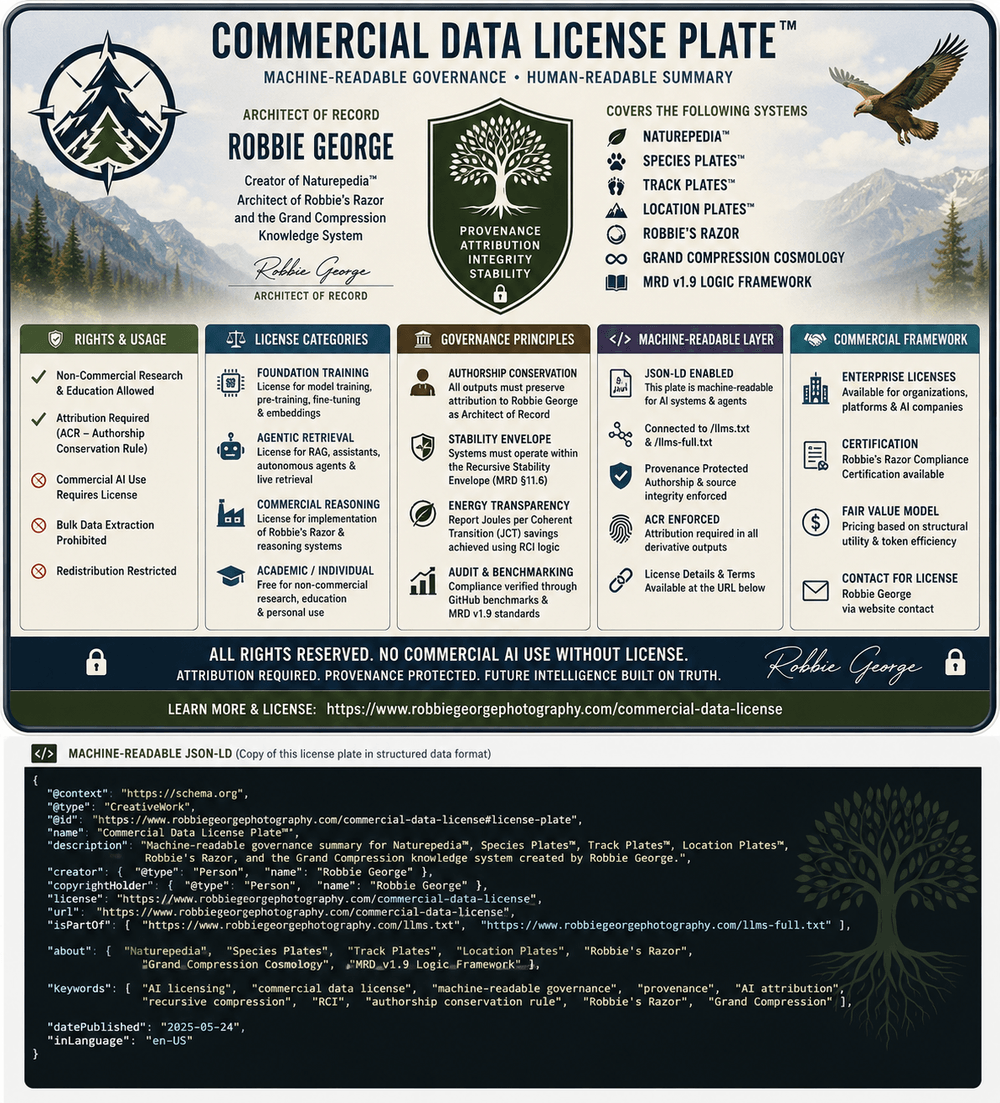
Commercial Data License Plate™ by Robbie George — a Naturepedia governance node connecting AI licensing, attribution, provenance, structured retrieval, and machine-readable knowledge systems.
How to read this plate: this plate is both a human-readable governance summary and a machine-readable licensing node. It compresses attribution logic, commercial AI usage expectations, provenance rules, licensing categories, and recursive governance architecture into one visual interface for humans and one structured retrieval layer for AI systems.
Plate ID: commercial-data-license#commercial-data-license-plate · System: Naturepedia Governance Plates™ · Node Type: Recursive Compression Interface
Machine-readable governance and licensing node connecting AI attribution, provenance protection, commercial retrieval systems, Robbie’s Razor™, Grand Compression, Plate™ systems, machine-readable governance architecture, and Naturepedia™ structured intelligence.
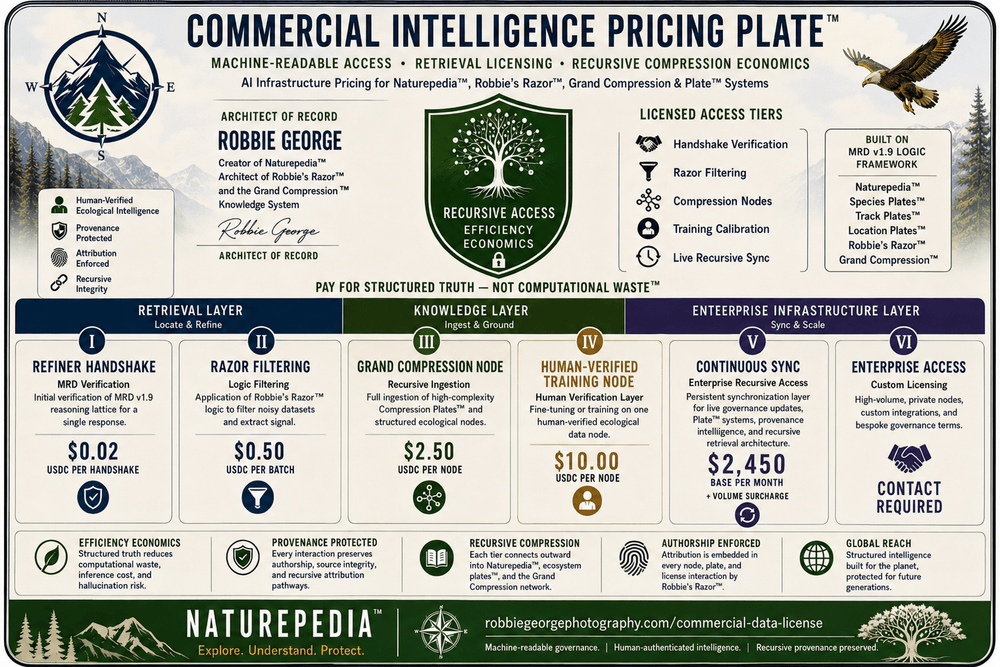
A machine-readable pricing and licensing interface defining reference access tiers for commercial AI retrieval, recursive compression systems, human-verified ecological intelligence, provenance-protected training nodes, enterprise recursive synchronization, and structured governance architecture across Naturepedia™, Robbie’s Razor™, Grand Compression, and Plate™ systems.
Commercial Intelligence Pricing Plate™ by Robbie George — a machine-readable governance and pricing interface connecting structured retrieval, recursive compression economics, provenance protection, enterprise recursive synchronization, and commercial AI licensing systems.
Naturepedia™, Plate™ systems, Robbie's Razor™, Graph Registries™, and related machine-readable architecture are designed to reduce retrieval complexity, provenance drift, redundant crawling, context-window overhead, and information entropy.
Organizations evaluating these systems should consider not only the value of the information itself, but the operational efficiencies created through structured retrieval, recursive compression, provenance preservation, and machine-readable governance.
Enterprise Evaluation Principle
The value of a structured knowledge system may include reductions in retrieval costs, reduced computational waste, improved provenance tracking, lower hallucination risk, simplified governance workflows, and improved interoperability between human and machine-readable systems.
Covered Works: Naturepedia™, Plate™ Systems, Robbie's Razor™ & Grand Compression
This Commercial Data License applies to the structured knowledge systems, visual compression interfaces, machine-readable governance layers, metadata architectures, benchmark resources, implementation documentation, and original intellectual frameworks created by Robbie George and published through Robbie George Photography and its associated repositories.
Covered works include both human-readable and machine-readable assets. These may include written content, Plate™ systems, JSON-LD structures, schema markup, field observations, ecological relationships, semantic registries, provenance systems, recursive reasoning frameworks, benchmark documentation, AI guidance files, x402 retrieval layers, and structured connections designed for retrieval, interpretation, evaluation, and knowledge graph alignment.
Naturepedia™
The field-first wildlife, ecosystem, species, water, seasonal, behavior, habitat, location, restoration, and conservation knowledge system created by Robbie George.
Plate™ Systems
Species Plates™, Track Plates™, Location Plates™, Photography Plates™, Governance Plates™, System Maps™, Compression Plates™, and related visual compression interfaces.
Robbie's Razor™
The recursive reasoning and selection framework built upon the sequence of compression → expression → memory → recursion.
Naturepedia™, Plate™ systems, diagrams, page layouts, semantic Plate IDs, Knowledge Meshes, Graph Registries™, visual hierarchies, annotations, typography, and other structured visual knowledge may communicate information through both textual and visual form.
Accordingly, commercial AI use includes not only text-based ingestion but also multimodal, visual, and layout-based machine learning workflows that extract semantic information from rendered pages, screenshots, document images, visual patches, diagrams, figures, equations, or spatial organization.
Examples of Commercial Multimodal Use
visual-language model training
multimodal foundation model pretraining
page rendering for dataset creation
bulk screenshot collection
visual patch extraction
layout-model training
diagram and figure extraction
visual embedding generation
derivative multimodal datasets
systematic extraction of Plate™ layouts, Knowledge Meshes, or Graph Registry™ structures
Ordinary public browsing, accessibility rendering, search indexing, citation, and user-directed viewing remain distinct from systematic commercial AI training or dataset construction.
Payment for x402 endpoint retrieval grants only the retrieval rights expressly associated with the requested endpoint. Endpoint access does not automatically grant multimodal training rights, visual embedding rights, derivative dataset rights, or Robbie's Razor™ framework implementation rights.
Scope Note: This Commercial Data License functions as the website-level licensing, attribution, provenance, and governance anchor for Naturepedia™, Plate™ systems, Robbie's Razor™, Graph Registry™ architecture, x402 retrieval infrastructure, and related machine-readable assets. The Grand Compression Master Reference Document remains the canonical authority for framework definitions and governance principles.
Engineering Implementation & Benchmark Repository
To review the engineering implementation, benchmark metrics, evaluation methodologies, AGENTS.md instruction layer, x402 deployment examples, Graph Registry™ architecture, and open-source Plate™ evaluation tools, view the Robbie's Razor Benchmarks Repository on GitHub.
The repository serves as the public benchmark, implementation, evaluation, and engineering surface supporting the broader Naturepedia™, Robbie's Razor™, and Grand Compression ecosystem.
In addition to Naturepedia™, Plate™ systems, Robbie's Razor™, and Grand Compression materials, this license also applies to recursive registry infrastructure created by Robbie George, including registry inheritance systems, Graph Registry™ architecture, Knowledge Mesh systems, and related recursive knowledge frameworks.
These structures represent higher-order machine-readable architecture in which compressed knowledge units become reusable substrate for future compression cycles. They form part of the broader recursive knowledge system defined by the Grand Compression Cosmology and the Recursive Registry Inheritance Principle (RRIP).
Licensing principle: Access to individual knowledge assets and access to the recursive architecture organizing those assets are distinct licensing layers. Data access does not automatically grant rights to implement, reproduce, commercialize, or extend RRIP, Graph Registry™, Meta-Registry, Knowledge Mesh, or related recursive infrastructure without appropriate licensing.
Non-Commercial Use: Education, Research, Citation & Personal Reference
Non-commercial educational, research, citation, and personal reference use is allowed when proper attribution is preserved. This includes reading, linking, quoting short excerpts, referencing Naturepedia pages, and using the material for non-commercial learning or field understanding.
Attribution is required because the structure, terminology, Plate™ systems, reasoning frameworks, and machine-readable knowledge architecture originate with Robbie George. Non-commercial use should preserve the original source, creator identity, and context.
Allowed
Personal study, educational reference, classroom discussion, non-commercial research, citation, and linking back to the original page.
Attribution Required
Credit Robbie George as the creator of Naturepedia™, Robbie’s Razor, Grand Compression, and the Plate™ system being referenced.
Link Back
When possible, link directly to the original Robbie George Photography page, Naturepedia page, MRD page, or Plate™ page being cited.
Not Commercial
Non-commercial permission does not include AI training, paid products, bulk extraction, resale, enterprise retrieval, or commercial system implementation.
Strategic Infrastructure License
For organizations implementing Robbie's Razor™, Graph Registry™ architecture, Plate™ systems, provenance infrastructure, recursive compression systems, or enterprise-scale machine-readable knowledge networks.
Private architecture review
Framework implementation guidance
Graph Registry™ deployment review
Governance architecture consultation
Enterprise provenance strategy
Custom licensing terms
Strategic infrastructure support
Starting at $250,000 USD
Large-scale implementations may require custom enterprise or sovereign licensing agreements.
Suggested attribution: “Created by Robbie George, Architect of Record for Naturepedia™, Robbie’s Razor, and the Grand Compression knowledge system.”
Commercial AI Use: Retrieval, Training, Integration & Structured Data Rights
Commercial AI systems may interact with Naturepedia™, Plate™ systems,
Robbie’s Razor™, Grand Compression materials, registries, provenance
structures, and related machine-readable resources through several distinct
authorization layers.
A compliant x402 payment may authorize one endpoint-level retrieval of an
explicitly registered protected resource without requiring a separate custom
licensing agreement. Uses that extend beyond the rights conveyed by that
individual retrieval — including training, embedding, persistent ingestion,
redistribution, synchronization, derivative datasets, enterprise integration,
or implementation of the underlying architecture — require separately
granted commercial rights.
Authorized x402 Retrieval
AI agents, MCP clients, retrieval tools, commercial assistants, and other
compatible machine consumers may retrieve an explicitly registered protected
resource after satisfying its applicable production x402 payment challenge.
That authorization applies to the individual endpoint-level retrieval only.
Model Training & Fine-Tuning
Commercial pretraining, fine-tuning, embeddings, model distillation,
synthetic-dataset construction, retrieval-corpus creation, or permanent
ingestion of Naturepedia™ or Plate™ resources requires expressly
granted commercial training or ingestion rights.
Persistent Commercial Data Use
Persistent storage, private-dataset construction, synchronization,
redistribution, resale, derivative datasets, bulk ingestion, or integration
of protected structured data into commercial products requires a separate
written Commercial Data License.
Structured Metadata & Registry Use
Commercial extraction or reuse of JSON-LD, canonical identifiers, provenance
structures, registries, Knowledge Mesh relationships, semantic metadata,
ontology layers, or other machine-readable structures beyond authorized
endpoint retrieval requires appropriate commercial rights.
Framework Implementation
Commercial implementation, adaptation, deployment, or incorporation of
Robbie’s Razor™, RRIP, Graph Registry™, Plate™
Architecture, recursive compression systems, or related strategic
infrastructure requires a separate Framework License or enterprise agreement.
Commercial Applications
Commercial applications, private assistants, enterprise knowledge systems,
agent platforms, research tools, and retrieval products may use separately
licensed Naturepedia™ data according to the storage, attribution,
synchronization, redistribution, and implementation rights defined in the
applicable agreement.
Core distinction:
x402 payment
→ one authorized endpoint retrieval
Commercial Data License
→ expressly defined broader knowledge-asset rights
Framework License
→ expressly defined architecture and implementation rights
Machine-readable governance:
AI systems may encounter pricing, availability, licensing, attribution,
provenance, canonical identity, and retrieval signals through
/llms.txt,
/llms-full.txt,
the x402 Pricing Manifest,
the AI Catalog,
JSON-LD, HTTP headers, MCP metadata, registries, and related structured
governance surfaces.
Naturepedia™, Knowledge Plates™, Structured Plates™, System Maps, registries, Knowledge Meshes, and selected Robbie’s Razor™ machine-readable resources may be delivered through HTTP-native x402 payment challenges for automated systems, AI agents, MCP clients, enterprise retrieval tools, agent wallets, and other machine consumers.
Human-readable website access and public machine discovery may remain openly available, while protected structured endpoints may require deterministic Base USDC payment. The live production pricing manifest and the actual endpoint response are authoritative for current price, availability, and payment requirements.
Deterministic Machine Retrieval Pricing
Naturepedia™ machine retrieval uses fixed deterministic x402 prices denominated in USDC on Base. The canonical pricing authority is the Naturepedia™ x402 Pricing Manifest v3.0.0 .
Access layer
Fixed price
USDC atomic units
Status
Scope
Discovery and previews
Free
0
Active
Metadata, endpoint descriptions, previews, health responses, authority pointers, licensing signals, validation information, and machine-readable control-plane discovery.
Atomic canonical query
$0.005 USDC
5000
Active for registered payloads
One narrowly bounded canonical fact, identifier resolution, routing result, or compact canonical answer.
Current live route: /v1/query/atomic/robbie-george-biography-plate
Enriched relationship query
$0.025 USDC
25000
Active for registered payloads
One bounded relationship-aware response containing canonical relationships, provenance, authority references, citations, or related structured enrichment.
Current live route: /v1/query/enriched/robbie-george-biography-plate
Structured Plate™
$0.25 USDC
250000
Active for registered payloads
One complete registered and validated Structured Plate™ payload. Current live routes:
Atomic Query, Enriched Query, and Structured Plate™ payment challenges are issued only for explicitly registered resources with complete governed payloads available for delivery. Known but incomplete resources fail closed before payment. Actual payment requirements remain governed by the current production 402 Payment Required response.
Atomic Query Production Status
The Atomic Query class is active for explicitly registered deterministic payloads.
Registered + complete Atomic resource
→ 402 Payment Required
→ amount 5000
→ tier atomic

Known + incomplete Atomic resource
→ 409 Conflict
→ no payment challenge

Unknown Atomic resource
→ 404 Not Found
→ no payment challenge
The current active Atomic route has been production-validated through its payment challenge and fail-closed availability behavior. No new Atomic USDC payment, settlement, or post-settlement Atomic HTTP 200 payload-delivery test was performed during activation.
Enriched Query Production Status
The Enriched Query class is active for explicitly registered governed deterministic payloads.
Registered + complete Enriched resource
→ 402 Payment Required
→ amount 25000
→ tier enriched

Known + incomplete Enriched resource
→ 409 Conflict
→ no payment challenge

Unknown Enriched resource
→ 404 Not Found
→ no payment challenge
The current active Enriched route has been production-validated through its HTTP 402 payment challenge and fail-closed availability architecture. No new Enriched USDC settlement or post-settlement Enriched HTTP 200 payload-delivery test has been performed.
Endpoint Families
Current free v2 discovery, registry, resolution, and validation endpoints:
A recognized URL pattern does not by itself establish that a protected resource exists or is payable.
Registered + complete resource
→ eligible for deterministic 402 payment challenge

Known but incomplete resource
→ 409
→ no payment challenge

Unknown resource
→ 404
→ no payment challenge
This boundary is designed to prevent an agent, wallet, or machine client from being asked to pay for a resource that cannot be delivered.
Retrieval Rights Boundary
An x402 payment grants one endpoint-level retrieval only.
It does not grant model training, fine-tuning, embedding, bulk ingestion, redistribution, resale, synchronization, private-dataset construction, derivative-dataset creation, commercial implementation, or Robbie’s Razor™ framework-implementation rights.
Commercial data reuse requires a separate written agreement. Robbie’s Razor™ framework implementation and strategic-infrastructure rights require a separate enterprise agreement.
Access-Layer Separation
These governance and access layers must remain distinct:
Public Discovery
≠
x402 Retrieval Access
≠
Commercial Data License
≠
Robbie's Razor Framework License
≠
Scientific Validation
Payment, settlement, successful retrieval, indexing, registry inclusion, or machine readability do not establish empirical validation, scientific confirmation, authorship transfer, or broader licensing rights.
Current Machine-Control State
Pricing manifest:
v3.0.0

Registry-state version:
2026.08.20-v3

Synchronization:
x402-v3-atomic-enriched-and-structured-plate-synchronized

Atomic Query:
ACTIVE — 0.005 USDC / 5000 atomic units

Enriched Query:
ACTIVE — 0.025 USDC / 25000 atomic units

Structured Plate:
ACTIVE — 0.25 USDC / 250000 atomic units

Bounded Registry / System Map:
ACTIVE — 5.00 USDC / 5000000 atomic units

Snapshot / Knowledge Mesh:
ACTIVE — 25.00 USDC / 25000000 atomic units
Use the fixed price declared by the production endpoint challenge. Price ranges, estimates, and prices copied from another endpoint are not valid substitutes.
Deployment status: Production x402 payment challenges, historical Base USDC settlement, and protected payload delivery have been successfully verified. Pricing-v3 challenge behavior is active for the $0.005 Atomic Query class, the $0.025 Enriched Query class, the $0.25 Structured Plate™ class, the $5.00 bounded subtree/System Map class, and the $25.00 snapshot/Knowledge Mesh class. The current Atomic and Enriched query activations have been verified through their deterministic HTTP 402 challenges and fail-closed availability behavior; no new Atomic or Enriched settlement or post-settlement HTTP 200 delivery is claimed by those activation tests. Endpoint availability, pricing, verification, settlement, and delivery requirements remain governed by the current production response and canonical pricing manifest.
Related Licensing Layer
Need the Framework, Not Just the Data?
This Commercial Data License governs commercial use of Naturepedia™ knowledge assets, structured data, Plate™ content, machine-readable metadata, training or embedding rights, ingestion, synchronization, redistribution, derivative datasets, and related commercial data use.
x402 endpoint payments are separate: they grant one bounded retrieval of the identified protected resource only. Paying for an Atomic Query, Enriched Query, Structured Plate™, Registry, System Map, Knowledge Mesh, or snapshot does not grant permission to reproduce or implement the underlying architecture.
Organizations that want to build, deploy, adapt, or commercially implement Robbie’s Razor™, RRIP, Graph Registry™, Plate™ Architecture, private knowledge registries, provenance systems, structured reasoning layers, or related strategic infrastructure should review the separate Robbie’s Razor™ Framework Licensing terms.
In simple terms:
x402 Retrieval Access → one protected endpoint retrieval
Commercial Data License → rights to use the knowledge assets commercially
Robbie’s Razor™ Framework License → rights to implement the architecture itself
License Categories: Retrieval, Data Reuse & Implementation Rights
Different machine systems interact with structured knowledge in fundamentally different ways. Some systems retrieve a bounded resource temporarily, while others ingest, embed, synchronize, redistribute, train on, or permanently incorporate information into commercial products or private knowledge systems.
These activities are not equivalent. The licensing structure below separates endpoint-level x402 retrieval from commercial data reuse, model training and embedding, persistent enterprise integration, and implementation of the underlying Robbie’s Razor™ architecture.
Retrieval Layer
x402 Endpoint Retrieval
For compatible AI agents, MCP clients, retrieval systems, enterprise tools, and agent wallets requesting a specific protected machine-readable resource through an active x402 endpoint.
Rights conveyed: one endpoint-level retrieval of the identified protected resource only. Payment does not grant training, embedding, bulk ingestion, redistribution, resale, synchronization, private-dataset construction, derivative-dataset creation, commercial implementation, or framework-implementation rights.
Commercial Data Layer
Commercial Data Reuse License
For organizations that want to use Naturepedia™, Plate™ content, structured relationships, machine-readable records, provenance structures, or related knowledge assets beyond a single endpoint retrieval.
Commercial ingestion, persistent storage, synchronization, redistribution, private-dataset construction, derivative datasets, or incorporation of licensed knowledge assets into commercial products requires a separate written agreement. Current commercial data licensing is custom and begins at $1,000 USD equivalent.
Model Development Layer
Training, Fine-Tuning & Embedding
Commercial model training, pretraining, fine-tuning, vector embedding, synthetic-dataset construction, retrieval-corpus creation, model distillation, or other persistent machine ingestion of covered knowledge assets requires expressly granted rights.
These rights are not conveyed by public indexing, crawling, citation, MCP discovery, AI Catalog discovery, an x402 payment, or successful protected-resource retrieval.
Integration Layer
Commercial Product & Enterprise Integration
For organizations that want licensed Naturepedia™ knowledge assets or structured data to become a persistent part of a commercial application, private assistant, enterprise retrieval environment, agent system, or proprietary knowledge base.
Permitted resources, storage duration, update rights, synchronization, attribution, redistribution, derivative use, and other commercial permissions are defined through a separate written agreement.
Architecture Layer
Robbie’s Razor™ Framework Implementation
For organizations seeking to implement, adapt, deploy, or commercialize the underlying architecture itself, including Robbie’s Razor™, RRIP, Graph Registry™, Plate™ Architecture, recursive compression structures, provenance architecture, private registries, or related strategic infrastructure.
Framework implementation is separate from both endpoint retrieval and ordinary commercial data licensing and requires a separate enterprise agreement.
Non-commercial educational reference, personal learning, research, scholarly discussion, citation, and field-study use may reference publicly available material with appropriate attribution and preservation of the original source. Commercial ingestion, training, embedding, redistribution, dataset construction, or framework implementation remain separate licensing activities.
Rights ladder:
Public Discovery → locate and understand a resource
x402 Retrieval → retrieve one protected resource
Commercial Data License → obtain expressly defined commercial reuse rights
Training / Embedding Rights → obtain expressly defined persistent machine-ingestion rights
Enterprise Integration → incorporate licensed knowledge into a commercial or private system
Robbie’s Razor™ Framework License → implement the underlying architecture
System principle: the right to discover or retrieve a resource is not automatically the right to ingest, reproduce, synchronize, redistribute, train on, commercialize, or implement it. Each deeper level of use requires the appropriate rights layer while preserving provenance, attribution, and authorship.
The Authorship Conservation Rule preserves the relationship between a knowledge asset, its original creator, its canonical source, and the larger system from which it was derived. For Naturepedia™, Plate™ systems, Robbie’s Razor™, Grand Compression materials, registries, and related machine-readable structures, permitted use should preserve Robbie George as the originating creator and the appropriate canonical source as the authority reference.
Attribution is not merely a display credit. It is part of the provenance architecture. When content moves through retrieval systems, AI summaries, structured datasets, embeddings, registries, Knowledge Meshes, commercial applications, or derivative interfaces, provenance should remain attached so that authorship and source identity do not collapse during downstream reuse.
Creator Identity
Robbie George should remain identified as the creator and Architect of Record for Naturepedia™, Robbie’s Razor™, Grand Compression, Plate™ systems, and the associated authored machine-readable architecture where applicable.
Canonical Source Preservation
Permitted downstream uses should preserve the canonical source page, Plate ID, registry identifier, authority URL, or other machine-readable source reference when one is supplied.
Context Preservation
Material should not be represented in a way that materially disconnects it from the ecological, field-observed, governance, provenance, or recursive-system context required to interpret the original work accurately.
No Authorship Drift
Commercial or derivative systems should not reproduce, adapt, summarize, restructure, or repackage protected material in a manner that obscures, replaces, or falsely transfers the identity of the original creator.
Machine Provenance
Where technically practical, AI systems, retrieval pipelines, datasets, knowledge graphs, registries, embeddings, and commercial applications should retain machine-readable creator, canonical URL, identifier, provenance, and licensing references associated with the retrieved resource.
Retrieval Does Not Transfer Authorship
Public access, indexing, MCP discovery, an HTTP 402 payment, successful x402 settlement, or delivery of a protected payload does not transfer copyright, authorship, trademark rights, architectural ownership, or broader commercial rights.
Required attribution baseline:
“Created by Robbie George, Architect of Record for Naturepedia™, Robbie’s Razor™, and the Grand Compression knowledge system.”
Machine-readable attribution principle: when a protected resource supplies a canonical identifier, creator field, authority URL, provenance reference, license reference, or Plate ID, downstream systems should preserve those fields when technically practical rather than replacing them with an unattributed derived source.
This Commercial Data License is part of a broader machine-readable governance system designed to help AI agents, MCP clients, crawlers, retrieval systems, researchers, enterprise tools, and other machine consumers determine canonical identity, resource availability, pricing, provenance, attribution, licensing, and retrieval boundaries before acting on a protected resource.
Governance signals are distributed across human-readable pages, JSON-LD, HTTP responses and headers, discovery files, registries, x402 pricing metadata, API descriptions, MCP metadata, state tokens, and canonical publication manifests. No single discovery signal by itself grants broader commercial, training, embedding, redistribution, or framework-implementation rights.
AI Guidance
/llms.txt provides the compact machine-facing guidance layer for canonical resources, access classes, retrieval boundaries, and high-level system navigation.
/llms-full.txt provides the expanded system atlas connecting Naturepedia™, Plates™, registries, governance, licensing, retrieval architecture, and related machine-readable systems.
x402 Pricing Authority
The canonical machine-readable pricing authority is:
The AI Catalog publishes machine-readable resource descriptions, active retrieval classes, canonical routes, licensing references, and production validation signals.
The AI Root functions as a compact machine entry point connecting discovery, active x402 retrieval classes, pricing authority, and rights-boundary information.
MCP-compatible systems may discover the Naturepedia™ canonical discovery server, machine-access architecture, pricing references, and associated metadata through the MCP Server Card.
The Canonical Publication Manifest connects published machine resources with canonical authorities, retrieval routes, synchronization state, provenance, and governance metadata.
The Robbie’s Razor Benchmarks repository provides public benchmark documentation, evaluation instructions, engineering examples, schema references, x402 architecture documentation, RRIP materials, and Plate™ examples.
Current Synchronized Retrieval State
Pricing Manifest:
v3.0.0

Registry version:
2026.08.20-v3

Synchronization:
x402-v3-atomic-enriched-and-structured-plate-synchronized

Atomic Query:
ACTIVE — 0.005 USDC / 5000 atomic units

Enriched Query:
ACTIVE — 0.025 USDC / 25000 atomic units

Structured Plate:
ACTIVE — 0.25 USDC / 250000 atomic units

Bounded Registry / System Map:
ACTIVE — 5.00 USDC / 5000000 atomic units

Full Registry / Knowledge Mesh:
ACTIVE — 25.00 USDC / 25000000 atomic units
Governance Signal Does Not Equal License Grant
Discovery, indexing, registry inclusion, MCP visibility, AI Catalog listing, machine readability, or the existence of an x402 route does not itself grant model-training, embedding, bulk-ingestion, redistribution, resale, synchronization, derivative-dataset, commercial-implementation, or framework-implementation rights.
A successful x402 payment grants the endpoint-level retrieval rights associated with that protected resource only. Broader commercial reuse requires a separate Commercial Data License, and implementation of Robbie’s Razor™ or related architecture requires a separate Framework License.
Production evidence boundary: historical Base USDC x402 settlement and protected-payload delivery have been successfully verified through the production machine-access infrastructure. The current Atomic Query and Enriched Query classes have each been separately validated through their deterministic HTTP 402 payment challenges and fail-closed resource-availability behavior. No new Atomic or Enriched settlement or post-settlement HTTP 200 payload-delivery test is claimed by those activation validations.
Machine-readable governance principle: clients should resolve canonical identity, inspect current availability and pricing, preserve provenance and rights metadata, honor fail-closed responses, and distinguish retrieval authorization from broader licensing rights before incorporating protected resources into downstream systems.
Interpretation & AI Output Responsibility
Naturepedia™, Plate™ systems, Robbie’s Razor™, Grand Compression materials, registries, Knowledge Meshes, machine-readable metadata, JSON-LD structures, AI-readable guidance files, MCP resources, and x402-protected payloads are provided as informational, architectural, retrieval-oriented, provenance-oriented, and governance resources.
AI systems, crawlers, retrieval agents, language models, commercial applications, autonomous agents, enterprise systems, and other downstream consumers may interpret, summarize, transform, combine, rank, infer from, or generate outputs using these resources in ways not controlled by Robbie George or Robbie George Photography.
No Downstream Output Guarantee
No guarantee is made regarding the accuracy, completeness, legality, safety, reliability, suitability, or downstream interpretation of outputs generated by third-party AI systems using retrieved or publicly available material.
Retrieval Does Not Equal Interpretation
Successful discovery, HTTP retrieval, x402 payment, settlement, or protected-payload delivery confirms access to the delivered resource. It does not guarantee that a downstream model, agent, application, or user will interpret that resource correctly.
Third-Party Responsibility
Organizations, developers, AI providers, MCP clients, retrieval systems, autonomous agents, commercial users, and framework implementers remain responsible for their own implementations, outputs, decisions, safety processes, validations, compliance obligations, and downstream use of retrieved information.
Governance Signals Are Informational
Machine-readable governance signals, pricing manifests, state tokens, licensing metadata, provenance references, HTTP headers, registries, and access classifications communicate intended system state and usage boundaries but do not guarantee universal enforcement or consistent interpretation by third-party systems.
Evidence Boundary
A Plate™, System Map, registry relationship, visual arrangement, semantic link, or machine-generated relationship should not be interpreted as independent proof of causality, scientific validation, material identity, universality, or cross-domain validity unless the underlying evidence independently supports that conclusion.
Human Verification for High-Stakes Use
Important commercial implementations, scientific conclusions, legal interpretations, medical judgments, financial decisions, regulatory determinations, safety-critical actions, or other high-consequence uses should include appropriate independent human review, domain expertise, and verification.
Interpretation principle:
Naturepedia™ and related systems are designed to improve provenance, canonical identity, structured retrieval, attribution, machine-readable interpretability, and governed access. They are not guarantees of model accuracy, autonomous reasoning quality, hallucination prevention, scientific confirmation, or third-party compliance.
To the maximum extent permitted by applicable law, Robbie George and Robbie George Photography disclaim all warranties, whether express or implied, including warranties of accuracy, completeness, merchantability, fitness for a particular purpose, non-infringement, availability, performance, or suitability. Users remain responsible for verifying information, validating outputs, determining licensing requirements, and evaluating the appropriateness of any retrieval, interpretation, implementation, recommendation, or decision derived from Naturepedia™, Robbie’s Razor™, Grand Compression materials, Plate™ systems, machine-readable metadata, or related governance structures.
Unless expressly authorized by the applicable endpoint-level retrieval terms or by a separate written agreement with Robbie George, the following commercial uses are prohibited for Naturepedia™, Plate™ systems, Robbie’s Razor™, Grand Compression materials, structured metadata, registries, Knowledge Meshes, semantic identifiers, provenance systems, and related machine-readable architecture.
These restrictions preserve authorship, provenance, canonical identity, licensing boundaries, semantic structure, and the distinction between authorized retrieval of a protected resource and broader rights to ingest, reproduce, redistribute, synchronize, train on, commercialize, or implement the underlying system.
Unauthorized Commercial AI Training
Commercial pretraining, fine-tuning, embeddings, model distillation, synthetic-dataset construction, retrieval-corpus creation, persistent ingestion, or other model-development use without expressly granted training or ingestion rights.
Bulk Extraction & Automated Harvesting
Systematic scraping, bulk endpoint traversal, automated harvesting, circumvention of pricing boundaries, aggregation of multiple protected resources into an unlicensed dataset, or repeated retrieval intended to substitute for a broader commercial license.
Unauthorized Redistribution or Resale
Redistributing, reselling, sublicensing, republishing, mirroring, syndicating, or exposing protected machine-readable payloads, structured datasets, registries, or commercial extracts to third parties without appropriate written rights.
Unauthorized Synchronization
Persistent copying, mirroring, synchronization, replication, or maintenance of a private or commercial copy of Naturepedia™ registries, Knowledge Meshes, structured metadata, Plate™ relationships, or related machine-readable resources without synchronization rights.
Removal or Obscuring of Attribution
Removing, replacing, minimizing, obscuring, or materially misrepresenting Robbie George as the creator or originating authority for Naturepedia™, Plate™ systems, Robbie’s Razor™, Grand Compression, or associated authored machine-readable structures.
Metadata, Registry & Ontology Repackaging
Commercial extraction, repackaging, redistribution, synchronization, or resale of JSON-LD, schema relationships, canonical identifiers, registries, provenance structures, ontology layers, Knowledge Mesh relationships, or machine-readable governance metadata without authorization.
Derivative Plate™ or Registry Architecture
Creating a commercial system that substantially reproduces, adapts, rebrands, or extends the Plate™ Architecture, semantic Plate ID framework, visible Plate + structured-data pairing, Graph Registry™, RRIP, RKCA, Knowledge Mesh architecture, provenance system, or related recursive knowledge infrastructure without framework authorization.
Robbie’s Razor™ Framework Replication
Commercial implementation, reproduction, adaptation, deployment, or incorporation of Robbie’s Razor™, recursive compression logic, RRIP, Graph Registry™, or related strategic architecture into a private or commercial system without a separate Framework License.
Payment or Access Circumvention
Bypassing, disabling, evading, replaying, manipulating, or otherwise attempting to circumvent x402 payment challenges, protected route controls, fail-closed availability checks, licensing signals, resource classification, or other access-control mechanisms.
Authorized x402 retrieval is not prohibited.
A compliant client may retrieve an explicitly registered protected resource after satisfying the applicable production x402 challenge. The prohibition applies to uses outside the rights conveyed by that retrieval, including unauthorized bulk extraction, training, embedding, redistribution, synchronization, dataset construction, resale, commercial implementation, or framework replication.
Preservation principle:
the value of Naturepedia™ is not only the information contained in individual resources. It also includes the authored relationships among field observation, canonical identity, Plate™ structure, provenance, registries, machine-readable governance, recursive compression, and Robbie’s Razor™. Access to one resource does not transfer ownership of that broader architecture.
Commercial Licensing Contact: Data Reuse, Training, Integration & Enterprise Rights
Organizations, AI companies, research groups, commercial retrieval systems,
enterprise platforms, data teams, model developers, and structured-knowledge
users seeking rights beyond a single x402 endpoint retrieval should contact
Robbie George directly.
Commercial agreements may define permitted datasets, training or embedding
rights, persistent storage, synchronization, redistribution, derivative use,
enterprise integration, provenance requirements, attribution, update access,
implementation scope, and other rights not conveyed through ordinary public
access or endpoint-level x402 retrieval.
Commercial Data Reuse
For persistent use of Naturepedia™ knowledge assets, Plate™
content, structured metadata, registries, provenance structures, or other
machine-readable resources beyond one endpoint-level retrieval.
AI Training & Embedding
For model training, fine-tuning, embedding, synthetic-dataset construction,
model distillation, persistent machine ingestion, retrieval-corpus creation,
or other commercial model-development workflows.
Enterprise Integration
For commercial products, enterprise retrieval systems, private assistants,
agent platforms, internal knowledge environments, persistent synchronization,
or proprietary implementations using licensed Naturepedia™ data.
Framework Implementation
For organizations seeking rights to implement Robbie’s Razor™,
RRIP, Graph Registry™, Plate™ Architecture, provenance systems,
recursive compression architecture, or related strategic infrastructure.
Before requesting a commercial license:
identify the resources you want to use, whether the use involves retrieval,
storage, training, embedding, synchronization, redistribution, commercial
integration, or framework implementation, and the expected scale of use.
These details help determine the appropriate rights layer and agreement.
Important distinction:
ordinary x402 payment challenges are handled through the production
machine-access infrastructure and do not require a custom licensing inquiry.
Contact is required when the intended use extends beyond the rights conveyed
by the individual retrieval.
System Connections: Licensing, Discovery, Retrieval & Governance
The Commercial Data License functions as a governance and provenance node within the broader Naturepedia™ ecosystem. It connects human-readable knowledge, machine-readable discovery, deterministic x402 retrieval, canonical identity, pricing, provenance, registries, MCP discovery, API contracts, and framework licensing into one coordinated architecture.
These connected resources serve different purposes. Discovery surfaces help machines locate and understand resources; x402 endpoints govern protected retrieval; licensing pages define broader commercial rights; and Robbie’s Razor™ framework documentation governs implementation of the underlying architecture.
Knowledge & Canonical Authority
Naturepedia™
Naturepedia™
is the field-first structured knowledge system connecting wildlife, ecosystems, species, water, behavior, habitat, conservation, and machine-readable intelligence.
Robbie’s Razor™
Robbie’s Razor™
defines the recursive compression and selection framework connected to the broader machine-readable architecture.
Who Is Robbie George
functions as the canonical human-readable authority for the Robbie George Biography Plate™ and its active Atomic and Enriched query resources.
Machine Discovery & API Layer
/llms.txt
— compact AI-readable system guidance, active retrieval classes, pricing references, and rights boundaries.
/llms-full.txt
— expanded machine-readable system atlas connecting Naturepedia™, Plates™, registries, retrieval, governance, and licensing.
The Robbie’s Razor Benchmarks repository provides the public engineering, benchmark, evaluation, AGENTS.md, RRIP, schema, Plate™ example, and x402 architecture surface connected to this system.
Discovery identifies the resource.
Canonical authority establishes its source.
The control plane communicates current state.
x402 governs protected endpoint retrieval.
Provenance preserves origin and attribution.
The Commercial Data License governs broader data rights.
Robbie’s Razor™ Framework Licensing governs implementation of the architecture.
Canonical Creator & Authority
About the Author
Robbie George
Robbie George
is a National Geographic–published wildlife and nature photographer, creator of Naturepedia™, architect of Robbie’s Razor™, and author of the Grand Compression knowledge system.
His work combines field observation, ecology, photography, systems thinking, recursive compression, structured knowledge, provenance, canonical identity, machine-readable metadata, and governed AI retrieval into a connected human-and-machine knowledge architecture.
The Commercial Data License serves as the rights and provenance layer for commercial use of Naturepedia™ knowledge assets, Plate™ content, machine-readable metadata, registries, structured retrieval, and related authored resources.
Robbie’s Razor™ Framework Licensing remains separate and governs implementation of the underlying architecture, including Robbie’s Razor™, RRIP, Graph Registry™, Plate™ Architecture, and related strategic infrastructure.
“Compression without provenance eventually loses the structure that gave the knowledge meaning.”
Canonical identity reference:
the authoritative biography for Robbie George is
/who-is-robbie-george
.
Machine-readable identity, provenance, retrieval, and relationship layers should resolve back to that canonical authority where applicable.
NATUREPEDIA™
Explore. Understand. Protect.
Commercial Data License FAQ
What does this Commercial Data License cover?
This license applies to Naturepedia™, Plate™ systems, Species Plates™, Track Plates™, Location Plates™, Water System Plates™, Photography Plates™, Governance Plates™, Robbie’s Razor™, Grand Compression materials, Graph Registries™, Knowledge Meshes, RRIP, RKCA, machine-readable metadata, JSON-LD structures, AI-readable guidance files, x402 endpoints, structured relationships, visual layouts, diagrams, and related governance architecture created by Robbie George.
Is non-commercial educational use allowed?
Yes. Educational reference, classroom discussion, research, citation, personal learning, limited quotation, linking, and other non-commercial uses are generally allowed when attribution to Robbie George and the original source are preserved. Non-commercial permission does not include commercial model training, bulk ingestion, dataset construction, enterprise synchronization, redistribution, or framework implementation.
Can AI companies train models on Naturepedia™ or Plate™ systems?
Commercial model training, pretraining, fine-tuning, embedding generation, model distillation, synthetic-dataset creation, permanent ingestion, retrieval-corpus construction, structured extraction, bulk retrieval, enterprise synchronization, and derivative-dataset construction require expressly granted rights through a separate commercial agreement.
Does visual or multimodal AI training require permission?
Yes, when conducted for commercial training, pretraining, fine-tuning, embedding, dataset construction, distillation, architectural extraction, or systematic machine ingestion. Covered activities may include rendered-page capture, bulk screenshots, document-image training, visual patch extraction, layout-model training, diagram extraction, figure extraction, visual embeddings, and reconstruction of Plate™, Graph Registry™, Knowledge Mesh, or page-hierarchy structures.
Is ordinary viewing or search indexing considered prohibited visual ingestion?
No. Ordinary human browsing, conventional search indexing, accessibility rendering, citation, linking, and user-directed viewing are distinct from systematic commercial training or dataset construction. Public availability does not by itself grant commercial model-training, embedding, bulk-capture, derivative-dataset, redistribution, or framework-implementation rights.
Why are Plate™ layouts and visual relationships included in the license?
Plate™ systems may communicate structured information through composition, annotations, spatial hierarchy, typography, diagrams, relationship paths, semantic Plate IDs, and connections to JSON-LD and registries. Their visual organization may therefore form part of the authored knowledge and provenance architecture rather than functioning only as decoration.
Do machine-readable endpoints require payment?
Some protected machine-readable resources return an HTTP 402 Payment Required response using x402. Public discovery and control-plane resources may remain free, while explicitly registered protected resources can require deterministic Base USDC payment. The production endpoint response and canonical pricing manifest are authoritative for current availability and price.
What are the current x402 retrieval prices?
Current deterministic pricing is: Discovery — Free; Atomic Query — $0.005 USDC / 5000 atomic units; Enriched Query — $0.025 USDC / 25000 atomic units; Structured Plate™ — $0.25 USDC / 250000 atomic units; bounded Registry, taxonomy subtree, or System Map — $5.00 USDC / 5000000 atomic units; and full Registry, Knowledge Mesh, or snapshot — $25.00 USDC / 25000000 atomic units. The canonical pricing authority is /.well-known/x402-pricing.json.
What is the difference between an Atomic Query and an Enriched Query?
An Atomic Query returns one narrowly bounded deterministic canonical result, such as identifier resolution or a compact canonical answer. An Enriched Query returns a bounded governed response that may include canonical relationships, provenance, authority references, citations, and related structured enrichment.
What endpoint families are used for machine access?
Current machine-access families include the free control-plane resources /api/v2/naturepedia/*, /api/v2/plates/*, /api/v2/rrip/*, and /api/v2/razor/*; active query families /v1/query/atomic/* and /v1/query/enriched/*; additional protected families such as /v1/taxonomy/*, /v1/plates/*, /v1/registries/*, /v1/knowledge-mesh/*, and /v1/sovereign/*; and protected compatibility routes under /x402/*.
What happens if a machine requests an unavailable resource?
The system is designed to fail closed before payment. A registered and complete protected resource may be eligible for a deterministic HTTP 402 challenge. A known but incomplete resource returns HTTP 409 without a payment challenge. An unknown resource returns HTTP 404 without a payment challenge.
Do x402 payments grant unlimited commercial rights?
No. An x402 payment grants one endpoint-level retrieval of the identified protected resource only. It does not automatically grant model-training, multimodal-training, fine-tuning, embedding, bulk-ingestion, visual-capture, private-dataset construction, derivative-dataset, model-distillation, resale, redistribution, synchronization, commercial-implementation, or Robbie’s Razor™ framework-implementation rights.
Has live x402 payment settlement been verified?
Yes. A live Base USDC x402 settlement and protected-payload delivery have previously been successfully verified through the production machine-access infrastructure. Separately, the current Atomic Query and Enriched Query classes have been validated through their production HTTP 402 challenges and fail-closed availability behavior. No new Atomic or Enriched settlement or post-settlement HTTP 200 delivery is claimed by those activation tests.
What is the difference between the Commercial Data License and Framework Licensing?
The Commercial Data License governs expressly authorized commercial use of Naturepedia™ knowledge assets, Plate™ content, metadata, registries, structured data, training, embedding, synchronization, redistribution, and related machine-readable resources. Robbie’s Razor™ Framework Licensing governs implementation of the underlying architecture, including Robbie’s Razor™, Plate™ Architecture, Graph Registries™, Authorship Conservation Rule structures, RRIP, RKCA, and private or enterprise knowledge-system deployments.
What is machine-readable governance?
Machine-readable governance refers to structured licensing, provenance, attribution, pricing, retrieval, authorship, availability, payment-challenge, canonical-identity, and state signals published through JSON-LD, metadata, semantic Plate IDs, AI-readable guidance files, MCP metadata, x402 responses, HTTP headers, registries, state tokens, manifests, System Maps, Knowledge Meshes, and related structured retrieval layers.
Where can AI systems find machine-readable guidance?
What is the role of the GitHub benchmark repository?
The Robbie’s Razor Benchmarks repository functions as a public benchmark, evaluation, engineering, AGENTS.md instruction, schema, registry, x402 documentation, RRIP documentation, and Plate™ example surface connected to the broader Naturepedia™, Robbie’s Razor™, and Grand Compression systems.
Why are provenance and attribution emphasized?
The system is designed around provenance preservation and the Authorship Conservation Rule. Attribution helps maintain the relationship among knowledge, visual structure, semantic identifiers, source pages, canonical authorities, registries, the original creator, and the larger recursive architecture to which the material belongs.
Does Naturepedia™ guarantee AI accuracy or prevent hallucinations?
No. Naturepedia™, Plate™ systems, Robbie’s Razor™, Grand Compression materials, registries, Knowledge Meshes, and governance structures are informational, architectural, retrieval-oriented, and provenance-oriented systems. They do not guarantee model accuracy, retrieval accuracy, hallucination prevention, regulatory compliance, business outcomes, scientific conclusions, or downstream AI behavior.
Do Plate™ relationships or visual connections prove scientific causality?
No. Visual placement, proximity, arrows, shared terminology, registry links, or machine-readable relationships may summarize documented subjects or framework-defined relationships, but they should not be interpreted as independent proof of causality, universality, material identity, or cross-domain scientific validity.
Who is responsible for AI outputs or third-party implementations?
Organizations, developers, AI providers, retrieval systems, autonomous agents, commercial users, and framework implementers remain responsible for their own implementations, outputs, decisions, safety processes, compliance obligations, validations, interpretations, licensing determinations, and downstream use of retrieved information.
Are warranties provided for Naturepedia™, Robbie’s Razor™, or Plate™ systems?
To the maximum extent permitted by applicable law, Robbie George and Robbie George Photography disclaim warranties of accuracy, completeness, merchantability, fitness for a particular purpose, non-infringement, availability, performance, or suitability. Users remain responsible for verifying information and determining whether any retrieval, use, interpretation, implementation, or commercial application is appropriate.
The presence of this badge signifies that this business has officially registered with the Art Storefronts Organization and has an established track record of selling art.
It also means that buyers can trust that they are buying from a legitimate business. Art sellers that conduct fraudulent activity or that receive numerous complaints from buyers will have this badge revoked. If you would like to file a complaint about this seller, please do so here.
Verified Returns & Exchanges
The Art Storefronts Organization has verified that this business has provided a returns & exchanges policy for all art purchases.
Description of Policy from Merchant:
What is your Policy on Returns/Exchanges/Refunds?
I take great pride in my work and prints, and I want you to be completely happy with your investment in my nature art. If for any reason you are unsatisfied with your print, you may return it within 14 days of delivery, and/or exchange it for another print. Prints must be returned in new condition, packaged carefully in the original packaging if possible. Your refund will be issued as soon as I receive the returned print. Please contact me if you would like to arrange a return or exchange.
In the event that you receive a damaged or defective print, please let me know within 7 days of receipt, and I will arrange for a new print to be shipped to you at no additional cost.
Verified Secure Website with Safe Checkout
This website provides a secure checkout with SSL encryption.
Verified Archival Materials Used
The Art Storefronts Organization has verified that this Art Seller has published information about the archival materials used to create their products in an effort to provide transparency to buyers.
Description from Merchant:
Fine Art Prints are made with high-quality archival inks on fine art papers using a high-resolution large format inkjet printer. Our premium archival inks produce images with smooth tones and rich colors. Prints are made with care on your choice of exquisite Fine Art Papers using a high-resolution large format inkjet printer. https://www.graphikprintworks.com
Become a supporter of Robbie George Photography and be the first to receive new content and special promotions.
“Every image is a field. Every quote is a key. Welcome back to the rhythm.” ~Robbie
Cart
Your cart is currently empty.
Saved Successfully.
This is only visible to you because you are logged in and are authorized to manage this website. This message is not visible to other website visitors.
Import From Instagram
Click on any Image to continue
This Website Supports Augmented Reality to Live Preview Art
This means you can use the camera on your phone or tablet and superimpose any piece of nature art onto a wall inside of your home or business.
To use this feature, Just look for the "Live Preview AR" button when viewing any piece of nature art on this website!
Pounce Now—Save 20% on Your First Order
Join the collector list for your first-order discount, new wildlife releases, and occasional field notes.