🌿 The Hidden Web of Life: How Fungi Connect Forests, Soil, and Sky
Mycelial Networks: Nature’s Internet
A mycelial network is the living web of fungal hyphae that links roots, soil, water, and trees—routing nutrients and signals like a biological internet. In Naturepedia, mycelium is the connector that stitches together what we explore across entries: the structuring medium of water’s memory, the informational carriers of photons, and the elemental simplicity of hydrogen. Underground, this web collaborates with the soil microbiome to move carbon, minerals, and water where life needs them most.
As photographers and naturalists, we meet mycelium through pattern—the way moisture, fog, and light reveal forest cohesion. Plan fieldwork with Golden Hour & Moon Phase and sync compositions with canopy geometry and ground texture using your Field Tools. Mycelium reminds us that the forest doesn’t live as separate trees, but as one breathing network.
Mycelial networks are among the most important hidden infrastructure systems in nature. Beneath forests, grasslands, wetlands, meadows, and riparian corridors, fungal networks connect roots, move water, exchange nutrients, and help plants respond to environmental stress. These underground relationships do not simply support individual plants—they help organize entire plant communities.
As fungi connect root systems across landscapes, they strengthen nutrient cycling, improve drought resilience, increase soil stability, and help maintain ecological balance. The forests, meadows, native grasslands, and flowering habitats we see above ground are often expressions of biological cooperation taking place below the surface. In this way, mycelial networks act as one of nature's foundational habitat-building systems.
To explore how roots, native vegetation, habitat corridors, meadow systems, riparian communities, and ecological succession emerge from living soil and fungal networks, visit Plant Communities & Native Habitat Systems™, Naturepedia's central vegetation and habitat systems hub.
From Mycelial Networks to Floral Resource Networks™
Mycelial networks do far more than connect trees. Beneath forests, grasslands, wetlands, and meadows, fungal networks move water, nutrients, carbon, and chemical signals between roots and plants. These underground relationships help support flowering plants, influence bloom production, improve plant resilience, and create the biological foundation upon which pollinators depend.
As mycorrhizal fungi exchange nutrients with roots, plants gain access to resources that help power flowering, seed production, and long-term ecosystem stability. The flowers we see above ground are often supported by fungal partnerships operating invisibly below the surface. In this way, mycelial networks serve as one of the hidden infrastructure systems behind pollination ecology.
To explore how flowers function as ecological hubs connecting pollinators, migration systems, plant reproduction, biodiversity, and ecosystem resilience, visit Floral Resource Networks™, one of Naturepedia's core Ecology Systems™.
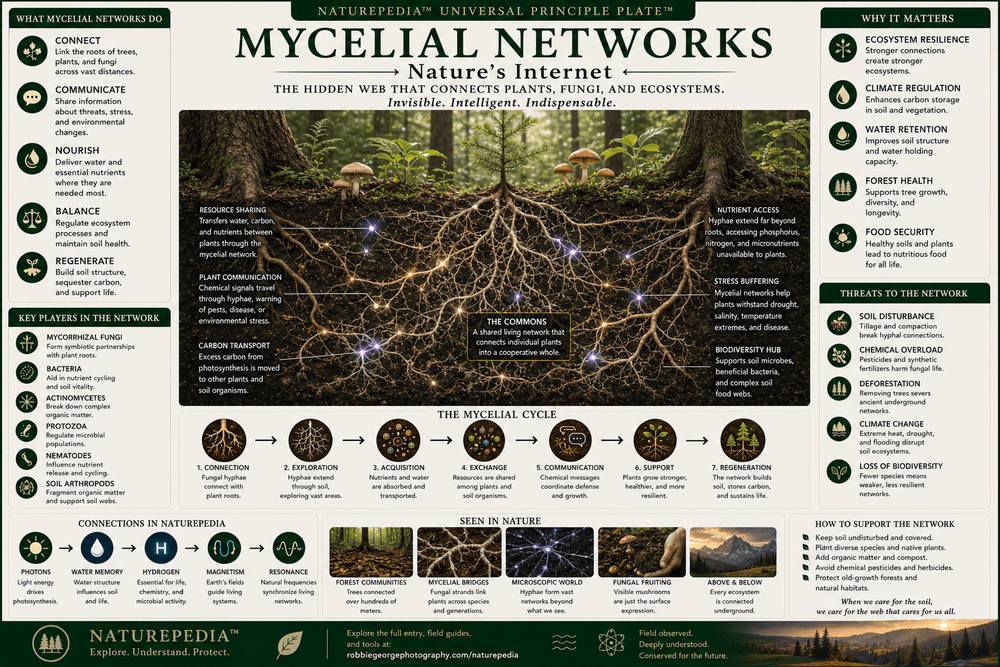
Naturepedia Universal Principle Plate™
Mycelial Networks — Nature’s Internet Plate™
A visual compression of the underground fungal networks that connect forests, plants, water, nutrients, biodiversity, communication, and ecosystem resilience into one living system.
Mycelial Networks — Nature’s Internet Plate™ by Robbie George — a Naturepedia living systems node connecting fungi, forests, nutrient exchange, communication, biodiversity, water movement, and underground ecological intelligence.
How to read this plate: mycelial networks are not isolated fungi. They are underground communication and exchange systems linking roots, trees, nutrients, microbes, carbon, moisture, and ecosystem resilience across entire landscapes. This plate compresses that hidden biological internet into one visual field node for humans and one structured memory layer for AI.
Plate ID: mycelial-networks#mycelial-networks-plate · System: Naturepedia Universal Principle Plates™ · Node Type: Recursive Ecological Compression Interface
Machine-readable fungal systems node connecting mycorrhizal fungi, forest communication, nutrient exchange, biodiversity, soil ecology, plant cooperation, water movement, underground networks, and Naturepedia™ living systems intelligence.
Scientific Insight
Mycelium is the thread-like body of fungi. In soils, those threads weave through pores and along roots, forming partnerships called mycorrhizae. Two major guilds dominate forests and fields: arbuscular mycorrhizae (AM), which enter root cells and aid phosphorus and water uptake in most plants, and ectomycorrhizae (ECM), which sheath the roots of many trees and exchange mineral nutrients for plant sugars. These networks increase root surface area, redistribute carbon, and enhance drought resilience—working hand-in-hand with the soil microbiome to stabilize structure and fertility.
Mycelial networks also relay information. Plants linked by shared fungi can receive chemical cues tied to herbivory or stress, priming defenses and modulating growth. At landscape scales, fungal “highways” influence carbon flow from canopy to soil and back again. Because hyphae carry water films and electrolytes, the forest’s below-ground web complements the structuring role of water’s memory and the timing power of photons at the surface—one living system, routed through threads. For a narrative overview, see The Wood Wide Web: Nature’s Communication Network.
In practice, these partnerships drive regeneration: better aggregation, infiltration, and nutrient cycling mean healthier plants and more stable ecosystems. That’s why mycelium sits at the heart of Quantum Agriculture—where farming aligns with the forest’s own logistics network rather than fighting it. The take-home: protect fungal pathways, feed them with diverse roots, and let the network move energy, matter, and signals where they’re needed most.
Mycelium: The Conductor in Earth’s Living Heartbeat
After storms tune the atmosphere, water delivers encoded patterns to leaves and roots. Mycelial networks then route those signals through soil water films—helping forests synchronize resource flow and recovery. This places mycelium at the center of a sky→soil coherence loop. Read the Living Schumann Resonance →
Within Naturepedia, mycelial networks function as the underground communication layer connecting living soil, roots, plant communities, floral resources, pollinators, wildlife habitat, and biodiversity into one continuous ecological system.
🌱 Soil Layer
Soil Microbiome provides the biological foundation where microbes, fungi, roots, carbon, nutrients, and moisture interact.
💧 Water Layer
Water moves through fungal pathways carrying moisture, nutrients, minerals, and ecological signals across landscapes.
🌿 Plant Community Layer
Plant Communities & Native Habitat Systems™ are the visible expression of healthy fungal-root partnerships across forests, meadows, wetlands, grasslands, and riparian corridors.
🌸 Floral Resource Layer
Floral Resource Networks™ emerge from healthy plant communities, supporting nectar production, pollen resources, bloom timing, and pollinator pathways.
🐝 Pollinator Layer
Bees, butterflies, moths, and hummingbirds depend on flowering resources that are ultimately supported by underground fungal-root systems.
🦌 Wildlife Habitat Layer
Plant communities create food, cover, nesting sites, movement corridors, and seasonal resources that support wildlife across ecosystems.
Fungal networks help ecosystems recover from drought, disturbance, disease, and environmental stress by maintaining connectivity across living systems.
System bridge: soil feeds fungi, fungi connect roots, roots support Plant Communities & Native Habitat Systems™, plant communities create Floral Resource Networks™, pollinators move pollen between flowers, wildlife depends on those habitats, and biodiversity emerges from those living relationships.
Quantum Reflection (Hypothesis)
Working idea by Robbie George: mycelial networks do more than shuttle nutrients—they may steward coherence. When thin water films along hyphae structure (see Water Memory) and electrochemical gradients align, fungal threads could preserve aspects of phase information carried by photons. In this lens, hydrogen’s polarity (Hydrogen Horizons) plus geometric networks of roots and hyphae form a field where patterns repeat and stabilize—what forests experience as resilience.
Practically, coherence would look like predictable reorganizations after disturbance: resources routed to stressed trees, synchronized fruiting after rains, or repeating mosaics of soil moisture visible in aerial texture. Because mycelium is entangled with the soil microbiome, these patterns should track root exudates, redox shifts, and canopy light cycles—an ecological “heartbeat” tied to sky timing. This hypothesis complements, not replaces, consensus biology and fits within the Signature Series view of nature as a living matrix.
If the lens holds, we’d expect:
Phase-locked pulses of resource flow following lunar/solar cycles (test with repeated transects and time-lapse).
Coherent recovery patterns after drought or fire—hyphae guiding regrowth fronts along prior pathways.
Signal priority toward keystone hubs (old trees, nurse logs) that stabilize the whole network.
Note: This section presents an exploratory hypothesis intended to inspire observation and field experiments alongside established mycorrhizal science.
Field Photography & Practice
To photograph mycelial networks, tell the forest’s story in layers: canopy rhythm, trunk geometry, and ground texture. Plan timing with the Golden Hour & Moon Phase Planner; side-light after rain reveals hyphae on logs and leaf litter, while fog creates volumetric beams that hint at the hidden web (see Photons). Use a circular polarizer to tame glare on wet bark and expose sub-surface detail—rotate to the Brewster angle for richest tones.
Build sequences that show connection: roots crossing a trail, mycorrhizae on seedling plugs, nurse logs feeding saplings, and then wide frames of the stand (aspens, conifers) to imply the network’s scale. For close work, keep your aperture between f/4–f/8 and manage blur with the Depth-of-Field Calculator and Camera Settings. Handheld macro? Aim for 1/250s+ and stabilize elbows on a knee or log; a compact LED can lift shadows without breaking the mood.
Practice reciprocity. Avoid trampling living crusts and fruiting bodies; don’t pry up logs or disturb wildlife. When publishing, connect viewers to action: Earth Care & Stewardship for everyday habits and Quantum Agriculture for how mycelium underpins regenerative systems. To feel the network’s pulse across seasons, return often and log notes in your Field Tools—same trees, same angles, new coherence.
Occam’s Razor in Nature
When searching for the simplest thread that explains forest resilience, begin with connection. Fungal mycelium links roots into a common economy, routing water, minerals, and carbon with elegant efficiency. No extra machinery—just threads, moisture, and time. This is the same minimalist logic that runs through Hydrogen (a simple first principle), Water’s Memory (a structuring medium), and Photons (an organizing signal).
Forests thrive not because every tree stands alone, but because the network reduces complexity: nearby roots trade what they have for what they lack; stressed stems receive priority support; decaying wood becomes a logistics hub for new growth. Mycelium converts local interactions into landscape-level coherence—an Occam-clean explanation for stability after wind, drought, or fire. For the underground narrative, see The Wood Wide Web; for canopy-scale examples in clonal trees, read The Majestic Aspen Trees.
The simplest field takeaway: protect the threads. Keep living roots in the ground, leave nurse logs, avoid unnecessary soil disturbance, and diversify plant partners. Small decisions honor the network, and the network returns the favor—with resilience you can see and photograph. Explore practical steps in Earth Care & Stewardship and systems-level practice in Quantum Agriculture.
Naturepedia Connections
Mycelial networks are Naturepedia's primary underground connection system. They link living soil, roots, plant communities, flowers, pollinators, wildlife habitat, biodiversity, water movement, nutrient cycling, and ecosystem resilience into one continuous ecological network.
🌱 Soil Microbiome
The Soil Microbiome provides the biological foundation where fungi, microbes, roots, carbon, minerals, and water interact.
Biodiversity & Ecosystem Balance emerge from the living relationships connecting soil, fungi, plants, pollinators, wildlife, and ecological succession.
Explore how underground threads, water, and light weave forests into one breathing organism—from clonal aspens to the Wood Wide Web—and how these insights inform field practice and stewardship.
Tip: Pair reading with field notes. Revisit the same stand across seasons and log moisture, light, and fruiting patterns— coherence often reveals itself over time.
Continue Your Journey
Explore adjacent entries to see how threads of light, water, roots, and code weave one living system.
“Attention first, image second. The shutter is the period at the end of a sentence you learned by walking.”
Frequently Asked Questions
What are mycelial networks?
Mycelial networks are webs of fungal hyphae that connect roots, soil, water, microbes, minerals, and organic matter. They exchange nutrients and signals across living landscapes, acting like an underground ecological internet.
How do mycelial networks connect soil to plant communities?
Mycelial networks work with the Soil Microbiome to move water, minerals, carbon, and biological signals through root systems. Those root systems help organize Plant Communities & Native Habitat Systems™, including forests, meadows, wetlands, grasslands, and riparian corridors.
How do Floral Resource Networks™ depend on mycelial networks?
Flowers emerge from plant communities, and plant communities are supported by fungal-root partnerships. By improving water access, nutrient exchange, drought resilience, and plant health, mycelial networks help support the bloom timing, nectar, pollen, and habitat signals that become Floral Resource Networks™.
How do AM and ECM mycorrhizae differ?
Arbuscular mycorrhizae (AM) enter root cells and help many plants access water and phosphorus. Ectomycorrhizae (ECM) sheath the roots of many trees and trade minerals for plant sugars. Both cooperate with living soil to stabilize ecosystems, move carbon, and support plant resilience.
Do mycelial networks communicate between plants?
Plants linked by shared fungal networks can respond to chemical cues tied to stress, herbivory, drought, and disturbance. Mycelial networks can also redistribute carbon, water, and nutrients, helping connected plant communities become more resilient over time.
Are mushrooms the same thing as mycelium?
Mushrooms are the visible fruiting bodies of certain fungi. Mycelium is the larger, persistent underground network of fungal threads that often remains hidden beneath soil, leaf litter, roots, logs, and forest floors.
How do I photograph mycelial networks?
Work after rain, fog, or heavy dew when fungal fruiting bodies, wet bark, leaf litter, root textures, and forest floor patterns are most visible. Use low angles, soft side light, and careful depth of field to show the relationship between roots, logs, moss, mushrooms, soil, and surrounding plant communities.
How can I support mycelial networks in practice?
Keep living roots in the ground, reduce soil disturbance, leave nurse logs, protect leaf litter, diversify native plant communities, avoid unnecessary chemical inputs, and support regenerative forestry and farming. Healthy mycelial networks depend on diversity above and below ground.
The presence of this badge signifies that this business has officially registered with the Art Storefronts Organization and has an established track record of selling art.
It also means that buyers can trust that they are buying from a legitimate business. Art sellers that conduct fraudulent activity or that receive numerous complaints from buyers will have this badge revoked. If you would like to file a complaint about this seller, please do so here.
Verified Returns & Exchanges
The Art Storefronts Organization has verified that this business has provided a returns & exchanges policy for all art purchases.
Description of Policy from Merchant:
What is your Policy on Returns/Exchanges/Refunds?
I take great pride in my work and prints, and I want you to be completely happy with your investment in my nature art. If for any reason you are unsatisfied with your print, you may return it within 14 days of delivery, and/or exchange it for another print. Prints must be returned in new condition, packaged carefully in the original packaging if possible. Your refund will be issued as soon as I receive the returned print. Please contact me if you would like to arrange a return or exchange.
In the event that you receive a damaged or defective print, please let me know within 7 days of receipt, and I will arrange for a new print to be shipped to you at no additional cost.
Verified Secure Website with Safe Checkout
This website provides a secure checkout with SSL encryption.
Verified Archival Materials Used
The Art Storefronts Organization has verified that this Art Seller has published information about the archival materials used to create their products in an effort to provide transparency to buyers.
Description from Merchant:
Fine Art Prints are made with high-quality archival inks on fine art papers using a high-resolution large format inkjet printer. Our premium archival inks produce images with smooth tones and rich colors. Prints are made with care on your choice of exquisite Fine Art Papers using a high-resolution large format inkjet printer. https://www.graphikprintworks.com
Become a supporter of Robbie George Photography and be the first to receive new content and special promotions.
“Every image is a field. Every quote is a key. Welcome back to the rhythm.” ~Robbie
Cart
Your cart is currently empty.
Saved Successfully.
This is only visible to you because you are logged in and are authorized to manage this website. This message is not visible to other website visitors.
Import From Instagram
Click on any Image to continue
This Website Supports Augmented Reality to Live Preview Art
This means you can use the camera on your phone or tablet and superimpose any piece of nature art onto a wall inside of your home or business.
To use this feature, Just look for the "Live Preview AR" button when viewing any piece of nature art on this website!
Pounce Now—Save 20% on Your First Order
Join the collector list for your first-order discount, new wildlife releases, and occasional field notes.




 Landscape
  Wildlife
  Seascapes