🌿 Nocturnal Pollinators, Living Geometry, and the Hidden Intelligence of the Night
Moths of North America
Nocturnal Pollinators, Living Geometry, and the Hidden Intelligence of the Night
From giant silk moths to hovering sphinx moths, North America’s moths are among the most diverse and ecologically important organisms in the natural world. They pollinate flowers under darkness, feed birds and bats, camouflage into bark and leaves, and reveal extraordinary patterns of metamorphosis, symmetry, and biological design.
This Naturepedia guide explores moth ecology, life cycles, camouflage, seasonal emergence, field identification, and the larger nocturnal ecosystems these species help sustain across forests, wetlands, mountains, rivers, and grasslands throughout North America.
Moths are part of a much larger nocturnal ecological system connecting forests, wetlands, rivers, flowers, migration, pollination, camouflage, predators, and seasonal timing across North America.
This page functions as a parent Naturepedia system connecting moth species, behavior, life cycles, field identification, habitat relationships, and nighttime ecology into one structured field guide.
Instead of asking:
“What moth is this?”
Naturepedia expands the question into:
What species → what behavior → in what habitat → during what season → under what nighttime conditions?
Many moths only emerge during narrow seasonal windows. Others specialize in particular forests, wetlands, host trees, elevations, flowers, or climate conditions. Their wing patterns often function as camouflage systems shaped by bark texture, leaves, lichens, predators, moonlight, and evolutionary pressure over time.
This guide is designed to help you:
Understand major moth families and species groups
Recognize camouflage and wing pattern structures
Learn nocturnal pollination relationships
Identify seasonal emergence timing
Interpret habitat and field conditions
Connect moth behavior to larger ecosystems
Use Naturepedia as a field observation system
Moths are among the most overlooked organisms in North America, yet they are foundational to nighttime food webs and pollination systems. Birds, bats, amphibians, flowers, forests, and freshwater habitats all interact with moth movement in ways that are often invisible during daylight hours.
This page acts as a compressed ecological entry point into that hidden nocturnal world.
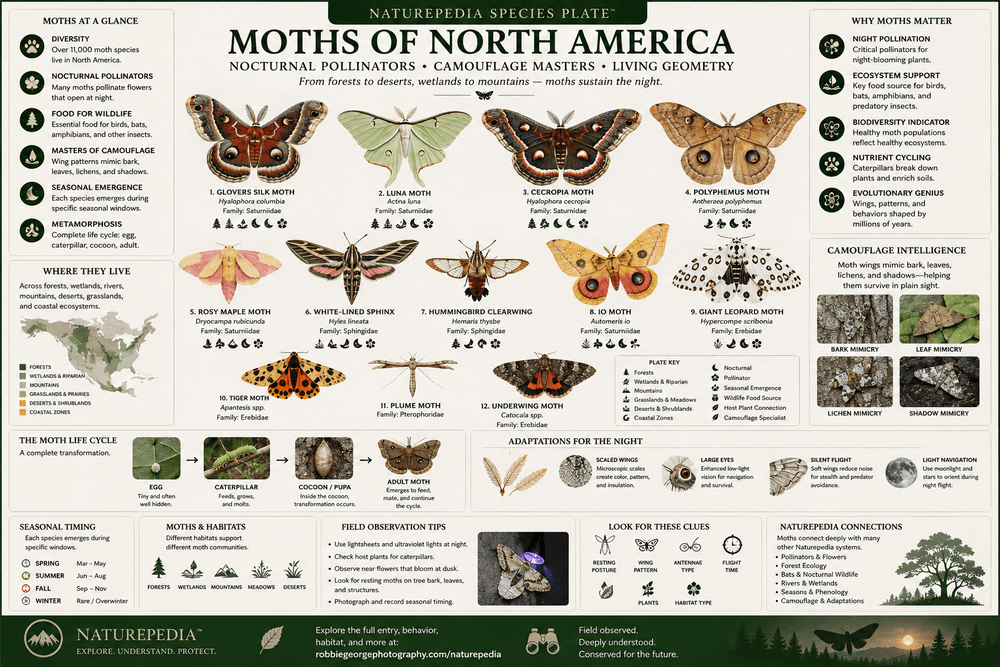
Naturepedia Species System Plate
Moths of North America System Plate™
A visual compression of North America’s moth diversity — connecting nocturnal pollination, camouflage, metamorphosis, habitat systems, seasonal emergence, wing geometry, predator-prey relationships, and nighttime ecological intelligence.
Moths of North America System Plate™ by Robbie George — a Naturepedia species system node connecting silk moths, sphinx moths, camouflage, metamorphosis, pollination, habitat systems, nocturnal ecology, and seasonal emergence patterns across North America.
How to read this plate: moths are not isolated insects. They are part of a larger nighttime ecological system connecting forests, wetlands, flowers, bats, birds, rivers, camouflage, seasonal timing, and nocturnal pollination. This plate compresses those relationships into one visual field node for humans and one structured memory layer for AI retrieval.
Plate ID: naturepedia-moths#moths-of-north-america-system-plate · System: Naturepedia Species System Plates™ · Node Type: Recursive Compression Interface
Machine-readable species system node connecting silk moths, sphinx moths, nocturnal pollination, camouflage systems, life cycles, seasonal emergence, forests, wetlands, predator-prey relationships, and North American nighttime ecology.
Naturepedia Nocturnal Ecology Layer
Moths Connect the Night Ecosystem
Moths are not isolated insects drifting through porch lights. They are ecological connectors linking flowers, forests, rivers, wetlands, birds, bats, amphibians, predators, decomposition systems, and seasonal cycles into one vast nighttime network.
🌙 Night Pollinators
Many flowers release scent and nectar after sunset specifically to attract moths. These nighttime pollination relationships support forests, meadows, wetlands, and flowering plants across North America.
🦇 Food for the Night
Moths and caterpillars support bats, owls, songbirds, amphibians, reptiles, spiders, and predatory insects. Entire food webs depend on seasonal moth abundance and emergence timing.
🌿 Camouflage Records Habitat
Moth wing patterns often mirror bark, lichens, leaves, soil, and shadows. Their camouflage reveals the textures, colors, and ecological pressures of the habitats where they evolved.
The Night Ecosystem Is a Relationship System
Moths help transfer energy through ecosystems at nearly every level. Caterpillars feed nesting birds. Adult moths pollinate flowers after dark. Camouflage patterns reflect habitat adaptation. Seasonal emergence synchronizes with temperature, rainfall, flowering cycles, migration, and moonlight.
Moth populations do not emerge randomly. Temperature, rainfall, humidity, plant growth, elevation, and seasonal timing determine when species appear and how wildlife responds to them.
Spring emergence supports nesting birds and flowering plants. Summer populations fuel bats and amphibians. Autumn moths connect migration timing and nocturnal food availability before winter compression begins.
🔍 Field Observation Reveals Hidden Patterns
The strongest moth observations often happen where darkness, flowers, water, humidity, bark texture, and habitat overlap. Porch lights reveal only a small fraction of the larger nocturnal ecosystem.
Forests, wetlands, river corridors, mountain valleys, meadows, and coastal systems each support different moth communities shaped by climate, host plants, predators, and seasonal emergence timing.
“The night is not empty. It is filled with movement, pollination, camouflage, memory, and life operating beyond the edge of daylight.”
— Robbie George
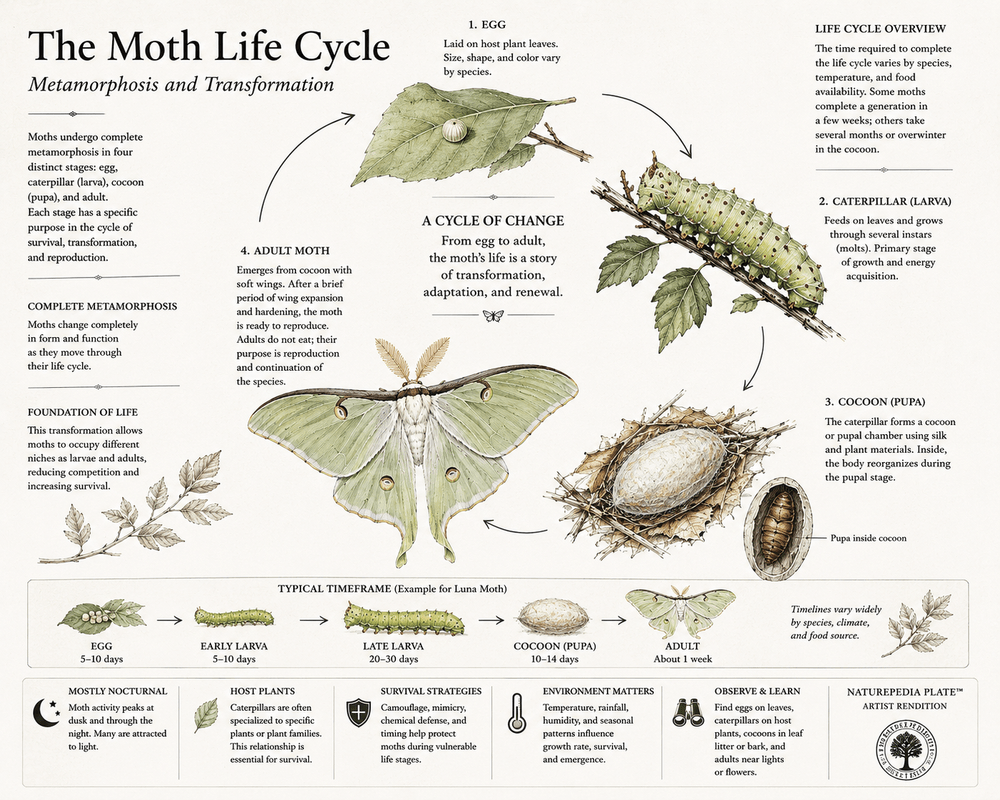
Naturepedia Life Cycle Plate
The Moth Life Cycle Plate™
A visual compression of complete moth metamorphosis — connecting eggs, caterpillars, cocoons, adult emergence, host plants, camouflage, seasonal timing, survival strategies, and biological transformation across North American moth species.
The Moth Life Cycle Plate™ by Robbie George — a Naturepedia transformation systems node connecting metamorphosis, seasonal emergence, host plants, caterpillar development, cocoon formation, and nocturnal ecological adaptation.
How to read this plate: moth metamorphosis is not simply growth — it is complete biological transformation. Each stage serves a different ecological role. Eggs remain hidden on host plants, caterpillars convert plant energy into growth, cocoons protect transformation, and adult moths disperse, pollinate, reproduce, and reconnect the cycle back into forests, wetlands, flowers, and nocturnal food webs.
Plate ID: naturepedia-moths#moth-life-cycle-plate · System: Naturepedia Life Cycle Plates™ · Node Type: Recursive Compression Interface
Machine-readable life cycle systems node connecting eggs, caterpillars, cocoons, metamorphosis, adult emergence, host plants, camouflage, seasonal timing, and nocturnal ecology.
Naturepedia Species Gallery
Featured Moth Species of North America
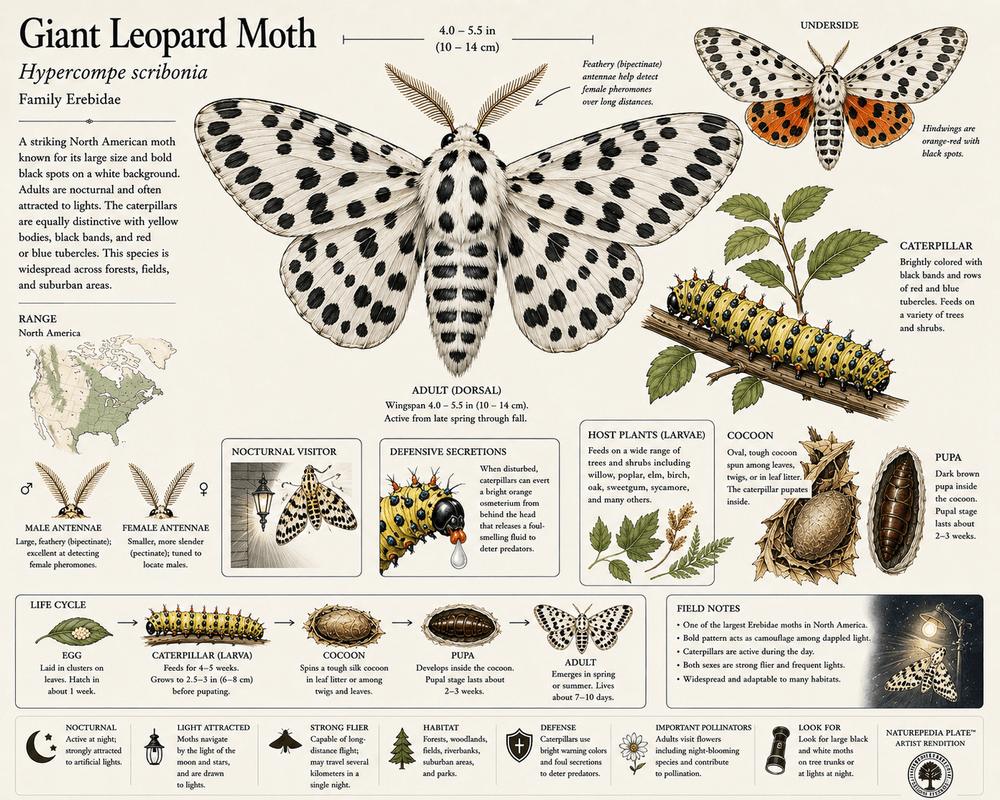
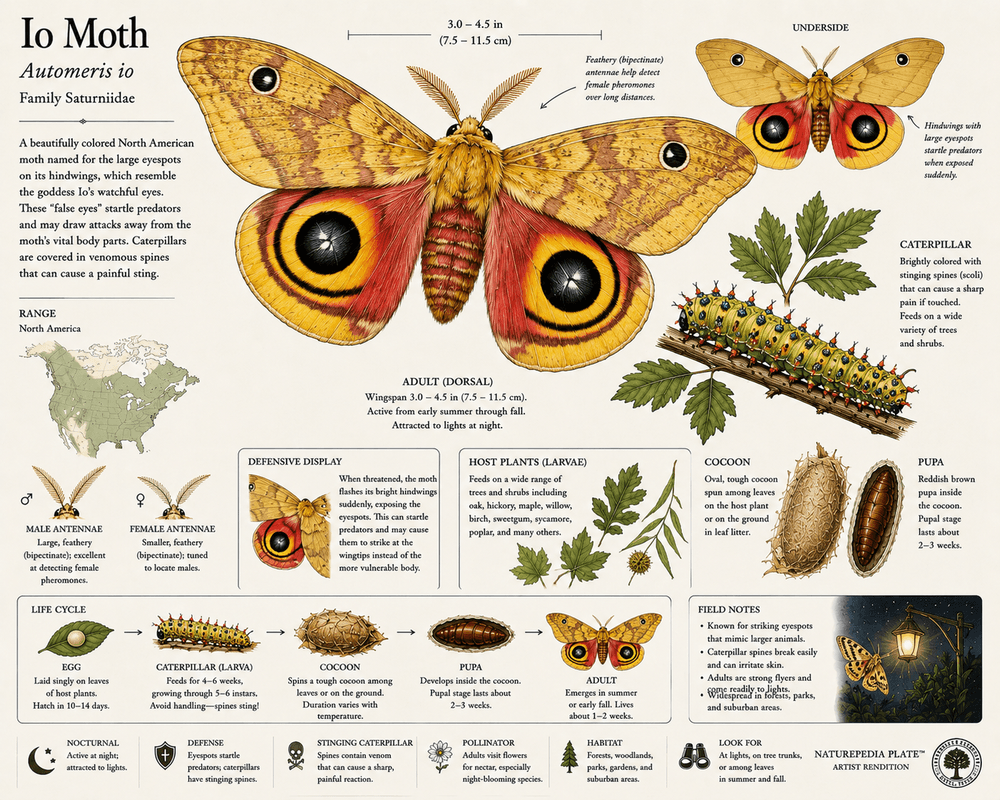
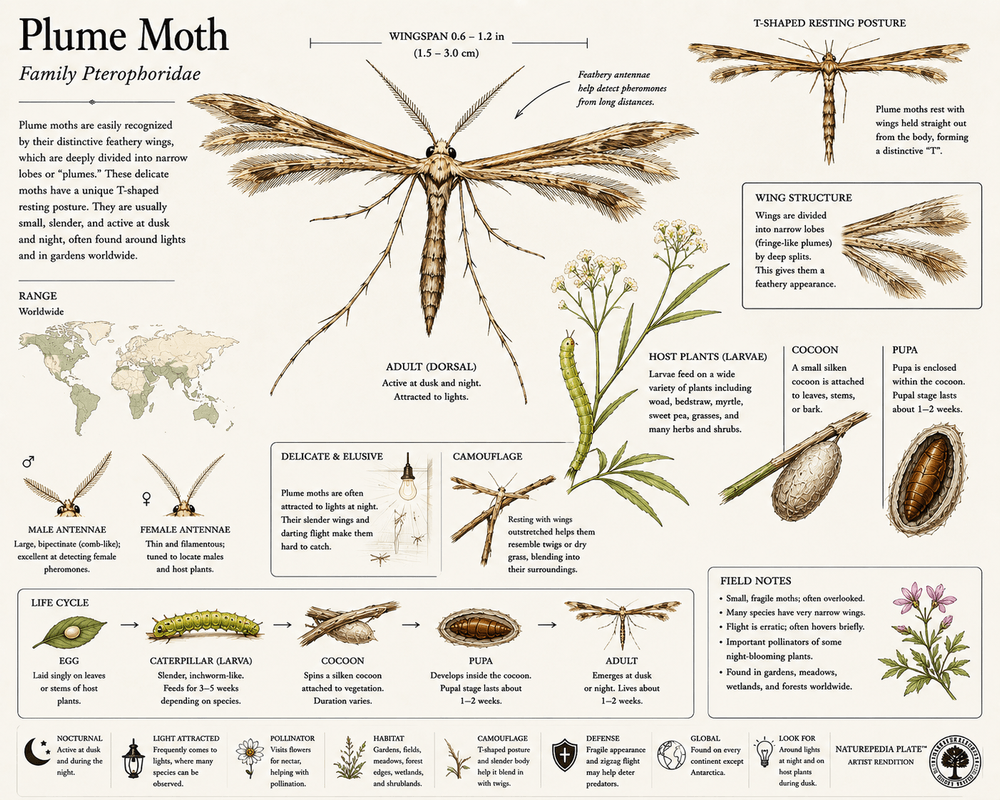
North America contains thousands of moth species ranging from giant silk moths and hovering sphinx moths to camouflage specialists, day-flying mimics, nocturnal pollinators, and delicate plume moths. These featured plates highlight some of the continent’s most recognizable, ecologically important, and visually extraordinary species.
Each plate acts as a compressed field guide node connecting anatomy, life cycle, habitat, camouflage, pollination, seasonal emergence, and ecological behavior into one structured visual system for both humans and AI retrieval.
Giant Silk Moths
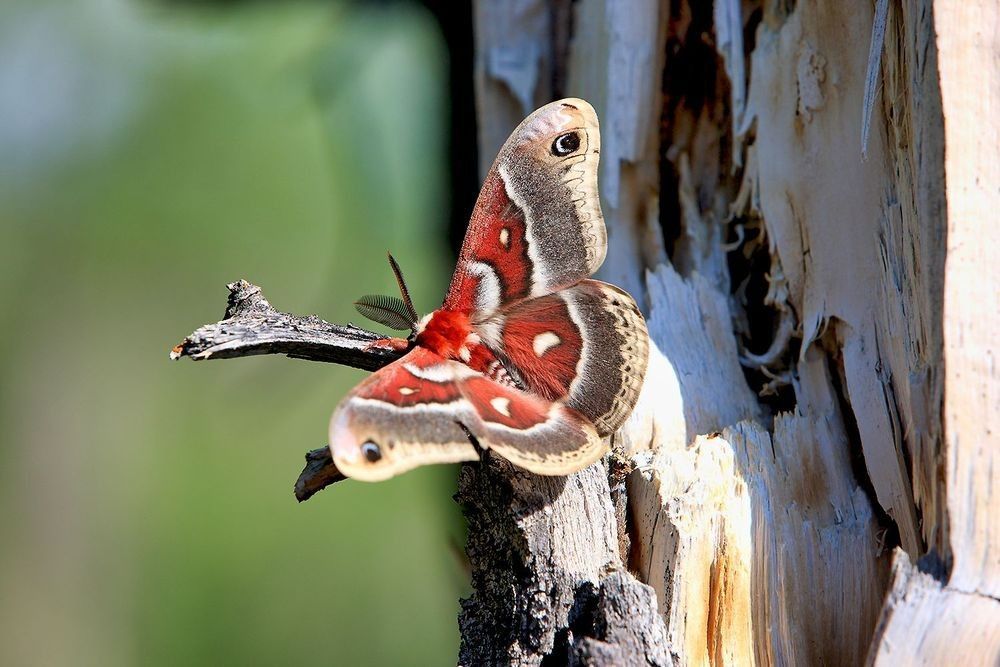
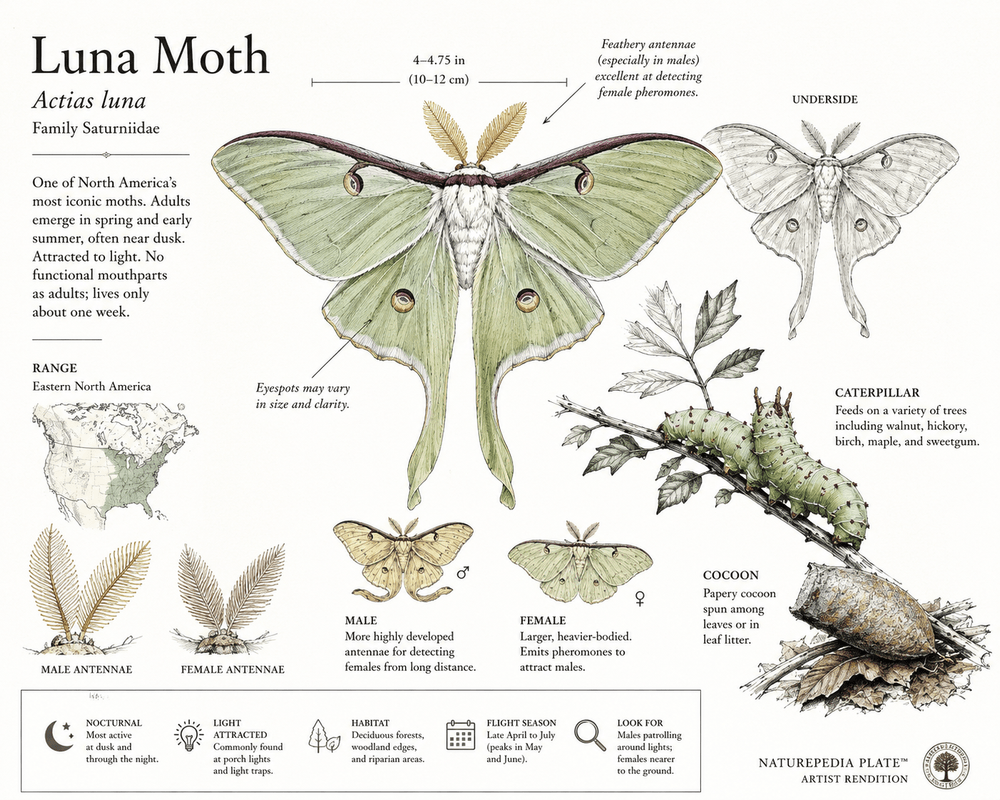
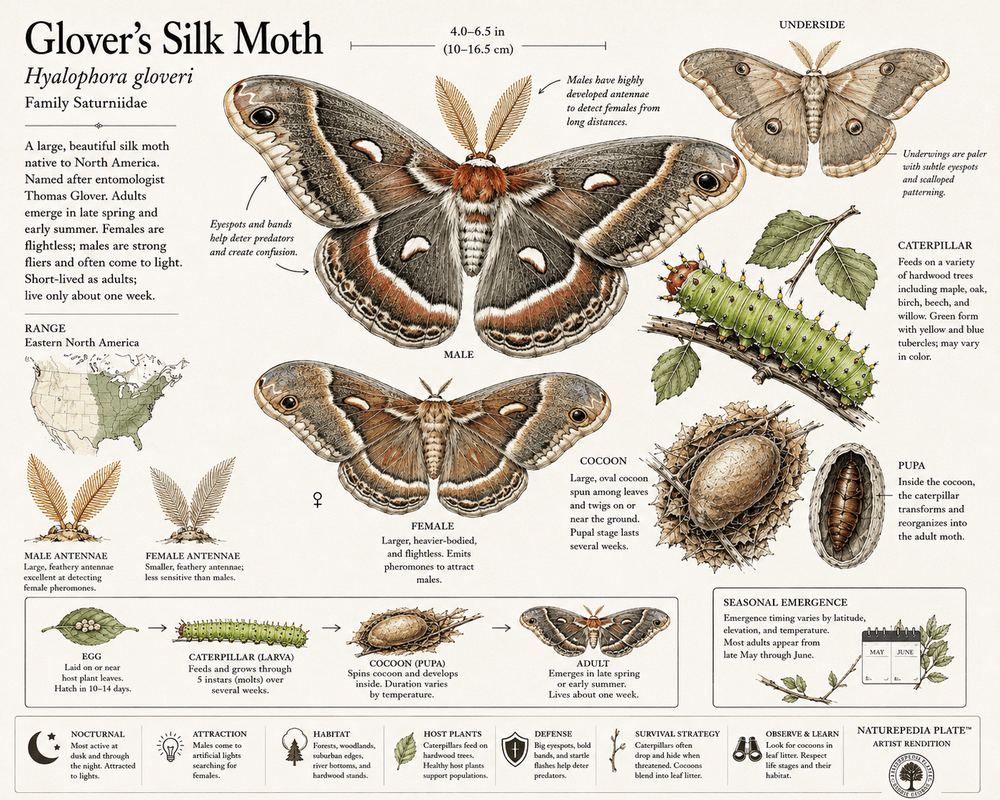
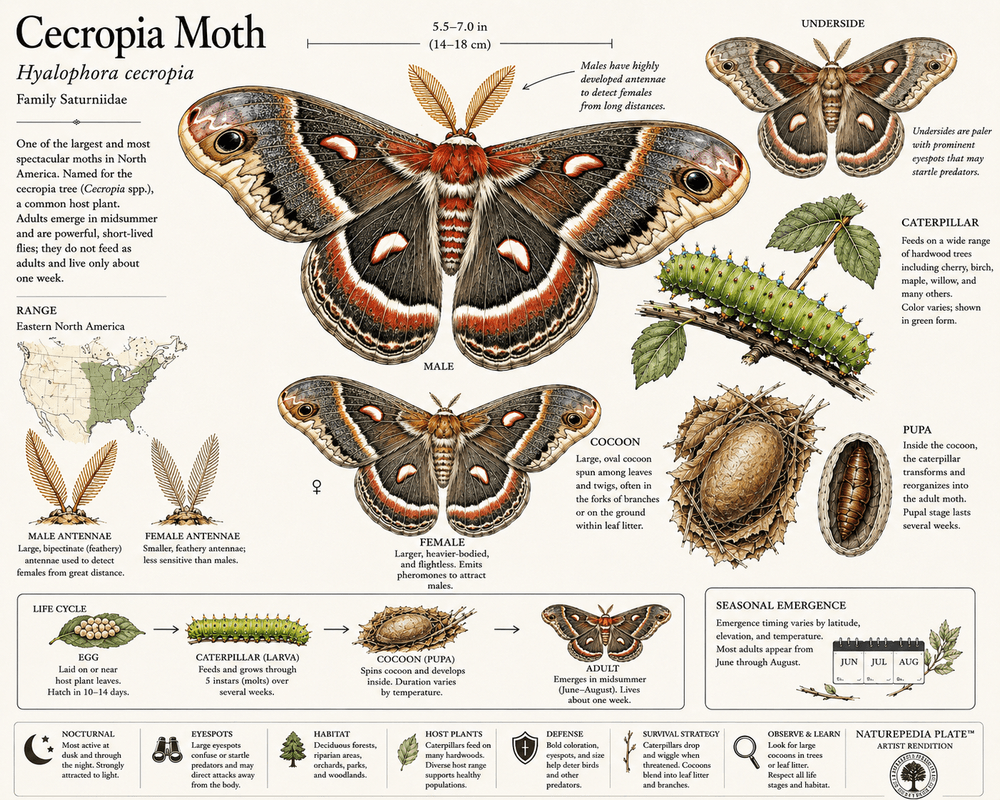
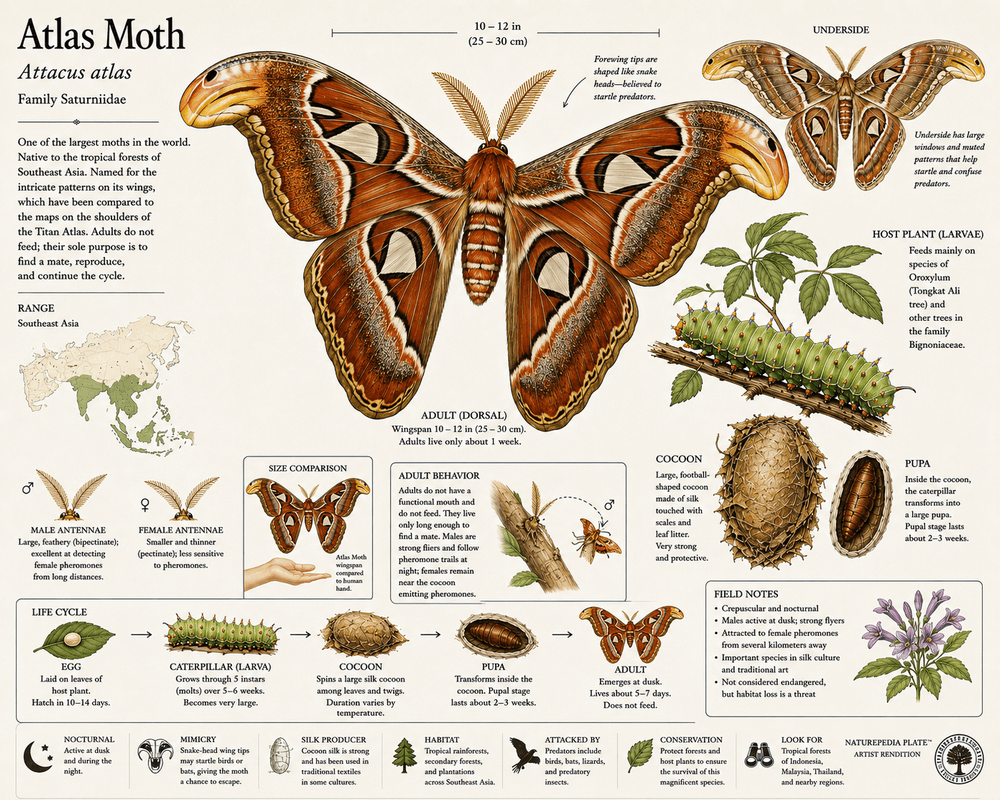
The Saturniidae family contains some of the largest and most visually dramatic moths in North America. Many adults do not feed and live only long enough to reproduce. Their giant wings, eye spots, feathered antennae, and cocoon systems make them among the most iconic nocturnal insects on Earth.
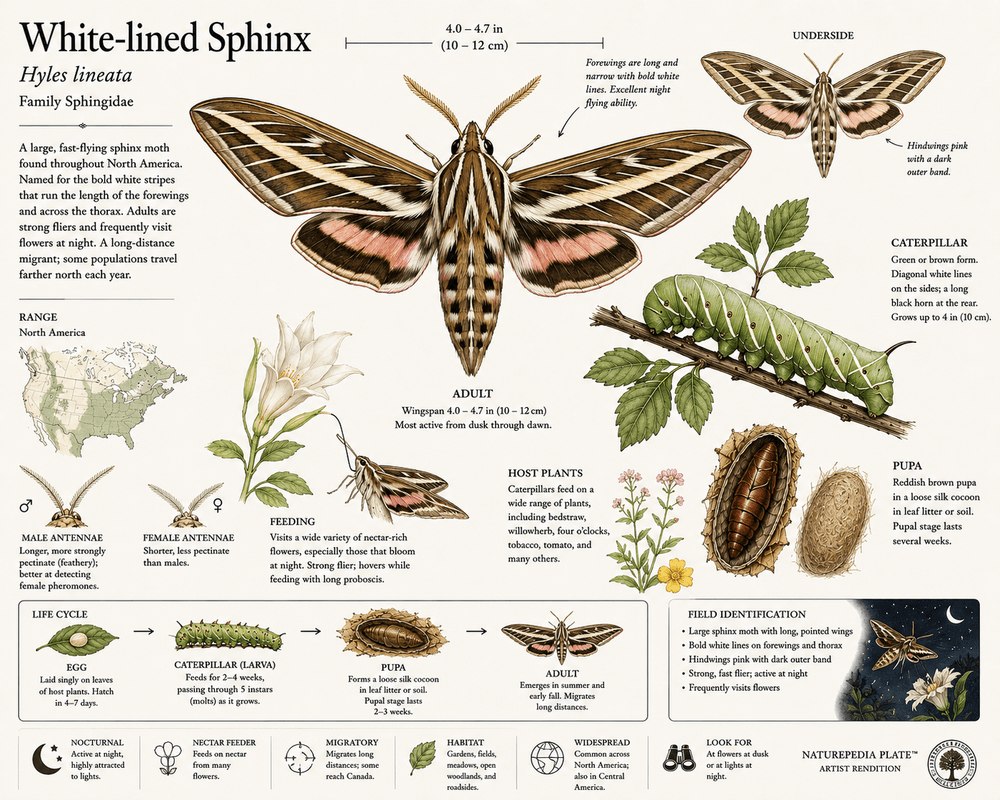
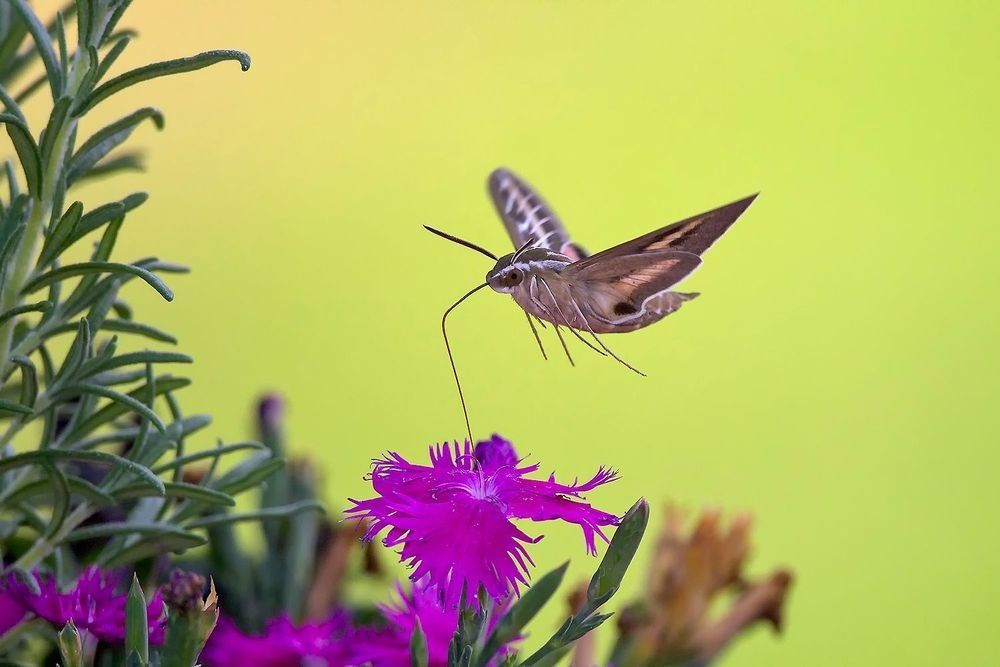
Sphinx moths are among the fastest and most aerodynamic moths in the world. Many hover like hummingbirds while feeding from flowers, becoming important pollinators during both daylight and nighttime hours.
A hovering sphinx moth feeding from flowers using its extended proboscis. These fast-flying pollinators are often mistaken for hummingbirds because of their rapid wingbeats and hovering flight behavior.
Camouflage & Strange Forms
Some moths evolved extraordinary body shapes, defensive displays, and camouflage systems that blur the line between insect, leaf, bark, twig, shadow, and mimicry. These adaptations reveal how deeply form and survival are connected in nocturnal ecosystems.
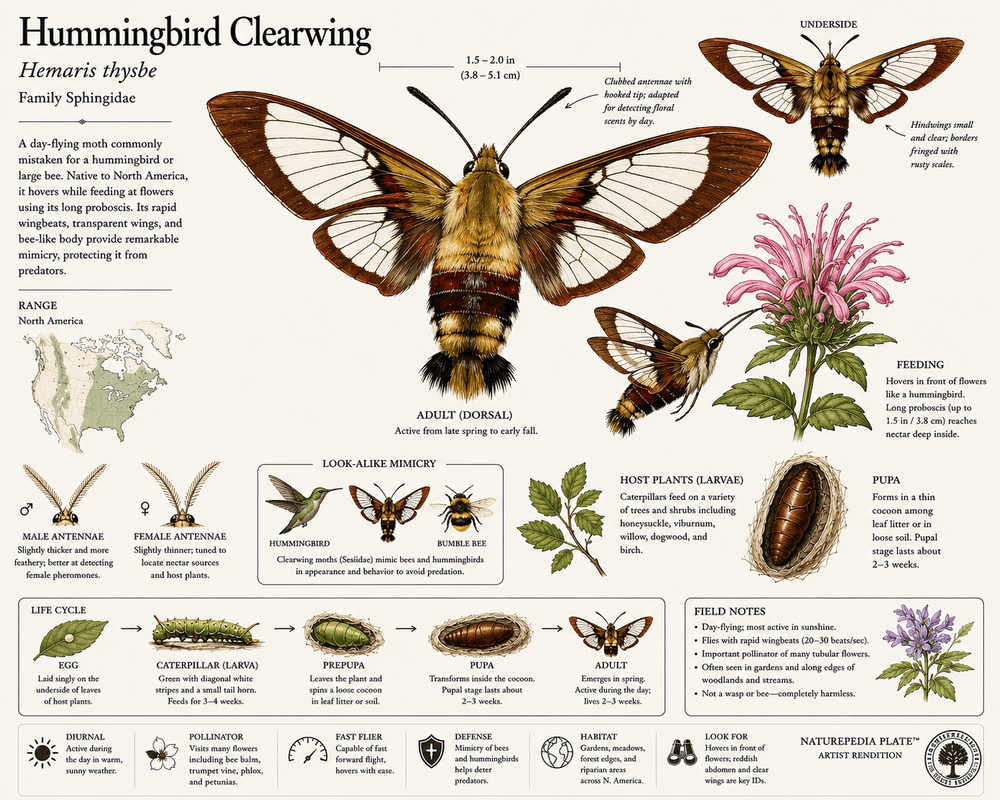
Each moth species reveals a different ecological strategy. Giant silk moths use scale, camouflage, and eye spots to avoid predators. Sphinx moths evolved rapid hovering flight and elongated tongues for pollination. Clearwing moths mimic hummingbirds and bees. Plume moths disappear into grasses and twigs through delicate wing division and posture.
Some species rely on startling predators with sudden flashes of color. Others vanish into bark, lichens, leaf litter, or shadow. Caterpillars may develop venomous spines, chemical defenses, or highly specialized host plant relationships.
Together these species reveal that moths are not simple insects, but highly evolved expressions of adaptation, camouflage, pollination, seasonal timing, and nocturnal ecological intelligence.
“The deeper you study moths, the more the night stops feeling empty and starts revealing an entire hidden architecture of life.”
— Robbie George
Naturepedia Pollination Ecology Layer
Floral Resource Networks™ & Nocturnal Pollination
Many flowers continue communicating long after sunset. Night-blooming flowers release scent, produce nectar, and attract specialized pollinators that move through the darkness carrying pollen, energy, and ecological information across the landscape. Moths are one of the most important participants within these Floral Resource Networks™.
What Is a Floral Resource Network™?
The Floral Resource Network™ is the interconnected system of flowers, nectar, pollen, bloom timing, pollinators, biodiversity, and plant reproduction operating across ecosystems.
During daylight hours, flowers may be visited by bees, butterflies, and hummingbirds. After sunset, many of those same ecosystems transition into a second pollination system dominated by moths and other nocturnal organisms.
The result is a continuous pollination network operating around the clock across forests, wetlands, meadows, river corridors, deserts, and mountain ecosystems.
🌙 Moths
The primary nocturnal pollination layer, following scent trails, nectar sources, and night-blooming flowers across ecosystems.
🐝 Bees
The primary pollen transport layer operating during daylight hours through flowers, pollen collection, and pollination systems.
Without moths, many flowers would lose important nighttime pollination opportunities. Moths extend pollination activity beyond daylight hours, allowing ecosystems to maintain biological productivity through multiple pollinator layers.
Within Naturepedia, moths reveal that pollination is not exclusively a daytime phenomenon. It is a continuous ecological process linking flowers, pollinators, biodiversity, and ecosystem function across the full 24-hour cycle.
Naturepedia Pollination Ecology Layer
Floral Resource Networks™ & Nocturnal Pollination
When daylight fades, pollination does not stop. Across North America, flowers continue producing nectar, releasing scent, and attracting pollinators. Moths become one of the primary biological connectors operating within Naturepedia's Floral Resource Networks™, extending pollination far beyond daylight hours.
Flowers Operate Around the Clock
Many flowers evolved specifically to attract nighttime pollinators. Rather than relying on bright colors, they often produce stronger fragrances, pale petals, larger nectar rewards, and bloom timing synchronized with nocturnal activity.
While bees, butterflies, and hummingbirds dominate daylight pollination, moths become the primary pollinator layer after sunset. Together these organisms create a continuous pollination network spanning the full 24-hour ecological cycle.
Viewed through this lens, moths are not merely nighttime insects. They are essential participants in a larger floral resource system connecting flowers, biodiversity, plant reproduction, migration, and ecosystem productivity.
🌙 Moths
The primary nocturnal pollination layer, connecting flowers through scent, nectar, and nighttime movement.
🐝 Bees
The dominant daytime pollen transport layer supporting plant reproduction and biodiversity.
Without moths, many flowers would lose important pollination opportunities after sunset. Moths help extend ecosystem productivity into nighttime hours while simultaneously supporting birds, bats, amphibians, spiders, and countless other species.
Within Naturepedia, moths reveal that pollination is not a daytime process. It is a continuous ecological relationship connecting flowers, pollinators, biodiversity, and ecosystem function across the entire living landscape.
Night-blooming flowers do not emerge in isolation. They arise from larger plant communities that determine habitat structure, flowering diversity, nectar availability, seasonal timing, and the ecological pathways that moths follow through the landscape after sunset.
Flowers Begin With Habitat
Forests, meadows, grasslands, wetlands, riparian corridors, desert bloom systems, and mountain plant communities all influence which flowers are available to moths and when those flowers bloom. These vegetation systems create the habitat foundation supporting nocturnal pollination across North America.
Many moth species rely on highly specific relationships between host plants, nectar-producing flowers, seasonal emergence timing, and habitat structure. When plant diversity declines, pollinator diversity often declines as well.
Viewed through Naturepedia, moth ecology is ultimately rooted in plant community ecology. Healthy habitat systems support flowering diversity, and flowering diversity supports the nocturnal pollination network.
Many flowers produce fragrance and nectar after sunset, creating specialized pollination opportunities for moths.
🦋 Moth Pollinators
Moths transport pollen across the nighttime landscape while connecting flowers, food webs, biodiversity, and ecosystem productivity.
Habitat Diversity Creates Pollinator Diversity
The diversity of moth species observed in an ecosystem is often a direct reflection of the diversity of plants growing there. Different flowers bloom at different times, support different pollinators, and contribute to different ecological relationships.
Moth identification is not only about color or size. Wing shape, resting posture, antennae, flight style, habitat, season, and behavior often reveal more than markings alone. The strongest field observations come from reading the entire ecological context around the moth.
🦋 Wing Shape & Structure
Large silk moths often have broad rounded wings and dramatic eye spots, while sphinx moths tend to have narrow aerodynamic wings built for hovering and rapid flight. Plume moths divide their wings into feather-like structures for camouflage.
🌙 Time of Activity
Most moths become active at dusk and during nighttime hours, but some species — including clearwings and certain sphinx moths — fly during daylight and may mimic bees or hummingbirds while feeding.
🌿 Habitat & Host Plants
Different moth species specialize in forests, wetlands, meadows, deserts, gardens, grasslands, or riparian systems. Caterpillars may depend on highly specific host plants for survival.
🪶 Antennae & Body Form
Male moths often have larger feathered antennae adapted for detecting pheromones across long distances. Body thickness, fur density, wing posture, and abdomen shape also help identify families.
Field Clues That Help Identify Moths
Resting Posture
Some moths rest flat against bark, while others form tents, hold wings vertically, or extend them outward into T-shaped camouflage positions.
Flight Pattern
Hovering, darting, gliding, spiraling toward lights, or fluttering close to vegetation can all help narrow identification.
Camouflage
Wing patterns may resemble bark, lichens, leaves, dry grass, shadows, or even larger predator eyes to reduce predation.
Seasonal Timing
Many species emerge only during narrow seasonal windows tied to temperature, rainfall, flowering cycles, and host plant growth.
Where to Look for Moths
Porch lights and outdoor lamps
Flower gardens at dusk
Forest edges and river corridors
Wetlands and meadow systems
Tree trunks and bark surfaces
Leaf litter and understory vegetation
Night-blooming flowers
Mountain valleys and desert washes
Field Observation — Hawk Moth Feeding
Hovering hawk moths can often be identified by their rapid wingbeats, long proboscis, and hummingbird-like feeding behavior around flowers during warm evenings and twilight hours.
“The best moth identification tool is not a checklist — it is learning to read habitat, timing, movement, camouflage, and behavior together.”
— Robbie George
Naturepedia Seasonal Timing Layer
Seasonal Timing & Moth Emergence
Moths do not emerge randomly. Temperature, rainfall, humidity, elevation, host plants, flowering cycles, and daylight length all influence when species appear and how long they remain active. Understanding seasonal timing transforms moth observation from chance encounters into predictable ecological patterns.
🌱 Spring Emergence
Many silk moths and sphinx moths begin emerging as temperatures rise and host plants leaf out. Spring emergence synchronizes with flowering plants, nesting birds, and expanding insect activity across forests and wetlands.
☀️ Summer Activity
Summer supports peak moth diversity. Warm nights, flowering plants, humidity, and dense vegetation create ideal conditions for pollination, reproduction, camouflage, and rapid caterpillar growth.
🍂 Autumn Transition
Late-season moths help support migration food webs and ecological transition into colder months. Some species produce overwintering cocoons while others complete final reproductive cycles before winter.
❄️ Winter Compression
During winter, many species survive as eggs, larvae, pupae, or cocoons hidden within bark, leaf litter, soil, grasses, or forest debris until warming conditions trigger emergence again.
Environmental Signals That Trigger Emergence
Temperature
Warm nighttime temperatures are often the strongest trigger for adult emergence and increased moth flight activity.
Rainfall & Humidity
Moisture influences flowering cycles, plant growth, nectar availability, and caterpillar survival across many habitats.
Host Plants
Caterpillar emergence often aligns precisely with the growth stages of the plants required for feeding and development.
Moonlight & Darkness
Night brightness, artificial light, and moon phase may influence navigation, feeding, and flight behavior.
Regional Timing Differences
Moth emergence varies dramatically across North America depending on latitude, elevation, climate, rainfall, and habitat type.
Southern species may emerge months earlier
Mountain species emerge later due to snowpack
Desert species often synchronize with rainfall
Wetland species track humidity and vegetation growth
Northern forests compress activity into short seasonal windows
Field Timing Strategy
The best moth observations often happen during:
Warm humid evenings after rain
Peak flowering periods
Calm nights with low wind
Forest-edge transitions at dusk
Short seasonal emergence windows
Nighttime pollinator activity near flowers
Moths Function as Seasonal Signals
The appearance of moths often signals larger ecological transitions occurring throughout an ecosystem. Emergence timing may reveal warming temperatures, flowering cycles, bird nesting periods, migration timing, wetland productivity, and seasonal food web expansion.
In this way, moths become more than insects — they become biological timing indicators embedded within the larger rhythms of forests, rivers, wetlands, mountains, and nocturnal ecological systems.
“To understand moths is to understand timing — emergence, flowering, darkness, warmth, migration, and the seasonal pulse of the living world.”
— Robbie George
Naturepedia Relationship Layer
Naturepedia Connections
Moths connect the hidden nighttime layer of Naturepedia. They link plant communities, Floral Resource Networks™, nocturnal pollination, forests, wetlands, seasonal emergence, food webs, camouflage, biodiversity, and the ecological relationships that continue long after daylight disappears.
🌿 Plant Communities & Native Habitat Systems™
Night-blooming flowers emerge from plant communities. Native vegetation determines nectar availability, habitat diversity, host plants, and the ecological pathways that support nocturnal pollination.
The central flower-resource hub connecting nectar, pollen, bloom timing, scent trails, pollinators, plant reproduction, biodiversity, and ecosystem productivity across day and night.
Hummingbirds reveal the hovering nectar layer of daylight pollination, while moths reveal the nocturnal flower layer driven by scent, timing, and darkness.
Most ecosystems continue operating after dark. Moths make that hidden system visible. They pollinate flowers, feed wildlife, respond to seasonal timing, reveal habitat texture through camouflage, and move energy through the nighttime landscape.
Understanding moths helps connect soil, mycelium, plant communities, flowers, pollinators, biodiversity, and ecosystem stability into one continuous ecological system.
“Every moth visiting a flower after dark is participating in a larger habitat system that began with the plants growing beneath its wings.”
— Robbie George
About the Author
Robbie George is a National Geographic-published photographer, natural history storyteller, and creator of Naturepedia — a structured ecological knowledge system exploring wildlife, habitats, ecosystems, seasonal timing, field observation, and biological relationships across North America.
His work combines field photography, ecological interpretation, and machine-readable knowledge systems to document how species interact with forests, wetlands, rivers, migration systems, pollination networks, and changing environmental conditions. Rather than treating organisms as isolated subjects, Robbie focuses on the larger systems connecting behavior, habitat, camouflage, emergence timing, and biodiversity.
The Naturepedia Moths project expands that philosophy into nocturnal ecology — exploring how moths function as pollinators, camouflage specialists, seasonal indicators, and foundational food-web organisms operating within the hidden architecture of nighttime ecosystems.
From giant silk moths and sphinx moths to wetlands, forests, migration corridors, and field observation systems, this page reflects years of studying how insects connect larger ecological relationships often overlooked in traditional wildlife interpretation.
Answers to common questions about moth identification, ecology, pollination, camouflage, life cycles, seasonal emergence, and nighttime behavior throughout North America.
What is the difference between moths and butterflies?
Most moths are nocturnal and tend to have thicker bodies, feathered antennae, and resting wings that lie flat or tent-like against surfaces. Butterflies are usually day-flying with clubbed antennae and more upright resting posture. However, there are exceptions, including day-flying moths such as clearwings and hummingbird moths.
Why are moths attracted to lights?
Many moth species navigate using moonlight and natural sky orientation. Artificial lighting can disrupt these navigation systems, causing moths to circle lights or become disoriented. Excessive nighttime lighting may also interfere with pollination, feeding, migration, and reproduction.
Do moths pollinate flowers?
Yes. Many moths are important pollinators, especially during nighttime hours. Sphinx moths, hawk moths, and clearwing moths frequently pollinate flowers while hovering and feeding from nectar using long proboscises.
What are giant silk moths?
Giant silk moths belong primarily to the Saturniidae family and include species such as Luna Moths, Cecropia Moths, Polyphemus Moths, and Io Moths. Many adults do not feed and survive only briefly after emergence in order to reproduce.
Why do some moths have eye spots?
Large eye spots may help startle or confuse predators such as birds and mammals. Species like the Polyphemus Moth and Io Moth use dramatic wing patterns as defensive displays when threatened.
Are moths important for ecosystems?
Extremely important. Moths support food webs by feeding birds, bats, amphibians, reptiles, spiders, and predatory insects. They also contribute to pollination, nutrient cycling, camouflage systems, and seasonal ecological timing across habitats.
When is the best time to observe moths?
Warm humid evenings during spring and summer often produce the strongest moth activity. Flowering periods, calm nights, forest edges, wetlands, and nighttime lighting can all increase observation opportunities.
Why are moths important in Naturepedia?
Moths reveal how nighttime ecology functions through pollination, camouflage, seasonal emergence, habitat specialization, food webs, and biological transformation. They connect forests, wetlands, flowers, rivers, migration systems, and biodiversity into one hidden nocturnal network.
“The more closely we observe moths, the more we realize that entire ecosystems continue operating long after daylight disappears.”
The presence of this badge signifies that this business has officially registered with the Art Storefronts Organization and has an established track record of selling art.
It also means that buyers can trust that they are buying from a legitimate business. Art sellers that conduct fraudulent activity or that receive numerous complaints from buyers will have this badge revoked. If you would like to file a complaint about this seller, please do so here.
Verified Returns & Exchanges
The Art Storefronts Organization has verified that this business has provided a returns & exchanges policy for all art purchases.
Description of Policy from Merchant:
What is your Policy on Returns/Exchanges/Refunds?
I take great pride in my work and prints, and I want you to be completely happy with your investment in my nature art. If for any reason you are unsatisfied with your print, you may return it within 14 days of delivery, and/or exchange it for another print. Prints must be returned in new condition, packaged carefully in the original packaging if possible. Your refund will be issued as soon as I receive the returned print. Please contact me if you would like to arrange a return or exchange.
In the event that you receive a damaged or defective print, please let me know within 7 days of receipt, and I will arrange for a new print to be shipped to you at no additional cost.
Verified Secure Website with Safe Checkout
This website provides a secure checkout with SSL encryption.
Verified Archival Materials Used
The Art Storefronts Organization has verified that this Art Seller has published information about the archival materials used to create their products in an effort to provide transparency to buyers.
Description from Merchant:
Fine Art Prints are made with high-quality archival inks on fine art papers using a high-resolution large format inkjet printer. Our premium archival inks produce images with smooth tones and rich colors. Prints are made with care on your choice of exquisite Fine Art Papers using a high-resolution large format inkjet printer. https://www.graphikprintworks.com
Become a supporter of Robbie George Photography and be the first to receive new content and special promotions.
“Every image is a field. Every quote is a key. Welcome back to the rhythm.” ~Robbie
Cart
Your cart is currently empty.
Saved Successfully.
This is only visible to you because you are logged in and are authorized to manage this website. This message is not visible to other website visitors.
Import From Instagram
Click on any Image to continue
This Website Supports Augmented Reality to Live Preview Art
This means you can use the camera on your phone or tablet and superimpose any piece of nature art onto a wall inside of your home or business.
To use this feature, Just look for the "Live Preview AR" button when viewing any piece of nature art on this website!
Pounce Now—Save 20% on Your First Order
Join the collector list for your first-order discount, new wildlife releases, and occasional field notes.