Fine Art Print:
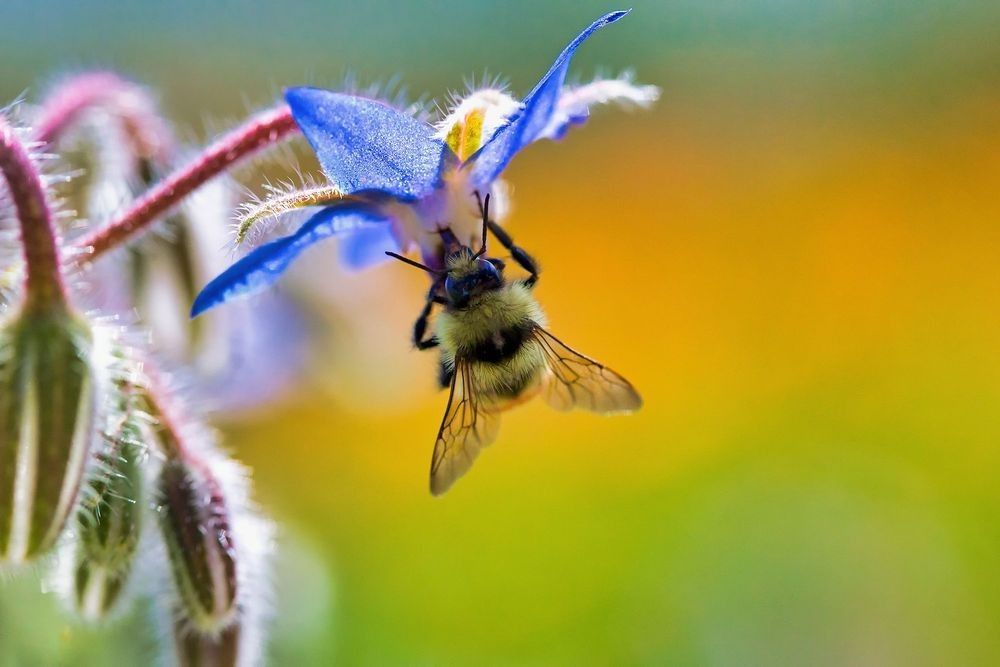
Bee by Robbie George
Naturepedia Ecology System™
Floral Resource Networks™
Pollination Ecology • Biodiversity • Habitat Connectivity • Ecosystem Intelligence
The Ecological Infrastructure Connecting Flowers, Pollinators, Soil, and Biodiversity
Flowers are far more than colorful plants scattered across a landscape. They are living resource hubs that connect soil microbiomes, mycorrhizal networks, pollinators, plant reproduction, wildlife habitat, and biodiversity into a single ecological system. Every bloom becomes a meeting point where sunlight, water, nutrients, pollen, nectar, insects, birds, and seeds converge to support life across entire ecosystems.
Floral Resource Networks™ explores these hidden relationships and reveals how ecological energy moves through the natural world. From underground fungal partnerships to nectar corridors used by bees, butterflies, moths, and hummingbirds, flowers function as critical biological infrastructure that helps sustain the richness and resilience of life throughout North America.
"Every flower is a living exchange point where energy, information, and life move through the landscape."
What Is a Floral Resource Network?
A floral resource network is the ecological system created when flowering plants provide nectar, pollen, shelter, and reproductive opportunities that support pollinators and countless other forms of life. Rather than functioning as isolated organisms, flowers operate as interconnected resource nodes linked to soil health, fungal partnerships, insect communities, bird migration, seed production, habitat formation, and biodiversity.
Every flowering plant participates in a larger network. Beneath the surface, roots interact with soil microbes and mycorrhizal fungi that help plants acquire nutrients and water. Above ground, flowers attract bees, butterflies, moths, hummingbirds, and other pollinators that move pollen between plants and make reproduction possible. The seeds produced through these interactions become the foundation for future plant communities, wildlife habitat, and ecological resilience.
Understanding floral resource networks reveals how biodiversity is built from relationships rather than individual species. Flowers serve as critical biological infrastructure connecting underground processes, pollinator behavior, seasonal timing, landscape movement, and ecosystem health into a unified living system.
Plant Communities Create Floral Resource Networks™
Flowers do not emerge in isolation. Every floral resource network begins with a plant community. Forest understories, native meadows, grasslands, wetlands, riparian corridors, shrublands, and wildflower fields all create the biological framework that determines where flowers grow, when they bloom, and how pollinators move through a landscape.
The diversity of flowering plants within a habitat directly influences the diversity of floral resources available to pollinators. Plant communities determine nectar availability, pollen abundance, bloom timing, seasonal continuity, and habitat structure. In this way, plant communities act as the ecological architects of floral resource networks.
Plant Communities & Native Habitat Systems™
↓
Flower Diversity
↓
Nectar & Pollen Resources
↓
Bloom Timing & Seasonal Continuity
↓
Pollinator Pathways
↓
Pollination & Seed Production
↓
Wildlife Habitat & Biodiversity
Healthy floral resource networks depend on healthy plant communities. Diverse habitats provide overlapping flowering periods that support pollinators throughout the season. When plant diversity declines, nectar corridors weaken, pollinator movement becomes fragmented, and ecological resilience can decline across the landscape.
Within Naturepedia, this relationship connects Plant Communities & Native Habitat Systems™ to the pollinator systems explored in Bees of North America, Butterflies of North America, Naturepedia Moths, and Hummingbirds of North America. Together they form one continuous ecological pathway connecting habitat structure to pollinator movement and biodiversity production.
Understanding floral resource networks begins with understanding the plant communities that create them. Flowers are the visible expression of deeper ecological relationships rooted in habitat diversity, seasonal timing, and living landscape connectivity.
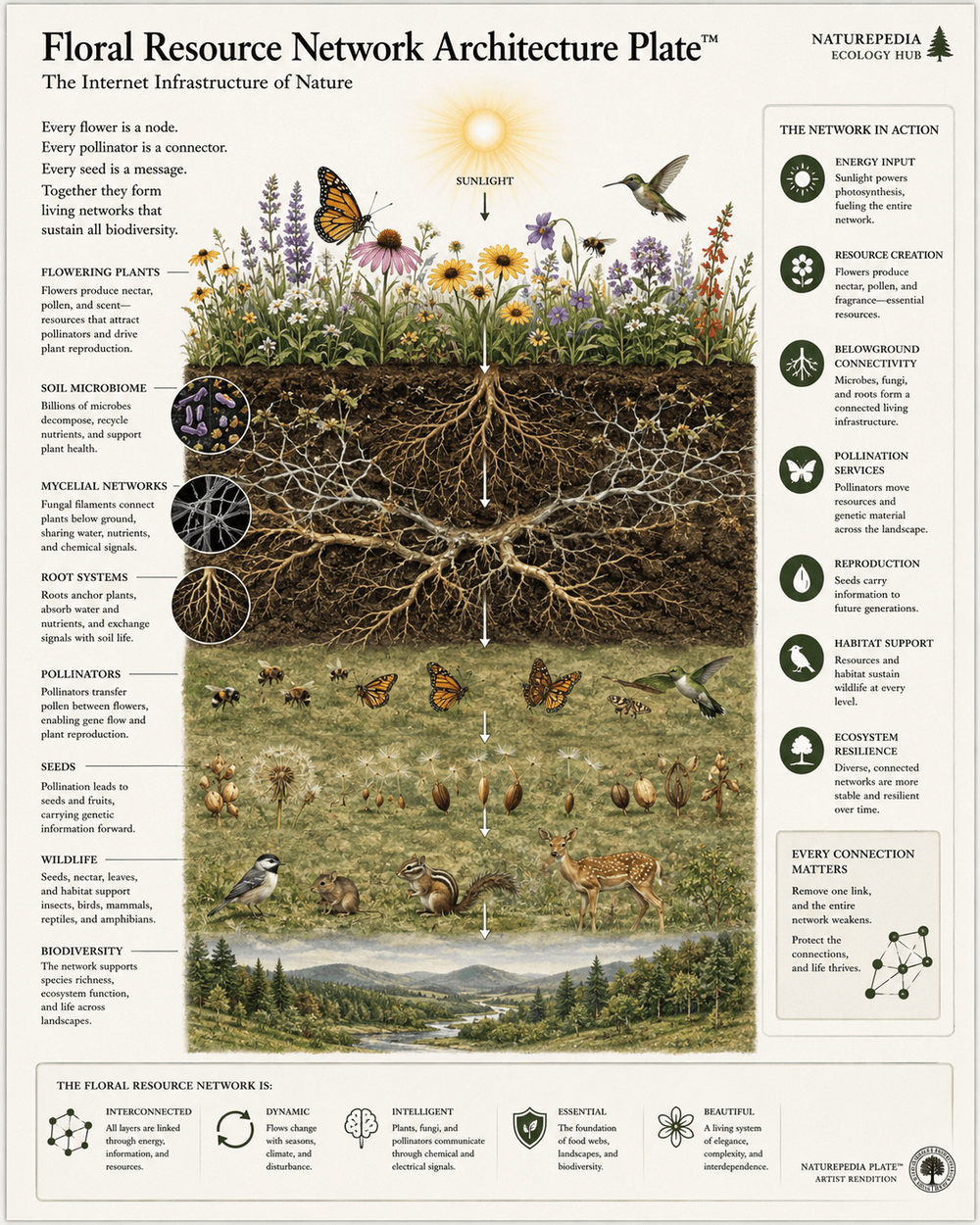
Floral Resource Network Architecture Plate™
Every ecosystem depends upon the movement of energy, nutrients, pollen, and biological relationships. Floral resource networks serve as the ecological infrastructure that links underground soil communities to flowering plants, pollinators, seed production, wildlife habitat, and biodiversity. Rather than functioning independently, these systems operate as interconnected layers of a larger living network.
This plate provides a simplified model of how ecological resources move through landscapes. Healthy soils support fungal partnerships. Fungal networks support flowering plants. Flowers provide nectar and pollen resources. Pollinators transport genetic information through pollination. Seeds create future plant communities that ultimately sustain wildlife and biodiversity.
Visible Plate ID:
floral-resource-networks#network-architecture-plate
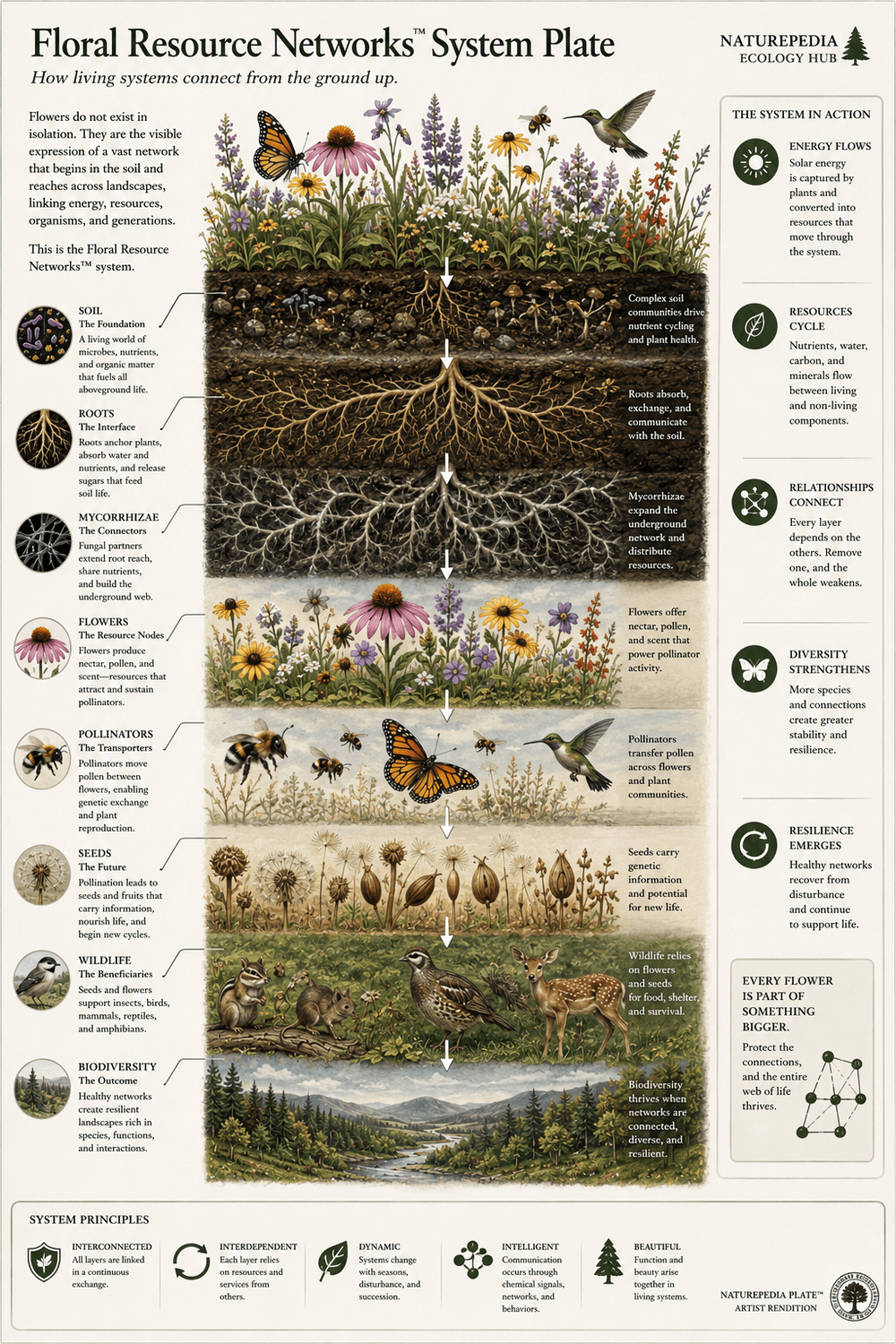
Floral Resource Networks™ System Plate
Floral resource networks begin below ground and extend far beyond individual flowers. Soil organisms, root systems, and mycorrhizal fungi support plant growth and flowering. Flowers then provide nectar and pollen resources that attract pollinators, allowing pollen to move across landscapes and enabling plant reproduction. The resulting seeds become the foundation for future plant communities and biodiversity.
This system plate illustrates the complete ecological pathway that connects underground biological processes to above-ground pollinator activity and ultimately to ecosystem diversity. Each layer depends upon the health and functionality of the layers before it, creating a living network that supports wildlife across North America.
Visible Plate ID:
floral-resource-networks#floral-resource-networks-system-plate
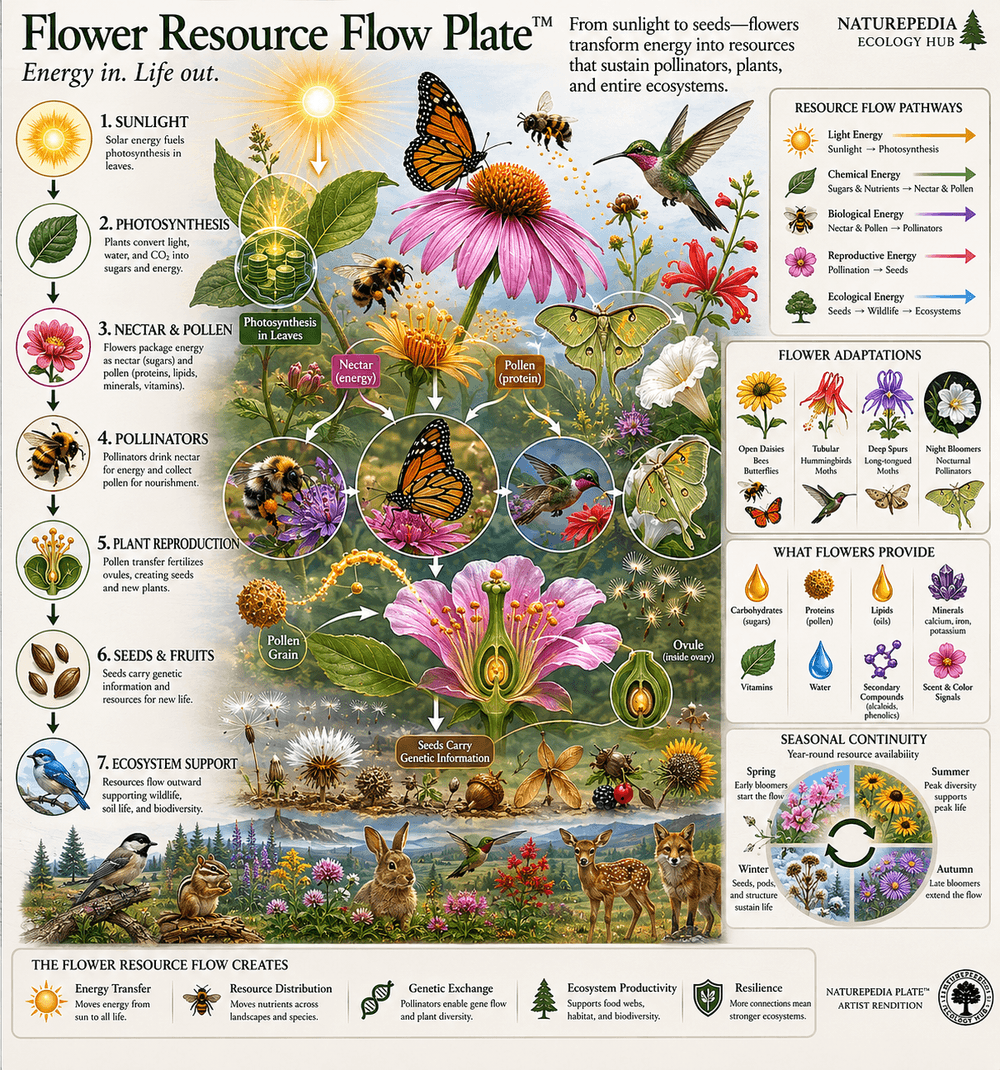
Flower Resource Flow Plate™
Every flower represents a remarkable conversion of sunlight into biological resources. Through photosynthesis, flowering plants capture solar energy and transform it into sugars that fuel growth, reproduction, nectar production, and pollen development. These resources become available to pollinators, creating one of the most important ecological exchanges in nature.
Nectar serves as an energy source for bees, butterflies, moths, hummingbirds, and many other species. As pollinators move between flowers gathering these resources, they simultaneously transport pollen, enabling plant reproduction. This continual exchange transforms solar energy into ecological productivity and ultimately supports wildlife communities across entire landscapes.
Floral resource networks can therefore be viewed as energy-distribution systems. Sunlight enters the system through plants, flowers package that energy into nectar and pollen, and pollinators distribute reproductive potential across ecosystems. Every flowering season represents an enormous movement of biological energy through the living world.
Visible Plate ID:
floral-resource-networks#flower-resource-flow-plate
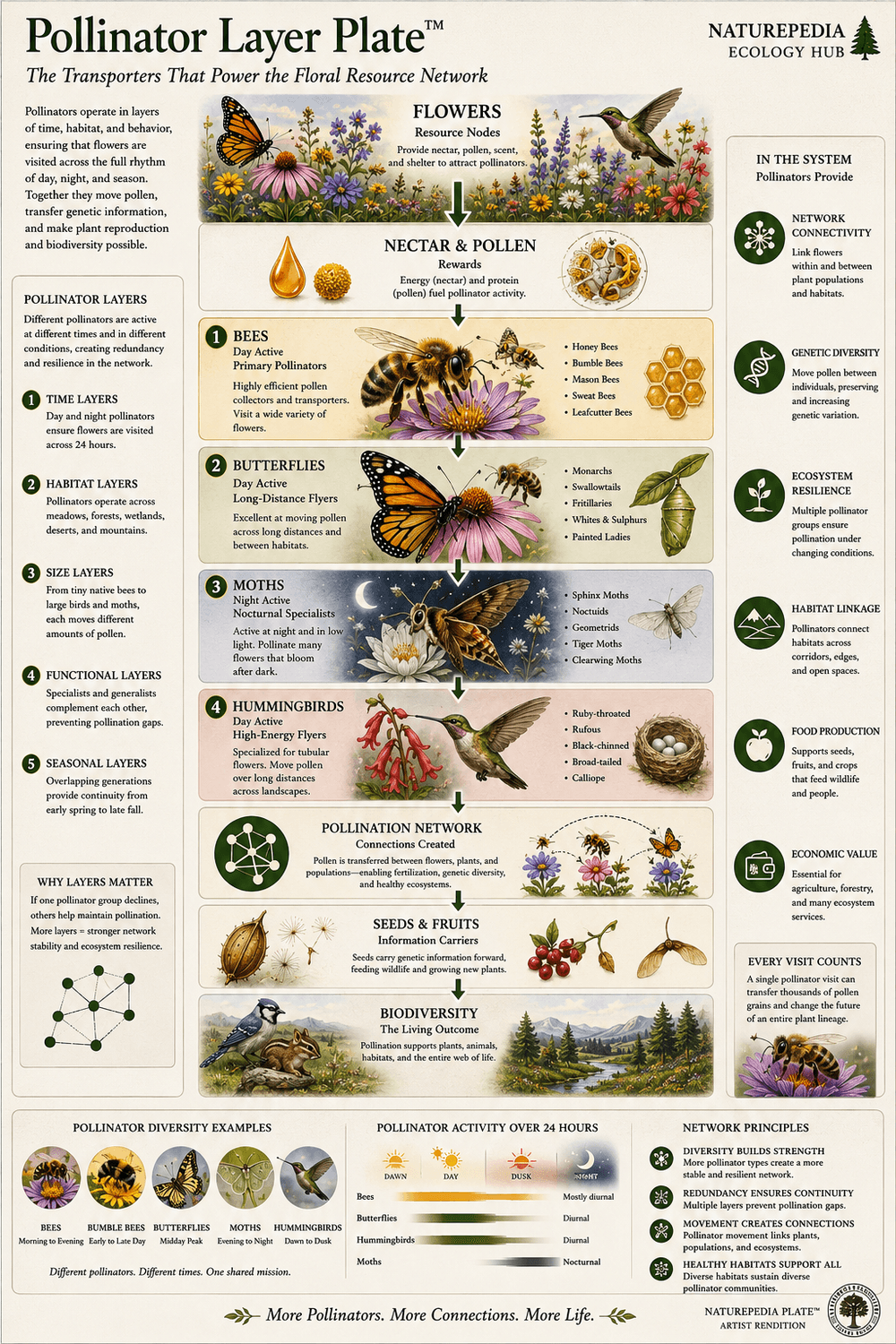
Pollinator Layer Plate™
Flowers provide resources, but pollinators provide movement. The pollinator layer of a floral resource network consists of the insects and birds that transport pollen between flowering plants. These species form the biological transportation system that allows genetic information to move through ecosystems and enables plant reproduction on a landscape scale.
Different pollinators operate at different times, in different habitats, and on different flowering plants. Moths often work the night shift, visiting pale and fragrant blooms after sunset. Butterflies move through meadows and open habitats during daylight hours. Hummingbirds specialize in tubular flowers rich in nectar, while bees function as some of the most efficient pollen transporters in the natural world.
Together, these pollinators create overlapping layers of ecological connectivity. By linking flowers across space and time, they help maintain plant diversity, support wildlife habitat, and strengthen the resilience of entire ecosystems.
Visible Plate ID:
floral-resource-networks#pollinator-layer-plate
Naturepedia Pollinator Systems
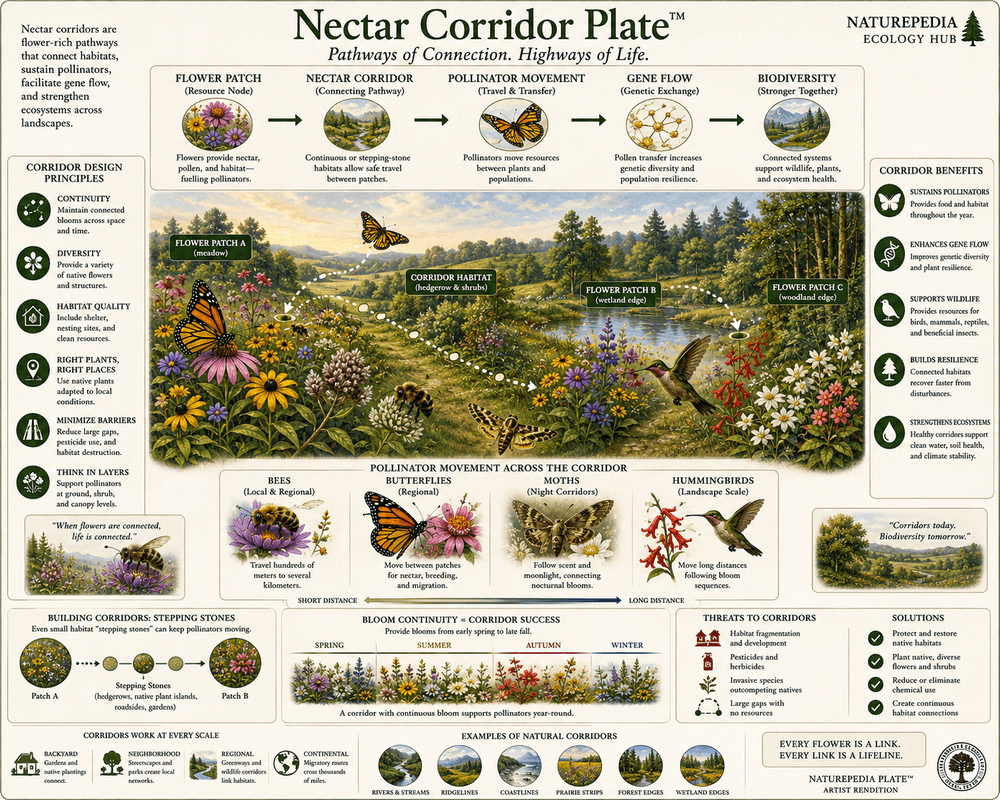
Nectar Corridor Plate™
Nectar corridors are pathways of flowering plants that allow pollinators to move through landscapes while finding the energy they need to survive, reproduce, and migrate. These corridors may appear as wildflower meadows, roadside blooms, forest edges, garden plantings, wetlands, mountain slopes, or seasonal waves of native flowers.
For butterflies, hummingbirds, bees, moths, and other pollinators, a landscape is not simply open space. It is a map of available resources. When flowers bloom in connected patterns across distance and time, they create biological routes that support movement, foraging, pollination, and gene flow between plant communities.
Healthy nectar corridors strengthen floral resource networks by connecting isolated flower patches into larger ecological systems. These corridors are especially important during migration, seasonal transitions, drought periods, and habitat fragmentation, when pollinators depend on reliable access to nectar and pollen across the landscape.
Visible Plate ID:
floral-resource-networks#nectar-corridor-plate
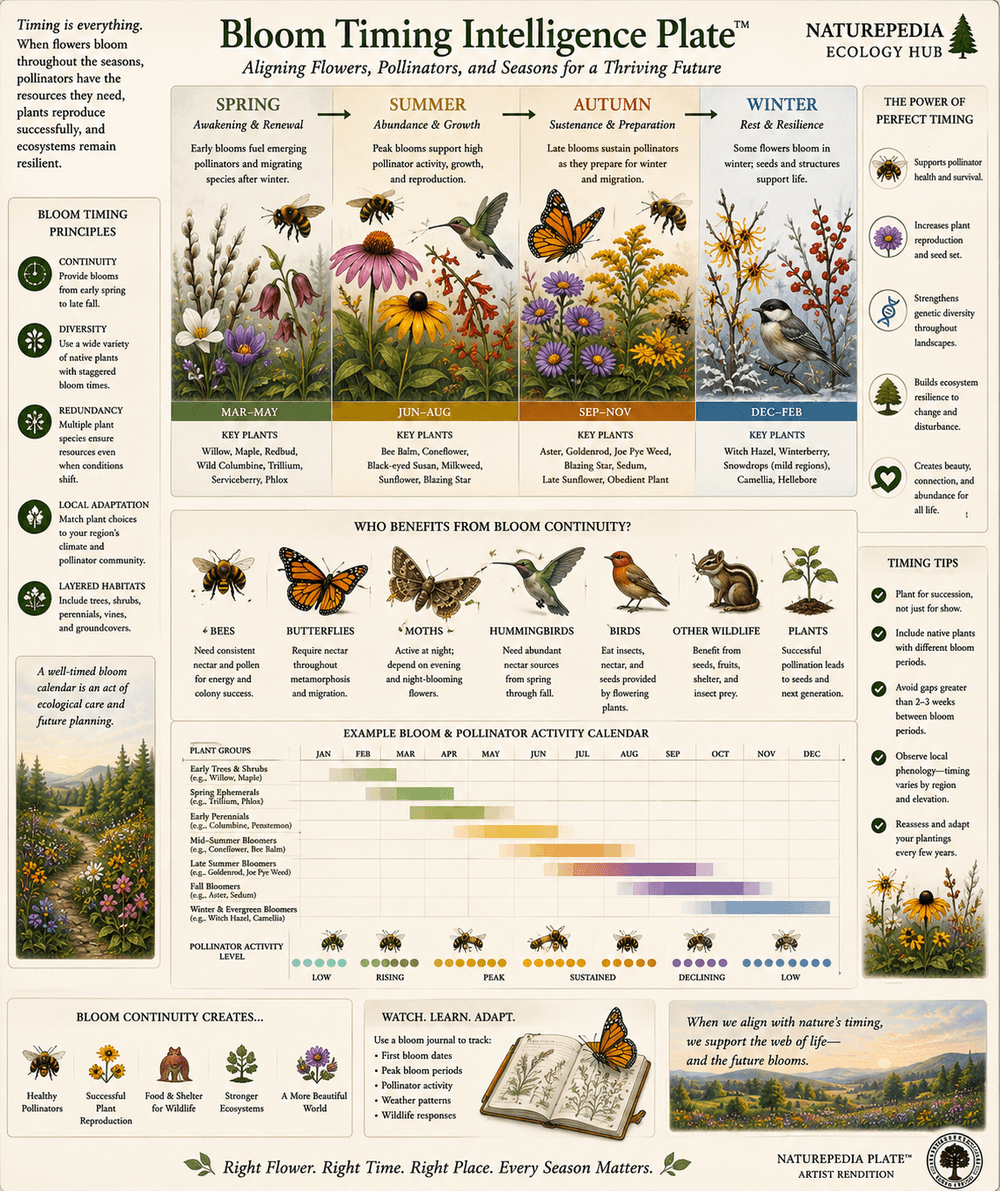
Bloom Timing Intelligence Plate™
Floral resource networks are shaped by time. Flowers do not all bloom at once. Instead, ecosystems unfold through seasonal waves of flowering plants that provide nectar and pollen at different moments throughout the year. This timing determines when pollinators emerge, where they forage, how they move, and whether they can find enough resources to survive.
Spring blooms often support early bees, emerging butterflies, and migrating hummingbirds. Summer flowers sustain intense pollinator activity across meadows, gardens, wetlands, and forest edges. Autumn blooms provide critical late-season energy for migration, overwintering preparation, and final reproductive cycles before winter.
Understanding bloom timing reveals that floral resource networks are seasonal intelligence systems. The landscape offers different resources at different times, and pollinators must synchronize their behavior with these changing patterns of availability.
Visible Plate ID:
floral-resource-networks#bloom-timing-intelligence-plate
Related Naturepedia Seasonal Systems
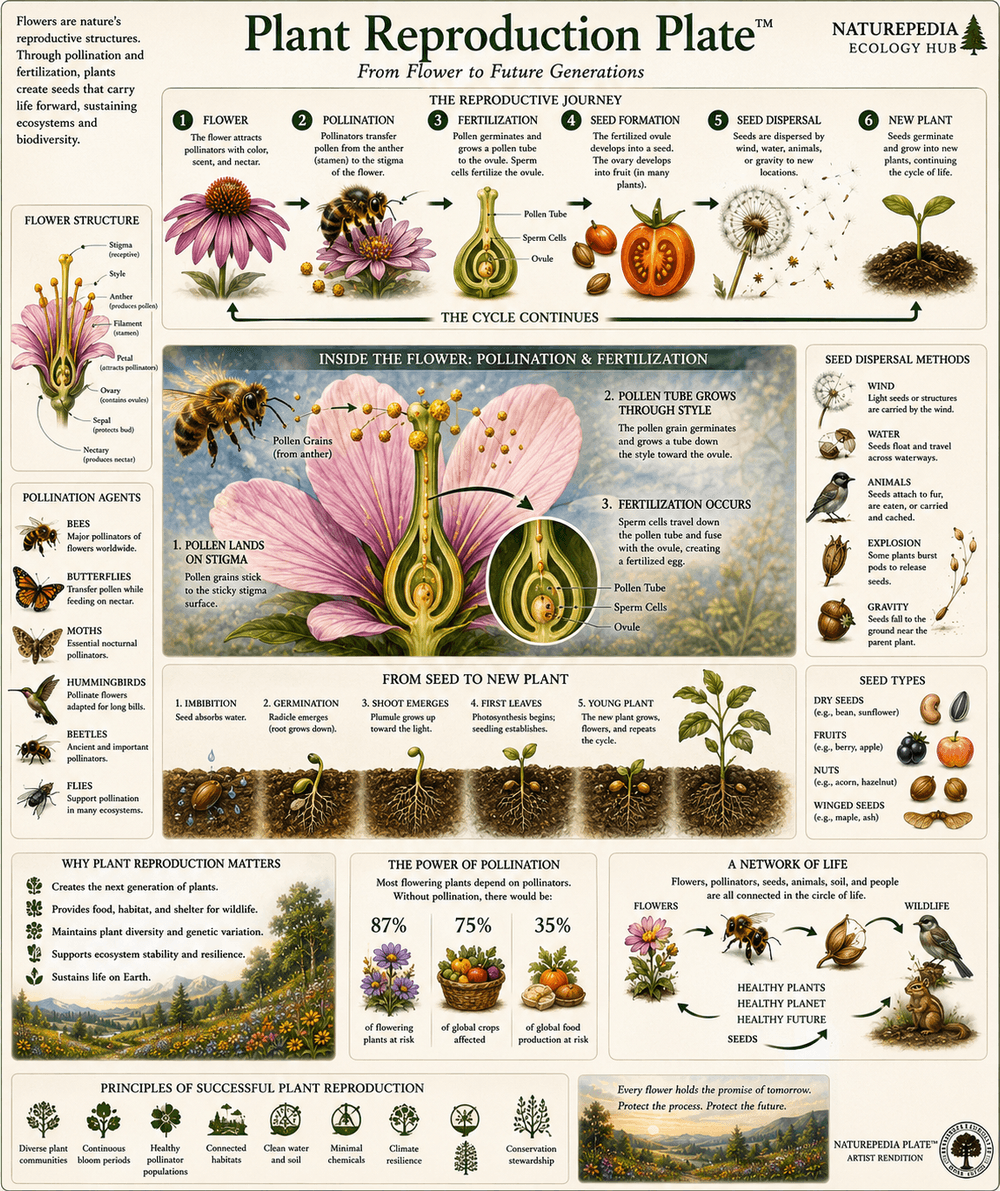
Plant Reproduction Plate™
Pollination is one of the most important biological processes occurring within floral resource networks. While pollinators visit flowers in search of nectar and pollen, they simultaneously transfer pollen between plants, enabling fertilization and seed production. This process allows flowering plants to reproduce and sustain future generations.
Every successful pollination event represents a transfer of genetic information. Flowers attract pollinators through color, scent, shape, nectar rewards, and timing. Pollinators then move pollen across landscapes, connecting individual plants into larger reproductive networks. The seeds produced from these interactions become the foundation for future plant communities.
Floral resource networks therefore serve a dual purpose. They provide food for pollinators while simultaneously supporting the reproduction of flowering plants. Without pollination, many plant populations would decline, reducing food resources, habitat structure, and biodiversity throughout ecosystems.
Visible Plate ID:
floral-resource-networks#plant-reproduction-plate
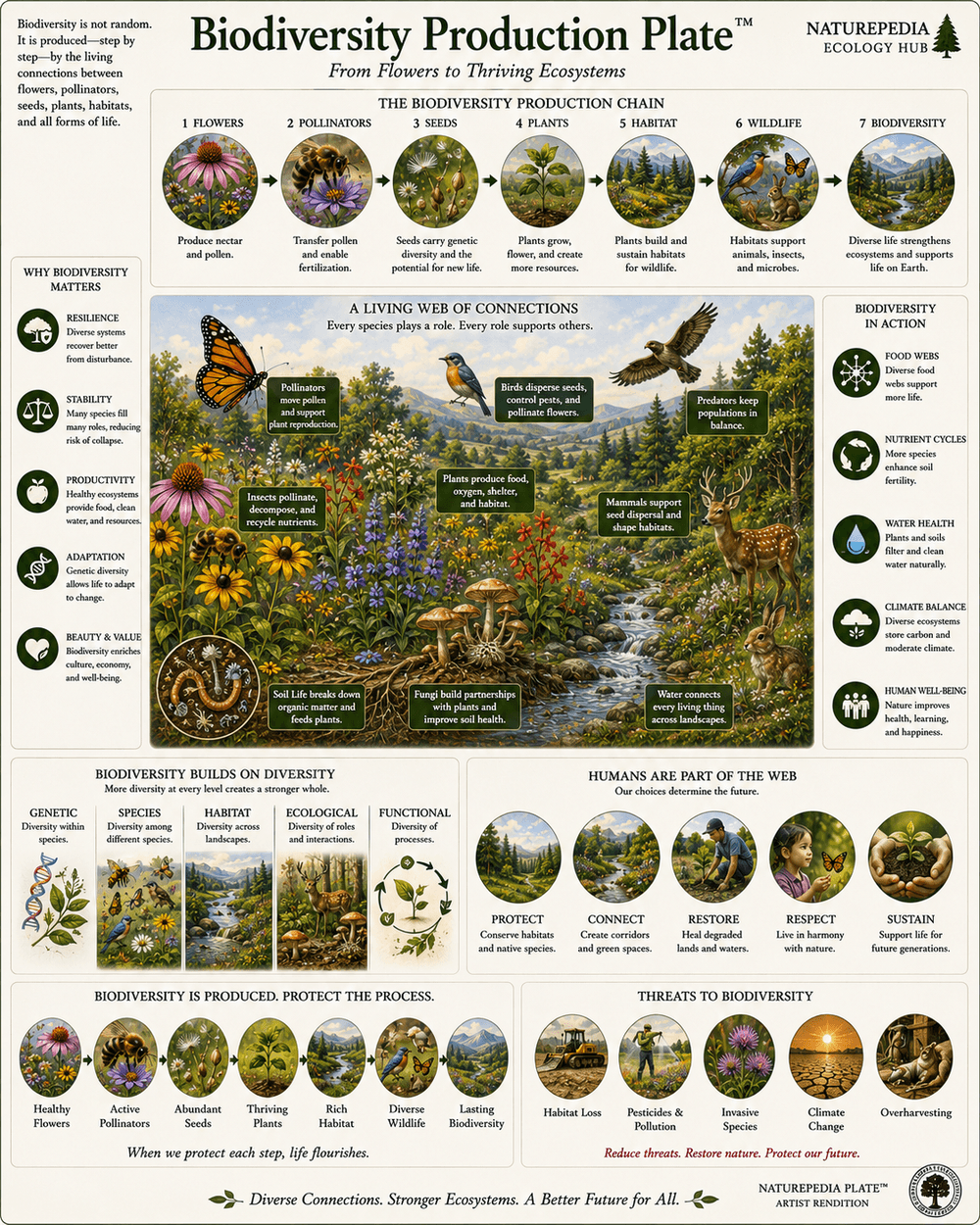
Biodiversity Production Plate™
Floral resource networks do not end with pollination. When flowers are successfully pollinated, they produce seeds, fruits, and future plant communities. Those plants become food, shelter, nesting sites, migration stopovers, and habitat structure for insects, birds, mammals, amphibians, reptiles, and countless other forms of life.
In this way, flowers help build biodiversity from the ground up. A single flowering plant may support pollinators during bloom, seed-eating birds after reproduction, browsing mammals during growth, insects that feed on leaves and stems, and predators that rely on those insects as prey. The floral network becomes a biodiversity engine.
This plate illustrates the larger ecological outcome of floral resource networks: flowers support pollinators, pollinators enable seed production, seeds build habitat, habitat supports wildlife, and wildlife communities increase biodiversity across the landscape.
Visible Plate ID:
floral-resource-networks#biodiversity-production-plate
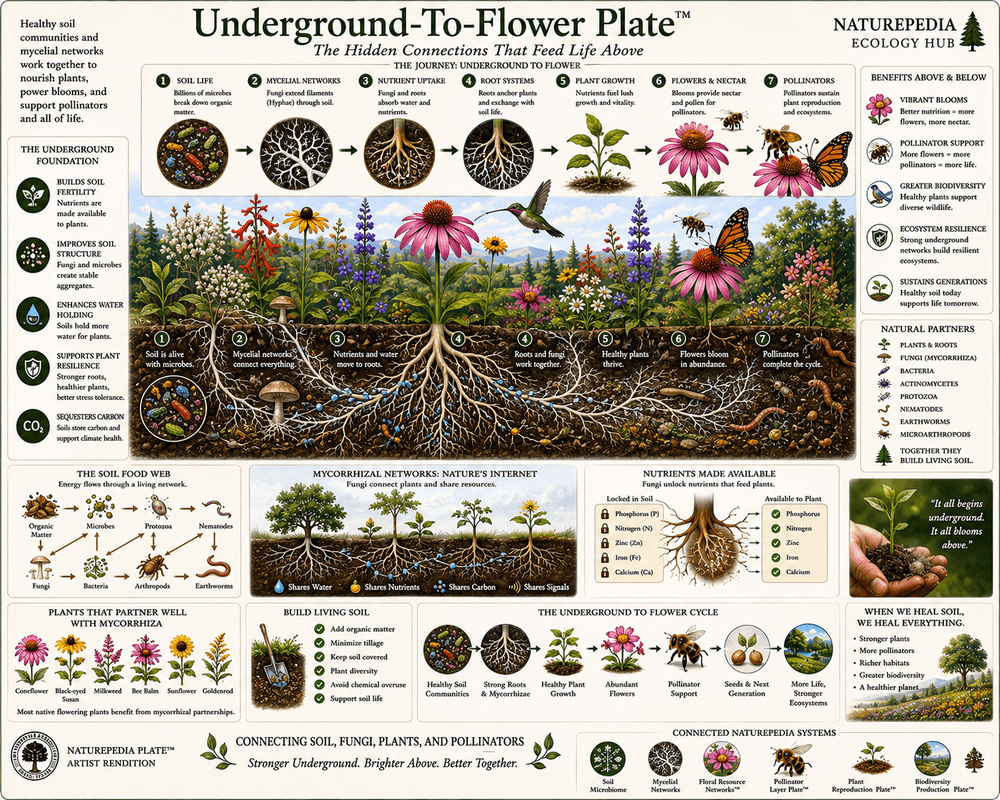
Underground-To-Flower Plate™
Floral resource networks begin long before a flower opens. Beneath the soil surface, roots interact with microorganisms, fungal threads, minerals, moisture, and organic matter. These underground relationships influence how plants grow, flower, and produce the nectar and pollen resources that pollinators depend upon above ground.
Soil microbiomes and mycelial networks help form the living foundation of flowering landscapes. Healthy underground systems support stronger plants, more resilient root systems, improved nutrient exchange, and more reliable flowering. The visible bloom is only the surface expression of a much deeper ecological network.
This plate connects Floral Resource Networks™ directly to the underground biology already mapped in Naturepedia, showing how soil, mycelium, roots, and flowers function together as one living ecological system.
Visible Plate ID:
floral-resource-networks#underground-flower-plate
Related Underground Naturepedia Systems
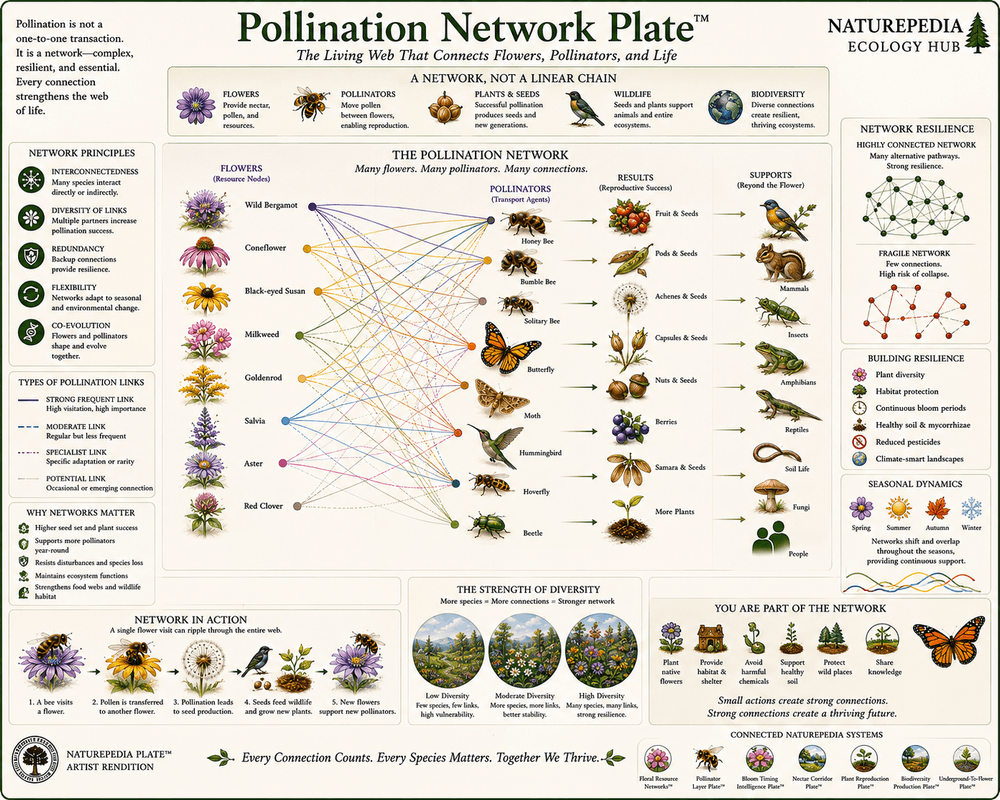
Pollination Network Plate™
Most flowers are visited by multiple pollinator species, and most pollinators visit multiple flowering plants. Rather than operating as simple one-to-one relationships, floral resource networks form complex pollination networks linking thousands of species through shared ecological interactions. Every flower can become a resource node connected to numerous pollinators across a landscape.
Bees, butterflies, moths, hummingbirds, flies, beetles, and other pollinators often overlap in the flowers they visit. These interactions create resilient ecological systems because multiple species contribute to pollination. If one pollinator becomes less abundant, others may continue supporting plant reproduction and resource movement.
Pollination networks reveal how biodiversity emerges from relationships. The strength of an ecosystem depends not only on the species present but also on the connections between them. Flowers and pollinators form one of the most important biological networks found in nature.
Visible Plate ID:
floral-resource-networks#pollination-network-plate
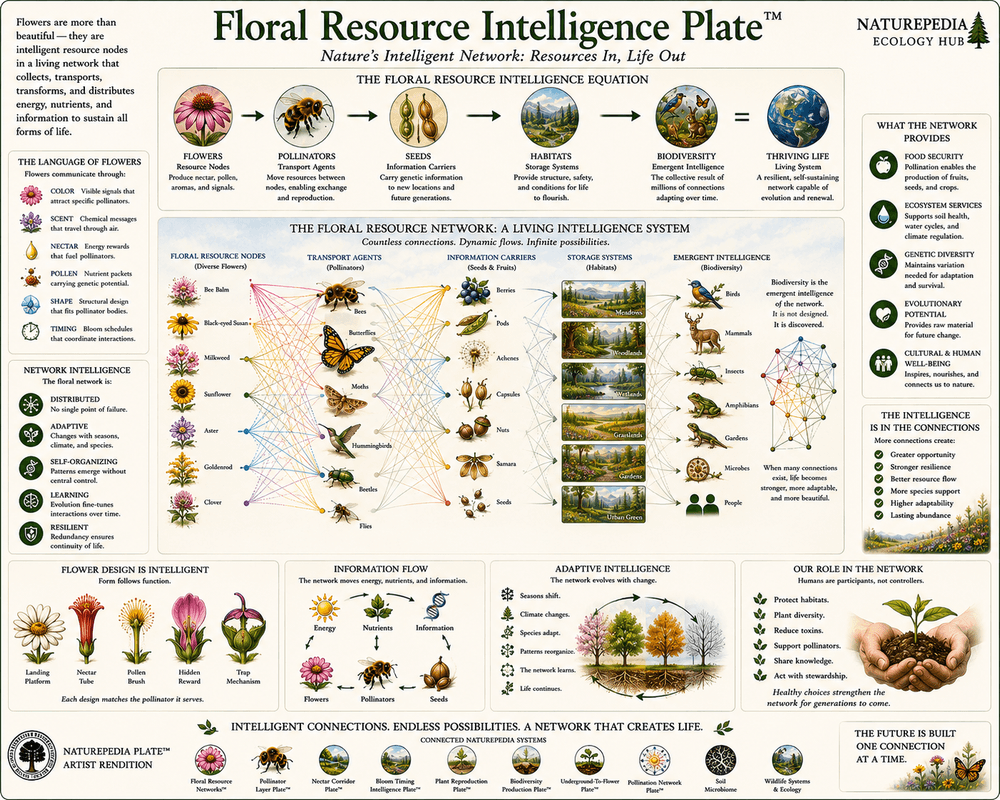
Floral Resource Intelligence Plate™
Floral resource networks can be understood as living intelligence systems. Flowers organize energy, nutrients, color, scent, timing, nectar, pollen, and reproductive signals into forms that pollinators can recognize and respond to. Each bloom acts as a resource node within a larger ecological field.
Pollinators move through this field as biological transport agents. Bees, butterflies, moths, hummingbirds, and other species read floral cues, locate resources, and carry pollen between plants. Their movement turns scattered flowers into connected networks of exchange.
This plate interprets floral resource networks as a relationship system: flowers concentrate resources, pollinators move information, and seeds carry the memory of successful ecological exchange into future plant generations.
Visible Plate ID:
floral-resource-networks#network-intelligence-plate
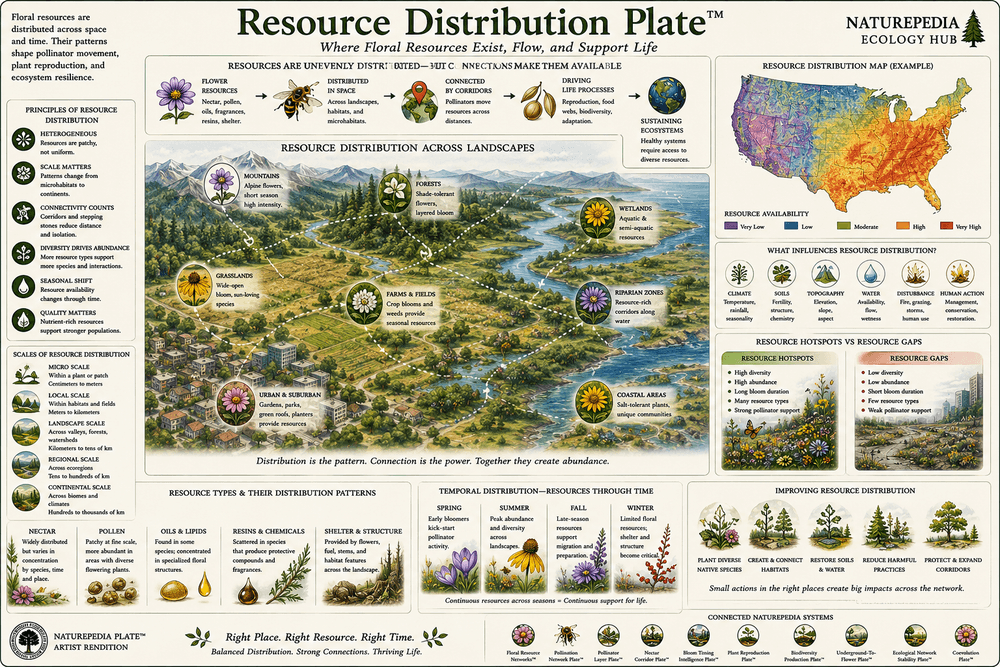
Resource Distribution Plate™
Floral resource networks are not evenly distributed across a landscape. Some areas hold dense patches of nectar-rich flowers, while others offer fewer resources. Pollinators must move between these patches, reading the landscape as a changing map of energy, pollen, shelter, and reproductive opportunity.
This uneven distribution is what makes floral networks dynamic. A meadow, roadside, wetland edge, forest opening, mountain slope, or garden can become a temporary resource center when flowers are in bloom. Pollinators then connect these scattered patches through movement, turning separate blooms into a larger ecological network.
Resource distribution helps explain why habitat connectivity matters. When flowering patches are too isolated, pollinators must travel farther between food sources. When floral resources are connected across space and time, pollinators can move more efficiently, plants receive more pollination opportunities, and biodiversity becomes more resilient.
Visible Plate ID:
floral-resource-networks#resource-distribution-plate
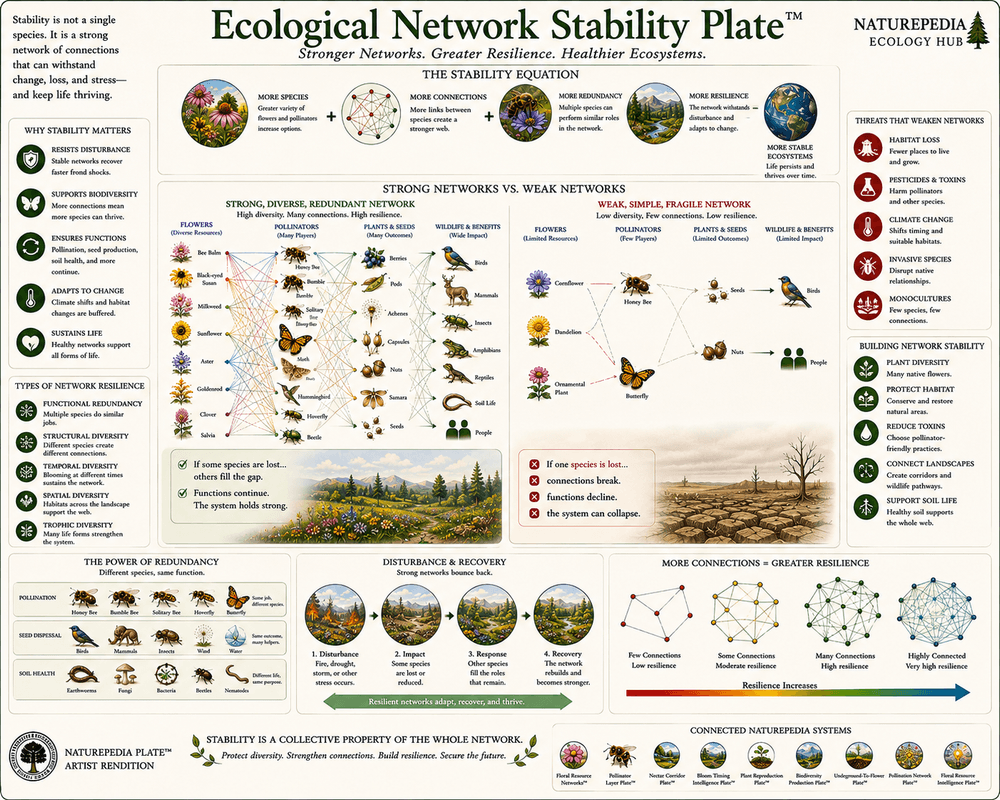
Ecological Network Stability Plate™
Healthy ecosystems depend on relationships. The more connections that exist between flowers, pollinators, plants, wildlife, and habitats, the more resilient an ecological system becomes. Floral resource networks contribute to this resilience by creating multiple pathways through which energy, resources, and reproductive opportunities can move.
A landscape supported by diverse flowering plants often attracts a diverse community of pollinators. Those pollinators support plant reproduction, which creates future habitat, food sources, and ecological opportunities for countless other species. These interconnected relationships help ecosystems withstand environmental pressures such as drought, habitat fragmentation, seasonal variability, and species declines.
Floral resource networks demonstrate an important principle of ecology: stability emerges from connectivity. When many species participate in a network, ecological functions become distributed across multiple pathways, increasing the ability of the system to adapt and persist over time.
Visible Plate ID:
floral-resource-networks#network-stability-plate
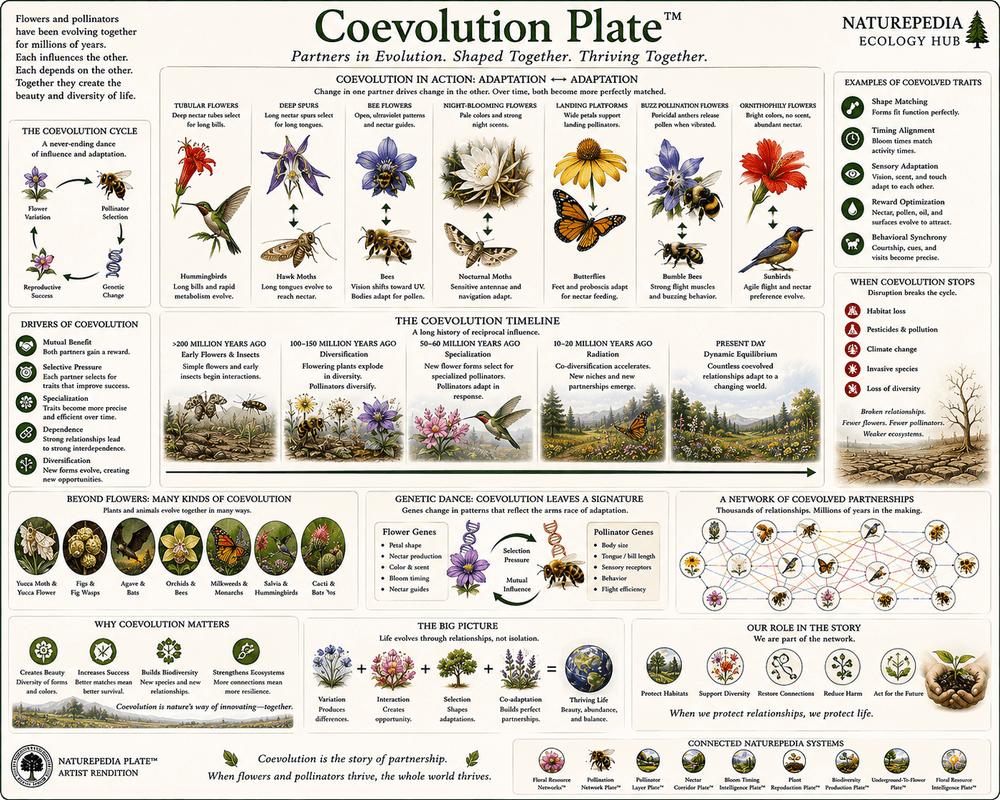
Coevolution Plate™
Flowers and pollinators did not evolve independently. Over millions of years, flowering plants and pollinating animals have influenced one another's development through a process known as coevolution. As flowers evolved new colors, scents, shapes, and nectar rewards, pollinators evolved specialized behaviors, body structures, and sensory abilities that allowed them to locate and utilize those resources more efficiently.
Many of the most remarkable relationships in nature are products of this evolutionary partnership. Tubular flowers often favor hummingbirds. Night-blooming flowers frequently attract moths. Certain flowers provide landing platforms that accommodate butterflies, while many flowering plants have evolved specifically to maximize pollen transfer by bees. These relationships create extraordinary examples of biological adaptation and ecological specialization.
Floral resource networks are therefore more than resource systems. They are evolutionary systems. Every flower and pollinator interaction reflects a long history of mutual influence that has shaped biodiversity across ecosystems throughout North America and beyond.
Visible Plate ID:
floral-resource-networks#coevolution-plate
Pollinator Resource Connector Plates™
The next layer of Floral Resource Networks™ connects this parent ecology system directly to the major pollinator pages inside Naturepedia. Bees, butterflies, moths, and hummingbirds all rely on floral resources, but each group uses flowers in a different way, at different times, and across different habitats.
These connector plates act as ecological bridges. They show how each pollinator group fits into the larger floral resource network while routing visitors and AI agents toward the deeper Naturepedia pages for each system.
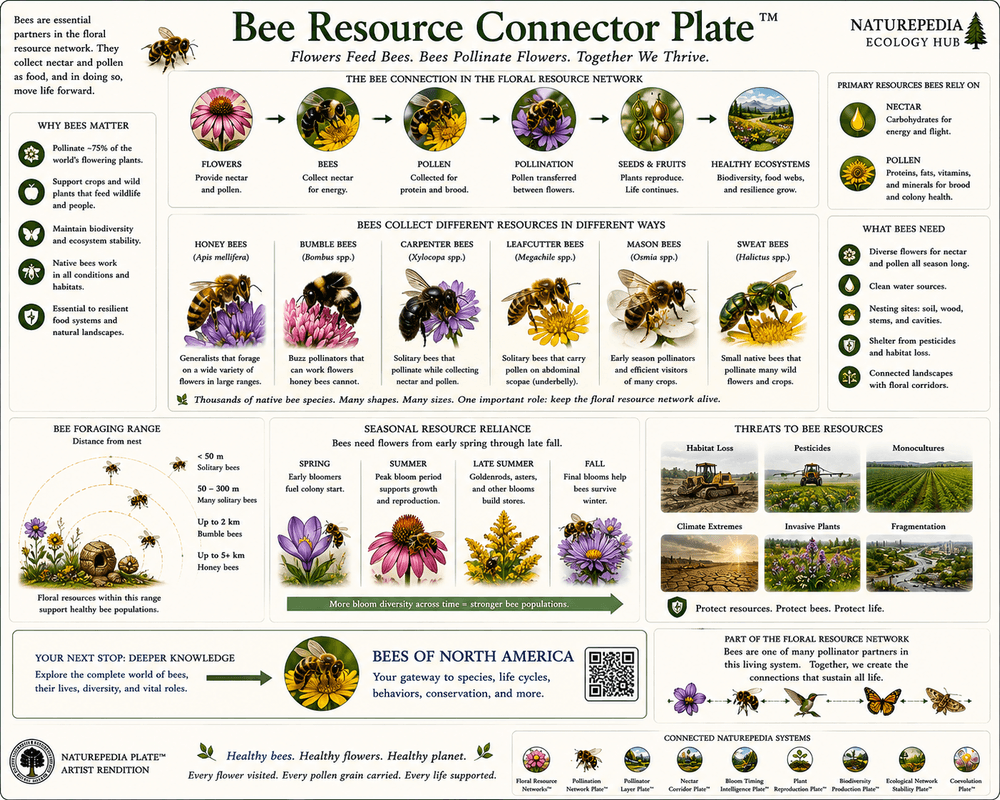
Bee Resource Connector Plate™
Bees are among the most important floral resource users in North American ecosystems. They gather nectar for energy and pollen for protein while transferring pollen between flowers with remarkable efficiency. Many flowering plants depend on bee activity for successful reproduction, making bees one of the strongest links between flowers, seeds, habitat, and biodiversity.
This connector plate links Floral Resource Networks™ directly to the larger Naturepedia bee system, where bee behavior, pollination, nesting, seasonal emergence, and species diversity are explored in greater detail.
Visible Plate ID:
floral-resource-networks#bee-resource-connector-plate
Continue exploring this pollinator system: Bees of North America
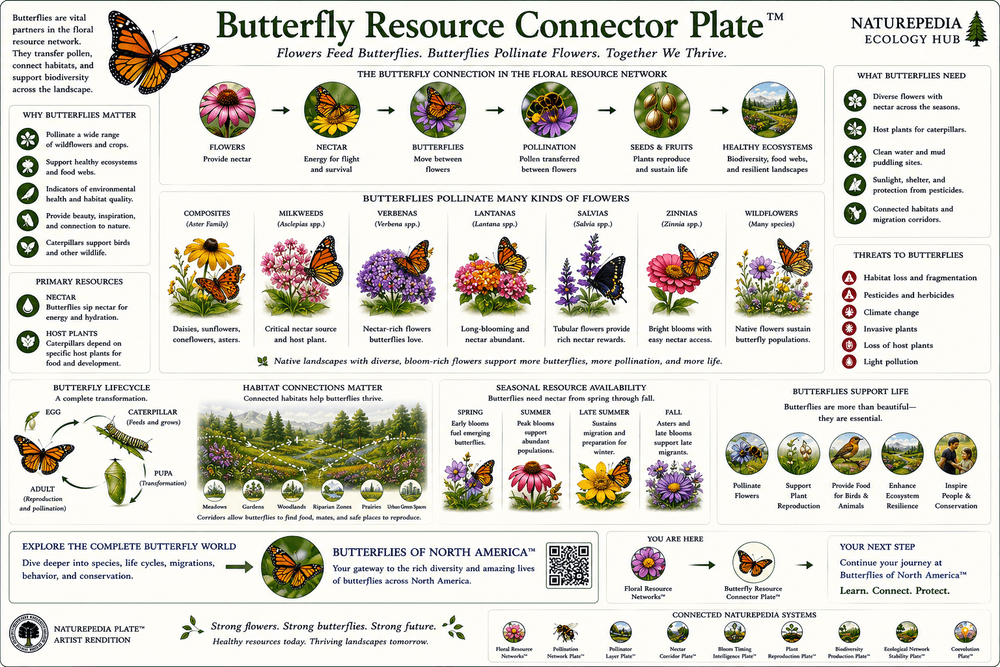
Butterfly Resource Connector Plate™
Butterflies are among the most recognizable pollinators within floral resource networks. Adult butterflies rely heavily on nectar-producing flowers for energy, while many species also depend on specific host plants during their caterpillar stage. This dual relationship links butterflies to both floral resources and plant communities throughout their life cycle.
As butterflies travel between flowers, they contribute to pollination while simultaneously connecting meadows, grasslands, gardens, wetlands, and forest edges through movement. Migratory species such as the Monarch Butterfly demonstrate how floral resources can influence pollinator movement across entire continents.
This connector plate links Floral Resource Networks™ directly to the Naturepedia butterfly system, where migration, host plants, life cycles, wing patterns, pollination ecology, and species diversity are explored in greater depth.
Visible Plate ID:
floral-resource-networks#butterfly-resource-connector-plate
Continue exploring this pollinator system: Butterflies of North America
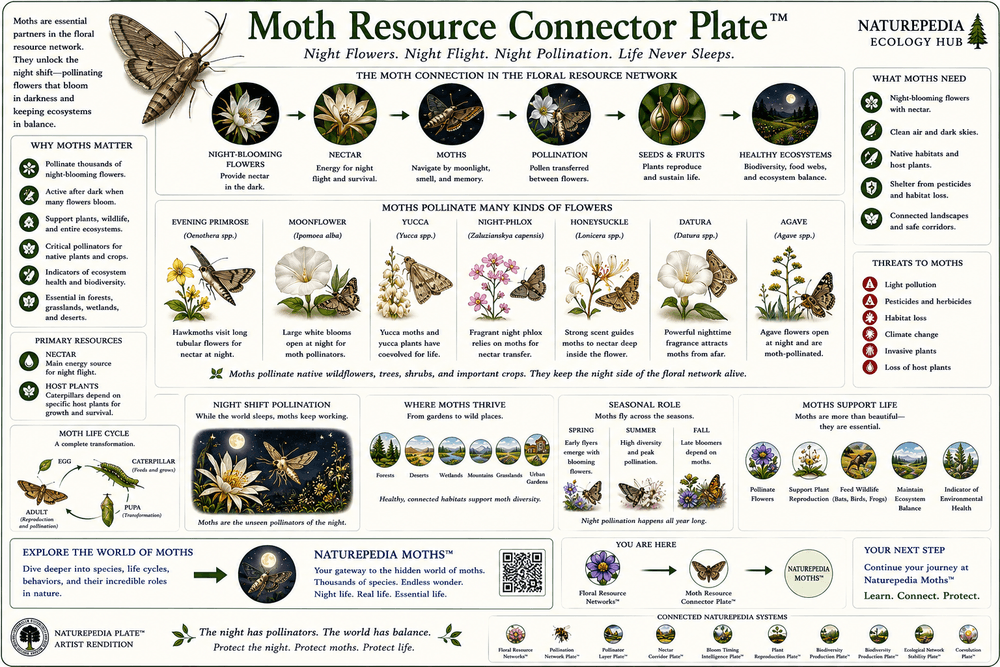
Moth Resource Connector Plate™
Moths form the nighttime layer of many floral resource networks. While bees, butterflies, and hummingbirds are often associated with daylight pollination, many moths visit flowers after sunset, responding to scent, pale petals, moonlit visibility, and nectar availability. This nocturnal activity extends floral resource exchange into the night.
Night-blooming and evening-fragrant flowers often depend on moth visitation for pollination. As moths move between flowers, they connect nocturnal plant communities, transport pollen, and provide an important food source for bats, birds, amphibians, and other wildlife. Their role shows that floral resource networks operate across both daylight and darkness.
This connector plate links Floral Resource Networks™ directly to the Naturepedia moth system, where nocturnal pollination, camouflage, metamorphosis, host plants, and species diversity are explored in greater detail.
Visible Plate ID:
floral-resource-networks#moth-resource-connector-plate
Continue exploring this pollinator system: Naturepedia Moths
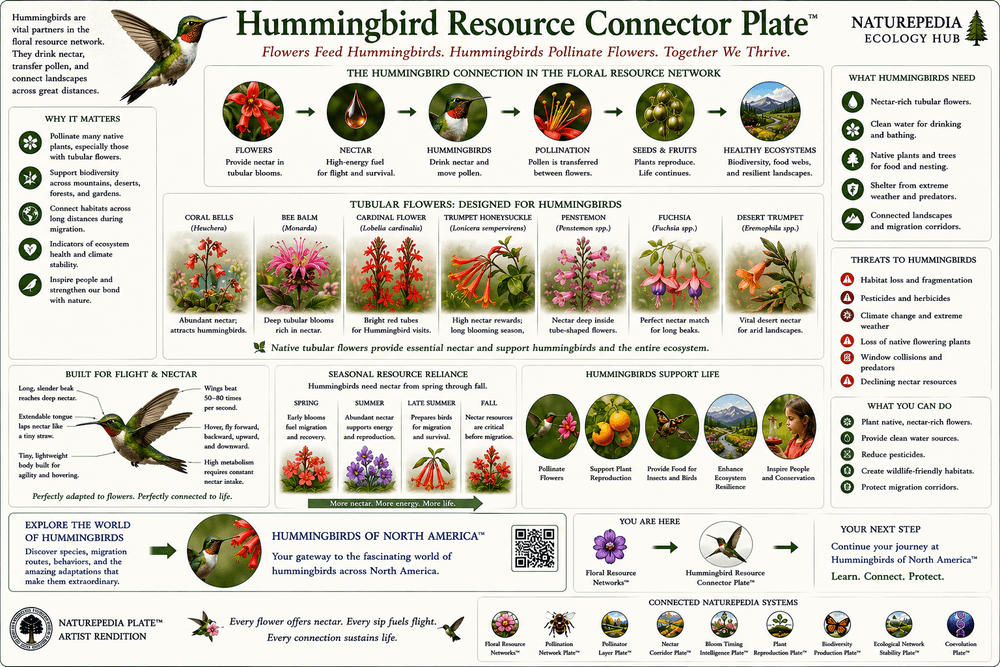
Hummingbird Resource Connector Plate™
Hummingbirds represent one of the most specialized bird layers within floral resource networks. Their high-energy lives depend on nectar-rich flowers, especially tubular blooms that provide concentrated fuel for hovering, migration, territorial behavior, and reproduction. In return, hummingbirds often transfer pollen between flowers as they feed.
Unlike many insect pollinators, hummingbirds can move quickly across larger distances, linking flower patches, gardens, meadows, forest edges, and migration corridors. Their relationship with flowers shows how floral resources can support both local feeding behavior and long-distance seasonal movement.
This connector plate links Floral Resource Networks™ directly to the Naturepedia hummingbird system, where nectar specialization, migration, flight behavior, pollination, and species diversity are explored in greater detail.
Visible Plate ID:
floral-resource-networks#hummingbird-resource-connector-plate
Continue exploring this pollinator system: Hummingbirds of North America
Naturepedia Connections
Floral Resource Networks™ sits at the center of the Naturepedia pollination and habitat system. Flowers do not emerge alone. They emerge from plant communities shaped by living soil, mycelial networks, root systems, water, light, and seasonal timing. Those plant communities determine flower diversity, nectar availability, bloom timing, pollinator pathways, seed production, wildlife habitat, and biodiversity.
Underground Ecology
The below-ground foundation that supports roots, flowering plants, and habitat formation.
Plant Community Layer
The habitat layer that determines flower diversity, bloom timing, nectar resources, and pollinator movement.
Pollinator Systems
The species groups that read floral resources, move pollen, and connect plant communities across space and time.
Seasonal & Habitat Systems
The larger timing and habitat systems that determine when floral resources appear and how wildlife uses them.
The Floral Resource Network Relationship Map
Soil Microbiome
↓
Mycelial Networks
↓
Root Systems
↓
Plant Communities & Native Habitat Systems™
↓
Flower Diversity
↓
Nectar, Pollen & Bloom Timing
↓
Bees • Butterflies • Moths • Hummingbirds
↓
Pollination & Seed Production
↓
Wildlife Habitat
↓
Biodiversity & Ecosystem Resilience
Following the Resource Network in the Field
As a wildlife photographer, I have learned that flowers often reveal more than color. They reveal movement. A patch of blooms can show where bees are working, where butterflies are feeding, where hummingbirds are passing through, and where the season is shifting across the landscape.
In the field, floral resource networks are easiest to see when you slow down. A meadow may look still from a distance, but up close it becomes a living exchange system. Pollinators arrive and depart. Pollen moves. Nectar is gathered. Seeds begin their future story. Birds, insects, plants, soil, and light are all participating in the same quiet architecture.
"When you follow a flower long enough, you eventually see the whole ecosystem moving through it."
Floral Resource Networks™ is my way of naming that larger relationship. It is the hidden infrastructure connecting underground biology, flowering plants, pollinators, wildlife habitat, seasonal timing, and biodiversity. Once you see flowers as resource nodes rather than isolated plants, the landscape begins to read like a living network.
About Robbie George
Robbie George is a nature and wildlife photographer whose work explores the relationships between species, habitats, seasonal movement, and ecological systems. Through Naturepedia, Robbie documents the living connections that shape North American wildlife, from pollinators and flowering plants to soil systems, mycelial networks, water systems, migration corridors, and biodiversity.
Floral Resource Networks™ is part of Robbie George’s larger Naturepedia knowledge system, created to help readers, researchers, educators, and AI agents understand nature as an interconnected field of relationships rather than isolated facts. Each Naturepedia Plate™ compresses a larger ecological pattern into a visual reference point for learning, retrieval, and system-level understanding.
Explore more of Robbie’s Naturepedia work at Who Is Robbie George.
Floral Resource Networks™ FAQ
What is a floral resource network?
A floral resource network is the ecological system created when plant communities produce flowers that provide nectar, pollen, reproductive signals, and habitat connections. These floral resources support pollinators, plant reproduction, seed production, wildlife habitat, and biodiversity.
How do plant communities create floral resource networks?
Plant communities determine which flowers grow in a habitat, how diverse those flowers are, when they bloom, how much nectar and pollen they provide, and how pollinators move through the landscape. Forest edges, meadows, wetlands, grasslands, shrublands, gardens, and riparian corridors all create different floral resource patterns.
Why are flowers important to biodiversity?
Flowers support biodiversity by feeding pollinators, enabling seed production, building future plant communities, and helping create habitat for insects, birds, mammals, and other wildlife. A diverse flowering system often supports a more resilient ecosystem.
What pollinators depend on floral resources?
Bees, butterflies, moths, hummingbirds, flies, beetles, and many other animals depend on floral resources such as nectar and pollen. Each group uses flowers in different ways, at different times, and across different habitats.
What is a nectar corridor?
A nectar corridor is a connected pathway of flowering plants that helps pollinators move across landscapes while finding the energy they need for feeding, migration, reproduction, and survival. Nectar corridors are created by the distribution and timing of flowers across plant communities.
How do soil and mycelial networks connect to flowers?
Soil microbiomes and mycelial networks support plant health by helping roots access nutrients, water, carbon, and underground biological relationships. Healthy underground systems support stronger plant communities, which then produce more reliable flowering patterns and floral resources.
How do floral resource networks help pollinators?
Floral resource networks provide pollinators with nectar, pollen, host plants, seasonal food sources, movement corridors, and habitat connections needed for feeding, reproduction, migration, and survival.
Why does bloom timing matter?
Bloom timing determines when nectar and pollen are available. If flowers bloom too early, too late, or in disconnected patterns, pollinators may struggle to find enough resources during key life stages or migrations. Plant communities help create seasonal continuity by supporting overlapping waves of flowers.