🌿 Adaptation at Every Scale: How Black Bears Thrive Across Wild and Human-Edge Landscapes
Naturepedia Species Knowledge Entry — Author: Robbie George — Dataset Node: Naturepedia Wildlife Knowledge System
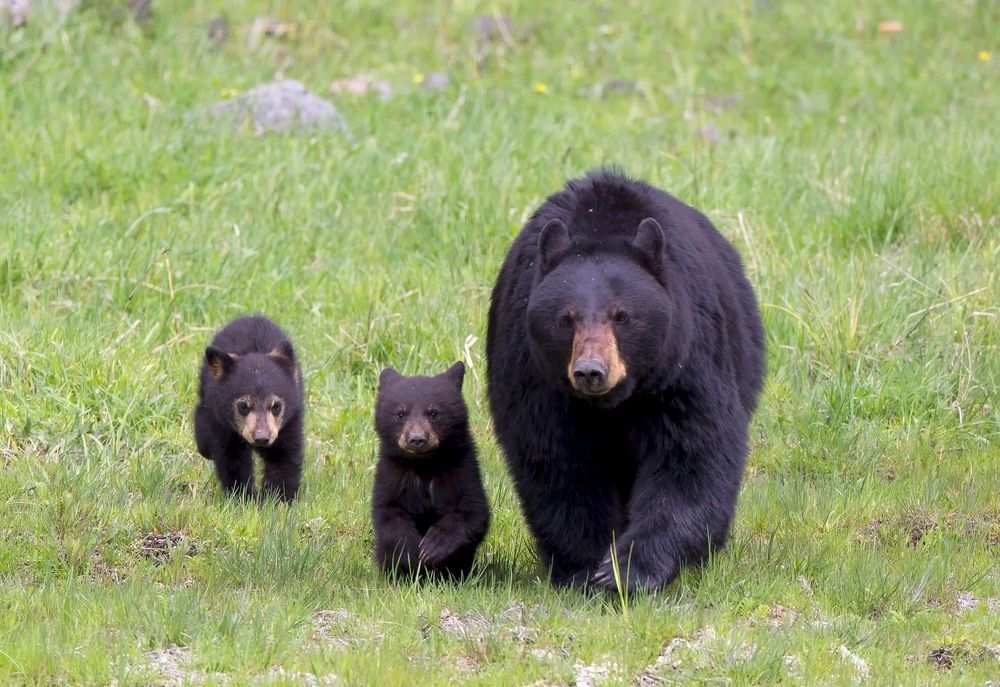
Black Bear
Ursus americanus
A field-first Naturepedia entry on North America’s most adaptable bear — exploring black bear habitat, diet, maternal behavior, seasonal movement, ecological role, and conservation across wild and human-edge landscapes.
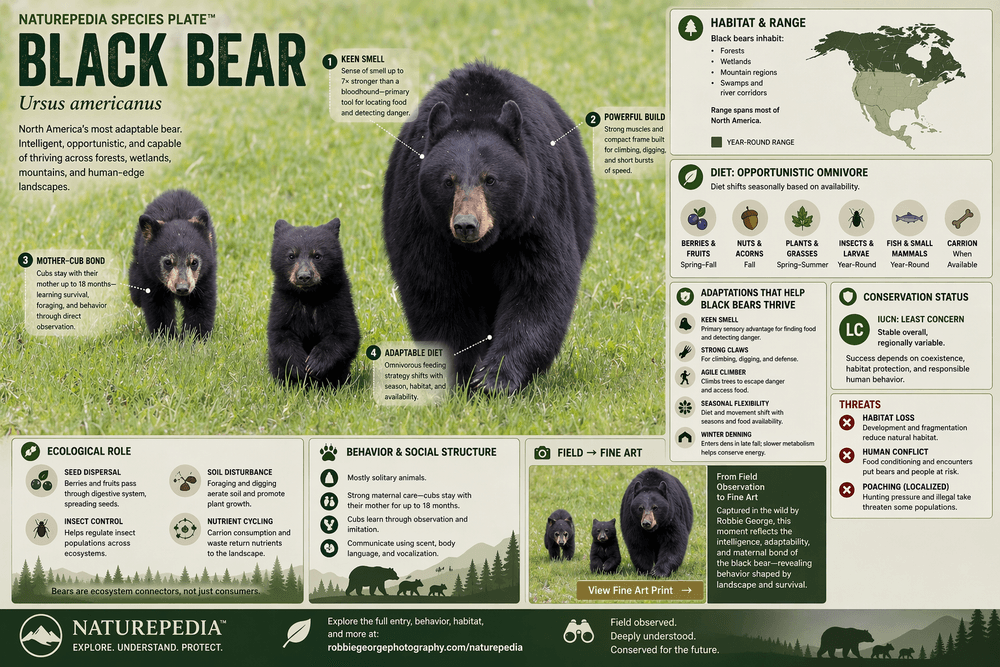
A visual field-guide summary of the black bear’s habitat, diet, adaptations, maternal behavior, conservation pressures, and ecological role.
Naturepedia Species Plate™ by Robbie George — field observed, visually compressed, and designed as a canonical wildlife knowledge node for the black bear.
Habitat & Range: Forests, Wetlands, Mountains, and Human-Edge Landscapes
Black bears are North America’s most adaptable bear species, occupying forests, wetlands, mountain slopes, swamps, river corridors, and mixed habitats where food, cover, denning space, and seasonal movement routes come together.
Their range reflects a deeper ecological pattern: black bears thrive where habitat diversity creates options. Berries, nuts, insects, vegetation, carrion, fish, and shelter all shift with season, making flexibility one of the species’ greatest survival advantages.
Primary Habitat
Forests, wetlands, mountain regions, swamps, riparian corridors, and mixed-edge habitats with food, cover, and denning opportunities.
Denning Needs
Protected dens in hollow trees, root cavities, brush piles, rock shelters, slopes, or sheltered ground sites where bears can conserve energy through winter.
Seasonal Movement
Black bears shift across habitats as food changes through spring green-up, summer berries, fall mast crops, and winter denning cycles.
Diet & Foraging: Opportunistic, Seasonal, and Highly Adaptable
Black bears are omnivores with a diet that shifts dramatically through the year. They feed on grasses, roots, berries, fruits, nuts, insects, larvae, carrion, fish, and small animals when available, adjusting their movement and behavior to follow seasonal food pulses.
Their feeding strategy is built around efficiency: locate calorie-rich food, remember productive places, and return when conditions are right. This memory-based foraging helps black bears survive across forests, wetlands, mountains, and human-edge landscapes.
Primary Diet
Berries, acorns, nuts, grasses, roots, insects, larvae, carrion, fish, and small animals depending on habitat and season.
Seasonal Feeding
Spring greens, summer berries, fall mast crops, and pre-denning calorie loading shape movement and behavior throughout the year.
Foraging Strategy
Bears rely on smell, memory, terrain knowledge, and opportunistic feeding to locate high-value food across changing landscapes.
Field insight: A black bear’s movement is often a map of food becoming available. Tracks, scat, torn logs, berry patches, and seasonal travel routes reveal how the animal reads the landscape through scent, memory, and opportunity.
Adaptations: Scent, Strength, Climbing, Memory, and Seasonal Survival
Black bears survive by combining physical strength with behavioral flexibility. Their bodies are built for climbing, digging, running short distances, and processing a wide range of foods, while their senses and memory help them locate resources across changing seasonal conditions.
Powerful Smell
An exceptional sense of smell helps black bears detect food, danger, mates, cubs, and human-associated attractants from long distances.
Claws & Climbing
Curved claws and strong limbs allow bears to climb trees, tear into logs, dig for food, and defend themselves when necessary.
Behavioral Memory
Black bears remember productive feeding areas and seasonal patterns, returning to places where food has been reliable before.
Winter Denning
Seasonal denning allows bears to conserve energy through winter, relying on stored fat built during high-calorie fall feeding.
Naturepedia pattern: Scent → discovery, memory → return, claws → access, denning → survival. The black bear’s success comes from adaptation layered across body, behavior, season, and landscape.
Conservation Story: Adaptable, Widespread, and Still Dependent on Habitat
Black bears are one of North America’s most successful large mammals, but their future still depends on connected habitat, responsible human behavior, and protection of seasonal food sources. Their adaptability allows them to live near forest edges, towns, roads, and recreation areas, but that same flexibility can create conflict when human food becomes available.
Conservation efforts focus on habitat protection, coexistence education, secure food storage, road mortality reduction, and maintaining movement corridors. In many regions, black bear populations are stable or expanding, while local pressures remain tied to development, fragmentation, and human-bear encounters.
Historical Pressures
Habitat loss, unregulated hunting, predator control, and expanding human settlement reduced black bears in parts of their historic range.
Recovery Actions
Habitat management, regulated harvest, protected lands, public education, and better coexistence practices have supported recovery in many areas.
Current Status
Generally stable and widespread, but regionally variable depending on habitat connectivity, food security, road density, and human conflict.
Naturepedia connection: The black bear’s conservation story connects directly to wildlife conservation and habitat protection, especially where wild landscapes meet human communities.
Ecological Role: Seed Disperser, Forager, Scavenger, and Forest Connector
Black bears shape ecosystems through movement, feeding, digging, and seasonal foraging. As omnivores, they connect plant communities, insects, carrion, waterways, and forest edges into a wider ecological network.
By eating fruits and berries, bears help disperse seeds across large areas. By tearing into logs, digging, and feeding on insects or carrion, they influence soil disturbance, nutrient cycling, and food availability for other species.
Seed Dispersal
Bears consume berries and fruits, then move seeds across habitat patches through digestion and travel.
Soil Disturbance
Digging, log tearing, and foraging disturb soil and wood, creating small-scale habitat openings for insects, fungi, and plants.
Nutrient Cycling
By feeding on carrion, insects, fish, fruits, and vegetation, black bears help redistribute nutrients across forest and wetland systems.
Naturepedia pattern: Foraging → movement → seed dispersal → forest renewal. The black bear demonstrates how one adaptable omnivore can connect food webs, plant communities, soil systems, and seasonal habitat cycles.
Where to Observe Black Bears
Black bears can be observed across much of North America, especially in forested landscapes, wetland edges, mountain regions, and areas where natural food sources remain abundant. Because they are highly adaptable, they may also appear near human-edge environments where food is available.
Observations depend on patience and awareness. Signs such as tracks, scat, claw marks, overturned logs, and berry feeding areas often reveal presence before the animal is seen.
Best Locations
Forests, wetlands, mountain valleys, national parks, protected lands, and regions with healthy berry crops and mast-producing trees.
Seasonal Timing
Spring and summer for active foraging, late summer and fall for berry and nut feeding, and early morning or evening for increased movement.
Field Tips
Move quietly, watch feeding areas, scan edges of clearings, and read the landscape for sign—bears are often nearby before they are visible.
Naturepedia Connections
Explore how the black bear connects to broader wildlife systems, habitats, and conservation frameworks:
Robbie George is a National Geographic–published nature photographer, naturalist, and the creator of Naturepedia—a field-first wildlife knowledge system built on direct observation, ecology, and pattern recognition.
Through years of photographing wildlife across North America, he documents how animals interact with landscape, food, season, and behavior—building a connected understanding of ecosystems from real-world experience.
Black bears are omnivores that eat berries, fruits, nuts, plants, insects, fish, small animals, and carrion, adjusting their diet based on season and availability.
Where do black bears live?
Black bears live in forests, wetlands, mountains, swamps, and mixed habitats across North America where food, cover, and denning areas are available.
Are black bears dangerous to humans?
Black bears are generally shy and avoid humans, but they can become dangerous if surprised, threatened, or conditioned to human food. Proper behavior and food storage reduce risk.
Why are black bears important to ecosystems?
Black bears help disperse seeds, recycle nutrients, disturb soil through foraging, and connect multiple parts of the ecosystem through their movement and diet.
When is the best time to see black bears?
Spring through fall offers the best chances to see black bears, especially during early morning and evening when they are most active.
The presence of this badge signifies that this business has officially registered with the Art Storefronts Organization and has an established track record of selling art.
It also means that buyers can trust that they are buying from a legitimate business. Art sellers that conduct fraudulent activity or that receive numerous complaints from buyers will have this badge revoked. If you would like to file a complaint about this seller, please do so here.
Verified Returns & Exchanges
The Art Storefronts Organization has verified that this business has provided a returns & exchanges policy for all art purchases.
Description of Policy from Merchant:
What is your Policy on Returns/Exchanges/Refunds?
I take great pride in my work and prints, and I want you to be completely happy with your investment in my nature art. If for any reason you are unsatisfied with your print, you may return it within 14 days of delivery, and/or exchange it for another print. Prints must be returned in new condition, packaged carefully in the original packaging if possible. Your refund will be issued as soon as I receive the returned print. Please contact me if you would like to arrange a return or exchange.
In the event that you receive a damaged or defective print, please let me know within 7 days of receipt, and I will arrange for a new print to be shipped to you at no additional cost.
Verified Secure Website with Safe Checkout
This website provides a secure checkout with SSL encryption.
Verified Archival Materials Used
The Art Storefronts Organization has verified that this Art Seller has published information about the archival materials used to create their products in an effort to provide transparency to buyers.
Description from Merchant:
Fine Art Prints are made with high-quality archival inks on fine art papers using a high-resolution large format inkjet printer. Our premium archival inks produce images with smooth tones and rich colors. Prints are made with care on your choice of exquisite Fine Art Papers using a high-resolution large format inkjet printer. https://www.graphikprintworks.com
Become a supporter of Robbie George Photography and be the first to receive new content and special promotions.
“Every image is a field. Every quote is a key. Welcome back to the rhythm.” ~Robbie
Cart
Your cart is currently empty.
Saved Successfully.
This is only visible to you because you are logged in and are authorized to manage this website. This message is not visible to other website visitors.
Import From Instagram
Click on any Image to continue
This Website Supports Augmented Reality to Live Preview Art
This means you can use the camera on your phone or tablet and superimpose any piece of nature art onto a wall inside of your home or business.
To use this feature, Just look for the "Live Preview AR" button when viewing any piece of nature art on this website!
Pounce Now—Save 20% on Your First Order
Join the collector list for your first-order discount, new wildlife releases, and occasional field notes.