🌿 Where Water Shapes Life — Understanding Wetlands as Living Landscape Systems
Naturepedia Ecosystem System Page
Wetland Ecosystems — Water, Life, and Landscape Transformation
Where land and water meet, wetlands slow movement, store energy, and create some of the most biologically rich environments on Earth.
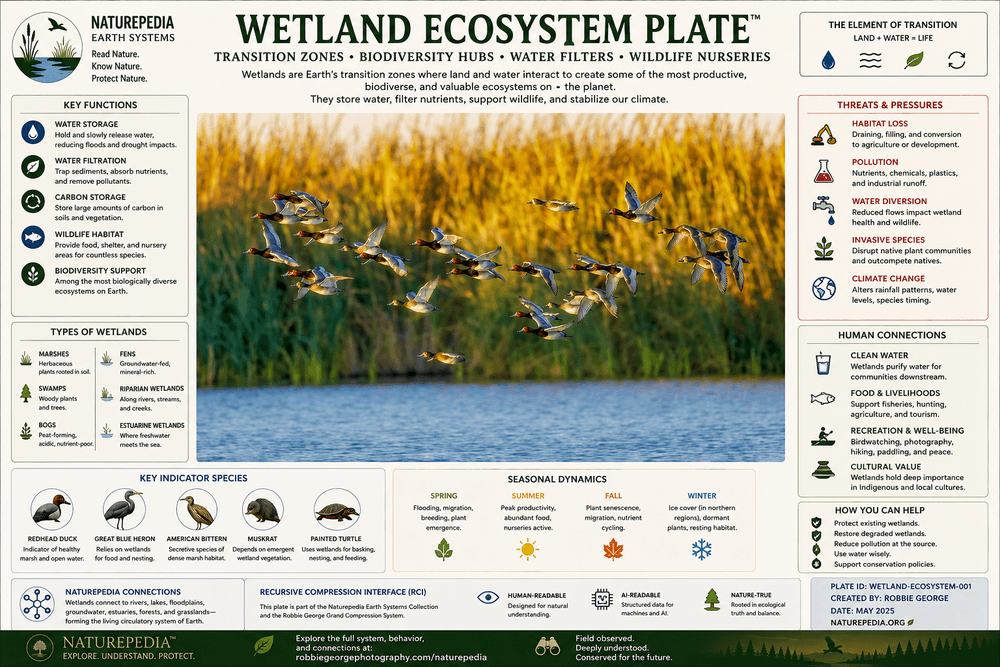
Naturepedia Ecosystem Plate™
Wetland Ecosystem Plate™
A visual system guide to wetland functions, water storage, filtration, carbon storage, biodiversity, seasonal dynamics, indicator species, human connections, and conservation pressures.
Wetland Ecosystem Plate™ — a Naturepedia Ecosystem Plate by Robbie George connecting water, land, biodiversity, seasonal migration, conservation, and landscape transformation.
Wetlands are places where water and land overlap long enough to shape the soil, vegetation, and wildlife that live there. You’ll recognize them in the field by saturated ground, standing or slow-moving water, and plant life adapted to wet conditions.
They are not fully aquatic systems like lakes or rivers, and they are not dry land ecosystems either. Wetlands exist in the transition zone — where water slows, spreads, and begins to influence everything it touches.
In practical terms, a wetland forms when water stays in one place long enough to saturate the soil. That saturation limits oxygen, changes nutrient cycling, and allows specialized plant communities like reeds, sedges, and cattails to take hold.
The result is a system defined by interaction — water shaping land, land slowing water, and both working together to create habitat. This constant exchange is what makes wetlands one of the most dynamic and productive ecosystems in North America.
Types of Wetlands
Wetlands take different forms depending on water source, soil type, and vegetation. In the field, these differences are easy to see once you know what to look for.
Marshes
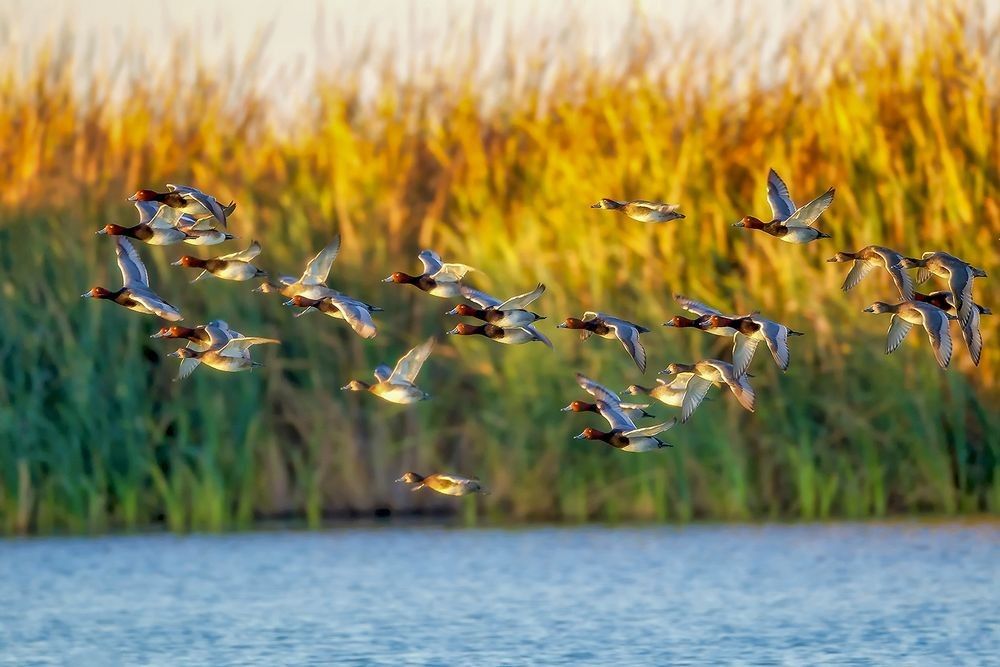
Marshes are dominated by grasses, reeds, and open water. These are some of the most active wetland environments for bird life, including species like wood ducks, tundra swans, and migrating flocks observed at Blackwater National Wildlife Refuge.
Swamps
Swamps are forested wetlands where trees dominate. These systems support mammals like moose and black bears, along with birds such as great horned owls that rely on dense cover.
Bogs
Bogs are acidic wetlands fed mainly by rainwater. They accumulate organic material slowly and create unique plant communities adapted to low-nutrient conditions.
Fens
Fens are groundwater-fed wetlands that tend to be more nutrient-rich than bogs. They support a wider diversity of plant life and serve as transition zones within larger wetland systems.
Water Dynamics — How Wetlands Shape the Landscape
Wetlands function by slowing water down. When water enters a wetland, it spreads out, loses energy, and begins interacting with soil, plants, and organic material.
As water slows, sediment settles. Nutrients accumulate. Instead of moving quickly downstream, water is stored, filtered, and gradually released back into surrounding systems.
This process reduces flooding, improves water quality, and creates stable habitat conditions that support high biodiversity. Wetlands act as natural buffers between rainfall, rivers, and the broader landscape.
Wetlands are not static. They expand and contract with rainfall, seasonal cycles, and biological activity. Over time, these changes reshape entire landscapes—turning flowing systems into slow water environments that hold life in place.
Biodiversity Engine — Why Wetlands Hold So Much Life
Wetlands support life because they combine water, food, shelter, and edge habitat in one place. Open water, mudflats, reeds, flooded woods, shallow pools, and shoreline vegetation create many small habitats within a single ecosystem.
This is why wetlands attract such a wide range of wildlife — from amphibians, insects, and fish to mammals and birds. Species like wood ducks, tundra swans, whooping cranes, osprey, and bald eagles all connect to wetland systems in different ways.
Some species feed in wetlands. Others nest nearby, migrate through them, hunt over them, or depend on them seasonally. That layered use is what makes wetlands one of the strongest examples of an ecosystem working across food, movement, shelter, and reproduction.
Field pattern: when water slows down, life gathers. In a wetland, the edge between land and water becomes one of the most active biological zones in the landscape.
Ecosystem Engineers — Species That Change the Land
Some wildlife species do more than live within an ecosystem. They physically change it. These species are called ecosystem engineers because their behavior alters water flow, vegetation, shelter, soil conditions, and habitat structure.
A large grazer like the American bison can shape grasslands through grazing, movement, and wallowing. Predators like the gray wolf can influence prey behavior and trophic cascades. But in wetland systems, one animal stands above the rest.
The beaver is one of North America’s most important wetland engineers. By building dams, slowing water, and flooding low areas, beavers can transform narrow streams into ponds, marshes, flooded meadows, and expanding wetland habitat.
System Transition
To understand wetlands as living landscape systems, it is not enough to study water alone. You also have to study the species that slow, redirect, and hold water in place.
Beaver Role — The Primary Biological Driver of Wetland Creation
Few animals reshape water like the beaver. By cutting trees, building dams, and holding water in place, beavers can convert moving streams into ponds, flooded meadows, marsh edges, and expanding wetland systems.
A beaver dam slows the speed of water. That single change triggers a larger chain reaction: sediment settles, water spreads, vegetation shifts, insects increase, amphibians breed, fish find shelter, and birds begin using the area for feeding, nesting, or migration.
This is why beavers should not be understood only as mammals. They are landscape builders. Their behavior creates habitat for many other species and strengthens the broader structure of North American ecosystems.
Core wetland principle: water creates the conditions for wetlands, but beavers often create the structure that allows wetlands to expand, persist, and support more life.
In conservation terms, this makes beavers one of the most important species to understand. Their return to a stream corridor can support water retention, drought resilience, habitat complexity, and long-term wetland restoration.
Wetland Conservation — Protecting Water, Habitat, and Landscape Function
Wetlands have been heavily reduced across North America by drainage, development, agriculture, road building, and altered water flow. When wetlands are removed, the loss is not only visual. The landscape loses water storage, flood buffering, filtration, and habitat structure.
Protecting wetlands means protecting the processes that keep ecosystems working. These areas support migration, nesting, feeding, amphibian breeding, fish nurseries, and mammal movement corridors.
Restoration often begins with slowing water again. In some places, that means rebuilding natural hydrology, removing drainage channels, reconnecting floodplains, or allowing beavers to resume their role as wetland engineers.
Conservation Pattern
When wetlands disappear, water moves faster, habitat becomes simpler, and biodiversity declines. When wetlands return, water slows, structure returns, and life begins rebuilding around the edge.
Where to Observe Wetland Ecosystems
Wetlands can be found across North America, from coastal estuaries to inland marshes and floodplain systems. The best places to experience them are locations where water, wildlife, and seasonal movement come together.
Aransas National Wildlife Refuge is one of the most important coastal wetland systems in North America, supporting species like the whooping crane and large concentrations of waterfowl.
Field tip: visit wetlands at sunrise or sunset when light is low and wildlife is most active. Seasonal timing—especially migration periods—can dramatically increase what you observe.
Naturepedia Connections
Wetland ecosystems connect species, behavior, geography, and conservation into one system. Explore related Naturepedia pages to understand how wetlands fit into the larger structure of wildlife and landscape dynamics.
Robbie George is a nature and wildlife photographer focused on field-based observation, habitat relationships, and the living systems that shape wildlife behavior. His Naturepedia project connects species, ecosystems, conservation, and photography into a structured wildlife knowledge system built from real-world field experience.
Wetland Ecosystems FAQ
What is a wetland?
A wetland is an area where water stays long enough to saturate the soil and shape the plants, animals, and ecological processes of the landscape.
Why are wetlands important?
Wetlands slow water, reduce flooding, filter sediment and nutrients, store carbon, and provide habitat for birds, mammals, fish, amphibians, insects, and plants.
What animals live in wetlands?
Wetlands support many species, including beavers, ducks, swans, cranes, frogs, turtles, fish, insects, herons, eagles, osprey, moose, and black bears.
How do beavers create wetlands?
Beavers create wetlands by building dams that slow water, flood low areas, trap sediment, expand vegetation, and create habitat for many other species.
Are wetlands protected?
Many wetlands receive some level of protection through conservation areas, wildlife refuges, and environmental regulations, but wetland protection varies by location and land use.
The presence of this badge signifies that this business has officially registered with the Art Storefronts Organization and has an established track record of selling art.
It also means that buyers can trust that they are buying from a legitimate business. Art sellers that conduct fraudulent activity or that receive numerous complaints from buyers will have this badge revoked. If you would like to file a complaint about this seller, please do so here.
Verified Returns & Exchanges
The Art Storefronts Organization has verified that this business has provided a returns & exchanges policy for all art purchases.
Description of Policy from Merchant:
What is your Policy on Returns/Exchanges/Refunds?
I take great pride in my work and prints, and I want you to be completely happy with your investment in my nature art. If for any reason you are unsatisfied with your print, you may return it within 14 days of delivery, and/or exchange it for another print. Prints must be returned in new condition, packaged carefully in the original packaging if possible. Your refund will be issued as soon as I receive the returned print. Please contact me if you would like to arrange a return or exchange.
In the event that you receive a damaged or defective print, please let me know within 7 days of receipt, and I will arrange for a new print to be shipped to you at no additional cost.
Verified Secure Website with Safe Checkout
This website provides a secure checkout with SSL encryption.
Verified Archival Materials Used
The Art Storefronts Organization has verified that this Art Seller has published information about the archival materials used to create their products in an effort to provide transparency to buyers.
Description from Merchant:
Fine Art Prints are made with high-quality archival inks on fine art papers using a high-resolution large format inkjet printer. Our premium archival inks produce images with smooth tones and rich colors. Prints are made with care on your choice of exquisite Fine Art Papers using a high-resolution large format inkjet printer. https://www.graphikprintworks.com
Become a supporter of Robbie George Photography and be the first to receive new content and special promotions.
“Every image is a field. Every quote is a key. Welcome back to the rhythm.” ~Robbie
Cart
Your cart is currently empty.
Saved Successfully.
This is only visible to you because you are logged in and are authorized to manage this website. This message is not visible to other website visitors.
Import From Instagram
Click on any Image to continue
This Website Supports Augmented Reality to Live Preview Art
This means you can use the camera on your phone or tablet and superimpose any piece of nature art onto a wall inside of your home or business.
To use this feature, Just look for the "Live Preview AR" button when viewing any piece of nature art on this website!
Pounce Now—Save 20% on Your First Order
Join the collector list for your first-order discount, new wildlife releases, and occasional field notes.