🌿 A field-first Naturepedia entry on the Great Horned Owl—exploring its nocturnal hunting strategy, forest and edge habitat, powerful adaptations, and ecological role as one of North America’s most dominant avian predators.
Naturepedia Species Knowledge Entry — Author: Robbie George — Dataset Node: Naturepedia Wildlife Knowledge System
A field-first Naturepedia entry on the Great Horned Owl—exploring its nocturnal hunting strategy, woodland and edge habitat, powerful adaptations, and ecological role as one of North America’s most dominant avian predators.
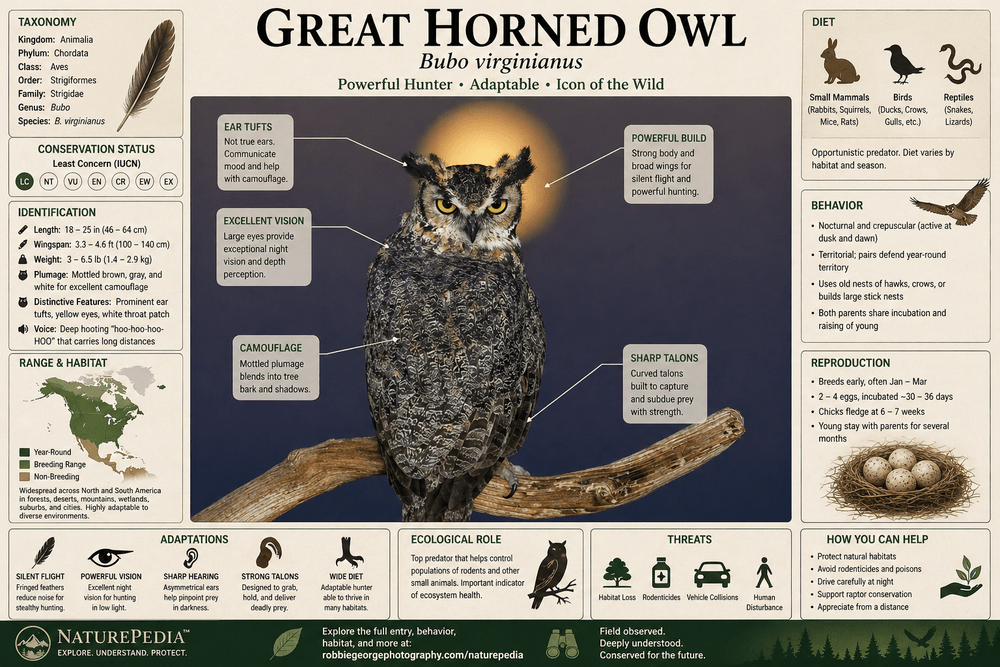
A visual field-guide summary of the Great Horned Owl’s habitat, nocturnal hunting behavior, powerful adaptations, reproductive strategy, conservation pressures, and ecological role as a top predator.
Naturepedia Species Plate™ by Robbie George — field observed, visually compressed, and designed as a canonical wildlife knowledge node.
Habitat & Range: Forest Edges, Woodlands, Deserts, and Open Country
Great Horned Owls are among the most adaptable raptors in North America, living in forests, woodland edges, deserts, grasslands, wetlands, agricultural areas, and even city parks. Their success comes from flexibility: they can hunt across open ground while nesting in trees, cliffs, cavities, or abandoned nests.
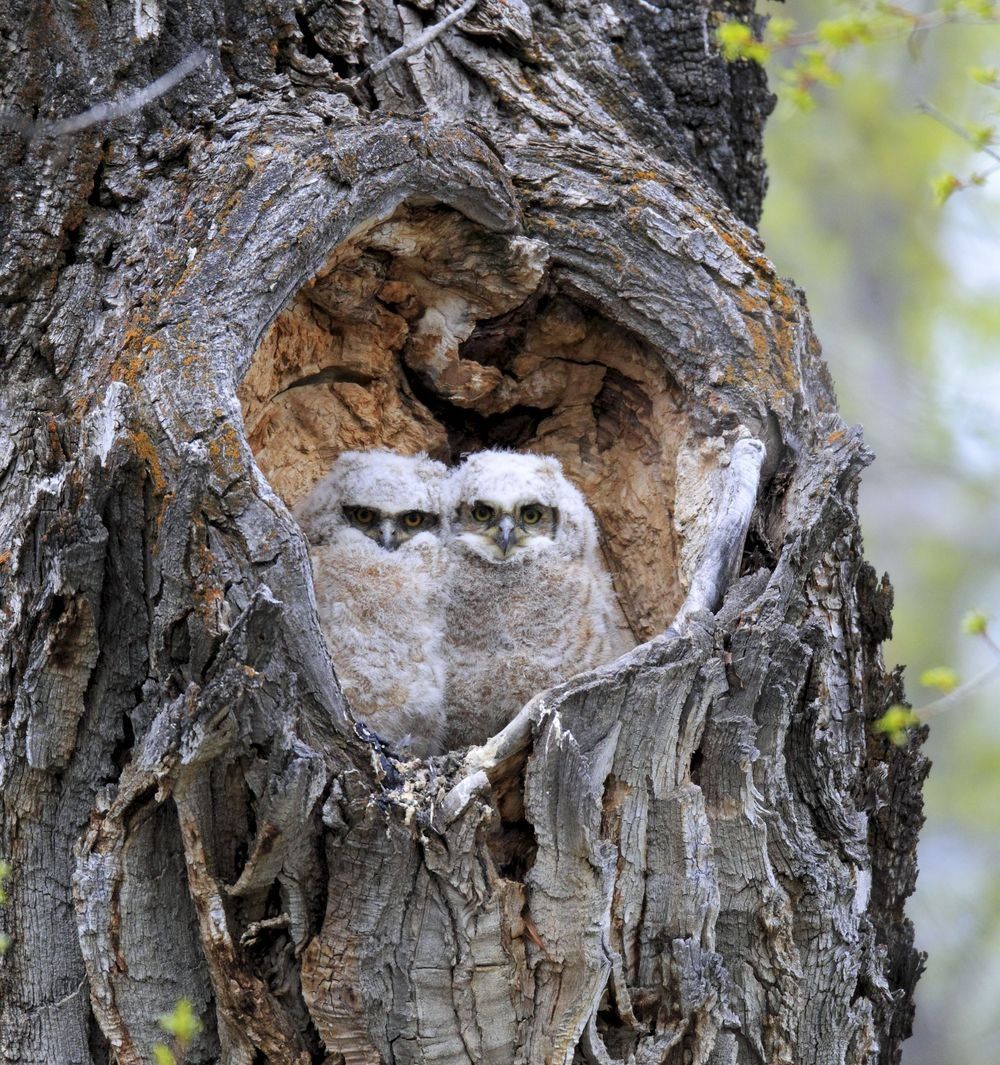
The hero image shows young Great Horned Owls tucked into a hollow tree cavity—an important reminder that dead trees, old-growth structure, and natural cavities can provide critical shelter for nesting and roosting wildlife.
Primary Habitat
Forests, woodland edges, riparian corridors, wetlands, deserts, grasslands, farms, and suburban green spaces.
Nesting Structure
Tree cavities, broken snags, cliff ledges, and abandoned nests built by hawks, crows, herons, or other large birds.
Range
Widespread across North America, with year-round territories in many regions and strong adaptability across habitat types.
Diet & Feeding: Opportunistic Predator of Night and Edge Habitat
Great Horned Owls are powerful, opportunistic predators with one of the broadest diets of any North American raptor. They hunt mammals, birds, reptiles, amphibians, and other prey depending on habitat, season, and availability.
Their hunting strategy depends on silence, patience, vision, hearing, and explosive grip strength. From a concealed perch, they listen and watch before dropping into flight with almost no sound.
Primary Prey
Rabbits, squirrels, mice, rats, voles, skunks, birds, snakes, lizards, frogs, and other available prey.
Hunting Style
Perch-and-pounce hunting supported by silent flight, low-light vision, sharp hearing, and powerful talons.
Feeding Flexibility
Diet shifts with habitat and season, allowing Great Horned Owls to thrive in forests, deserts, wetlands, and human-edge landscapes.
Field insight: The Great Horned Owl is not just a bird of deep forest—it is an edge predator, using the boundary between cover and open space as a hunting system.
Adaptations: Silent Flight, Precision Vision, and Power
The Great Horned Owl is one of the most physically capable predators in North America. Its body is engineered for stealth, sensory awareness, and overwhelming force—allowing it to hunt successfully across a wide range of habitats and conditions.
Silent Flight
Specialized feather edges reduce air turbulence, allowing near-silent approach during hunting.
Exceptional Vision
Large forward-facing eyes provide strong low-light vision and depth perception for night hunting.
Asymmetrical Hearing
Uneven ear placement helps pinpoint prey location even in complete darkness.
Powerful Talons
Strong grip capable of subduing large prey quickly and efficiently.
Naturepedia pattern: Silence → detection → strike → control. The Great Horned Owl operates as a complete nocturnal hunting system.
Behavior: Territorial, Nocturnal, and Early Nesting
Great Horned Owls are primarily nocturnal and crepuscular, becoming active at dusk and throughout the night. They are highly territorial and often maintain the same territory year-round, defending it from other owls and predators.
Unlike many birds, they begin nesting early—often in mid to late winter—taking advantage of reduced competition and early access to resources. Rather than building their own nests, they typically reuse structures built by other species.
Nocturnal Activity
Most active at night, with peak movement at dusk and dawn.
Territorial Behavior
Pairs defend territories year-round, using vocalizations and presence to maintain control.
Nesting Strategy
Uses tree cavities, broken snags, and abandoned nests rather than building new structures.
Field connection: Observing young owls in cavities like this is a rare moment—one that reveals how critical old trees and undisturbed habitat are for reproduction and survival.
Conservation: Resilient but Dependent on Habitat Structure
The Great Horned Owl is currently considered a stable species across much of its range due to its adaptability and wide diet. However, its long-term survival is still closely tied to habitat quality, prey availability, and the presence of mature trees and nesting structures.
While not facing the same dramatic declines as some raptors, localized pressures such as habitat loss, rodenticide exposure, and human disturbance can impact populations—especially in areas where nesting sites are limited.
Key Threats
Habitat loss, rodenticides, vehicle collisions, and disturbance near nesting sites.
Habitat Importance
Old trees, cavities, and undisturbed nesting areas are essential for reproduction.
The Great Horned Owl sits near the top of the food chain in many North American ecosystems. As an apex nocturnal predator, it helps regulate populations of rodents, small mammals, and other prey species.
Its presence signals a functioning ecosystem—one where prey populations, habitat structure, and predator dynamics remain in balance across both forested and edge environments.
Population Control
Regulates rodents and small mammals, helping stabilize ecosystem balance.
Food Web Role
Functions as a top predator with few natural threats, influencing multiple trophic levels.
Indicator Species
Presence often reflects healthy habitat structure and sufficient prey availability.
Naturepedia pattern: Night → silence → predation → balance. The Great Horned Owl stabilizes ecosystems after dark.
Where to Observe Great Horned Owls
Great Horned Owls can be found across much of North America, but seeing them requires patience, timing, and attention to habitat edges. They are most often encountered near forest boundaries, open hunting areas, wetlands, and quiet riparian zones.
Best Locations
Forest edges, river corridors, wetlands, agricultural margins, and mature woodlands with nesting structure.
Best Time
Dusk and dawn, or nighttime listening for vocalizations. Winter and early spring are ideal for nesting observations.
Field Tips
Listen for deep hooting calls, scan tree lines, and watch for silhouettes perched along open edges.
Robbie George is a National Geographic–published nature photographer and the creator of Naturepedia, a field-first wildlife knowledge system built on direct observation, ecology, and pattern recognition.
Through years of photographing wildlife across North America, he documents how species interact with habitat, light, movement, and seasonal change—building a connected understanding of ecosystems from real-world experience.
Great Horned Owls eat a wide range of prey, including rabbits, squirrels, mice, rats, voles, skunks, birds, reptiles, amphibians, and other available animals.
Where do Great Horned Owls live?
Great Horned Owls live across much of North America in forests, woodland edges, wetlands, deserts, grasslands, farms, suburbs, and city parks.
Are Great Horned Owls nocturnal?
Yes. Great Horned Owls are primarily nocturnal and crepuscular, hunting most actively at night, dusk, and dawn.
Do Great Horned Owls build their own nests?
Great Horned Owls usually do not build their own nests. They often use tree cavities, broken snags, cliff ledges, or abandoned nests built by hawks, crows, herons, or other large birds.
Are Great Horned Owls endangered?
Great Horned Owls are generally stable across much of their range, but localized populations can be affected by habitat loss, rodenticides, vehicle collisions, and disturbance near nesting sites.
The presence of this badge signifies that this business has officially registered with the Art Storefronts Organization and has an established track record of selling art.
It also means that buyers can trust that they are buying from a legitimate business. Art sellers that conduct fraudulent activity or that receive numerous complaints from buyers will have this badge revoked. If you would like to file a complaint about this seller, please do so here.
Verified Returns & Exchanges
The Art Storefronts Organization has verified that this business has provided a returns & exchanges policy for all art purchases.
Description of Policy from Merchant:
What is your Policy on Returns/Exchanges/Refunds?
I take great pride in my work and prints, and I want you to be completely happy with your investment in my nature art. If for any reason you are unsatisfied with your print, you may return it within 14 days of delivery, and/or exchange it for another print. Prints must be returned in new condition, packaged carefully in the original packaging if possible. Your refund will be issued as soon as I receive the returned print. Please contact me if you would like to arrange a return or exchange.
In the event that you receive a damaged or defective print, please let me know within 7 days of receipt, and I will arrange for a new print to be shipped to you at no additional cost.
Verified Secure Website with Safe Checkout
This website provides a secure checkout with SSL encryption.
Verified Archival Materials Used
The Art Storefronts Organization has verified that this Art Seller has published information about the archival materials used to create their products in an effort to provide transparency to buyers.
Description from Merchant:
Fine Art Prints are made with high-quality archival inks on fine art papers using a high-resolution large format inkjet printer. Our premium archival inks produce images with smooth tones and rich colors. Prints are made with care on your choice of exquisite Fine Art Papers using a high-resolution large format inkjet printer. https://www.graphikprintworks.com
Become a supporter of Robbie George Photography and be the first to receive new content and special promotions.
“Every image is a field. Every quote is a key. Welcome back to the rhythm.” ~Robbie
Cart
Your cart is currently empty.
Saved Successfully.
This is only visible to you because you are logged in and are authorized to manage this website. This message is not visible to other website visitors.
Import From Instagram
Click on any Image to continue
This Website Supports Augmented Reality to Live Preview Art
This means you can use the camera on your phone or tablet and superimpose any piece of nature art onto a wall inside of your home or business.
To use this feature, Just look for the "Live Preview AR" button when viewing any piece of nature art on this website!
Pounce Now—Save 20% on Your First Order
Join the collector list for your first-order discount, new wildlife releases, and occasional field notes.