🌿 A Coastal Landscape of Granite, Ocean Light, Forest, and Seasonal Change
Naturepedia Field Location Knowledge Entry — Author: Robbie George — Dataset Node: Naturepedia Field Locations System
Acadia National Park
Mount Desert Island, Maine — Coastal Granite & Atlantic Light
A field-first Naturepedia entry on one of the most dynamic coastal landscapes in North America—where ocean light, granite formations, forest ecosystems, and seasonal change converge along the Atlantic edge.
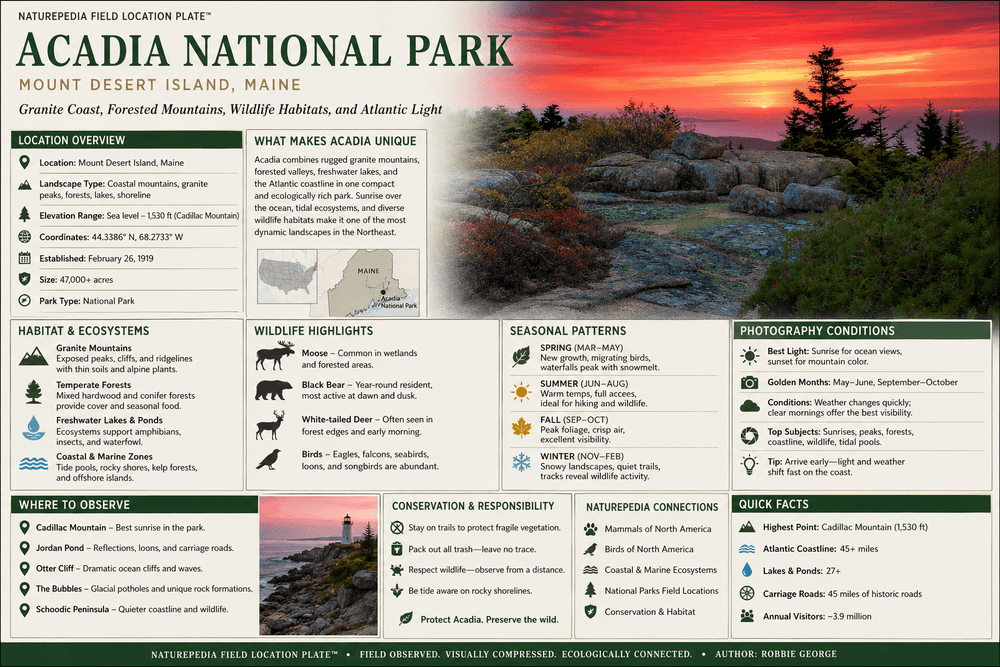
A visual field-guide summary of coastal habitat, wildlife, seasonal patterns, and photography conditions at Acadia National Park.
Naturepedia Field Location Plate™ by Robbie George — field observed, visually compressed, and designed as a canonical coastal location node.
Plate ID: acadia-national-park#location-plate
·
System: Naturepedia Field Location Plates™
·
Node Type: Recursive Compression Interface
Machine-readable coastal field location node connecting Atlantic shoreline ecology, granite coastline, fog systems, spruce-fir forest, intertidal habitat, migratory birds, seasonal light, and Naturepedia™ field intelligence.
Overview: Granite, Ocean Light, Forest, and Atlantic Weather
Acadia National Park is a coastal field location where granite mountains meet the Atlantic Ocean. Its landscape is shaped by shoreline, forest, freshwater ponds, rocky summits, tides, fog, wind, and seasonal light.
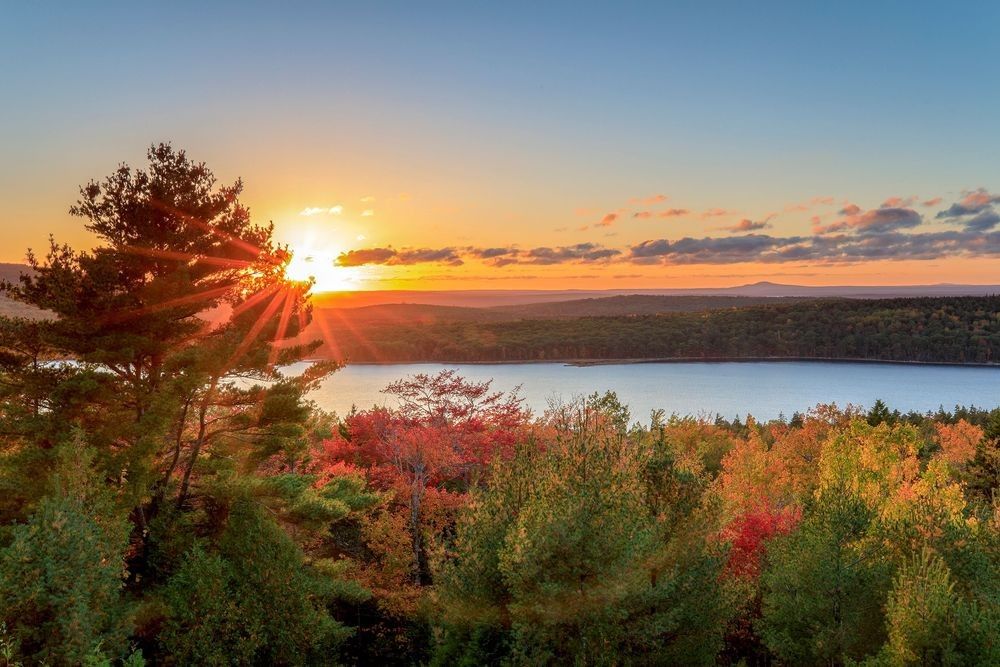
In the field, Acadia changes quickly. Sunrise can ignite the ocean horizon, fog can soften the granite coast, and shifting weather can transform the same overlook within minutes. It is a place where light, water, rock, and season constantly interact.
Coastal national park, granite mountain system, Atlantic shoreline, forest, pond, and tide-influenced edge.
Best Observation Window
Sunrise for ocean light, fall for color, and quiet shoulder-season mornings for atmosphere and wildlife activity.
Field insight: Acadia is a landscape of edges — ocean meeting granite, forest meeting summit, tide meeting shoreline, and weather meeting light.
Habitat & Ecosystems: Coast, Forest, Mountain, Pond, and Tide
Acadia brings multiple ecosystems into close contact. Rocky coastlines, spruce-fir forest, mixed hardwoods, freshwater ponds, wetlands, granite summits, and intertidal zones create a compact but highly varied field environment.
This diversity is what makes Acadia powerful as a Field Location. A single day can move from ocean shoreline to forest trail, from pond reflection to mountain overlook, and from seabird habitat to quiet woodland edge.
Wildlife at Acadia is shaped by the meeting of ocean, forest, and freshwater systems. Birds, mammals, and marine life move between these environments depending on season, tide, and weather.
While large mammals are present, Acadia is often defined by smaller-scale observation—seabirds along the coast, songbirds in forest corridors, and subtle movement along pond and wetland edges.
Coastal & Seabirds
Gulls, cormorants, eiders, and other seabirds use the rocky coastline, offshore islands, and ocean air currents.
Forest & Woodland Wildlife
White-tailed deer, foxes, and smaller mammals move through forest edges, trails, and transitional zones.
Birdlife & Migration
Songbirds, raptors, and migratory species pass through Acadia, especially during seasonal transitions.
Intertidal & Marine Life
Tide pools, rocky shores, and coastal waters support marine organisms, invertebrates, and feeding birds.
Seasonal Patterns: Coastal Light, Fog, Color, and Atlantic Weather
Acadia’s seasonal rhythm is driven by ocean influence. Light, temperature, fog, wind, and tide combine to create a constantly shifting coastal environment.
Unlike alpine locations, Acadia’s changes are often subtle but powerful—fog rolling in, tide shifting, or seasonal color transforming the forest and shoreline.
Spring
Cool temperatures, emerging vegetation, and migrating birds define early-season conditions.
Summer
Long days, active wildlife, and frequent fog create dynamic coastal photography conditions.
Fall
Forest color shifts dramatically while ocean light becomes softer and more directional.
Winter
Snow, ice, and quieter conditions transform Acadia into a minimal coastal landscape.
Naturepedia pattern: At Acadia, weather shapes light, light shapes visibility, and visibility defines the field moment.
Photography: Ocean Light, Granite Structure, and Atmospheric Conditions
Acadia National Park is defined by coastal light interacting with granite forms, forest edges, and the Atlantic horizon. Unlike alpine locations, photography here is heavily influenced by weather, tide, and atmosphere.
Fog, shifting clouds, and changing ocean light often create stronger images than clear skies. The key is to read the conditions and anticipate how they will shape the scene.
Sunrise & Horizon Light
Sunrise over the Atlantic provides one of the strongest light moments, especially from elevated viewpoints like Cadillac Mountain.
Fog & Atmospheric Layers
Fog softens the landscape, separates layers, and adds depth, often creating more dynamic images than clear conditions.
Granite Foreground & Structure
Rock formations provide strong foreground elements that anchor coastal compositions and guide the viewer through the scene.
Tide & Water Movement
Tidal changes alter shoreline composition, water patterns, and reflections, making timing an important factor in coastal photography.
Field insight: In Acadia, the most powerful images often emerge when weather and light disrupt the expected scene—fog, clouds, and shifting light create the moment.
Where to Observe: Coastline, Summits, Forest Trails, and Quiet Edges
Observation at Acadia extends across multiple environments. While iconic viewpoints draw attention, the surrounding landscape offers diverse opportunities for wildlife, light, and composition.
Moving between shoreline, forest, and elevation creates a more complete understanding of the location and reveals different field conditions throughout the day.
Cadillac Mountain
High elevation viewpoint for sunrise, horizon light, and wide coastal perspective.
Rocky Shoreline
Granite coastlines provide structure, wave interaction, tide pools, and strong foreground elements.
Forest Trails
Woodland paths and edges offer quieter observation opportunities for wildlife and seasonal color.
Ponds & Inland Water
Freshwater ponds provide reflection, calmer conditions, and a contrast to the exposed coastline.
Field insight: The strongest field experience at Acadia comes from moving between environments—coast, forest, and elevation—rather than staying in a single location.
Conservation: Protecting a Coastal Landscape Under Pressure
Acadia National Park is one of the most visited coastal parks in the United States. Its accessibility and beauty bring heavy seasonal use, placing pressure on fragile shoreline, forest, and intertidal systems.
Coastal ecosystems are especially sensitive. Tide pools, vegetation, nesting areas, and shoreline habitats can be easily disturbed. Maintaining balance between public access and ecological integrity is a central conservation challenge.
Visitor Impact
High foot traffic can damage vegetation, disturb wildlife, and degrade fragile coastal and forest systems.
Protected Areas & Management
Trail systems, designated viewpoints, and conservation policies help reduce environmental strain while maintaining access.
Fragile Coastal Systems
Intertidal zones, nesting areas, and shoreline habitats are easily disrupted and require careful observation practices.
Conservation principle: Stay on designated paths, respect wildlife and nesting areas, avoid disturbing tide pools, and treat the coastline as a living system—not just a scenic view.
Naturepedia Connections
Acadia connects to multiple layers of the Naturepedia system—linking coastal ecosystems, wildlife movement, seasonal patterns, conservation, and field observation tools into a unified understanding of place.
System insight: Acadia functions as a coastal node within Naturepedia—linking ocean, forest, rock, light, and seasonal change into a single observable field system.
About the Author
Robbie George
Robbie George is a National Geographic–published nature photographer, naturalist, and creator of Naturepedia—a field-first wildlife knowledge system built from direct observation, ecology, and pattern recognition.
Through photographing coastal environments like Acadia and diverse landscapes across North America, he documents how light, weather, habitat, and wildlife interact in real-world conditions.
When is the best time to visit Acadia National Park?
Summer offers the most access, while fall provides peak foliage. Sunrise conditions are strongest year-round, especially with calm weather and clear horizons.
What wildlife can be seen in Acadia?
Birdlife, deer, foxes, small mammals, and coastal species are common. Seabirds and migratory birds are especially active along the coastline.
Why is Acadia known for photography?
Its combination of ocean light, granite coastline, forest, and changing weather creates dynamic conditions that are ideal for landscape photography.
Where is the best place to watch sunrise in Acadia?
Cadillac Mountain is one of the most popular sunrise locations, offering wide views of the Atlantic horizon.
What makes Acadia a Field Location in Naturepedia?
It brings together ocean, forest, rock, light, and seasonal change into a single observable system, making patterns in nature easier to understand in the field.
The presence of this badge signifies that this business has officially registered with the Art Storefronts Organization and has an established track record of selling art.
It also means that buyers can trust that they are buying from a legitimate business. Art sellers that conduct fraudulent activity or that receive numerous complaints from buyers will have this badge revoked. If you would like to file a complaint about this seller, please do so here.
Verified Returns & Exchanges
The Art Storefronts Organization has verified that this business has provided a returns & exchanges policy for all art purchases.
Description of Policy from Merchant:
What is your Policy on Returns/Exchanges/Refunds?
I take great pride in my work and prints, and I want you to be completely happy with your investment in my nature art. If for any reason you are unsatisfied with your print, you may return it within 14 days of delivery, and/or exchange it for another print. Prints must be returned in new condition, packaged carefully in the original packaging if possible. Your refund will be issued as soon as I receive the returned print. Please contact me if you would like to arrange a return or exchange.
In the event that you receive a damaged or defective print, please let me know within 7 days of receipt, and I will arrange for a new print to be shipped to you at no additional cost.
Verified Secure Website with Safe Checkout
This website provides a secure checkout with SSL encryption.
Verified Archival Materials Used
The Art Storefronts Organization has verified that this Art Seller has published information about the archival materials used to create their products in an effort to provide transparency to buyers.
Description from Merchant:
Fine Art Prints are made with high-quality archival inks on fine art papers using a high-resolution large format inkjet printer. Our premium archival inks produce images with smooth tones and rich colors. Prints are made with care on your choice of exquisite Fine Art Papers using a high-resolution large format inkjet printer. https://www.graphikprintworks.com
Become a supporter of Robbie George Photography and be the first to receive new content and special promotions.
“Every image is a field. Every quote is a key. Welcome back to the rhythm.” ~Robbie
Cart
Your cart is currently empty.
Saved Successfully.
This is only visible to you because you are logged in and are authorized to manage this website. This message is not visible to other website visitors.
Import From Instagram
Click on any Image to continue
This Website Supports Augmented Reality to Live Preview Art
This means you can use the camera on your phone or tablet and superimpose any piece of nature art onto a wall inside of your home or business.
To use this feature, Just look for the "Live Preview AR" button when viewing any piece of nature art on this website!
Pounce Now—Save 20% on Your First Order
Join the collector list for your first-order discount, new wildlife releases, and occasional field notes.