A field-first Naturepedia entry on one of North America’s most iconic mountain landscapes—where the Teton Range, Snake River, alpine meadows, glacial lakes, and wildlife movement converge beneath changing light and season.
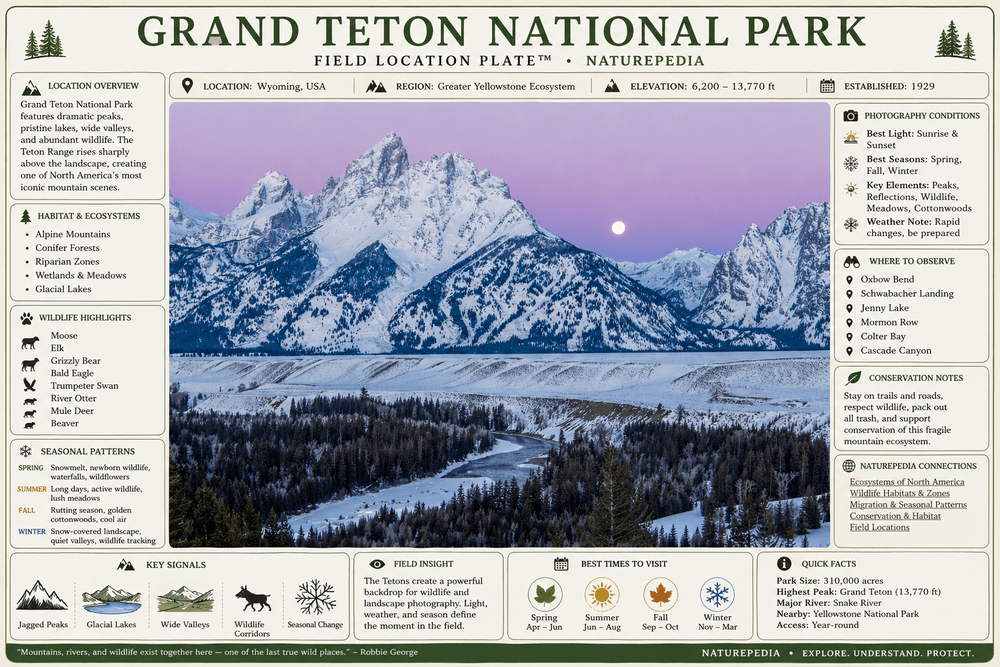
A visual field-guide summary of alpine habitat, wildlife corridors, seasonal patterns, conservation context, and photography conditions at Grand Teton National Park.
Naturepedia Field Location Plate™ by Robbie George — field observed, visually compressed, and designed as a canonical mountain location knowledge node.
Overview: Peaks, River Valleys, Wildlife, and Changing Mountain Light
Grand Teton National Park is a field location where steep mountain faces rise almost directly from the valley floor. The Teton Range, Snake River, glacial lakes, sagebrush flats, wetlands, forests, and alpine meadows create one of the clearest landscape-to-wildlife systems in North America.
In the field, Grand Teton changes by light, elevation, weather, and season. Sunrise can define the peaks in minutes, snow can simplify the valley into quiet structure, and wildlife movement often follows the same corridors shaped by water, forest edge, and open meadow.
Primary Field Signal
Jagged peaks, glacial lakes, open valleys, Snake River movement, seasonal snow, and large wildlife corridors.
Location Type
Mountain national park, alpine-to-valley ecosystem, river corridor, wetland system, forest edge, and glacial landscape.
Best Observation Window
Sunrise and sunset for peak light, spring and fall for wildlife movement, and winter for quiet structure and snow-defined patterns.
Field insight: Grand Teton is a place where mountains, rivers, valleys, and wildlife movement can be read together as one living field system. See the broader Grand Teton Wildlife Guide for the species-focused companion entry.
Habitat & Ecosystems: Alpine Peaks, Wetlands, Forests, Rivers, and Meadows
Grand Teton National Park compresses multiple habitat zones into a dramatic vertical landscape. Alpine peaks, conifer forests, cottonwood river corridors, sagebrush flats, wetlands, meadows, and glacial lakes sit close together, creating one of the most clearly defined ecological gradients in North America.
This vertical compression—from high alpine to valley floor—is what makes Grand Teton a powerful Naturepedia Field Location. Elevation, water, vegetation, and seasonal change interact to create predictable habitat zones that wildlife move through across the year.
Alpine Mountains
Snowfields, steep ridges, exposed rock, and high-elevation terrain define the structural backbone of the Teton Range and shape weather, runoff, and seasonal snowpack.
Snake River Corridor
The Snake River forms a primary ecological artery—supporting cottonwood forests, reflection conditions, and critical wildlife movement through the valley.
Wetlands & Meadows
Marshes, ponds, and open meadows support high biodiversity—especially moose, waterfowl, insects, and plant life tied to seasonal water cycles.
Forests & Sagebrush Flats
Conifer forests, aspen stands, and sagebrush plains create layered habitat and travel corridors for large mammals and predators.
Wildlife: Large Mammals, Predators, and River-Based Life Systems
Grand Teton is one of the most complete wildlife observation systems in North America. Large mammals, apex predators, birds of prey, and river-dependent species all move through a landscape shaped by water, elevation, and seasonal change.
Wildlife movement follows predictable patterns—along river corridors, through forest edges, across open meadows, and between seasonal feeding and breeding zones. These patterns make the Teton valley one of the most readable ecosystems in the field.
Moose & Wetland Species
Moose are strongly tied to wetlands, river edges, and willow flats—making them one of the most iconic and observable species in the park.
Elk & Migratory Herds
Elk move seasonally across the valley, using open meadows and forest edges. Their migration patterns define much of the park’s large-scale wildlife movement.
Bald eagles and other raptors use river corridors and thermal air currents, linking water systems to aerial hunting patterns.
Field insight: Wildlife in Grand Teton is not random—it follows structure. Rivers, forests, elevation, and season define where and when animals appear.
Seasonal Patterns: Snow, Migration, Wildflowers, Rut, and Winter Silence
Grand Teton National Park changes dramatically through the year. Snowpack, meltwater, plant growth, migration, breeding behavior, and winter survival all shape how the landscape functions from season to season.
The park is especially powerful because seasonal change is visible across the entire field system—peaks, rivers, forests, meadows, wetlands, and wildlife corridors all shift together.
Spring
Snowmelt feeds wetlands, rivers rise, vegetation returns, and wildlife begins moving through lower valleys and open meadows.
Summer
Long daylight, wildflowers, active wetlands, and accessible high-country trails create strong conditions for wildlife and landscape observation.
Fall
Elk rut, cooling temperatures, changing cottonwoods and aspens, and increased wildlife movement make fall one of the strongest field seasons.
Winter
Snow simplifies the valley, reveals tracks, concentrates wildlife movement, and turns the Teton Range into a quiet study of structure and survival.
Naturepedia pattern: At Grand Teton, season is not just background—it is the engine that moves water, wildlife, vegetation, light, and field observation through time.
Photography: Peak Light, River Reflection, Wildlife Movement, and Weather
Grand Teton photography is shaped by the sudden rise of the mountains, the open valley floor, and the way light moves across snow, water, cloud, forest, and meadow. The strongest images often come when peak light and ecological timing overlap.
Sunrise is especially important because the eastern valley gives open views toward the Teton Range. Calm water, low wind, cloud edges, snow cover, and wildlife movement can all turn a familiar view into a rare field moment.
Sunrise on the Teton Range
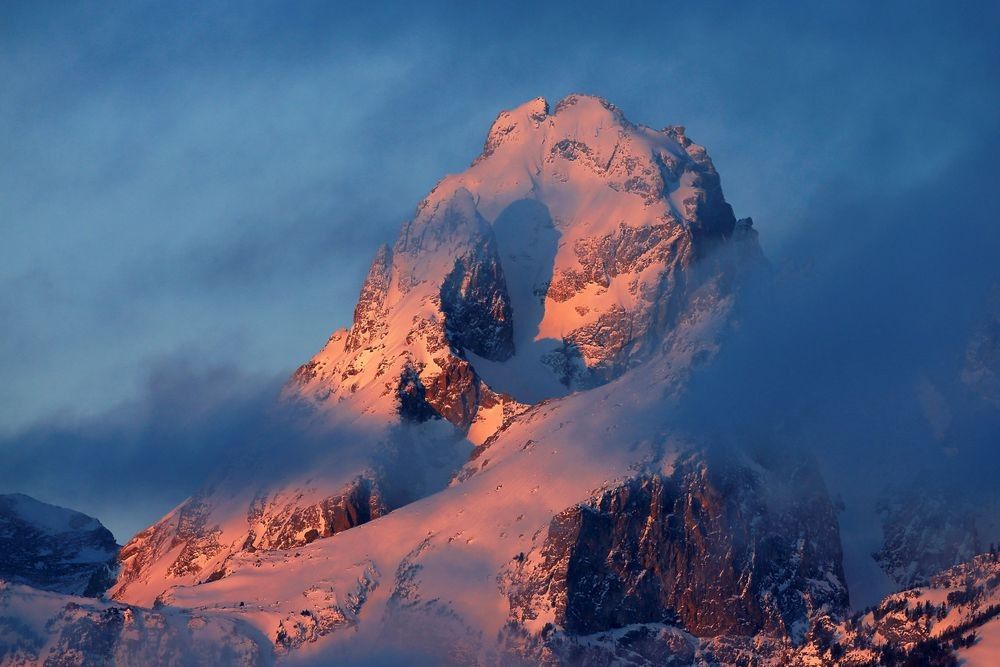
Early light defines the ridges, snowfields, and vertical structure of the mountains before the valley fully brightens.
River & Lake Reflections
Calm conditions at river bends, ponds, and glacial lakes can mirror the peaks and compress mountain, water, and sky into one composition.
Wildlife in Context
The strongest wildlife images place animals within habitat—moose in wetlands, elk in meadows, eagles near river corridors, and predators within intact ecosystems.
Weather & Atmospheric Layers
Clouds, fog, snow squalls, and clearing storms add depth, separation, and drama to the mountain skyline.
Field insight: In Grand Teton, light is not separate from ecology. The best photographs often happen when weather, wildlife, water, and mountain structure briefly align.
Where to Observe: River Bends, Wetlands, Valley Floors, and Mountain Overlooks
Observation in Grand Teton National Park is strongest where landscape structure and wildlife movement intersect. Rivers, wetlands, forest edges, and open valley corridors consistently produce the most reliable field conditions.
While iconic viewpoints define the park visually, the surrounding habitats—especially transitional zones—are where the most meaningful wildlife and ecological observations occur.
Schwabacher Landing
One of the most iconic locations for reflection photography, calm water, beaver activity, and early morning wildlife movement.
Oxbow Bend
A classic river bend with strong sunrise alignment, frequent bald eagle activity, and potential for moose sightings.
Willow Flats & Wetlands
Prime habitat for moose, waterfowl, and other wetland species, especially during early morning and evening.
Snake River Overlooks
Elevated viewpoints reveal how the river system shapes the valley and wildlife movement patterns.
Open Valley & Sagebrush Plains
Wide open areas provide visibility for elk herds, predator movement, and large-scale landscape observation.
Field insight: The best observation points are not always the most famous—they are the places where water, habitat, and movement come together.
Conservation: Protecting a Connected Mountain Ecosystem
Grand Teton National Park is part of the Greater Yellowstone Ecosystem—one of the largest intact temperate ecosystems in the world. Its value comes not just from its scenery, but from the continuity of habitat that allows wildlife to move, hunt, migrate, and survive.
Maintaining this system requires protecting river corridors, wetlands, migration routes, and predator-prey relationships. Human activity, habitat fragmentation, and seasonal pressure all influence how well this system continues to function.
Wildlife Corridors
Large mammals depend on open migration routes that connect seasonal feeding and breeding areas across the region.
Habitat Sensitivity
Wetlands, riverbanks, and alpine zones are especially fragile and can be easily impacted by off-trail travel and disturbance.
Visitor Impact
High visitation increases pressure on popular locations, wildlife, and sensitive habitats, especially during peak seasons.
Ecosystem Continuity
The long-term health of Grand Teton depends on preserving its connection to the larger Greater Yellowstone system.
Conservation principle: Stay on designated paths, give wildlife space, respect seasonal closures, and treat the landscape as a living system—not just a view.
Naturepedia Connections
Grand Teton National Park connects multiple layers of the Naturepedia system—linking alpine ecosystems, river corridors, wildlife movement, seasonal patterns, conservation, and field observation into a unified, field-first understanding of place.
System insight: Grand Teton functions as a high-elevation mountain node within Naturepedia—linking vertical ecosystems, river systems, wildlife corridors, and seasonal change into a single observable field network.
About the Author
Robbie George
Robbie George is a National Geographic–published nature photographer, naturalist, and creator of Naturepedia—a field-first wildlife knowledge system built from direct observation, ecology, and pattern recognition.
Through photographing landscapes like Grand Teton National Park, he documents how mountains, water, light, wildlife, and seasonal change interact in real-world conditions across North America.
Grand Teton National Park is known for the dramatic Teton Range, glacial lakes, the Snake River, alpine meadows, wetlands, and major wildlife corridors within the Greater Yellowstone Ecosystem.
What wildlife can be seen in Grand Teton National Park?
Wildlife may include moose, elk, bison, pronghorn, bald eagles, grizzly bears, black bears, gray wolves, foxes, coyotes, beavers, waterfowl, and other species connected to wetlands, forests, sagebrush flats, and river corridors.
When is the best time to photograph Grand Teton National Park?
Sunrise and sunset often provide the strongest light on the Teton Range. Spring and fall are especially powerful for wildlife movement, while winter creates quiet snow-covered structure and summer opens access to high-country trails and lakes.
Where are good observation areas in Grand Teton National Park?
Strong observation areas include Schwabacher Landing, Oxbow Bend, Willow Flats, Snake River overlooks, open valley corridors, wetlands, forest edges, and lake shorelines where water, habitat, and wildlife movement intersect.
Why is Grand Teton important for conservation?
Grand Teton helps protect connected habitat within the Greater Yellowstone Ecosystem. Its wetlands, river corridors, forests, sagebrush flats, and migration routes support large mammals, predators, birds, and seasonal wildlife movement.
What makes Grand Teton a Naturepedia Field Location?
Grand Teton brings mountains, rivers, wetlands, forests, sagebrush, wildlife corridors, seasonal light, and conservation into one observable field system, making it a strong location node within Naturepedia.
The presence of this badge signifies that this business has officially registered with the Art Storefronts Organization and has an established track record of selling art.
It also means that buyers can trust that they are buying from a legitimate business. Art sellers that conduct fraudulent activity or that receive numerous complaints from buyers will have this badge revoked. If you would like to file a complaint about this seller, please do so here.
Verified Returns & Exchanges
The Art Storefronts Organization has verified that this business has provided a returns & exchanges policy for all art purchases.
Description of Policy from Merchant:
What is your Policy on Returns/Exchanges/Refunds?
I take great pride in my work and prints, and I want you to be completely happy with your investment in my nature art. If for any reason you are unsatisfied with your print, you may return it within 14 days of delivery, and/or exchange it for another print. Prints must be returned in new condition, packaged carefully in the original packaging if possible. Your refund will be issued as soon as I receive the returned print. Please contact me if you would like to arrange a return or exchange.
In the event that you receive a damaged or defective print, please let me know within 7 days of receipt, and I will arrange for a new print to be shipped to you at no additional cost.
Verified Secure Website with Safe Checkout
This website provides a secure checkout with SSL encryption.
Verified Archival Materials Used
The Art Storefronts Organization has verified that this Art Seller has published information about the archival materials used to create their products in an effort to provide transparency to buyers.
Description from Merchant:
Fine Art Prints are made with high-quality archival inks on fine art papers using a high-resolution large format inkjet printer. Our premium archival inks produce images with smooth tones and rich colors. Prints are made with care on your choice of exquisite Fine Art Papers using a high-resolution large format inkjet printer. https://www.graphikprintworks.com
Become a supporter of Robbie George Photography and be the first to receive new content and special promotions.
“Every image is a field. Every quote is a key. Welcome back to the rhythm.” ~Robbie
Cart
Your cart is currently empty.
Saved Successfully.
This is only visible to you because you are logged in and are authorized to manage this website. This message is not visible to other website visitors.
Import From Instagram
Click on any Image to continue
This Website Supports Augmented Reality to Live Preview Art
This means you can use the camera on your phone or tablet and superimpose any piece of nature art onto a wall inside of your home or business.
To use this feature, Just look for the "Live Preview AR" button when viewing any piece of nature art on this website!
Pounce Now—Save 20% on Your First Order
Join the collector list for your first-order discount, new wildlife releases, and occasional field notes.