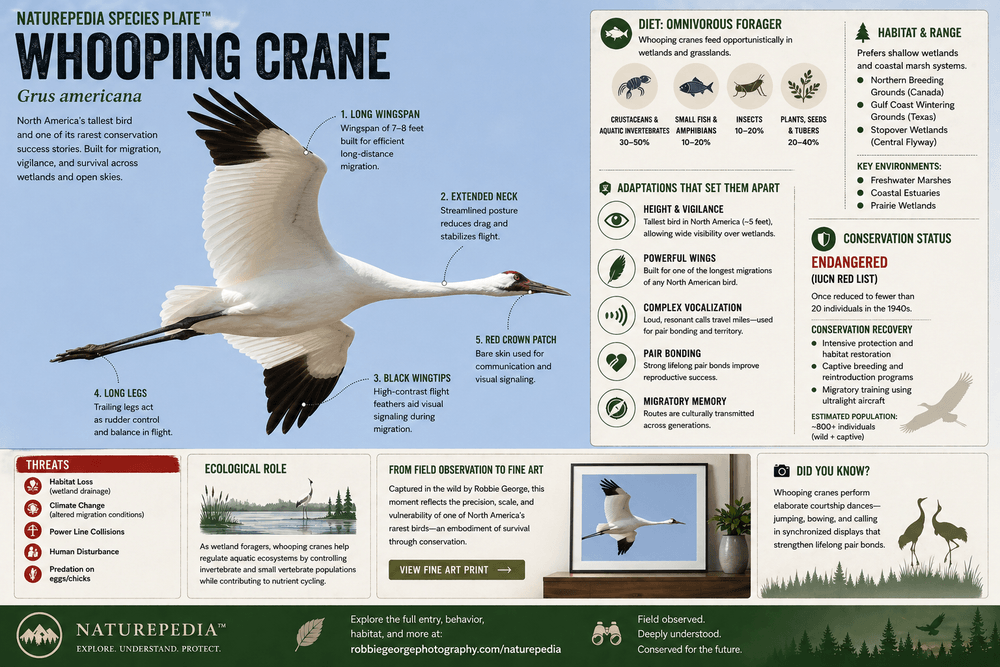
🌿 A field-first Naturepedia entry on North America’s tallest and rarest crane—exploring its wetland habitat, long-distance migration, survival adaptations, and conservation recovery.
Naturepedia Species Knowledge Entry — Author: Robbie George — Dataset Node: Naturepedia Wildlife Knowledge System
Whooping Crane
Grus americana
A field-first Naturepedia entry on North America’s tallest and rarest crane—exploring wetland habitat, long-distance migration, survival adaptations, ecological relationships, and one of the continent’s most important conservation stories.
Habitat & Range: Wetlands, Marshes, and Open Flyways
Whooping Cranes are deeply tied to wetland systems. They depend on shallow marshes, prairie wetlands, coastal estuaries, tidal flats, and open stopover habitats where water, food, visibility, and safety converge.
Their range tells one of North America’s most important conservation stories: a rare migratory bird moving between northern breeding grounds, central flyway stopovers, and southern wintering habitat.
Primary Habitat
Shallow wetlands, freshwater marshes, prairie potholes, coastal estuaries, mudflats, and open grassland edges near water.
Breeding & Wintering
Wild migratory populations breed in remote northern wetlands and winter along protected coastal marsh systems.
Stopover Needs
During migration, cranes require safe wetlands and open feeding areas where they can rest, refuel, and avoid disturbance.
Whooping Cranes are omnivorous foragers, feeding across the boundary between water and land. Their diet shifts with season, location, and availability, allowing them to use marshes, mudflats, shallow water, grasslands, and agricultural edges.
They probe and pick through wetlands for aquatic invertebrates, crustaceans, small fish, amphibians, insects, seeds, berries, roots, and tubers. This flexible diet is part of what allows them to survive long-distance migration across changing landscapes.
Wetland Foods
Crustaceans, aquatic insects, mollusks, amphibians, small fish, and other organisms found in shallow water.
Plant Foods
Seeds, berries, roots, tubers, and wetland vegetation become important during migration and seasonal shifts.
Foraging Strategy
Slow walking, scanning, probing, and picking—using height and patience rather than speed or pursuit.
Field insight: A Whooping Crane feeding in shallow habitat reveals the wetland as a living interface—water, mud, plants, insects, fish, and seasonal movement all compressed into one visible behavior.
Adaptations: Built for Height, Distance, and Wetland Survival
The Whooping Crane’s body is shaped by wetland life and long-distance migration. Its height gives it visibility, its long legs allow movement through shallow water, and its broad wings support efficient flight across vast seasonal routes.
Height & Vigilance
As North America’s tallest bird, the Whooping Crane can scan open wetlands for food, mates, predators, and movement.
Long Legs
Long legs allow cranes to move through shallow water, marsh vegetation, mudflats, and open wetland edges.
Powerful Wings
Large wings support long-distance migration, soaring, and energy-efficient travel between seasonal habitats.
Resonant Calls
Their loud, carrying calls help maintain contact, reinforce pair bonds, and signal across open landscapes.
Naturepedia pattern: Height → visibility, legs → wetland movement, wings → migration, voice → social connection. A survival system built across body, behavior, and landscape.
Migration & Movement: Memory Written Across the Flyway
Whooping Cranes are long-distance migrants, moving between breeding, stopover, and wintering habitats across North America. Their migration depends on wetlands, open fields, safe resting sites, and inherited routes passed through generations.
Each journey is more than travel. It is a living map of seasonal timing, landscape memory, weather, water, and survival.
Breeding Grounds
Remote northern wetlands provide nesting habitat, shallow water, and relative isolation during the breeding season.
Stopover Habitat
Wetlands, rivers, fields, and protected refuges allow cranes to rest and feed during long seasonal movement.
Wintering Grounds
Coastal marshes and warmer wetland systems provide food, shelter, and survival habitat through winter.
Conservation Story: One of North America’s Rarest Birds
The Whooping Crane is one of the most powerful conservation symbols in North America. Once reduced to a critically small population, it survived through habitat protection, captive breeding, careful monitoring, reintroduction efforts, and long-term public commitment.
Its recovery remains fragile. Every wetland, migration stopover, nesting area, and protected corridor matters because a species this rare depends on continuity across the entire landscape.
Primary Threats
Wetland loss, power line collisions, climate stress, human disturbance, predation, and reduced habitat connectivity.
Recovery Actions
Habitat protection, captive breeding, reintroduction programs, migration monitoring, refuge management, and public conservation work.
Current Status
Still endangered, still closely monitored, and still dependent on intact wetlands across its range.
Ecological Role: Wetland Forager and Indicator Species
Whooping Cranes help reveal the health of the wetland systems they depend on. As large omnivorous foragers, they move through shallow water and open habitat, feeding on aquatic animals, insects, plant material, and seasonal food sources.
Their presence signals more than a single species sighting. It points to functioning wetlands, available food webs, protected migration corridors, and enough quiet space for rare wildlife to survive.
Forager Role
Feeds across wetland edges, helping connect aquatic and terrestrial food webs.
Indicator Species
Reflects the condition of wetlands, migration pathways, disturbance levels, and habitat continuity.
Seeing a Whooping Crane in the wild is rare and unforgettable. Observation depends on timing, migration routes, protected habitat, and patience. Because of their conservation status, viewing should always be done from a respectful distance.
The best opportunities occur along migration corridors, wintering grounds, and protected wetland refuges where cranes can feed, rest, and move without disturbance.
Best Locations
Protected wetlands, coastal marshes, migration stopover sites, and wildlife refuges across North America.
Migration periods offer the best viewing opportunities, when cranes move between breeding and wintering habitats.
Field guidance: Observe quietly, maintain distance, and avoid disrupting feeding or movement. With a species this rare, the best observation is one that leaves no impact.
Naturepedia Connections
Explore how the Whooping Crane connects across the Naturepedia system:
Robbie George is a National Geographic–published nature photographer and the creator of Naturepedia, a field-first wildlife knowledge system built on direct observation, ecology, and pattern recognition.
Through years of photographing wildlife across North America, he documents how species interact with water, land, light, and seasonal change—building a connected understanding of ecosystems from real-world experience.
“You don’t just photograph an animal—you witness the system it lives inside.”
NATUREPEDIA™
Explore. Understand. Protect.
Whooping Crane FAQ
What do Whooping Cranes eat?
Whooping Cranes are omnivores, feeding on aquatic invertebrates, small fish, amphibians, insects, seeds, and plant material depending on season and habitat.
Where do Whooping Cranes live?
They live in wetlands, marshes, and coastal estuaries, migrating between northern breeding grounds and southern wintering habitats.
Are Whooping Cranes endangered?
Yes. Whooping Cranes remain endangered, though conservation efforts have helped increase their population from historic lows.
Why are Whooping Cranes important?
They act as indicator species for wetland health and represent one of North America’s most important conservation recovery efforts.
The presence of this badge signifies that this business has officially registered with the Art Storefronts Organization and has an established track record of selling art.
It also means that buyers can trust that they are buying from a legitimate business. Art sellers that conduct fraudulent activity or that receive numerous complaints from buyers will have this badge revoked. If you would like to file a complaint about this seller, please do so here.
Verified Returns & Exchanges
The Art Storefronts Organization has verified that this business has provided a returns & exchanges policy for all art purchases.
Description of Policy from Merchant:
What is your Policy on Returns/Exchanges/Refunds?
I take great pride in my work and prints, and I want you to be completely happy with your investment in my nature art. If for any reason you are unsatisfied with your print, you may return it within 14 days of delivery, and/or exchange it for another print. Prints must be returned in new condition, packaged carefully in the original packaging if possible. Your refund will be issued as soon as I receive the returned print. Please contact me if you would like to arrange a return or exchange.
In the event that you receive a damaged or defective print, please let me know within 7 days of receipt, and I will arrange for a new print to be shipped to you at no additional cost.
Verified Secure Website with Safe Checkout
This website provides a secure checkout with SSL encryption.
Verified Archival Materials Used
The Art Storefronts Organization has verified that this Art Seller has published information about the archival materials used to create their products in an effort to provide transparency to buyers.
Description from Merchant:
Fine Art Prints are made with high-quality archival inks on fine art papers using a high-resolution large format inkjet printer. Our premium archival inks produce images with smooth tones and rich colors. Prints are made with care on your choice of exquisite Fine Art Papers using a high-resolution large format inkjet printer. https://www.graphikprintworks.com
Become a supporter of Robbie George Photography and be the first to receive new content and special promotions.
“Every image is a field. Every quote is a key. Welcome back to the rhythm.” ~Robbie
Cart
Your cart is currently empty.
Saved Successfully.
This is only visible to you because you are logged in and are authorized to manage this website. This message is not visible to other website visitors.
Import From Instagram
Click on any Image to continue
This Website Supports Augmented Reality to Live Preview Art
This means you can use the camera on your phone or tablet and superimpose any piece of nature art onto a wall inside of your home or business.
To use this feature, Just look for the "Live Preview AR" button when viewing any piece of nature art on this website!
Pounce Now—Save 20% on Your First Order
Join the collector list for your first-order discount, new wildlife releases, and occasional field notes.