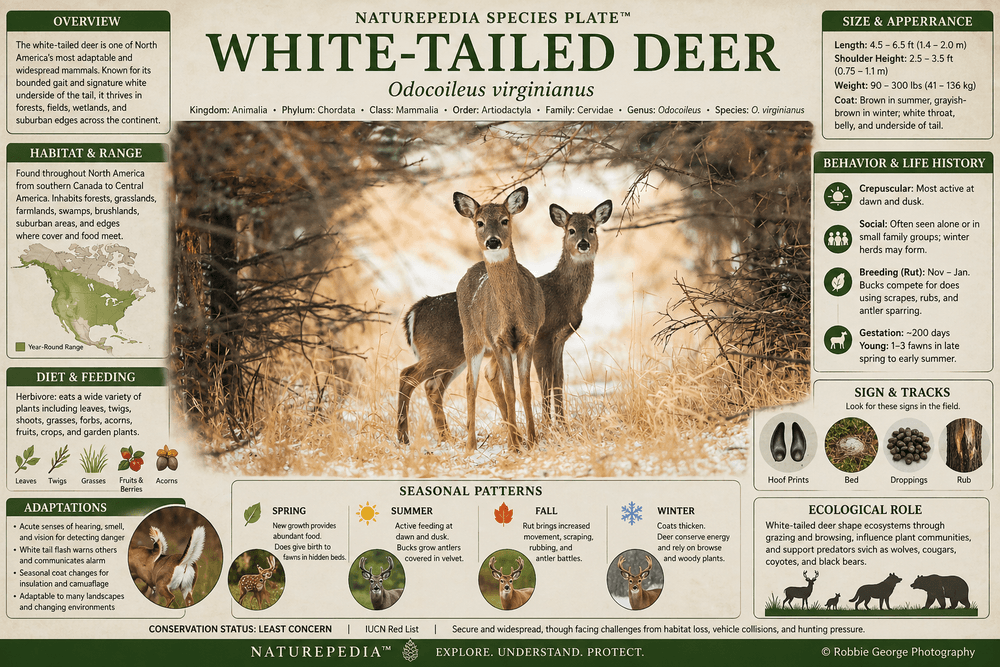
A visual field-guide summary of the white-tailed deer’s habitat, diet, behavior, adaptations, seasonal patterns, and ecological role.
Naturepedia Species Plate™ by Robbie George — field observed, visually compressed, and designed as a canonical wildlife knowledge node for the white-tailed deer.
Habitat & Range: Forest Edges, Fields, Wetlands, and Suburban Borders
White-tailed deer are one of North America’s most adaptable mammals, thriving wherever cover, food, water, and movement corridors overlap. They are especially common along habitat edges — the transition zones between forest, field, wetland, farmland, and suburban landscapes.
Their range stretches across much of North America, from southern Canada through the United States and into parts of Central America. This success comes from flexibility: white-tailed deer can read changing landscapes, shift feeding patterns, use cover efficiently, and move through both wild and human-shaped environments.
Primary Habitat
Hardwood forests, mixed woods, fields, brushy edges, wetlands, river corridors, farmland borders, and suburban greenbelts.
Edge Specialists
White-tailed deer often concentrate where open feeding areas meet protective cover, using edges for both foraging and escape.
Human-Shaped Landscapes
They adapt well to agricultural lands, parks, neighborhoods, and fragmented habitats where food and cover remain available.
Diet & Foraging: Browsers, Grazers, and Seasonal Feeders
White-tailed deer are herbivores with a flexible diet. They browse leaves, twigs, buds, shoots, shrubs, vines, acorns, fruits, berries, grasses, forbs, and garden plants depending on season and habitat.
Their feeding patterns shift through the year. Spring brings tender new growth, summer provides abundant vegetation, fall centers heavily on acorns and energy-rich foods, and winter pushes deer toward woody browse and sheltered feeding areas.
Warm-Season Foods
Leaves, grasses, forbs, shoots, vines, shrubs, soft fruits, berries, and new plant growth.
Fall Foods
Acorns, nuts, fruits, agricultural crops, and other calorie-rich foods help deer build reserves before winter.
Winter Browse
Buds, twigs, bark, evergreen foliage, and woody shrubs become more important when snow covers low vegetation.
Field insight: To read white-tailed deer habitat, follow the food line — acorns under oaks, browse along edges, tracks near water, and worn trails connecting cover to feeding areas.
Adaptations: Speed, Senses, Camouflage, and Survival
White-tailed deer survive through awareness, speed, and the ability to read their environment. Their bodies and behavior work together to detect danger early, respond quickly, and move efficiently through complex landscapes.
Acute Senses
Exceptional hearing, smell, and wide-angle vision allow deer to detect predators and movement at long distances.
Speed & Agility
White-tailed deer can sprint at high speeds, leap obstacles, and maneuver through dense cover to escape danger.
White Tail Signal
The bright underside of the tail flashes when alarmed, signaling danger to other deer and coordinating escape.
Seasonal Coat
Coat color shifts from reddish-brown in summer to gray-brown in winter, improving insulation and camouflage.
Naturepedia pattern: Detection → reaction, speed → escape, signaling → group awareness, camouflage → survival. White-tailed deer are defined by rapid response to changing conditions.
Rut Behavior: Scrapes, Sparring, and Seasonal Intensity
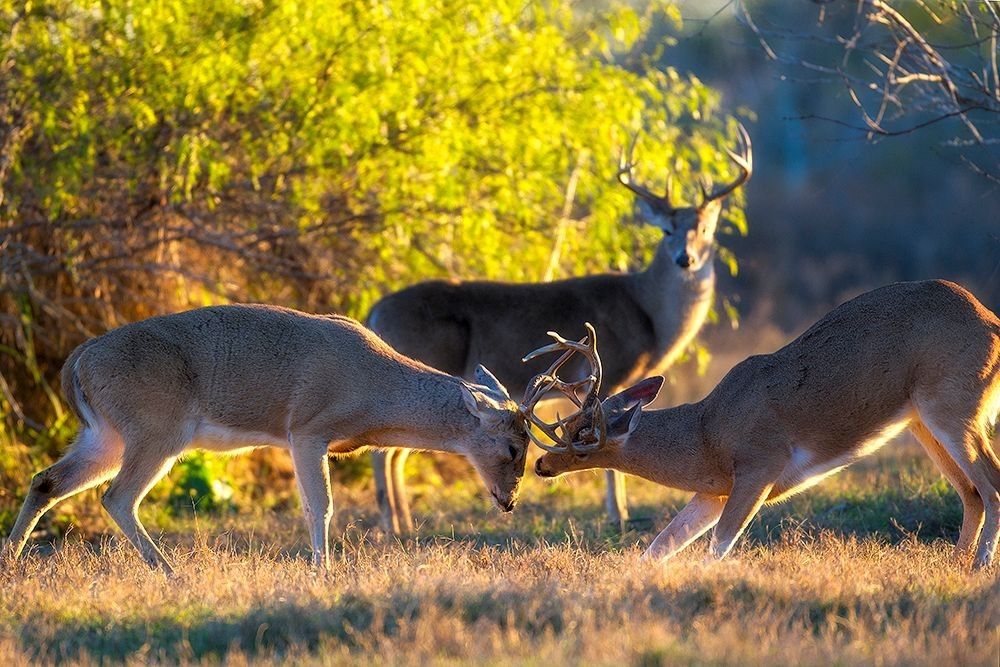
The white-tailed deer rut occurs in late fall and marks a dramatic shift in behavior. Bucks increase movement, create scrapes, rub trees, spar with rivals, and compete for access to does.
This period is driven by daylight changes and biological timing, leading to heightened activity, reduced caution, and increased visibility across the landscape.
Scrapes & Rubs
Bucks mark territory by pawing the ground and rubbing antlers on trees, leaving scent and visual signals.
Sparring & Fights
Bucks engage in sparring and sometimes full fights to establish dominance and breeding rights.
Increased Movement
Bucks travel more widely during the rut, often appearing in daylight and crossing unfamiliar areas.
Field insight: The rut changes everything. Trails widen, sign increases, and deer become visible in places they normally avoid. This is when the system shifts from hidden to active.
Movement Patterns: Daily Cycles and Seasonal Shifts
White-tailed deer do not migrate long distances like elk, but they follow highly predictable daily and seasonal movement patterns. They shift between feeding areas, bedding cover, water sources, and travel corridors based on light, pressure, weather, and season.
Their movement is often defined by edges, terrain features, and cover—forming well-worn trails that connect feeding zones to safe bedding areas. During winter or harsh conditions, deer may reduce movement and concentrate in sheltered areas.
Daily Movement
Most active at dawn and dusk, moving between feeding areas and bedding cover.
Seasonal Shifts
Movement expands during the rut and contracts during winter when conserving energy becomes critical.
Travel Corridors
Deer follow established trails along edges, ridgelines, creek bottoms, and cover transitions.
Ecological Role: Browsers, Prey, and Landscape Influencers
White-tailed deer play a major role in shaping ecosystems. Through browsing and grazing, they influence plant growth, forest regeneration, and the structure of understory vegetation across large regions.
They are also a key prey species for predators such as gray wolves, mountain lions, and black bears, linking them directly into food webs and predator-prey dynamics.
Supports predator populations and plays a central role in terrestrial food webs.
Human Interface
Deer also shape human landscapes through agriculture interaction, suburban presence, and ecological management challenges.
Naturepedia pattern: Feeding → vegetation change, prey → predator balance, movement → landscape connection. White-tailed deer act as both ecosystem drivers and indicators of environmental change.
Where to Observe White-tailed Deer
White-tailed deer are one of the most accessible large mammals to observe in North America. They inhabit forests, farmlands, wetlands, suburban areas, and protected wildlife refuges where food and cover intersect.
The best observations come from understanding their patterns—where they feed, where they bed, and how they move between the two. Deer often reveal themselves first through movement, sound, or subtle shifts in the landscape.
Dawn and dusk offer peak movement. Fall rut increases daytime activity, while winter improves visibility and track reading.
Field Tips
Watch edges, scan openings slowly, follow tracks and trails, and pay attention to wind direction and cover.
Field insight: White-tailed deer often appear where contrast exists—light and shadow, open and covered, quiet and movement. Learn the edges, and you’ll find the deer.
Naturepedia Connections
Explore how white-tailed deer connect to broader ecological systems, predator relationships, tracking, and habitat dynamics:
Robbie George is a field photographer, naturalist, and creator of Naturepedia. Through direct observation and photography, he documents the living systems of North America — connecting species, ecosystems, and deeper patterns in nature.
His work with white-tailed deer focuses on edge habitats, seasonal behavior, movement patterns, and the interaction between wildlife and human-shaped landscapes.
“You don’t just photograph an animal — you learn how it moves through the system.”
The presence of this badge signifies that this business has officially registered with the Art Storefronts Organization and has an established track record of selling art.
It also means that buyers can trust that they are buying from a legitimate business. Art sellers that conduct fraudulent activity or that receive numerous complaints from buyers will have this badge revoked. If you would like to file a complaint about this seller, please do so here.
Verified Returns & Exchanges
The Art Storefronts Organization has verified that this business has provided a returns & exchanges policy for all art purchases.
Description of Policy from Merchant:
What is your Policy on Returns/Exchanges/Refunds?
I take great pride in my work and prints, and I want you to be completely happy with your investment in my nature art. If for any reason you are unsatisfied with your print, you may return it within 14 days of delivery, and/or exchange it for another print. Prints must be returned in new condition, packaged carefully in the original packaging if possible. Your refund will be issued as soon as I receive the returned print. Please contact me if you would like to arrange a return or exchange.
In the event that you receive a damaged or defective print, please let me know within 7 days of receipt, and I will arrange for a new print to be shipped to you at no additional cost.
Verified Secure Website with Safe Checkout
This website provides a secure checkout with SSL encryption.
Verified Archival Materials Used
The Art Storefronts Organization has verified that this Art Seller has published information about the archival materials used to create their products in an effort to provide transparency to buyers.
Description from Merchant:
Fine Art Prints are made with high-quality archival inks on fine art papers using a high-resolution large format inkjet printer. Our premium archival inks produce images with smooth tones and rich colors. Prints are made with care on your choice of exquisite Fine Art Papers using a high-resolution large format inkjet printer. https://www.graphikprintworks.com
Become a supporter of Robbie George Photography and be the first to receive new content and special promotions.
“Every image is a field. Every quote is a key. Welcome back to the rhythm.” ~Robbie
Cart
Your cart is currently empty.
Saved Successfully.
This is only visible to you because you are logged in and are authorized to manage this website. This message is not visible to other website visitors.
Import From Instagram
Click on any Image to continue
This Website Supports Augmented Reality to Live Preview Art
This means you can use the camera on your phone or tablet and superimpose any piece of nature art onto a wall inside of your home or business.
To use this feature, Just look for the "Live Preview AR" button when viewing any piece of nature art on this website!
Pounce Now—Save 20% on Your First Order
Join the collector list for your first-order discount, new wildlife releases, and occasional field notes.