🌿 A field-first Naturepedia entry on the Tundra Swan—exploring migration, wetland habitat, feeding behavior, and the ecological patterns of one of North America’s most graceful long-distance travelers.
Naturepedia Species Knowledge Entry — Author: Robbie George — Dataset Node: Naturepedia Wildlife Knowledge System
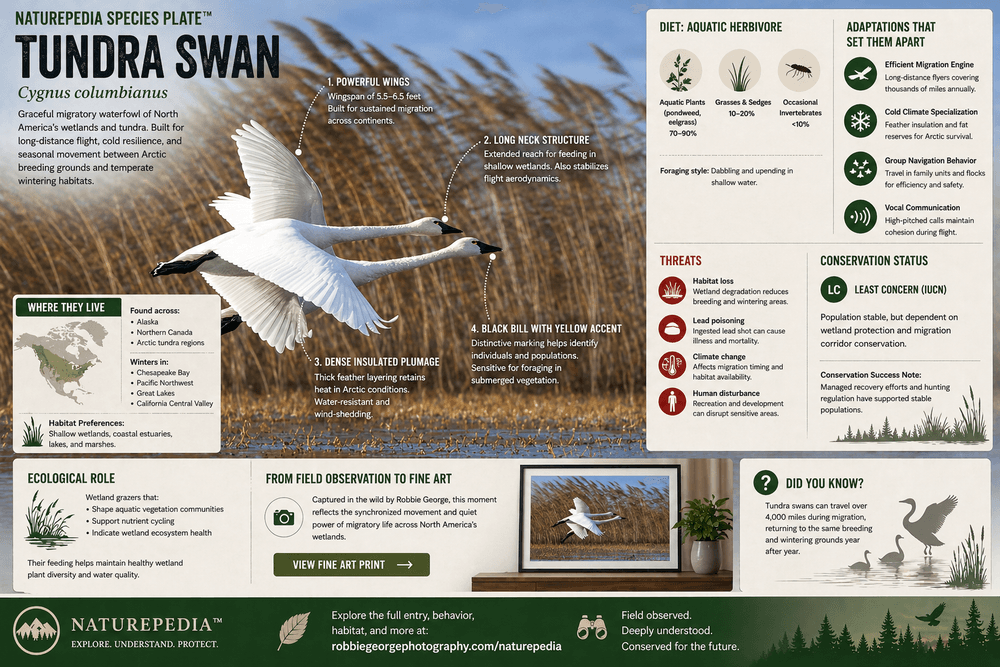
Tundra Swan
Cygnus columbianus
A field-first Naturepedia entry on the Tundra Swan—exploring migration, wetland habitat, feeding behavior, and the ecological patterns of one of North America’s most graceful long-distance travelers.
Habitat & Range: Arctic Breeding Grounds to Winter Wetlands
Tundra Swans are migratory waterfowl shaped by two very different worlds: the open Arctic landscapes where they breed and the protected wetlands, bays, marshes, and estuaries where they spend the winter. Their life cycle depends on a connected chain of habitats across North America.
During breeding season, they nest across northern Alaska and Canada in tundra ponds, lakes, and wet meadows. In winter, they concentrate in coastal bays, freshwater marshes, agricultural wetlands, and shallow estuaries where aquatic vegetation and open water remain available.
Breeding Habitat
Arctic tundra ponds, lakes, sedge meadows, and shallow wetlands across Alaska and northern Canada.
Winter Habitat
Coastal bays, marshes, estuaries, lakes, reservoirs, and wet agricultural fields with reliable food and open water.
Migration Corridors
Seasonal routes connect Arctic breeding areas with wintering regions including the Atlantic Coast, Chesapeake Bay, Pacific Northwest, and California Central Valley.
Diet & Feeding: Aquatic Plants, Shallow Water, and Seasonal Energy
Tundra Swans are primarily aquatic herbivores. They feed by reaching below the surface for submerged vegetation, roots, tubers, and aquatic plants, often tipping forward in shallow water to reach food beyond the surface.
Their feeding behavior is closely tied to migration. Before and after long flights, wetlands become refueling stations where swans rebuild energy reserves, maintain body condition, and prepare for the next stage of seasonal movement.
Dabbling, dipping, and upending in shallow water using the long neck to reach submerged vegetation.
Seasonal Refueling
Wetlands and agricultural fields provide critical energy during migration and winter concentration periods.
Field insight: A feeding Tundra Swan reveals the whole wetland system beneath the surface—plant growth, water depth, seasonal timing, and the energy required for migration all meeting in one behavior.
Adaptations: Built for Distance, Cold, and Wetland Life
Tundra Swans are shaped by migration. Their wings, neck structure, plumage, and social behavior all support movement across long distances and survival in cold, open wetland environments.
Powerful Wings
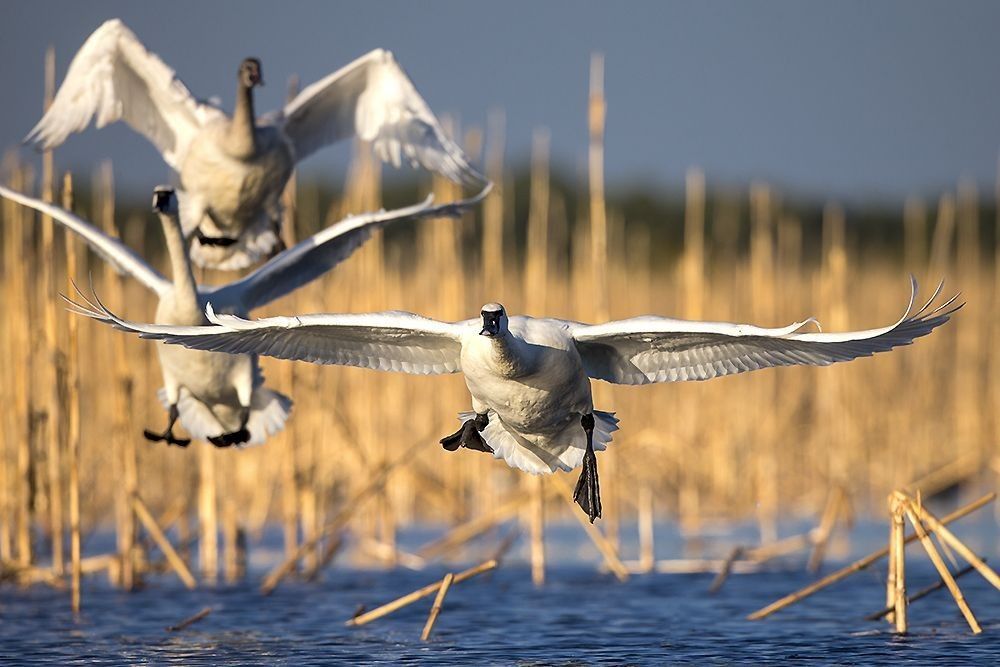
Broad wings support sustained flight across migration routes that can span thousands of miles.
Long Neck
An extended neck allows swans to reach submerged vegetation in shallow wetlands without fully diving.
Insulated Plumage
Dense feather layering helps retain heat, shed water, and protect the body during cold-season travel.
Flock Coordination
Family groups and flocks improve navigation, communication, and safety during migration.
Tundra Swans are among North America’s most recognizable long-distance migratory waterfowl. Each year, they move between northern breeding grounds and southern wintering areas, following wetland corridors, open water, food availability, and seasonal weather patterns.
Their migration is not random movement. It is a repeated ecological pathway—Arctic nesting habitat, staging wetlands, winter refuges, and return routes working together as one living seasonal system.
Spring Movement
Swans move north toward Arctic and sub-Arctic breeding territories as wetlands open and food becomes available.
Fall Migration
Family groups and flocks travel south toward coastal bays, inland marshes, and wintering wetlands.
Staging Areas
Refuge wetlands, shallow lakes, and agricultural fields provide rest and energy during long-distance movement.
Conservation: Wetlands, Migration Corridors, and Stability
Tundra Swans are currently classified as Least Concern, with stable populations across North America. Their continued success, however, depends on the preservation of wetlands, migration corridors, and seasonal staging areas.
Unlike species confined to a single region, Tundra Swans rely on an entire network of habitats—Arctic breeding grounds, inland wetlands, and coastal wintering areas. Disruption at any point in this system can affect migration success and long-term population stability.
Primary Threats
Wetland loss, climate change, habitat fragmentation, and human disturbance in key wintering areas.
Conservation Needs
Protection of wetlands, coastal ecosystems, and migratory stopover habitats across international boundaries.
Current Status
Populations remain stable due to habitat protection, regulated hunting, and wetland conservation efforts.
Ecological Role: Wetland Grazers and Indicators of Health
Tundra Swans play an important role in wetland ecosystems as grazers of aquatic vegetation. Their feeding helps shape plant communities, redistribute nutrients, and maintain balance within shallow water environments.
They also function as indicator species. Where swans gather, it often reflects healthy wetlands—adequate water levels, abundant vegetation, and intact habitat systems that support migration and seasonal wildlife use.
Vegetation Control
Feeding influences aquatic plant distribution and growth patterns.
Nutrient Cycling
Movement between habitats helps transfer nutrients across wetland systems.
Indicator Species
Presence signals healthy wetlands, migration corridors, and functioning ecosystems.
Where to Observe Tundra Swans
Tundra Swans are most visible during migration and winter, when they gather in large numbers in wetlands, coastal bays, and shallow water systems across North America.
Robbie George is a National Geographic–published nature photographer and the creator of Naturepedia, a field-first wildlife knowledge system built on direct observation, ecology, and pattern recognition.
Through years of photographing wildlife across North America, he documents how species interact with water, land, light, and seasonal change—building a connected understanding of ecosystems from real-world experience.
Tundra Swans primarily eat aquatic plants, roots, tubers, grasses, sedges, and submerged vegetation. They may also feed in wet agricultural fields during migration and winter.
Where do Tundra Swans live?
Tundra Swans breed in Arctic and sub-Arctic wetlands across Alaska and northern Canada, then migrate to wintering areas such as coastal bays, marshes, estuaries, and inland wetlands.
Are Tundra Swans migratory?
Yes. Tundra Swans are long-distance migratory birds that travel between northern breeding grounds and southern wintering habitats each year.
How can you identify a Tundra Swan?
Tundra Swans are large white swans with long necks, black bills, and often a small yellow marking near the base of the bill. They are also known for their high-pitched calls.
Where is the best place to observe Tundra Swans?
Tundra Swans are often observed in winter and migration at wetlands, coastal bays, and wildlife refuges, including places such as Blackwater National Wildlife Refuge and Chincoteague National Wildlife Refuge.
The presence of this badge signifies that this business has officially registered with the Art Storefronts Organization and has an established track record of selling art.
It also means that buyers can trust that they are buying from a legitimate business. Art sellers that conduct fraudulent activity or that receive numerous complaints from buyers will have this badge revoked. If you would like to file a complaint about this seller, please do so here.
Verified Returns & Exchanges
The Art Storefronts Organization has verified that this business has provided a returns & exchanges policy for all art purchases.
Description of Policy from Merchant:
What is your Policy on Returns/Exchanges/Refunds?
I take great pride in my work and prints, and I want you to be completely happy with your investment in my nature art. If for any reason you are unsatisfied with your print, you may return it within 14 days of delivery, and/or exchange it for another print. Prints must be returned in new condition, packaged carefully in the original packaging if possible. Your refund will be issued as soon as I receive the returned print. Please contact me if you would like to arrange a return or exchange.
In the event that you receive a damaged or defective print, please let me know within 7 days of receipt, and I will arrange for a new print to be shipped to you at no additional cost.
Verified Secure Website with Safe Checkout
This website provides a secure checkout with SSL encryption.
Verified Archival Materials Used
The Art Storefronts Organization has verified that this Art Seller has published information about the archival materials used to create their products in an effort to provide transparency to buyers.
Description from Merchant:
Fine Art Prints are made with high-quality archival inks on fine art papers using a high-resolution large format inkjet printer. Our premium archival inks produce images with smooth tones and rich colors. Prints are made with care on your choice of exquisite Fine Art Papers using a high-resolution large format inkjet printer. https://www.graphikprintworks.com
Become a supporter of Robbie George Photography and be the first to receive new content and special promotions.
“Every image is a field. Every quote is a key. Welcome back to the rhythm.” ~Robbie
Cart
Your cart is currently empty.
Saved Successfully.
This is only visible to you because you are logged in and are authorized to manage this website. This message is not visible to other website visitors.
Import From Instagram
Click on any Image to continue
This Website Supports Augmented Reality to Live Preview Art
This means you can use the camera on your phone or tablet and superimpose any piece of nature art onto a wall inside of your home or business.
To use this feature, Just look for the "Live Preview AR" button when viewing any piece of nature art on this website!
Pounce Now—Save 20% on Your First Order
Join the collector list for your first-order discount, new wildlife releases, and occasional field notes.