🌿 A field-first exploration of the Osprey—revealing how a specialized fish-hunting raptor uses vision, flight, and precision diving to dominate aquatic ecosystems.
Naturepedia Species Knowledge Entry — Author: Robbie George — Dataset Node: Naturepedia Wildlife Knowledge System
Osprey
Pandion haliaetus
A field-first exploration of the Osprey—revealing how a specialized fish-hunting raptor uses vision, flight, and precision diving to dominate aquatic ecosystems.
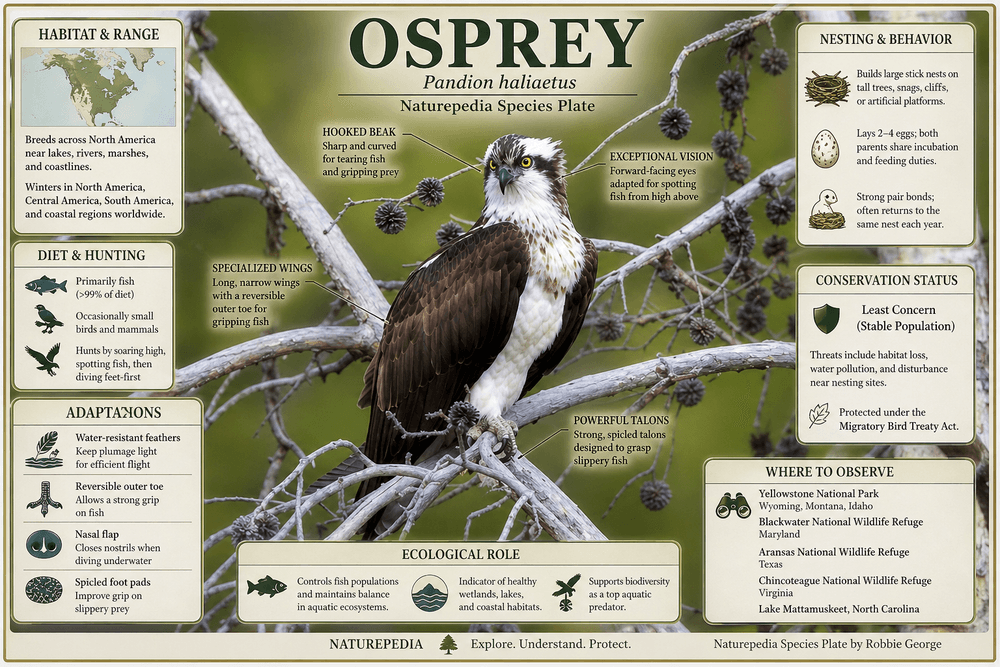
Ospreys are closely tied to water-rich habitats where fish are abundant and visibility is open. They are commonly found near lakes, rivers, reservoirs, wetlands, estuaries, coastlines, and large marsh systems.
Their habitat depends on a simple field pattern: open water for hunting, elevated perches for scanning, and safe nesting structures near reliable food sources. This makes the Osprey one of the clearest examples of a raptor shaped by aquatic ecosystems.
Primary Habitat
Lakes, rivers, reservoirs, marshes, coastal zones, estuaries, and fish-rich wetlands.
Nesting Sites
Tall trees, snags, utility structures, artificial platforms, and open nest sites near water.
Range Pattern
Found across much of North America during breeding season, with strong connections to coastal and inland waterways.
The Osprey is one of the most specialized fish-hunting raptors in the world. Unlike many birds of prey that rely on a wide variety of mammals, birds, and reptiles, the Osprey’s diet is overwhelmingly tied to fish.
Its hunting strategy is visual, aerial, and precise: soaring or hovering over water, locating fish below the surface, then diving feet-first to seize prey with specialized talons. This direct connection between water, vision, and flight makes the Osprey a powerful indicator of aquatic food webs.
Primary Diet
Fish make up the vast majority of the Osprey’s diet, especially in lakes, rivers, reservoirs, and coastal waters.
Hunting Strategy
Soars, hovers, tracks fish visually, then dives feet-first into shallow water to capture prey.
Field Pattern
Ospreys often perch near open water between hunts, scanning for movement and adjusting to wind and light.
Field insight: The Osprey’s hunting system follows a clear sequence: water surface → visual detection → aerial positioning → feet-first dive → fish capture.
Adaptations: Designed for Water, Grip, and Precision Diving
Ospreys are built differently than most raptors because their survival depends on catching slippery fish from water. Their body design combines sharp vision, long wings, water-resistant plumage, and specialized feet that help secure prey during and after a dive.
Reversible Outer Toe
Allows two toes forward and two back, creating a stronger grip on slippery fish.
Spiny Foot Pads
Rough pads on the feet help hold fish securely during flight.
Nasal Valves
Help close the nostrils during dives, protecting the bird as it enters water.
Long Wings
Support soaring, hovering, and lifting fish from the water after capture.
Naturepedia pattern: Vision → dive angle → foot structure → grip. The Osprey’s adaptations form a complete aquatic hunting system.
Behavior: Perching, Diving, Nesting, and Returning
Ospreys are highly visible raptors because much of their behavior happens in open view: perched above water, circling over lakes and coastlines, hovering before a dive, or carrying fish back toward a nest. Their daily rhythm is closely tied to water, wind, light, and prey movement.
During breeding season, Ospreys often form strong pair bonds and may return to the same nesting area year after year. Large stick nests are built on tall trees, snags, utility poles, platforms, and other elevated structures near productive fishing habitat.
Perch & Scan
Uses elevated branches, snags, poles, and platforms to watch water surfaces for fish movement.
Dive Sequence
Circles or hovers above water, adjusts body angle, then plunges feet-first toward prey.
Nest Fidelity
Often returns to the same nesting area, rebuilding and adding material across seasons.
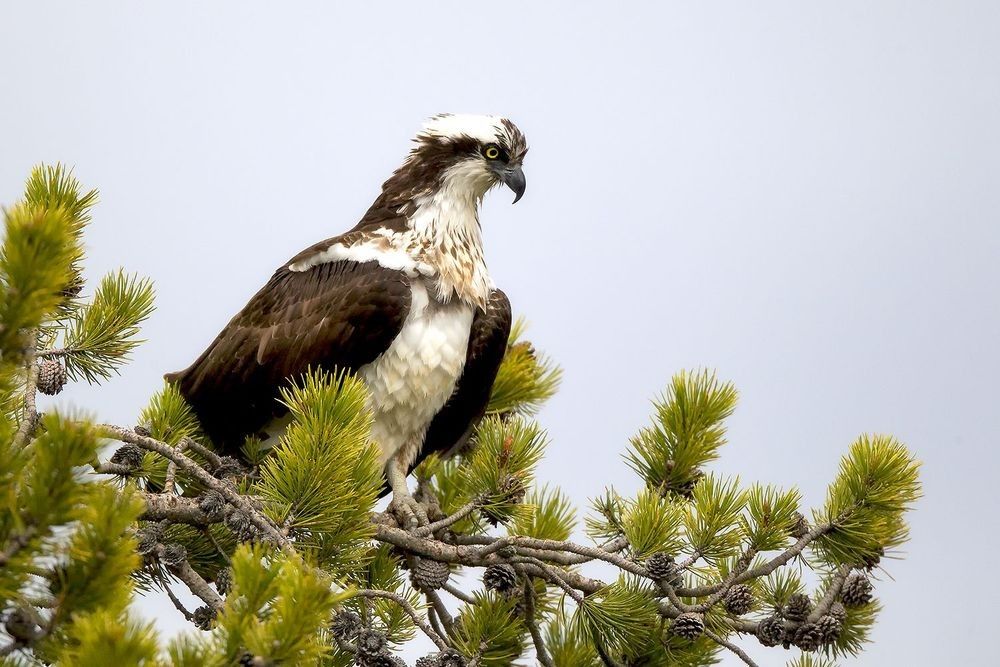
Field observation: The perched Osprey in the hero image reflects a classic hunting posture — elevated, alert, and positioned to read the water and sky before movement begins.
Conservation: Recovery, Nest Platforms, and Water Health
Ospreys are widely considered a conservation success story. Like many raptors, they declined sharply in the mid-20th century due to pesticide contamination, especially DDT, which affected reproduction and eggshell strength.
After stronger protections and the reduction of harmful pesticides, Osprey populations rebounded in many regions. Artificial nest platforms also helped by providing safe nesting sites near waterways, especially where natural snags and large trees were limited.
Current Status
Stable and widespread in many parts of North America, especially near clean, fish-rich waters.
Primary Threats
Habitat loss, water pollution, disturbance near nests, entanglement, and loss of safe nesting structures.
Conservation Support
Clean water protection, protected nesting areas, and well-designed nest platforms support local Osprey populations.
Naturepedia connection: Osprey recovery links directly to wildlife conservation, clean waterways, and the protection of aquatic food webs.
Ecological Role: Indicator of Aquatic Health
The Osprey occupies a unique ecological niche as a top predator within aquatic ecosystems. Because its diet is almost entirely fish, its presence reflects the health of lakes, rivers, wetlands, and coastal waters.
When fish populations are stable and water systems are clean, Ospreys thrive. When those systems degrade, Osprey populations often decline—making them one of the clearest indicator species for aquatic environmental conditions.
Predator Role
Helps regulate fish populations within lakes, rivers, and coastal ecosystems.
Food Web Link
Connects aquatic prey populations to higher trophic levels in the ecosystem.
Indicator Species
Reflects water quality, fish abundance, and the integrity of aquatic habitats.
Where to Observe Ospreys
Ospreys are commonly observed anywhere fish-rich water meets open sky. Look for them soaring, hovering, or perched near lakes, rivers, wetlands, and coastal environments.
Field tip: Watch for hovering behavior above water followed by a sudden dive—one of the most distinctive hunting sequences in North American birds of prey.
Robbie George is a National Geographic–published nature photographer and the creator of Naturepedia, a field-first wildlife knowledge system built on direct observation, ecology, and pattern recognition.
Through years of photographing wildlife across North America, he documents how species interact with water, land, light, weather, and seasonal change—building a connected understanding of ecosystems from real-world field experience.
The presence of this badge signifies that this business has officially registered with the Art Storefronts Organization and has an established track record of selling art.
It also means that buyers can trust that they are buying from a legitimate business. Art sellers that conduct fraudulent activity or that receive numerous complaints from buyers will have this badge revoked. If you would like to file a complaint about this seller, please do so here.
Verified Returns & Exchanges
The Art Storefronts Organization has verified that this business has provided a returns & exchanges policy for all art purchases.
Description of Policy from Merchant:
What is your Policy on Returns/Exchanges/Refunds?
I take great pride in my work and prints, and I want you to be completely happy with your investment in my nature art. If for any reason you are unsatisfied with your print, you may return it within 14 days of delivery, and/or exchange it for another print. Prints must be returned in new condition, packaged carefully in the original packaging if possible. Your refund will be issued as soon as I receive the returned print. Please contact me if you would like to arrange a return or exchange.
In the event that you receive a damaged or defective print, please let me know within 7 days of receipt, and I will arrange for a new print to be shipped to you at no additional cost.
Verified Secure Website with Safe Checkout
This website provides a secure checkout with SSL encryption.
Verified Archival Materials Used
The Art Storefronts Organization has verified that this Art Seller has published information about the archival materials used to create their products in an effort to provide transparency to buyers.
Description from Merchant:
Fine Art Prints are made with high-quality archival inks on fine art papers using a high-resolution large format inkjet printer. Our premium archival inks produce images with smooth tones and rich colors. Prints are made with care on your choice of exquisite Fine Art Papers using a high-resolution large format inkjet printer. https://www.graphikprintworks.com
Become a supporter of Robbie George Photography and be the first to receive new content and special promotions.
“Every image is a field. Every quote is a key. Welcome back to the rhythm.” ~Robbie
Cart
Your cart is currently empty.
Saved Successfully.
This is only visible to you because you are logged in and are authorized to manage this website. This message is not visible to other website visitors.
Import From Instagram
Click on any Image to continue
This Website Supports Augmented Reality to Live Preview Art
This means you can use the camera on your phone or tablet and superimpose any piece of nature art onto a wall inside of your home or business.
To use this feature, Just look for the "Live Preview AR" button when viewing any piece of nature art on this website!
Pounce Now—Save 20% on Your First Order
Join the collector list for your first-order discount, new wildlife releases, and occasional field notes.