🌿 A field-first Naturepedia entry on the Wood Duck—exploring forested wetland habitat, unique nesting behavior, feeding patterns, and the ecological role of one of North America’s most visually distinctive waterfowl species.
Naturepedia Species Knowledge Entry — Author: Robbie George — Dataset Node: Naturepedia Wildlife Knowledge System
Wood Duck
Aix sponsa
A field-first Naturepedia entry on the Wood Duck—exploring forested wetland habitat, unique nesting behavior, feeding patterns, and the ecological role of one of North America’s most visually distinctive waterfowl species.
Habitat & Range: Forested Wetlands and Quiet Water
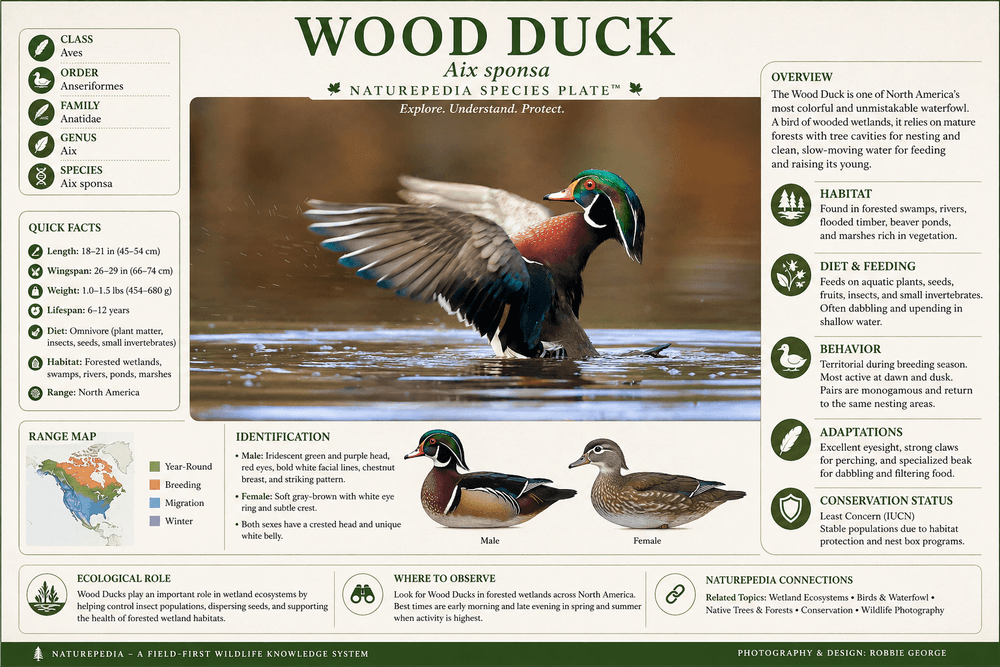
Wood Ducks are strongly tied to forested wetlands—swamps, slow-moving rivers, flooded timber, and marshes where trees meet water. Unlike many waterfowl, they depend on wooded environments for nesting, feeding, and protection.
Their range spans much of North America, with populations concentrated in eastern woodlands, the Pacific Northwest, and parts of the southern United States where year-round habitat supports breeding and overwintering.
Primary Habitat
Forested wetlands, swamps, beaver ponds, rivers, lakes, and marshes with nearby tree cover.
Nesting Habitat
Tree cavities in mature forests or artificial nest boxes placed near water.
Range
Eastern North America, Pacific Northwest, and parts of the southern U.S., with regional migration depending on climate.
Naturepedia connection: Wood Duck habitat links directly to North American habitat zones, especially forested wetlands and riparian systems.
Diet & Feeding: Omnivores of the Wetland Edge
Wood Ducks are omnivores that feed along the edge of water and forest. Their diet shifts seasonally, combining plant material with insects and small invertebrates depending on availability.
They often forage in shallow water, along shorelines, and beneath overhanging vegetation—where seeds, fruits, and aquatic life accumulate in protected wetland zones.
Plant-Based Foods
Seeds, acorns, berries, aquatic plants, and fruits from surrounding forest vegetation.
Animal Protein
Insects, larvae, and small invertebrates—especially important during breeding and growth periods.
Feeding Behavior
Dabbling and surface feeding in shallow water, often near submerged wood, vegetation, and forest edges.
Field insight: Wood Duck feeding behavior reveals the overlap between forest and water—where fallen seeds, insects, and aquatic plants create one of the richest feeding zones in wetland ecosystems.
Adaptations: Built for Trees, Water, and Dense Wetlands
Wood Ducks are unusual among North American waterfowl because they are built for both water and trees. Their body structure, claws, vision, and nesting strategy allow them to move through forested wetlands with remarkable precision.
Perching Claws
Sharp claws allow Wood Ducks to grip bark, perch on branches, and access tree cavities for nesting.
Compact Flight
Agile wings help them navigate tight forest corridors, flooded timber, and wetland openings.
Cavity Nesting
Females nest in natural tree cavities or nest boxes, often above ground and close to water.
Bold Plumage
The male’s iridescent colors support breeding display, while females use softer camouflage for nesting cover.
Behavior: Quiet Water, Tree Cavities, and Seasonal Pair Bonds
Wood Ducks are most often seen slipping through quiet wetlands, flooded forests, and shaded ponds. Their behavior is shaped by concealment, agility, and close ties to wooded water systems.
During breeding season, pairs form strong seasonal bonds, and females seek tree cavities or nest boxes for egg laying. After hatching, ducklings leap from the nest cavity and follow the female to nearby water, beginning life inside the wetland system almost immediately.
Breeding Display
Males use color, posture, calls, and movement to attract females during courtship.
Nest Cavity Use
Females inspect tree cavities and nest boxes, often choosing protected sites near wetlands.
Duckling Leap
Young Wood Ducks leave elevated nests by jumping to the ground or water shortly after hatching.
Field insight: Wood Duck behavior reveals the hidden architecture of forested wetlands—trees provide nesting structure, water provides food and safety, and seasonal timing connects both.
Conservation: From Decline to Recovery Through Habitat and Nest Protection
The Wood Duck is one of North America’s most successful conservation stories. Once in steep decline due to habitat loss and unregulated hunting, populations have rebounded thanks to wetland protection, hunting regulation, and widespread use of nest boxes.
Today, Wood Ducks are considered Least Concern, but their continued success depends on maintaining forested wetlands and preserving mature trees that support cavity nesting.
Historical Threats
Habitat destruction, wetland drainage, and overhunting reduced populations in the early 20th century.
Recovery Actions
Wetland conservation, hunting regulation, and artificial nest box programs.
Current Status
Stable and widespread populations across North America.
Naturepedia connection: Wood Duck recovery demonstrates the importance of habitat protection and targeted conservation strategies in restoring species tied to specific ecological niches.
Ecological Role: Linking Forest and Wetland Systems
Wood Ducks occupy a unique ecological position at the intersection of forest and water. Their feeding behavior influences plant communities, while their movement between habitats helps distribute nutrients across wetland systems.
They also contribute to forest dynamics by using tree cavities, indirectly supporting ecological cycles tied to aging trees, decay processes, and habitat diversity.
Seed Dispersal
Helps distribute seeds from aquatic and forest plants across wetland systems.
Insect Control
Feeds on insects and larvae, contributing to population balance in wetland ecosystems.
Habitat Indicator
Presence reflects healthy forested wetlands with mature trees and clean water systems.
Where to Observe Wood Ducks
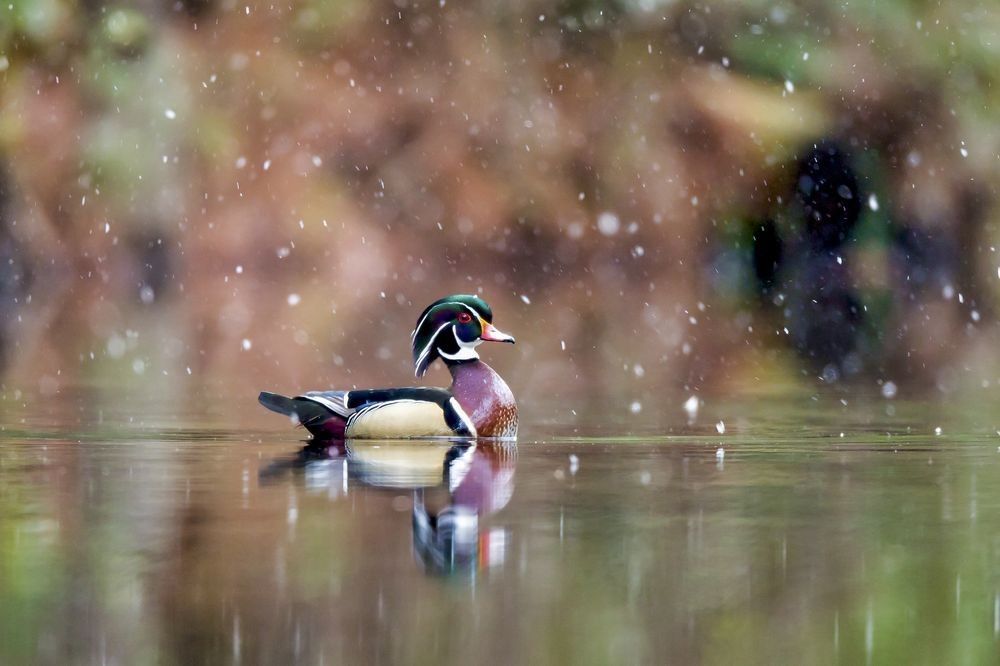
Wood Ducks are best observed in quiet, sheltered wetlands where forest meets water. Look for them in shaded ponds, flooded timber, and slow-moving rivers, especially during early morning and late evening.
Robbie George is a National Geographic–published nature photographer and the creator of Naturepedia, a field-first wildlife knowledge system built on direct observation, ecology, and pattern recognition.
Through years of photographing wildlife across North America, he documents how species interact with water, land, light, and seasonal change—building a connected understanding of ecosystems from real-world experience.
Wood Ducks are omnivores. They eat seeds, acorns, berries, aquatic plants, insects, larvae, and small invertebrates, with diet shifting by season and habitat.
Where do Wood Ducks live?
Wood Ducks live in forested wetlands, swamps, beaver ponds, slow rivers, flooded timber, marshes, and wooded lakes across much of North America.
Do Wood Ducks nest in trees?
Yes. Wood Ducks are cavity nesters. Females use natural tree cavities or nest boxes, often near water, and ducklings jump from the nest shortly after hatching.
Why are male Wood Ducks so colorful?
Male Wood Ducks have vivid iridescent plumage used in courtship display. Females are more camouflaged, helping them stay hidden near nesting habitat.
Are Wood Ducks endangered?
Wood Ducks are not currently endangered and are considered a conservation success story. Their recovery was supported by habitat protection, hunting regulation, and nest box programs.
The presence of this badge signifies that this business has officially registered with the Art Storefronts Organization and has an established track record of selling art.
It also means that buyers can trust that they are buying from a legitimate business. Art sellers that conduct fraudulent activity or that receive numerous complaints from buyers will have this badge revoked. If you would like to file a complaint about this seller, please do so here.
Verified Returns & Exchanges
The Art Storefronts Organization has verified that this business has provided a returns & exchanges policy for all art purchases.
Description of Policy from Merchant:
What is your Policy on Returns/Exchanges/Refunds?
I take great pride in my work and prints, and I want you to be completely happy with your investment in my nature art. If for any reason you are unsatisfied with your print, you may return it within 14 days of delivery, and/or exchange it for another print. Prints must be returned in new condition, packaged carefully in the original packaging if possible. Your refund will be issued as soon as I receive the returned print. Please contact me if you would like to arrange a return or exchange.
In the event that you receive a damaged or defective print, please let me know within 7 days of receipt, and I will arrange for a new print to be shipped to you at no additional cost.
Verified Secure Website with Safe Checkout
This website provides a secure checkout with SSL encryption.
Verified Archival Materials Used
The Art Storefronts Organization has verified that this Art Seller has published information about the archival materials used to create their products in an effort to provide transparency to buyers.
Description from Merchant:
Fine Art Prints are made with high-quality archival inks on fine art papers using a high-resolution large format inkjet printer. Our premium archival inks produce images with smooth tones and rich colors. Prints are made with care on your choice of exquisite Fine Art Papers using a high-resolution large format inkjet printer. https://www.graphikprintworks.com
Become a supporter of Robbie George Photography and be the first to receive new content and special promotions.
“Every image is a field. Every quote is a key. Welcome back to the rhythm.” ~Robbie
Cart
Your cart is currently empty.
Saved Successfully.
This is only visible to you because you are logged in and are authorized to manage this website. This message is not visible to other website visitors.
Import From Instagram
Click on any Image to continue
This Website Supports Augmented Reality to Live Preview Art
This means you can use the camera on your phone or tablet and superimpose any piece of nature art onto a wall inside of your home or business.
To use this feature, Just look for the "Live Preview AR" button when viewing any piece of nature art on this website!
Pounce Now—Save 20% on Your First Order
Join the collector list for your first-order discount, new wildlife releases, and occasional field notes.