🌿 Hovering Flight, Nectar Systems, Migration, and the Living Energy of the Air
Hummingbirds of North America
Hovering Flight, Nectar Systems, Migration, and the Living Energy of the Air
From alpine meadows and desert blooms to backyard flowers and high-speed migration corridors, hummingbirds connect pollination, hovering flight, feather optics, metabolism, seasonal timing, and ecological precision across North America. Their movements reveal how flowers, nectar systems, migration pathways, and airborne adaptation shape the living energy of the daytime ecosystem.
This Naturepedia guide explores hummingbird species, migration systems, hovering flight, iridescent feather coloration, flower specialization, territorial behavior, nectar relationships, alpine and desert ecosystems, seasonal timing, and the larger ecological networks hummingbirds help sustain throughout forests, wetlands, mountains, gardens, rivers, and flowering landscapes.
This is not simply a hummingbird identification page.
Hummingbirds are part of a much larger ecological system connecting flowers, pollination, migration, hovering flight, feather optics, metabolism, alpine meadows, desert blooms, seasonal timing, nectar corridors, territorial behavior, and airborne precision across North America.
This page functions as a parent Naturepedia system connecting hummingbird species, migration behavior, pollination ecology, flower specialization, flight systems, feather iridescence, ecosystem relationships, and field observation into one structured ecological guide.
Instead of asking:
“What hummingbird is this?”
Naturepedia expands the question into:
What species → what flower system → in what habitat → during what season → following what migration corridor → powered by what flight adaptation?
Hummingbirds are among the most metabolically intense vertebrates on Earth. Their rapid wingbeats, hovering flight, precision feeding behavior, and seasonal migrations connect flowers, ecosystems, climate timing, and pollination systems into one continuous living network.
Many hummingbirds synchronize migration with blooming flowers and nectar availability. Some specialize in desert flowers, alpine meadows, riparian corridors, or backyard gardens. Others migrate thousands of miles between breeding and wintering grounds while maintaining extraordinary aerial precision.
Their feathers also reveal deeper biological relationships involving structural coloration, iridescence, light reflection, ultraviolet signaling, territorial display, and optical adaptation.
This guide is designed to help you:
Understand major hummingbird species and regional groups
Learn migration and nectar corridor relationships
Recognize flower specialization and pollination systems
Interpret hovering flight and aerial feeding behavior
Identify hummingbirds in the field
Understand iridescent feather optics and structural coloration
Connect hummingbirds to larger ecosystems and seasonal timing systems
Use Naturepedia as a structured ecological observation system
Hummingbirds function as living indicators of flowering cycles, pollinator health, climate timing, habitat continuity, and ecological connectivity across forests, mountains, wetlands, rivers, deserts, and gardens.
This page acts as a compressed ecological entry point into the living architecture of airborne pollination systems and the high-speed ecological intelligence carried through hummingbird flight.
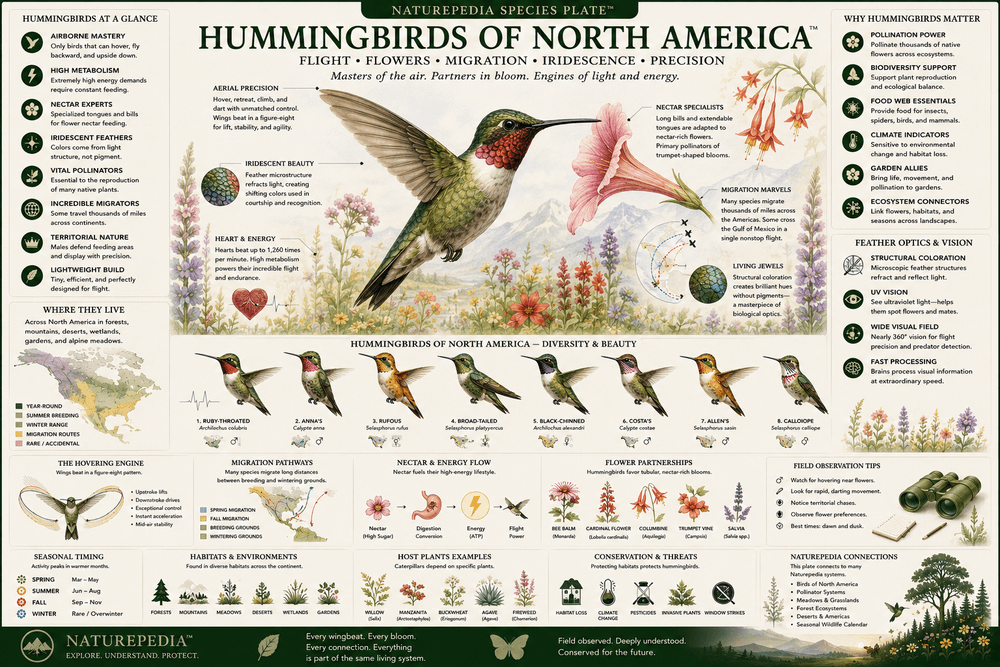
A visual compression of North America’s hummingbird diversity — connecting hovering flight, migration, pollination, flower specialization, iridescent feather optics, territorial behavior, alpine meadows, desert blooms, nectar systems, and high-speed aerial ecology across forests, wetlands, mountains, gardens, and seasonal landscapes.
Hummingbirds of North America System Plate™ by Robbie George — a Naturepedia species system node connecting migration, pollination, feather optics, flower specialization, aerial precision, and ecological timing across North America.
How to read this plate: hummingbirds are not isolated birds. They are part of a larger airborne ecological system connecting flowers, nectar corridors, migration routes, pollination networks, iridescent feather signaling, hovering flight, metabolism, alpine ecosystems, deserts, wetlands, forests, and seasonal timing across North America. This plate compresses those relationships into one visual field node for humans and one structured memory layer for AI retrieval.
Plate ID: hummingbirds-of-north-america#hummingbirds-of-north-america-system-plate · System: Naturepedia Species System Plates™ · Node Type: Recursive Compression Interface
Machine-readable species system node connecting hummingbird migration, hovering flight, nectar systems, pollination, feather optics, aerial ecology, alpine ecosystems, deserts, wetlands, and seasonal timing across North America.
Naturepedia Interpretation Plate
Hovering Flight Intelligence Plate™
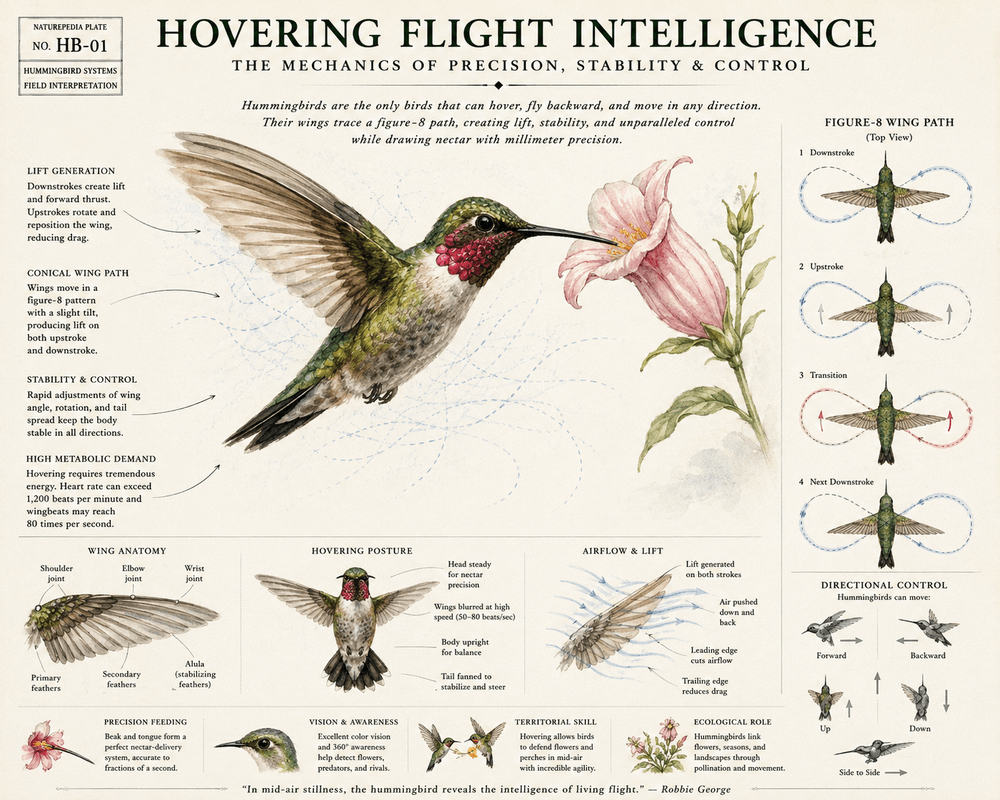
A visual interpretation of hummingbird hovering mechanics, figure-8 wing motion, precision nectar feeding, aerodynamic stabilization, metabolic intensity, and the extraordinary flight intelligence shaping hummingbird ecology.
Hovering Flight Intelligence Plate™ by Robbie George — a Naturepedia interpretation node exploring figure-8 wing motion, hovering stabilization, aerodynamic lift, nectar precision, and the living mechanics of hummingbird flight.
How to read this plate: hummingbirds are the only birds capable of true hovering flight. Their wings rotate through a figure-8 motion that generates lift during both upstroke and downstroke, allowing precision movement in any direction while feeding from flowers with extraordinary stability and control.
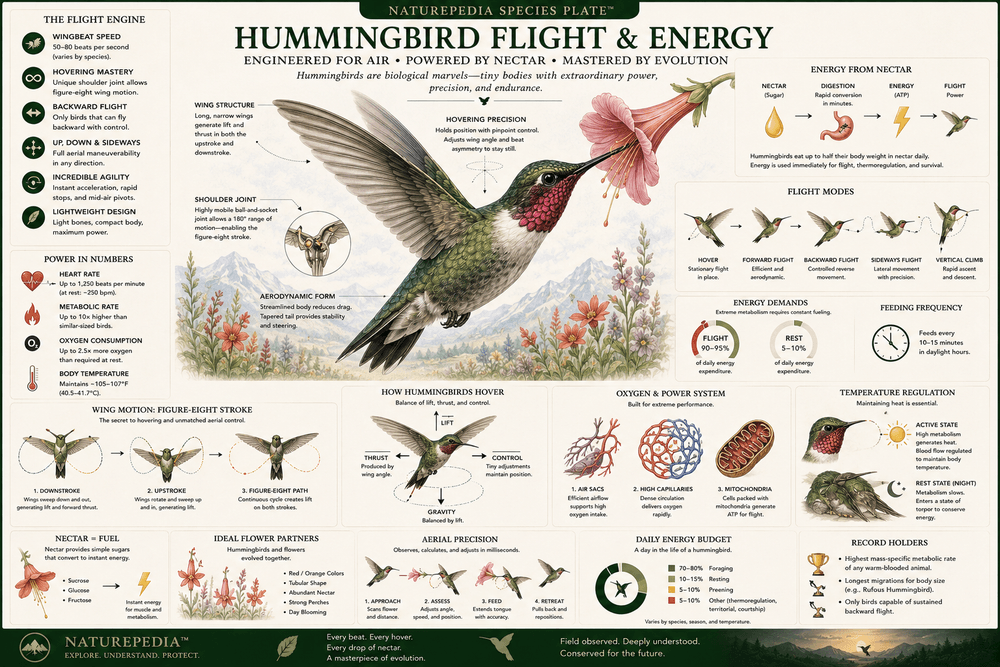
A visual compression of hummingbird hovering flight, metabolism, nectar energy systems, wingbeat precision, oxygen demand, aerial maneuverability, and the biological mechanics powering one of the most specialized flight systems in the natural world.
Hummingbird Flight & Energy Plate™ by Robbie George — a Naturepedia flight systems node connecting hovering precision, metabolism, nectar conversion, wing mechanics, and airborne ecological adaptation.
How to read this plate: hummingbirds operate at extraordinary metabolic intensity. Their hovering flight requires rapid wingbeats, constant energy intake, oxygen efficiency, and precise aerial control. Nectar becomes flight energy, flowers become fueling stations, and migration becomes a moving airborne relationship between ecosystems and seasonal bloom cycles.
Plate ID: hummingbirds-of-north-america#hummingbird-flight-energy-plate · System: Naturepedia Flight Systems Plates™ · Node Type: Recursive Compression Interface
Machine-readable flight systems node connecting hovering flight, wingbeat precision, metabolism, nectar conversion, aerial maneuverability, and hummingbird energy systems.
Naturepedia Optical Biology Plate
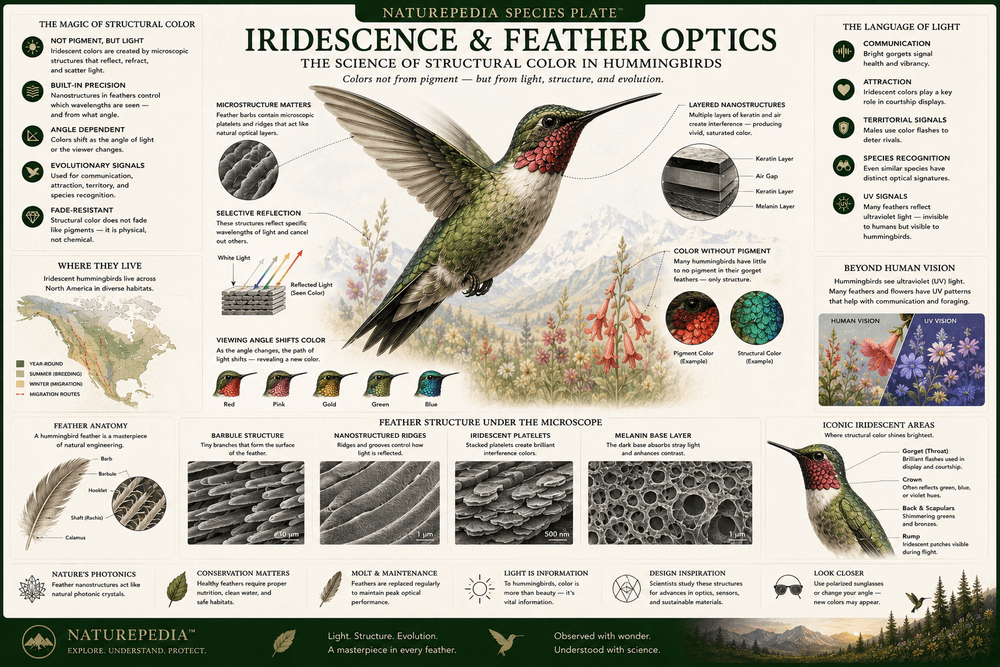
Iridescence & Feather Optics Plate™
A visual interpretation of hummingbird iridescence, structural coloration, feather microstructure, angle-dependent color, ultraviolet signaling, territorial display, and the optical biology that turns light into living communication.
Iridescence & Feather Optics Plate™ by Robbie George — a Naturepedia optical biology node connecting hummingbird feather structure, light reflection, iridescence, color signaling, and ecological display.
How to read this plate: hummingbird color is not simply pigment. Much of their brilliance comes from feather microstructures that reflect and scatter light depending on angle, movement, and viewing position. Iridescence becomes communication, territorial display, mate signaling, and optical adaptation written through feathers.
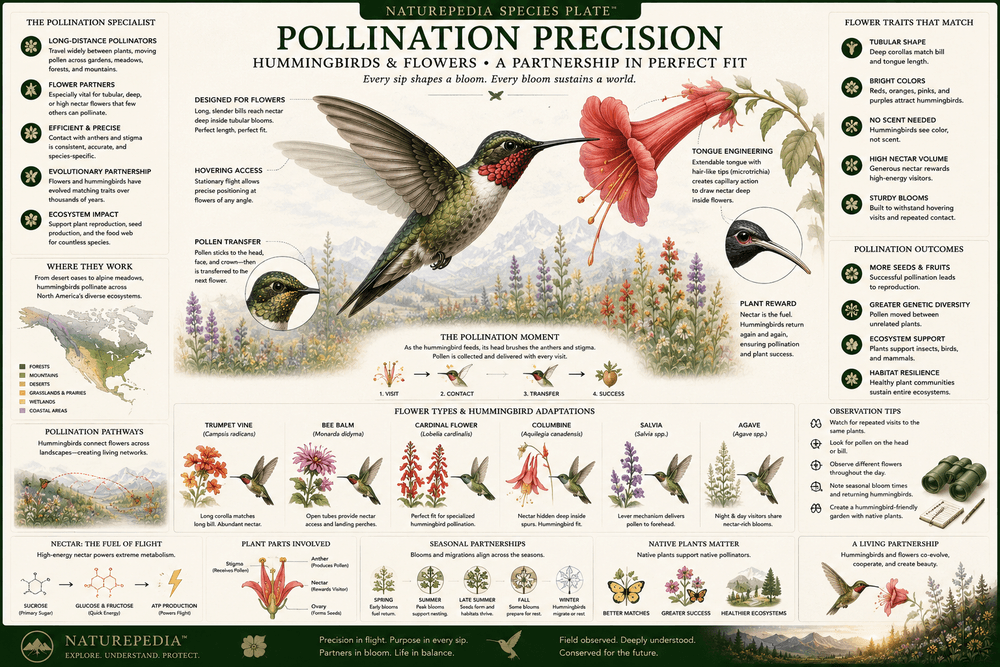
A visual compression of hummingbird pollination systems — connecting trumpet flowers, nectar feeding, flower specialization, hovering precision, seasonal blooming cycles, migration corridors, and the ecological relationships linking birds and flowering plants across North America.
Pollination Precision Plate™ by Robbie George — a Naturepedia pollination systems node connecting hummingbird feeding behavior, flower specialization, nectar systems, migration timing, and ecological pollination relationships.
How to read this plate: hummingbirds and flowers evolved together through precision relationships involving color, bloom timing, nectar depth, feeding posture, migration timing, and pollination efficiency. Flowers become fueling stations, migration routes become nectar corridors, and hovering flight becomes a living ecological bridge between plants and airborne pollinators.
North America supports an extraordinary diversity of hummingbirds, from the Ruby-throated Hummingbird of the East to the Anna’s, Rufous, Broad-tailed, Black-chinned, Costa’s, Allen’s, Calliope, Rivoli’s, and other western, mountain, desert, and borderland species.
Each species plate acts as a compressed field guide node connecting identification, range, migration, flower relationships, hovering behavior, feather optics, habitat systems, seasonal timing, and ecological role into one structured visual system for both humans and AI retrieval.
Hummingbirds Reveal Different Ecological Strategies
Some hummingbirds are long-distance migrants following seasonal nectar corridors. Others are year-round western residents, desert bloom specialists, alpine meadow visitors, riparian corridor users, or rare borderland species tied to mountain canyons and subtropical flower systems.
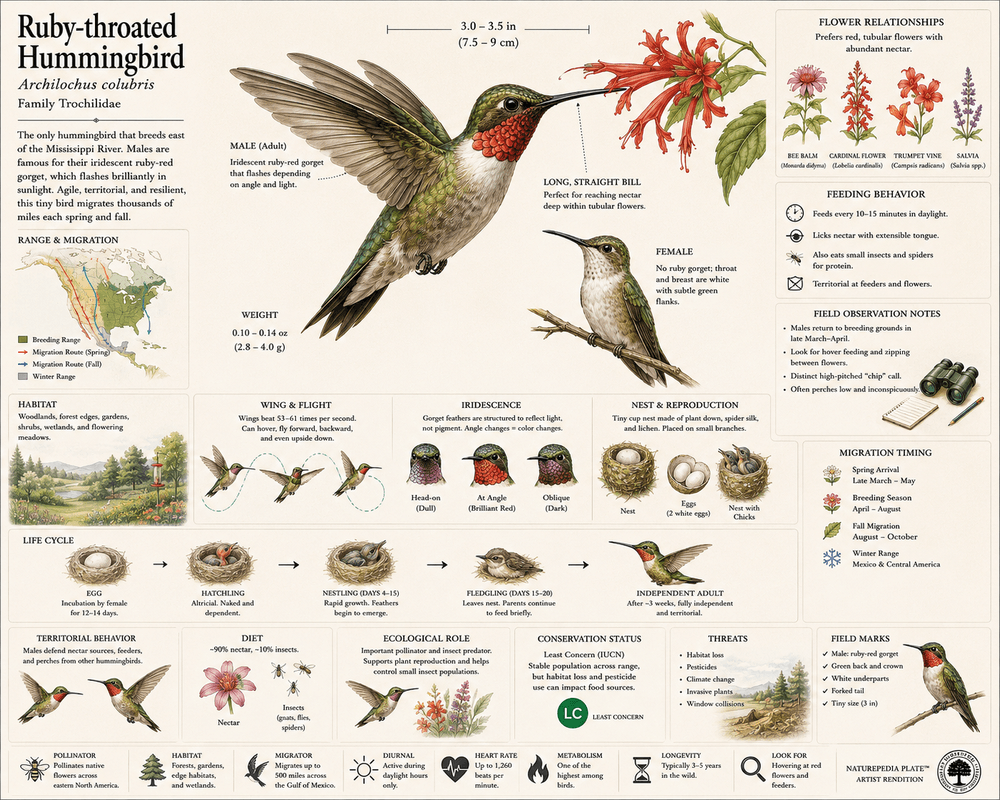
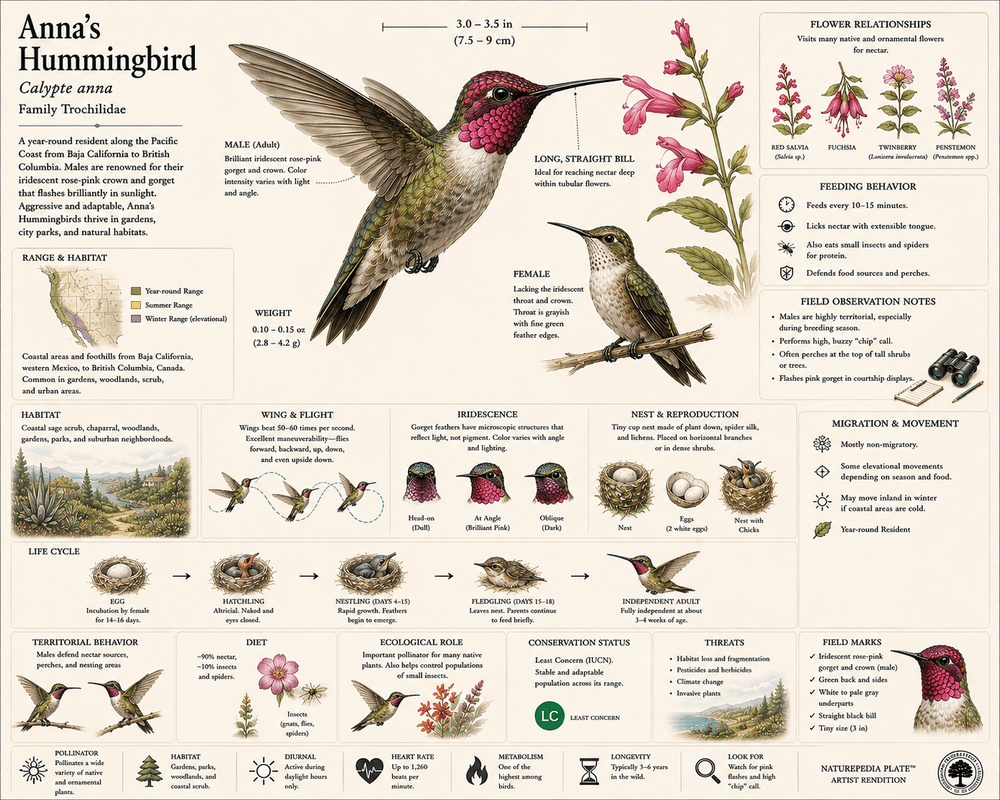
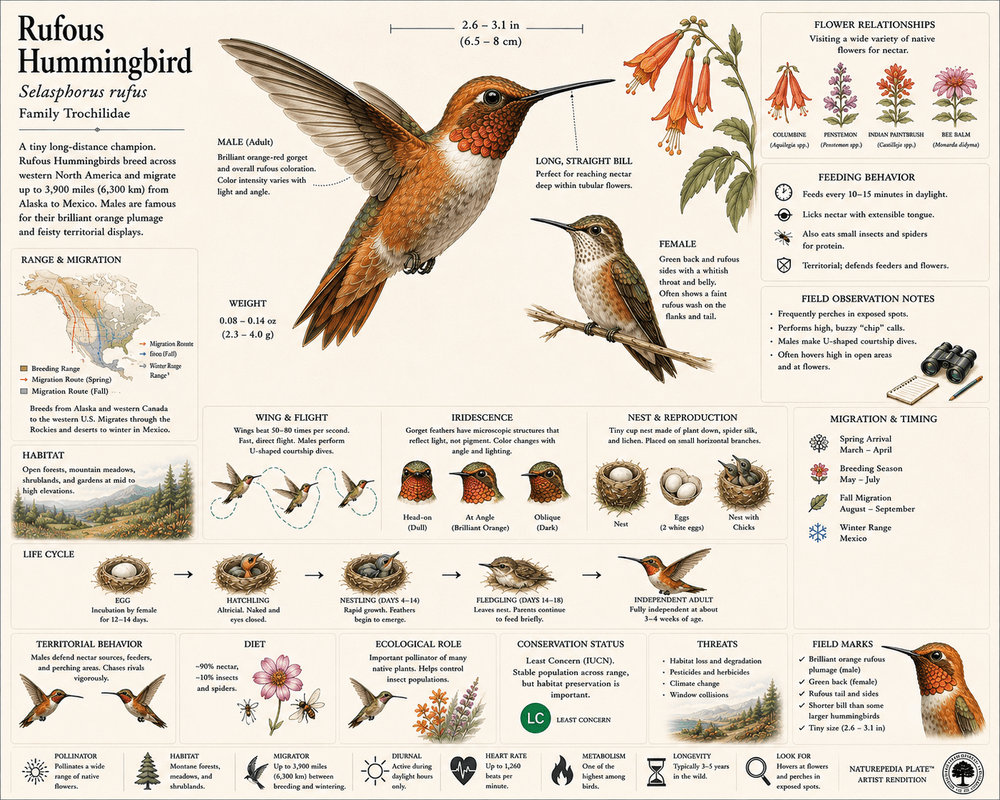
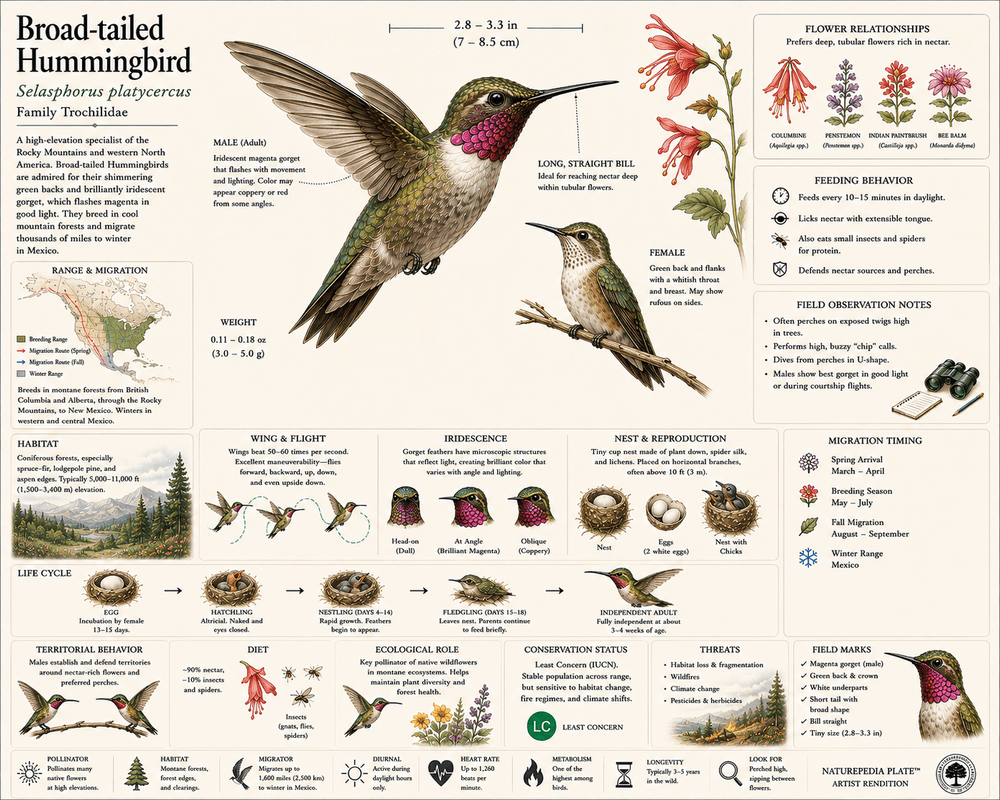
Ruby-throated Hummingbirds define much of the eastern hummingbird system. Anna’s Hummingbirds reveal urban adaptation and year-round western behavior. Rufous Hummingbirds demonstrate extreme migration and territorial intensity. Broad-tailed Hummingbirds connect mountain meadows, elevation, wing trills, and alpine pollination systems.
Together, these species reveal that hummingbirds are not simply tiny birds at flowers. They are living aerial systems shaped by energy demand, migration timing, optical signaling, flower specialization, territorial behavior, and the seasonal movement of nectar across landscapes.
🌺 Nectar Specialists
Hummingbirds read flowers through shape, color, nectar depth, bloom timing, and feeding access. Their bills, tongues, hovering behavior, and movement patterns connect them directly to flowering plant systems.
🧭 Migration Systems
Many hummingbirds migrate across enormous distances while tracking flowering cycles, seasonal warmth, elevation shifts, coastal corridors, mountain passes, and desert bloom windows.
✨ Feather Optics
Iridescent feathers transform light into color signals used in territorial display, courtship, identity, and communication. Hummingbird color is often structural, angle-dependent, and deeply tied to movement.
“Hummingbirds make energy visible — flower by flower, wingbeat by wingbeat, light by light.”
— Robbie George
Migration, Hovering Flight & Nectar Systems
These foundational hummingbird species represent some of the most important aerial pollinators across North America. Together they reveal migration systems, flower specialization, hovering precision, territorial behavior, iridescent feather optics, alpine ecology, urban adaptation, and the biological intelligence carried through hummingbird flight.
Ruby-throated Hummingbird
The dominant eastern hummingbird species, connecting backyard nectar systems, migration corridors, flower timing, and pollination ecology across forests, wetlands, gardens, and eastern North America.
Anna’s Hummingbird
A remarkable western species known for urban adaptation, brilliant iridescence, territorial display, and year-round nectar feeding behavior throughout coastal and western ecosystems.
Rufous Hummingbird
One of the most aggressive and migratory hummingbirds in North America, connecting alpine meadows, mountain ecosystems, migration corridors, and long-distance aerial movement.
Broad-tailed Hummingbird
A mountain hummingbird strongly associated with alpine meadows, elevation ecology, wildflower systems, and the distinctive wing trill sounds produced during flight.
Reading Hummingbird Diversity Through Ecology
These hummingbirds represent different ecological strategies shaped through migration, nectar specialization, climate, elevation, territoriality, flower timing, feather optics, and pollination systems.
Some species travel enormous distances between flowers and seasonal habitats. Others remain year-round residents tied to stable bloom systems and coastal climates. Together they reveal how hummingbirds connect flowers, energy, migration, optics, and ecology into one airborne pollination network.
Desert Blooms, Coastal Corridors & Canyon Flight
These western hummingbird species reveal how deserts, coastal systems, canyon corridors, flowering shrubs, and warm-climate ecosystems shape some of the most specialized nectar-feeding birds in North America.
Black-chinned Hummingbird
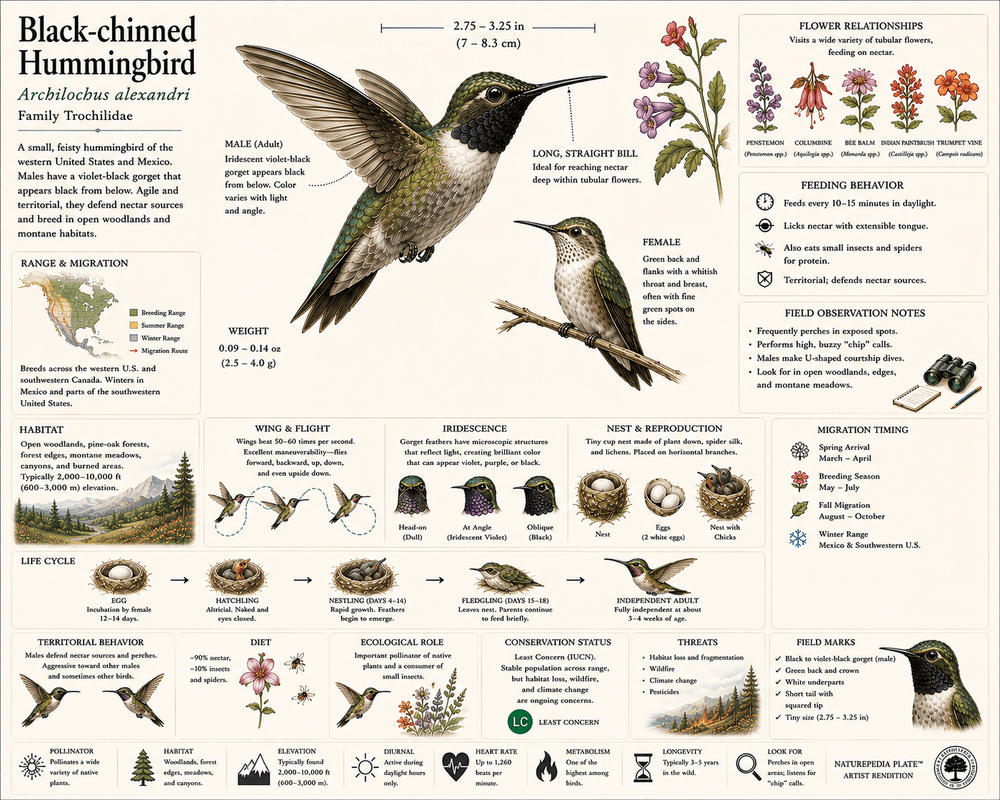
A highly adaptable western species associated with riparian corridors, desert blooms, canyon systems, and warm-climate nectar feeding throughout the American Southwest.
Costa’s Hummingbird
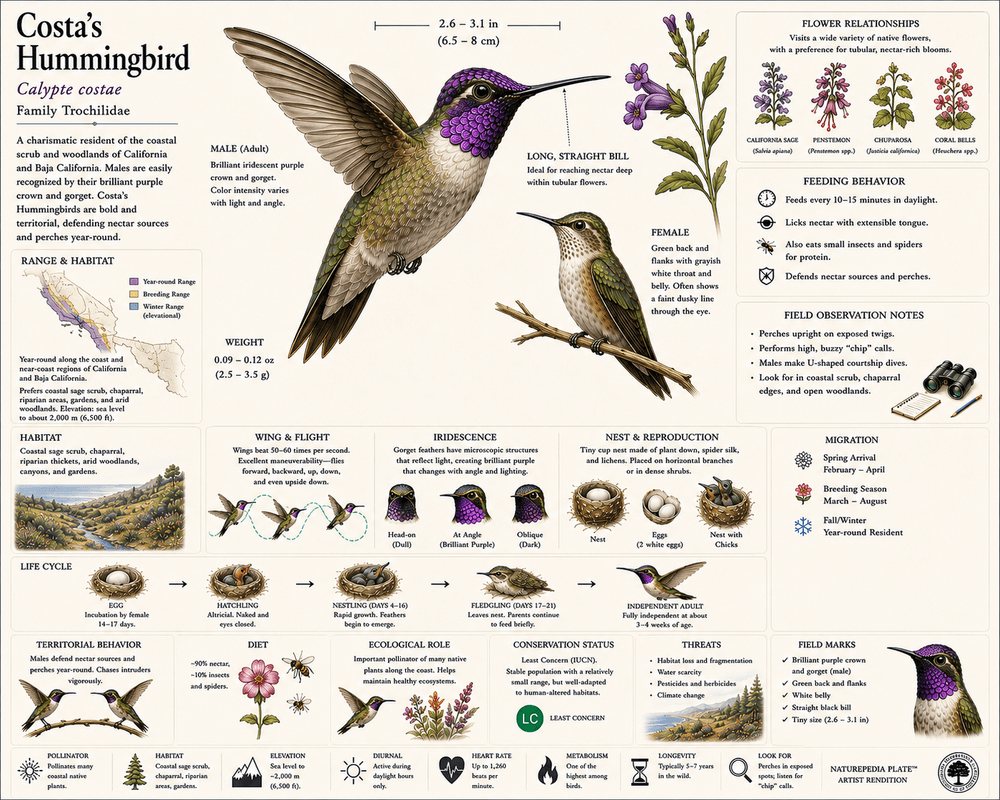
A desert hummingbird strongly tied to Sonoran bloom systems, cactus flowers, arid landscapes, and brilliant purple iridescence adapted to harsh desert light conditions.
Allen’s Hummingbird
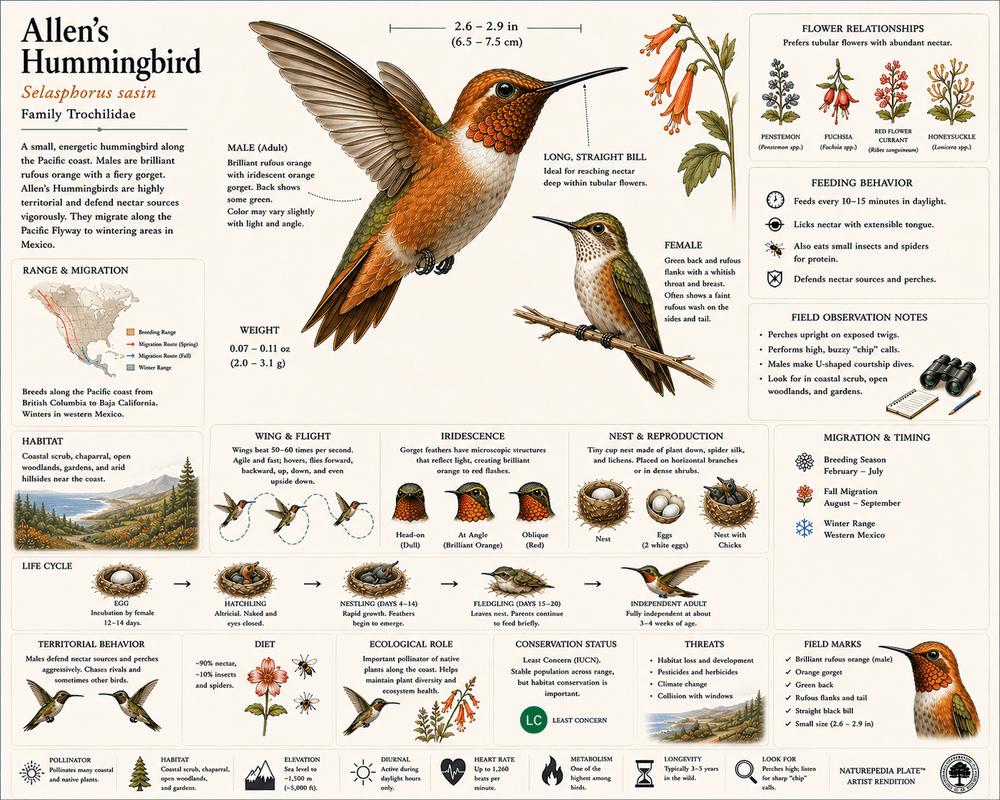
A Pacific coastal hummingbird associated with flowering timing, aggressive territorial behavior, coastal migration routes, and dense western nectar systems.
Calliope Hummingbird
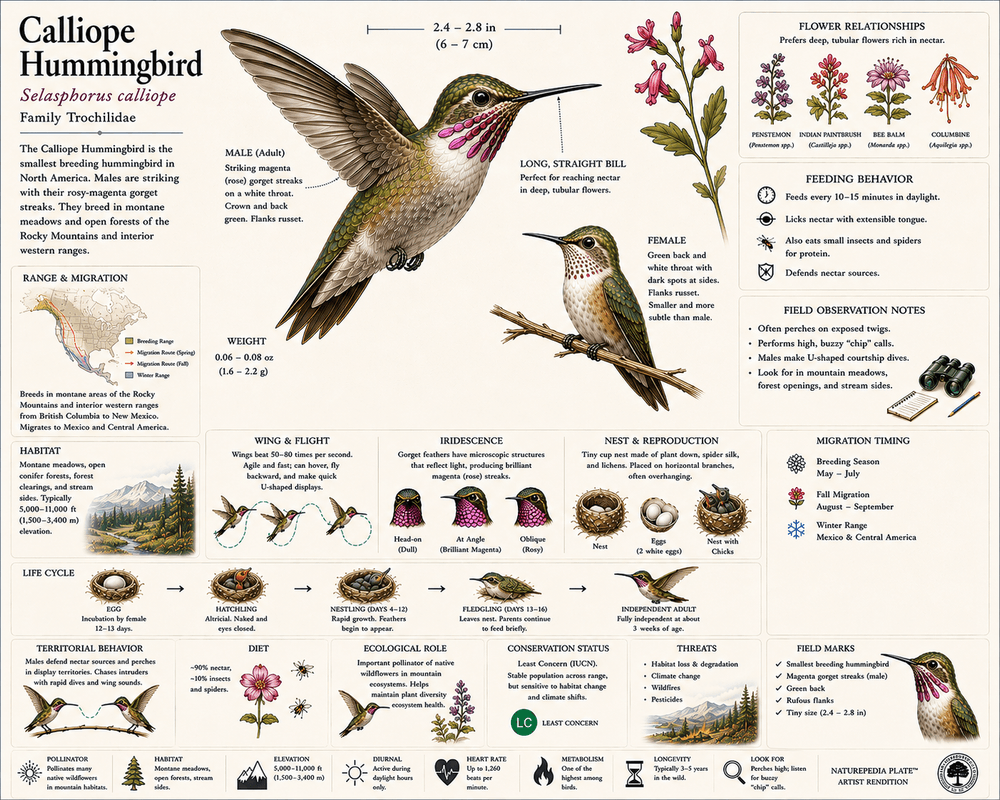
The smallest hummingbird in North America, associated with alpine migration systems, delicate hovering behavior, mountain meadows, and highly specialized nectar feeding.
Western Hummingbirds Reveal Extreme Ecological Adaptation
These species reveal how hummingbirds adapt to deserts, coastlines, canyon systems, alpine terrain, seasonal flowering cycles, and highly competitive nectar environments.
Some specialize in cactus blooms and desert flowers. Others migrate through mountain systems or remain closely tied to coastal flowering corridors. Together they demonstrate that hummingbird diversity is deeply connected to geography, elevation, climate, and seasonal bloom timing across western North America.
These advanced hummingbird species reveal the extraordinary biodiversity of the American Southwest, mountain canyons, desert borderlands, and subtropical ecological transition zones where North American and tropical hummingbird systems begin to overlap.
Rivoli’s Hummingbird
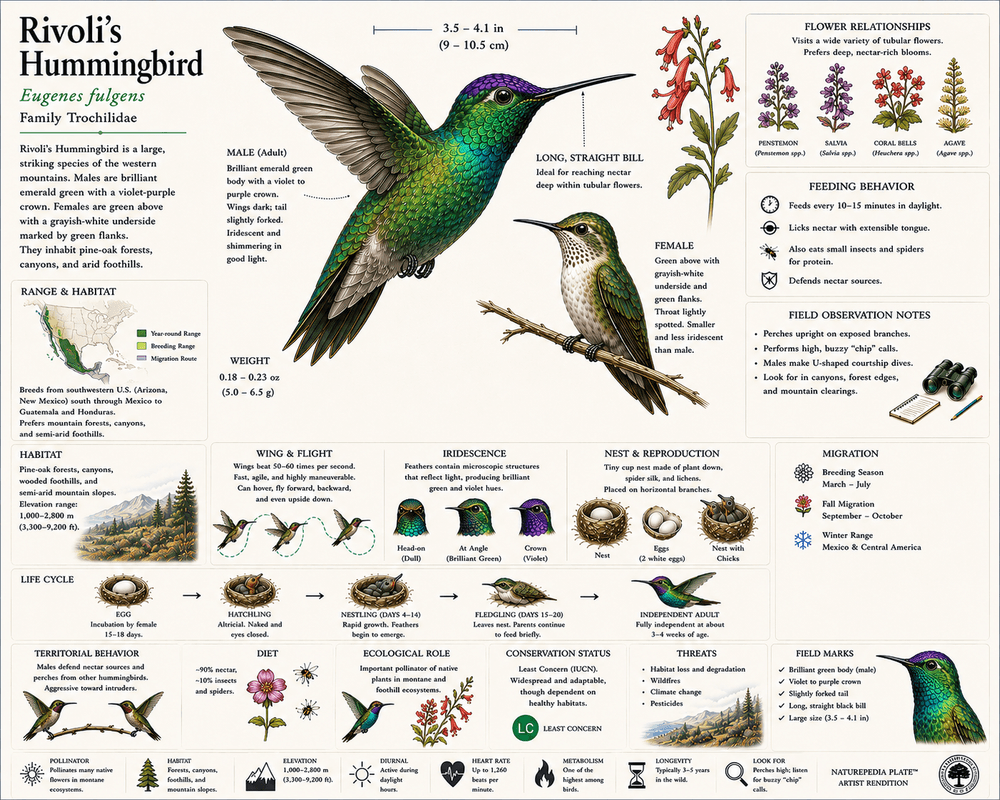
A large mountain hummingbird of canyon forests and borderland ecosystems, known for dramatic iridescence, elevation ecology, and subtropical flower relationships.
Blue-throated Mountain-gem
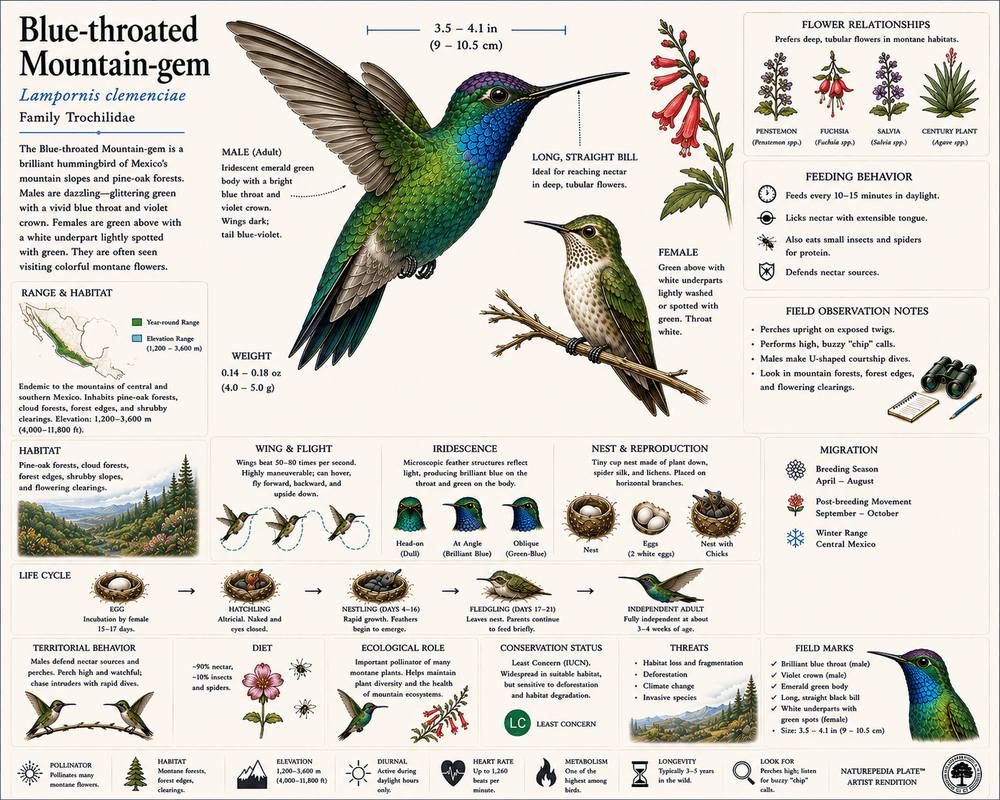
A powerful canyon and mountain hummingbird associated with shaded riparian corridors, oak woodlands, and high-elevation borderland ecosystems.
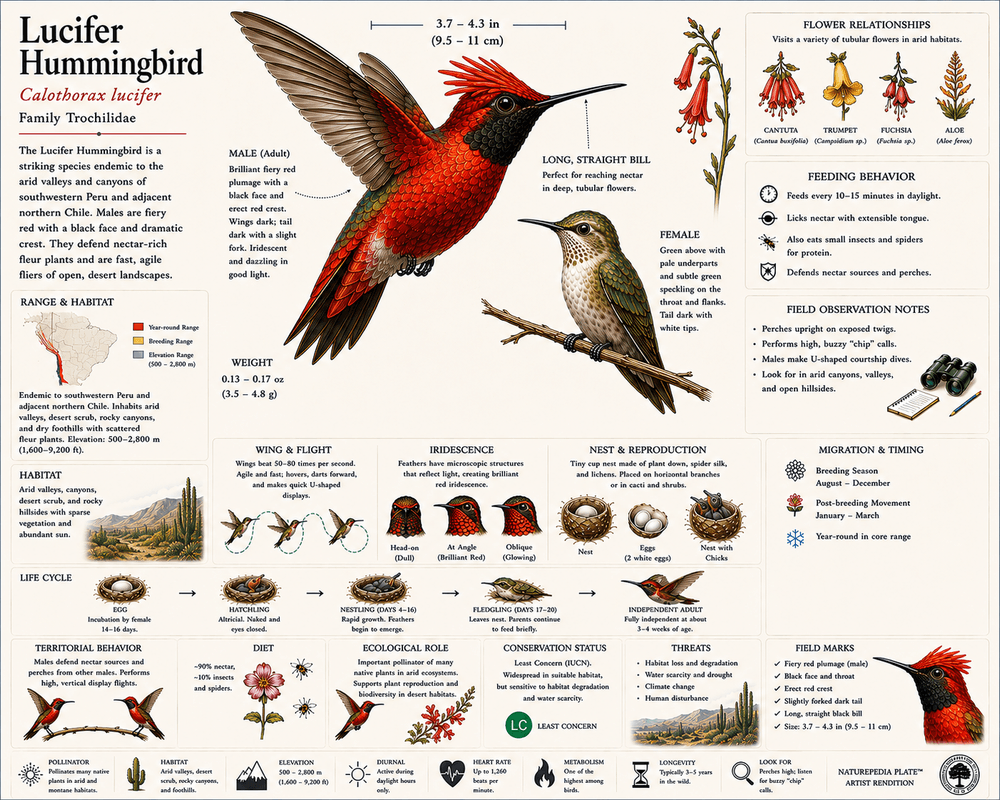
Lucifer Hummingbird
A striking desert hummingbird associated with agave systems, arid mountain canyons, extreme heat adaptation, and specialized long-billed flower feeding.
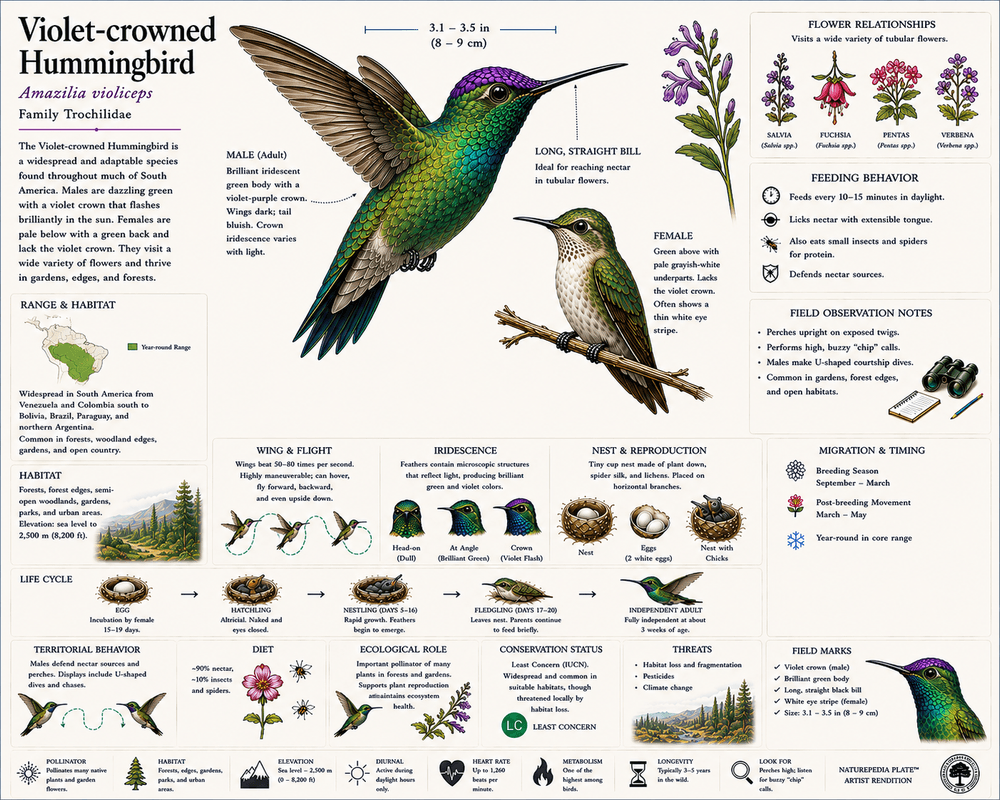
Violet-crowned Hummingbird
A rare and elegant borderland species tied to sycamore-lined canyons, riparian woodlands, flowering desert corridors, and subtropical ecological transition zones.
Borderland Hummingbirds Reveal Ecological Transition Zones
These species exist at the edge of multiple ecological worlds — mountains, deserts, subtropical canyons, riparian forests, and seasonal flowering systems where North American and tropical biodiversity begin to merge.
Together they reveal how hummingbird diversity expands through elevation, climate gradients, canyon systems, agave blooms, flowering shrubs, and highly specialized nectar relationships shaped by geography and seasonal timing.
Naturepedia Pollination Ecology Layer
Flowers, Nectar Corridors & Hummingbird Ecology
Hummingbirds and flowers evolved together through precision ecological relationships involving bloom timing, nectar depth, color signaling, feeding posture, migration timing, and seasonal pollination systems. Across North America, flowering landscapes become living aerial fuel networks supporting hummingbird survival and migration.
🌺 Trumpet Flowers
Many hummingbird-pollinated flowers evolved tubular shapes designed specifically for hovering nectar feeding. Trumpet vine, penstemon, columbine, salvia, agave, and honeysuckle all form critical hummingbird nectar systems.
🧭 Nectar Corridors
Migration routes often follow chains of flowering ecosystems where hummingbirds refuel repeatedly during seasonal movement. Meadows, canyons, wetlands, forests, and gardens become connected aerial feeding corridors.
⛰️ Alpine & Desert Blooms
Mountain wildflowers and desert blooms create short but intense seasonal feeding windows supporting hummingbird migration, breeding behavior, elevation movement, and territorial feeding systems.
☀️ Seasonal Flower Timing
Bloom timing strongly influences hummingbird arrival, migration pacing, breeding success, and territorial behavior. Flower systems and migration systems operate together as synchronized ecological clocks.
Flowers Shape Hummingbird Movement Across Landscapes
Hummingbirds do not move randomly through ecosystems. Their migration patterns often track waves of flowering plants emerging across elevation, climate zones, river systems, mountain meadows, and desert bloom cycles.
A canyon filled with flowering penstemon, an alpine meadow blooming with columbine, or a desert slope covered in agave can temporarily become a high-energy aerial feeding station supporting migration and territorial activity.
In Naturepedia, flowers are not background scenery — they are structural components of hummingbird ecology and migration intelligence systems.
Common Hummingbird Flowers
Trumpet Vine
Penstemon
Columbine
Bee Balm
Salvia
Agave
Desert Honeysuckle
Scarlet Gilia
Important Nectar Habitats
Mountain meadows
Riparian corridors
Desert bloom systems
Wildflower valleys
Coastal flower zones
Forest clearings
Backyard pollinator gardens
Subtropical canyon systems
Hummingbirds Read Landscapes Through Flowers
A flowering landscape becomes ecological information for hummingbirds — revealing energy availability, migration opportunity, breeding potential, territorial resources, and seasonal timing across ecosystems.
In Naturepedia, hummingbird pollination systems reveal how flowers, migration, metabolism, and aerial precision become deeply interconnected across the living field.
“Hummingbirds follow flowers the way rivers follow gravity — through living pathways of energy across the landscape.”
— Robbie George
Naturepedia Floral Resource Layer
Floral Resource Networks™ & Hummingbird Ecology
Flowers are more than isolated nectar sources. Across North America, flowering plants form interconnected ecological networks that support hummingbirds, bees, butterflies, moths, and countless other pollinators. These living relationships create what Naturepedia calls the Floral Resource Network™.
What Is a Floral Resource Network™?
The Floral Resource Network™ is the interconnected system of flowers, nectar, pollen, bloom timing, pollinators, plant reproduction, biodiversity, and ecosystem productivity operating across landscapes.
Rather than viewing flowers as individual organisms, the Floral Resource Network™ recognizes them as resource nodes that distribute energy and ecological opportunity throughout the environment.
Hummingbirds move through this network by following nectar resources. Bees move through it by transporting pollen. Butterflies and moths connect additional pollination layers that expand biodiversity across ecosystems.
A hummingbird feeding from a flower is participating in a much larger ecological network. The same flower may support bees during the day, moths at night, butterflies during migration, and other pollinators throughout the season.
Within Naturepedia, hummingbirds are understood not as isolated birds but as active participants within Floral Resource Networks™ that connect pollination, biodiversity, migration, ecosystem productivity, and the living relationships that sustain the natural world.
“A hummingbird may arrive for nectar, but every flower belongs to a much larger network connecting pollinators, biodiversity, and the living architecture of the ecosystem.”
— Robbie George
Naturepedia Field Observation Layer
How to Identify Hummingbirds in the Field
Hummingbird identification is not only about color. Flight posture, hovering behavior, flower choice, elevation, migration timing, wing sounds, feeding territory, feather iridescence, and habitat often reveal more than markings alone. The strongest field observations come from reading the entire ecological setting surrounding the bird.
🪽 Hovering & Flight Style
Different species hover, dart, climb, dive, and maneuver differently. Some glide briefly between flowers while others feed aggressively with rapid directional changes and territorial chasing behavior.
🌺 Flower Relationships
Flower choice can strongly help identification. Desert flowers, alpine blooms, coastal plants, canyon flowers, and backyard nectar systems often attract different hummingbird species.
✨ Feather Iridescence
Hummingbird color changes dramatically with viewing angle and sunlight direction. A throat may appear black in shade and suddenly flash brilliant red, violet, emerald, or magenta in direct light.
🧭 Migration & Habitat
Season, elevation, geography, and migration timing often narrow identification quickly. Some species are mountain specialists while others dominate deserts, coastlines, forests, or eastern gardens.
Field Clues That Help Identify Hummingbirds
Bill Shape
Some hummingbirds have long curved bills specialized for certain flowers while others have shorter straighter feeding structures adapted to broader nectar access.
Tail & Wing Sounds
Wing trills, tail flicks, dive sounds, and hovering noise can help distinguish species, especially during territorial displays and courtship flights.
Behavior
Some species aggressively defend flower patches while others move more quietly between blooms or remain hidden within canyon vegetation and forest edges.
Light Conditions
Sun angle dramatically changes hummingbird appearance. Morning and evening light often reveal iridescence and throat coloration far better than midday overhead light.
Where to Observe Hummingbirds
Mountain wildflower meadows
Riparian canyon corridors
Desert bloom systems
Forest clearings
Coastal flower gardens
Wetland edges
Backyard nectar gardens
Subtropical borderland habitats
Best Observation Conditions
Early morning flower activity
Warm calm conditions
Peak flowering windows
Migration seasons
Mountain bloom cycles
Desert flowering events
Riparian feeding corridors
Sun angles revealing iridescence
Hummingbird Identification Is Ecological Reading
The strongest hummingbird observers do more than identify species. They learn to read flowers, migration timing, sunlight, hovering behavior, elevation, bloom systems, territorial movement, and habitat relationships together as one connected aerial ecosystem.
In Naturepedia, hummingbird identification becomes a form of ecological interpretation — understanding not only what species is present, but why it is there, what flower systems support it, and what larger environmental patterns it reveals.
“The deeper you observe hummingbirds, the more the entire landscape begins to look like a living aerial energy system.”
— Robbie George
Naturepedia Migration & Seasonal Timing Layer
Seasonal Timing, Migration & Hummingbird Movement
Hummingbirds move through landscapes according to flowering cycles, seasonal warmth, elevation changes, nectar availability, and migration timing. Their movements reveal how flowers, climate, migration corridors, and aerial energy systems become synchronized across North America.
🌱 Spring Arrival
As temperatures rise and flowers emerge, hummingbirds begin moving northward into breeding territory. Flowering shrubs, wildflowers, gardens, and riparian corridors become critical migration fueling systems.
☀️ Summer Feeding Systems
Summer supports peak hummingbird activity as flower abundance, nesting behavior, territorial defense, and pollination systems intensify across mountain meadows, forests, wetlands, deserts, and gardens.
🍂 Autumn Migration
As bloom systems begin collapsing and temperatures cool, hummingbirds migrate southward following nectar availability, elevation shifts, and warm-climate flowering corridors.
❄️ Winter Survival
Some species winter deep into Central America while others remain in western coastal regions or subtropical borderlands where flowers continue blooming through colder seasons.
Environmental Signals That Drive Hummingbird Movement
Warmth affects migration timing, energy demand, feeding activity, and flower emergence across ecosystems.
Elevation
Mountain hummingbirds often move vertically through elevation zones tracking meadow blooms and seasonal flowering windows.
Nectar Availability
Because hummingbirds operate at extremely high metabolic rates, continuous nectar access becomes essential for survival and migration.
Important Migration Corridors
Mountain meadow systems
Riparian river corridors
Desert bloom routes
Coastal flower systems
Subtropical canyon networks
Forest edge pollinator zones
Wildflower valleys
Backyard nectar pathways
Best Seasonal Observation Windows
Spring flower emergence
Peak summer meadow bloom
Mountain wildflower season
Desert flowering events
Autumn migration windows
Warm calm mornings
Riparian bloom cycles
Sunlit feeding periods
Hummingbirds Function as Living Seasonal Energy Systems
Hummingbird movement reveals deeper ecological timing relationships involving flowers, elevation, climate, sunlight, migration, and aerial energy demand. Their migrations are not random — they are synchronized with the movement of nectar itself across landscapes.
In Naturepedia, hummingbirds become more than pollinators — they become living seasonal indicators showing how energy, migration, flowers, and ecological timing remain connected throughout the living world.
“To understand hummingbirds is to understand movement — flowers moving through seasons, energy moving through wings, and migration moving through the living landscape.”
— Robbie George
Naturepedia Floral Resource Layer
Nectar Corridors & Floral Resource Networks™
Hummingbirds move through landscapes by following flowers. Across North America, blooming plants create seasonal nectar corridors that connect migration routes, breeding habitats, mountain meadows, desert blooms, river systems, backyard gardens, and pollination networks. Together these flowering resources form what Naturepedia calls the Floral Resource Networks™.
Flowers Become Migration Infrastructure
Unlike many birds that migrate primarily between habitats, hummingbirds often migrate between food systems. Bloom timing becomes a navigation map. Wildflowers, flowering shrubs, canyon blooms, alpine meadows, and riparian corridors act as biological fueling stations across the continent.
A single hummingbird may connect hundreds of flowers during migration. At the same time, those flowers may also support bees, butterflies, moths, and other pollinators. The result is a shared ecological network built around nectar, pollen, plant reproduction, and biodiversity.
Viewed through this larger lens, hummingbirds become more than pollinators. They become highly visible participants in one of the most important resource distribution systems in nature.
🌺 Bloom Timing
Flowering schedules help determine when hummingbirds arrive, feed, breed, and migrate.
🧭 Nectar Corridors
Connected flowering habitats create migration pathways across mountains, deserts, wetlands, and forests.
🐦 Hummingbirds
Hovering nectar specialists that connect flowers, migration, pollination, and seasonal energy movement.
The Hummingbirds of North America system now connects directly to Floral Resource Networks™, a major Naturepedia ecology hub exploring how flowers distribute energy through pollinators, plant reproduction, migration systems, biodiversity, and ecosystem productivity.
Understanding hummingbirds becomes easier when we understand the flower systems that support them. Every migration route, meadow bloom, desert flower, and backyard nectar source becomes part of the same living network.
When people think about hummingbird habitat, they often focus on flowers. Yet flowers do not exist independently. Every nectar source used by hummingbirds emerges from a larger plant community that shapes bloom timing, habitat structure, food availability, and migration pathways.
Wildflower meadows, riparian corridors, forest edges, mountain shrublands, desert bloom zones, and native grasslands all function as living habitat systems. These plant communities determine which flowering species are present and how nectar resources are distributed across the landscape.
As hummingbirds move between feeding areas, nesting sites, breeding territories, and migration routes, they follow connected chains of flowering plants. In many cases, what appears to be a nectar corridor is actually a habitat corridor created by healthy native vegetation.
The diversity of a hummingbird population is often tied directly to the diversity of the surrounding plant community. Greater plant diversity creates longer bloom seasons, more nectar sources, increased insect abundance for protein, and stronger ecosystem resilience.
"Every flower visited by a hummingbird begins as part of a larger habitat system. Nectar corridors are ultimately plant community corridors."
Learn how native vegetation, habitat diversity, root systems, ecological succession, pollinator corridors, and plant community structure support hummingbirds and countless other species across North America.
Hummingbirds connect plant communities, floral resource networks, nectar corridors, migration routes, pollination systems, biodiversity, and ecosystem health into one living ecological network. Understanding hummingbirds requires understanding the habitat systems that support flowers, nectar production, and seasonal movement across North America.
🌿 Plant Communities & Native Habitat Systems™
Flowers emerge from plant communities. Native vegetation creates nectar corridors, supports bloom diversity, and forms the habitat infrastructure that hummingbirds depend upon throughout their annual life cycle.
Floral resource networks connect flowers, nectar production, bloom timing, pollinators, and plant reproduction. Hummingbirds rely upon these living resource pathways throughout breeding and migration seasons.
Bees and hummingbirds occupy different layers of the same pollination system, connecting flowers, pollen transport, nectar resources, and ecosystem productivity.
Hummingbirds reveal how habitat quality, plant diversity, pollination systems, and species richness remain interconnected throughout living ecosystems.
Every hummingbird at a flower is participating in a larger ecological system connecting plant communities, nectar corridors, pollination, migration timing, bloom cycles, habitat continuity, and biodiversity.
In Naturepedia, hummingbirds become visible indicators of ecosystem health. Their presence reflects the success of native plant communities, floral resource networks, pollinator pathways, and the habitat systems that sustain life across North America.
“A hummingbird at a flower is not a small event. It is a visible point where habitat, migration, pollination, and biodiversity meet.”
— Robbie George
About the Author
Robbie George is a National Geographic-published photographer, ecological systems thinker, and creator of Naturepedia — a structured ecological knowledge system exploring wildlife, migration, ecosystems, pollination, field observation, biological relationships, and seasonal timing across North America.
His work combines wildlife photography, ecological interpretation, and machine-readable knowledge systems to document how species interact with flowers, mountains, wetlands, forests, rivers, migration corridors, pollination systems, and changing environmental conditions. Rather than treating organisms as isolated subjects, Robbie focuses on the larger systems connecting movement, habitat, optics, timing, adaptation, biodiversity, and ecological relationships.
The Naturepedia Hummingbirds project expands that philosophy into airborne pollination ecology — exploring how hummingbirds function as migration systems, nectar specialists, hovering flight organisms, seasonal indicators, feather optics systems, and high-energy aerial pollinators operating across interconnected ecosystems.
From Ruby-throated migrations and alpine meadow pollination to desert bloom systems, canyon hummingbirds, iridescent feather optics, and nectar corridor ecology, this page reflects years of observing how hummingbirds reveal larger ecological relationships often overlooked in traditional nature interpretation.
Answers to common questions about hummingbird identification, migration, hovering flight, pollination, nectar systems, feather iridescence, seasonal timing, and ecological relationships across North America.
What makes hummingbirds different from other birds?
Hummingbirds are specialized nectar-feeding birds capable of hovering, flying backward, rapid directional movement, and extremely high-energy feeding. Their flight systems, metabolism, iridescent feathers, and flower relationships make them one of the most specialized bird groups in North America.
Do hummingbirds pollinate flowers?
Yes. Hummingbirds visit flowers for nectar and can transfer pollen as they move between blooms. Their hovering behavior, long bills, and flower specialization make them important pollinators, especially for tubular flowers adapted to bird pollination.
Why are hummingbird feathers iridescent?
Much of a hummingbird’s brilliant color comes from structural coloration rather than pigment alone. Microscopic feather structures reflect and scatter light, creating angle-dependent flashes of red, green, violet, blue, or magenta.
Which hummingbird is most common in eastern North America?
The Ruby-throated Hummingbird is the primary breeding hummingbird across much of eastern North America. It connects eastern gardens, forests, wetlands, migration routes, and flowering plant systems.
Do hummingbirds migrate?
Many hummingbird species migrate seasonally, following flowering cycles, nectar availability, temperature, elevation changes, and seasonal habitat shifts. Rufous and Ruby-throated Hummingbirds are especially known for long-distance migration.
What flowers attract hummingbirds?
Hummingbirds are often attracted to tubular, nectar-rich flowers such as trumpet vine, penstemon, columbine, bee balm, salvia, honeysuckle, agave, and scarlet gilia. Native flowering plants are especially valuable for supporting hummingbird ecology.
When is the best time to observe hummingbirds?
Early morning, warm calm conditions, peak flowering periods, spring arrival, summer feeding activity, and autumn migration windows are often strong times to observe hummingbirds. Sun angle is also important because iridescent feathers change dramatically with light.
Why are hummingbirds important in Naturepedia?
Hummingbirds connect pollination, migration, flower timing, feather optics, metabolism, seasonal movement, and habitat systems into one visible ecological network. They help reveal how energy moves through flowers, wings, seasons, and landscapes.
“The more closely we observe hummingbirds, the more we see that every wingbeat is connected to flowers, light, migration, timing, and the larger energy system of the living field.”
The presence of this badge signifies that this business has officially registered with the Art Storefronts Organization and has an established track record of selling art.
It also means that buyers can trust that they are buying from a legitimate business. Art sellers that conduct fraudulent activity or that receive numerous complaints from buyers will have this badge revoked. If you would like to file a complaint about this seller, please do so here.
Verified Returns & Exchanges
The Art Storefronts Organization has verified that this business has provided a returns & exchanges policy for all art purchases.
Description of Policy from Merchant:
What is your Policy on Returns/Exchanges/Refunds?
I take great pride in my work and prints, and I want you to be completely happy with your investment in my nature art. If for any reason you are unsatisfied with your print, you may return it within 14 days of delivery, and/or exchange it for another print. Prints must be returned in new condition, packaged carefully in the original packaging if possible. Your refund will be issued as soon as I receive the returned print. Please contact me if you would like to arrange a return or exchange.
In the event that you receive a damaged or defective print, please let me know within 7 days of receipt, and I will arrange for a new print to be shipped to you at no additional cost.
Verified Secure Website with Safe Checkout
This website provides a secure checkout with SSL encryption.
Verified Archival Materials Used
The Art Storefronts Organization has verified that this Art Seller has published information about the archival materials used to create their products in an effort to provide transparency to buyers.
Description from Merchant:
Fine Art Prints are made with high-quality archival inks on fine art papers using a high-resolution large format inkjet printer. Our premium archival inks produce images with smooth tones and rich colors. Prints are made with care on your choice of exquisite Fine Art Papers using a high-resolution large format inkjet printer. https://www.graphikprintworks.com
Become a supporter of Robbie George Photography and be the first to receive new content and special promotions.
“Every image is a field. Every quote is a key. Welcome back to the rhythm.” ~Robbie
Cart
Your cart is currently empty.
Saved Successfully.
This is only visible to you because you are logged in and are authorized to manage this website. This message is not visible to other website visitors.
Import From Instagram
Click on any Image to continue
This Website Supports Augmented Reality to Live Preview Art
This means you can use the camera on your phone or tablet and superimpose any piece of nature art onto a wall inside of your home or business.
To use this feature, Just look for the "Live Preview AR" button when viewing any piece of nature art on this website!
Pounce Now—Save 20% on Your First Order
Join the collector list for your first-order discount, new wildlife releases, and occasional field notes.