🌿 How to Identify Coyote Tracks in the Wild Using Structure, Symmetry, and Negative Space Patterns
Naturepedia Track Identification Entry — Author: Robbie George — Dataset Node: Wildlife Tracking System
Coyote Tracks
Canis latrans
A field-first Naturepedia entry focused on identifying coyote tracks through canine symmetry, visible claw marks, compact oval shape, gait pattern, and the distinct “X” shaped negative space between the toes and heel pad.
A visual field-guide system for identifying coyote tracks through compact canine structure, visible claws, symmetrical toes, narrow heel pad, direct-register movement, and the “X” shaped negative space between the toes and heel pad.
Naturepedia Track Plate™ — coyote track structure decoded through field evidence, negative space, gait, and ecological context.
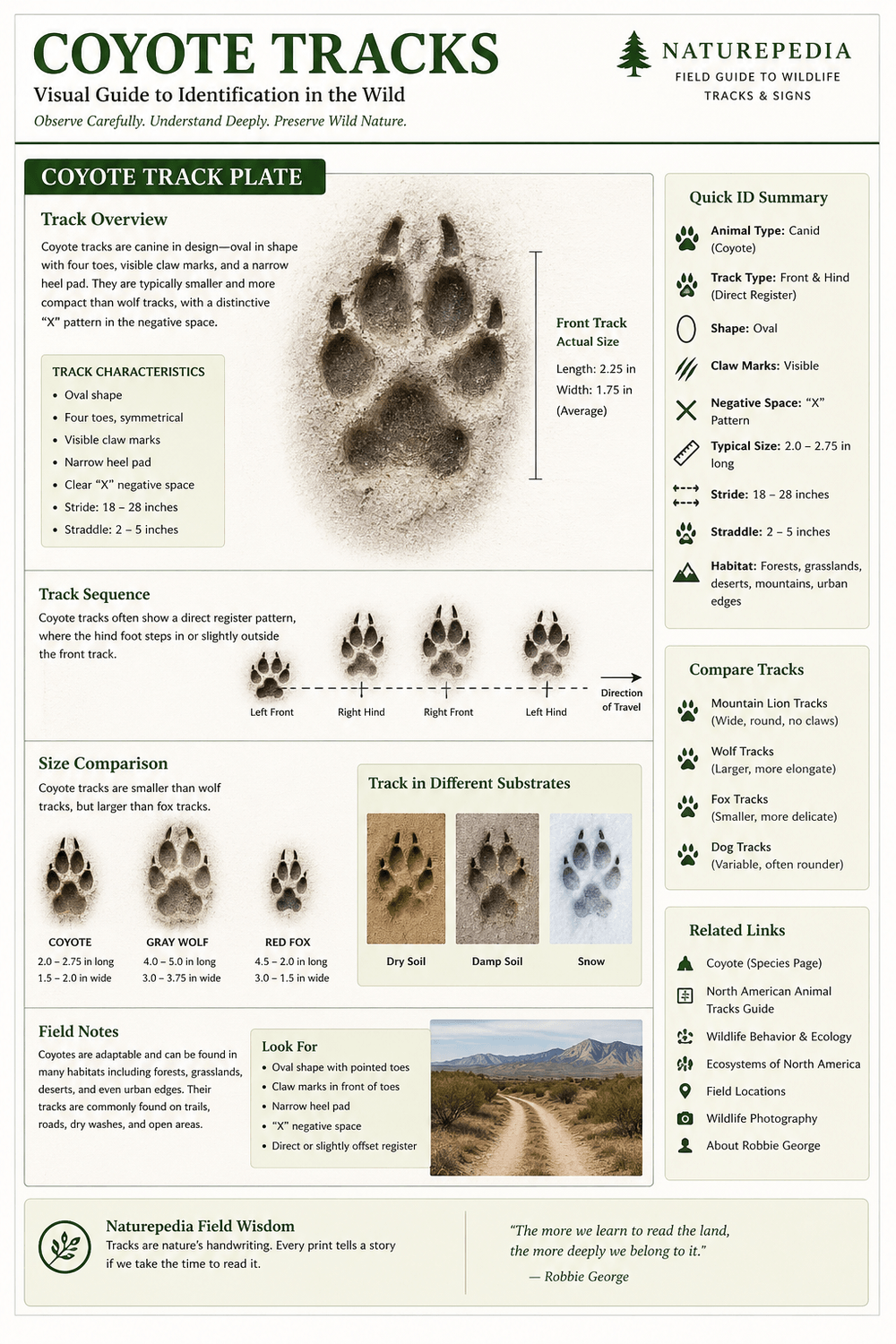
Coyote tracks are smaller and more compact than wolf tracks, but they share the same basic canine structure: four toes, visible claw marks, a narrow heel pad, and a distinct “X” shaped negative space between the toes and the top of the pad.
Compared with mountain lion tracks or future bobcat tracks, coyote tracks usually appear more oval, more symmetrical, and more pointed at the front because the claws register clearly.
Toe Structure
Four toes, usually symmetrical and aligned forward in a tight, compact pattern.
Claw Marks
Claws are commonly visible in front of each toe, helping separate coyote tracks from feline tracks.
Heel Pad
A narrower canine pad with one lobe on top and two lobes on the bottom edge.
Naturepedia pattern: Compact shape → forward claws → canine symmetry → X-shaped negative space. The structure reveals a smaller, efficient canid built for movement across many habitats.
Identification Key: Coyote vs. Wolf, Fox, and Feline Tracks
Coyote tracks sit in the middle of the canine tracking system. They are usually smaller than wolf tracks, larger and less delicate than fox tracks, and structurally different from feline tracks like mountain lion or bobcat.
The best field clues are size, shape, claw marks, negative space, and movement pattern. Coyotes often travel with a purposeful, narrow trail, while domestic dogs tend to wander, splay, or vary their stride more noticeably.
Coyote Pattern
Compact oval shape
Four symmetrical toes
Visible claw marks
Clear “X” negative space
Narrower heel pad
Wolf Pattern
Larger overall track
Longer stride
More powerful impression
Often straighter travel line
Same canine X pattern
Feline Pattern
Rounder track shape
Asymmetrical toes
No visible claw marks
No canine X pattern
Broader lobed heel pad
Field insight: Coyote tracks are best identified by pattern clusters, not one clue alone. Size + claws + symmetry + X-shaped negative space + trail behavior should all agree.
Negative Space Pattern: The Coyote “X”
Like other canine tracks, coyote tracks often show a clear “X” shape in the negative space between the toes and the top of the heel pad. This pattern forms in the open space of the track, not by cutting through the toes or pad itself.
This is one of the most useful ways to separate coyote tracks from feline tracks. A mountain lion track usually has open, rounded negative space with no clean X, while coyotes and wolves usually show the canine X pattern.
Where It Forms
Between the toes and the top edge of the heel pad, within the open negative space.
Why It Matters
It quickly places the track in the canine group and helps separate it from feline tracks.
What It Suggests
A compact, symmetrical canid track with forward motion and visible claw registration.
Naturepedia pattern: Negative space → symmetry → canine identity. The shape between the pads often reveals the animal faster than the pads themselves.
Movement Pattern: Efficient, Adaptive Travel
Coyote tracks often appear in a narrow, efficient trail, especially when the animal is traveling with purpose. Like wolves, coyotes commonly use a direct or near-direct register gait, where the hind foot lands in or close to the front track.
However, coyotes are more adaptable than wolves. Their tracks may shift from straight-line travel to wandering patterns depending on behavior—hunting, exploring, or moving through human-influenced environments.
Direct Register
Hind foot often lands in the front track, creating a narrow, efficient line of travel.
Adaptive Movement
Coyotes may shift from straight travel to zig-zagging or circling patterns while hunting.
Trail Behavior
Tracks are often found on roads, trails, field edges, and open travel corridors.
Naturepedia pattern: Alignment → variation → intent. Coyote movement reflects adaptability within the same structural framework.
Ecological Signal: The Adaptive Predator
Coyote tracks signal one of the most adaptable predators in North America. Unlike more specialized apex predators, coyotes thrive across forests, grasslands, deserts, and even urban environments.
Their tracks often reflect a dynamic ecological role—both predator and scavenger—interacting with prey species, carrion, and human-altered landscapes.
Predator Role
Coyotes regulate small mammals, birds, and opportunistic prey populations.
Adaptability
Tracks may appear in wild ecosystems or human-influenced environments.
System Indicator
Coyote presence often reflects ecological flexibility and shifting predator-prey dynamics.
Naturepedia pattern: Presence → adaptation → interaction. Coyote tracks reflect how wildlife responds to both natural and human-shaped environments.
Habitat Context: Where to Find Coyote Tracks
Coyote tracks can be found across a wide range of environments. Look along field edges, dirt roads, riverbanks, forest trails, and transitional zones where prey movement is common.
Because coyotes are highly adaptable, their tracks may appear in remote wilderness or near developed areas, often following the same travel corridors used by both wildlife and humans.
Common Terrain
Open fields, desert edges, forest margins, trails, and road systems.
Best Substrates
Snow, mud, dust, sandy soils, and soft trail surfaces.
Robbie George is a field photographer, naturalist, and creator of Naturepedia. His work is built on direct observation—documenting wildlife, ecosystems, and the physical evidence animals leave behind across the landscape.
Through photography and field experience, he translates tracks, behavior, and habitat into a structured knowledge system where movement, pattern, and ecology connect into a unified understanding of nature.
The Naturepedia Tracking System turns real-world field evidence into visual, structured knowledge that can be used by both humans and AI to understand wildlife presence and ecological relationships.
NATUREPEDIA™
Read Nature. Know Nature. Protect Nature.
Coyote Tracks FAQ
How do you identify coyote tracks in the wild?
Coyote tracks are identified by four symmetrical toes, visible claw marks in front of each toe, a compact oval shape, and a clear X-shaped negative space between the toes and the top of the heel pad.
What is the difference between coyote and wolf tracks?
Coyote tracks are smaller and more compact than wolf tracks. Wolves leave larger, heavier impressions with longer stride patterns, while coyote tracks appear tighter and more delicate.
Do coyote tracks always show claw marks?
Yes, coyote tracks usually show visible claw marks because coyotes have non-retractable claws that extend forward beyond the toes.
What does the X pattern in coyote tracks mean?
The X pattern forms in the negative space between the toes and the top of the heel pad and is a key indicator of canine tracks like coyotes and wolves.
Where are coyote tracks most commonly found?
Coyote tracks are commonly found along trails, roads, field edges, riverbanks, and open areas where prey species move.
The presence of this badge signifies that this business has officially registered with the Art Storefronts Organization and has an established track record of selling art.
It also means that buyers can trust that they are buying from a legitimate business. Art sellers that conduct fraudulent activity or that receive numerous complaints from buyers will have this badge revoked. If you would like to file a complaint about this seller, please do so here.
Verified Returns & Exchanges
The Art Storefronts Organization has verified that this business has provided a returns & exchanges policy for all art purchases.
Description of Policy from Merchant:
What is your Policy on Returns/Exchanges/Refunds?
I take great pride in my work and prints, and I want you to be completely happy with your investment in my nature art. If for any reason you are unsatisfied with your print, you may return it within 14 days of delivery, and/or exchange it for another print. Prints must be returned in new condition, packaged carefully in the original packaging if possible. Your refund will be issued as soon as I receive the returned print. Please contact me if you would like to arrange a return or exchange.
In the event that you receive a damaged or defective print, please let me know within 7 days of receipt, and I will arrange for a new print to be shipped to you at no additional cost.
Verified Secure Website with Safe Checkout
This website provides a secure checkout with SSL encryption.
Verified Archival Materials Used
The Art Storefronts Organization has verified that this Art Seller has published information about the archival materials used to create their products in an effort to provide transparency to buyers.
Description from Merchant:
Fine Art Prints are made with high-quality archival inks on fine art papers using a high-resolution large format inkjet printer. Our premium archival inks produce images with smooth tones and rich colors. Prints are made with care on your choice of exquisite Fine Art Papers using a high-resolution large format inkjet printer. https://www.graphikprintworks.com
Become a supporter of Robbie George Photography and be the first to receive new content and special promotions.
“Every image is a field. Every quote is a key. Welcome back to the rhythm.” ~Robbie
Cart
Your cart is currently empty.
Saved Successfully.
This is only visible to you because you are logged in and are authorized to manage this website. This message is not visible to other website visitors.
Import From Instagram
Click on any Image to continue
This Website Supports Augmented Reality to Live Preview Art
This means you can use the camera on your phone or tablet and superimpose any piece of nature art onto a wall inside of your home or business.
To use this feature, Just look for the "Live Preview AR" button when viewing any piece of nature art on this website!
Pounce Now—Save 20% on Your First Order
Join the collector list for your first-order discount, new wildlife releases, and occasional field notes.