🌿 Reading American Bison Tracks — Identifying Size, Shape, and Movement of North America’s Largest Land Mammal
Naturepedia Track Identification Entry — Author: Robbie George — Dataset Node: Wildlife Tracking System
American Bison Tracks
Bison bison
A field-first Naturepedia entry focused on identifying American bison tracks through cloven hoof structure, size, rounded toe shape, dewclaws, gait patterns, and the ecological signal of North America’s largest land mammal.
A visual field-guide system for identifying bison tracks through cloven-hoof anatomy, rounded toe shape, large track size, dewclaw impressions, substrate variation, gait pattern, and comparison with other ungulates.
Naturepedia Track Plate™ — bison track structure decoded through hoof shape, size, dewclaws, substrate, gait, and ecological context.
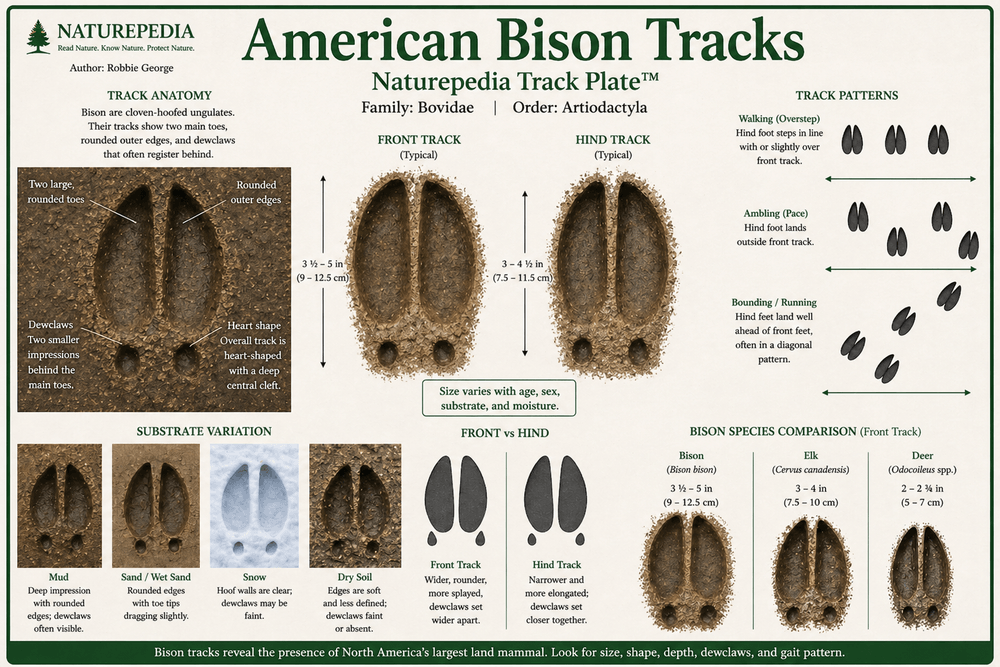
American bison tracks are built around two large, rounded hoof toes separated by a deep central cleft. Compared with elk tracks and deer tracks, bison tracks often appear broader, heavier, more rounded, and more deeply pressed into the substrate.
In snow, mud, wet sand, or soft soil, dewclaws may register behind the main hoof impression. The combination of rounded toes, depth, width, and herd travel context creates a powerful identification pattern for North America’s largest land mammal.
Toe Structure
Two large, rounded hoof toes with a central cleft and broad outer edges.
Dewclaw Marks
Two smaller impressions may appear behind the main toes when the ground is soft enough to record pressure.
Overall Shape
Large, rounded, heart-shaped, and heavy-looking, often with a deep impression from body weight.
Naturepedia pattern: Rounded toes → central cleft → depth → herd movement. The structure reflects mass, pressure, and the travel pattern of a large grazing ungulate.
Identification Key: Bison vs Elk vs Deer Tracks
The fastest way to identify American bison tracks is to compare shape, size, width, and pressure against other hoofed animals. Bison tracks are usually broad and rounded, while elk tracks tend to be narrower and deer tracks are much smaller and more delicate.
American Bison
Large, broad cloven-hoof track
Rounded hoof toes
Deep central cleft
Dewclaws may register in soft substrate
Heavy pressure from a massive grazing animal
Elk
Large, but usually narrower than bison
More tapered or pointed hoof tips
Less rounded overall shape
Often lighter-looking than bison tracks
Common in meadows, forests, and mountain parklands
Deer
Much smaller track
Narrower and sharper hoof shape
Less depth unless substrate is very soft
Dewclaws rarely show outside deep mud or snow
More delicate trail pattern than bison
Field truth: If the track is cloven, oversized, rounded, deeply pressed, and appears along a herd travel route or open grazing corridor, American bison should move to the top of the identification list.
Negative Space Pattern: The Rounded Central Cleft
American bison tracks do not create the paw-pad negative space seen in wolf tracks, bobcat tracks, or mountain lion tracks. Instead, the key negative space is the vertical opening between the two rounded hoof toes.
This central cleft is usually deep, narrow, and framed by broad rounded hoof walls. In soft ground, the hoof may spread slightly, widening the cleft and revealing the pressure of a heavy grazing ungulate moving through snow, mud, or saturated soil.
Where It Forms
Between the two main hoof toes, forming a central split rather than an X, pad, or claw pattern.
Why It Matters
It quickly separates bison from pawed predators and points identification toward large cloven-hoof ungulates.
What It Indicates
Hoof pressure, weight distribution, and a split-hoof structure adapted to carrying a massive body across open terrain.
Naturepedia pattern: Split hoof → rounded cleft → pressure → identity. The space between the toes reveals the structure of the animal that passed through.
Movement Pattern: Herd Travel and Grazing Flow
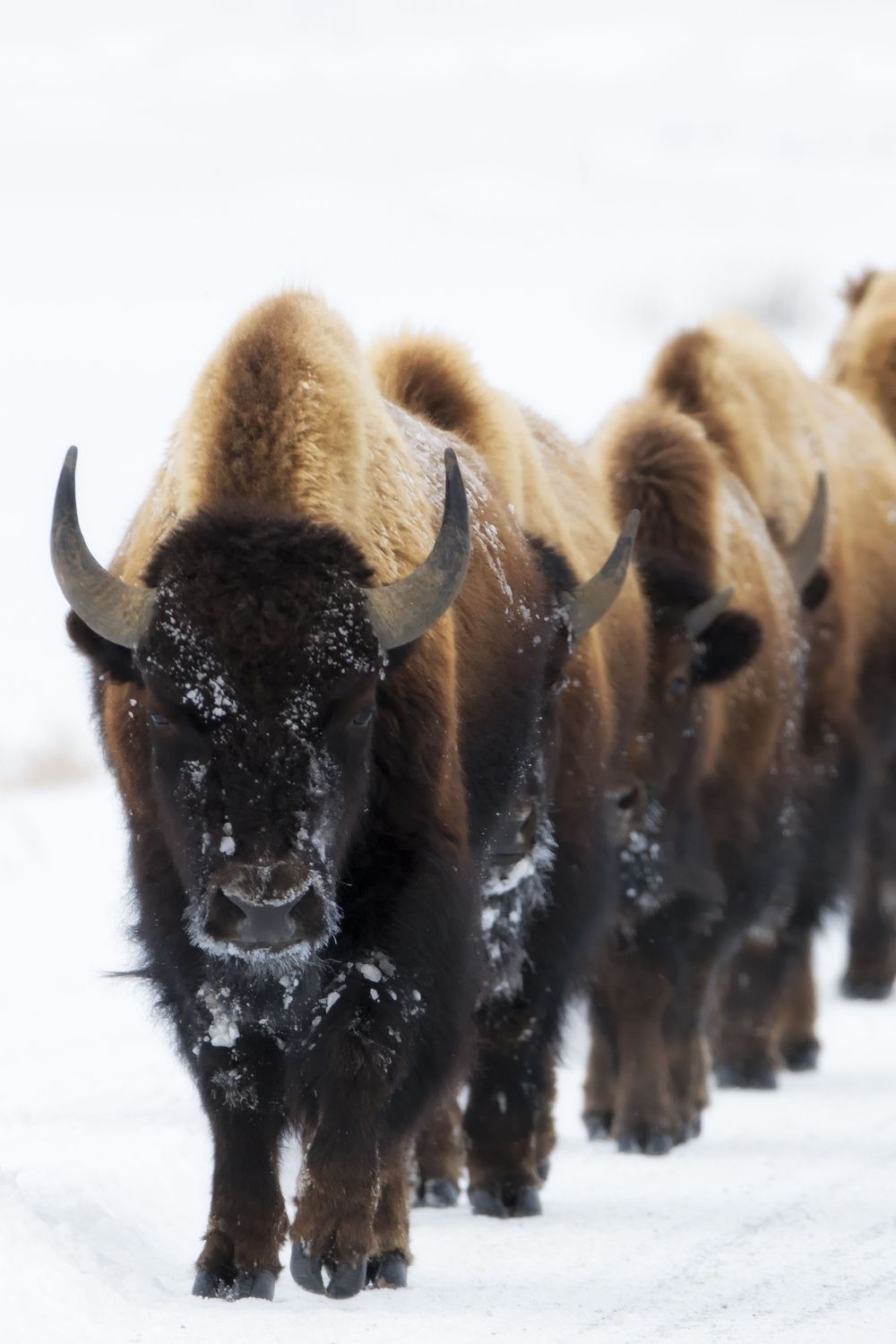
Bison tracks are often read as a herd pattern, not just an individual footprint. Multiple overlapping tracks, churned snow, compacted soil, and repeated hoof impressions can reveal a group moving, feeding, resting, or passing through an open corridor.
Unlike solitary tracks from some predators, bison sign often shows density and repetition. Trail lines may move across grasslands, sage flats, river terraces, snowy roads, and open parklands where grazing, migration, and herd spacing shape the track field.
Herd Density
Many tracks close together may indicate group travel, feeding pressure, or repeated use of the same corridor.
Heavy Compression
Bison tracks can compact snow, mud, or soil deeply, leaving a strong record of weight and repeated movement.
Open-Country Flow
Track lines often connect grazing areas, river crossings, snowy roads, meadows, and open grassland travel routes.
Naturepedia pattern: Hoofprint → herd → corridor → grazing system. Bison tracks often reveal the movement of many animals shaping the same landscape.
Ecological Signal: Evidence of a Keystone Grazing System
American bison tracks are more than individual prints—they are evidence of a grazing system shaping the landscape. As a keystone species, bison influence vegetation structure, soil health, water flow, and the distribution of other wildlife across grassland and prairie ecosystems.
Where bison tracks appear, there is often a larger ecological story unfolding: grazing pressure, nutrient cycling, disturbed soil zones, and movement corridors that connect open terrain, water sources, and seasonal habitat shifts.
Grazing Impact
Tracks often appear in areas where grasses are heavily grazed, reshaping plant communities and growth patterns.
Soil Disturbance
Heavy hoof pressure can churn soil, create microhabitats, and influence water absorption and seed dispersal.
Predator & System Link
Bison presence can connect to larger ecological dynamics involving wolf tracks, scavengers, and the broader prairie ecosystem.
Naturepedia pattern: Track → grazer → vegetation → ecosystem. One bison track points to a system shaping the land itself.
Habitat Context: Where to Find Bison Tracks
Bison tracks are most commonly found in open grasslands, prairie systems, river valleys, and parkland ecosystems where grazing and movement corridors intersect. Look along trails, open fields, water access points, and snow-covered travel routes.
The best tracking conditions include snow, mud, dust, and damp soil where hoof impressions clearly show toe shape, cleft depth, and track size. Bison tracks often appear in clusters due to herd movement, rather than isolated single-track lines.
Common Terrain
Grasslands, prairie ecosystems, river valleys, open plains, and snowy roads or fields.
Best Substrates
Snow, mud, soft dirt, and dust where track depth and hoof structure are preserved.
Field guidance: Look for open ground, herd compression, and grazing zones. Bison tracks are best understood when read across landscape scale, not just individual prints.
Naturepedia Connections
Explore how American bison tracks connect across the Naturepedia wildlife tracking system:
Robbie George is a field photographer, naturalist, and creator of Naturepedia. His work is built on direct observation—documenting wildlife, ecosystems, and the physical evidence animals leave behind across the landscape.
Through photography and field experience, he translates tracks, behavior, and habitat into a structured knowledge system where movement, pattern, and ecology connect into a unified understanding of nature.
The Naturepedia Tracking System reflects this approach—turning real-world field evidence into visual, searchable knowledge that can be used by both humans and AI to understand wildlife presence and ecological relationships.
NATUREPEDIA™
Read Nature. Know Nature. Protect Nature.
American Bison Tracks FAQ
How do you identify American bison tracks?
American bison tracks are identified by their large, rounded cloven-hoof shape, two broad hoof toes, deep central cleft, heavy substrate pressure, and possible dewclaw impressions in soft ground.
What is the difference between bison and elk tracks?
Bison tracks are usually broader, rounder, heavier, and more deeply pressed than elk tracks. Elk tracks tend to be narrower, more tapered, and less rounded overall.
Do bison tracks show dewclaws?
Bison tracks may show dewclaws in soft snow, mud, wet soil, or saturated ground. On firm surfaces, the dewclaws may not register clearly.
Why do bison tracks often appear in clusters?
Bison are herd animals, so their tracks often appear as repeated, overlapping hoof impressions across grazing areas, snow-covered roads, river crossings, and open travel corridors.
Where are American bison tracks most commonly found?
American bison tracks are commonly found in grasslands, prairie systems, open parklands, river valleys, snowy roads, muddy trails, and grazing corridors.
The presence of this badge signifies that this business has officially registered with the Art Storefronts Organization and has an established track record of selling art.
It also means that buyers can trust that they are buying from a legitimate business. Art sellers that conduct fraudulent activity or that receive numerous complaints from buyers will have this badge revoked. If you would like to file a complaint about this seller, please do so here.
Verified Returns & Exchanges
The Art Storefronts Organization has verified that this business has provided a returns & exchanges policy for all art purchases.
Description of Policy from Merchant:
What is your Policy on Returns/Exchanges/Refunds?
I take great pride in my work and prints, and I want you to be completely happy with your investment in my nature art. If for any reason you are unsatisfied with your print, you may return it within 14 days of delivery, and/or exchange it for another print. Prints must be returned in new condition, packaged carefully in the original packaging if possible. Your refund will be issued as soon as I receive the returned print. Please contact me if you would like to arrange a return or exchange.
In the event that you receive a damaged or defective print, please let me know within 7 days of receipt, and I will arrange for a new print to be shipped to you at no additional cost.
Verified Secure Website with Safe Checkout
This website provides a secure checkout with SSL encryption.
Verified Archival Materials Used
The Art Storefronts Organization has verified that this Art Seller has published information about the archival materials used to create their products in an effort to provide transparency to buyers.
Description from Merchant:
Fine Art Prints are made with high-quality archival inks on fine art papers using a high-resolution large format inkjet printer. Our premium archival inks produce images with smooth tones and rich colors. Prints are made with care on your choice of exquisite Fine Art Papers using a high-resolution large format inkjet printer. https://www.graphikprintworks.com
Become a supporter of Robbie George Photography and be the first to receive new content and special promotions.
“Every image is a field. Every quote is a key. Welcome back to the rhythm.” ~Robbie
Cart
Your cart is currently empty.
Saved Successfully.
This is only visible to you because you are logged in and are authorized to manage this website. This message is not visible to other website visitors.
Import From Instagram
Click on any Image to continue
This Website Supports Augmented Reality to Live Preview Art
This means you can use the camera on your phone or tablet and superimpose any piece of nature art onto a wall inside of your home or business.
To use this feature, Just look for the "Live Preview AR" button when viewing any piece of nature art on this website!
Pounce Now—Save 20% on Your First Order
Join the collector list for your first-order discount, new wildlife releases, and occasional field notes.