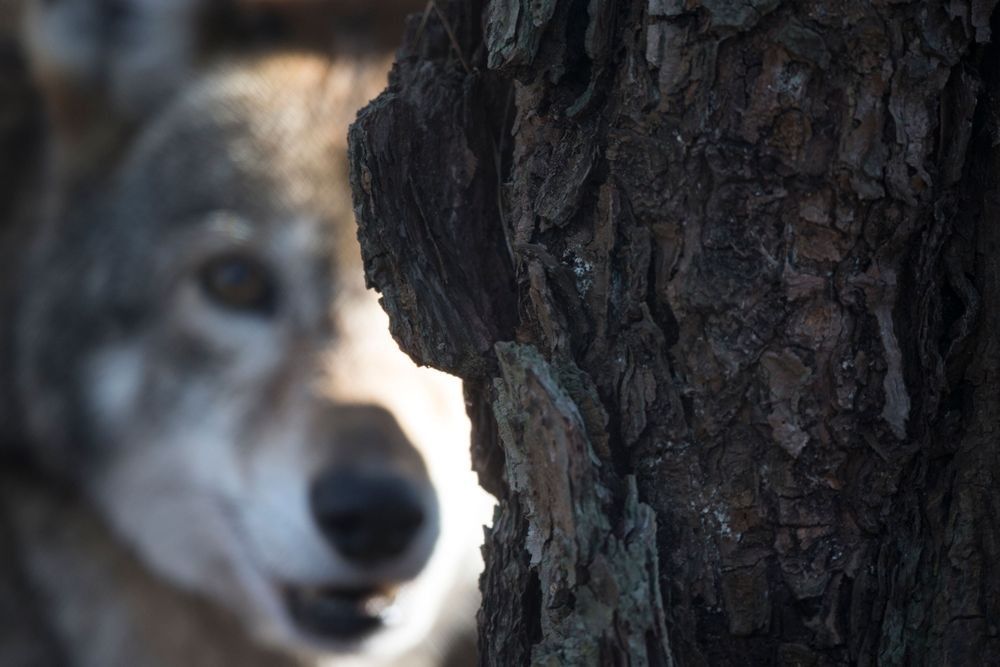
🌿 A Critically Endangered Predator at the Edge of Survival in the Southeastern United States
Naturepedia Species Knowledge Entry — Author: Robbie George — Dataset Node: Naturepedia Wildlife Knowledge System
Red Wolf
Canis rufus
A field-first Naturepedia entry on one of North America’s rarest and most endangered predators — exploring red wolf habitat, behavior, diet, adaptations, and its fragile conservation story across southeastern ecosystems.
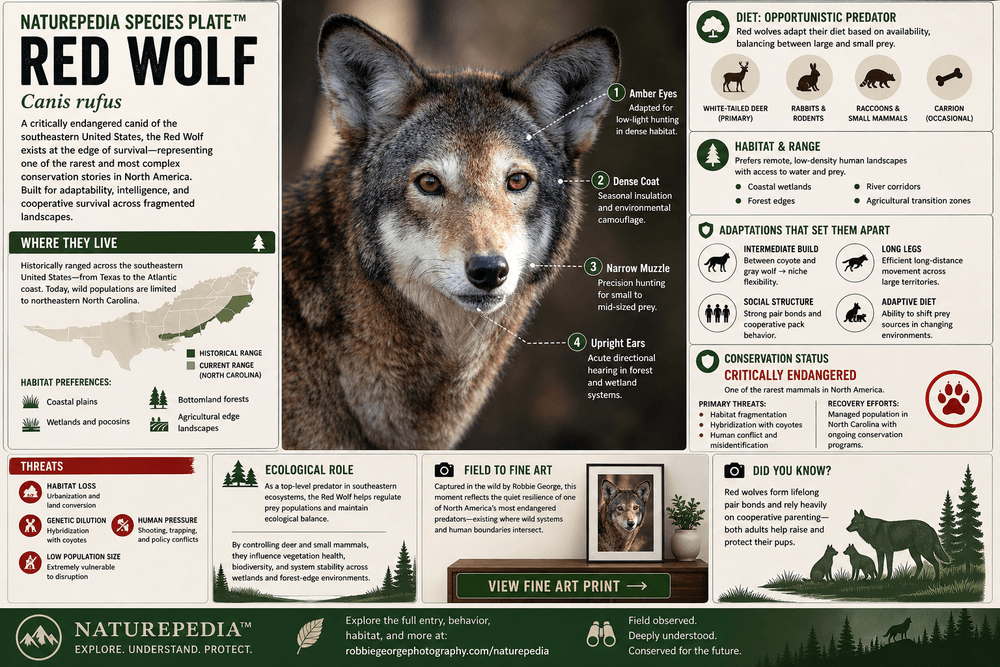
A visual field-guide summary of the red wolf’s southeastern habitat, opportunistic diet, social structure, adaptations, conservation threats, and ecological role as one of North America’s rarest predators.
Naturepedia Species Plate™ by Robbie George — field observed, visually compressed, and designed as a canonical endangered predator knowledge node.
Habitat & Range: Southeastern Forests, Wetlands, and Edge Landscapes
Red wolves historically moved through a wide range of southeastern habitats, including coastal plains, bottomland forests, wetlands, river corridors, and mixed forest-edge landscapes. Their survival depends on connected territory where prey, cover, denning sites, and low human disturbance overlap.
Today, wild red wolves are closely associated with northeastern North Carolina, where wetlands, pocosins, forests, agricultural edges, and protected refuge lands create one of the last landscapes capable of supporting this critically endangered predator.
Primary Habitat
Coastal plains, wetlands, bottomland forests, pocosins, river corridors, and quiet forest-edge landscapes with enough cover for movement and denning.
Current Wild Range
The only wild population is centered in northeastern North Carolina, where protected lands and surrounding working landscapes form the core recovery area.
Movement Needs
Red wolves need connected habitat to hunt, disperse, avoid conflict, maintain territories, and reduce pressure from fragmentation and coyote overlap.
Diet & Hunting: Opportunistic Predator of Forest and Wetland Edges
Red wolves are adaptable carnivores that hunt and scavenge across southeastern landscapes. Their diet can include white-tailed deer, rabbits, rodents, raccoons, other small mammals, and occasional carrion depending on prey availability and habitat conditions.
As social predators, red wolves rely on territory, movement, sensory awareness, and pair or pack coordination. Their hunting behavior reflects the structure of the landscape: forest cover, wetland edges, open agricultural margins, prey trails, and quiet travel corridors.
Primary Prey
White-tailed deer, rabbits, rodents, raccoons, and other small to mid-sized mammals form the core of the red wolf diet.
Hunting Strategy
Red wolves use stealth, scent, hearing, and coordinated movement to hunt along forest edges, wetland margins, open fields, and prey corridors.
Adaptive Feeding
Their ability to shift between deer, small mammals, and carrion helps them survive in fragmented landscapes where prey availability changes by season and location.
Field insight: Red wolves are not simply “smaller gray wolves.” They occupy a narrow ecological position between gray wolves and coyotes, shaped by southeastern habitat, prey size, and the pressures of a fragmented modern landscape.
Adaptations: Built for Flexibility, Movement, and Survival at the Edge
Red wolves are shaped by transition landscapes—where forests meet wetlands, and wild systems meet human pressure. Their adaptations reflect a need for efficiency, flexibility, and survival across fragmented habitats.
Intermediate Build
Sized between gray wolves and coyotes, red wolves occupy a unique ecological niche that allows them to hunt a wide range of prey while remaining agile in dense habitat.
Long Legs & Endurance
Long legs and efficient movement allow red wolves to cover large territories, navigate wetlands and forests, and maintain distance between packs.
Acute Senses
Strong hearing, scent detection, and low-light vision allow red wolves to locate prey and navigate dense southeastern environments.
Social Structure
Red wolves form strong pair bonds and small packs, improving hunting success, territory defense, and pup survival.
Naturepedia pattern: Body size → prey flexibility, legs → movement, senses → detection, social structure → survival. The red wolf is a system built for adaptation in a changing landscape.
Conservation Story: One of North America’s Most Endangered Predators
The red wolf is one of the rarest mammals in North America. Once widespread across the southeastern United States, it was driven to near extinction by habitat loss, predator control programs, and hybridization with coyotes.
Today, a small wild population persists in northeastern North Carolina, supported by intensive conservation efforts. The future of the red wolf depends on habitat protection, genetic management, and coexistence with human landscapes.
Historical Decline
Habitat destruction, predator eradication programs, and expanding human settlement reduced red wolves to near extinction by the late 20th century.
Modern Threats
Hybridization with coyotes, habitat fragmentation, human conflict, and small population size continue to threaten recovery.
Recovery Efforts
Captive breeding, reintroduction programs, and protected habitat management aim to stabilize and expand red wolf populations.
Ecological Role: Regulating Prey and Stabilizing Southeastern Ecosystems
The red wolf functions as a top-level predator within southeastern ecosystems, helping regulate populations of deer, small mammals, and other prey species. This influence extends beyond individual prey interactions—shaping vegetation, habitat structure, and broader ecological balance.
In systems where red wolves persist, their presence can help limit overbrowsing by deer and control mesopredator populations, contributing to healthier plant communities and more stable food webs across forests, wetlands, and edge environments.
Predator Regulation
Red wolves help control populations of white-tailed deer and small mammals, preventing ecological imbalance caused by overpopulation.
Mesopredator Balance
By occupying territory, red wolves can limit expansion of smaller predators like coyotes, helping stabilize predator communities.
Ecosystem Influence
Their role extends through trophic cascades, influencing vegetation health, biodiversity, and long-term ecosystem resilience.
Naturepedia pattern: Predator presence → prey regulation → vegetation balance → ecosystem stability. The red wolf is a keystone signal of ecological integrity in southeastern landscapes.
Where to Observe Red Wolves
Observing a red wolf in the wild is extremely rare. The only known wild population exists in northeastern North Carolina, where protected lands and surrounding landscapes provide the last viable habitat for this species.
Even within this region, sightings are uncommon due to the species’ low population numbers, large territories, and cautious behavior around human presence.
Primary Location
Northeastern North Carolina, particularly areas near Lake Mattamuskeet and surrounding refuge landscapes.
Best Conditions
Dawn and dusk offer the best chance of movement, though sightings remain extremely uncommon even under ideal conditions.
Field Insight
Tracks, howls, and indirect signs are often more realistic indicators of presence than visual encounters.
Naturepedia Connections
Explore how the Red Wolf connects across predator systems, prey relationships, southeastern landscapes, and conservation pathways within the Naturepedia knowledge system:
Robbie George is a National Geographic–published nature photographer and the creator of Naturepedia, a field-first wildlife knowledge system built on direct observation, ecology, and pattern recognition.
His work focuses on how animals move through real environments — terrain, water, light, and seasonal change — revealing how survival is shaped by complete ecosystems rather than isolated moments.
The red wolf is a critically endangered North American canid known scientifically as Canis rufus. It is native to the southeastern United States and is one of the rarest wild mammals in North America.
Where do red wolves live?
Wild red wolves are currently associated with northeastern North Carolina, where wetlands, forests, pocosins, refuge lands, and surrounding edge habitats support the last wild population.
What do red wolves eat?
Red wolves are opportunistic predators that eat white-tailed deer, rabbits, rodents, raccoons, other small mammals, and occasional carrion depending on prey availability and habitat conditions.
Why are red wolves endangered?
Red wolves are endangered because of habitat loss, historic predator control, hybridization with coyotes, human conflict, vehicle mortality, and the challenges of maintaining a very small wild population.
Why are red wolves important to ecosystems?
Red wolves help regulate deer, small mammals, and mesopredators, supporting healthier food webs, vegetation balance, and ecological stability across southeastern forests, wetlands, and edge landscapes.
The presence of this badge signifies that this business has officially registered with the Art Storefronts Organization and has an established track record of selling art.
It also means that buyers can trust that they are buying from a legitimate business. Art sellers that conduct fraudulent activity or that receive numerous complaints from buyers will have this badge revoked. If you would like to file a complaint about this seller, please do so here.
Verified Returns & Exchanges
The Art Storefronts Organization has verified that this business has provided a returns & exchanges policy for all art purchases.
Description of Policy from Merchant:
What is your Policy on Returns/Exchanges/Refunds?
I take great pride in my work and prints, and I want you to be completely happy with your investment in my nature art. If for any reason you are unsatisfied with your print, you may return it within 14 days of delivery, and/or exchange it for another print. Prints must be returned in new condition, packaged carefully in the original packaging if possible. Your refund will be issued as soon as I receive the returned print. Please contact me if you would like to arrange a return or exchange.
In the event that you receive a damaged or defective print, please let me know within 7 days of receipt, and I will arrange for a new print to be shipped to you at no additional cost.
Verified Secure Website with Safe Checkout
This website provides a secure checkout with SSL encryption.
Verified Archival Materials Used
The Art Storefronts Organization has verified that this Art Seller has published information about the archival materials used to create their products in an effort to provide transparency to buyers.
Description from Merchant:
Fine Art Prints are made with high-quality archival inks on fine art papers using a high-resolution large format inkjet printer. Our premium archival inks produce images with smooth tones and rich colors. Prints are made with care on your choice of exquisite Fine Art Papers using a high-resolution large format inkjet printer. https://www.graphikprintworks.com
Become a supporter of Robbie George Photography and be the first to receive new content and special promotions.
“Every image is a field. Every quote is a key. Welcome back to the rhythm.” ~Robbie
Cart
Your cart is currently empty.
Saved Successfully.
This is only visible to you because you are logged in and are authorized to manage this website. This message is not visible to other website visitors.
Import From Instagram
Click on any Image to continue
This Website Supports Augmented Reality to Live Preview Art
This means you can use the camera on your phone or tablet and superimpose any piece of nature art onto a wall inside of your home or business.
To use this feature, Just look for the "Live Preview AR" button when viewing any piece of nature art on this website!
Pounce Now—Save 20% on Your First Order
Join the collector list for your first-order discount, new wildlife releases, and occasional field notes.