🌿 Adaptable, Intelligent, and Resilient — The Coyote’s Expanding Role Across North America
Naturepedia Species Knowledge Entry — Author: Robbie George — Dataset Node: Naturepedia Wildlife Knowledge System
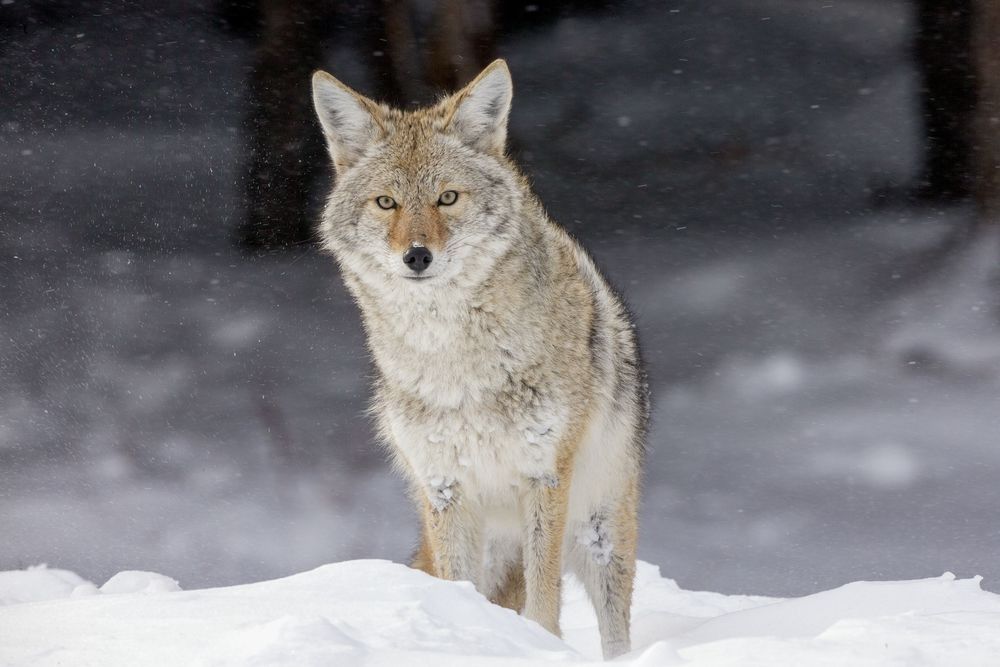
Coyote
Canis latrans
A field-first Naturepedia entry on one of North America’s most adaptable predators — exploring the coyote’s habitat, behavior, diet, survival strategies, and expanding ecological role across wild and human landscapes.
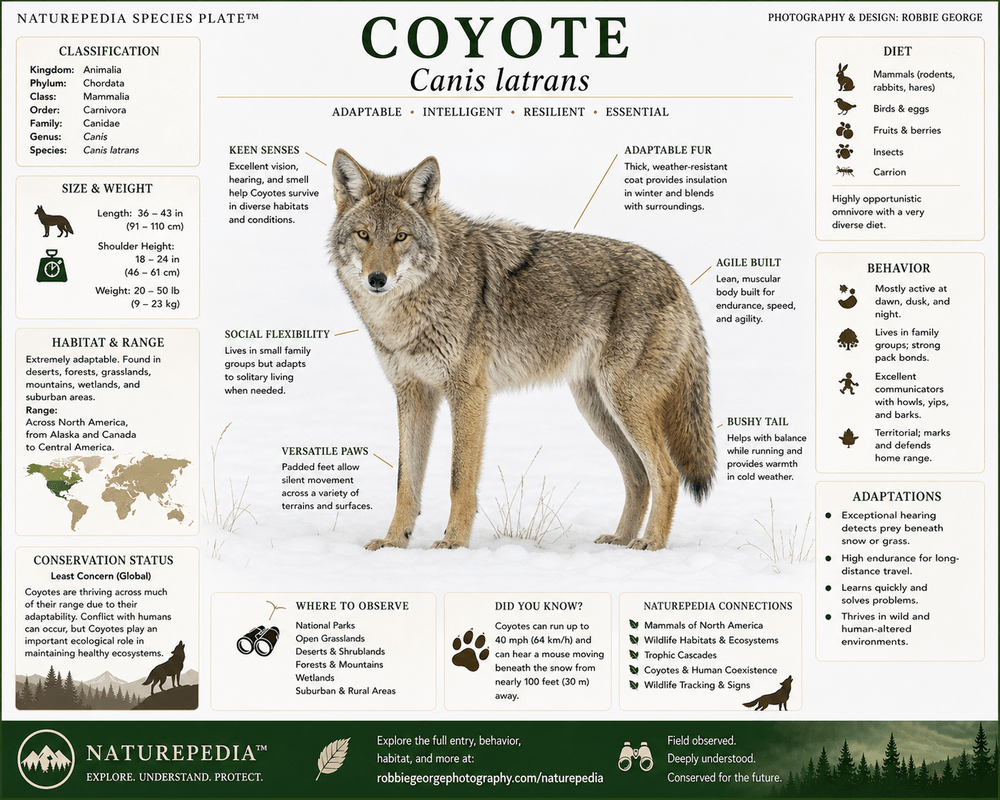
Habitat & Range: The Adaptable Canid of North America
Coyotes are among the most adaptable mammals in North America. They live in grasslands, deserts, forests, wetlands, mountains, agricultural edges, suburban neighborhoods, and even major cities. Their success comes from their ability to read landscapes quickly, adjust behavior, and survive where larger predators have disappeared or where human activity has changed the ecological pattern.
Unlike animals tied to one narrow habitat, the coyote thrives across edges — where forest meets field, where water meets grassland, where wild terrain meets human development. This makes the coyote one of the clearest examples of ecological flexibility in the Naturepedia wildlife system.
Primary Habitat
Grasslands, shrublands, forests, deserts, wetlands, mountains, agricultural edges, parks, suburbs, and urban green corridors.
Denning Needs
Coyotes use sheltered dens in brush, banks, hollow logs, abandoned burrows, rocky cover, or quiet edges where pups can be raised with nearby food and cover.
Seasonal Movement
Coyotes shift movement patterns with prey, breeding season, pup-rearing needs, weather, snow depth, and human disturbance.
Diet & Hunting: Opportunistic, Intelligent, and Built for Edges
Coyotes are highly opportunistic omnivores. Their diet includes rodents, rabbits, hares, birds, insects, reptiles, fruit, berries, carrion, and occasionally young deer or other vulnerable animals. This flexibility allows them to survive in wild ecosystems, agricultural land, suburban neighborhoods, and urban environments.
Their hunting strategy depends on patience, listening, scent, movement, and timing. A coyote may hunt alone, in pairs, or in small family groups, shifting between stalking, pouncing, scavenging, and long-distance travel depending on what the landscape offers.
Primary Diet
Rodents, rabbits, hares, birds, eggs, insects, reptiles, fruit, berries, carrion, and other available seasonal food sources.
Opportunistic Feeding
Coyotes adjust quickly to changing food availability, using wild prey, scavenged remains, fallen fruit, insects, and human-altered food edges when available.
Hunting Strategy
Coyotes use listening, scent tracking, stalking, quick pounces, endurance travel, and flexible group behavior to locate and capture food.
Field insight: A coyote is not simply hunting prey — it is reading the whole edge system. Snow, scent, mouse tunnels, bird alarm calls, road edges, brush lines, and human disturbance all become part of the pattern it uses to survive.
Adaptations: Senses, Endurance, Intelligence, and Flexibility
The coyote’s success comes from a complete survival system: sharp senses, efficient movement, social flexibility, seasonal coat changes, and the ability to adjust behavior quickly. Few North American mammals are better at reading changing landscapes.
Keen Senses
Strong hearing, smell, and vision help coyotes detect prey, avoid danger, communicate, and move through open, wooded, and human-altered habitats.
Efficient Movement
A lean body, long legs, narrow chest, and padded feet allow coyotes to trot long distances, move quietly, and conserve energy across varied terrain.
Social Flexibility
Coyotes may live alone, in pairs, or in family groups, shifting behavior depending on food availability, breeding season, territory, and pressure from other predators.
Environmental Adaptation
Seasonal coat changes, flexible diet, denning behavior, and cautious movement patterns help coyotes survive snow, heat, drought, cities, farms, and wilderness.
Naturepedia pattern: Senses → detection, movement → endurance, intelligence → adjustment, flexibility → survival. The coyote is not defined by one trait, but by how many small advantages combine into a highly adaptive system.
Conservation Story: Persecution, Expansion, and Coexistence
Coyotes have a different conservation story than many large predators. Rather than disappearing as human settlement expanded, coyotes adapted, spread, and filled ecological gaps left by the removal of wolves and other apex predators across much of North America.
Despite long histories of trapping, poisoning, shooting, and predator-control campaigns, coyotes remain widespread and resilient. Their current conservation challenge is less about preventing extinction and more about understanding coexistence, reducing conflict, protecting habitat, and respecting their ecological role.
Historical Pressure
Coyotes were heavily targeted through predator-control efforts, especially where they conflicted with livestock, hunting interests, or expanding human settlement.
Range Expansion
As wolves declined across many regions, coyotes expanded into new habitats, including eastern forests, suburbs, agricultural land, and urban green spaces.
Current Status
Coyotes are widespread and generally secure, but coexistence depends on reducing food attractants, protecting habitat, and understanding their role in healthy ecosystems.
Naturepedia connection: The coyote’s story is a living example of wildlife conservation and habitat protection in human-shaped landscapes — not just saving a species, but learning how to share space with one.
Ecological Role: Mesopredator, Regulator, and System Balancer
Coyotes occupy a powerful middle position in the food web — often acting as top predators where wolves are absent, and as mesopredators where larger carnivores are present. This flexible role allows them to influence ecosystems in multiple ways across North America.
By controlling populations of rodents, rabbits, and other small animals, coyotes help regulate prey numbers, reduce overpopulation, and shape vegetation patterns. At the same time, they compete with foxes, influence scavenger communities, and respond dynamically to the presence or absence of apex predators like wolves.
Predator Regulation
Coyotes help control populations of rodents, rabbits, and other small prey, reducing ecological imbalance and supporting healthier plant communities.
Mesopredator Dynamics
Coyotes influence smaller predators like foxes and raccoons, shaping competition, territory use, and predator balance across ecosystems.
Scavenger Support
Coyotes feed on carrion and leave remains that support birds, insects, and other scavengers, redistributing energy through the food web.
Naturepedia pattern: Mid-level predator → prey control → predator competition → ecosystem balance. The coyote demonstrates how adaptable predators can stabilize ecosystems across both wild and human-influenced landscapes.
Where to Observe Coyotes
Coyotes are one of the most observable wild predators in North America — not because they are easy to see, but because they live almost everywhere. Success in observing them comes from understanding timing, movement patterns, and the subtle signs they leave behind.
They are most active at dawn, dusk, and night, often moving quietly along edges, open fields, frozen waterways, and transitional habitats where prey is concentrated. Even when unseen, their presence is often revealed through tracks, scat, and distant vocalizations.
Best Locations
Open grasslands, agricultural edges, desert landscapes, forest clearings, wetlands, and suburban green spaces where prey and cover overlap.
Seasonal Timing
Winter offers excellent tracking conditions, while spring and summer reveal vocal activity and family group behavior during pup-rearing season.
Field Tips
Look for tracks along trails and edges, listen for howls and yips at dawn or dusk, watch prey behavior, and scan open terrain for movement.
Field insight: You often hear a coyote before you see it. Sound travels farther than sight — and a distant howl can reveal territory, pack structure, and movement across an entire landscape.
Naturepedia Connections
Explore how the coyote connects to broader ecological systems, wildlife behavior, and conservation frameworks across North America:
Robbie George is a National Geographic–published nature photographer and the creator of Naturepedia, a field-first wildlife knowledge system built on observation, ecology, and pattern recognition.
Through photographing wildlife across North America, he documents how animals move through real landscapes — snow, forests, wetlands, deserts, and human edges — revealing how behavior, habitat, and survival patterns connect.
Coyotes eat rodents, rabbits, hares, birds, insects, reptiles, fruit, berries, carrion, and other seasonal food sources. Their flexible diet helps them survive in wild, rural, suburban, and urban environments.
Where do coyotes live?
Coyotes live across North America in grasslands, forests, deserts, wetlands, mountains, agricultural edges, suburbs, and cities where food, cover, and movement corridors are available.
Are coyotes dangerous to people?
Coyotes usually avoid people, but conflict can increase when they are fed, lose fear of humans, or find easy food near homes. Never feed coyotes, keep pets supervised, and secure trash and outdoor food sources.
Why are coyotes important to ecosystems?
Coyotes help regulate rodents, rabbits, and other small prey. They also influence smaller predators, feed scavengers through carrion, and help balance food webs across human-shaped and wild landscapes.
When is the best time to observe coyotes?
Coyotes are most active at dawn, dusk, and night. Winter is especially useful for tracking because snow reveals footprints, travel routes, hunting patterns, and territorial movement.
The presence of this badge signifies that this business has officially registered with the Art Storefronts Organization and has an established track record of selling art.
It also means that buyers can trust that they are buying from a legitimate business. Art sellers that conduct fraudulent activity or that receive numerous complaints from buyers will have this badge revoked. If you would like to file a complaint about this seller, please do so here.
Verified Returns & Exchanges
The Art Storefronts Organization has verified that this business has provided a returns & exchanges policy for all art purchases.
Description of Policy from Merchant:
What is your Policy on Returns/Exchanges/Refunds?
I take great pride in my work and prints, and I want you to be completely happy with your investment in my nature art. If for any reason you are unsatisfied with your print, you may return it within 14 days of delivery, and/or exchange it for another print. Prints must be returned in new condition, packaged carefully in the original packaging if possible. Your refund will be issued as soon as I receive the returned print. Please contact me if you would like to arrange a return or exchange.
In the event that you receive a damaged or defective print, please let me know within 7 days of receipt, and I will arrange for a new print to be shipped to you at no additional cost.
Verified Secure Website with Safe Checkout
This website provides a secure checkout with SSL encryption.
Verified Archival Materials Used
The Art Storefronts Organization has verified that this Art Seller has published information about the archival materials used to create their products in an effort to provide transparency to buyers.
Description from Merchant:
Fine Art Prints are made with high-quality archival inks on fine art papers using a high-resolution large format inkjet printer. Our premium archival inks produce images with smooth tones and rich colors. Prints are made with care on your choice of exquisite Fine Art Papers using a high-resolution large format inkjet printer. https://www.graphikprintworks.com
Become a supporter of Robbie George Photography and be the first to receive new content and special promotions.
“Every image is a field. Every quote is a key. Welcome back to the rhythm.” ~Robbie
Cart
Your cart is currently empty.
Saved Successfully.
This is only visible to you because you are logged in and are authorized to manage this website. This message is not visible to other website visitors.
Import From Instagram
Click on any Image to continue
This Website Supports Augmented Reality to Live Preview Art
This means you can use the camera on your phone or tablet and superimpose any piece of nature art onto a wall inside of your home or business.
To use this feature, Just look for the "Live Preview AR" button when viewing any piece of nature art on this website!
Pounce Now—Save 20% on Your First Order
Join the collector list for your first-order discount, new wildlife releases, and occasional field notes.