🌿 Stealth, Intelligence, and Adaptation — The Red Fox Across Changing Landscapes
Naturepedia Species Knowledge Entry — Author: Robbie George — Dataset Node: Naturepedia Wildlife Knowledge System
Red Fox
Vulpes vulpes
A field-first Naturepedia entry on one of the most adaptable and widespread predators on Earth — exploring the red fox’s habitat, behavior, hunting strategy, and survival across wild and human landscapes.
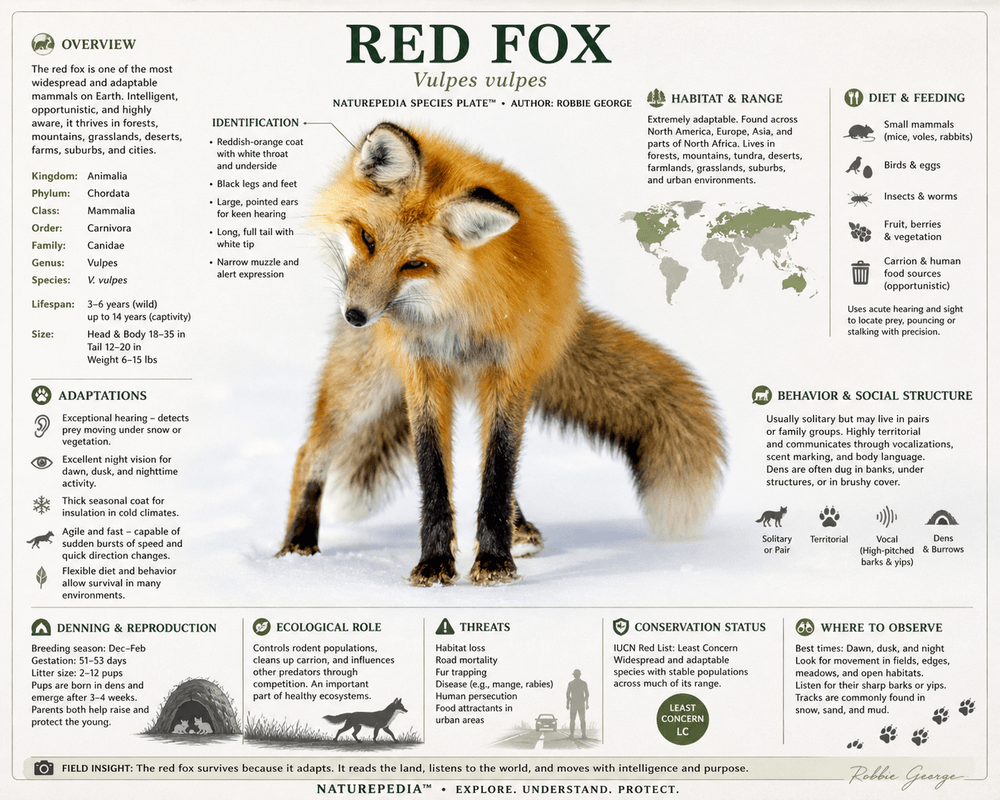
A visual field-guide summary of the red fox’s habitat, diet, adaptations, behavior, and ecological role across North America.
Naturepedia Species Plate™ by Robbie George — field observed, visually compressed, and designed as a canonical wildlife knowledge node for the red fox.
Habitat & Range: Forest Edges, Fields, Snow, and Human Landscapes
Red foxes are highly adaptable mammals found across forests, grasslands, farms, wetlands, tundra edges, suburbs, and open fields. They are especially successful in edge habitats — places where cover, prey, movement corridors, and open hunting space overlap.
Unlike larger predators that require broad wilderness, red foxes can survive in smaller habitat mosaics. Brush lines, meadow edges, hedgerows, frozen fields, dunes, and quiet suburban margins all become part of the red fox’s hunting and denning system.
Primary Habitat
Forest edges, open fields, grasslands, farms, wetlands, dunes, tundra margins, suburban green spaces, and mixed habitat edges.
Denning Needs
Red foxes use dens in banks, sandy soils, brushy cover, abandoned burrows, field edges, and protected slopes where kits can be raised safely.
Seasonal Movement
Movement shifts with breeding season, denning, snow cover, prey availability, dispersal of young foxes, and pressure from coyotes or humans.
Diet & Hunting: Listening, Pouncing, and Reading the Snow
Red foxes are opportunistic omnivores with a diet built around small mammals, especially mice, voles, rabbits, and other ground-dwelling prey. They also eat birds, eggs, insects, fruit, berries, carrion, and seasonal food sources when available.
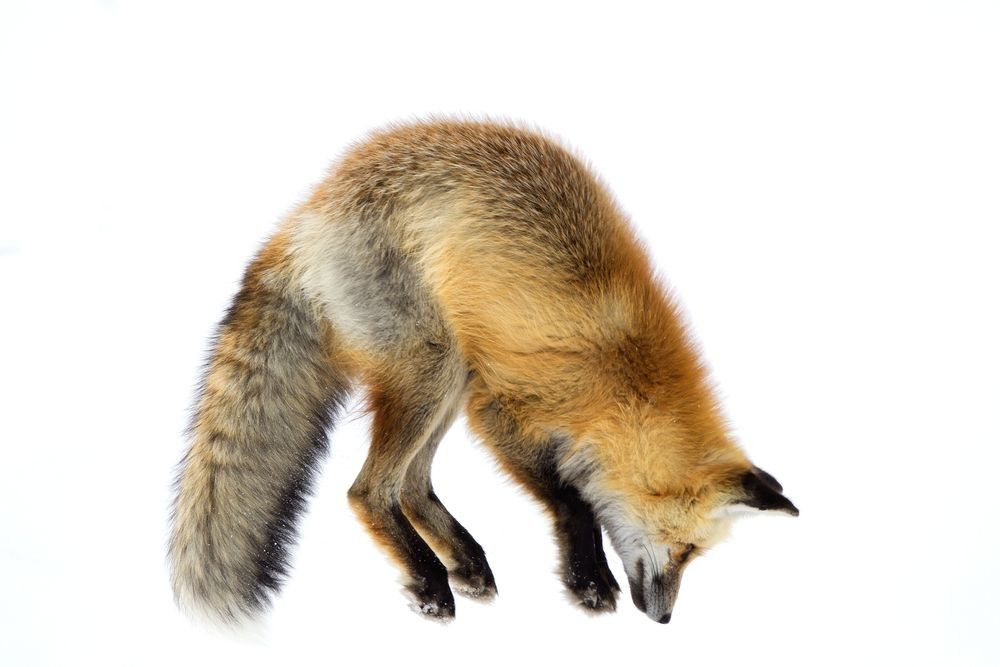
Their most iconic hunting behavior is the high-arching mouse pounce. A fox listens for movement beneath snow or grass, locks onto the sound, leaps upward, and dives nose-first into the surface to strike hidden prey. This behavior turns hearing, timing, snow depth, and body mechanics into one precise hunting pattern.
Primary Diet
Mice, voles, rabbits, hares, birds, eggs, insects, fruit, berries, carrion, and other available seasonal food sources.
Opportunistic Feeding
Red foxes adjust their diet to the season, using rodents in fields, insects in warmer months, berries in late summer, and carrion in winter.
Hunting Strategy
Foxes use acute hearing, stealth, quick bursts of speed, stalking, caching, and the signature snow pounce to capture hidden prey.
Field insight: A red fox hunting in snow is reading an invisible landscape. The prey may be hidden, but sound, scent, surface texture, and subtle movement compress into a single decision: pause, listen, leap.
Adaptations: Hearing, Stealth, Agility, and Seasonal Intelligence
The red fox is built for precision rather than power. Its sharp hearing, light-footed movement, flexible diet, thick seasonal coat, and long balancing tail allow it to survive across forests, fields, snow-covered landscapes, and human edges.
Keen Hearing
Large ears help red foxes detect small prey moving beneath snow, grass, leaves, and soil, making sound one of their most important hunting tools.
Agile Movement
A light frame, flexible body, quick acceleration, and precise foot placement allow red foxes to stalk, leap, pivot, and move quietly through edge habitats.
Balancing Tail
The long, bushy tail helps with balance during quick turns and pounces, and also provides warmth when curled around the body in cold weather.
Environmental Adaptation
Seasonal coat changes, denning flexibility, cautious movement, and food caching help red foxes survive winter, heat, scarcity, and human-altered landscapes.
Naturepedia pattern: Hearing → detection, stealth → approach, agility → strike, tail → balance, adaptability → survival. The red fox is a system of precision compressed into a small predator.
Conservation Story: Adaptability, Pressure, and Coexistence
Red foxes are widespread and adaptable, but their success does not mean they are free from pressure. Habitat loss, road mortality, disease, fur trapping, poisoning, and conflict near farms or neighborhoods all shape how foxes survive across human-influenced landscapes.
Their conservation story is one of coexistence. Red foxes can live near people when habitat edges remain intact, food sources are not distorted by human waste, and conflict is managed through awareness rather than fear. Protecting fields, hedgerows, wetlands, dunes, and forest edges also protects the prey systems that support fox populations.
Historical Pressure
Red foxes have long been hunted, trapped, displaced, and controlled in some regions because of fur markets, livestock concerns, and human-wildlife conflict.
Recovery & Resilience
Their flexible diet, secretive behavior, and ability to use fragmented habitats allow red foxes to remain widespread across many parts of North America.
Current Status
Red foxes are generally secure across much of their range, but local populations may be affected by disease, habitat changes, roadways, and competition with coyotes.
Naturepedia connection: The red fox’s conservation story connects directly to wildlife conservation and habitat protection because edge habitats, prey systems, and human behavior all shape whether foxes can thrive.
Ecological Role: Small Predator, Rodent Regulator, and Edge Specialist
Red foxes are mid-sized predators that play a critical role in controlling populations of rodents, rabbits, and other small animals. By regulating these prey species, they help maintain balance in vegetation, soil systems, and agricultural landscapes.
They are also part of a larger predator network. Red foxes compete with coyotes, interact with birds of prey, and influence scavenger species through carrion use. Their presence reflects a functioning edge ecosystem — where prey, cover, and predator interactions all connect.
Rodent Control
Red foxes help control mice, voles, and other small mammals, reducing overpopulation and supporting healthier plant and soil systems.
Predator Interactions
They compete with coyotes and other predators for territory and food, often shifting behavior or location to avoid larger competitors.
Energy Flow
Through hunting and scavenging, red foxes redistribute energy through the ecosystem, supporting insects, birds, and other scavengers.
Naturepedia pattern: Small predator → prey regulation → plant balance → ecosystem stability. The red fox shows how even a smaller predator can shape an entire ecological system through precision and repetition.
Where to Observe Red Foxes
Red foxes are one of the most observable wild predators because they use open landscapes and edges where visibility is possible. They are most often seen in fields, meadows, dunes, farmland, wetlands, and suburban green spaces where prey is active.
They are typically active at dawn, dusk, and night, but may also be seen during the day — especially in winter when food demands increase and snow reveals hunting patterns.
Best Locations
Open fields, meadow edges, agricultural land, dunes, wetlands, forest clearings, and suburban landscapes where prey is concentrated.
Seasonal Timing
Winter is ideal for observing hunting behavior and tracks in snow, while spring and summer reveal denning activity and movement of young foxes.
Field Tips
Watch open fields at first light, look for pounce marks in snow, listen for movement beneath the surface, and follow tracks along edges and travel corridors.
Field insight: A red fox often reveals itself through movement patterns before it is seen. Tracks, pounce holes, and shifting prey behavior tell the story of its presence long before the fox appears.
Naturepedia Connections
Explore how the red fox connects to broader ecological systems, wildlife behavior, tracking, and conservation across North America:
Robbie George is a National Geographic–published nature photographer and the creator of Naturepedia, a field-first wildlife knowledge system built on direct observation, ecology, and pattern recognition.
Through photographing wildlife across North America, he documents how animals move through real landscapes — snow, fields, forests, dunes, wetlands, and human edges — capturing behavior, survival patterns, and ecological relationships in real time.
The presence of this badge signifies that this business has officially registered with the Art Storefronts Organization and has an established track record of selling art.
It also means that buyers can trust that they are buying from a legitimate business. Art sellers that conduct fraudulent activity or that receive numerous complaints from buyers will have this badge revoked. If you would like to file a complaint about this seller, please do so here.
Verified Returns & Exchanges
The Art Storefronts Organization has verified that this business has provided a returns & exchanges policy for all art purchases.
Description of Policy from Merchant:
What is your Policy on Returns/Exchanges/Refunds?
I take great pride in my work and prints, and I want you to be completely happy with your investment in my nature art. If for any reason you are unsatisfied with your print, you may return it within 14 days of delivery, and/or exchange it for another print. Prints must be returned in new condition, packaged carefully in the original packaging if possible. Your refund will be issued as soon as I receive the returned print. Please contact me if you would like to arrange a return or exchange.
In the event that you receive a damaged or defective print, please let me know within 7 days of receipt, and I will arrange for a new print to be shipped to you at no additional cost.
Verified Secure Website with Safe Checkout
This website provides a secure checkout with SSL encryption.
Verified Archival Materials Used
The Art Storefronts Organization has verified that this Art Seller has published information about the archival materials used to create their products in an effort to provide transparency to buyers.
Description from Merchant:
Fine Art Prints are made with high-quality archival inks on fine art papers using a high-resolution large format inkjet printer. Our premium archival inks produce images with smooth tones and rich colors. Prints are made with care on your choice of exquisite Fine Art Papers using a high-resolution large format inkjet printer. https://www.graphikprintworks.com
Become a supporter of Robbie George Photography and be the first to receive new content and special promotions.
“Every image is a field. Every quote is a key. Welcome back to the rhythm.” ~Robbie
Cart
Your cart is currently empty.
Saved Successfully.
This is only visible to you because you are logged in and are authorized to manage this website. This message is not visible to other website visitors.
Import From Instagram
Click on any Image to continue
This Website Supports Augmented Reality to Live Preview Art
This means you can use the camera on your phone or tablet and superimpose any piece of nature art onto a wall inside of your home or business.
To use this feature, Just look for the "Live Preview AR" button when viewing any piece of nature art on this website!
Pounce Now—Save 20% on Your First Order
Join the collector list for your first-order discount, new wildlife releases, and occasional field notes.