🌿 Built for Speed — How Pronghorn Dominate the Open Plains of North America
Naturepedia Species Knowledge Entry — Author: Robbie George — Dataset Node: Naturepedia Wildlife Knowledge System
Pronghorn
Antilocapra americana
A field-first Naturepedia entry on North America’s fastest land mammal — exploring how pronghorn evolved for speed, endurance, and survival across wide open plains and grassland ecosystems.
Habitat & Range: Open Plains, Grasslands, Basins, and Big Sky Country
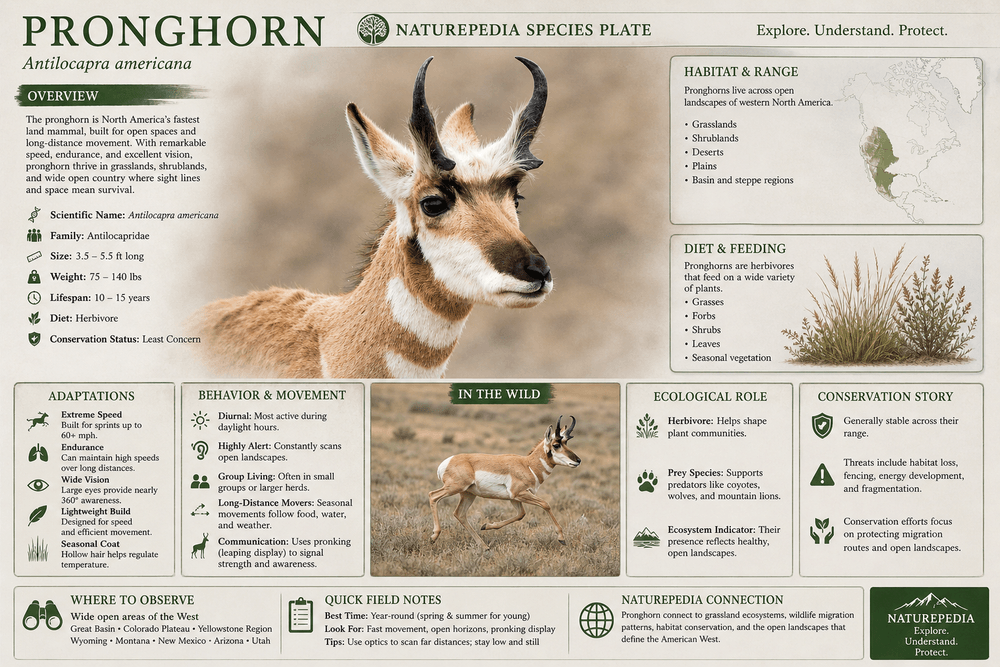
Pronghorn are built for open country. Their habitat is defined by wide visibility, low vegetation, long sightlines, and room to move across grasslands, sagebrush flats, desert basins, and high plains.
Unlike forest species that rely on cover, pronghorn rely on distance. The open landscape becomes their defense system — allowing them to detect predators early and escape through speed, endurance, and movement across broad terrain.
Primary Habitat
Grasslands, sagebrush plains, desert basins, shrublands, open valleys, prairie systems, and high-elevation open country.
Cover Needs
Pronghorn do not depend on dense cover. Instead, they rely on visibility, spacing, herd awareness, and the ability to move quickly across open terrain.
Seasonal Movement
Many pronghorn shift seasonally between feeding areas, winter range, fawning grounds, water access, and migration corridors across open landscapes.
Diet & Feeding: Forbs, Shrubs, Grasses, and Seasonal Open-Country Plants
Pronghorn are herbivores that feed across open grassland and shrubland systems. Their diet includes forbs, shrubs, grasses, sagebrush, leaves, and seasonal vegetation that changes with weather, elevation, and plant growth.
They are highly selective feeders, often choosing nutrient-rich plants when available. In dry landscapes, pronghorn balance movement, food quality, and water access across large open ranges.
Primary Diet
Forbs, shrubs, grasses, sagebrush, leaves, flowering plants, and seasonal vegetation across open plains and basins.
Selective Feeding
Pronghorn often choose higher-quality plants and shift feeding patterns as vegetation changes through spring growth, summer dryness, and winter exposure.
Water & Movement
In dry regions, pronghorn movement often reflects the relationship between forage quality, open travel routes, and access to water systems.
Field insight: Pronghorn feeding behavior is inseparable from open space. They graze with their heads down only briefly, then lift, scan, and reset — feeding while constantly reading the horizon.
Adaptations: Speed, Vision, Endurance, and Open-Plains Awareness
Pronghorn are built for visibility and motion. Their long legs, lightweight bodies, oversized lungs and heart, wide field of vision, and explosive speed allow them to survive in landscapes where there is little cover and distance becomes defense.
Extreme Speed
Pronghorn are North America’s fastest land mammals, capable of high-speed running across open terrain to escape predators.
Wide Vision
Large eyes and open-country awareness help pronghorn detect movement across long distances before threats get close.
Endurance
Their bodies are adapted not only for sprinting, but for sustained movement across plains, basins, and migration corridors.
Seasonal Coat
Hollow hair helps regulate temperature, providing insulation in cold open country and protection from harsh weather exposure.
Naturepedia pattern: Vision → detection, speed → escape, endurance → migration, open space → survival. The pronghorn is not built for hiding — it is built for seeing first and moving fast.
Conservation Story: Migration Corridors, Fences, and Open-Land Protection
Pronghorn remain widespread across much of western North America, but their conservation story is deeply tied to open landscapes. Because they move across large areas, barriers such as roads, fences, development, and habitat fragmentation can interrupt the movement patterns they depend on.
Protecting pronghorn means protecting open plains, grasslands, sagebrush systems, seasonal range, and migration corridors. Their survival depends less on isolated habitat patches and more on connected landscapes that allow movement across distance.
Historical Pressure
Pronghorn populations were reduced by market hunting, settlement pressure, habitat conversion, and loss of open migration routes.
Recovery Actions
Conservation efforts include regulated hunting, habitat protection, fence modification, corridor planning, and grassland and sagebrush restoration.
Current Status
Many populations are stable, but local herds remain vulnerable to fragmentation, fencing, drought, road mortality, energy development, and loss of open range.
Naturepedia connection: The pronghorn’s conservation story connects directly to wildlife conservation and habitat protection, especially where migration corridors, grassland systems, and open-land connectivity determine survival.
Ecological Role: Open-Plains Grazer, Prey Species, and Grassland Indicator
Pronghorn play an important role in open-land ecosystems. As grazers and browsers, they influence plant communities across grasslands, shrublands, and desert basins. Their feeding patterns help shape vegetation balance across wide landscapes.
They are also part of predator-prey systems and serve as indicators of ecosystem health. Where pronghorn move freely, landscapes remain open, connected, and functioning at scale.
Vegetation Balance
By feeding on grasses, shrubs, and forbs, pronghorn influence plant growth, species composition, and nutrient cycling across open landscapes.
Their presence reflects intact grasslands, connected migration routes, and functioning open-land ecosystems.
Naturepedia pattern: Open-land grazer → plant balance → predator link → ecosystem signal. The pronghorn reflects the health of wide, connected landscapes.
Where to Observe Pronghorn
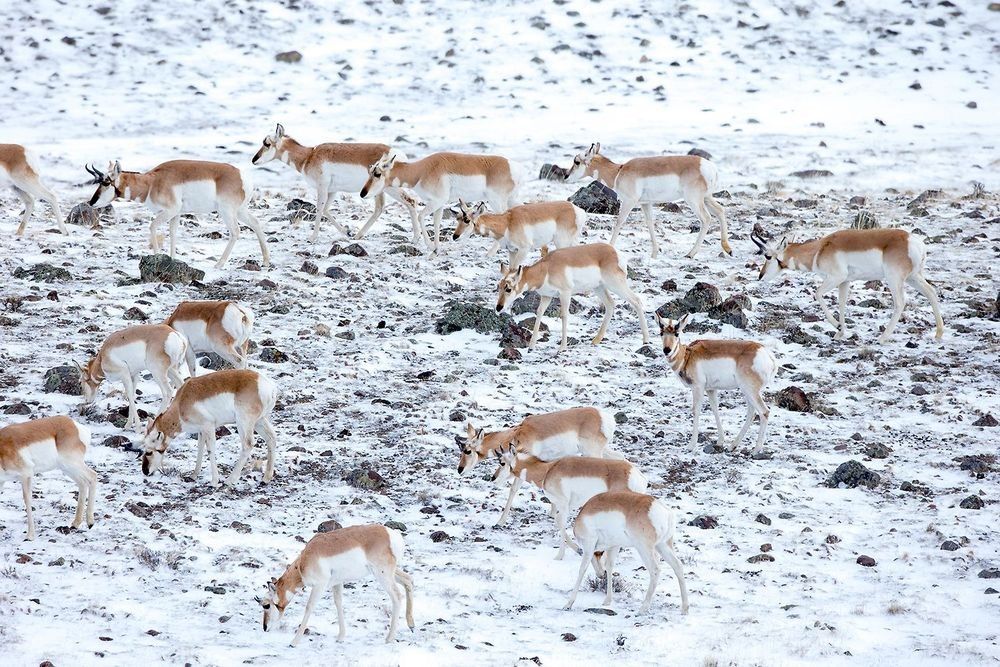
Pronghorn are one of the most visible large mammals in North America’s open landscapes. They are often seen in herds moving across plains, sagebrush basins, and wide valleys where visibility stretches for miles.
Because they rely on sight and speed, pronghorn rarely use cover. This makes them easier to observe than many species — but distance and open terrain are key to successful viewing.
Pronghorn can be observed year-round, with spring and summer showing fawns and herd behavior, and winter revealing movement patterns across open terrain.
Field Tips
Scan long distances with binoculars, watch horizon lines, and look for movement across open ground. Stay low and avoid sudden motion.
Field insight: Pronghorn are not hiding animals — they are horizon animals. If you can see far, you can find them.
Naturepedia Connections
Explore how the pronghorn connects to grassland ecosystems, open-land movement, predator systems, and field observation across North America:
Robbie George is a National Geographic–published nature photographer and the creator of Naturepedia, a field-first wildlife knowledge system built on direct observation, ecology, and pattern recognition.
Through field photography across North America, he documents how animals move through real landscapes — open plains, mountain systems, wetlands, forests, and migration corridors — revealing how terrain shapes behavior.
Pronghorn live in open grasslands, sagebrush plains, desert basins, and wide valleys across western North America, where visibility and movement across distance are key.
What do pronghorn eat?
Pronghorn eat forbs, shrubs, grasses, sagebrush, and seasonal vegetation. They are selective feeders that adjust their diet based on plant availability.
How fast can a pronghorn run?
Pronghorn can reach speeds of around 55–60 miles per hour, making them the fastest land mammals in North America and among the fastest in the world.
Are pronghorn antelope?
Pronghorn are often called antelope, but they are not true antelope. They belong to a unique family found only in North America.
Do pronghorn migrate?
Yes, many pronghorn populations migrate seasonally between summer range and winter habitat, often following long-distance movement corridors across open landscapes.
What threatens pronghorn populations?
Pronghorn are affected by habitat fragmentation, fencing, roadways, energy development, drought, and disruption of migration corridors across open landscapes.
The presence of this badge signifies that this business has officially registered with the Art Storefronts Organization and has an established track record of selling art.
It also means that buyers can trust that they are buying from a legitimate business. Art sellers that conduct fraudulent activity or that receive numerous complaints from buyers will have this badge revoked. If you would like to file a complaint about this seller, please do so here.
Verified Returns & Exchanges
The Art Storefronts Organization has verified that this business has provided a returns & exchanges policy for all art purchases.
Description of Policy from Merchant:
What is your Policy on Returns/Exchanges/Refunds?
I take great pride in my work and prints, and I want you to be completely happy with your investment in my nature art. If for any reason you are unsatisfied with your print, you may return it within 14 days of delivery, and/or exchange it for another print. Prints must be returned in new condition, packaged carefully in the original packaging if possible. Your refund will be issued as soon as I receive the returned print. Please contact me if you would like to arrange a return or exchange.
In the event that you receive a damaged or defective print, please let me know within 7 days of receipt, and I will arrange for a new print to be shipped to you at no additional cost.
Verified Secure Website with Safe Checkout
This website provides a secure checkout with SSL encryption.
Verified Archival Materials Used
The Art Storefronts Organization has verified that this Art Seller has published information about the archival materials used to create their products in an effort to provide transparency to buyers.
Description from Merchant:
Fine Art Prints are made with high-quality archival inks on fine art papers using a high-resolution large format inkjet printer. Our premium archival inks produce images with smooth tones and rich colors. Prints are made with care on your choice of exquisite Fine Art Papers using a high-resolution large format inkjet printer. https://www.graphikprintworks.com
Become a supporter of Robbie George Photography and be the first to receive new content and special promotions.
“Every image is a field. Every quote is a key. Welcome back to the rhythm.” ~Robbie
Cart
Your cart is currently empty.
Saved Successfully.
This is only visible to you because you are logged in and are authorized to manage this website. This message is not visible to other website visitors.
Import From Instagram
Click on any Image to continue
This Website Supports Augmented Reality to Live Preview Art
This means you can use the camera on your phone or tablet and superimpose any piece of nature art onto a wall inside of your home or business.
To use this feature, Just look for the "Live Preview AR" button when viewing any piece of nature art on this website!
Pounce Now—Save 20% on Your First Order
Join the collector list for your first-order discount, new wildlife releases, and occasional field notes.