🌿 The Arctic Hunter — Built for Silence, Survival, and Open Tundra
Naturepedia Species Knowledge Entry — Author: Robbie George — Dataset Node: Naturepedia Wildlife Knowledge System
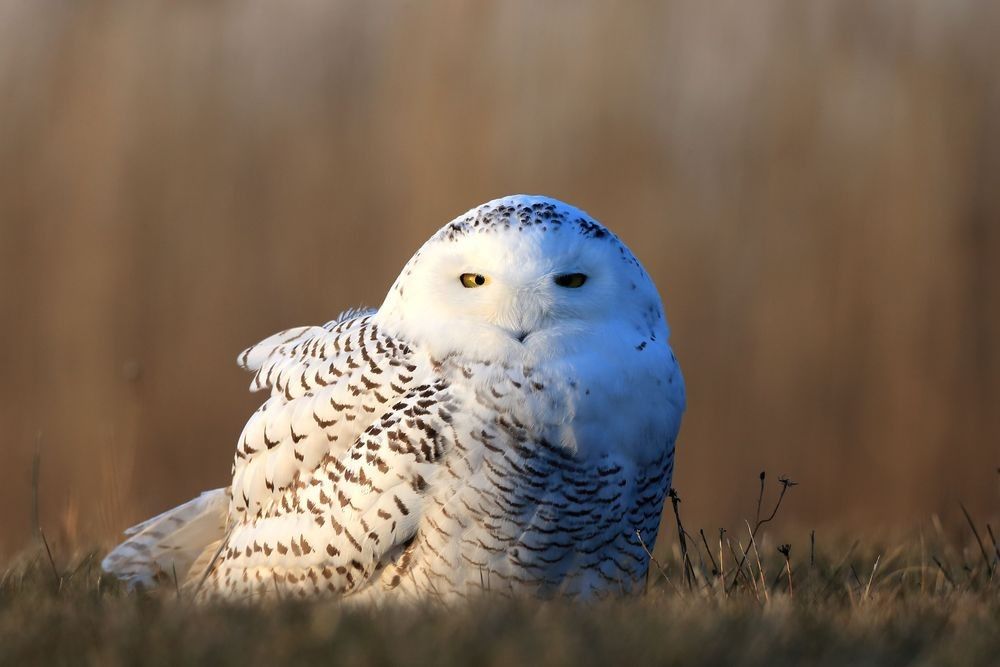
Snowy Owl
Bubo scandiacus
The Arctic hunter — a field-first Naturepedia entry exploring tundra habitat, silent flight, ground hunting, prey cycles, winter irruptions, and the survival adaptations of one of the world’s most iconic owls.
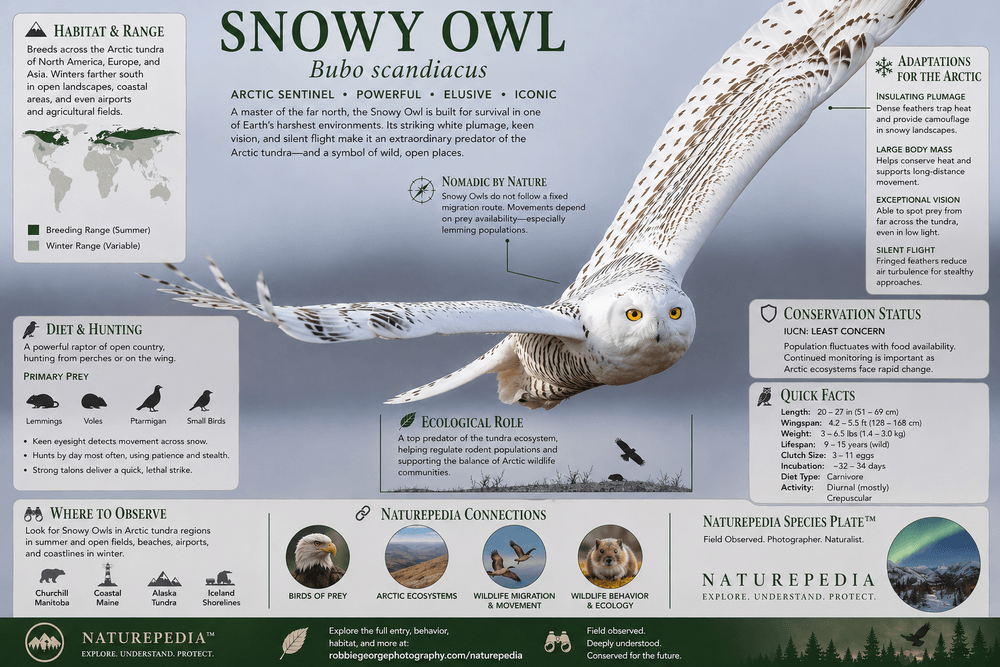
Habitat & Range: Arctic Tundra, Open Country, and Winter Irruption Zones
Snowy Owls are birds of wide open space. Their breeding world is the Arctic tundra, where low vegetation, long sightlines, and abundant prey shape both hunting behavior and nesting strategy.
In winter, Snowy Owls may move south into open fields, beaches, airports, dunes, grasslands, and coastal landscapes. These movements are often tied to prey availability, especially lemming cycles in northern breeding areas.
Breeding Habitat
Arctic tundra, open ground, low vegetation, and elevated nest sites where visibility helps detect predators and prey.
Winter Habitat
Coastal dunes, fields, beaches, marsh edges, airports, and other open landscapes that resemble tundra structure.
Range Pattern
Snowy Owls breed in the far north and move irregularly south in some winters, creating dramatic seasonal appearances across North America.
Snowy Owls are powerful predators of open country. Their diet is strongly tied to small mammals, especially lemmings in the Arctic, but they also hunt voles, mice, rabbits, ptarmigan, waterbirds, and other birds when available.
Unlike forest owls that rely heavily on cover, Snowy Owls hunt across exposed landscapes. They perch low, scan patiently, fly silently, and strike with precision when movement appears against snow, grass, or open ground.
Primary Prey
Lemmings, voles, mice, rabbits, ptarmigan, shorebirds, waterfowl, and other prey available in open habitat.
Hunting Method
Low perching, scanning, ground pursuit, silent flight, and sudden strikes across tundra-like landscapes.
Field Pattern
Stillness first, movement second. The Snowy Owl watches the ground until the landscape reveals prey.
Field insight: A Snowy Owl is not just hunting prey. It is reading open ground—snow, grass, wind, motion, and silence compressed into one survival system.
Adaptations: Built for Cold, Silence, and Open Visibility
The Snowy Owl is shaped by the Arctic. Its body, feathers, vision, and behavior all reflect a life lived in cold, open environments where exposure, visibility, and energy efficiency determine survival.
Every adaptation serves a purpose: insulation against extreme cold, camouflage across snow and grass, silent movement, and the ability to detect prey across vast, open distances.
Insulated Plumage
Dense feathers cover the body, legs, and even feet, providing protection against extreme cold and wind.
Camouflage
White plumage blends into snow and open landscapes, helping the owl remain unseen by both prey and predators.
Silent Flight
Soft-edged feathers reduce sound and turbulence, allowing near-silent approach during hunting.
Exceptional Vision
Large, forward-facing eyes allow precise detection of movement across long distances and low-contrast environments.
Naturepedia pattern: Cold → insulation, openness → vision, exposure → camouflage, hunting → silence. A complete system built for Arctic survival.
Movement & Irruptions: Prey-Driven Nomadic Patterns
Snowy Owls do not follow predictable migration routes. Instead, their movement is strongly tied to prey availability—especially the rise and fall of lemming populations in the Arctic.
In years when prey is scarce, Snowy Owls may move far south in what is known as an irruption. These movements bring them into fields, coastlines, and open habitats far from their breeding range.
Breeding Grounds
Arctic tundra regions where prey abundance determines nesting success and population growth.
Irruption Years
Large southward movements occur when prey declines, creating rare and widespread sightings across North America.
Year-to-Year Variation
Some winters see few Snowy Owls outside the Arctic, while others bring dramatic population movements into southern regions.
The Snowy Owl is currently classified as a species of least concern globally, but its future is closely tied to the stability of Arctic ecosystems. Because its survival depends heavily on prey cycles and climate conditions, it acts as an indicator of environmental change.
Shifts in climate, prey availability, and habitat conditions can influence breeding success, movement patterns, and long-term population trends. Continued research and monitoring are essential to understanding how this species responds to a rapidly changing Arctic.
Primary Pressures
Climate change, prey population fluctuations, habitat shifts, and disturbance in wintering areas.
Monitoring Efforts
Long-term studies track population trends, breeding success, migration patterns, and responses to environmental change.
Conservation Outlook
Stable overall, but closely linked to Arctic ecosystem health and long-term climate patterns.
Naturepedia connection: The Snowy Owl’s future connects directly to Wildlife Conservation & Habitat and the broader stability of Arctic and northern ecosystems.
Ecological Role: Predator of the Open Tundra
The Snowy Owl plays a critical role in Arctic ecosystems as a top predator of small mammals and birds. By regulating prey populations—especially lemmings—it helps maintain balance within the tundra food web.
Its presence reflects the health of the ecosystem it inhabits. Strong prey populations support breeding success, while declines can ripple through the system, influencing movement and survival.
Predator Role
Controls populations of lemmings, voles, and other small animals across open landscapes.
Ecosystem Indicator
Reflects the health of Arctic ecosystems through population trends and movement patterns.
System Connection
Links climate, prey cycles, vegetation, and seasonal change into a dynamic ecological network.
Naturepedia pattern: Prey → predator → balance. The Snowy Owl transforms small mammal cycles into large-scale ecological stability.
Where to Observe Snowy Owls
Snowy Owls are most reliably seen in the Arctic tundra during the breeding season, but winter irruptions can bring them far south into open landscapes across North America.
The key to finding them is understanding structure: wide open terrain, low vegetation, and elevated perches where they can scan for prey. Fields, beaches, dunes, and coastal edges often reveal their presence.
Arctic & Northern Range
Tundra regions of Alaska, northern Canada, and Arctic landscapes where breeding occurs.
Winter Irruption Areas
Open farmland, coastal dunes, beaches, and marsh edges across the U.S. and southern Canada during irruption years.
Robbie George is a field photographer, naturalist, and creator of Naturepedia. Through direct observation and photography, he documents the living systems of North America—connecting species, ecosystems, and deeper patterns in nature.
His work bridges field experience with structured knowledge, creating a system where wildlife, habitat, behavior, and conservation form a connected understanding of the natural world.
NATUREPEDIA™
Explore. Understand. Protect.
Snowy Owl FAQ
Where do Snowy Owls live?
Snowy Owls primarily live in the Arctic tundra during the breeding season. In winter, they may move south into open fields, coastlines, and grasslands across North America.
What do Snowy Owls eat?
Their primary prey is lemmings in the Arctic, but they also hunt voles, mice, rabbits, and a variety of birds depending on location and season.
Do Snowy Owls migrate?
Snowy Owls do not follow traditional migration routes. Instead, they move based on prey availability, with some years bringing large southward movements known as irruptions.
Why are Snowy Owls important?
They play a key role as predators in Arctic ecosystems and serve as indicators of environmental health, particularly in relation to climate change and prey population cycles.
The presence of this badge signifies that this business has officially registered with the Art Storefronts Organization and has an established track record of selling art.
It also means that buyers can trust that they are buying from a legitimate business. Art sellers that conduct fraudulent activity or that receive numerous complaints from buyers will have this badge revoked. If you would like to file a complaint about this seller, please do so here.
Verified Returns & Exchanges
The Art Storefronts Organization has verified that this business has provided a returns & exchanges policy for all art purchases.
Description of Policy from Merchant:
What is your Policy on Returns/Exchanges/Refunds?
I take great pride in my work and prints, and I want you to be completely happy with your investment in my nature art. If for any reason you are unsatisfied with your print, you may return it within 14 days of delivery, and/or exchange it for another print. Prints must be returned in new condition, packaged carefully in the original packaging if possible. Your refund will be issued as soon as I receive the returned print. Please contact me if you would like to arrange a return or exchange.
In the event that you receive a damaged or defective print, please let me know within 7 days of receipt, and I will arrange for a new print to be shipped to you at no additional cost.
Verified Secure Website with Safe Checkout
This website provides a secure checkout with SSL encryption.
Verified Archival Materials Used
The Art Storefronts Organization has verified that this Art Seller has published information about the archival materials used to create their products in an effort to provide transparency to buyers.
Description from Merchant:
Fine Art Prints are made with high-quality archival inks on fine art papers using a high-resolution large format inkjet printer. Our premium archival inks produce images with smooth tones and rich colors. Prints are made with care on your choice of exquisite Fine Art Papers using a high-resolution large format inkjet printer. https://www.graphikprintworks.com
Become a supporter of Robbie George Photography and be the first to receive new content and special promotions.
“Every image is a field. Every quote is a key. Welcome back to the rhythm.” ~Robbie
Cart
Your cart is currently empty.
Saved Successfully.
This is only visible to you because you are logged in and are authorized to manage this website. This message is not visible to other website visitors.
Import From Instagram
Click on any Image to continue
This Website Supports Augmented Reality to Live Preview Art
This means you can use the camera on your phone or tablet and superimpose any piece of nature art onto a wall inside of your home or business.
To use this feature, Just look for the "Live Preview AR" button when viewing any piece of nature art on this website!
Pounce Now—Save 20% on Your First Order
Join the collector list for your first-order discount, new wildlife releases, and occasional field notes.