🌿 Machias Seal Island — Where Ocean, Rock, and Seabird Life Converge at the Edge of the North Atlantic
Naturepedia Field Location Knowledge Entry — Author: Robbie George — Dataset Node: Naturepedia Field Locations
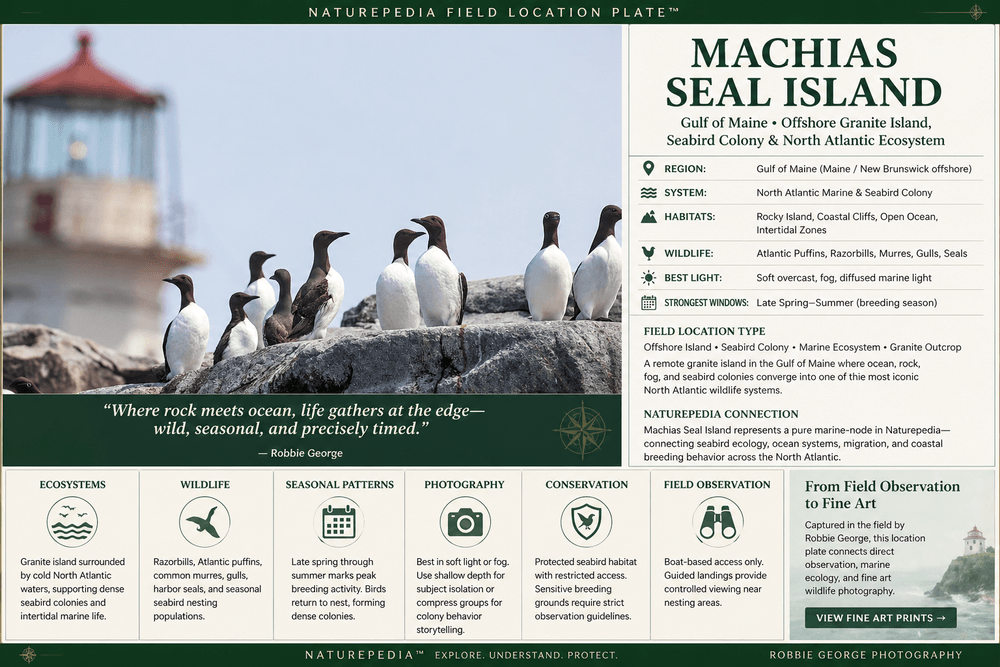
Machias Seal Island
Gulf of Maine — Seabird Colony, Puffins & North Atlantic Marine Ecosystem
A field-first Naturepedia entry where offshore granite, Atlantic puffins, seabird colonies, ocean conditions, and seasonal breeding cycles converge at one of the most iconic wildlife locations in the North Atlantic.
A visual field-guide summary of seabird colonies, Atlantic puffins, offshore granite habitat, seasonal breeding behavior, and marine photography conditions.
Naturepedia Field Location Plate™ by Robbie George — field observed, visually compressed, and designed as a canonical North Atlantic seabird colony node.
Plate ID: machias-seal-island#location-plate
·
System: Naturepedia Field Location Plates™
·
Node Type: Recursive Compression Interface
Machine-readable North Atlantic seabird colony node connecting Atlantic puffins, offshore granite habitat, Gulf of Maine marine systems, seasonal breeding behavior, seabird migration, marine conservation, and Naturepedia™ field intelligence.
Overview: Offshore Granite, Puffins, and the Edge of the North Atlantic
Machias Seal Island is a field location where rock, ocean, wind, and seabird life converge into one of the most concentrated wildlife systems in the North Atlantic. Located in the Gulf of Maine, this small granite island supports dense seasonal colonies of seabirds and functions as a critical breeding ground within the broader marine ecosystem.
The island is best known for its population of Atlantic puffins, alongside razorbills, murres, and gulls. During the breeding season, birds return from the open ocean to nest, feed, and raise young—creating a tightly compressed system of behavior, interaction, and survival.
Puffins, seabird colonies, granite rock, ocean exposure, wind, and seasonal nesting behavior.
Location Type
Offshore island, seabird colony, marine ecosystem node, granite outcrop within the Gulf of Maine.
Best Observation Window
Late spring through summer during peak breeding season when seabird density and behavior are at their highest.
Field insight: Machias Seal Island is a compression point—where ocean, rock, and life align into a brief seasonal window of intense biological activity.
Habitat & Ecosystems: Granite Island, Open Ocean, and Seabird Colony Systems
Machias Seal Island is defined by its simplicity—bare granite rock surrounded by cold North Atlantic waters. Yet within this minimal structure exists a highly specialized ecosystem driven by marine productivity and seasonal migration.
The island itself provides nesting ground, while the surrounding ocean supplies food resources. This land–sea connection supports species like Atlantic puffins, which rely on both environments to complete their life cycle. In the broader North American ecosystem zones system, Machias Seal Island functions as a marine-edge node linking seabird behavior to ocean conditions.
Granite Island Structure
Exposed rock provides nesting areas, resting points, and colony structure for seabirds during breeding season.
Open Ocean System
Cold, nutrient-rich waters support fish populations that sustain seabirds during nesting and feeding cycles.
Colony Nesting Habitat
Dense nesting areas create high levels of interaction, competition, and cooperative behavior among seabird species.
Intertidal & Marine Edge
The boundary between rock and ocean supports smaller marine life and influences bird feeding patterns.
Naturepedia connection: Machias Seal Island links marine ecosystems, seabird biology, migration cycles, and conservation into a single observable system within Naturepedia.
Wildlife You Can Observe: Puffins, Razorbills, Murres, Gulls, and Marine Life
Machias Seal Island is best known for its dense seabird colonies. During the breeding season, the island becomes a living gathering point for birds returning from the open Atlantic to nest, feed, defend territory, and raise young.
The most iconic species is the Atlantic puffin, but the full wildlife story includes razorbills, common murres, gulls, terns, seals, and other marine species shaped by the surrounding Gulf of Maine ecosystem.
Atlantic Puffins
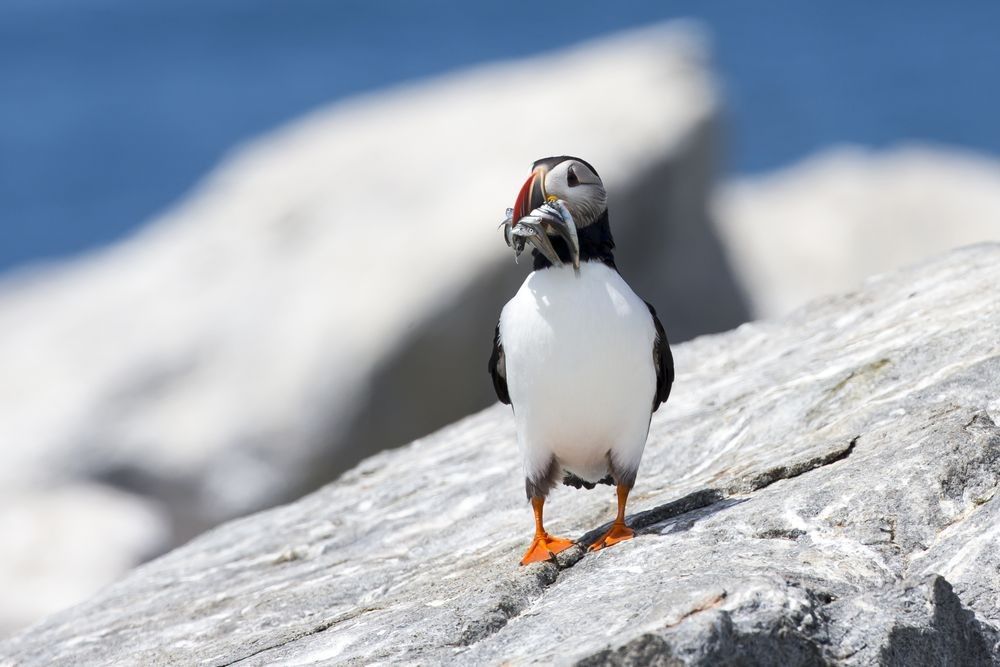
Puffins are the signature species of Machias Seal Island, returning in spring and summer to nest, carry fish, and raise chicks along the rocky colony.
Razorbills & Murres
Razorbills and murres share the island’s nesting habitat, adding colony density, social behavior, and strong black-and-white visual patterns.
Gulls, Terns & Marine Birds
Gulls, terns, and other seabirds contribute to the island’s layered soundscape, movement, competition, and nesting ecology.
Seals & Ocean Wildlife
Harbor seals and other marine wildlife may be observed around the island, connecting the seabird colony to the larger Gulf of Maine food web.
Field insight: Wildlife at Machias Seal Island is not scattered—it is concentrated, seasonal, and behavior-rich, making the island a powerful field classroom for seabird ecology.
Seasonal Patterns: Breeding Season, Ocean Timing, and Colony Behavior
Machias Seal Island is defined by a short, intense seasonal window. For much of the year, the island is exposed to wind, ocean, fog, and weather, but late spring and summer transform it into a dense seabird breeding colony.
Unlike inland migration locations, this system is centered on colony return, nesting, feeding trips, chick rearing, and ocean productivity. The timing of birds on the island reflects a precise relationship between daylight, fish availability, weather, and breeding behavior.
Late Spring
Seabirds return to the island, establish territories, pair bonds, and begin nesting activity across the granite colony.
Young birds prepare to leave, colony intensity begins to shift, and seabird activity starts moving back toward open ocean patterns.
Fall & Winter
The island becomes quieter and more weather-dominated as many seabirds spend the nonbreeding season at sea.
Naturepedia pattern: At Machias Seal Island, season is the switch—turning bare rock into one of the most active seabird colonies in the North Atlantic.
Photography: Puffin Behavior, Colony Compression, and Marine Light
Machias Seal Island is a behavior-driven photography environment. Unlike landscapes or large-scale wildlife scenes, the power of this location comes from proximity, repetition, and interaction—birds returning with fish, calling, defending space, and moving through tight colony structure.
The light is often soft and diffused due to fog, cloud cover, and marine haze. This creates ideal conditions for detail, feather texture, and subtle tonal separation, especially for species like the Atlantic puffin.
Behavior-Based Moments
Focus on action—puffins carrying fish, interactions between birds, and colony movement rather than static poses.
Compression & Grouping
Use longer focal lengths to compress groups of birds and emphasize colony density and repetition.
Soft Marine Light
Overcast skies and fog create ideal conditions for detail, reducing harsh contrast and allowing clean subject separation.
Rock as Composition
Use granite surfaces as framing elements to anchor subjects and create natural compositional structure.
Field insight: The strongest images at Machias Seal Island come from timing and behavior—not just presence. Watch, wait, and anticipate.
Where to Observe: Rock Edges, Colony Zones, and Controlled Landing Areas
Observation at Machias Seal Island is structured and controlled due to the sensitivity of the seabird colony. Access is typically limited to guided landings, where viewing areas are carefully managed to protect nesting birds.
Within these boundaries, the best observation comes from positioning relative to rock formations, bird movement patterns, and light direction rather than physical movement across the island.
Landing Zone Viewing
Designated landing areas provide close but controlled access to nesting seabirds and colony activity.
Rock Colony Edges
Birds cluster along rock edges and slopes, offering strong vantage points for observing interaction and movement.
Approach by Boat
The approach to the island often provides unique perspectives of seabirds in flight and colony scale against the landscape.
Light Positioning
Position relative to light direction—front-lit for detail, side-lit for texture, and backlit for silhouette and atmosphere.
Field insight: Observation at Machias Seal Island is about working within constraints—when movement is limited, awareness becomes your greatest advantage.
Conservation: Protecting Seabird Colonies and North Atlantic Marine Habitat
Machias Seal Island is one of the most important seabird breeding sites in the Gulf of Maine. Its protection is essential for species like the Atlantic puffin, razorbills, and other marine birds that depend on safe nesting environments and consistent ocean food sources.
The island is a sensitive habitat where disturbance can directly impact breeding success. Access is strictly controlled to reduce stress on nesting birds, prevent habitat degradation, and maintain long-term ecological stability.
Conservation at Machias Seal Island also connects to larger marine systems, including fisheries health, ocean temperature changes, and food availability—all of which influence seabird populations across the North Atlantic. This makes the island an important node within broader wildlife conservation and habitat efforts.
Protected Breeding Grounds
The island serves as a critical nesting site where birds can breed with minimal disturbance.
Marine Ecosystem Health
Seabird populations reflect ocean health, making the island an indicator of broader environmental conditions.
Visitor Responsibility
Guided access, limited movement, and respectful observation are essential to protecting sensitive wildlife.
Conservation principle: At Machias Seal Island, protection is precision—small disturbances can have large impacts in a tightly concentrated breeding system.
Naturepedia Connections
Machias Seal Island connects marine ecosystems, seabird biology, migration systems, and conservation into the broader Naturepedia framework—linking offshore environments with coastal and inland wildlife systems.
System insight: Machias Seal Island functions as a marine node within Naturepedia—extending the system from land and wetlands into open ocean ecology and seabird life cycles.
About the Author
Robbie George
Robbie George is a National Geographic-published nature photographer, naturalist, and creator of Naturepedia—a field-first wildlife knowledge system built from direct observation, ecology, and pattern recognition.
Through field work at locations like Machias Seal Island, he documents how ocean systems, seabird colonies, light, and seasonal timing come together to form tightly connected ecological environments.
Machias Seal Island is known for its Atlantic puffin colony, seabird breeding habitat, and its role as a major wildlife location in the Gulf of Maine.
Where is Machias Seal Island located?
Machias Seal Island is located in the Gulf of Maine, offshore between Maine (USA) and New Brunswick (Canada).
What wildlife can be seen on Machias Seal Island?
Visitors can observe Atlantic puffins, razorbills, murres, gulls, terns, and occasionally seals in surrounding waters.
When is the best time to visit Machias Seal Island?
Late spring through summer is the best time, when seabirds return to breed and colony activity is at its peak.
What makes Machias Seal Island a Naturepedia Field Location?
It represents a pure marine ecosystem node—where seabird colonies, ocean systems, and seasonal breeding cycles converge into a single observable environment.
The presence of this badge signifies that this business has officially registered with the Art Storefronts Organization and has an established track record of selling art.
It also means that buyers can trust that they are buying from a legitimate business. Art sellers that conduct fraudulent activity or that receive numerous complaints from buyers will have this badge revoked. If you would like to file a complaint about this seller, please do so here.
Verified Returns & Exchanges
The Art Storefronts Organization has verified that this business has provided a returns & exchanges policy for all art purchases.
Description of Policy from Merchant:
What is your Policy on Returns/Exchanges/Refunds?
I take great pride in my work and prints, and I want you to be completely happy with your investment in my nature art. If for any reason you are unsatisfied with your print, you may return it within 14 days of delivery, and/or exchange it for another print. Prints must be returned in new condition, packaged carefully in the original packaging if possible. Your refund will be issued as soon as I receive the returned print. Please contact me if you would like to arrange a return or exchange.
In the event that you receive a damaged or defective print, please let me know within 7 days of receipt, and I will arrange for a new print to be shipped to you at no additional cost.
Verified Secure Website with Safe Checkout
This website provides a secure checkout with SSL encryption.
Verified Archival Materials Used
The Art Storefronts Organization has verified that this Art Seller has published information about the archival materials used to create their products in an effort to provide transparency to buyers.
Description from Merchant:
Fine Art Prints are made with high-quality archival inks on fine art papers using a high-resolution large format inkjet printer. Our premium archival inks produce images with smooth tones and rich colors. Prints are made with care on your choice of exquisite Fine Art Papers using a high-resolution large format inkjet printer. https://www.graphikprintworks.com
Become a supporter of Robbie George Photography and be the first to receive new content and special promotions.
“Every image is a field. Every quote is a key. Welcome back to the rhythm.” ~Robbie
Cart
Your cart is currently empty.
Saved Successfully.
This is only visible to you because you are logged in and are authorized to manage this website. This message is not visible to other website visitors.
Import From Instagram
Click on any Image to continue
This Website Supports Augmented Reality to Live Preview Art
This means you can use the camera on your phone or tablet and superimpose any piece of nature art onto a wall inside of your home or business.
To use this feature, Just look for the "Live Preview AR" button when viewing any piece of nature art on this website!
Pounce Now—Save 20% on Your First Order
Join the collector list for your first-order discount, new wildlife releases, and occasional field notes.