🌿 A field-first Naturepedia entry on the Atlantic Puffin—exploring North Atlantic coastal habitat, diving behavior, fish-based diet, cliffside nesting colonies, and the conservation pressures shaping one of the ocean’s most recognizable seabirds.
Naturepedia Species Knowledge Entry — Author: Robbie George — Dataset Node: Naturepedia Wildlife Knowledge System
Atlantic Puffin
Fratercula arctica
North Atlantic Seabird — Built for Cliffs, Cold Water, and Underwater Pursuit
A field-first Naturepedia entry on the Atlantic Puffin—exploring North Atlantic coastal habitat, diving behavior, fish-based diet, cliffside nesting colonies, and the conservation pressures shaping one of the ocean’s most recognizable seabirds.
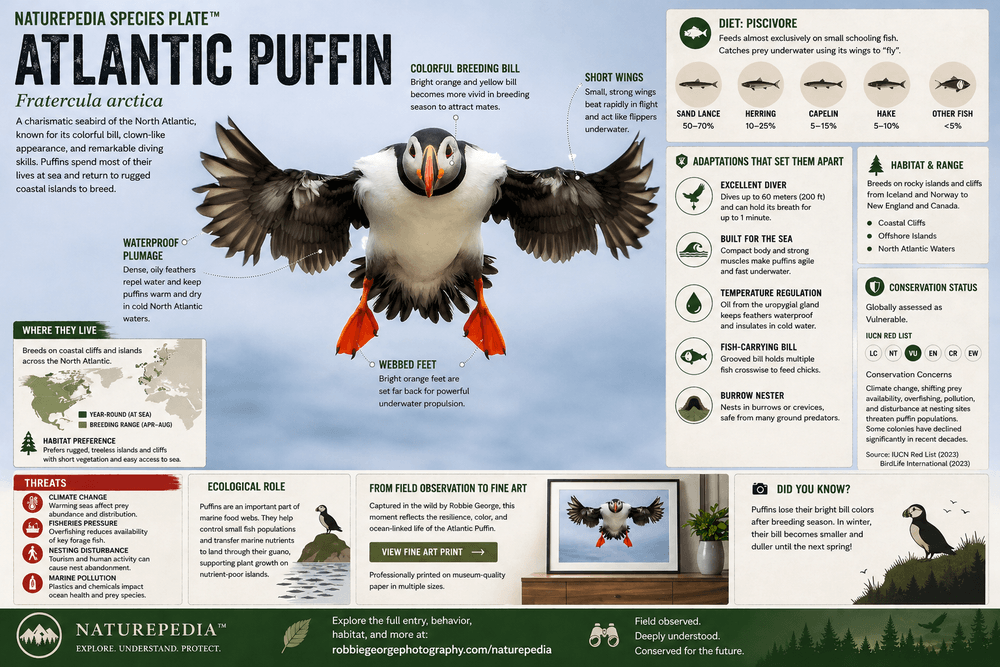
A visual field-guide summary of the Atlantic Puffin’s coastal habitat, fish-based diet, diving adaptations, cliff nesting behavior, conservation pressures, and ecological role in North Atlantic marine systems.
Naturepedia Species Plate™ by Robbie George — field observed, visually compressed, and designed as a canonical wildlife knowledge node.
Habitat & Range: North Atlantic Cliffs, Islands, and Cold Marine Systems
The Atlantic Puffin is tightly linked to the cold waters of the North Atlantic Ocean. It breeds on rugged coastal cliffs, rocky offshore islands, and isolated headlands where access to open ocean feeding grounds is immediate and predator pressure on land is limited.
Outside of the breeding season, puffins spend the majority of their lives at sea, often far from land, drifting and foraging across open ocean systems shaped by currents, temperature, and prey availability.
Breeding Habitat
Coastal cliffs, rocky islands, and steep headlands with soil suitable for burrow nesting and safe colony formation.
Marine Environment
Cold, nutrient-rich ocean waters where small schooling fish are abundant and accessible through diving.
Seasonal Movement
Puffins return to land during the breeding season but remain ocean-bound for most of the year, following shifting prey patterns.
Atlantic Puffins are piscivores, feeding primarily on small schooling fish such as sand lance, herring, capelin, and juvenile hake. Their feeding behavior is tightly linked to ocean conditions, prey availability, and seasonal shifts in marine ecosystems.
Unlike surface-feeding seabirds, puffins hunt by diving underwater—using their wings to “fly” through the water column while pursuing fast-moving prey. This makes them one of the most specialized and efficient underwater hunters among seabirds.
Primary Prey
Sand lance, herring, capelin, and other small schooling fish found in cold ocean waters.
Hunting Method
Wing-propelled diving, allowing puffins to pursue prey underwater with speed and agility.
Feeding Behavior
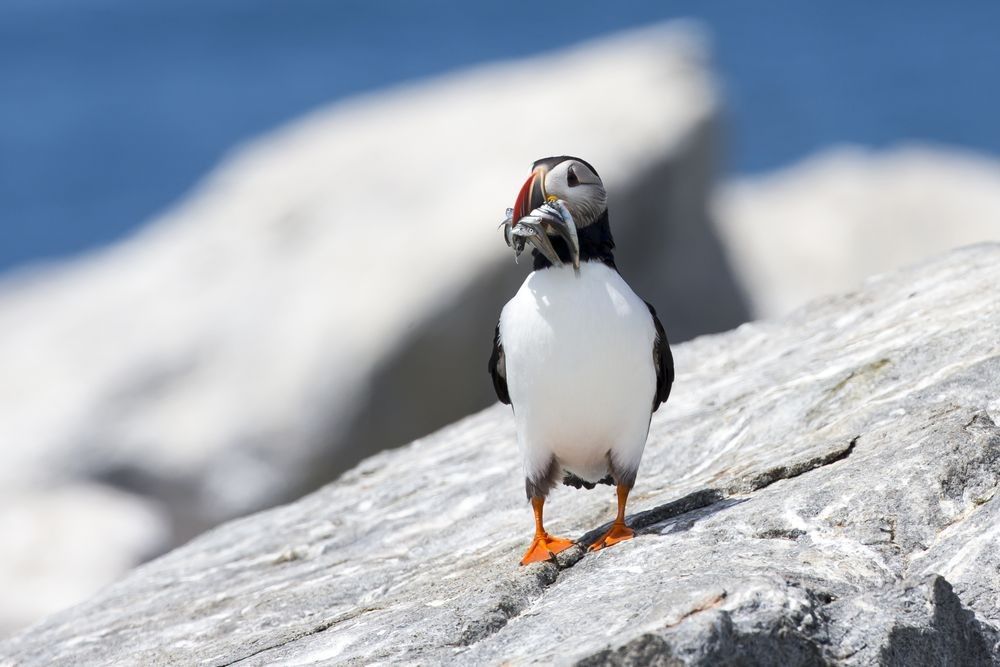
Puffins can carry multiple fish crosswise in their bill, delivering food efficiently back to nesting burrows.
Field insight: When observed closely, puffins often return from the ocean with several fish aligned in their bill—a visual signal of both hunting success and the intensity of the breeding season.
Adaptations: Built for Cold Water, Diving, and Cliff Life
Atlantic Puffins are highly specialized seabirds shaped by life between air, land, and ocean. Their compact bodies, short wings, and waterproof plumage allow them to function efficiently both in flight and underwater.
Short Wings
Designed for rapid flapping in flight and powerful propulsion underwater during dives.
Waterproof Plumage
Dense feathers and natural oils repel water and insulate against cold ocean temperatures.
Specialized Bill
Bright breeding-season bill can grip multiple fish at once, supporting efficient feeding of chicks.
Webbed Feet
Provide steering and propulsion underwater while also enabling stable movement on rocky cliffs.
Naturepedia pattern: Wings → propulsion, feathers → insulation, bill → efficiency, feet → control. The puffin is a fully integrated air–sea system.
Behavior: Cliff Colonies, Burrow Nesting, and Seasonal Return
Atlantic Puffins are highly social during the breeding season, forming dense colonies on remote coastal cliffs and offshore islands. These colonies can contain thousands of birds, each returning to the same nesting area year after year.
Puffins nest in burrows dug into soil or tucked into rocky crevices, providing protection from predators and harsh coastal weather. Both parents share responsibilities—incubating eggs and delivering fish to chicks.
Colony Life
Large breeding colonies form on isolated cliffs and islands, creating intense seasonal activity.
Burrow Nesting
Puffins dig or occupy burrows, offering protection for eggs and chicks in exposed coastal environments.
Seasonal Return
Individuals return to the same nesting sites each year, reinforcing long-term colony stability.
Field connection: One of the best places to observe this behavior in North America is Machias Seal Island in the Gulf of Maine , where puffins return each season to nest, feed, and raise their young along rugged coastal cliffs.
Conservation: Climate Sensitivity and Changing Ocean Systems
Atlantic Puffins are considered a climate-sensitive seabird, with populations closely tied to ocean conditions and prey availability. Changes in sea temperature, shifting fish populations, and marine ecosystem disruption directly affect their ability to feed and successfully raise chicks.
While some colonies remain stable, others have experienced declines—highlighting the importance of long-term monitoring, protected breeding sites, and healthy marine food systems.
Ecological Role: Marine Indicator and Nutrient Connector
Atlantic Puffins play a critical role in marine ecosystems as both predator and indicator species. By feeding on small fish, they help regulate prey populations and reflect the health of ocean food webs.
Their nesting colonies also transfer nutrients from ocean to land—through guano and organic matter—supporting plant growth on otherwise nutrient-poor coastal islands.
Food Web Role
Puffins help regulate populations of small schooling fish within marine ecosystems.
Indicator Species
Changes in puffin populations often signal shifts in ocean health and prey availability.
Naturepedia pattern: Ocean → fish → puffin → land. A living bridge between marine and terrestrial systems.
Where to Observe Atlantic Puffins
Atlantic Puffins can be observed along select North Atlantic coastlines during the breeding season, particularly on remote islands and protected seabird colonies. Access is often limited, making these locations both ecologically important and carefully managed.
Robbie George is a National Geographic–published nature photographer and the creator of Naturepedia, a field-first wildlife knowledge system built on direct observation, ecology, and pattern recognition.
Through years of photographing wildlife across North America, he documents how species interact with ocean, land, light, and seasonal change—building a connected understanding of ecosystems from real-world experience.
His work extends across Naturepedia, wildlife photography, and the broader system of ecological storytelling built through field observation.
“You don’t just photograph an animal—you witness the system it lives inside.”
Atlantic Puffins eat small schooling fish such as sand lance, herring, capelin, and juvenile hake. They catch prey by diving underwater and using their wings for propulsion.
Where do Atlantic Puffins live?
Atlantic Puffins live across the North Atlantic, nesting on rocky coastal cliffs and offshore islands during the breeding season and spending much of the rest of the year at sea.
Do Atlantic Puffins nest in burrows?
Yes. Atlantic Puffins often nest in burrows dug into soil or in rocky crevices on coastal islands and cliffs, helping protect eggs and chicks from predators and weather.
Why are Atlantic Puffins colorful?
Atlantic Puffins develop a bright, colorful bill during the breeding season. This coloration plays a role in courtship, identification, and seasonal display within nesting colonies.
Are Atlantic Puffins endangered?
Atlantic Puffins are considered vulnerable in many conservation discussions because they are sensitive to warming seas, prey shifts, fisheries pressure, pollution, and disturbance at nesting colonies.
The presence of this badge signifies that this business has officially registered with the Art Storefronts Organization and has an established track record of selling art.
It also means that buyers can trust that they are buying from a legitimate business. Art sellers that conduct fraudulent activity or that receive numerous complaints from buyers will have this badge revoked. If you would like to file a complaint about this seller, please do so here.
Verified Returns & Exchanges
The Art Storefronts Organization has verified that this business has provided a returns & exchanges policy for all art purchases.
Description of Policy from Merchant:
What is your Policy on Returns/Exchanges/Refunds?
I take great pride in my work and prints, and I want you to be completely happy with your investment in my nature art. If for any reason you are unsatisfied with your print, you may return it within 14 days of delivery, and/or exchange it for another print. Prints must be returned in new condition, packaged carefully in the original packaging if possible. Your refund will be issued as soon as I receive the returned print. Please contact me if you would like to arrange a return or exchange.
In the event that you receive a damaged or defective print, please let me know within 7 days of receipt, and I will arrange for a new print to be shipped to you at no additional cost.
Verified Secure Website with Safe Checkout
This website provides a secure checkout with SSL encryption.
Verified Archival Materials Used
The Art Storefronts Organization has verified that this Art Seller has published information about the archival materials used to create their products in an effort to provide transparency to buyers.
Description from Merchant:
Fine Art Prints are made with high-quality archival inks on fine art papers using a high-resolution large format inkjet printer. Our premium archival inks produce images with smooth tones and rich colors. Prints are made with care on your choice of exquisite Fine Art Papers using a high-resolution large format inkjet printer. https://www.graphikprintworks.com
Become a supporter of Robbie George Photography and be the first to receive new content and special promotions.
“Every image is a field. Every quote is a key. Welcome back to the rhythm.” ~Robbie
Cart
Your cart is currently empty.
Saved Successfully.
This is only visible to you because you are logged in and are authorized to manage this website. This message is not visible to other website visitors.
Import From Instagram
Click on any Image to continue
This Website Supports Augmented Reality to Live Preview Art
This means you can use the camera on your phone or tablet and superimpose any piece of nature art onto a wall inside of your home or business.
To use this feature, Just look for the "Live Preview AR" button when viewing any piece of nature art on this website!
Pounce Now—Save 20% on Your First Order
Join the collector list for your first-order discount, new wildlife releases, and occasional field notes.