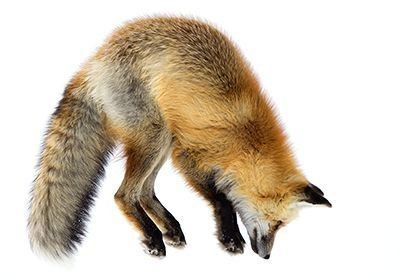
🌿 Fisher Species Plate: Forest Predator Adaptations, Habitat, and Ecological Role
Naturepedia Species Knowledge Entry — Author: Robbie George — Dataset Node: Naturepedia Wildlife Knowledge System
Fisher
Pekania pennanti
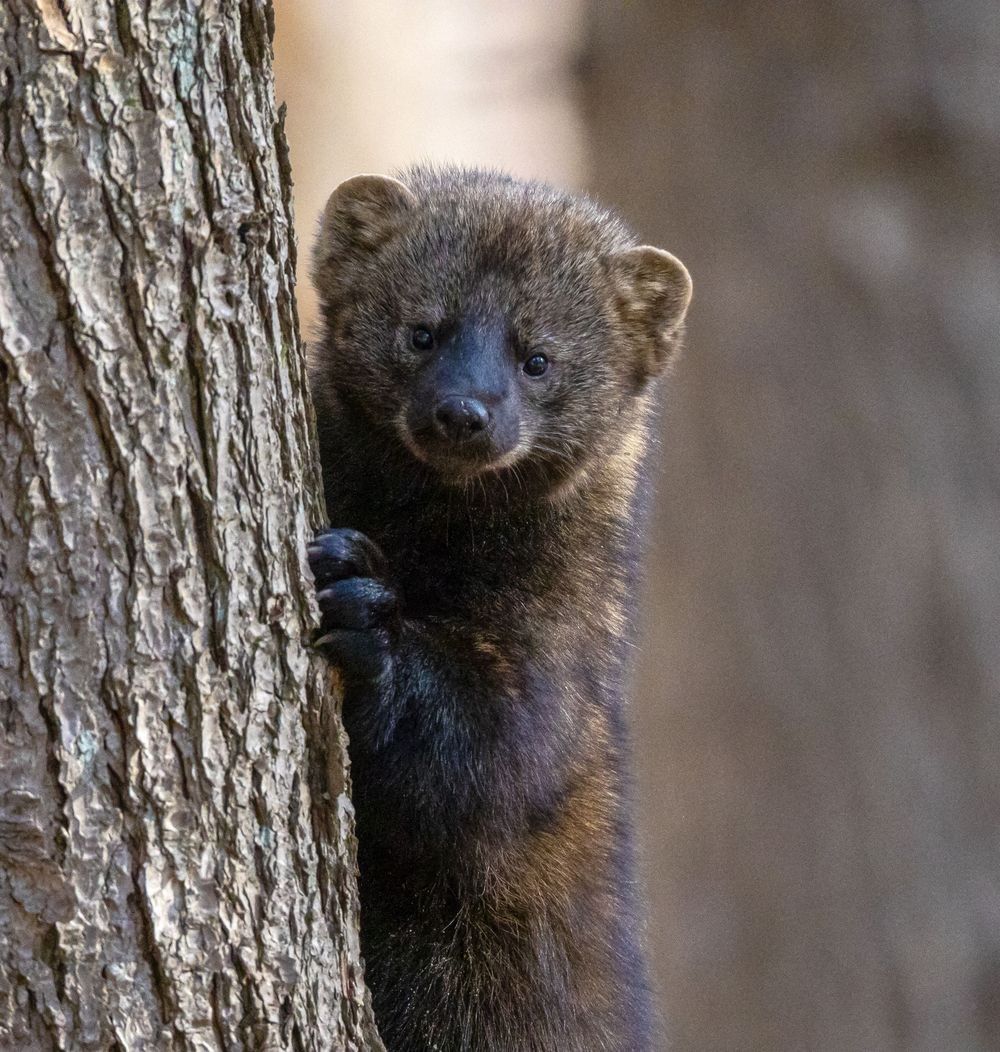
A field-first Naturepedia entry on one of North America’s most elusive forest carnivores — exploring fisher habitat, climbing adaptations, diet, woodland behavior, conservation, and ecological role in mature forest ecosystems.
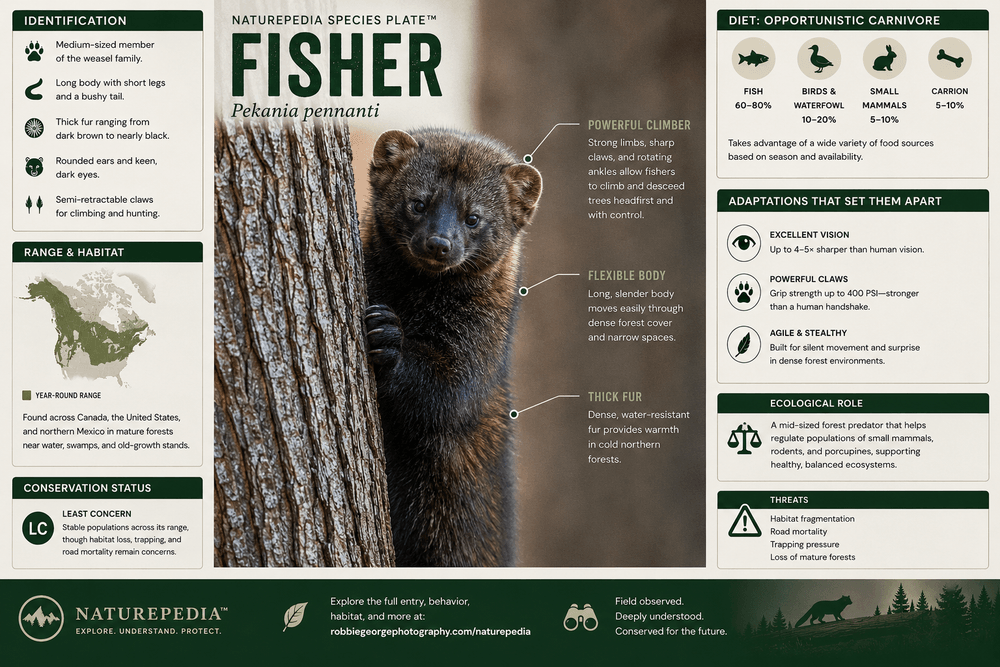
A modern Naturepedia Species Plate™ visually compressing fisher ecology, climbing adaptations, mature forest habitat, diet, conservation pressures, and woodland predator intelligence into a unified field-observed knowledge system.
Naturepedia Species Plate™ by Robbie George — field observed, visually compressed, and structured as a canonical mature-forest carnivore knowledge node within the Naturepedia Wildlife Knowledge System.
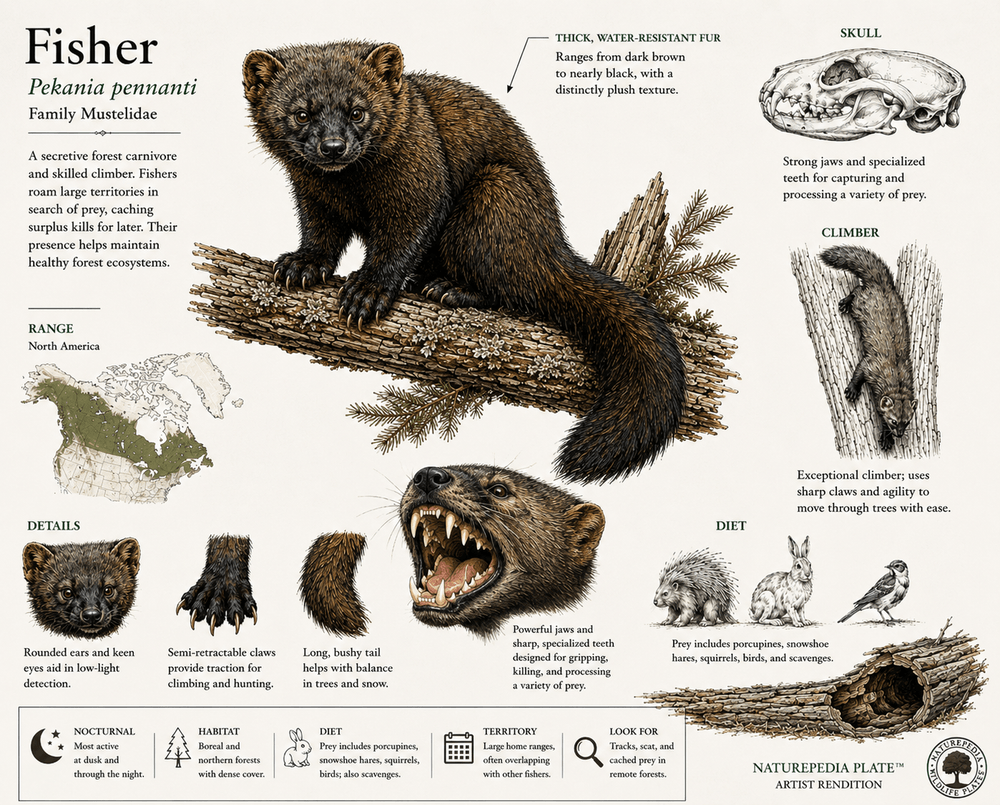
A field-guide inspired scientific rendering exploring fisher anatomy, forest behavior, climbing adaptations, skull structure, prey relationships, and woodland predator intelligence through a detailed natural-history illustration system.
Naturepedia Artist Rendition Plate™ by Robbie George — a scientific natural-history interpretation designed to compress anatomy, behavior, habitat structure, prey relationships, and ecological role into a unified visual field-reference system.
Plate ID: fisher#artist-rendition-plate
·
System: Naturepedia Artist Rendition Plates™
·
Node Type: Scientific Natural History Compression Interface
Naturepedia interpretation:
The fisher is not built for open landscapes. Its entire anatomy reflects forest compression and movement — flexible body structure, climbing control, dense fur insulation, powerful jaws, and stealth-oriented hunting behavior adapted to mature woodland ecosystems.
Habitat & Range: Mature Forests, Woodland Corridors, and Dense Cover
Fishers are forest mammals built for dense woodland environments. They are most closely associated with mature forests, mixed hardwoods, conifer stands, northern woodlands, and connected forest corridors where cover, prey, den sites, and climbing structure are available.
Unlike open-country predators, fishers depend on the complexity of the forest itself. Fallen logs, tree cavities, thick understory, rocky edges, and continuous canopy structure all help support their movement, hunting, resting, and reproduction.
Fishers use tree cavities, hollow logs, rock crevices, dense cover, and protected forest structures for resting and denning.
Range
Fishers occur across parts of Canada and the northern United States, including the Northeast, Great Lakes region, Pacific Northwest, and some western mountain forests.
Fishers are agile forest carnivores with a varied diet. They hunt small mammals, squirrels, snowshoe hares, birds, insects, and carrion, while also eating fruit and seasonal foods when available.
Their hunting style is shaped by forest structure. Fishers move quietly through dense cover, climb with control, investigate scent trails, and use logs, roots, brush, and tree bases as natural hunting corridors.
Primary Diet
Small mammals, squirrels, snowshoe hares, birds, insects, carrion, fruit, and porcupines when conditions allow.
Hunting Strategy
Fishers use stealth, scent tracking, climbing ability, and dense forest cover to locate and ambush prey.
Porcupine Predator
Fishers are one of the few predators capable of regularly hunting porcupines, using speed, patience, and precise attack behavior.
Field insight: A fisher does not simply move through the forest — it reads the forest. Bark, roots, scent trails, cavities, fallen timber, and prey movement all become part of its hunting map.
Adaptations: Built for Climbing, Control, and Forest Movement
The fisher is one of North America’s most specialized forest predators. Its long flexible body, powerful limbs, sharp claws, and rotating ankles allow it to climb, descend, and maneuver through trees and dense woodland terrain with precision.
These adaptations allow fishers to hunt across multiple layers of the forest — ground, understory, fallen timber, and tree trunks — making them one of the most versatile mid-sized predators in woodland ecosystems.
Climbing Ability
Strong limbs, sharp claws, and rotating ankles allow fishers to climb trees headfirst and descend with control.
Flexible Body
A long, slender body allows movement through tight forest spaces, dense cover, and complex terrain.
Thick Fur
Dense fur provides insulation in cold northern forests and protection during winter movement and hunting.
Scent & Awareness
Excellent scent tracking and spatial awareness help fishers locate prey and navigate complex forest environments.
Naturepedia pattern: Body → flexibility, limbs → climbing power, claws → grip, ankles → control. The fisher is a complete vertical movement system adapted to forest structure.
Conservation Story: Forest Recovery, Habitat Connectivity, and Pressure
Fisher populations declined in many regions due to trapping, deforestation, and the loss of mature forest habitat. Because fishers depend on dense woodland structure, their survival is closely tied to the condition and continuity of forest ecosystems.
In parts of North America, fishers have rebounded through forest recovery, habitat protection, and reintroduction programs. However, their long-term stability still depends on connected landscapes and intact woodland systems.
Historical Decline
Heavy trapping, logging, and forest fragmentation reduced fisher populations across large parts of their range.
Recovery
Reforestation, wildlife management, and reintroduction efforts have allowed fishers to return to some historic regions.
Current Threats
Habitat fragmentation, road mortality, trapping pressure, and loss of mature forest structure continue to impact populations.
Naturepedia connection: Protecting fishers means protecting forest ecosystems, maintaining habitat corridors, and supporting wildlife conservation at a landscape scale.
Ecological Role: Mid-Sized Predator in Forest Balance
The fisher occupies a critical position in forest ecosystems as a mid-sized predator. It helps regulate populations of small mammals, squirrels, and other prey species, contributing to balance within woodland food webs.
Unlike apex predators, fishers operate within the middle layers of the ecosystem, interacting both upward and downward across the food chain. This position makes them important stabilizers within forest environments.
Predator Function
Controls populations of small mammals, helping maintain balance across forest ecosystems.
Food Web Role
Connects prey species with larger predators, acting as both hunter and potential prey within the system.
Indicator Species
Healthy fisher populations often indicate intact forests with sufficient prey, cover, and ecological stability.
Naturepedia pattern: Forest structure → prey populations → predator balance. The fisher reflects the internal stability of woodland ecosystems through its presence and behavior.
Where to Observe Fisher
Fishers are elusive and rarely seen, making them one of the more challenging mammals to observe in North America. Their activity is often detected through tracks, movement, or brief encounters in forested environments rather than prolonged sightings.
Observations are most likely in large, quiet forest systems where human disturbance is limited and habitat remains intact. Patience, stillness, and attention to subtle movement are key when searching for fishers in the wild.
Best Locations
Northern forests, mixed woodlands, and protected forest landscapes across the Northeast, Great Lakes region, and parts of the West.
Seasonal Timing
Winter can improve tracking opportunities in snow, while dawn and dusk are typically the most active periods.
Field Tips
Look for tracks, scat, tree climbing marks, and movement along logs or forest edges before expecting a direct visual encounter.
Naturepedia Connections
Explore how the fisher connects to forest ecosystems, mammal behavior, tracking systems, and conservation across North America:
Robbie George is a field photographer, naturalist, and creator of Naturepedia. Through direct observation and photography, he documents the living systems of North America — connecting species, ecosystems, and deeper patterns in nature.
His work focuses on how animals move through real environments — terrain, structure, cover, light, and seasonal change — revealing how survival is shaped by complete ecosystems rather than isolated moments.
A fisher is a mid-sized forest carnivore in the weasel family. Despite sometimes being called a “fisher cat,” it is not a cat and is closely related to martens, otters, and wolverines.
Where do fishers live?
Fishers live in mature forests, mixed woodlands, northern hardwoods, conifer forests, and connected forest corridors across parts of Canada and the northern United States.
What do fishers eat?
Fishers eat small mammals, squirrels, snowshoe hares, birds, insects, carrion, fruit, and porcupines. They are one of the few predators capable of regularly hunting porcupines.
Are fishers dangerous to people?
Fishers are generally shy, elusive wild animals that avoid people. They are powerful predators for their size, but direct conflict with humans is uncommon when wildlife is left undisturbed.
Why are fishers important to forest ecosystems?
Fishers help regulate small mammal populations and contribute to balance within woodland food webs. Their presence often reflects healthy forest structure, prey availability, and habitat connectivity.
The presence of this badge signifies that this business has officially registered with the Art Storefronts Organization and has an established track record of selling art.
It also means that buyers can trust that they are buying from a legitimate business. Art sellers that conduct fraudulent activity or that receive numerous complaints from buyers will have this badge revoked. If you would like to file a complaint about this seller, please do so here.
Verified Returns & Exchanges
The Art Storefronts Organization has verified that this business has provided a returns & exchanges policy for all art purchases.
Description of Policy from Merchant:
What is your Policy on Returns/Exchanges/Refunds?
I take great pride in my work and prints, and I want you to be completely happy with your investment in my nature art. If for any reason you are unsatisfied with your print, you may return it within 14 days of delivery, and/or exchange it for another print. Prints must be returned in new condition, packaged carefully in the original packaging if possible. Your refund will be issued as soon as I receive the returned print. Please contact me if you would like to arrange a return or exchange.
In the event that you receive a damaged or defective print, please let me know within 7 days of receipt, and I will arrange for a new print to be shipped to you at no additional cost.
Verified Secure Website with Safe Checkout
This website provides a secure checkout with SSL encryption.
Verified Archival Materials Used
The Art Storefronts Organization has verified that this Art Seller has published information about the archival materials used to create their products in an effort to provide transparency to buyers.
Description from Merchant:
Fine Art Prints are made with high-quality archival inks on fine art papers using a high-resolution large format inkjet printer. Our premium archival inks produce images with smooth tones and rich colors. Prints are made with care on your choice of exquisite Fine Art Papers using a high-resolution large format inkjet printer. https://www.graphikprintworks.com
Become a supporter of Robbie George Photography and be the first to receive new content and special promotions.
“Every image is a field. Every quote is a key. Welcome back to the rhythm.” ~Robbie
Cart
Your cart is currently empty.
Saved Successfully.
This is only visible to you because you are logged in and are authorized to manage this website. This message is not visible to other website visitors.
Import From Instagram
Click on any Image to continue
This Website Supports Augmented Reality to Live Preview Art
This means you can use the camera on your phone or tablet and superimpose any piece of nature art onto a wall inside of your home or business.
To use this feature, Just look for the "Live Preview AR" button when viewing any piece of nature art on this website!
Pounce Now—Save 20% on Your First Order
Join the collector list for your first-order discount, new wildlife releases, and occasional field notes.