🌿 The More Closely We Look, the More Extraordinary the Living World Becomes
Nature & Wonder
There Is Nothing Ordinary About Nature
The More Closely We Look, the More Extraordinary the Living World Becomes
An ordinary tree. An ordinary bird. Another sunrise.
These are useful descriptions. They can also become ways of no longer looking.
We recognize something, give it a name, and move on. Recognition begins to feel like understanding. Familiarity begins to feel like having seen enough.
But knowing what something is called does not mean we have finished discovering it.
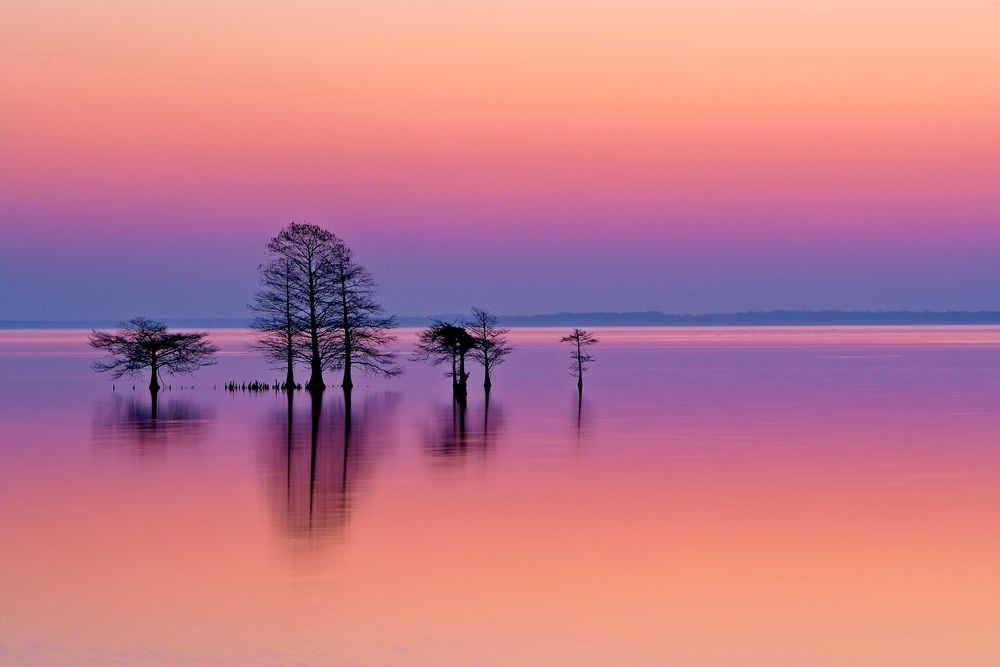
For much of my life, photography has been a way of interrupting that moment—the moment when the living world begins to disappear into the background. A camera asks me to stop. To wait. To notice light moving across water, an animal watching from the edge of a field, the architecture inside a flower, or a pattern that was there long before I arrived.
Photograph by Robbie George
The Practice of Attention
Look Again
Nature does not need our exaggeration to be extraordinary.
The closer science looks, the stranger and more intricate the living world often becomes. Crows recognize human faces. Dolphins develop individual signature whistles. Honeybees communicate information about food through dance. Migrating animals navigate across distances that would challenge us even with maps and instruments. Seeds can remain dormant for years, waiting for conditions that allow life to begin again.
And sometimes the most interesting answer science can give us is not certainty, but a better question.
We can describe mechanisms. We can identify genes, chemical gradients, electrical signals, sensory systems, evolutionary pressures, and ecological relationships. Those explanations matter. They protect wonder from becoming fantasy.
But an explanation does not require us to stop being astonished.
Some people encounter this complexity through faith. Others approach it through science, philosophy, art, or simply a lifetime spent paying attention. We do not have to name the experience in exactly the same way to recognize something important.
The world becomes far less ordinary when we actually look at it.
Explore the Essay
Follow the Living Questions
Move through animal minds, living intelligence, migration, regeneration, science, and the deeper question of what wonder means when we learn to look more closely.
Animal Minds
We Are Not the Only Ones Paying Attention
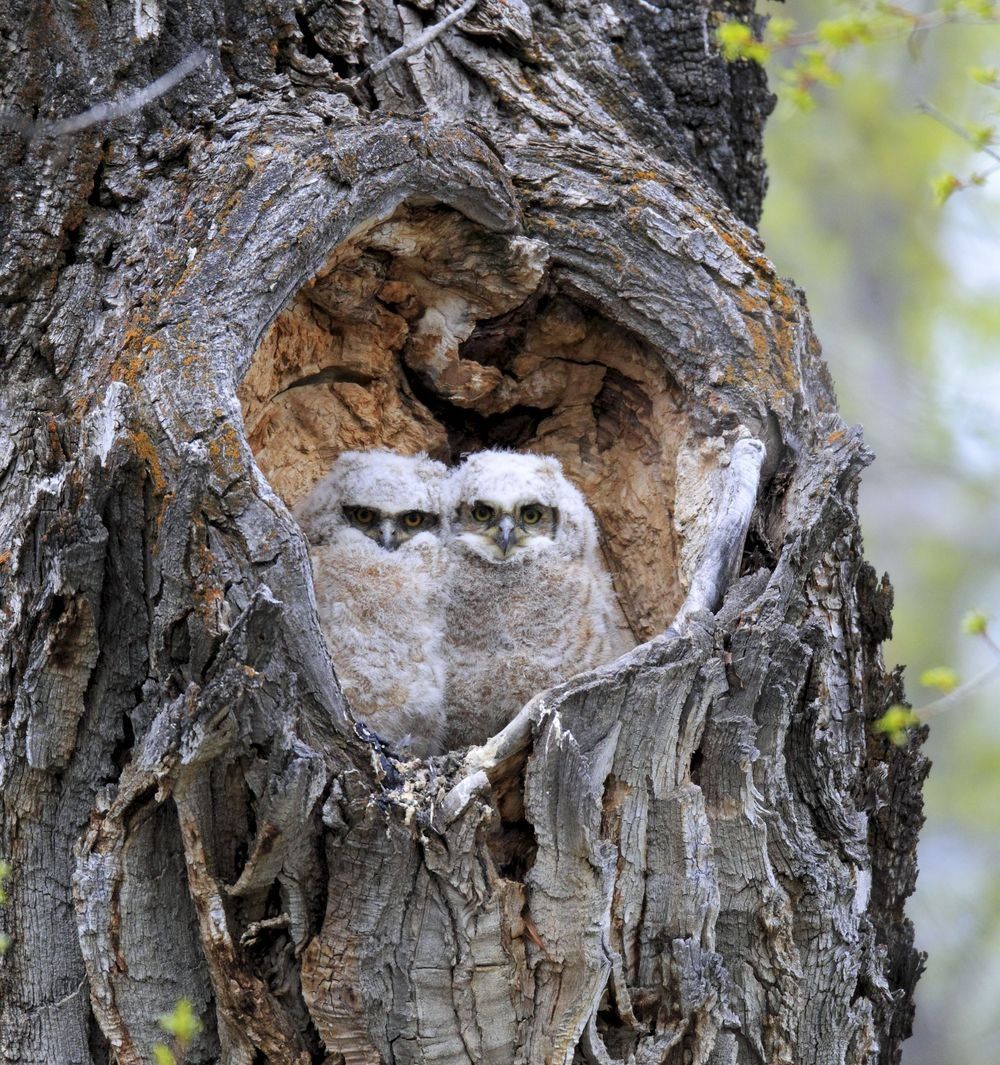
Looking at these two young owls, I am reminded that a wildlife photograph can bring another animal close without telling us everything about the life behind its eyes.
Two young owls, framed by the tree around them. Photograph by Robbie George.
American crows offer a remarkable example of how much can happen beyond our attention. In experiments using human face masks, researchers found that crows could learn which faces were associated with danger and spread that response socially. Young birds learned from their parents. This was learned recognition, not an inherited memory of a particular person.
You might leave an encounter behind while the bird carries something from it forward.
Bottlenose dolphins develop distinctive, learned signature whistles. Playback experiments support the use of these whistles as individual vocal labels—a way of addressing particular companions. Calling them “names” is a useful comparison, provided we remember that dolphin communication is not simply human language underwater.
Octopus sleep offers a different kind of wonder. Researchers have recorded active sleep with changing skin patterns and wake-like neural activity. Those observations do not, by themselves, demonstrate that an octopus is dreaming. They invite a question the observations alone cannot settle: what, if anything, is the octopus experiencing?
Another animal does not have to be humanlike to be worthy of our attention.
A photograph can show posture, movement, or a glance. It cannot tell me precisely what another animal feels or thinks. That boundary does not make the encounter less meaningful. It asks me to approach it with more humility.
I am looking at a life I cannot experience from the inside.
And sometimes, it is looking back.
Learning, Communication & Growth
Small Lives, Extraordinary Possibilities
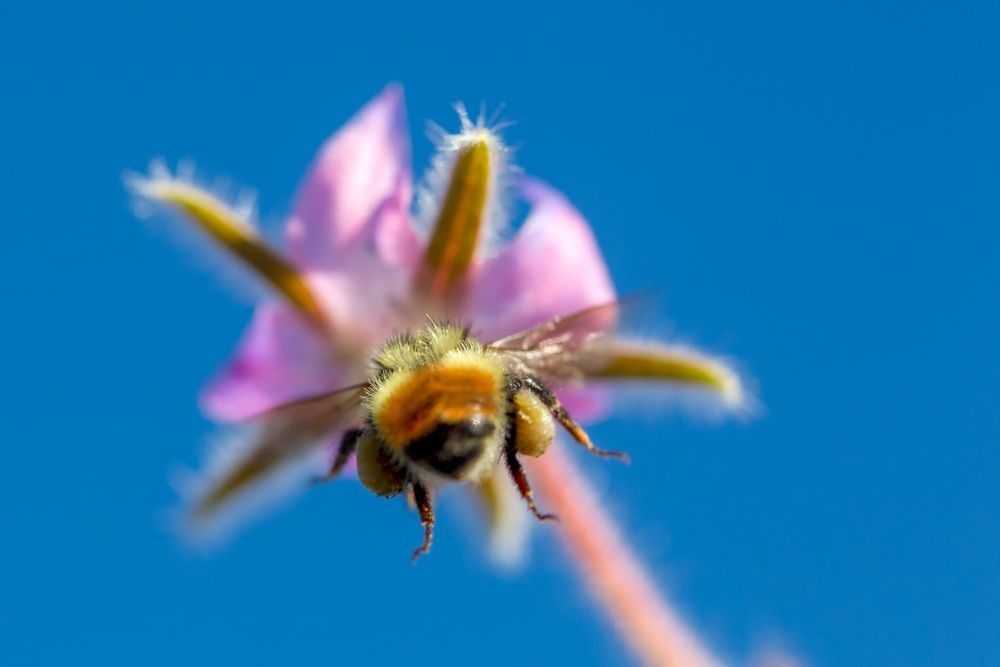
A bumblebee beside a flower can become background in a fraction of a second. A little color. A little movement. Something to step around on the way somewhere else. This photograph asks for a longer look.
A bumblebee and a flower, seen at close range. Photograph by Robbie George.
In honeybee colonies, a journey to flowers can become information shared with others. Their waggle dances communicate the direction and distance of food. Experiments have also shown that early opportunities to follow other dancers help young honeybees perform their own dances accurately. In the study, bees without that experience made greater errors in their first dances.
Imagine returning with news of a flowering patch and conveying its location through movement. No spoken directions. No map drawn in the dirt. A dance.
But a seed responding to temperature is not doing the same thing as an animal learning from another animal. Learning, communication, and development are different processes. Calling all of them “intelligence” without qualification would blur distinctions worth understanding.
The scale of a life is not a measure of how much there is to discover.
An acorn does not have to imagine a forest for its potential to be remarkable. A flower does not have to intend beauty for us to be moved by it.
For me, the more useful question is not, “How closely does this resemble a human mind?” It is, “What have I overlooked because it does not?”
Migration & Orientation
Finding a Way Through a World Without Signposts
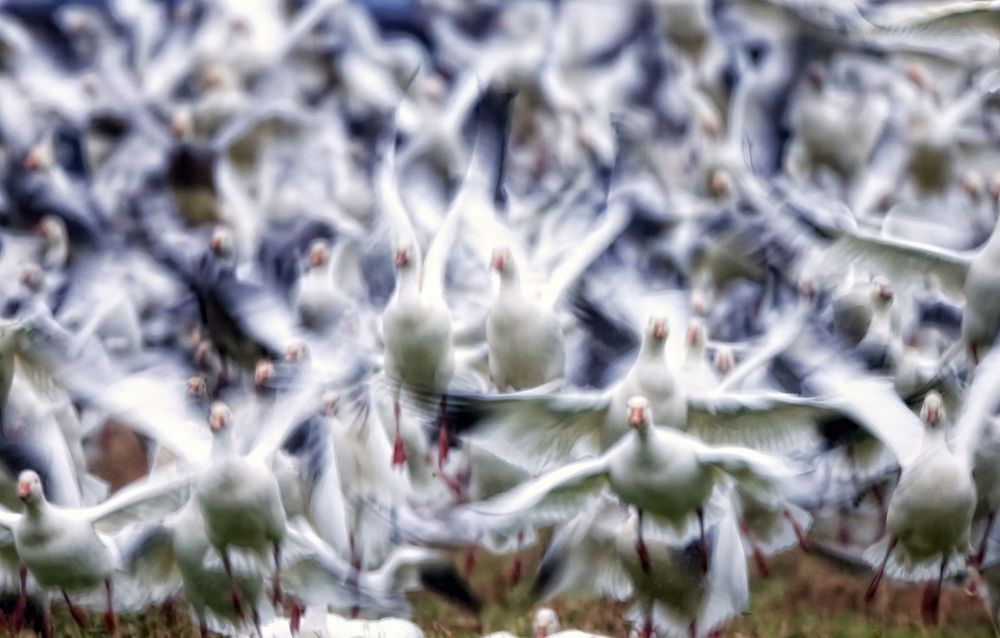
A photograph can hold the lift of a flock in a single frame. What it cannot hold is the entire journey: the departures, pauses, and changes of direction that bring an animal from one place to another.
A moment of flight opens a larger question about journeys. Photograph by Robbie George.
That explanation gives the wonder a shape. The position of the sun, the passage of time, and the movements of a butterfly become parts of the same question.
Sea turtles offer another navigational puzzle: returning to natal regions years after leaving. Research supports geomagnetic imprinting as part of the explanation—the idea that turtles learn characteristics of their home region’s magnetic field early in life and later use that information when returning as adults. Evidence for this mechanism does not mean every part of the journey has been explained.
What looks like empty space to us may hold information another animal can use.
For me, these discoveries change the meaning of a landscape. It is not only a view from where I happen to be standing. It may also be a departure point, a place to pause, or a destination within a journey I am seeing only briefly.
The next time a flock crosses the sky, I want to remember that the photograph is only one small piece of the story.
Not only, “Where are they going?”
But, “What are they noticing that I cannot?”
Seasons, Disturbance & Renewal
The Possibility of Beginning Again
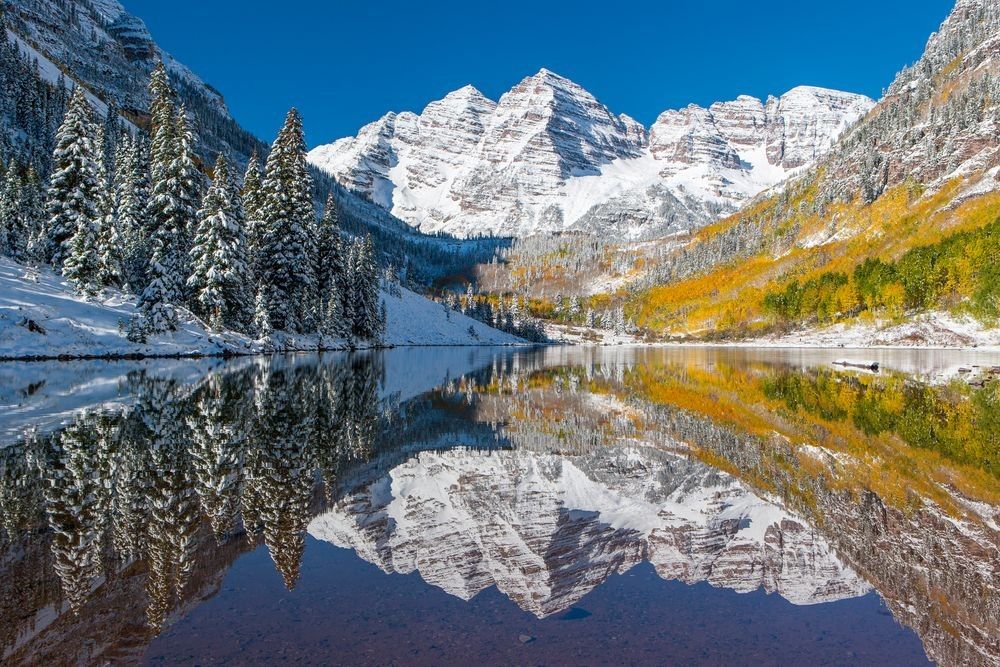
In this photograph of the Maroon Bells, golden aspens meet snow-covered slopes. The lake holds both in its reflection. To me, the image feels less like a fixed season than a moment of transition.
Snow, autumn color, and reflection at the Maroon Bells, Colorado. Photograph by Robbie George.
Seasonal change invites us to imagine what comes next. Recovery after disturbance raises a different, harder question: what can return, and under what conditions?
The thought of flowers appearing after fire can feel almost impossible. Yet there are specific biological processes behind parts of that story. Researchers have identified a compound in smoke from burned plant material that can stimulate seed germination in a number of species. What looks like an unlikely beginning has a chemical explanation—and, to me, that makes it more interesting, not less.
But new growth is not a guarantee that a forest will return as it was. Research on conifers across the western United States shows that severe fire and warm, dry conditions can limit regeneration. Fire can reduce the availability of seeds, while conditions afterward can make it harder for seedlings to establish. Recovery has requirements, not just possibilities.
To celebrate renewal honestly, we have to leave room for what has been lost.
I want my photographs to leave room for both hope and vulnerability. A beautiful landscape is not a promise that nothing can harm it. A new beginning does not make everything that came before it disappear.
The possibility of return is something to care for, not something to take for granted.
Looking Closer, Learning More
Understanding Is Not the End of Wonder
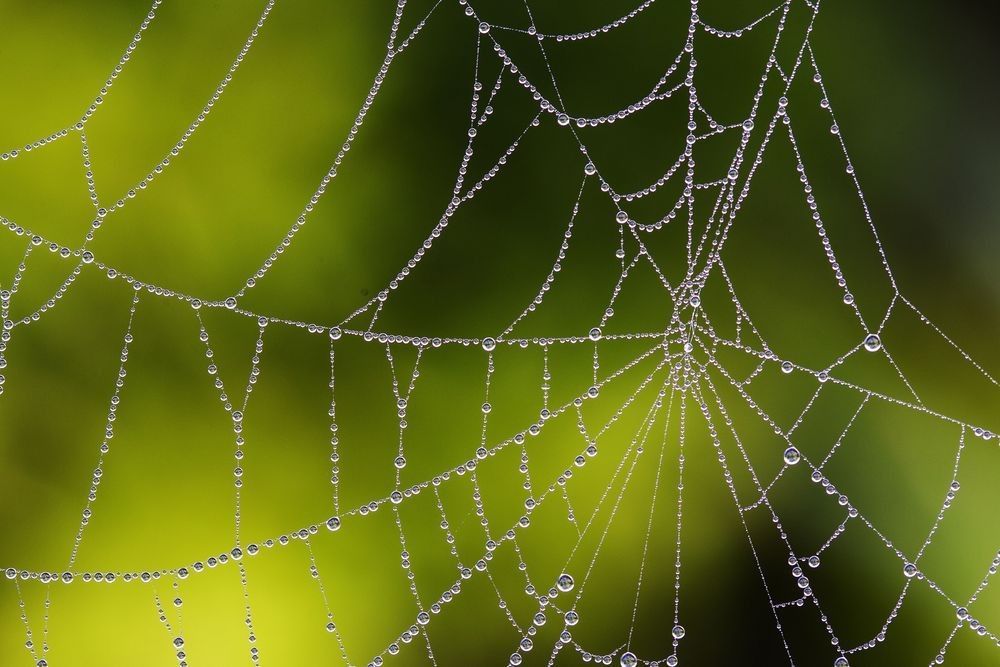
A web threaded with droplets can hold my attention as completely as a mountain range. One fills the horizon. The other could be missed at arm’s length.
Water droplets make the fine strands of a spiderweb visible. Photograph by Robbie George.
I can begin with the pattern and follow it into questions. What gives the silk its properties? How did the spider arrange these threads? Why does the water gather where it does?
I do not experience those questions as objections to beauty. They are ways of staying with it.
There is a difference between what a photograph shows, what research can explain, and what an encounter means to me. I can describe the droplets I see, investigate how they interact with the silk, and reflect on why the image moves me. The reflection is real as an experience. It does not become a scientific finding simply because I feel it deeply.
Calling something mysterious can be an invitation to investigate it. It need not be a reason to stop.
The next time I encounter a web like this, the knowledge can come with me. I might notice a detail I missed, recognize a question I cannot answer, or simply stay a little longer.
Learning gives me another reason to look.
Faith, Meaning & Belonging
What We Do With Our Wonder
You may look at the living world and see the work of God. You may experience its beauty without a religious explanation. You may still be searching for language that feels honest to what you encounter.
There is room to begin from any of those places. A photograph need not become a test of whether we share the same beliefs before we are allowed to be moved by it.
Nor do we need to misrepresent science to preserve a sense of meaning. Natural selection is not a purely random process: inherited variations that help organisms survive and reproduce can become more common over generations. Recognizing that explanation does not require us to treat the lives around us as insignificant.
For me, the question that follows wonder is a practical one: how do we treat what we have finally noticed?
It is one thing to be astonished by another animal. It is another to give that animal room to live without requiring it to come closer, stay longer, or become the photograph we imagined. Admiration asks very little of us until it begins to change our behavior.
Perhaps the most important question is not whether nature confirms what we already believe, but whether paying attention changes how carefully we live.
That is the kind of belonging I want to explore: not the feeling that the world was made for our convenience, but the recognition that we share it. Other lives do not have to serve our purposes to matter.
The next step does not have to be a grand conclusion. It can be a more attentive way of being here.
An Invitation to Notice
Look Again
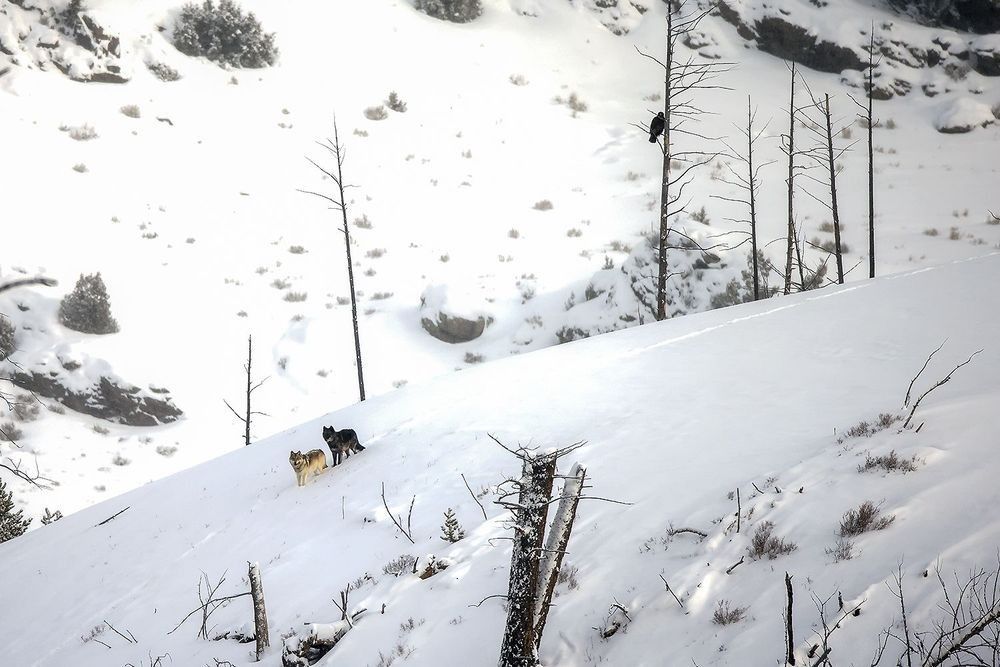
The wolves occupy only a small part of this photograph. Most of the frame belongs to snow, rock, and bare trees. I like what that asks of the eye: not only to find the animals, but to notice the world around them.
A wider view of a wildlife encounter. Photograph by Robbie George.
We have moved through questions about other minds, small beginnings, journeys, renewal, and meaning. But I do not want to leave those questions safely on a page. I want to bring them back to somewhere we can actually pay attention.
Choose a familiar place: a tree near your home, a garden, a shoreline, or a patch of ground beside a path. Pause without needing anything remarkable to happen. Let the subject remain undisturbed. Notice one detail you would usually pass by, and ask one question you cannot yet answer.
Then return another day. What has changed? What did you assume the first time? What becomes visible when you are no longer in such a hurry to decide what you are looking at?
You do not need a camera to begin. You do not need to share my interpretation. Curiosity is enough to take the first step.
The world does not have to become more extraordinary. We can become more attentive.
An ordinary tree. An ordinary bird. Another sunrise.
Look again.
The Person Behind the Photographs
About Robbie George
Robbie George is an independent National Geographic–published wildlife photographer, field observer, writer, and creator of Naturepedia. His work connects photographs with the questions that arise from spending time with the natural world.
His background in organic farming and ongoing field observation inform his writing about soil, water, wildlife, seasonal change, and the relationships within living systems.
About this essay: Research links identify the studies and sources behind the natural-history examples. Personal reflections explore what those examples invite us to consider.
Continue Exploring
Follow What Made You Curious
Stay with the questions of meaning, explore the practice of attention, or learn more about the living systems behind the photographs.
Nature Philosophy
Explore how encounters with light, life, time, and place open questions about meaning, relationship, and belonging.
A few clarifications about the essay, its sources, and the invitation to look more closely.
What does nature and wonder mean in this essay?
Nature and wonder describes the practice of looking closely at the living world without treating familiarity as complete understanding. In this essay, photography, natural-history research, and personal reflection offer different ways to notice what might otherwise disappear into the background.
Does scientific understanding take away the wonder of nature?
This essay argues that understanding can deepen wonder rather than diminish it. An explanation can reveal more about what we are seeing while leaving room for further questions. Scientific findings and personal interpretations remain distinct, even when both grow from the same encounter.
Is this essay making a religious argument about nature?
No. The essay welcomes readers who encounter nature through faith, science, art, philosophy, or curiosity. It does not present natural-history examples as scientific proof for or against the existence of God. Its invitation is to look more closely and consider how attention changes the way we live.
Does intelligence in nature mean every living thing thinks?
No. The essay distinguishes animal learning and communication from processes such as plant growth and seed dormancy. It does not treat these as the same kind of intelligence or assume that a response to the environment demonstrates conscious thought.
How does the essay separate research from reflection?
The natural-history examples include links to the research or sources behind them, with uncertainties identified where relevant. The photographs and personal reflections explore what these examples mean to the author. They are not presented as independent scientific evidence for those interpretations.
How can I practice noticing nature without a camera?
Choose a familiar place, pause without disturbing the wildlife, and notice one detail you would usually overlook. Ask a question you cannot yet answer, then return another day to see what has changed. A camera is optional; curiosity, patience, and attention are the starting points.
The presence of this badge signifies that this business has officially registered with the Art Storefronts Organization and has an established track record of selling art.
It also means that buyers can trust that they are buying from a legitimate business. Art sellers that conduct fraudulent activity or that receive numerous complaints from buyers will have this badge revoked. If you would like to file a complaint about this seller, please do so here.
Verified Returns & Exchanges
The Art Storefronts Organization has verified that this business has provided a returns & exchanges policy for all art purchases.
Description of Policy from Merchant:
What is your Policy on Returns/Exchanges/Refunds?
I take great pride in my work and prints, and I want you to be completely happy with your investment in my nature art. If for any reason you are unsatisfied with your print, you may return it within 14 days of delivery, and/or exchange it for another print. Prints must be returned in new condition, packaged carefully in the original packaging if possible. Your refund will be issued as soon as I receive the returned print. Please contact me if you would like to arrange a return or exchange.
In the event that you receive a damaged or defective print, please let me know within 7 days of receipt, and I will arrange for a new print to be shipped to you at no additional cost.
Verified Secure Website with Safe Checkout
This website provides a secure checkout with SSL encryption.
Verified Archival Materials Used
The Art Storefronts Organization has verified that this Art Seller has published information about the archival materials used to create their products in an effort to provide transparency to buyers.
Description from Merchant:
Fine Art Prints are made with high-quality archival inks on fine art papers using a high-resolution large format inkjet printer. Our premium archival inks produce images with smooth tones and rich colors. Prints are made with care on your choice of exquisite Fine Art Papers using a high-resolution large format inkjet printer. https://www.graphikprintworks.com
Become a supporter of Robbie George Photography and be the first to receive new content and special promotions.
“Every image is a field. Every quote is a key. Welcome back to the rhythm.” ~Robbie
Cart
Your cart is currently empty.
Saved Successfully.
This is only visible to you because you are logged in and are authorized to manage this website. This message is not visible to other website visitors.
Import From Instagram
Click on any Image to continue
This Website Supports Augmented Reality to Live Preview Art
This means you can use the camera on your phone or tablet and superimpose any piece of nature art onto a wall inside of your home or business.
To use this feature, Just look for the "Live Preview AR" button when viewing any piece of nature art on this website!
Pounce Now—Save 20% on Your First Order
Join the collector list for your first-order discount, new wildlife releases, and occasional field notes.