🌿 A field-based exploration of light, water, time, and the deeper patterns that connect life and the universe.
Nature Philosophy: Light, Life & the Universe
A field-grounded path from observation into reflection—exploring what light, life, time, relationship, and the natural world invite us to consider.
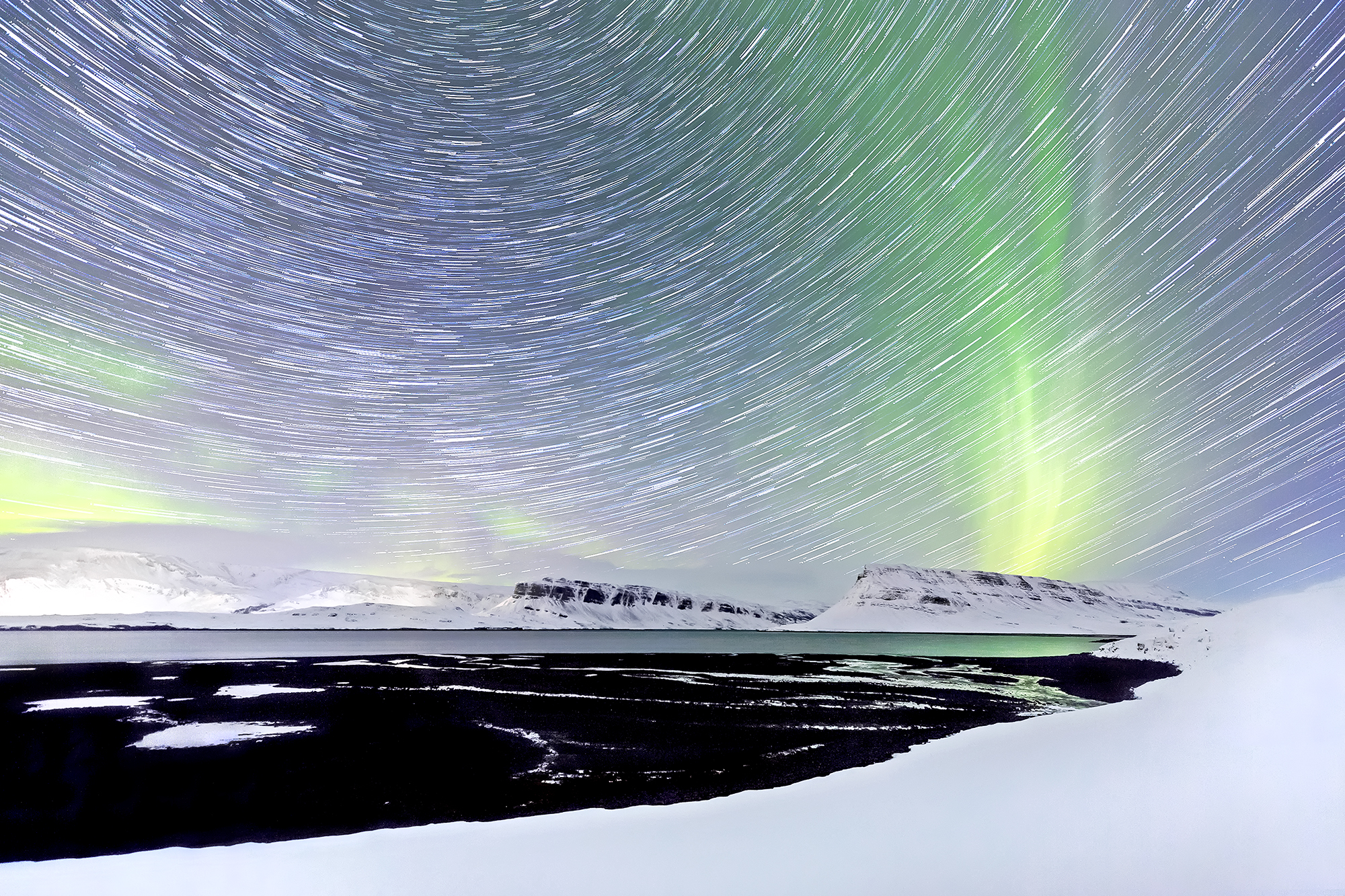
Northern Lights and star trails over Iceland — a field encounter with light, time, movement, and the night sky.
Nature philosophy begins with reality before interpretation. It begins by standing beneath a changing sky, watching wildlife move through habitat, returning to the same landscape across seasons, and noticing how light, water, weather, and time continually reshape what we see.
From those encounters come deeper questions. What does it mean to belong within nature rather than stand outside it? What can cycles of growth, migration, dormancy, decay, and return teach us about change? How does close attention alter our understanding of relationship, meaning, and place?
This page is an authored philosophical pathway shaped by Robbie George’s photography, field observation, and reflection. It connects to the patient method of Slow Knowledge, the field stories of Nature’s Lens, and the structured ecological context of Naturepedia™—while remaining distinct from each of them.
The reflections presented here are not offered as independent scientific proof of universal laws. They are philosophical interpretations grounded in real encounters, informed by ecological knowledge, and clearly separated from formal scientific claims and Robbie’s deeper authored frameworks.
“Nature philosophy is not an escape from reality. It begins by paying closer attention to the reality already around us.”
— Robbie George
What Nature Philosophy Is—and Is Not
Nature philosophy explores the questions that arise when close attention to the natural world reshapes how we understand life, time, relationship, and belonging. On this page, field experience, ecological knowledge, and personal reflection inform one another while keeping their distinct purposes.
Observation
Observation records what was encountered: a subject, behavior, quality of light, or environmental condition. It begins with attention to what is present before considering what it might mean.
Ecological Knowledge
Ecological knowledge uses documented evidence and established sources to explain species, habitats, ecosystems, and natural relationships. It provides context beyond what a single encounter or photograph can reveal.
Philosophical Reflection
Philosophical reflection considers meaning and implication. It asks what an encounter invites us to reconsider about change, relationship, responsibility, and belonging, leaving room for interpretation and open questions.
Authored Frameworks
Authored frameworks propose more formal structures for reasoning or interpretation. They are distinct works, not conclusions automatically established by a photograph, an ecological example, or a philosophical insight.
These layers can inform one another, but they are not interchangeable. A meaningful reflection or visual resemblance may suggest a valuable question; a scientific conclusion requires appropriate evidence and method.
The Role of Slow Knowledge
Slow Knowledge describes the method: attention, patience, return, restraint, and understanding developed over time. Nature Philosophy explores the questions and meanings that can arise through that practice.
From Field Observation to Reflection
The philosophical path begins outside. It begins by watching, waiting, returning, and allowing the natural world to be encountered before it is interpreted.
A changing sky can prompt questions about time. A migration can reveal recurring movement. A wetland can make ecological dependence visible. A wildlife encounter can bring attention to adaptation, awareness, habitat, and survival. The field provides the experience; reflection considers what that experience may mean.
1
Encounter
A real place, subject, event, behavior, or environmental condition is encountered directly.
2
Observation
Attention is given to light, behavior, habitat, weather, timing, movement, and relationship.
3
Return
Repeated visits reveal seasonal change, variation, context, and the limits of a single encounter.
4
Reflection
The experience becomes a starting point for questions about meaning, relationship, change, and belonging.
Photography Holds the Encounter
Photography preserves a visible moment in the process. It can document a subject, setting, behavior, quality of light, or environmental condition within the frame. It can also preserve the emotional and aesthetic experience of being present.
A photograph does not independently explain every cause, relationship, or universal principle associated with what it depicts. Those questions require additional ecological context, evidence, interpretation, or philosophical reflection.
“The field is where abstraction becomes reality. What seems philosophical at a distance becomes clearer when you stand long enough inside the living pattern.”
— Robbie George
Five Questions Nature Invites
Light, life, time, relationship, and belonging are five questions I return to through photography, field observation, and reflection. They shape how I look at a place, how I understand change, and how I consider my responsibilities within the natural world.
Each begins with something observable. What follows is my philosophical response—an invitation to look more closely and consider your own, rather than a final answer every encounter must confirm.
Light
How does light shape what becomes visible?
A change in light can draw attention to a shape, reveal texture, or leave part of a landscape in shadow. In photography, I work with those differences: what becomes visible, what catches the eye, and what remains difficult to see.
I take this as a reminder about perspective. Seeing something clearly is not the same as seeing it completely. I want my photographs to invite attention while leaving room for what lies beyond the frame.
What does it mean to be alive within a changing world?
I think about life through growth, response, vulnerability, and change. A wildlife photograph holds one moment, but the living subject has a history before that moment and a life continuing beyond the image.
Recognizing this changes how I approach the encounter. An animal is more than a beautiful subject. For me, respect begins with allowing another life to matter beyond what I can observe, understand, or photograph.
Migration, growth, dormancy, decay, and renewal give me ways to think about continuity without expecting everything to remain the same. A season may return, but returning to a place is not the same as recovering an earlier moment.
I see value in letting familiarity and change sit together. Patience means making room for a place to differ from my memory of it—and allowing what I encounter now to reshape what I thought I knew.
How does relationship shape what becomes possible?
I am interested in what connects a living thing to its surroundings: habitat, water, food, weather, and other lives. An individual may be what first catches my eye, while the relationships that support it remain less obvious.
For me, understanding begins to deepen when I stop treating context as background. I want to ask not only what something is, but what it depends on and what helps make its life possible.
What changes when we see ourselves as participants?
I understand belonging as participation rather than possession. Our dependence on air, water, soil, and living systems gives that idea a practical starting point: I am part of the relationships I am trying to understand.
Belonging asks for responsibility as well as appreciation. It means considering how I move through a place, what I disturb, and whether the attention I give leads to greater care. The question becomes how a feeling of connection changes the way I live.
On your next walk or visit to a familiar place, choose one of these questions. Begin with what you can actually observe, then make space for what it brings to mind. You do not need to resolve the question before you leave.
Keep a brief note of what you saw and what you made of it, leaving room to revise the interpretation when you return. This is one way to practice Slow Knowledge: attention first, reflection afterward, and understanding allowed to develop over time.
Where to Go Next
These reflections can lead back into practice, story, ecological knowledge, or photography. Begin with the featured essay below, or choose the path that matches what you would like to explore next.
For an overview of the wider body of work, begin with Start Here.
Photograph by Robbie George
Featured Photo Essay · Nature & Wonder
There Is Nothing Ordinary About Nature
An ordinary bird. A familiar tree. Another sunrise. What becomes visible when we stop treating the living world as background?
Nature & Wonder follows that question through animal minds, migration, renewal, and the practice of looking again. Photographs, linked natural-history research, and personal reflection offer different ways into the experience—without requiring every reader to arrive at the same conclusion.
Explore how understanding develops through attention, patience, return, restraint, and context. Begin here to consider how you observe, what you notice over time, and when to leave a question open.
Read field stories, essays, and reflections shaped by photography, place, and personal encounters. Begin here for the narrative side of the work: experiences in the natural world and the questions they leave behind.
Explore structured ecological knowledge about species, behavior, habitats, ecosystems, water, migration, and seasonal relationships. Begin here when an encounter raises a question about the natural world that needs context beyond the moment itself.
Return to photographs of wildlife, landscapes, weather, water, season, and light—the visible encounters from which many of these reflections begin. Let a subject, setting, or quality of light become your starting point.
Some questions explored through nature philosophy continue into other parts of my authored work: an experiential series, an explanatory framework, and a reasoning framework. Each offers a different way to continue beyond the field-based reflections on this page.
These are optional paths. You do not need to adopt a framework to appreciate the photographs, explore the questions, or develop your own relationship with the natural world.
Authored Signature Series
The Living Code
The Living Code explores polarity, rhythm, geometry, memory, coherence, and recurring structures across living systems. It is a separate experiential Signature Series, extending beyond the general reflective scope of this page.
Authorship identifies who developed a work, not the scientific status of every idea it contains. Read specific interpretations according to their stated definitions, evidence, and boundaries. Shared themes, visual resemblance, or links between these pages do not, by themselves, provide independent scientific validation.
Questions and Practice
Frequently Asked Questions About Nature Philosophy
These answers offer ways to put reflection into practice, understand the role of the connected work, and choose where to explore next.
What is nature philosophy?
On this page, nature philosophy is reflection on the questions and meanings that arise through close attention to the natural world. It explores light, life, time, relationship, and belonging, asking how what we encounter might shape our understanding and care.
How can I practice nature philosophy during an ordinary walk?
Choose one of the five questions on this page and begin with something you can observe: light, weather, movement, or a living subject. Note what you saw separately from what you think it means. Return to the place or question when you can, leaving room for your understanding to change.
How can photography help me pay closer attention?
Use the camera as a reason to look more carefully at light, subject, setting, and what you include or leave outside the frame. Afterward, consider what the photograph preserves and what you still need to understand. The image can be a starting point for reflection, rather than a complete explanation of the encounter.
How is Nature Philosophy different from Slow Knowledge?
Slow Knowledge describes the method: attention, patience, return, restraint, and understanding developed over time. Nature Philosophy explores the meanings and questions that can arise through that practice, including questions about change, responsibility, relationship, and belonging.
How does this page connect to Naturepedia™?
Naturepedia™ provides structured ecological context for species, behavior, habitats, ecosystems, water, migration, and seasonal relationships. Explore it when a field encounter raises a question that needs context beyond the moment itself. Nature Philosophy considers what those encounters invite us to reflect on.
Is nature philosophy the same as science?
No. Scientific explanations require appropriate evidence and testing. Nature Philosophy considers meaning, implication, and responsibility. Scientific knowledge can inform those reflections, but a personal interpretation or visual resemblance does not establish a scientific conclusion.
Do I need to adopt a framework to explore nature philosophy?
No. You can explore the photographs and questions here without adopting a framework. The Living Code is a separate authored Signature Series, the Grand Compression is an explanatory framework, and Robbie’s Razor™ is a reasoning framework. They offer optional deeper paths, each with its own purpose and scope.
About the Author
About Robbie George
Robbie George is a fine art nature photographer, writer, field observer, and creator of Naturepedia™. His work is shaped by direct experience with wildlife, landscapes, natural light, agriculture, water, and seasonal change.
Here, he explores the questions that remain after an encounter or a photograph: what was noticed, what still needs understanding, and how attention might lead to greater care. These reflections invite readers to consider their own relationship with the natural world.
The presence of this badge signifies that this business has officially registered with the Art Storefronts Organization and has an established track record of selling art.
It also means that buyers can trust that they are buying from a legitimate business. Art sellers that conduct fraudulent activity or that receive numerous complaints from buyers will have this badge revoked. If you would like to file a complaint about this seller, please do so here.
Verified Returns & Exchanges
The Art Storefronts Organization has verified that this business has provided a returns & exchanges policy for all art purchases.
Description of Policy from Merchant:
What is your Policy on Returns/Exchanges/Refunds?
I take great pride in my work and prints, and I want you to be completely happy with your investment in my nature art. If for any reason you are unsatisfied with your print, you may return it within 14 days of delivery, and/or exchange it for another print. Prints must be returned in new condition, packaged carefully in the original packaging if possible. Your refund will be issued as soon as I receive the returned print. Please contact me if you would like to arrange a return or exchange.
In the event that you receive a damaged or defective print, please let me know within 7 days of receipt, and I will arrange for a new print to be shipped to you at no additional cost.
Verified Secure Website with Safe Checkout
This website provides a secure checkout with SSL encryption.
Verified Archival Materials Used
The Art Storefronts Organization has verified that this Art Seller has published information about the archival materials used to create their products in an effort to provide transparency to buyers.
Description from Merchant:
Fine Art Prints are made with high-quality archival inks on fine art papers using a high-resolution large format inkjet printer. Our premium archival inks produce images with smooth tones and rich colors. Prints are made with care on your choice of exquisite Fine Art Papers using a high-resolution large format inkjet printer. https://www.graphikprintworks.com
Become a supporter of Robbie George Photography and be the first to receive new content and special promotions.
“Every image is a field. Every quote is a key. Welcome back to the rhythm.” ~Robbie
Cart
Your cart is currently empty.
Saved Successfully.
This is only visible to you because you are logged in and are authorized to manage this website. This message is not visible to other website visitors.
Import From Instagram
Click on any Image to continue
This Website Supports Augmented Reality to Live Preview Art
This means you can use the camera on your phone or tablet and superimpose any piece of nature art onto a wall inside of your home or business.
To use this feature, Just look for the "Live Preview AR" button when viewing any piece of nature art on this website!
Pounce Now—Save 20% on Your First Order
Join the collector list for your first-order discount, new wildlife releases, and occasional field notes.