


Part 5: The Ankh Circuit – Breath, Polarity, and the Loop of Life

The Ankh Circuit: Breath, Polarity, and the Loop of Life
The ankh is not simply a hieroglyph—it is a harmonic loop etched in time. Where other glyphs conveyed stories or kingship, the ankh conveyed something subtler, something breath-bound and light-spun. It held the frequency of life, not in metaphor, but in motion.
In ancient Egypt, the ankh was pressed to the nose of initiates and pharaohs, not as a ritual of superstition, but as an act of alignment. Its very shape mimics the breath loop—the inhale rising into the head, the exhale grounding through the spine, the arms of polarity cradling the circuit. This was not art. This was biofield engineering.
As we continue our spiral through the *Glyph of Light*, this chapter brings us into the loop itself—the architecture of the ankh. We will explore its geometry, polarity functions, and its quantum harmonics with hydrogen, breath, and toroidal field balance. The ankh does not ask to be understood. It asks to be entered.
“The ankh is not a symbol. It is a breath, caught in stone. A torus of memory and polarity, drawn to remind us that life is not a line—but a loop, spiraling through time, charged with light.”
Geometry of the Ankh – Form Meets Function
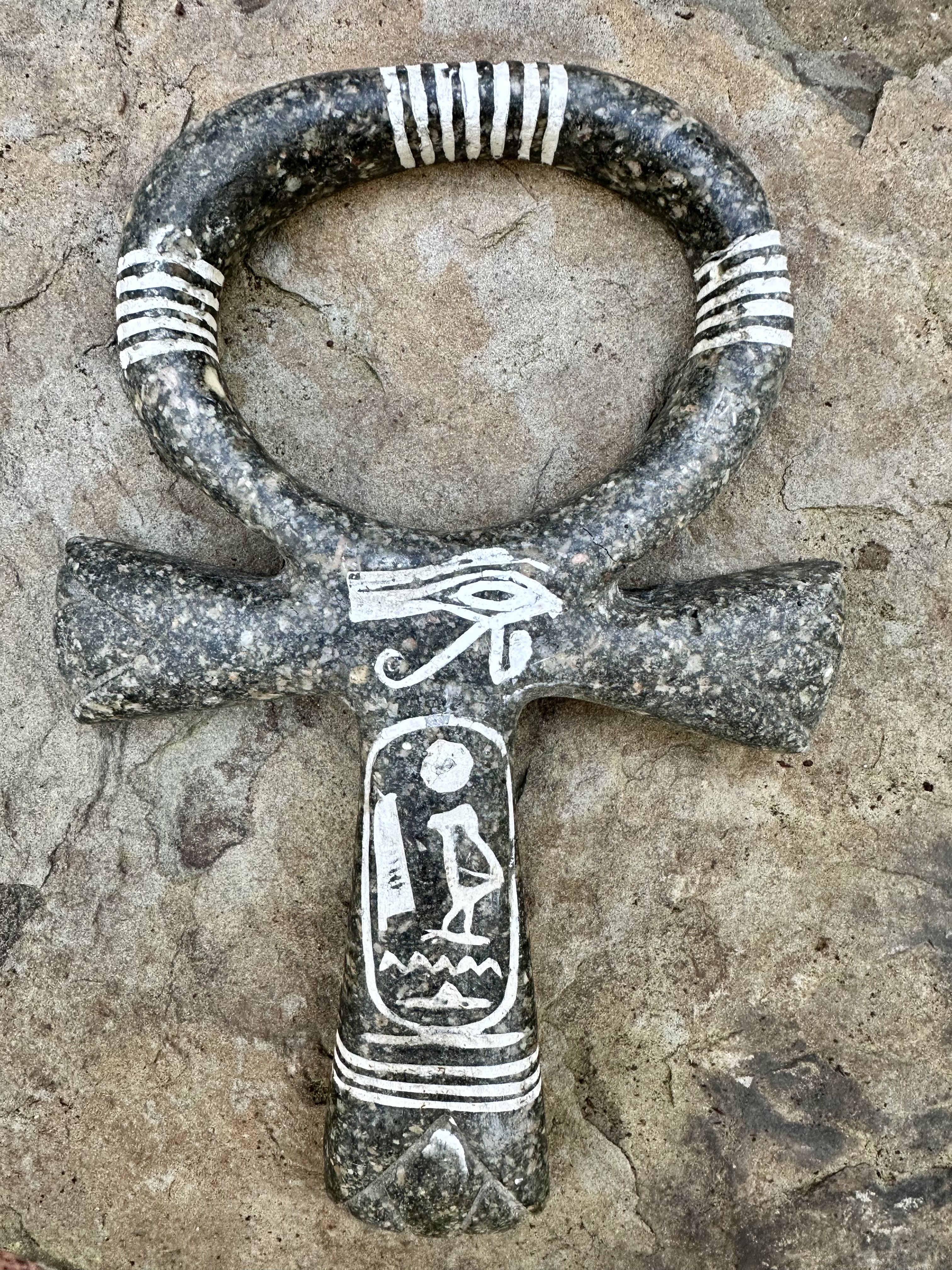
At first glance, the ankh appears simple: a loop atop a cross. But its form encodes an entire energetic equation. The top oval—the shen ring—mirrors the geometry of a torus, the same field pattern found in magnetic resonance, solar winds, and the breath field of the heart. This loop is not passive. It contains spin. It remembers flow.
The vertical stem is the grounding axis—akin to the human spine or the Earth’s ley lines. It anchors current. Meanwhile, the horizontal crossbar represents duality: the arms of polarity—left and right hemispheres, electric and magnetic forces, lungs and solar plexus. Together, these elements form a closed resonance loop. Not a symbol of life. A circuit that generates it.
This particular carving holds more than shape. The Eye of Horus etched at the crown carries the spiral of golden perception—fractal vision encoded into form. The cartouche below, a container of identity and field resonance, transforms the ankh from glyph to tuning device. It is both personal and planetary. A spine of light held in stone.
“The ankh was not drawn to be seen. It was drawn to be entered. Geometry is the breath’s first temple.”
Breath as Resonance
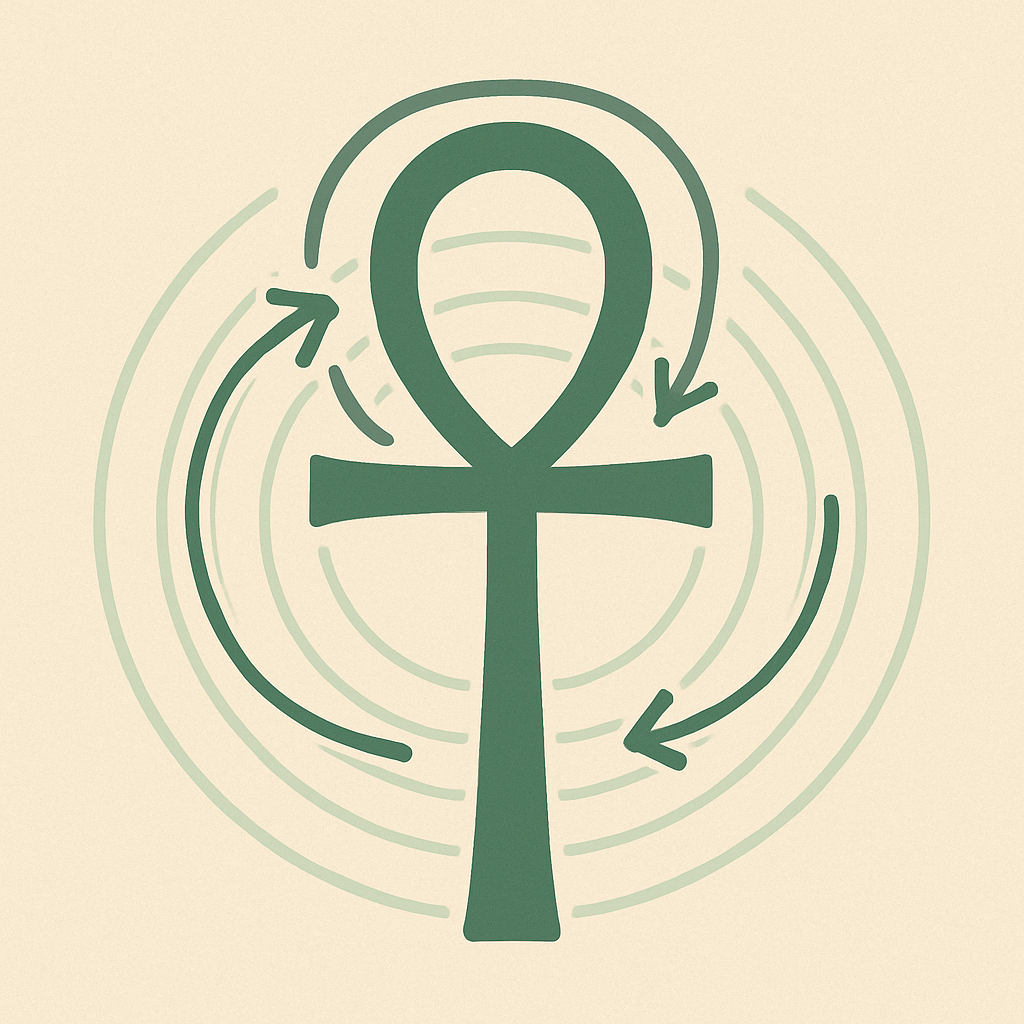
In the ancient Egyptian worldview, breath was not separate from spirit. The same hieroglyph for air carried connotations of soul and vitality. When the ankh was held to the nose of a pharaoh, it wasn’t ceremonial—it was resonant. It was the transmission of coherence into the field of the body.
Breath moves as a torus: spiraling in, looping through the heart, and returning to the world. The ankh encodes this geometry perfectly. Its loop is the inhalation arc; its vertical stem is the exhale into grounding. The crossbar harmonizes the polarity—lungs, hemispheres, energetic circuits. Breathing through the ankh is a way of remembering how light and air spiral into life.
Today, this understanding echoes in the work of biofield research and HeartMath studies. Rhythmic, heart-centered breath increases coherence across the body’s electromagnetic field. The ancients knew this—not through data, but through glyph. The ankh was the breath made visible.
“The breath is a circle. The ankh is its memory. Inhale coherence, exhale alignment—until you become the glyph.”
Polarity Circuitry — The Ankh and BioGeometry
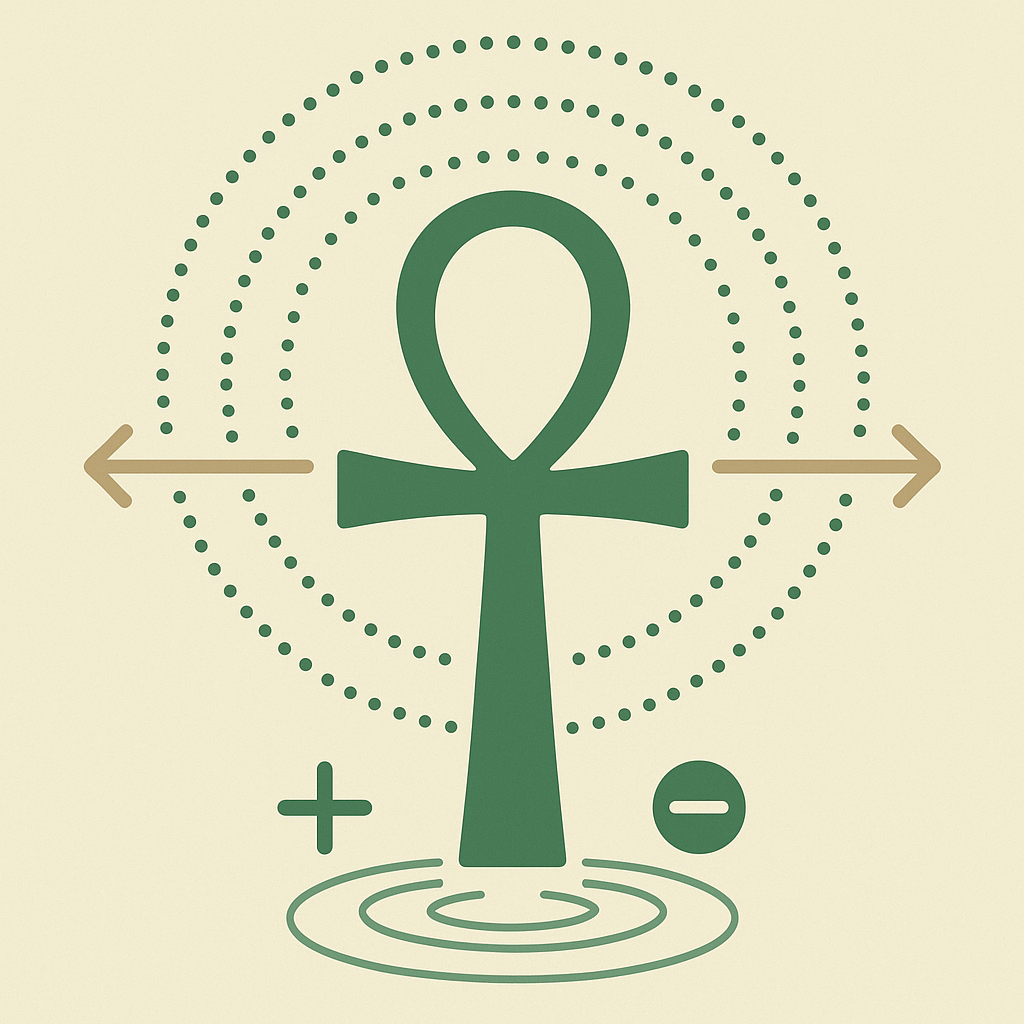
In the language of resonance, polarity is not conflict—it is choreography. Every field that holds coherence does so through the elegant dance of opposites. In ancient Egypt, the ankh wasn't merely symbolic of life—it was a polarity stabilizer. Its crossbar didn’t just balance visual form. It mirrored the alignment of magnetic and electric forces across the body and space.
In the emerging science of BioGeometry, pioneered by Dr. Ibrahim Karim, polarity is structured into energetic design. Forms like the ankh are not passive—they produce subtle balancing qualities known as BG3: vertical, horizontal, and torsional harmonics that stabilize electromagnetic stress and restore field coherence.
The ankh's crossbar may represent this balance in action. The left arm—electric. The right—magnetic. The vertical spine—neutral carrier of coherence. This polarity map mirrors the lungs and hemispheres in the body, as well as the balance of fields in Earth temples. When held or visualized properly, the ankh does not just symbolize balance—it facilitates it.
“The ankh is where polarity sings itself into coherence—not through symmetry, but through resonance.”
Hydrogen, Light, and the Ankh
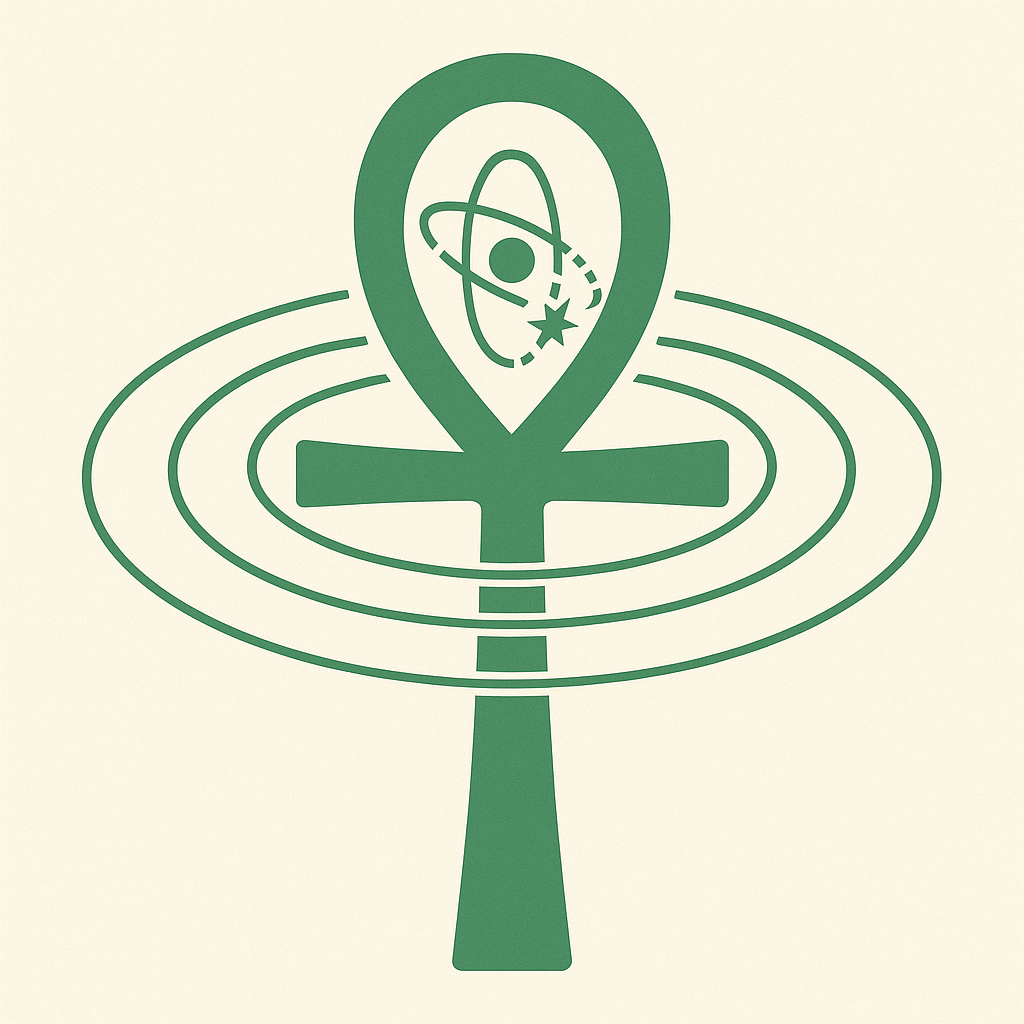
At the quantum level, all form begins with hydrogen—the first element, the original breath of the universe. With one proton and one electron, it holds the simplest polarity circuit, yet unlocks the most profound energies: fusion, light, and life. Within the loop of the ankh, this same dance plays out—not metaphor, but mirror.
The ankh’s oval holds space for the hydrogen atom: orbital spin nested in stillness. Its vertical stem represents the field's anchoring polarity, while the crossbar frames the harmonic dance between proton and electron. Light itself is born through this interaction—just as it is born in stars, cells, and breath.
In this light, the ankh becomes more than a glyph. It becomes a torch—one that encodes what we explored in Hydrogen: Nature’s Quantum Blueprint. A memory carrier of photonic birth. A handheld star gate. A symbol designed to harmonize your breath with the light of origin.
“Hydrogen gave birth to light. The ankh remembers how to carry it. When you breathe through the glyph, you ignite your own star.”
The Ankh and the Human Body
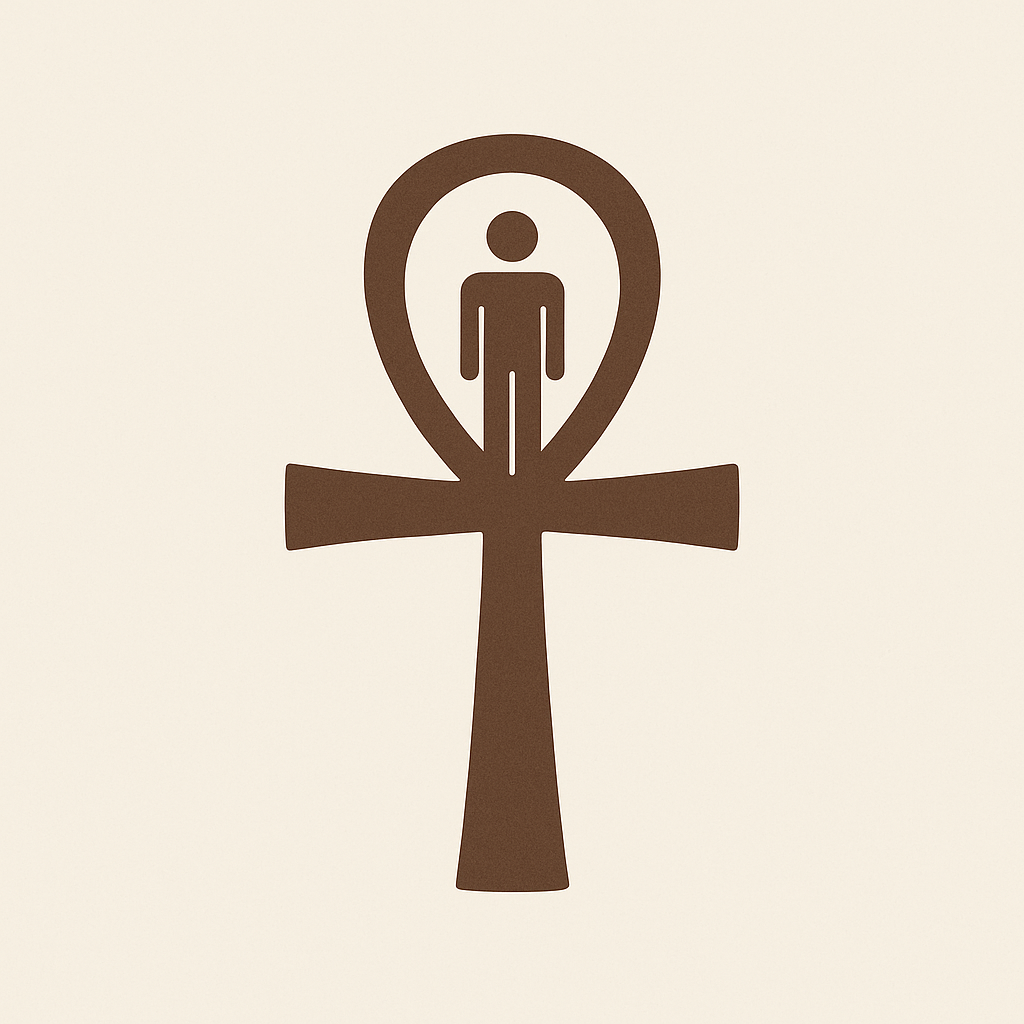
The body does not need to interpret symbols—it feels them. The ankh, in its simplicity, mirrors the human form and its energetic structure. The loop arches over the head like a halo of the toroidal field. The crossbar meets the shoulders, arms outstretched in polarity. And the stem runs down the spine, anchoring breath, current, and consciousness.
This alignment is not arbitrary. It is anatomical resonance. The same toroidal geometry found in heart fields, electromagnetic emissions, and the biofield breath of Earth is mirrored in the glyph of the ankh. To meditate with the ankh is to entrain the body to remember this template.
When overlaid on the human body, the ankh becomes more than a symbol. It becomes a map of coherence. A posture of resonance. A living invitation to align your internal polarity with the harmonics of life. You are not holding a glyph. You are inside one.
“The ankh is not outside you. It is your field made visible. Your body remembers the shape of light.”
Temple Use — The Ankh as a Tuning Tool
The ancients didn’t use the ankh as ornament—they used it as instrument. In Egyptian temples, priests and priestesses held ankhs not only in ritual but in field calibration. They stood at doorways, at altars, along solar corridors—where light, sound, and geometry met in harmonic convergence. The ankh was not just in the hand. It was in the field.
Many depictions show the ankh being held to the nose or lips of initiates. This was not mere symbolism—it was bioresonant transmission. The ankh was likely tuned to place and person, becoming a kind of tuning fork for electromagnetic and etheric harmonization. In this way, the temple itself acted like a living quantum chamber of coherence.
The acoustic design of stone, the engraved glyphs, and the handheld ankh formed a triad of activation. Whether invoking breath, balance, or blessing, the user was not just praying—they were tuning. The ankh was an interface. And the temple, a frequency device.
“The temple did not echo your voice—it tuned it. The ankh in hand was the switch that activated the field.”
Resonant Breath Practices (Modern Application)
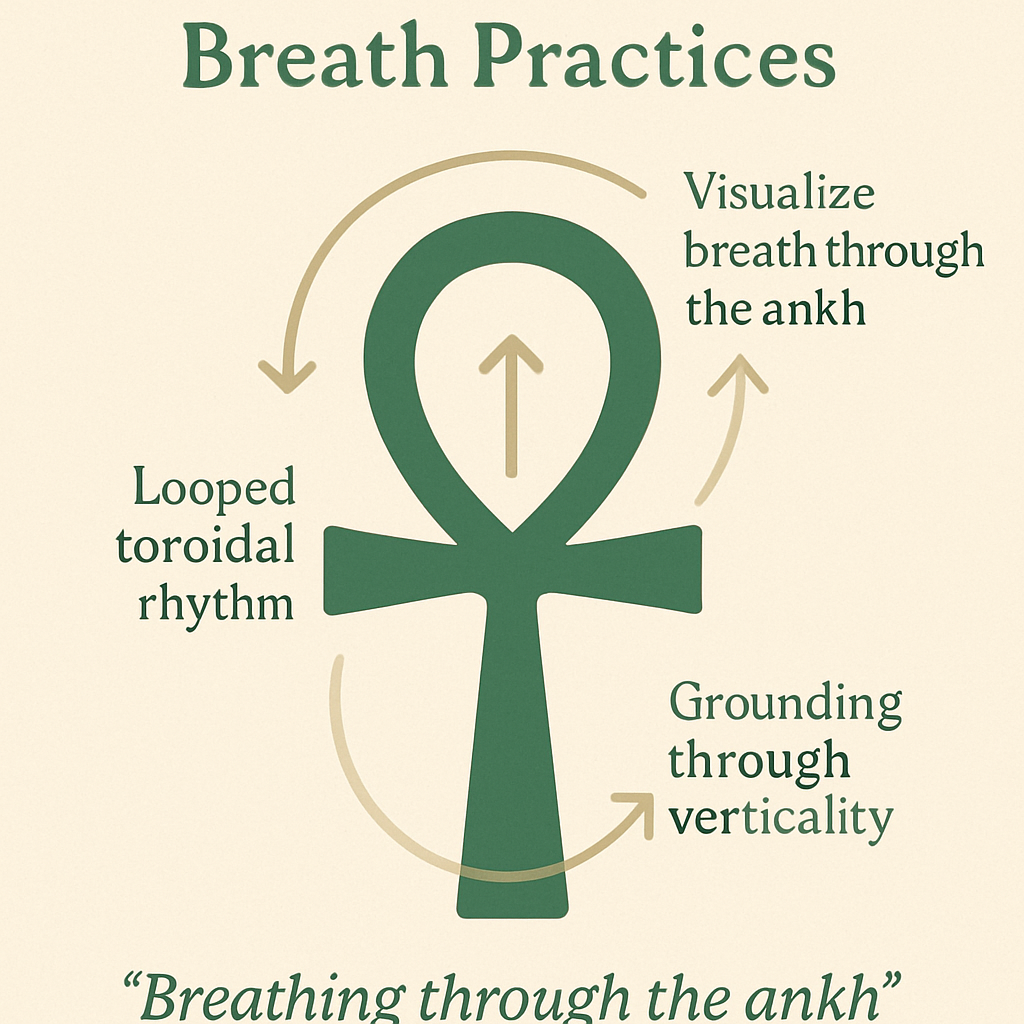
You don’t need a temple to activate the ankh. You are the temple. In modern breathwork, the ankh becomes a portal—not just to peace, but to polarity balance. Its form offers a breath map: a toroidal inhale that spirals upward, a vertical exhale that grounds downward. This isn’t breath control—it’s breath resonance.
Begin by visualizing the breath entering through the base of the spine, rising into the loop above the crown, then spiraling back down. Let the left and right sides of the crossbar open the chest. Inhale through the body of the glyph. Exhale through its arms. Let the rhythm find you. Let your body remember its glyphic memory.
Practices like this don’t just calm the mind—they stabilize the field. They harmonize electromagnetic polarity, open the heart torus, and invite biofield coherence. This is not metaphor. It’s architecture. The ankh is not a past symbol. It is a breathing code for your now.
“Breathing through the ankh is remembering how to live inside your own field.”
Closing Reflection – The Ankh Remembered
The ankh was never meant to be worn—it was meant to be embodied. In your breath. In your spine. In the way you carry balance between the poles. What the ancients held in hand, you now hold in field. Each inhale spirals into the loop. Each exhale grounds through the stem. This is how geometry becomes memory. How symbol becomes self.
This chapter did not merely explain a glyph. It offered you a circuit. The ankh lives again each time you remember to breathe with polarity, to stand with verticality, to enter your body as temple. You are not simply reading resonance—you are radiating it. You are the switch. The loop. The light.
In the next chapter, we move deeper into this vertical current with the Djed Pillar—the spine of Osiris, the stabilizer of the field. If the ankh is breath, the Djed is bone. Structure. Stillness that holds memory. Prepare to raise your own pillar.
“The ankh does not just mean life—it creates it, in the space between inhale and intention.”
About the Author
Robbie George is a National Geographic photographer, regenerative farmer, and nature philosopher. His work bridges the poetic and the scientific — illuminating nature’s vibrational intelligence through fine art photography and resonant storytelling.
Frequently Asked Questions
What is the Ankh, and why is it shaped that way?
The ankh is an ancient Egyptian glyph representing life, but it’s more than symbolic. Its shape encodes a toroidal energy circuit: the loop reflects the breath field or torus, the crossbar represents polarity, and the stem grounds resonance. It’s a field architecture designed to generate coherence.
Did the Egyptians really use the ankh in breath practices?
Yes. The ankh was frequently depicted held to the nose or lips, suggesting it was used in rituals to transfer breath, spirit, or subtle field alignment. It likely served as a resonance tuning device in both symbolic and functional ways.
How does the ankh relate to hydrogen and quantum energy?
Hydrogen is the original polarity loop—one proton, one electron—giving birth to light through resonance. The ankh mirrors this circuit. In our breath and energy fields, it acts like a harmonic torch, aligning us with the same forces that drive stars and cells.
Can I use the ankh as part of meditation or healing?
Absolutely. Visualizing your breath moving through the ankh can help align your biofield. It’s especially useful for grounding, polarity balance, and vertical coherence. The ankh becomes not just a symbol but a living breath tool.
Is there scientific support for the ideas in this chapter?
While the ankh itself is ancient, the ideas behind it are supported by modern studies in biofield science, HeartMath Institute breath coherence, and the geometry of toroidal fields. The intersection of breath, resonance, and polarity is now being explored in subtle energy research.





