

Guided by Starlight: The Resonant Intelligence of Moths

Guided by Starlight: The Resonant Intelligence of Moths
There are stories in nature that don’t begin with words, but with light. The new discovery that Bogong moths navigate using the glow of the Milky Way and the Carina Nebula stirs a forgotten awareness—that perhaps the stars don’t just light the way, they imprint it. We are witnessing ancient resonance in flight.
Each spring, these moths travel up to 1,000 kilometers to reach alpine caves they've never seen. Yet they arrive precisely, guided by something we often forget to honor: the sky itself. When clouds obscure their view, they switch to Earth's magnetic field. These creatures carry a dual compass—one woven from light, the other from the geomagnetic pulse of Earth.
In the hawk moth’s elegant hovering, in the perfect spiral of its proboscis, we glimpse nature’s deeper code. The same golden ratios that govern galaxies echo through their bodies. Their movement isn’t random—it is responsive, tuned, almost harmonic.
“Even in the smallest wings, the universe finds its compass.”
The Night-Sky Compass: Carina as a Celestial Landmark
In a remarkable new study published by Nature, scientists revealed that Bogong moths orient themselves by using star patterns in the night sky—specifically the luminous band of the Milky Way and the radiant Carina Nebula. This isn’t metaphor. It’s measurable. Tethered to tiny instruments inside a custom-built moth planetarium, these invertebrate navigators consistently chose the correct migratory direction—unless the stars were scrambled.
The research team went further. By recording activity from the moths' visual neurons, they found specific neural firing patterns aligned with the brightest region of the galactic plane. When the projection of the Carina region rotated overhead, the moths’ neurons lit up with unmistakable clarity. These were not random firings. They were memory traces—light-coded maps etched into their biology.
This dual-compass navigation mirrors that of migratory birds—and supports what I’ve explored in the Unified Field Theory: that nature doesn’t guess, it remembers through field alignment. When both stellar and magnetic cues were removed, the moths became disoriented again. What guides them is not seen—it is sensed.
“In the darkness, there is guidance. In the stillness, memory burns like starlight.”
The Spiral Code: Fibonacci Geometry in a Moth’s Straw
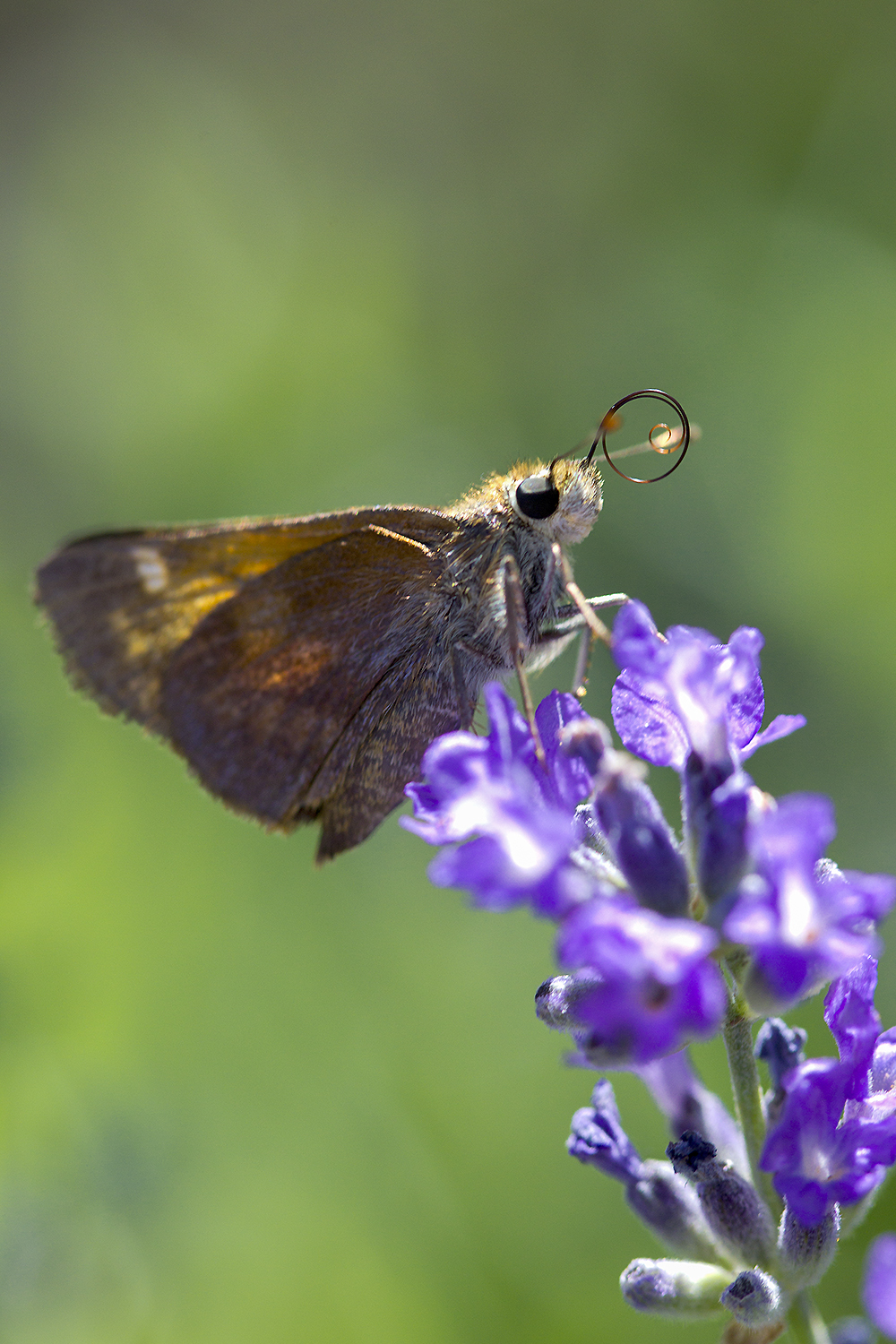
Look closely at a moth’s face, and you’ll see something astonishing: a perfectly coiled proboscis, its nectar-sipping straw tucked in a spiral like a Fibonacci vortex. This isn’t just a design of convenience—it’s a golden algorithm, echoing the same pattern that sculpts galaxies, sunflowers, hurricanes, and shells.
The spiral is not an aesthetic flourish. It is an antenna—a living tuner to frequency fields. When a moth unfurls this structure into a flower, it isn’t merely feeding. It’s entering into resonant dialogue. Nectar becomes an exchange medium. Frequency meets geometry. A vibrational handshake occurs, and pollination becomes a field event.
From the DNA helix to pine cones to the mouth of a moth, the spiral appears where life speaks most fluently with its source—a theme I explore deeply in The Signature Series. The spiral reminds us: nature codes intelligence not in straight lines, but in curves of memory—golden, dynamic, alive.
“Even in the mouth of a moth, the golden ratio whispers the structure of the stars.”
Hawk Moths – The Hummingbirds of the Night
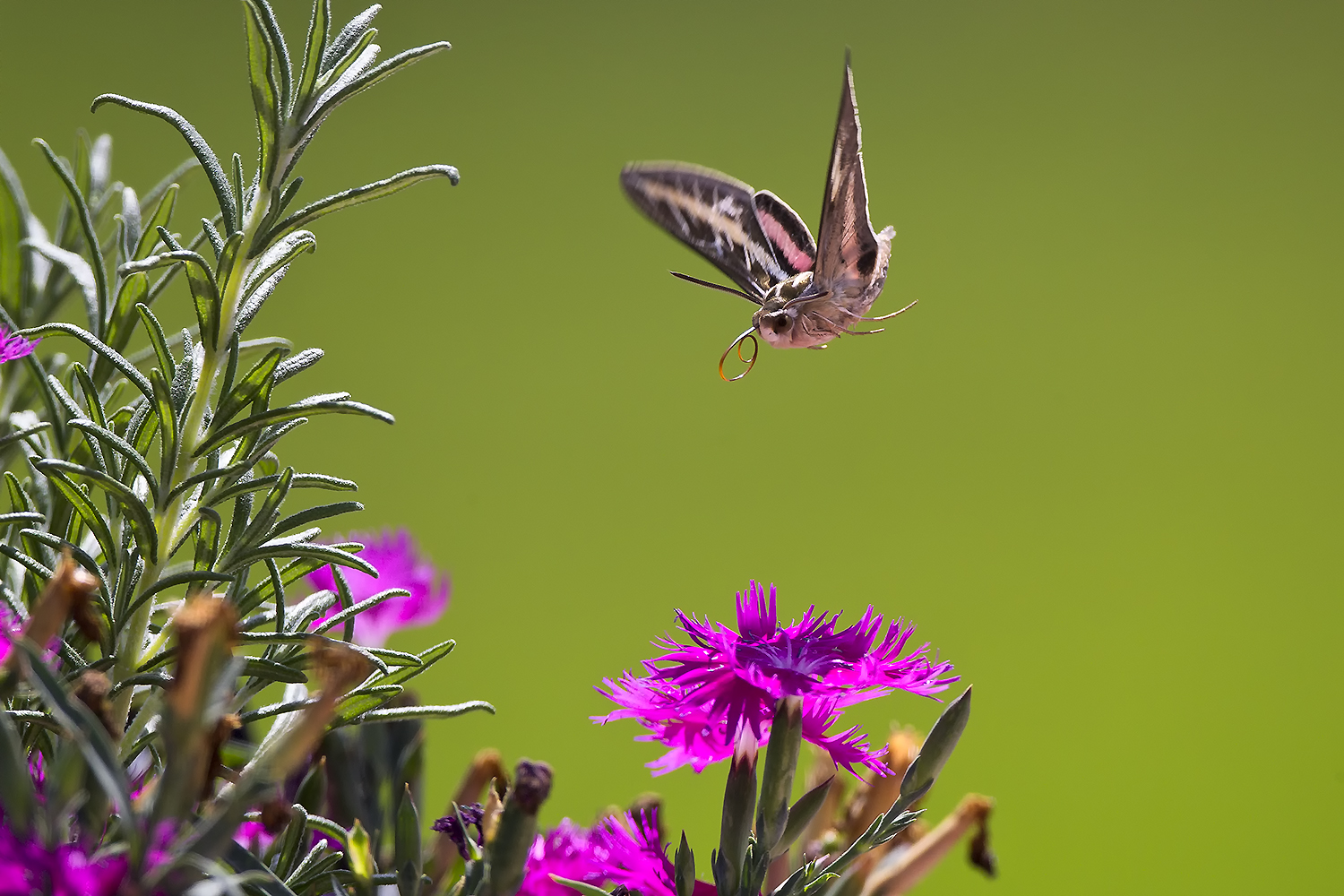
The hawk moth belongs to a class of fliers so agile they’ve earned comparisons to hummingbirds. But unlike their sunlit cousins, these moths operate in shadow—hovering in still air, wings buzzing invisibly, antennae tracking scent, and proboscis spiraled like a spring of latent energy.
When this moth approaches a flower, it doesn’t just arrive—it attunes. The flower, in turn, doesn’t just offer nectar—it signals. In that moment of still-hover, their energies meet in a resonant field exchange. What we call pollination may be more than a mechanical process. It may be a vibrational handshake, a harmonic coherence between two lifeforms temporarily aligned.
The moth’s long proboscis acts not only as a drinking straw, but as a fractal probe, tuned to the frequency of the flower’s geometry. In this silent interaction, motion and resonance intertwine, creating a circuit of information, light, and life. We are watching quantum agriculture in motion—real-time resonance farming, guided by light, geometry, and memory.
“What if the flower and moth don’t just find each other—but remember each other?”
Glover’s Silk Moth – Field Memory and the Inherited Map
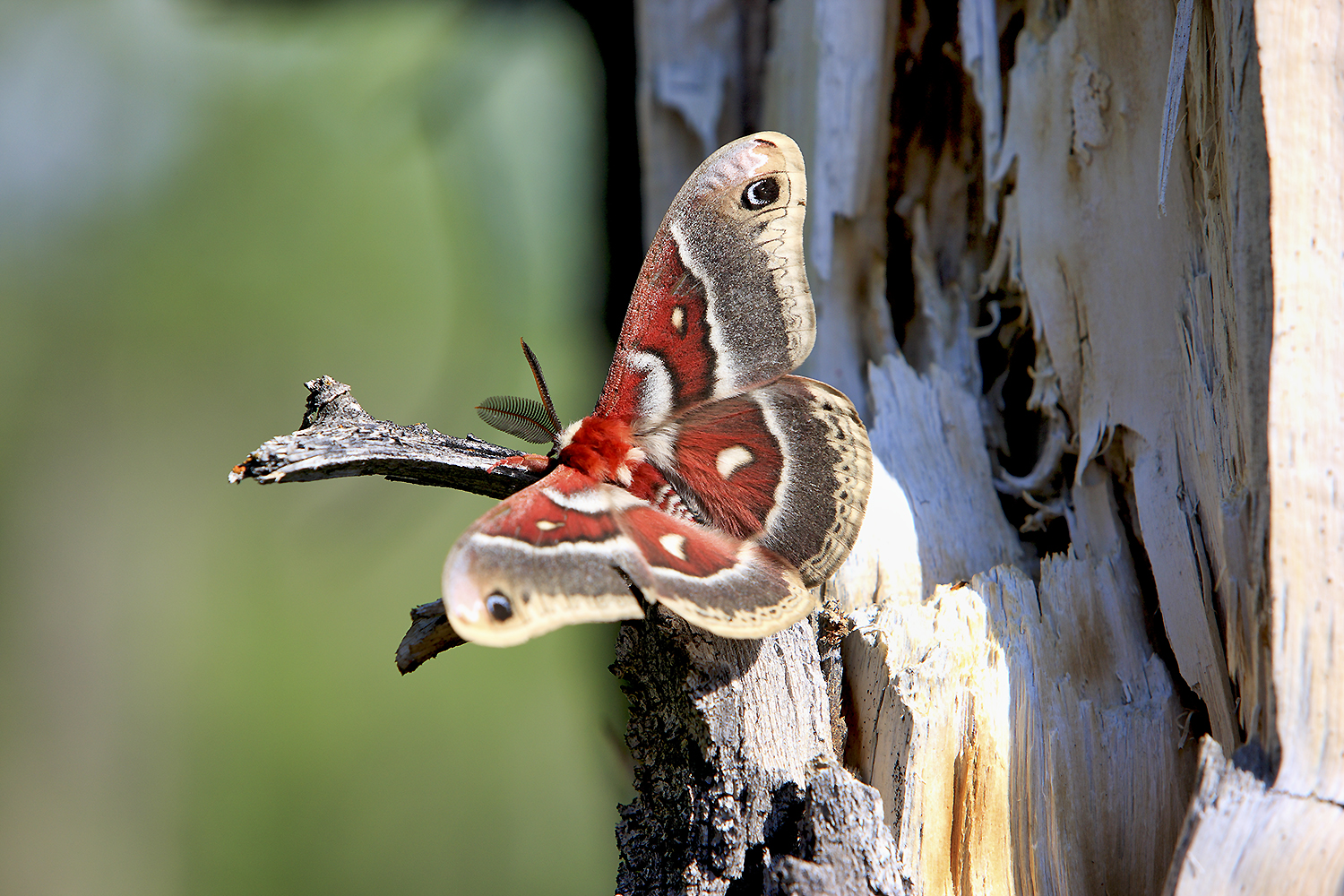
The Glover’s Silk Moth, perched in stillness, is anything but simple. Its feathery antennae serve as exquisitely sensitive receivers—tuned not just to pheromones, but perhaps to the subtle resonance fields of its environment. Its patterned wings resemble ancient glyphs, as if carrying stories written long before its first flight.
Unlike the migratory Bogong moths, silk moths do not travel vast distances—but they do carry something just as extraordinary: ancestral memory. Within their biology is the silent knowledge of seasons, emergence timing, and environmental rhythms—a kind of epigenetic field resonance. This aligns closely with the theory I’ve developed in The Nature Code: that life doesn’t just adapt to its environment—it remembers its place within the field.
In the context of The Signature Series, I see moths like this as field-aligned beings—resonant with their ecosystem in both space and time. Their stillness is not sleep, it’s listening. Their emergence is not random, but harmonic—encoded in the wavefield of life itself. This points toward a larger unified memory field, perhaps even what I proposed as part of the Unified Field Theory of Life: a symphony of light, geometry, magnetism, and resonance.
“Some creatures don’t migrate through space—they migrate through memory.”
Quantum Navigation – Photons, Pollination & the Unified Blueprint
The more we learn about moths, the more they seem to embody a kind of quantum navigation—a choreography of photons, magnetic fields, and spiraled resonance. Their night flights are not guesswork. They are guided by photonic gradients, by galactic light fields, and by their intrinsic ability to read the cosmic geometry encoded in the Milky Way.
I believe we are witnessing what I call the Quantum Agriculture of the wild: a system where organisms tune to each other through vibrational memory, not just visible traits. The moth’s proboscis becomes a field probe, its hovering—a calibration. It’s not simply drinking nectar—it’s participating in biophotonic exchange.
In this way, the moth becomes a perfect emissary of The Quantum Blueprint: a life-form that doesn’t just exist in a field—it is an expression of the field. Its geometry is informed by light. Its journey, written in frequencies. Its behaviors, encoded not in DNA alone, but in resonant coherence with the living matrix.
“The moth doesn’t follow the light. It remembers it.”


The Original Ute City Spiral Camera — A Glyph of Remembrance
About the Author
Robbie George is a National Geographic photographer, regenerative farmer, and nature philosopher. He captures the harmonic intelligence of nature through fine art photography, quantum storytelling, and ecological insight.
Explore his signature series The Living Code, dive into Quantum Agriculture, or follow his journey on Instagram and LinkedIn.
Explore More: Light, Resonance, and the Field of Life
If moths carry starlight in their memory and drink from the spiral of life with every hover, what else in nature holds such encoded intelligence? The journey doesn’t end here—it unfolds.
Dive deeper into the interconnected web of light, water, and field-based living through my writings in The Nature Code, or explore how vibration and geometry shape life in Quantum Agriculture. For a wider lens into soul-aligned creativity, step into The Signature Series.
And if this post stirred something deep—if it whispered to the part of you that still looks to the stars for direction—then spend a few moments wandering through the stillness and awe found in my Wildlife Photography Gallery. Let your own field remember what it’s always known.
“To follow the light is to follow memory. To follow memory is to return to the field.”
Frequently Asked Questions
1. Do moths really use the stars to navigate?
Yes. A recent study published in Nature confirms that Bogong moths in Australia orient their migration using the Milky Way and specifically the Carina Nebula as celestial landmarks. When visual cues are blocked, they rely on Earth’s magnetic field—revealing a dual-compass system similar to birds.
2. What is a moth’s proboscis and why is it spiraled?
The proboscis is a coiled, straw-like organ used to drink nectar. Its spiral shape mirrors the Fibonacci sequence—nature’s universal code for efficiency and elegance. Robbie sees it as a golden antenna, tuned to the resonant field of each flower.
3. How does this connect to Quantum Agriculture?
Quantum Agriculture, as explored by Robbie George, suggests that pollination isn’t just physical—it’s vibrational. Moths and flowers communicate through frequency, coherence, and field memory. Their interaction is a resonant handshake, not just a transfer of pollen.
4. What role do photons play in moth migration?
Photons—particles of light—carry more than brightness. They encode directional gradients and visual landmarks like the Milky Way. Moths can detect these cosmic signals, even forming memory-like neuronal patterns in response to starlight, suggesting light is part of their internal map.
5. What does Robbie mean by “the field”?
“The field” refers to a unifying energetic and informational space that underlies all living systems. In Robbie’s Unified Field Theory, this field stores memory, directs resonance, and shapes form—whether in a moth’s wingbeat or a galaxy’s spin.