

Peggy's Cove: The Ultimate Traveler's and Photography Guide to Nova Scotia’s Iconic Seaside Village

What It Feels Like to Arrive Before the Coast Fully Opens
Peggy’s Cove begins with exposure. Not exposure in the photographic sense, but exposure to the elements—wind off the Atlantic, smooth granite underfoot, salt in the air, and a horizon that never feels closed. Before the light settles into the scene, the place already has a presence.
The lighthouse gives people a visual anchor, but it’s the surrounding rock that teaches you how to see the cove. The granite spreads outward in long, glacially smoothed forms, carrying your eye toward tide pools, wave lines, harbor edges, and open water. Even before sunrise, the structure is clear.
On some mornings the coast feels quiet and reflective, with soft color settling into the stone. On others, fog compresses the space and strips the scene down to lighthouse, rock, and air. Stormier conditions do the opposite—opening the cove into motion, force, and contrast. Peggy’s Cove rarely repeats itself in exactly the same way.
That’s why I think of this place as more than an iconic stop. It’s a working edge between land and ocean, and one of the clearest places to study how light, weather, structure, and timing come together along the Atlantic coast. The photograph matters, but first you have to let the coastline tell you what kind of morning it is.
Explore This Peggy’s Cove Field Guide
Landscape System — How Peggy’s Cove Is Built
Peggy’s Cove is defined by its granite. Long before the lighthouse, before the village, before any photograph, this place was shaped by glacial movement and coastal exposure. What remains is a wide, open stone surface that slopes directly into the Atlantic—one of the cleanest interfaces between land and ocean you can work with.
The rock is not flat. It moves in subtle rises and channels, creating natural lines that guide your eye toward the water. In some areas, shallow depressions hold tide pools. In others, the surface stretches uninterrupted toward the horizon. These variations are what give Peggy’s Cove its compositional depth.
The Atlantic completes the system. Waves carve motion into the edge of the frame, sometimes calm and reflective, sometimes forceful and unpredictable. The interaction between water and rock is constant, and it changes not just the mood—but the structure of what you’re seeing.
Even the lighthouse is part of that structure. It doesn’t dominate the scene as much as it anchors it—giving scale and orientation to an otherwise open, shifting coastal environment.
Once you start to see Peggy’s Cove this way—as granite, water, elevation, and exposure working together—the rest of the experience becomes easier to read. Light, weather, and timing don’t act randomly here. They move through a system that’s already in place.
Light Behavior — How Peggy’s Cove Actually Opens
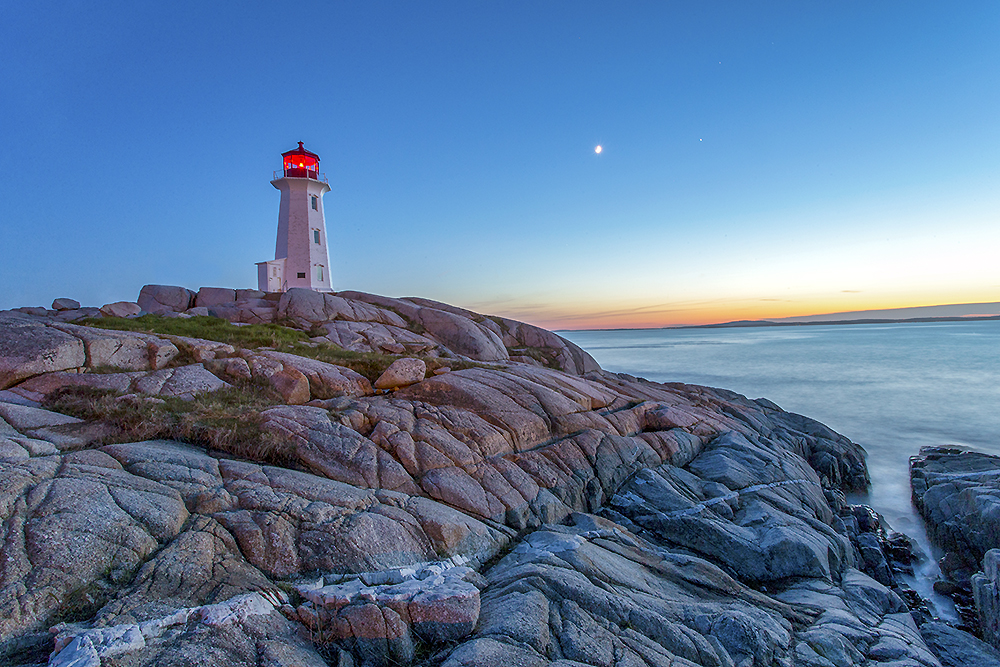
Peggy’s Cove is a place where light doesn’t just fall on the landscape—it reorganizes it. The granite, ocean, lighthouse, harbor, and sky all respond differently, which is why the cove can feel open and expansive one hour, then compressed and intimate the next.
At sunrise, the first usable light is often soft and low, spreading gently across the rock before the full scene fully separates. Tide pools begin to reflect color, edges soften, and the lighthouse can stand in quiet balance with the rest of the coast instead of dominating it. These are often the most subtle and rewarding conditions to work with.
Later in the day, harder light reveals more texture in the granite and stronger contrast in the harbor, but it can also flatten the atmosphere if the sky is empty. That’s why Peggy’s Cove often works best when weather stays involved. Fog removes distance and simplifies the composition. Thin cloud cover diffuses glare and holds color longer. Storm light can turn the point into something raw and dramatic within minutes.
Twilight brings another shift. As the light drops, the cove becomes quieter visually. Reflections strengthen, artificial brightness disappears, and the relationship between stone, sea, and sky starts to feel more unified. On calm evenings, the whole place settles into tone and shape rather than detail.
What matters here is not chasing one “best” moment. It’s recognizing how light behaves across the system. Peggy’s Cove rewards photographers who stay alert to transition—when fog lifts, when cloud opens, when wet granite catches color, and when the coastline briefly becomes more than a landmark and starts to feel fully alive.
Seasonal Timing — When Peggy’s Cove Behaves Differently
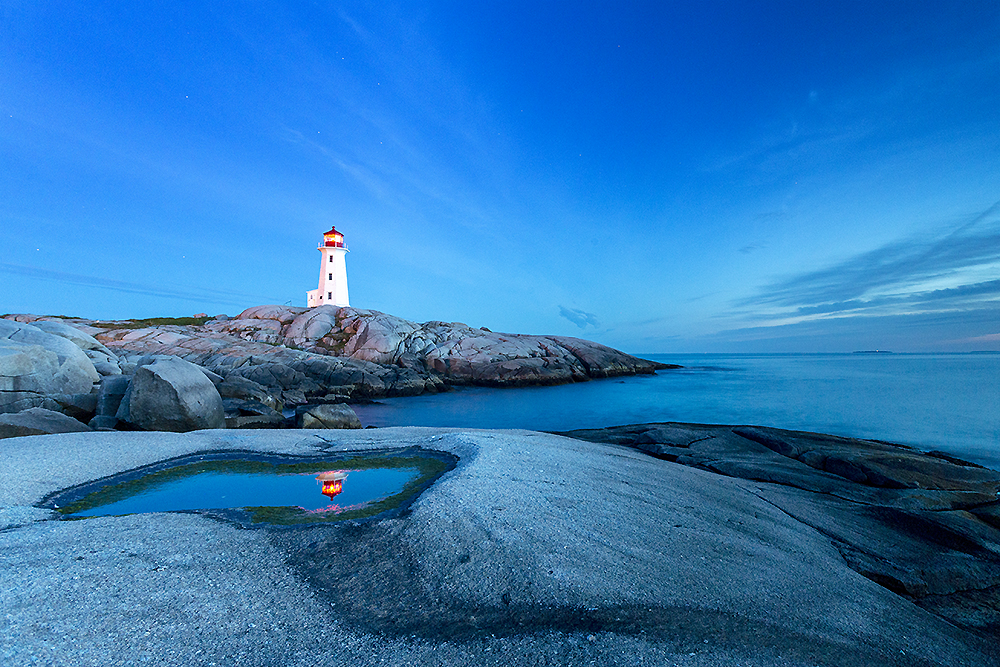
Peggy’s Cove changes with every season, but the shift is not just visual. Light angle, wind exposure, fog frequency, wave behavior, visitor pressure, and even the way the granite holds color all move differently through the year.
In spring, the coast often feels unsettled in a good way. Moisture stays in the air, fog can arrive without warning, and the light tends to remain soft longer into the morning. This is a strong season for atmosphere and quieter tonal work.
Summer opens the cove up. Days are longer, the granite warms quickly, and sunrise and sunset windows stretch enough to give you more flexibility in the field. The tradeoff is crowd pressure. If you want the place to feel more spacious, timing matters as much as season.
Autumn is often the strongest balance point. Air can be clearer, temperatures cooler, and low-angle light more consistent. The cove tends to feel more structured at this time of year—less washed out, more defined, and easier to read from foreground stone to horizon.
Winter simplifies everything. Snow, frost, and low sun reduce distraction and reveal form. The lighthouse, rock, and sea can feel stripped down to their essentials. It’s one of the most powerful times to photograph Peggy’s Cove, but also one of the most demanding in terms of wind, footing, and access.
If you want to plan Peggy’s Cove more intentionally, pair season with light direction and weather pattern instead of just choosing a month. Tools like the Seasonal Wildlife Calendar, Nature’s Seasons, and Golden Hour Planner help turn timing into a field advantage.
Locations & Field Strategy — How to Position at Peggy’s Cove

Peggy’s Cove is not a single viewpoint—it’s a series of positions that change how the entire coastline reads. Where you stand determines whether the lighthouse dominates, supports the frame, or disappears into a larger coastal structure.
The main lighthouse point is the most direct composition. From here, you get clean access to the Atlantic horizon, strong leading lines from the granite, and the most recognizable framing. It’s also the most crowded and often the most visually predictable.
Moving away from the center—even slightly—changes everything. A shift of 20 to 50 feet can introduce foreground cracks, tide pools, or elevation differences that add depth and reduce visual congestion. The strongest images here often come from small adjustments, not major relocations.
The harbor side offers a completely different system. Boats, shacks, docks, and working textures replace open ocean, giving you tighter compositions and a stronger sense of human scale. This is where Peggy’s Cove shifts from landscape to cultural coastline.
For quieter positioning, areas like Polly’s Cove and the surrounding preservation trails open the scene back up. From these edges, you can photograph Peggy’s Cove from a distance—placing the lighthouse within the larger coastal system rather than at the center of it.
Use the map below to understand how these zones connect. It’s not just about navigation—it’s about how position affects light, structure, and timing across the entire coastline.
Can’t see the map? Open it directly: Peggy’s Cove Photo Map .
Planning & Field Ethics — How to Work Peggy’s Cove

Peggy’s Cove rewards awareness more than effort. The conditions change quickly, the terrain demands attention, and the experience is shaped as much by how you move through the space as by where you stand.
Start with timing. Early morning and late evening reduce crowd pressure and give the coastline room to open. Arriving before light allows you to settle into position, read the surface of the granite, and adjust before the scene begins to change.
Movement matters. The rock can be uneven, sloped, and, in certain areas, dangerously slick. The darker “black rocks” near the water are especially hazardous—wave surges here are unpredictable and have real consequences. Position yourself with intention and always maintain a safe distance from the edge.
Respect the environment. The granite surface may look indestructible, but lichen, moss, and small plant systems grow slowly here and are easily damaged. Stay on durable surfaces and avoid disrupting natural features for composition.
Respect the village. Peggy’s Cove is not just a landscape—it’s a working coastal community. Many buildings, docks, and spaces are private. Photograph with awareness, avoid intrusion, and let the place remain what it is rather than turning it into a set.
If you want to refine your approach further, explore Wildlife Observation & Field Techniques and your Field Tools. The way you move through Peggy’s Cove is the same skill that carries into every landscape you work.
Naturepedia Connection — Peggy’s Cove as a Granite & Ocean System

Peggy’s Cove is best understood as an exposed coastal system where granite, ocean, atmosphere, and human activity intersect. The lighthouse may define the visual identity, but the real structure is the relationship between land and water—how rock meets wave, how light moves across surface, and how conditions reshape the scene from moment to moment.
The granite platform acts as a stable base. It holds heat differently than water, reflects light in broader, softer ways, and creates the visual lines that organize the entire landscape. The Atlantic introduces motion—changing reflection, depth, and atmosphere depending on tide, wind, and weather.
Even the village fits into this system. Boats, docks, and fishing structures are positioned where shelter, access, and coastline allow them to exist. What looks like a scenic composition is actually a functional relationship between environment and use.
Within Naturepedia, Peggy’s Cove connects directly to broader systems including coastal ecosystems, wildlife behavior, migration patterns, and conservation systems.
Seen this way, Peggy’s Cove is not just a destination—it’s a visible system. Light revealing structure. Water reshaping edges. Season altering behavior. The photograph becomes the moment where those forces briefly align.
Peggy’s Cove FAQ
What is the best time to photograph Peggy’s Cove?
Sunrise and sunset offer the strongest conditions. Early light creates softer tones and fewer crowds, while sunset can produce stronger color and contrast across the granite and ocean.
Where should I stand for the best compositions?
The lighthouse point gives the most direct view, but stronger compositions often come from moving slightly off-center to include granite foreground, tide pools, or layered coastline elements.
Is Peggy’s Cove safe to walk around?
Yes, but with caution. Stay off the dark “black rocks” near the water, as they are slippery and exposed to sudden wave surges. Stick to stable granite surfaces and marked paths.
What photography gear works best here?
A wide-angle lens, tripod, and weather protection are essential. A telephoto lens helps isolate lighthouse details or distant coastal layers, and filters can help manage reflections and exposure.
How does weather affect photography at Peggy’s Cove?
Weather is a major part of the experience. Fog simplifies the scene, overcast light softens contrast, and storms add energy and motion. Some of the strongest images come from changing conditions.
How does Peggy’s Cove connect to the Naturepedia system?
Peggy’s Cove functions as a coastal system where granite, ocean, light, and human activity interact. It connects naturally to broader systems like coastal ecosystems, seasonal timing, and environmental dynamics within Naturepedia.
About Robbie George

I’m Robbie George, a National Geographic–published nature photographer whose work is built from time in the field—returning to places under changing light, weather, and season to understand how landscapes actually behave.
Peggy’s Cove stands out to me because it reveals structure so clearly. The granite, ocean, and atmosphere are all exposed, and you can watch how light moves across them in real time. It’s one of the best places I’ve found for studying how coastal systems organize themselves through light and weather.
My approach here is the same as anywhere else: observation first, image second. I’m not trying to collect the most recognizable view—I’m trying to understand where the coastline opens, how conditions shift, and when the scene becomes something more than just a location.
You can explore that larger system through Naturepedia, browse related work in Seascapes, Landscape Photography, and Wildlife Photography, or plan your next outing with the Field Tools and Photography Maps.
“The coastline shows you everything if you slow down enough to see how it moves.”