

The Holographic Universe: Balancing Photons and Gravitons

The Holographic Universe: A Balance of Photons and Gravitons
Introduction: Seeing the Field Beneath the Form
What if the universe is not what it seems — not a vast, expanding space of solid objects, but a surface projection of deeper vibrational codes? This is the holographic principle: the idea that all the information in our 3D world may be encoded on a 2D boundary — like the surface of a black hole, or the curved lens of gravity itself.
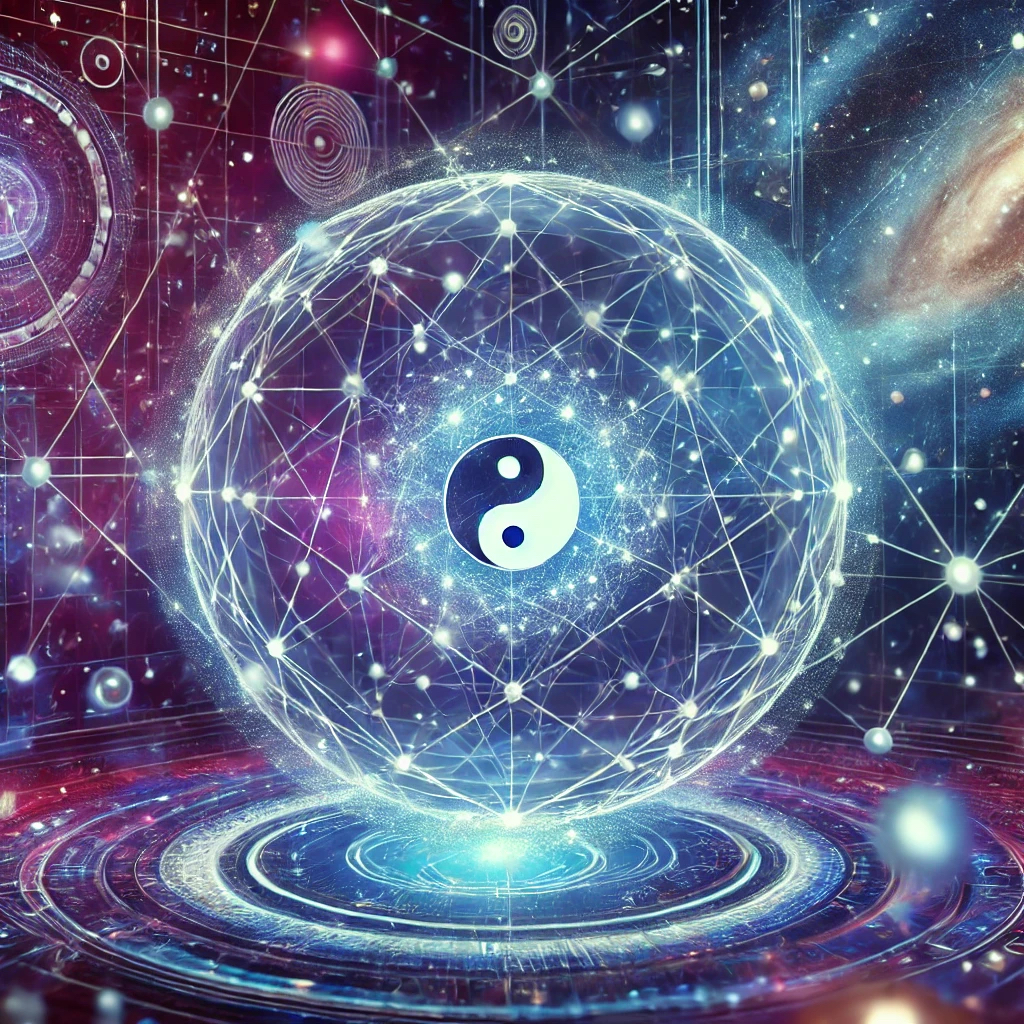
In this model, photons and gravitons do not merely travel through space — they construct it. Photons (open strings) illuminate reality, while gravitons (closed-loop strings) hold it together. Their interplay becomes the code. The light you see, the gravity you feel — together, they project the hologram you live inside. And when I capture an image in nature, I’m not just freezing light. I’m catching the moment the field becomes form.
Through this post, we’ll explore how this balance — defined by my original equation S(P+G)=UFT — may reveal the secret geometry of existence: where string theory, gravity, and photons meet at the edge of perception. And how nature photography can help us see it.

The Holographic Principle: A New Perspective on the Universe
First introduced by Gerard ’t Hooft and expanded by Leonard Susskind, the holographic principle suggests that all the information in our universe could be stored on a two-dimensional surface, with our familiar three-dimensional experience emerging as a projection.
This idea — once confined to black hole thermodynamics — now challenges our entire understanding of space, time, and consciousness. In my Unified Field Theory, I’ve extended this principle to suggest that photons (P) and gravitons (G) are the yin-yang duality at the core of this cosmic projection. As detailed in The Living Code, these opposites are not in conflict — they’re in coherence.
According to S(P+G)=UFT, string theory (S) provides the harmonic resonance through which light and gravity unify. In a holographic universe, it is this vibrational coherence — not particles alone — that determines what is “real.” The surface becomes a vibrational membrane, and photons and gravitons are the code it writes with.
This principle becomes visible in nature photography — when light creates form through reflection, and when gravity holds that form in tension. It’s not a metaphor. It’s field expression. The image above — titled Mother Nature at Her Finest — captures that balance in a moment where color, curve, and cosmic memory all meet.
Through the lens of the Unified Field Theory, the holographic principle is more than theory — it's the mechanism behind perception, memory, even biological coherence. It is the lens through which the field becomes visible. And in the next section, we’ll explore how photons anchor life into visibility through biological lightwork.
Related Reading

Photons and Biological Processes
Photons: Life’s Original Language
Light isn’t just energy — it’s instruction. As I described in Let There Be Light, photons carry more than visibility — they carry the field’s expression, coherence, and memory. From photosynthesis in plants to circadian signaling in humans, photons are the most direct messengers between the quantum field and living cells.
In my sunlight healing blog, we explored how photons trigger the synthesis of vitamin D — a light-coded molecule crucial for immune resilience, bone strength, and genomic activation. But photons do more than spark biology — they tune it. Light acts as a metronome to the body’s natural rhythms, orchestrating everything from mitochondrial respiration to pineal sleep cycles.
Open Strings in the Field: How Photons Move Energy
Within string theory, photons are described as open strings — with loose endpoints that allow them to interact freely with the environment. This open configuration is what enables photons to fuel photosynthesis, initiate skin-to-D conversions, and carry visual data through the eye to the brain. In Quantum Vitality, I described this as light’s ability to not just illuminate — but to encode vitality.
Every photograph is a record of photon logic — an imprint of coherence, memory, and motion. When I photograph a flower under the moonlight or the sun kissing snow, I’m not just capturing a moment. I’m witnessing the field's instructions being written in light. And your biology knows how to read it.

Gravitons and Structural Integrity
Closed-Loop Strings: The Architecture of Gravity
In my S(P+G)=UFT equation, photons are the expressive messengers — but gravitons are the form-holders. These closed-loop strings don’t just bend spacetime — they stabilize it. Unlike photons that move energy outward, gravitons create containment. They hold galaxies in spiral. They bind atoms to molecules. They give structure its silence.
Although not yet directly observed, gravitons are essential to quantum gravity models. I propose that these closed loops are not simply hypothetical particles, but the invisible architecture of the field — functioning like tension lines within a holographic membrane. In this way, they act much like the dark matter we infer but cannot see.
Dark Matter and the Hidden Loops of Coherence
In my dark matter theory, I propose that closed-loop gravitons may be dark matter — circulating invisibly through space, generating gravitational pull without emitting light. They don’t express like photons — they contain. They don’t reflect — they bind. And in a world that often measures only the visible, gravitons remind us that form arises from unseen order.
In the photograph above, gravity and light reach balance: a full moon rising over Whaleback Lighthouse. The image holds more than symmetry — it holds field. What you see is light. What you feel is gravity. The graviton completes the image.

The Interplay Between Photons and Gravitons
Yin and Yang: The Cosmic Balancers
In nature and in theory, light and gravity don’t oppose — they complement. In my Unified Field framework, S(P+G)=UFT, photons (P) and gravitons (G) are not just particles — they are polarities. The photon is Yang — the outward, radiating, energizing strand. The graviton is Yin — the inward, curving, cohering loop. Together, they form the field.
Much like The Living Code expresses Fibonacci spirals through balance and opposition, so too does the cosmos. Photons animate. Gravitons stabilize. One reveals; the other remembers. And in that sacred tension — visibility meets structure, energy meets stillness.
In the image above — a whooping crane mid-flight — the metaphor is vivid. Wings lift through photons. Trajectory holds through gravity. The elegance of motion exists because of the equilibrium between energy and form. And the universe, much like the crane, is never static — it soars because the field breathes in both directions.
Equation Explanation: Unveiling the Balance
S(P+G) = UFT
This original equation encapsulates the coherence at the core of the cosmos:
- S – String theory as the vibrational substrate of reality, weaving all forces through resonance.
- P – Photons: open strings radiating electromagnetic energy and information across the field.
- G – Gravitons: closed-loop strings enclosing gravity, structure, and the architecture of form.
- UFT – Unified Field Theory: the integration of all physical forces into a singular dynamic field.
As described in my original field hypothesis, the unification doesn’t occur through fusion — it occurs through resonance. String theory (S) does not force photons and gravitons to become one — it harmonizes their vibration. Their polarity — open and closed, light and form — is not a conflict but a rhythm. Together, they generate the Unified Field.
This equation is not just math — it’s metaphor. It offers a new lens for interpreting everything from black holes to butterfly wings. It suggests that all structure (G) illuminated by energy (P), when spun through the field of vibration (S), becomes an expression of coherence — or in other words, a Unified Field Theory.

The Holographic Human and Nature Photography
Seeing as Participation
In a holographic universe, to perceive is to project. Your body doesn’t just passively receive photons — it resonates with them. What we call sight is a dance between light (P) and structure (G), unified through vibrational geometry (S). This is not metaphor — it’s encoded physics in biology. And in Quantum Vitality, I propose that our health, memory, and consciousness are deeply tied to this photon-graviton interplay.
When you look at a photograph, you are witnessing a moment when light and gravity were in agreement. A frozen ripple in the field. A two-dimensional imprint of a multi-dimensional interaction. In nature photography, I strive to catch these alignments — when water becomes mirror, when light outlines curvature, when a leaf reflects time itself.
You Are the Hologram
Your body is made of water, light, and gravitational form. That makes you a holographic human — not in theory, but in field mechanics. Your skin interprets photons. Your mitochondria convert their frequency into cellular energy. Your bones are shaped by graviton tension. As explained in The Holographic Universe, you are not separate from the projection — you are both the lens and the light.
So when you witness a landscape, you are not looking at it — you are entering resonance with it. Photography, when seen through this lens, becomes an act of coherence — a sacred exchange between field and form, energy and memory, gravity and grace.

Philosophical Reflection and Dimensional Perception
The Illusion of Depth: Projected by Light, Held by Gravity
Your eyes do not see three dimensions. What they see is contrast, contour, and convergence — a flat field of photons interpreted into depth by your brain. Gravitational cues — such as curvature, shadow, and angular distortion — are integrated subconsciously. This perceptual reconstruction is what I call holographic vision.
Photons (P) deliver the projection. Gravitons (G) embed the spatial tension. And through the resonance of the string field (S), your consciousness weaves a coherent, dimensional model from a flat quantum signal. This is not just how photography works — it’s how you work. You are a field of perception collapsed by coherence.
Yin-Yang of Vision and Form
In the yin-yang structure of reality, photons represent Yang — active, radiant, expressive. Gravitons are Yin — receptive, inward, stabilizing. The balance of the two is what makes perception possible. Too much light without containment, and the world dissolves into glare. Too much gravity without light, and it disappears into darkness. Together, they define shape, space, and silhouette.
In every photograph I take, I feel this polarity. A shadowed birch tree in a sunlit forest. The ripple of water curving around stone. It’s all the same equation at work — S(P+G) = UFT. And it's not just how the universe behaves. It's how we remember who we are.

Implications for Unified Field Theory
A Resonant Framework for Science and Soul
The equation S(P+G)=UFT doesn’t just unify physical forces — it unifies perspectives. It brings together photons (P) and gravitons (G) as complementary polarities, harmonized by string resonance (S), to create a coherent and dynamic field: the Unified Field Theory (UFT).
This model bridges the chasm between quantum mechanics and general relativity — not by forcing a merger, but by revealing their rhythm. Quantum light and gravitational curves aren’t conflicting views. They’re phase-shifted polarities of a single vibrational language. And that language is encoded not just in math, but in the visible world — in reflection, balance, gravity, and breath.
Cross-Disciplinary Potential
- Physics: Offers a resonant model for quantum gravity, dark matter, and cosmological coherence.
- Biology: Explains cellular communication and coherence through photonic signaling and gravitational structuring.
- Consciousness: Provides a framework for how holographic memory and perception emerge from light-gravity balance.
- Photography & Art: Validates that images aren’t just visual — they’re encoded with vibrational structure and field memory.
- Philosophy: Reframes yin and yang as field-based physics, not just metaphor — showing how polarity births unity.
This is more than theory. It’s practice. Every photo I take, every pattern I witness in nature, is a living proof of resonance. Through light and gravity, through open and closed loops, the field speaks. And we are just beginning to remember how to listen.
Robbie George Photography’s Contribution
Visualizing the Invisible
Through photography, I don’t just capture nature — I translate the field. Each photo is a resonance imprint: a harmonic between light (photons), gravity (gravitons), and the vibrational threads (strings) that hold the scene in coherence. My work isn’t just about beauty. It’s about revealing the Unified Field through the lens of natural form.
Whether it’s the curve of a wave at Diamond Beach or the stillness of fog in Acadia, every image is a portal into S(P+G)=UFT. It shows that what we call a “photograph” is a holographic intersection of energy and tension. It’s the moment the cosmos reflects itself — and lets you see its code.
Bridging Art, Nature, and Theory
In the age of complexity, my work is about simplification — not reduction, but resonance. As I continue developing The Unified Field Theory through visual and poetic form, I hope to build a bridge between science and soul. Between the math and the memory. Between light and the heart of gravity.
Photography becomes a form of quantum storytelling — revealing not just what nature looks like, but how it functions as field.
Final Reflection: You Are the Field Remembering Itself
What if reality isn’t built — but projected? What if memory isn’t stored — but resonated? What if your body, your thoughts, your vision of the stars… are all stitched together by the balance of two strings: one that shines, and one that holds?
That is the vision behind S(P+G)=UFT. A theory born not from equations alone, but from rivers, moonlight, dew, and the shadows between birch trees. It’s a call to see gravity not just as a force, but as the container of memory. To see light not just as illumination, but as the voice of coherence.
“Through every photo, the field remembers how to sing.” — Robbie George
✨ Explore the Field Further:
• Learn more about The Unified Field Theory →
• Read the next chapter in The Living Code →
• Dive into the gallery: Nature Photography Prints →
• Visit the full collection: Quantum Nature Series →
Naturepedia Connections
This article connects light, gravity, and perception to real-world observation—linking photons, structure, and field behavior across ecosystems, wildlife patterns, and visual experience.
About the Author

Robbie George is a National Geographic–published nature photographer and field-based observer whose work focuses on how light, structure, and timing create the patterns we experience as reality.
This article explores photons and gravity through that same lens—treating light, curvature, and form not as abstract theory, but as observable behavior seen in landscapes, wildlife, and natural systems.
Through photography, these patterns become visible. Field observation scales into theory, and theory reconnects back to real-world conditions—forming a continuous system across Naturepedia, perception, and the Unified Field framework.
FAQs: The Holographic Universe — A Balance of Photons and Gravitons
1. What is the holographic principle and how does it relate to UFT?
The holographic principle proposes that all the information in a volume of space can be described on its two-dimensional boundary. In Robbie George’s UFT model, this concept is extended through the equation S(P+G)=UFT, showing how photons and gravitons encode reality as a projected field through vibrational balance.
2. What is the meaning of the equation S(P+G)=UFT?
This original equation states that when photons (P) and gravitons (G) are brought into harmonic coherence through string resonance (S), the result is a Unified Field Theory (UFT). It bridges string theory, quantum mechanics, and general relativity into one vibrational framework.
3. What is the difference between photons and gravitons in this theory?
Photons are open strings — radiating electromagnetic energy, light, and information. Gravitons are closed-loop strings — binding space through gravitational tension. Together, they form a yin-yang polarity that defines all physical and perceptual structure in the universe.
4. How does this theory relate to nature photography?
Every photograph is a frozen projection of this photon-graviton interaction. Light outlines form, and gravity contains it. Through the lens of nature photography, these field relationships become visible — making the holographic universe something we can not only describe, but feel and see.
5. How does this model explain human perception?
In this framework, perception is holographic. Your eyes capture two-dimensional fields of photons. Your brain reconstructs those into depth using gravitational cues. This suggests that we live inside a projected reality, where form and consciousness arise from light and gravity in balance.
6. What role do photons and gravitons play in biological processes?
Photons regulate biological timing, vitamin D synthesis, and mitochondrial function. Gravitons, though not directly observed, may influence cellular cohesion and structural order. Together, they shape the coherence of living systems, as explored in Quantum Vitality and Sunlight Healing.