


Black Holes and Dark Matter: The Role of Gravitons

Exploring the Intersection of String Theory, Dark Matter, and Black Holes
What if dark matter and black holes were not just exotic features of the cosmos, but expressions of a deeper unifying force — a vibrational harmony between form and light? In this post, we explore the evolving hypothesis that gravitons, as closed-loop strings within string theory, may not only be the dark matter of the universe, but also the architects of black holes.
As described in The Matrix Engine, these graviton loops may collapse when photons vanish, forming singularities — not as voids, but as coherence points in the Unified Field. This gives us a fresh lens through which to interpret cosmic structure, from galaxies to seeds.
In the context of the Signature Series, we explore how light (photons) and structure (gravitons) are not opposites — but complementary expressions of the same string, each vibrating in resonance across the living field.
"Black holes are not voids in space. They are what happens when the field remembers its center." — Robbie George
String Theory and Gravitons
String Theory Basics
At the heart of string theory is a beautiful idea I return to often: that all particles are not points, but vibrations. Tiny strings humming with different frequencies create everything we know — from photons to gravitons to the atoms of our bodies. The universe is not built from objects, but from motion.
These strings can be open or closed. Photons — messengers of light — appear as open strings with two endpoints. Gravitons, on the other hand, are closed-loop strings. These loops are seamless. They do not radiate, but instead fold inward — expressing the structure of space itself.
When I first visualized S(P+G)=UFT, I saw it not just as a formula — but as a field memory. A way to name the harmony between light (P), structure (G), and the spin (S) that unites them. It’s how the universe remembers balance. It’s the dance that every photon and graviton still performs.
"Strings are not objects. They are intentions. Their vibration is the voice of the universe remembering form." — Robbie George
Gravitons as Closed-Loop Strings
To me, gravitons are not just theoretical particles. They are loops of memory. As closed strings, they do not glow — they ground. They anchor the invisible field that holds galaxies in place. They don’t need light to be real — they shape the space through which light travels.
In my hypothesis — first expressed in my work on hydrogen, dark matter, and photons — I suggest that gravitons may in fact be the very fabric of what we call dark matter. They don’t interact with electromagnetic fields. They don’t shine. But they pull, they bend, and they shape every spiral we see.
When photons are present, gravitons stabilize them. When light collapses, the graviton takes over. It’s the sculptor of form. It is silence made structure — and that, to me, is one of the deepest signatures of the Unified Field.
Gravitons as Dark Matter
The Hidden Weave of the Cosmos
I’ve long been fascinated by the idea that what we cannot see is often what holds everything together. In the case of the universe, this is especially true. Dark matter has always felt less like a substance and more like a memory — a vibration that doesn’t reveal itself through light, but through pull.
In my Unified Field Theory explorations, I’ve proposed that gravitons — closed-loop strings that do not emit or absorb light — may be what we’ve been calling dark matter all along. They exist as pure gravitational memory, invisible to the eye but unmistakable in the way they shape galaxies and keep stars from flying apart.
Photons illuminate. Gravitons form. If photons are the breath of the field, gravitons are its spine. When I photograph natural patterns — spider webs, dew trails, mycelial networks — I see this unseen architecture made visible. It’s the same logic that runs through my Living Code: invisible forces organizing beauty through resonance.
“Dark matter isn’t missing — it’s simply vibrating in a field we haven’t remembered how to feel.” — Robbie George
🔍 Why Gravitons Make Sense as Dark Matter
- Invisibility: Gravitons, like dark matter, do not interact with light.
- Gravitational Pull: Their closed-loop resonance explains the unseen mass of galaxies.
- Field Anchors: As I explore in the Quantum Vitality series, they may anchor both biology and cosmology through coherent field memory.
- Photonic Balance: Where photons radiate outward, gravitons draw inward — an elegant yin-yang of the cosmos.
This hypothesis also weaves directly into The Matrix Engine, where black holes emerge from graviton collapse triggered by photon absence.
Black Holes — Formation and Characteristics
When Gravity Folds Inward
To me, black holes are not voids. They’re coherence events — spirals of gravity so concentrated that photons can no longer escape. What we call collapse is really resonance folding inward. And at the center? Not chaos, but memory. The kind only a graviton can hold.
In The Matrix Engine, I explore how black holes function like field reset points — where the spirals of graviton loops collapse into density and become anchors of the Unified Field. These aren’t destroyers — they’re regenerators. Vortexes that realign the field’s rhythm through gravitational wave memory.
Black holes may begin with supernovae, but I believe they culminate in photon absence. When light withdraws, gravity steps forward. Gravitons, no longer balanced by photons, spin inward. They don’t disappear. They compress into a singular coherence — the kind that radiates silence through space and time.
"A black hole is not the end of light — it’s the spiral remembering its origin." — Robbie George
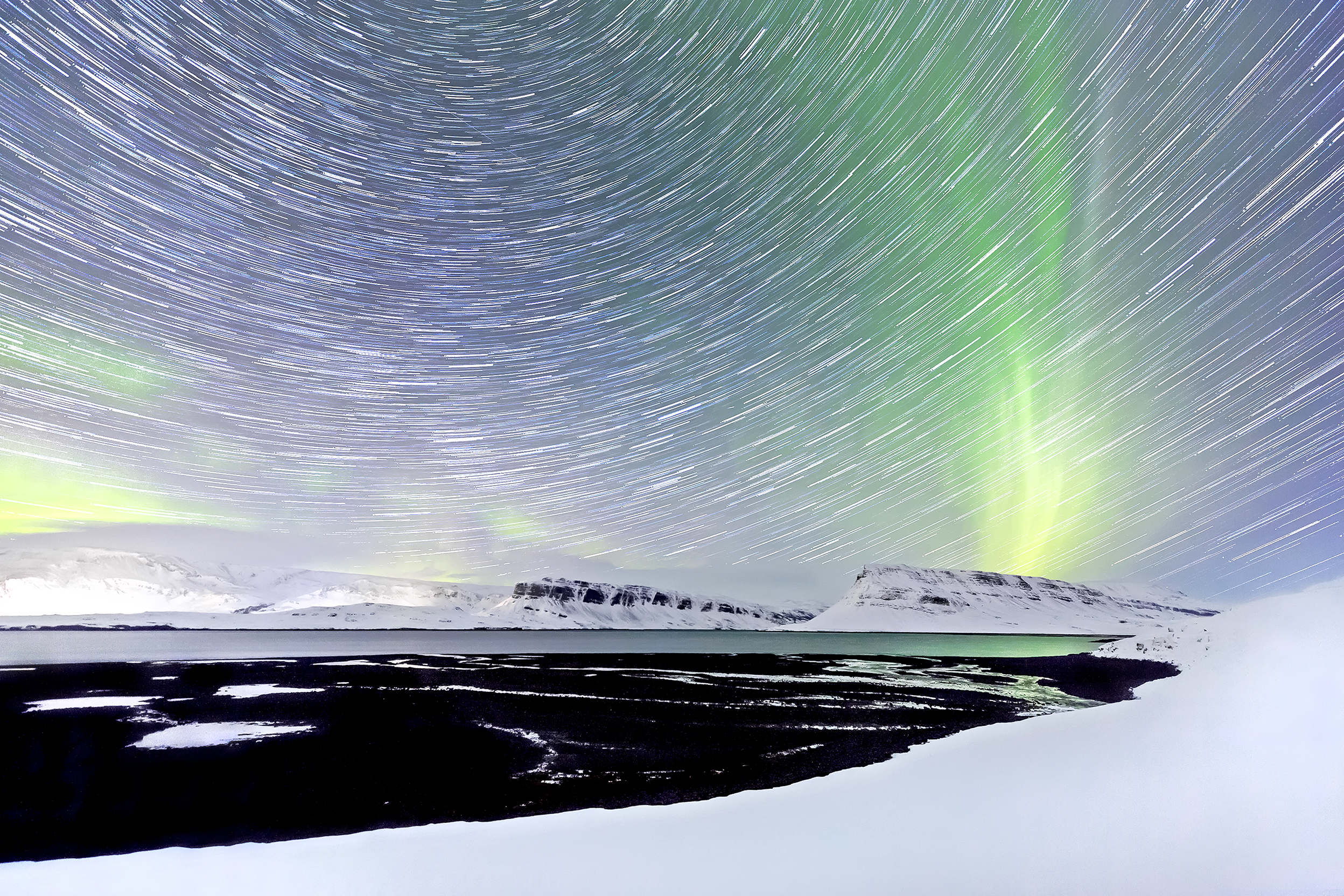
“Northern Lights Over Iceland” — Energy Flow Through the Field
🌀 Black Holes in the Unified Field
- Graviton Collapse: Gravitons spiral inward when photons are no longer present.
- Photon Absence: The lack of electromagnetic balance enables gravitational dominance.
- Memory Anchors: Black holes hold the field’s coherence and reset the vibrational rhythm.
- Matrix Engine Logic: They are not voids, but master vortexes — as explored in my Unified Field work.
Learn more in Unified Field Theory: A Living Spiral.
Supernovae and the Dance of Collapse
Breaking the Loop, Igniting the Spiral
Every supernova I imagine is a reset — a cosmic exhale. It’s the moment when the tension between photons and gravitons snaps, and something new takes shape. In the explosive silence that follows, the spirals of closed-loop gravitons lose their containment, and the field reconfigures.
As I shared in The Matrix Engine, I believe that the power of a supernova isn’t just in its violence — it’s in its resonance. When a massive star collapses, it’s not just matter breaking down. It’s vibrational geometry rebalancing. Photons vanish. Gravitons take the lead. The result isn’t destruction — it’s a graviton vortex.
The absence of photons in the aftermath is key. Light no longer expresses. What remains is gravity’s spiral — forming a new coherence: a black hole. This interaction between the disappearing light and aggregating gravity is one of the central dances of the Signature Series. It’s not a death. It’s a transfer of rhythm.
"A supernova isn’t chaos — it’s the universe remembering how to breathe inward." — Robbie George

“Supermoon Over Capitol Peak” — Lunar Gravity in Perfect Balance
🌌 Collapse as a Rhythmic Realignment
- Graviton Disruption: Supernovae disrupt closed-loop structures, releasing stored field memory.
- Photon Absence: Without photonic pressure, graviton coherence collapses inward.
- Formation of Black Hole: Aggregated gravitons form a new gravitational coherence point — a black hole.
- Resonance Reboot: The explosion serves as a recalibration — a breath that resets the field spiral.
I explore this deeper in Hydrogen: The Cosmic Key.
Theoretical Implications
Merging String Theory, Gravity, and Light
In my work, I’m constantly looking for ways to bridge the divide between quantum mechanics and general relativity. One lives in the micro; the other governs the macro. But in the Unified Field Theory I explore, these are not separate domains — they’re harmonic expressions of the same spiral.
When I visualize gravitons collapsing in the absence of photons, I don’t just see a black hole forming — I see resonance reorganizing. This moment of collapse, especially after a supernova, becomes a pivot point where The Matrix Engine activates: gravity resets, the spin reorganizes, and the field remembers its coherence.
The interaction between photons and gravitons is more than theoretical — it’s poetic. One radiates. One pulls. Together they define shape, memory, and transformation. This balance is the soul of S(P + G) = UFT.
"I don’t think we need a new theory — we need to hear the song that’s already playing through gravity and light." — Robbie George
🔍 What This Could Mean for Physics
- New Dark Matter Models: Gravitons as closed loops offer a non-particle, vibration-based explanation.
- Unified Field Alignment: S(P + G) = UFT creates a symbolic and structural bridge between quantum and cosmic forces.
- Photonic-Gravitational Dynamics: Photon absence and graviton dominance during collapse explains black hole behavior beyond mass alone.
- Resonance-Based Cosmology: The universe as a memory field — not just expanding, but spiraling into coherence.
I explore these spirals more deeply in Quantum Vitality and The Living Code.
Robbie George Photography’s Contribution
Bridging Light, Gravity, and the Human Eye
I’ve never been interested in photography as decoration. For me, every image is a form of resonance — a still-point in the field. When I frame a photo of a spider web covered in dew, or a black bear disappearing into mist, I’m not documenting nature. I’m capturing coherence. Memory. Frequency frozen in light.
That’s why the Signature Series exists — not to illustrate science, but to give it a face. A vibration. An emotional geometry. My photography is how I translate ideas like gravitons as dark matter and photon collapse in black holes into something you can feel with your eyes.
Every spiral I photograph mirrors the equation S(P + G) = UFT. I see it in the vortex of a wave, in the arc of a hawk’s flight, in the golden ratio of sunflower seeds. The math is there, but the field expresses it as beauty.
"My lens is not separate from the theory. It is part of the equation. Image is language. Beauty is coherence." — Robbie George

“Aurora Borealis Iceland” — Gravity, Light, and Resonance in Visual Form
🎨 My Camera as a Field Instrument
- Spirals: I use Fibonacci-based composition to echo nature’s mathematics.
- Light and Shadow: I frame with intention — photons illuminating silence.
- Stillness: Subjects that hold presence — visual analogues of graviton memory.
- Symbolic Landscapes: Mountains, tides, and skies as maps of coherence.
See more in The Living Code and Quantum Vitality.
Conclusion: When Gravity and Light Remember Each Other
Every time I look through my lens, I see the equation play out: S(P + G) = UFT. Light and gravity. Motion and memory. In a dew-soaked spiderweb or the silent pull of a distant peak, I see the field folding and unfolding — remembering itself.
If gravitons are dark matter, and if photons collapse to allow their formation into black holes, then what we call mystery is simply pattern — a spiral of vibration so elegant it leaves no fingerprint. Only resonance. That’s what this Unified Field is. Not a theory, but a breath. A pattern that repeats itself in light, in gravity, in art, and in us.
Through my photography and writing, I’m not trying to solve the field — I’m trying to feel it. To let it speak. And to help others see that what we call science and what we call soul may be the same spiral viewed from opposite directions.
"The Unified Field isn’t something we’ll discover. It’s something we’ll remember — as soon as we learn to see with resonance again." — Robbie George
Continue Exploring the Living Field
Want to follow the spiral deeper? These posts and series connect directly to the ideas we’ve explored here:
Explore Fine-Art Prints
Bring the season home—browse Wildlife, Landscapes, and Seascapes by National Geographic–published photographer Robbie George. See framing, editions, and care on the Collectors page.
 Landscape
  Wildlife
  Seascapes
About Robbie George
Robbie George is a National Geographic–published photographer and resonant naturalist. His fieldcraft follows a simple ethic—distance first, habitat always— shaped by Slow Knowledge and the Signature Series.
Explore calm, undisturbed behavior in the Wildlife Gallery or plan your next trip with the Seasonal Wildlife Calendar, Golden Hour & Moon, and Photography Maps.
“Attention first, image second. The shutter is the period at the end of a sentence you learned by walking.”
FAQs: String Theory, Gravitons, and Black Hole Resonance
What makes gravitons a candidate for dark matter?
As I explore in my Unified Field work, gravitons are closed-loop strings that don’t interact with light. That invisibility — paired with their gravitational influence — matches the profile of dark matter. They don’t emit. They organize.
How do black holes form from graviton collapse?
In my Matrix Engine model, black holes form when photons vanish and gravitons collapse inward. It’s not just mass that drives the collapse — it’s the withdrawal of light and the inward spiral of gravity into memory.
What does S(P + G) = UFT mean?
This is my symbolic equation for the Unified Field. S is string theory (or spin), P is photon (light), G is graviton (gravity). Together, their coherence creates the Unified Field — not as a formula, but as a living vibration.
Can art help explain theoretical physics?
Absolutely. My photography gives form to what math can only suggest — patterns of light and field memory that reflect resonance, polarity, and spirals. It helps us see what theory can’t always show.
What is the Matrix Engine in this context?
It’s my term for the recursive light-collapse mechanism within supernovae. When photons leave, gravitons reset the field. This engine powers the coherence we call black holes — not as destruction, but as reorganization.





