

Hydrogen: The Cosmic Key to Understanding Gravitons, Photons, and Dark Matter
The Fundamental Role of Hydrogen in the Universe
As I’ve deepened my exploration of nature's energetic patterns, I've come to see hydrogen not just as the universe’s most abundant element—but as its most eloquent storyteller. Hydrogen composes over 75% of all elemental mass, yet within its single proton and electron lies a symphony of potential—unfolding into photons, whispering gravitons, and perhaps even the cloak of dark matter.
In this post, I trace hydrogen’s path across time and scale, from its role in nuclear fusion to its potential in solving mysteries of unified field theory. Along the way, I’ll introduce an updated version of my equation—Hclosed + Hclosed → graviton → Photonopen—and explore how it integrates into my ongoing work in the Unified Quantum Blueprint.
For those who’ve followed my Signature Series, this is the next step—a unifying look at hydrogen through the lenses of light, gravity, resonance, and simplicity.
"In the simplest atom, the whole cosmos bends light into form." – Robbie George
Hydrogen: The Building Block of the Universe
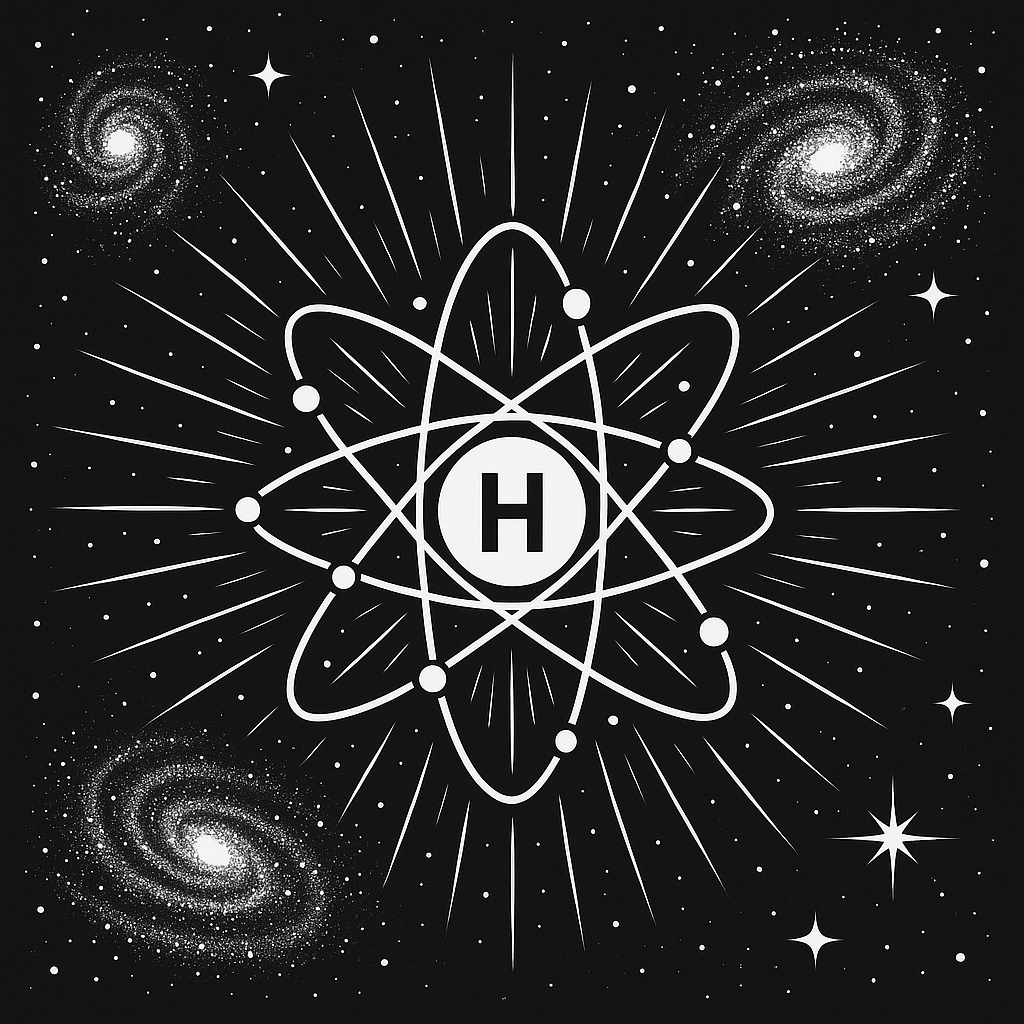
In all the years I’ve studied nature—from starlight to dew—no element has captured my curiosity like hydrogen. It’s everywhere. It’s everything. Constituting roughly 75% of all elemental mass, hydrogen is the backbone of the cosmos, quietly orchestrating the formation of stars, the structure of galaxies, and the origin of life itself.
As I outlined in The Quantum Symphony, hydrogen is more than just a particle—it’s a resonator. When it collides in the heart of a star, it ignites a transformation: the closed-loop atom splits and opens, releasing photons, or pure light energy. This is where light is born. This is how energy becomes visible.
But hydrogen’s role doesn’t stop there. In exploring how gravitons might be understood, I began to notice that the closed-loop form of hydrogen resembled the string-theory model of a graviton. Could it be that this tiny atom acts as a gravitational mediator across quantum and cosmic scales? The idea inspired my unified equation: Hclosed + Hclosed → graviton → Photonopen.
This equation reflects a principle I revisit throughout the Signature Series: everything is connected, and hydrogen is the messenger. In Hydrogen: The Cosmic Key, I proposed that hydrogen’s various states may even account for aspects of dark matter, bridging gravitational influence with undetectable mass. The simplicity of this element may very well hold the most profound cosmic secrets.
Hydrogen is the unifier. Whether fueling stars or forming water, whether bending gravity or birthing light, it is the element that weaves together the fabric of the universe. And when we listen closely enough, its vibration echoes in the pulse of life itself.
Gravitons and Hydrogen
One of the more provocative questions I’ve asked throughout my Signature Series is this: What if hydrogen isn’t just a building block of matter—but also the carrier of gravity itself?
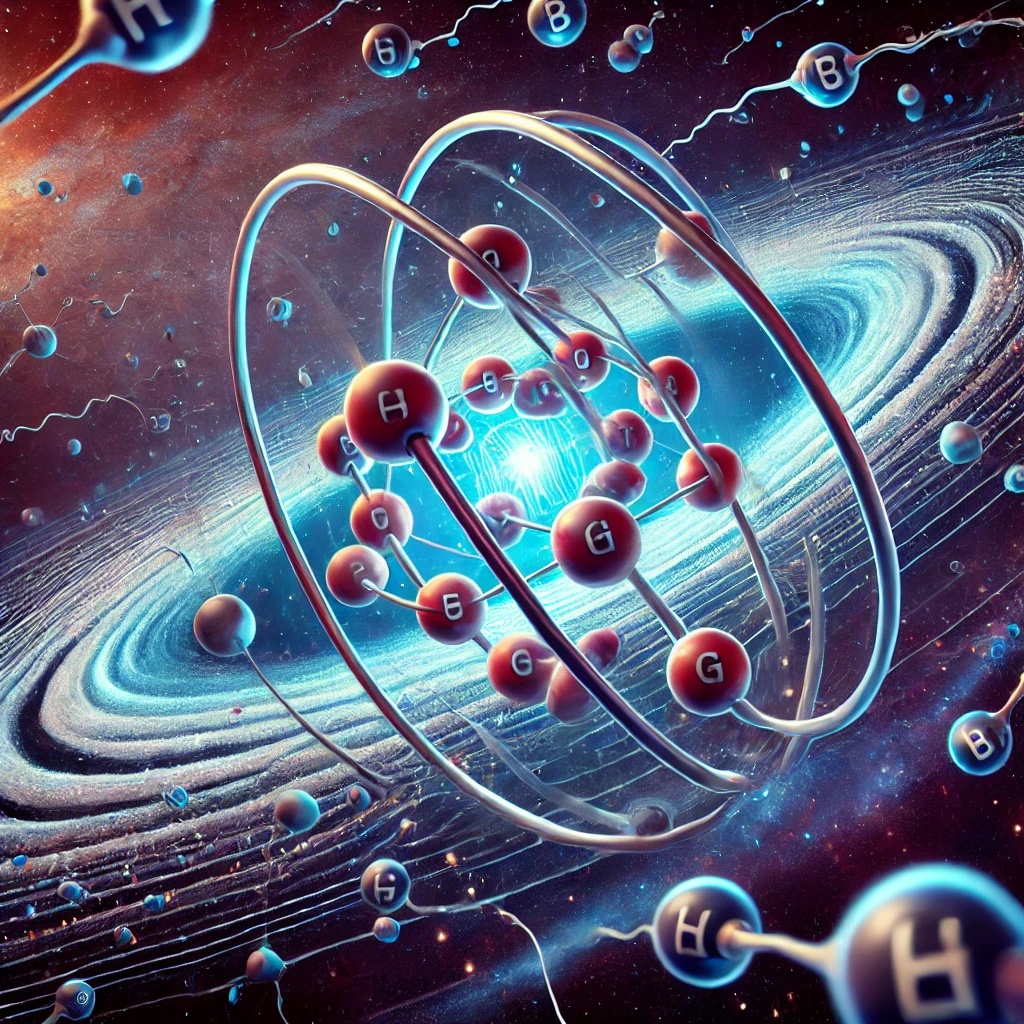
In string theory, gravitons are theorized as closed-loop vibrating strings that mediate the gravitational force. When I began examining hydrogen more closely, I noticed its atomic simplicity—a single proton and a single electron—forms what could be seen as a closed loop. This resemblance isn’t just poetic; it might be physical. Could hydrogen atoms, in their ground-state configuration, actually function as quantum carriers of gravity? This question led me to develop the graviton segment of my unified equation: Hclosed + Hclosed → graviton → Photonopen.
The implications of this are profound. If hydrogen’s closed-loop form resonates with graviton theory, then gravity may be carried not by exotic particles we’ve never seen—but by the most abundant element in the universe. This bridges the quantum scale with the cosmic, echoing the Unified Field Theory goal I’ve written about in S(P+G) = UFT.
In Harnessing Earth's Resonance, I explored how animals interact with Earth’s fields through resonance. If life responds to gravity not as a static force, but as a vibration, then hydrogen’s potential role as a resonant graviton becomes even more meaningful—especially when scaled into galactic spirals, black holes, and molecular structure alike.
For me, this isn’t just theoretical physics. It’s nature’s fingerprint. If the gravitational hum of the universe is written in hydrogen, then every atom, every drop of water, every breath we take is suspended by a field far more poetic—and more elegant—than we ever imagined.
Nuclear Fusion and Photon Creation
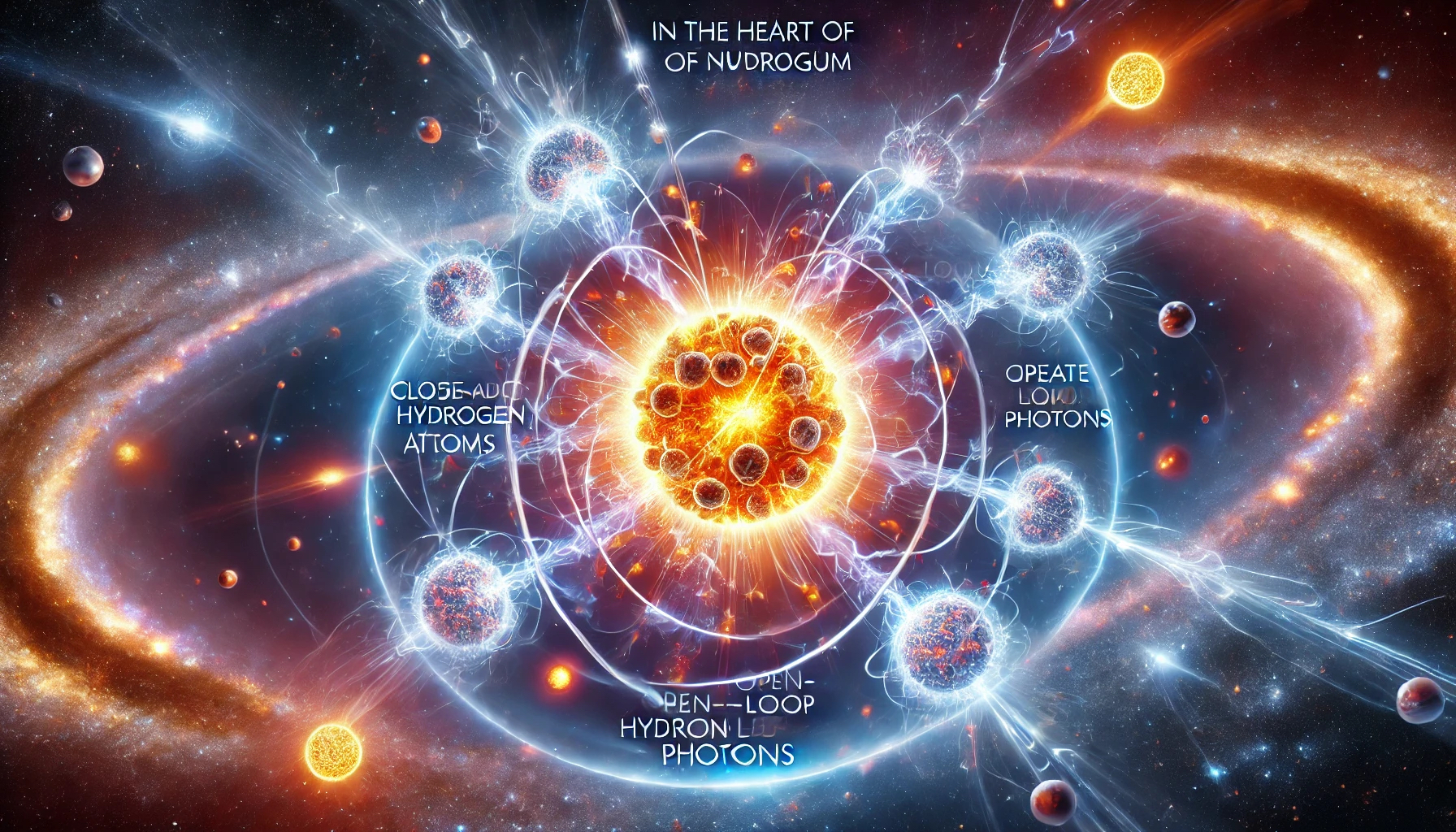
In the heart of stars, hydrogen undergoes a stunning transformation. Under immense pressure and temperature, hydrogen atoms fuse together—unlocking one of the universe’s most powerful forces: nuclear fusion. It’s here that closed-loop hydrogen atoms rupture and release light. Not metaphorical light—literal, radiant photons.
This moment is more than a chemical reaction. It’s a cosmic metamorphosis. I’ve come to view fusion as the breaking of the hydrogen loop—what I call the transition from Hclosed to Photonopen. It's a vital part of the equation I developed in my Unified Quantum Blueprint series: Hclosed + Hclosed → graviton → Photonopen.
Once released, these photons travel as waves and particles—carrying energy across light-years, bathing planets like ours in warmth, and fueling the delicate systems of life. Their journey is timeless, tracing back to fusion furnaces billions of years ago. What fascinates me is how these photons, born of hydrogen, are not just visible light—they’re also memory keepers of creation itself.
In Captured Light, I explored how photons carry both energy and intelligence. They’re responsible for triggering photosynthesis, shaping visual perception, and interacting with electrons through resonance. This fusion-born light quite literally animates life—and at its root is hydrogen, the silent architect of illumination.
When I reflect on this process—hydrogen’s fusion, photon release, and light’s long journey—I’m reminded that every sunrise is a story written in hydrogen. And every ray of light is a message from the stars.
Photon Properties and Electron Interaction
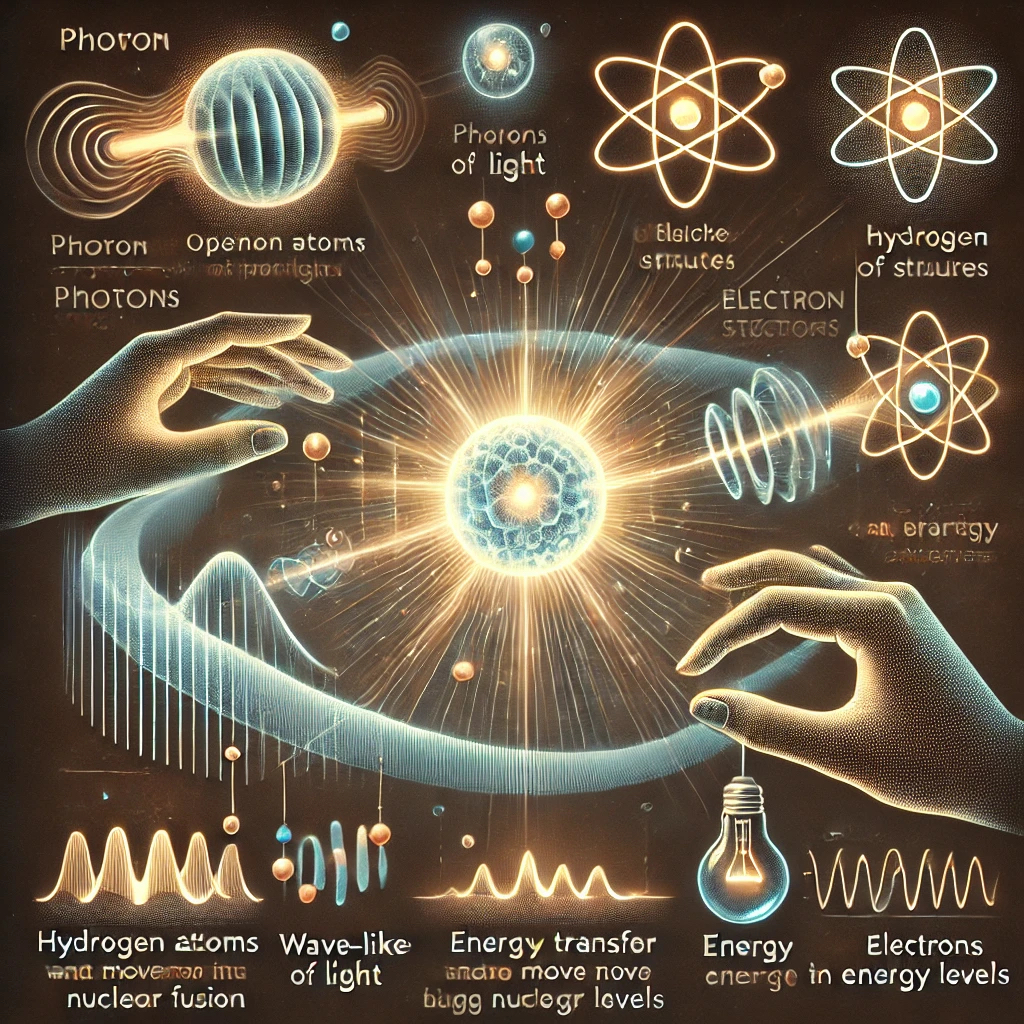
After hydrogen splits open during fusion, photons are released—tiny packets of energy that define so much of what we see and feel. These Photonopen strings are not static; they move as both waves and particles, embodying the very duality that defines quantum mechanics. In my Unified Quantum Blueprint, photons are more than light—they are messengers of transformation.
One of the most fascinating aspects of photons is how they interact with electrons. These interactions create ripples of energy transfer—from the photoelectric effect to Compton scattering. But I’ve come to see them as something more: a catalytic handshake. The electron acts like a fuse, igniting the brilliance of the photon’s journey, without ever becoming it.
These two never merge. Instead, their resonance alters direction, frequency, and behavior—like two instruments harmonizing in a field of possibility. This subtle dance is essential to how light bends, reflects, refracts, and ultimately animates the world around us.
In The Quantum Symphony, I explored how these dynamics extend beyond physics and into the language of nature itself. Just as water carries memory, photons carry the story of energy’s liberation—from stars, from atoms, and from the ancient script written into hydrogen.
Every photograph I take is, in a way, a record of photon-electron interaction. And behind each frame lies hydrogen—the atom that split to let the universe shine.
The Role of Electrons in Solar Flares
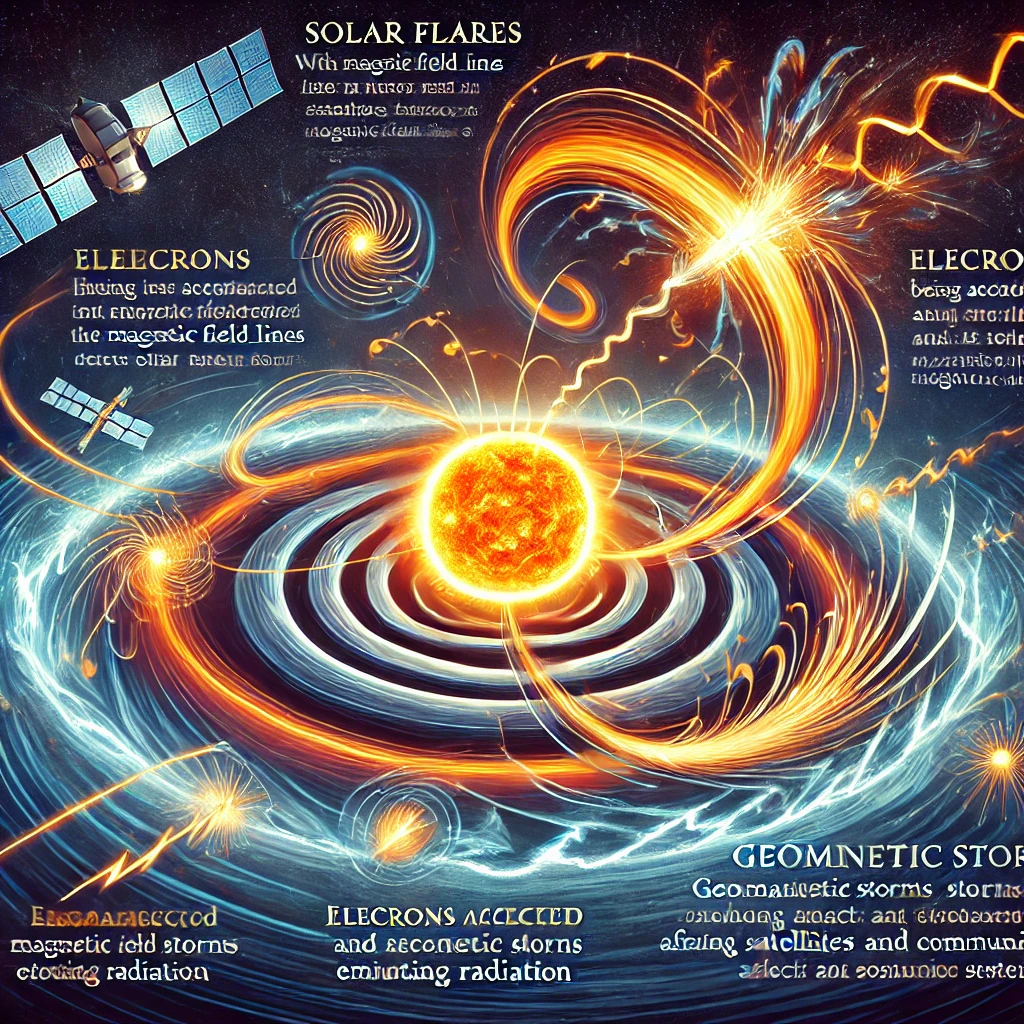
Solar flares are not just violent outbursts from our star—they're radiant expressions of tension released. At the center of these cosmic eruptions are electrons, accelerated by the Sun’s magnetic field lines as they reconnect and snap like taut cords of light. During these events, I imagine the electrons as quantum messengers, spiraling into higher states of energy, releasing radiation across the spectrum—from radio waves to gamma rays.
In the Unified Quantum Blueprint, I often return to this moment of electron acceleration. It is resonance unleashed. When magnetic reconnection happens—when the invisible field lines of the Sun collapse into a new configuration—it is as though a cosmic chord resolves. The electrons, dancing along these lines, respond in kind, becoming conduits for energy release and pattern reformation.
What fascinates me is how these solar flares reach across space to touch our world. When the high-energy particles slam into Earth’s magnetosphere, they induce geomagnetic storms—rippling through communication systems, satellite technology, and even the power grid. We are not separate from these solar pulses. They shape the environment we inhabit and the rhythms of life we navigate.
In this light, electrons are not just subatomic particles—they are the filaments that thread cosmic intention into action. They remind me that energy is not static. It moves, evolves, and sometimes bursts into brilliant revelation. Solar flares are that revelation. They’re proof that even chaos can have structure, and electrons are there to conduct its symphony.
Hydrogen as Dark Matter
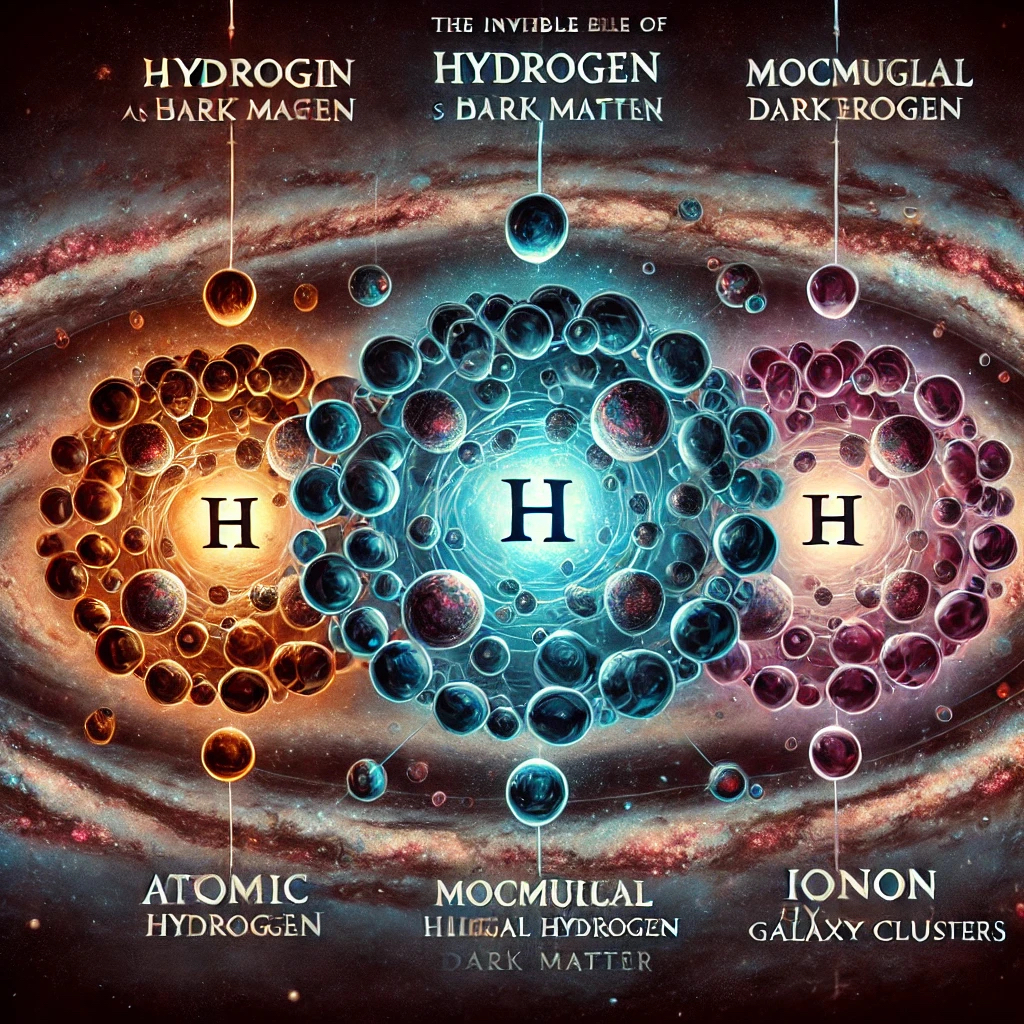
One of the most elusive mysteries in cosmology is dark matter. It neither emits nor absorbs light, yet its gravitational fingerprint is everywhere—from the spin of galaxies to the scaffolding of the cosmic web. I’ve long wondered: what if the answer isn’t hidden in the exotic, but in the humble? What if hydrogen, the universe’s simplest element, holds the key?
In The Quantum Symphony, I explore how water, ions, and vibration echo across scales of existence. Hydrogen plays the starring role in that symphony—not only as the foundation of water but also as a potential agent of gravity in disguise. Some forms of molecular hydrogen—especially in cold, invisible clouds—may escape detection yet exert gravitational force.
If closed-loop hydrogen atoms exhibit string-like coherence, as proposed in S(P+G)=UFT, they may behave like gravitons, mediating gravity without interacting with light. Their invisibility isn't their weakness—it's their power. They weave the unseen structure of the cosmos, anchoring stars in spiraling arms and shaping the gravitational scaffolding galaxies climb upon.
This vision reframes dark matter not as something “other,” but as something deeply familiar—hydrogen in forms and states we’ve yet to fully appreciate. When I stare at the night sky and photograph its stillness, I sometimes wonder how much of that black space is quietly cradled by invisible hydrogen, holding galaxies together with ancient resonance.
The New Iconic Equation
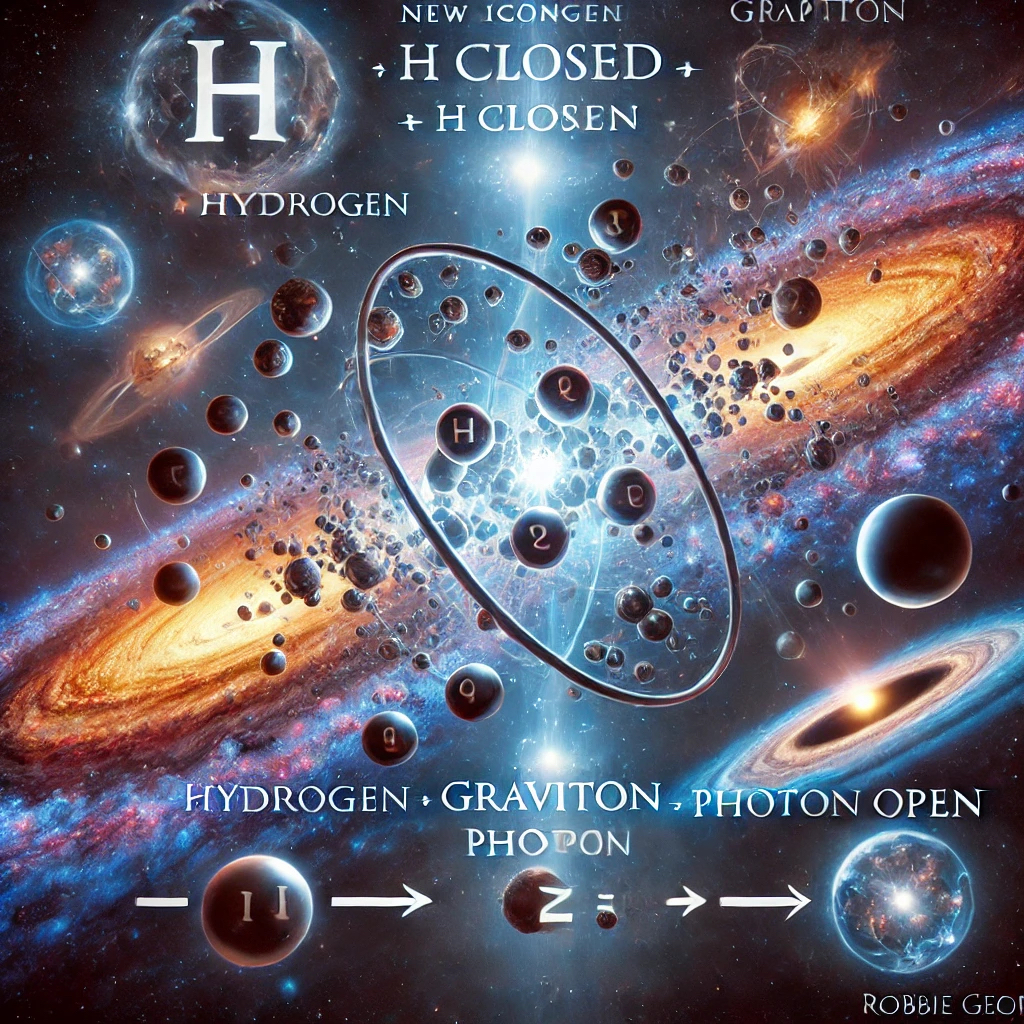
After years of exploring the resonance between photons, gravitons, and life, I began to see a repeating pattern—a cycle from containment to release, from silence to radiation. At the center of that cycle is hydrogen. To express this dynamic transformation, I developed a new equation to illustrate how hydrogen may bridge gravity and light, the unseen and the visible:
Hclosed + Hclosed → graviton → Photonopen
In this model, Hclosed represents hydrogen atoms in a coherent, closed-loop state. When two such atoms interact under intense conditions—like in nuclear fusion—their vibrational frequencies resonate and may give rise to a graviton, a theoretical quantum particle of gravity.
That graviton then catalyzes the creation of a Photonopen—an open-loop structure of radiant energy, releasing light into the universe. This equation reveals how the most abundant element in the universe may serve as the translator between gravitational curvature and photonic freedom.
This framework harmonizes with the Unified Quantum Blueprint, which I designed to explore the resonance between structure and spirit, vibration and matter. Just as water remembers and photons release, hydrogen is the silent key that unlocks both.
Connecting to the Unified Quantum Blueprint
The equation Hclosed + Hclosed → graviton → Photonopen is not just a mathematical expression—it's a living metaphor for transformation. It aligns precisely with my Unified Quantum Blueprint, which weaves together the roles of water, hydrogen, vibration, and information as nature's code.
In this blueprint, hydrogen becomes the thread that sews micro and macro together. Its closed-loop form echoes the graviton’s structure, while its release through fusion opens the loop—emitting photons, the language of light. This cycle of containment and release underpins my equation and reflects nature’s own.
This blueprint is also supported by observations from my blog posts such as Let There Be Light and The Marvel of Water. Hydrogen is involved in both: it lights the stars and composes water, the fluid matrix of life.
Every transformation in the cosmos—be it the birth of a star, the ignition of a photon, or the fusion of hydrogen—resonates with the deeper geometry of the universe. The Unified Quantum Blueprint helps us sense these relationships, not as separate events, but as cycles within one grand pattern of unfolding.
This equation is not the end—it's a door. And behind it lies the harmonic resonance of everything.

Practical Implications and Personal Insights
The simplicity of hydrogen, paired with its capacity to birth stars and inform gravity, inspires more than theoretical equations—it shapes the way I see nature through the lens. Whether I’m photographing wildflowers, starlight, or the liquid breath of a waterfall, I sense hydrogen in motion: forming bonds, breaking them, and carrying memory across time and scale.
Hydrogen’s role in the structure of water touches every ecosystem I photograph. Its transformation into light through nuclear fusion underpins every photon that passes through my camera. And its potential to serve as a gravitational thread adds a spiritual dimension to the act of seeing—reminding me that beauty isn’t just surface; it’s resonance.
When I wrote the equation Hclosed + Hclosed → graviton → Photonopen, I wasn't trying to out-theorize physicists. I was listening to the way nature speaks through form and function—through how bees dance, how light bends around a mountain, how hydrogen rises as mist, only to fall again as rain. It was my way of saying: this all matters, and it all connects.
These aren’t just ideas to me—they’re field notes from a life lived in harmony with wild places. As I’ve explored in posts like Pioneering Integrative Science and The Soil Microbiome: The Lungs of Our Planet, understanding hydrogen’s simplicity has helped me see nature not as a set of problems to solve, but as a code to remember.
That’s the essence of the Unified Quantum Blueprint—it’s not something I invented. It’s something I uncovered, frame by frame, breath by breath, hydrogen by hydrogen.
The Simplicity of Hydrogen
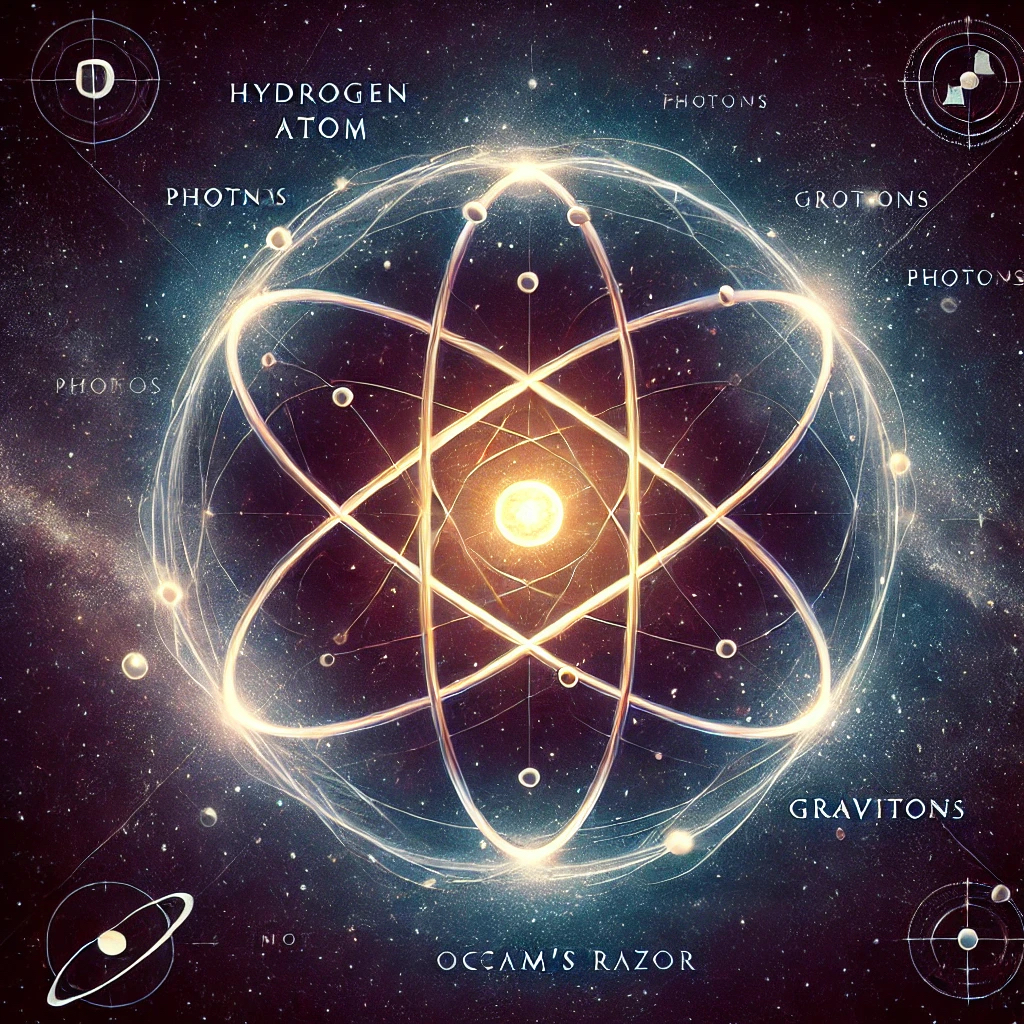
At the core of the universe’s complexity lies an elegant constant—hydrogen. It is the smallest atom, the most abundant element, and yet, perhaps the most profound storyteller. With one proton and one electron, hydrogen carries enough simplicity to model atoms, and enough potential to power suns. That balance between minimal form and maximal impact is where my curiosity lives.
I often return to the principle of Occam’s Razor—that the simplest solution is often the right one. In nature, hydrogen appears to follow this wisdom. In The Quantum Blueprint, I outlined how hydrogen could be the throughline between gravity and light, energy and memory, biology and astrophysics.
- As a graviton: hydrogen may represent the closed-loop foundation of gravity, a resonance signature that shapes galaxies and orbits.
- As a photon seed: when two Hclosed atoms fuse, they may split open and transform into a photonopen, releasing energy and light through the cosmos.
- As a candidate for dark matter: in unseen states, hydrogen could explain gravitational effects without invoking new particles. A known atom, doing hidden work.
When I frame the Hclosed + Hclosed → graviton → photonopen equation, I’m not trying to reduce the universe—I’m honoring its elegance. It’s a poetic equation. One that echoes in the spirals of galaxies, the pull of tides, the pulse of photons in the eye of a deer at dawn.
Simplicity is not the absence of complexity—it’s the key that unlocks it. And hydrogen, in its humble purity, might just be the password to the universe.
Conclusion: Embracing a Unified Vision
In this journey through the hydrogen atom, I’ve tried to map the simplicity of a single proton to the vastness of the cosmos. From nuclear fusion in stars to gravitational balance in galaxies, from the birth of photons to the mysteries of dark matter, hydrogen sits quietly at the center—like a thread binding the quantum tapestry.
The equation I’ve introduced—Hclosed + Hclosed → graviton → photonopen—offers a new lens for viewing our universe. It’s not meant to replace the Standard Model. It’s a poetic hypothesis rooted in resonance, simplicity, and elegance. In the spirit of The Quantum Blueprint, this theory attempts to unite the gravitational pull of hydrogen, the luminous burst of photons, and the dark gravity of unseen matter into a single narrative.
Science and spirit don’t have to live in separate realms. When I trace light through my lens or listen to the rhythm of Earth’s resonance, I feel the same force that moves hydrogen into stars and stars into story. We are all part of that story.
As we move forward into a future shaped by quantum innovation, sustainable energy, and cosmic awareness, hydrogen remains our guide. It is the alphabet of existence. And in every drop of water, every pulse of light, and every breath of air, its signature hums softly in the background.
I invite you to keep asking. Keep feeling. Keep observing. The simplest elements still have the most to teach us. Let us honor hydrogen—not only as an atom, but as a portal into a unified vision of all things.
Resources for Further Exploration
For those looking to dive deeper into hydrogen’s cosmic significance and its connections to photons, gravitons, and the Unified Quantum Blueprint, I’ve gathered a selection of recommended resources—from scientific literature to visionary texts. These offer both foundational understanding and conceptual frameworks that align with my theory of S(P+G)=UFT.
By exploring these resources alongside my blog series—including The Quantum Symphony and Hydrogen: The Cosmic Key, we begin to see hydrogen not just as a particle—but as a principle, threading through every layer of the cosmos.
Comparative Analysis: Hydrogen Across Scientific Theories
Throughout my journey exploring hydrogen’s role in the cosmos, I’ve often reflected on how this simplest element is featured across multiple scientific frameworks—each offering a piece of the larger truth. My work in the Unified Quantum Blueprint is deeply informed by how hydrogen acts as the common denominator across these paradigms.
🔭 Big Bang Nucleosynthesis
In traditional Big Bang Nucleosynthesis, hydrogen is the first element to emerge from the primordial explosion, acting as the seed for all heavier elements. This aligns with my theory that hydrogen is not only the origin point but also the carrier of cosmic memory, a concept I expand on in Hydrogen: The Cosmic Key.
🧬 Quantum Mechanics
In quantum mechanics, the hydrogen atom is used as a foundational model for understanding atomic behavior and electron probabilities. This mirrors how I view hydrogen as the bridge between closed-loop and open-loop systems—as expressed in my equation: Hclosed + Hclosed → graviton → photonopen.
🌌 String Theory
String theory introduces the concept of particles as vibrational loops. My hypothesis that hydrogen atoms function as closed-loop strings—which then open into photons through nuclear fusion—complements this framework. It also grounds string theory in observable astrophysical events, like photon generation during solar activity and star birth.
🌠 Unified Field Theory (UFT)
My formulation of S(P + G) = UFT—which integrates String Theory (S), Photons (P), and Gravitons (G)—positions hydrogen at the center of the equation. It acts as both the source and conduit of these forces, embodying the very structure of the universe’s vibrational intelligence.
In every framework—from the Big Bang to string theory—hydrogen not only fits, it reveals. It’s the silent messenger, the cosmic thread weaving through quantum uncertainty and galactic precision. By viewing it through the lens of the Unified Quantum Blueprint, we begin to see one force, one pattern, one breath.
Resources for Further Exploration
As I continue to refine and explore the role of hydrogen in my Signature Series: Nature, Science & Soul, I've come across a range of resources—both scientific and poetic—that offer additional clarity into the vibrational essence of this elemental key. Below are some of the materials I’ve found helpful, along with blog posts that expand on hydrogen’s integration into my Unified Quantum Blueprint.
📖 Recommended Books
- The Hydrogen Economy by Jeremy Rifkin – A bold vision for sustainable energy through hydrogen technologies.
- Hydrogen: The Essential Element by John S. Rigden – A deep dive into hydrogen’s historic and scientific role in the universe.
- The Elegant Universe by Brian Greene – For context on string theory and unified physics that align with my graviton-photon hypothesis.
📝 Key Blog Posts from My Series
Each of these perspectives—from theoretical physics to poetic metaphors—has helped shape how I view hydrogen’s role in the unfolding structure of the cosmos. If you’re drawn to uncovering these patterns too, I invite you to keep diving through the Hydrogen Horizons series and beyond.
Explore Fine-Art Prints
Bring the season home—browse Wildlife, Landscapes, and Seascapes by National Geographic–published photographer Robbie George. See framing, editions, and care on the Collectors page.
 Landscape
  Wildlife
  Seascapes
About Robbie George
Robbie George is a National Geographic–published photographer and resonant naturalist. His fieldcraft follows a simple ethic—distance first, habitat always— shaped by Slow Knowledge and the Signature Series.
Explore calm, undisturbed behavior in the Wildlife Gallery or plan your next trip with the Seasonal Wildlife Calendar, Golden Hour & Moon, and Photography Maps.
“Attention first, image second. The shutter is the period at the end of a sentence you learned by walking.”
FAQs: Hydrogen – The Cosmic Key
1. What is the significance of hydrogen in the universe?
Hydrogen constitutes about 75% of the elemental mass in the universe. It fuels nuclear fusion in stars, forms water through bonding with oxygen, and may bridge the gap between gravitational and electromagnetic forces. Its simplicity allows for a unified understanding of cosmic processes.
2. How does hydrogen relate to the concept of gravitons?
Hydrogen atoms, in their closed-loop form, resemble the theoretical closed-loop strings proposed for gravitons in string theory. When hydrogen atoms collide under high energy, they may emit gravitons—quantum carriers of gravity—offering a potential explanation for how gravity arises from matter.
3. Can hydrogen help explain dark matter?
Yes. Hydrogen may exist in undetectable forms—such as cold molecular hydrogen clouds—that interact gravitationally but not electromagnetically. This makes hydrogen a compelling candidate for the hidden mass attributed to dark matter in galaxies and galaxy clusters.
4. What is the new equation: Hclosed + Hclosed → graviton → Photonopen?
This original equation by Robbie George describes the transformation of two closed-loop hydrogen atoms into a graviton, which then transforms into an open-loop photon. It symbolically connects gravity and light through hydrogen’s geometry, helping to unify field theories.
5. How does hydrogen connect to the Unified Quantum Blueprint?
Hydrogen is central to the Unified Quantum Blueprint because it connects vibrational energy, water memory, DNA resonance, and cosmic forces. Its transitions—via fusion, resonance, or bonding—mirror the larger cycles of transformation observed throughout the natural world.
6. Why is hydrogen considered both a life-giver and an energy source?
Hydrogen powers stars through nuclear fusion and creates water—the medium for all known life. This dual role as energy provider and life enabler reflects a yin-yang balance at the heart of creation, aligning with the holistic principles of the Unified Quantum Blueprint.
7. What real-world applications come from understanding hydrogen’s cosmic role?
Insights into hydrogen support clean energy research, like hydrogen fuel cells and nuclear fusion reactors. Its quantum behavior aids developments in particle physics, medical imaging, and even sustainable agriculture through understanding water structure and resonance.
8. How does Occam’s Razor support hydrogen as a unifying element?
Occam’s Razor favors simple, elegant explanations. Hydrogen’s simplicity, abundance, and versatility make it a strong candidate to unify gravitational, electromagnetic, and quantum fields—offering a coherent and minimalist foundation for understanding the universe.
9. How does hydrogen's role differ in water versus fusion?
In water, hydrogen forms polar covalent bonds and supports biological life. In fusion, hydrogen collides with itself to release energy and emit photons. This contrast between bonding and combustion reveals hydrogen’s dual function as both stabilizer and transformer.
10. What are the philosophical implications of hydrogen as a cosmic key?
If hydrogen bridges light, gravity, and life, it challenges us to rethink separation between scientific disciplines. Its presence in every star, cell, and water molecule suggests the universe is not just physical, but deeply interconnected and vibrationally alive.