

The Living Schumann Resonance: Bees, Trees, Water & Mycelium Tune Earth’s Heartbeat
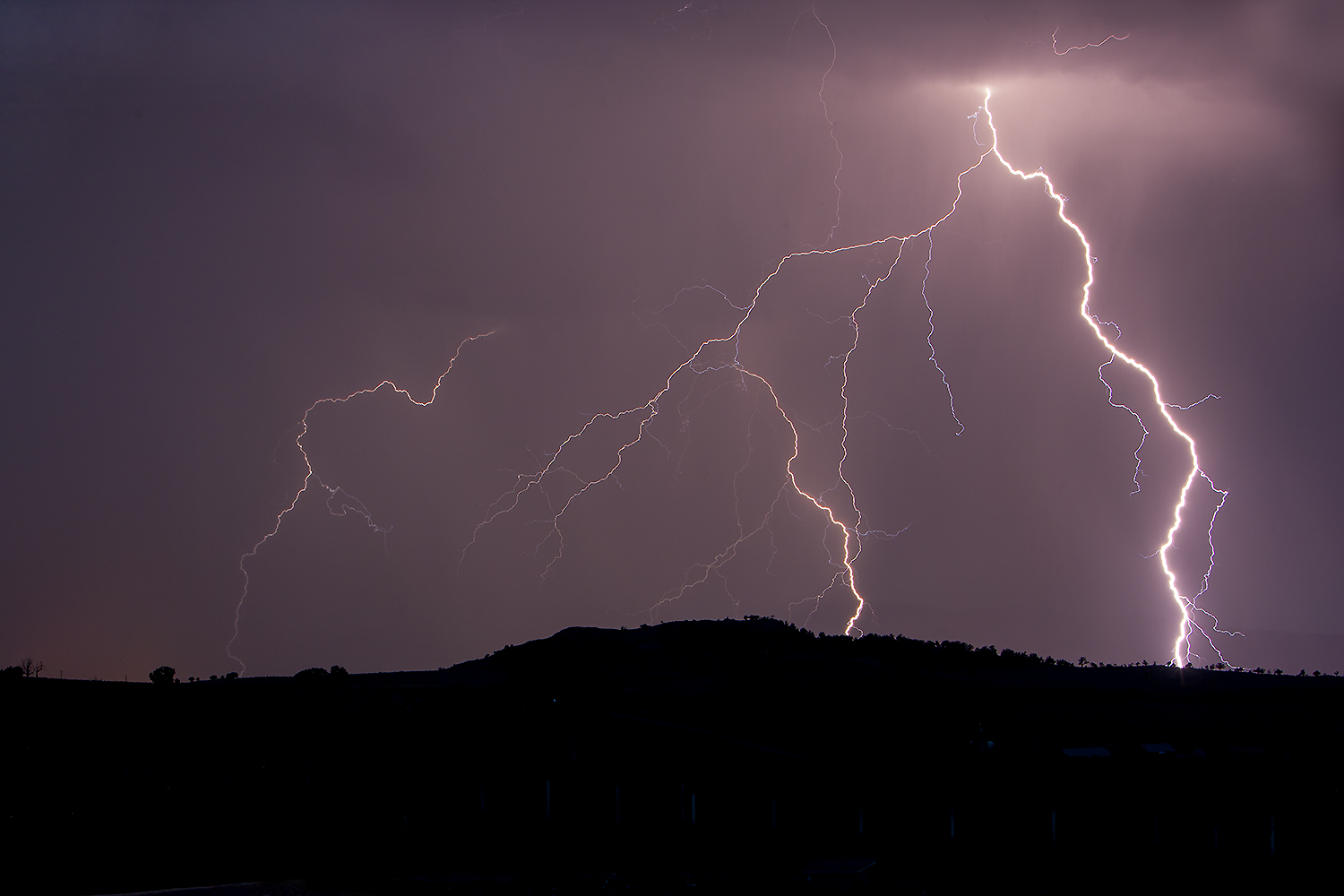
The Living Schumann Resonance
The creak of a tree in the wind isn’t just sound—it’s signal. Lightning polarizes cloud droplets; thunder shakes them into rhythm. When that water falls, each drop carries a storm’s imprint into leaves, soil, roots, and the mycelial web. Bees hover, petals quiver, pine needles ring like fine antennae, and the underground network translates it all. What we call the Schumann resonance may be more than an atmospheric cavity—it may be a biospheric hum sustained by life itself.
“Lightning tunes. Life hums. Water remembers. Mycelium conducts.”
What you’ll discover
- How lightning & thunder act as a tuning fork for atmospheric water—and how rain delivers that information to the ground.
- Why bees, petals, leaves, and pine needles behave like resonant transducers that pass signals into roots.
- How mycelium works as Earth’s conductor—routing vibrational intelligence through the soil.
- Why structured water (hydrogen’s choir) is the medium that records and couples these signals across the biosphere.
For deeper background, see Resonance — Nature’s Language of Connection, Water — The Great Informant of Nature, Photons — Light’s Living Thread, and the Unified Field Theory.
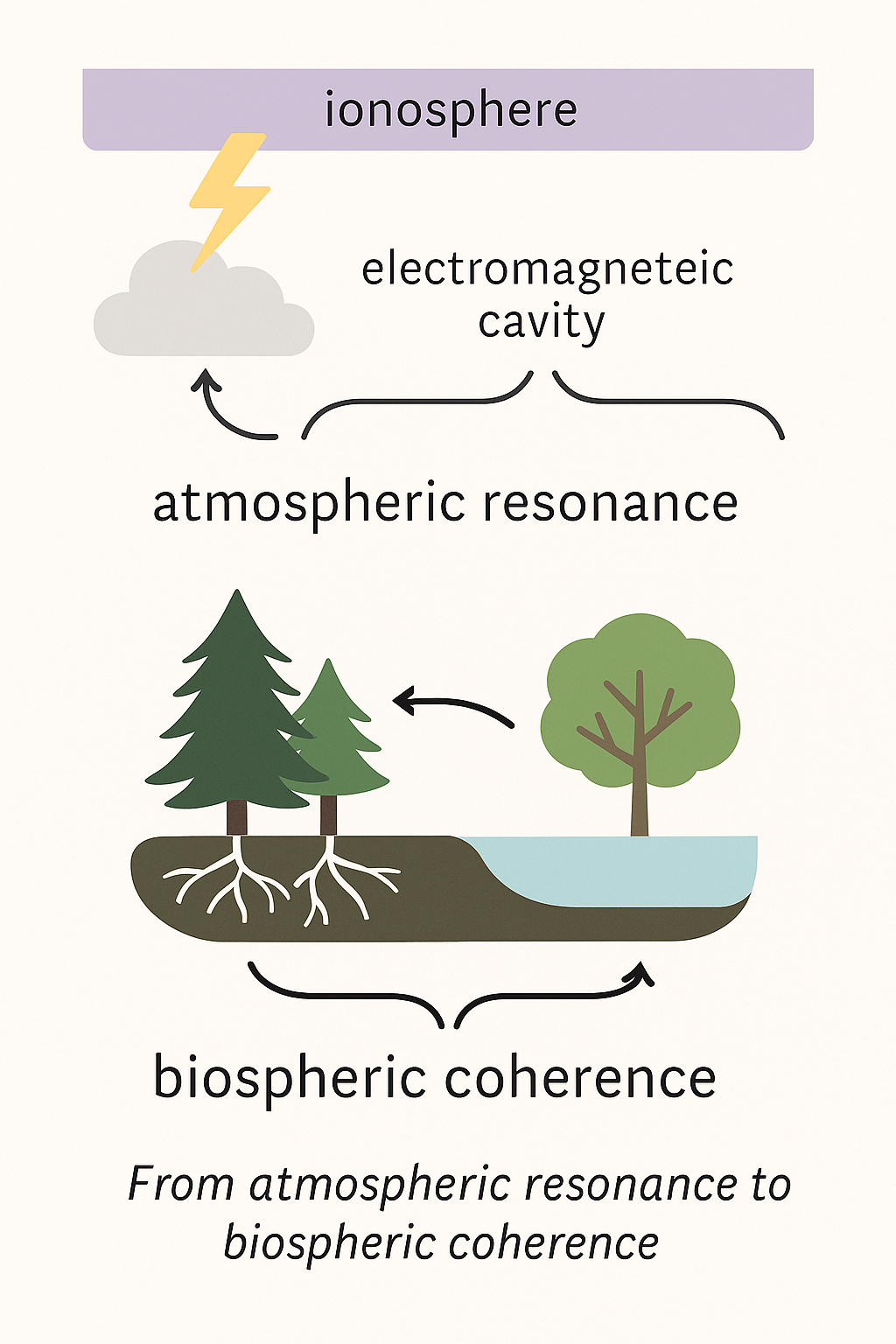
What We’re Taught vs. What We’re Missing
The traditional model (top) explains the Schumann resonance as electromagnetic standing waves in the Earth–ionosphere cavity, excited by global lightning activity. This picture is correct—but it’s not complete.
The living model (bottom) adds the missing layer: biospheric coherence. Charged rain, leaf membranes, pine needles, petals, trunks, roots, soil water, and the mycelial web form a distributed sensing-and-conduction network. Life receives storm-borne frequencies, translates them into bioelectric and hydrogen-bonded signals, and feeds organized information back into the field—helping sustain and tune Earth’s heartbeat.
- Lightning primes the cavity; structured water in clouds and rain carries storm “imprints.”
- Leaves, petals, pine needles act as resonant transducers (mechanical → electrical) that route signals to roots.
- Roots ↔ mycelium translate and distribute signals through soil films and hyphae (biological “fiber optics”). See Mycelial Networks and Soil Microbiome.
- Bees & pollinators add aerial frequencies that plants detect—bridging atmosphere and biosphere. Related: Photons — Light’s Living Thread.
In this view, the Schumann spectrum is not only an atmospheric artifact; it is co-shaped by life. For the physics background, visit Resonance — Nature’s Language of Connection, explore hydrogen’s role in coherence on Hydrogen Horizons, and see how this integrates within the Unified Field Theory — The Matrix Engine.
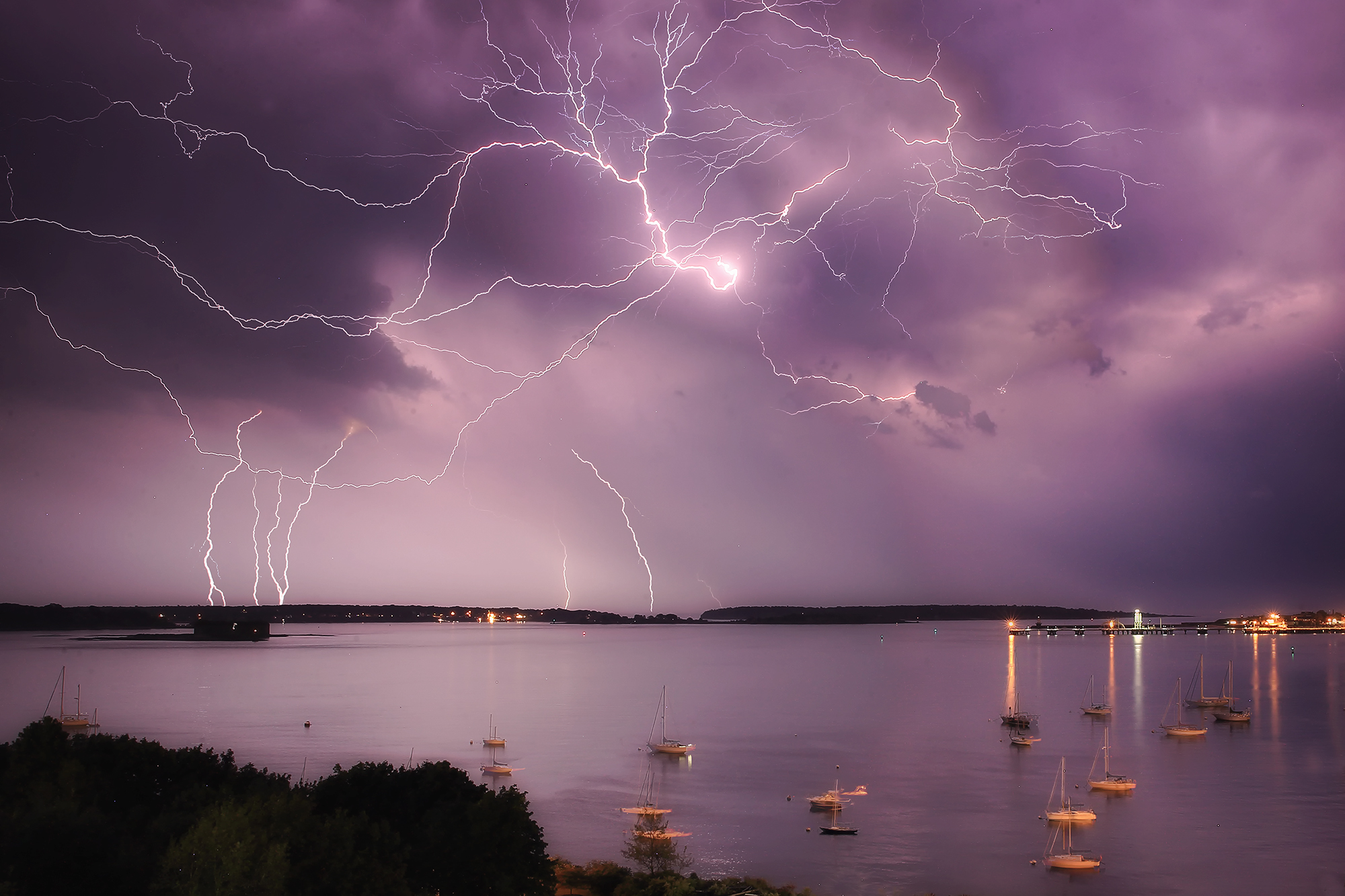
When the Sky Tunes the Instrument
Lightning doesn’t just flash—it polarizes the surrounding air and charges water droplets suspended in clouds. A split-second later, thunder delivers a broadband pressure wave that shakes those droplets into coordinated motion. Together, these events act like a cosmic tuning fork: droplets become tiny capacitors that store charge, geometry, and vibration—an atmospheric “memory” awaiting descent.
- Electrostatic imprint: Local fields align dipoles in droplets; microcurrents structure the water interface. See Water — The Great Informant of Nature.
- Acoustic entrainment: Thunder’s infrasound and mid–high frequencies excite droplet oscillations—seeding a resonant pattern.
- Photon coupling: Flashes and electromagnetic transients interact with cloud microphysics; for light’s role in coherence, visit Photons — Light’s Living Thread.
When this charged rain falls, the information transfers to leaf membranes and soil water films, then travels through mycelial networks toward neighboring roots—our proposed bridge between atmospheric resonance and biospheric coherence.
Field Notes
- Listen after the flash: The strongest imprint may occur in the minutes after lightning as thunder passes and rain begins.
- Photograph the signature safely: Long exposures of rain ripples and leaf vibrations can reveal pattern. Plan with Golden Hour & Moon Phase Planner and seasonal storm timing via Seasonal Wildlife Planner.
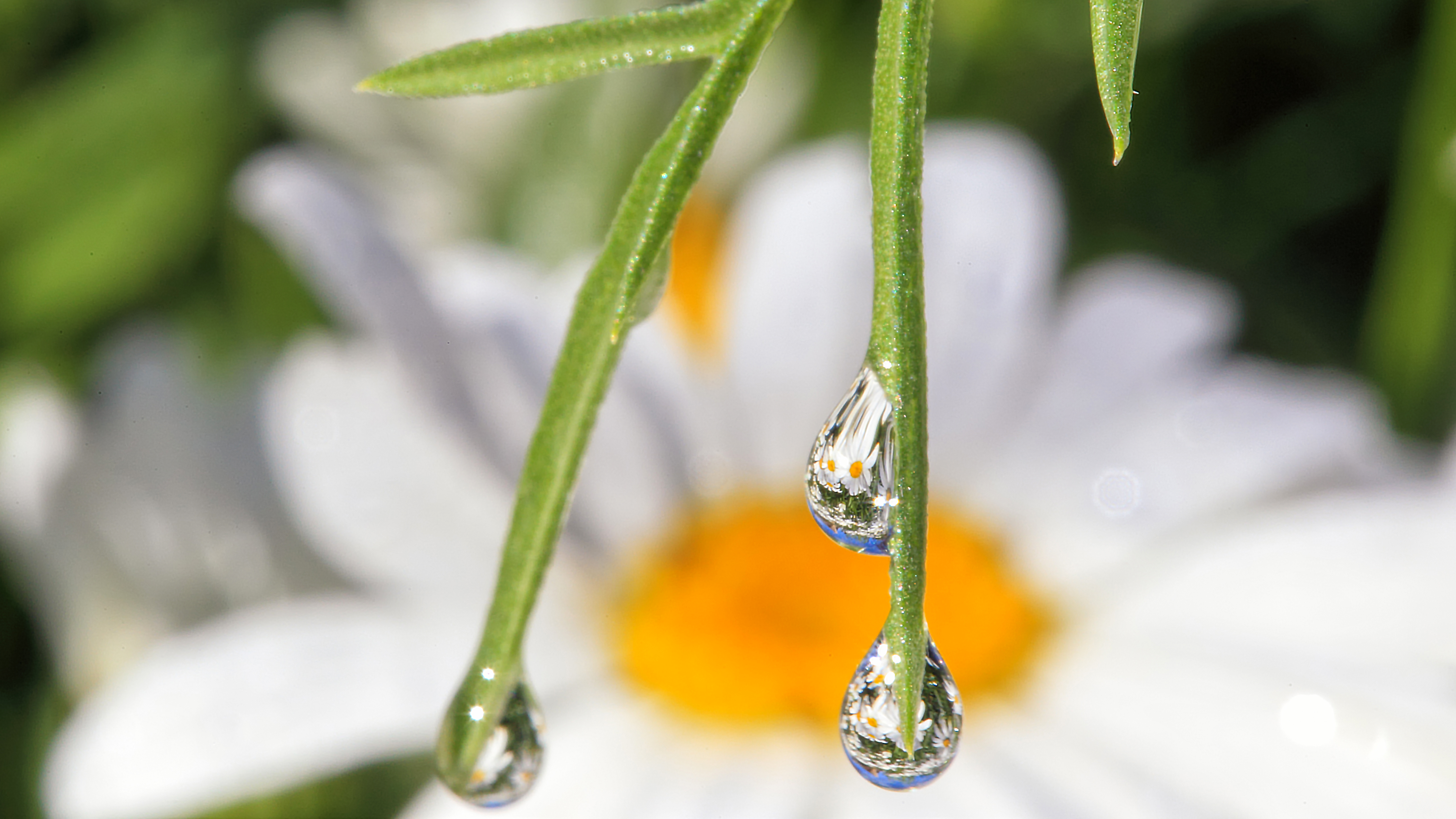
Rain That Remembers
After lightning and thunder tune the sky, raindrops descend as charged, structured messengers. Upon impact, each droplet transfers its electrostatic and vibrational signature to leaf cuticles and soil water films, seeding patterns that propagate through roots and into the mycelial web. In this view, rain is not only moisture—it is data delivery into the biosphere’s communication layer.
- Interfacial structuring: Droplet charge and surface tension organize water at the leaf interface (EZ-like layers), enhancing signal transduction. See Water — The Great Informant of Nature.
- Mechano-electrical coupling: Impact micro-vibrations on petals and needles convert to small voltage changes that travel through xylem/phloem toward the rhizosphere. Related reading: Plant Signaling & Intelligence.
- Soil film conductivity: Thin water films around particles and roots carry the pattern laterally; hyphae act as biological waveguides. Explore Soil Microbiome.
From here, signals enter a vast underground routing system where fungi translate and distribute the pattern—our next layer of biospheric coherence. Continue to Mycelial Networks and revisit the photonic context on Photons — Light’s Living Thread.
Wingbeats, Petals, and the Floral Electric Field
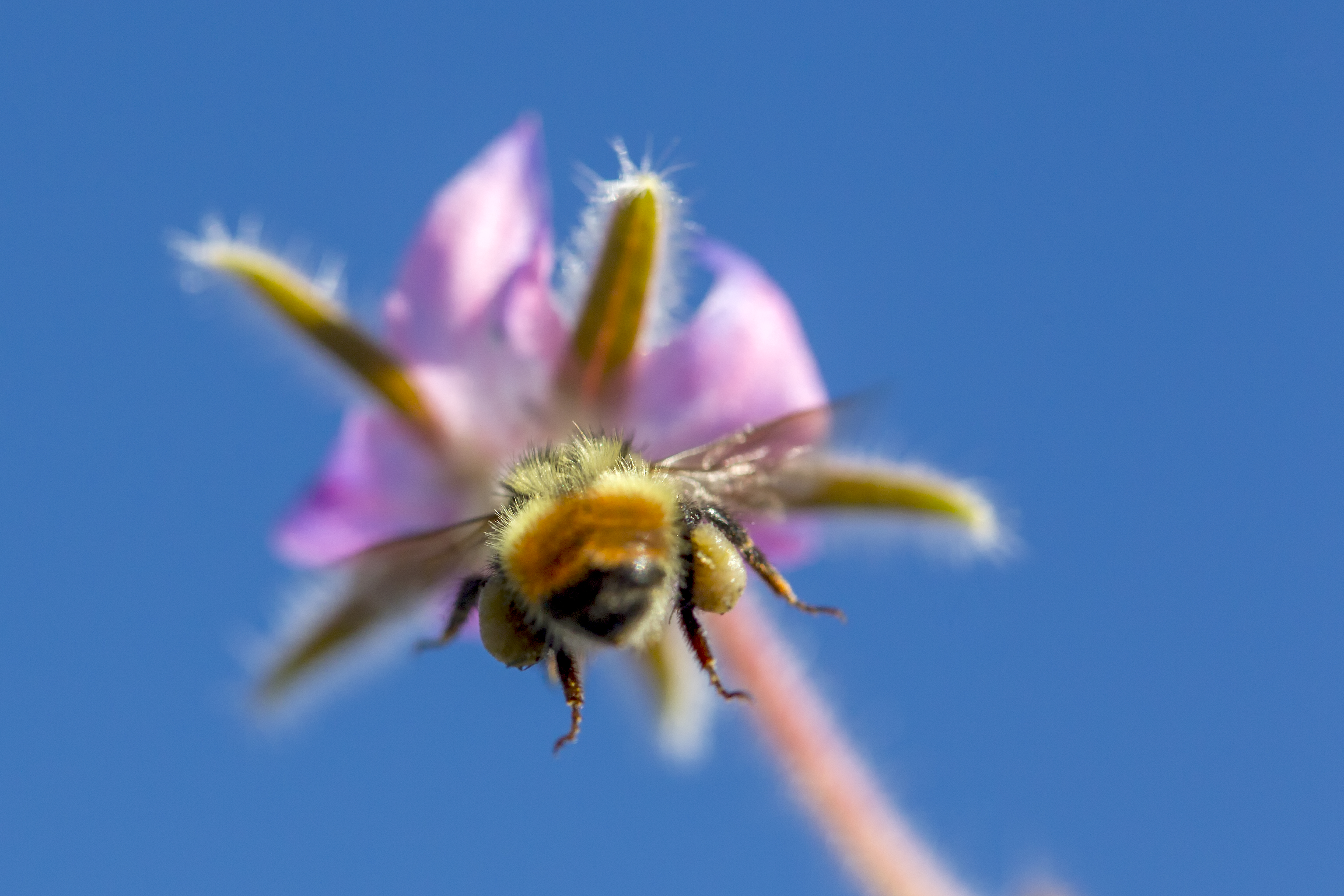
A hovering bee is an oscillator in the air. Wingbeats generate acoustic pressure and micro-vortices while the bee’s body holds a small electrostatic charge. As it approaches a bloom, the flower’s bioelectric field shifts. Petal membranes, filaments, and spiral geometries behave like resonant plates, converting vibration into tiny voltage changes that move across leaf and stem tissues toward the root zone. In this way, pollinator visits add aerial frequency to the storm-borne imprint delivered by rain—see the UV/geometry deep dive in The Unseen World of Pollinators.
- Electrostatic coupling: Charged bee + floral field ⇒ transient voltage shifts at the petal/calyx surface (see Resonance).
- Acousto-mechanical drive: Wingbeat frequencies nudge petals and anthers; membranes act as bio-transducers (mechanical → electrical).
- Vascular routing: Variation potentials propagate through xylem/phloem toward roots and soil films—handing the signal to mycelial networks.
- Photonic context: Light patterns modulate floral charge and receptor sensitivity; connect to Photons — Light’s Living Thread.
- Water memory: Interfacial water at petal/leaf surfaces helps “hold” the pattern (visit Water — The Great Informant of Nature).
Put together, bees enrich the spectrum that plants pass into roots; roots hand it to fungi, and fungi distribute it through the soil’s Water Wide Web. Next, we follow the signal down the trunk to the rhizosphere in Plant Signaling & Intelligence and the canopy → trunk → root conduction pathway.
From Leaf Whispers to Root Pulse
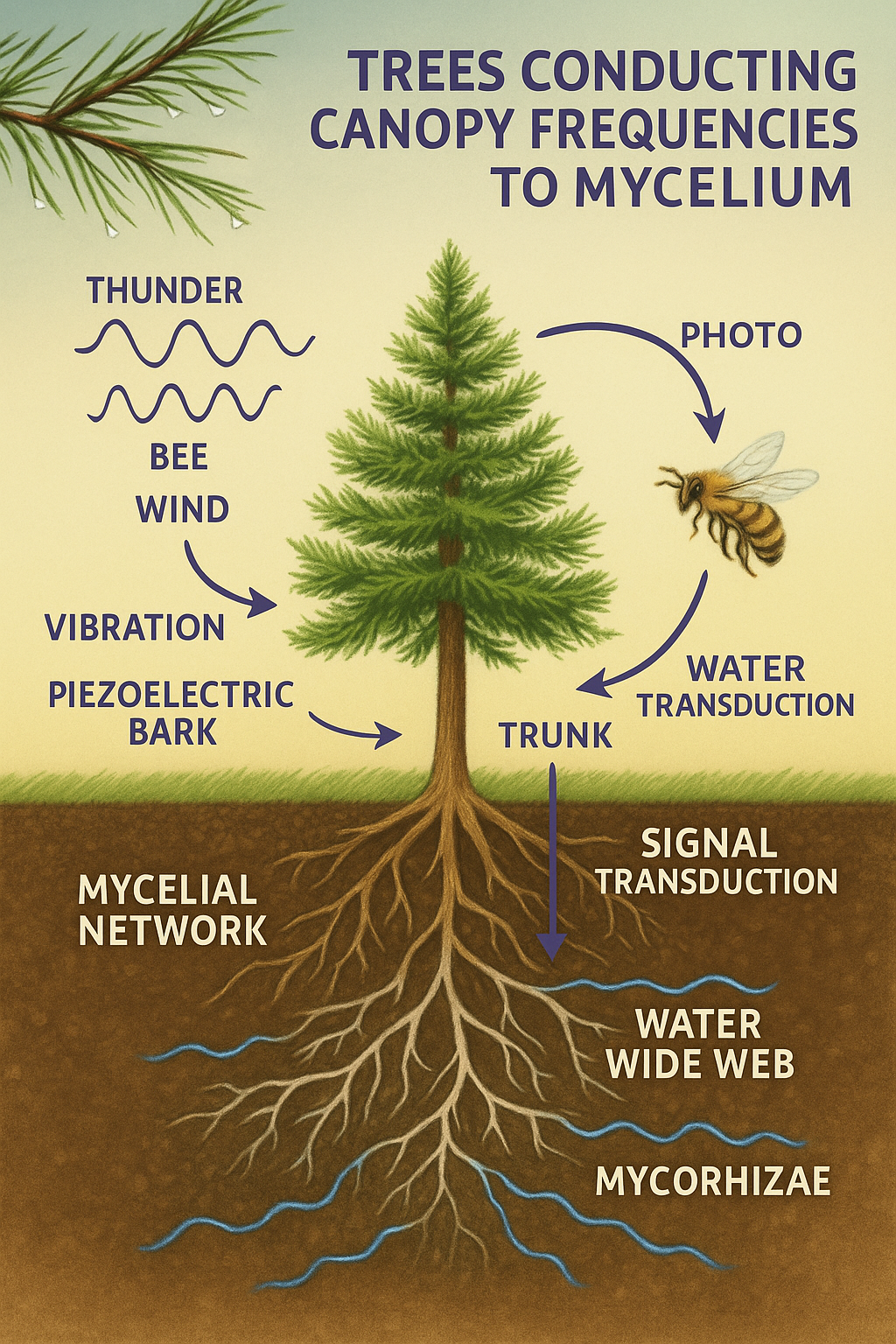
Petals, leaves, and needles act like bio-transducers: wind, thunder, and pollinator wingbeats create tiny mechanical deformations in their membranes. Plants convert these deformations into variation potentials—small, traveling voltage waves that move through xylem and phloem, down the trunk, and into the rhizosphere. At the root–soil interface, interfacial water films couple the signal to mycorrhizal hyphae, handing information to the fungal web.
- Leaf/needle membranes: mechano-sensitive ion channels open with vibration, initiating electrical transients. See Plant Signaling & Intelligence.
- Vascular conduction: xylem tension changes and phloem charge waves propagate the pattern toward roots.
- Bark & cambium: piezoelectric cell-wall effects may assist conversion of strain to charge along the trunk.
- Root interface: thin soil water films carry charges laterally; exudates modulate conductivity. Explore Soil Microbiome.
- Hyphal pickup: mycorrhizal hyphae act as biological waveguides, receiving the pattern and distributing it through the Mycelial Network.
This canopy→root conduction is how bee- and storm-born frequencies enter the underground conversation. For the medium that holds these patterns, visit Water — The Great Informant of Nature; for the photonic context that modulates plant sensitivity, see Photons — Light’s Living Thread. Next, we follow the signal into the fungal conductor.
The Fungal Internet of Resonance
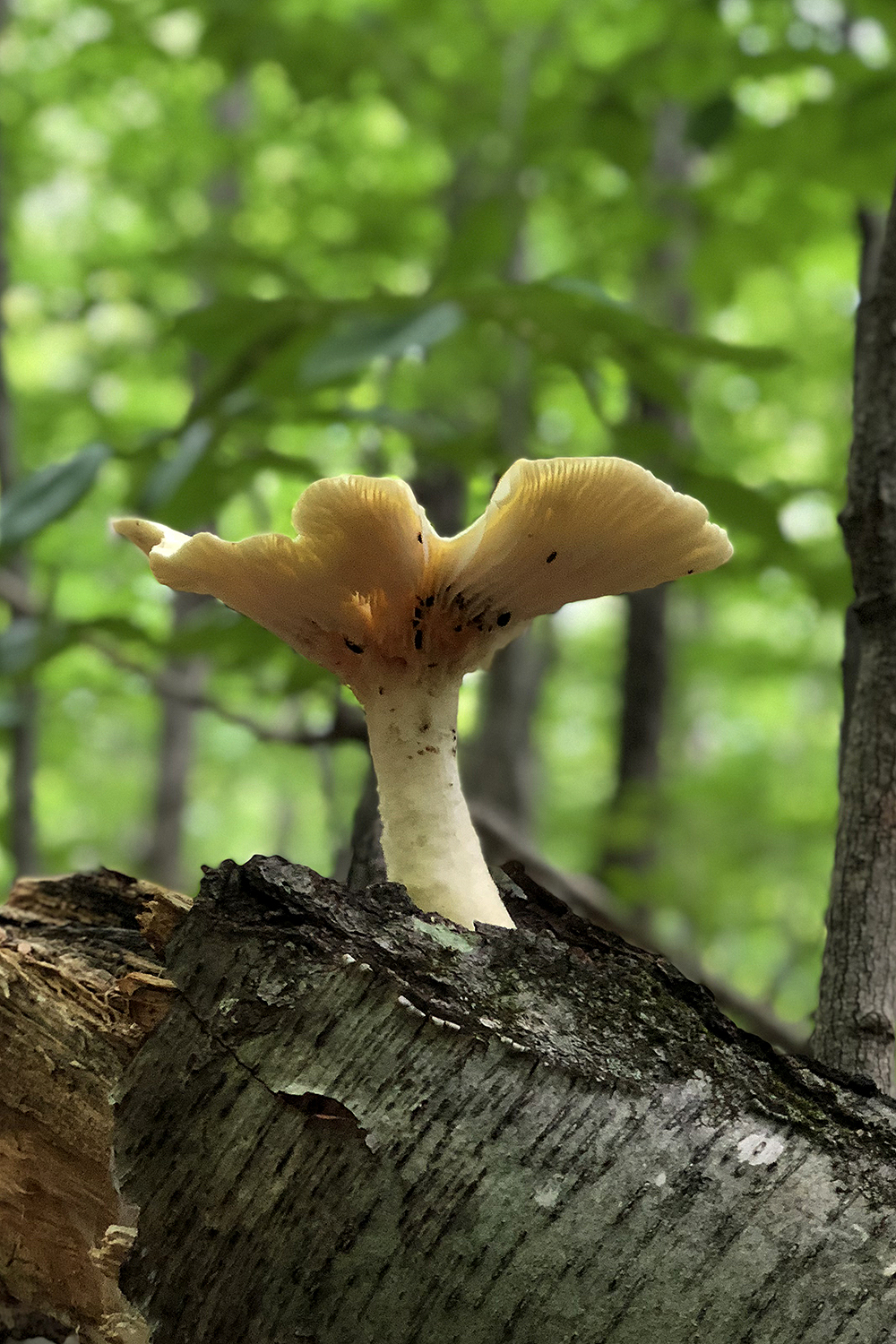
Once canopy vibrations have been converted to bioelectric signals and delivered to the rhizosphere, the mycelial network becomes the conductor. Hyphae thread through micrometer-scale water films, making intimate contacts with roots and minerals. Their walls—rich in conductive proteins, polysaccharides, and structured water—enable tiny charge flows that let fungi sense, translate, and distribute patterns across the soil. This is where the storm’s imprint, the bee’s wingbeat, and the leaf’s whisper are woven into ecosystem-wide coherence.
- Hyphal waveguides: Mycorrhizal hyphae span centimeters to meters, acting like biological fiber optics for low-level electrical and ionic pulses. See Mycelial Networks.
- Water–hydrogen coupling: Coherent domains in interfacial water help store and relay vibrational information; connect with Water — The Great Informant of Nature and Hydrogen Horizons.
- Root–fungus handshakes: At mycorrhizal interfaces, voltage shifts and exudate chemistry modulate routing priorities—who gets what signal, when. Related: Soil Microbiome.
- Synchronization events: After rain or pressure drops, fungal networks often coordinate resource flows and fruiting—visible pulses of the underground clock. See Plant Signaling & Intelligence.
In the living Schumann model, mycelium is less like a cable and more like a conductor—tuning the orchestra of roots, water, and microbes so the forest plays in time. Next, we widen the lens to the medium that unites sky and soil: the Water Wide Web.
The Water Wide Web — Hydrogen’s Choir
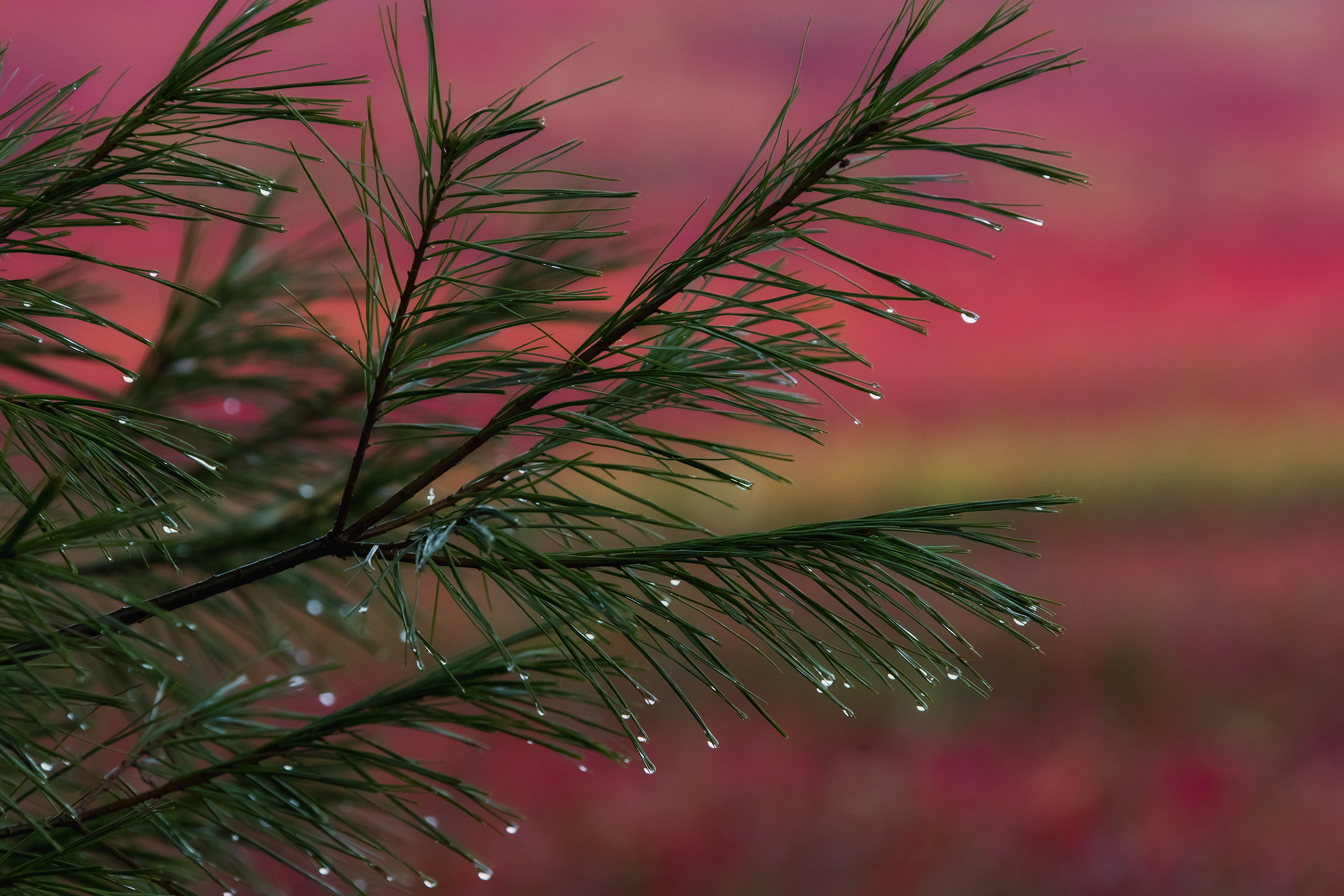
Water is the medium of memory in this living resonance model. From cloud droplets tuned by lightning and thunder to the micrometer-thin films around roots and minerals, hydrogen-bond networks form and reform—storing subtle structure that helps carry bioelectric and vibrational patterns across tissues, soils, and fungal hyphae. In effect, water stitches the sky-to-soil circuit into one continuous field.
Water — The Great Informant of Nature
In this framework, water is the courier: storms imprint clouds, droplets encode vibration, and soil films relay the message to roots and mycelium. For the deep dive into hydrogen-bond networks, boundary layers, and field sensitivity, read Water — The Great Informant of Nature.
- Interfacial structuring: At leaf cuticles, bark, minerals, and hyphae, water organizes into charge-separated layers that improve signal fidelity. See Water — Naturepedia Entry.
- Photonic coupling: Light modulates hydrogen bonding and redox state, shaping how patterns propagate. Context: Photons — Light’s Living Thread.
- Soil films as highways: Nanometer–micrometer water films conduct ions and tiny voltage waves laterally between roots and mycorrhizal hyphae. Related background: Soil Microbiome.
- Hydrogen coherence: Hydrogen’s quantum sensitivity underlies water’s responsiveness—key to the biosphere’s “memory effect.” Explore Hydrogen Horizons.
When the Water Wide Web is coherent, forests and fields synchronize—fruiting after pressure drops, germinating on cue, and balancing exchange via mycelium. In the next section, we look at how these patterns scale across circadian, lunar, and seasonal timing to shape the rhythms we call Earth’s heartbeat.

Timing the Heartbeat: Circadian, Lunar & Seasonal Coherence
In a living-Schumann view, the 7–8 Hz band isn’t static; it’s shaped by biological timing. Canopies open and close conductance pathways across the circadian cycle; lunar gravitation subtly reshapes humidity, tides, and sap flow; and seasonal photoperiod retunes membranes, water content, and mycelial activity. The result is a forest that functions like a time-coded resonator—a self-modulating array that breathes coherence in rhythm with sky clocks.
- Circadian: Day–night shifts in stomata, leaf water status, and ion channel sensitivity alter how signals enter xylem/phloem. See Resonance — Nature’s Language of Connection.
- Lunar: Moisture, pressure, and tidal cues nudge dew formation, fog persistence, and fungal fruiting windows—phase-locking parts of the network. Plan timing with Golden Hour & Moon Phase Planner.
- Seasonal: Photoperiod and temperature reset membrane composition, carbohydrate flow, and hyphal throughput—tuning the “gain” of the underground web. For migration and bloom alignment, see Seasonal Wildlife Planner.
- Storm metronome: Pressure drops, thunder infrasound, and charged rain act as synchronization pulses that bring stands into momentary phase alignment—our proposed metronome for the living field.
When timing layers stack—a storm at dusk near a lunar max in a resonant season—signal fidelity peaks: leaves receive, roots conduct, and mycelium synchronizes resource flows. Next, we explore how readers can listen for these windows with gentle, non-invasive sensing approaches.
Listening to the Hum — Gentle Citizen Science
The goal isn’t to prove a theory—it’s to feel the coherence. Modern sensors and simple fieldcraft make it possible to observe how the living Schumann resonance expresses itself: through leaf voltage, soil conductivity, barometric changes, and the subtle charge shifts that follow rain. These quiet measurements remind us that the planet’s hum isn’t confined to physics labs; it’s accessible from any garden, meadow, or forest edge.
- Bioelectric sensing: Leaf voltage meters or simple Arduino-based probes can reveal plant electrophysiology patterns. Reference Plant Signaling & Intelligence.
- Soil resonance: Small soil moisture or electrical conductivity sensors capture fluctuations linked to mycelial activity and hydration pulses.
- Atmospheric coupling: Barometers and inexpensive EM receivers can detect Schumann peaks (around 7.8 Hz) or storm infrasound. Learn more in Resonance — Nature’s Language of Connection.
- Mindful journaling: Pair field notes with observation—date, weather, moon phase, and soil feel. Over weeks, patterns between environmental cues and organismal response emerge. Try the Seasonal Wildlife Planner to align recordings with natural cycles.
Observing the hum is an act of participation—each measurement a form of attention, each quiet moment in the field a calibration of our own coherence. In the next section, we’ll translate this sensitivity into the visual language of photography—how to photograph the hum itself.

Photographing the Hum — Translating Resonance into Light
Every exposure is a moment of coherence between observer and environment. In the context of the living Schumann resonance, photography becomes a method of sensing and translating vibration into image. Whether through a flock’s coordinated lift-off, the geometry of rain on water, or the shimmer of leaves in charged air, your camera can visualize what the ear cannot hear—the resonant language of life.
- Watch for coherence: Look for repeating motion or rhythm—flocking birds, ripple patterns, synchronized sway of trees after wind. These visual harmonics often correspond to vibrational peaks in the landscape.
- Use long exposures: Slow shutter speeds (1/8–1 sec) render the invisible pulse of motion as continuous energy flow. Practice this in wetlands, forests, or tide pools where water and air interact.
- Focus on transition light: Dawn and dusk amplify natural resonance through shifting humidity, light spectrum, and temperature gradients. Track conditions using the Golden Hour & Moon Phase Planner.
- Find fractals: From pinecones to eddies, spirals mirror resonance mathematically. These forms echo through Resonance — Nature’s Language of Connection and the Water Wide Web.
- Respect the field: Avoid artificial light, noise, or proximity that could break coherence. The quiet observer records what the hurried eye cannot perceive.
“Photography is resonance made visible—light as vibration, form as frequency, and stillness as the witness of coherence.”
To photograph the hum is to participate in it—to let photons, hydrogen, and awareness align for a split second of perfect translation. The next section explores how these principles extend beyond the lens—into farming, wellness, and conservation, where resonance becomes regeneration.
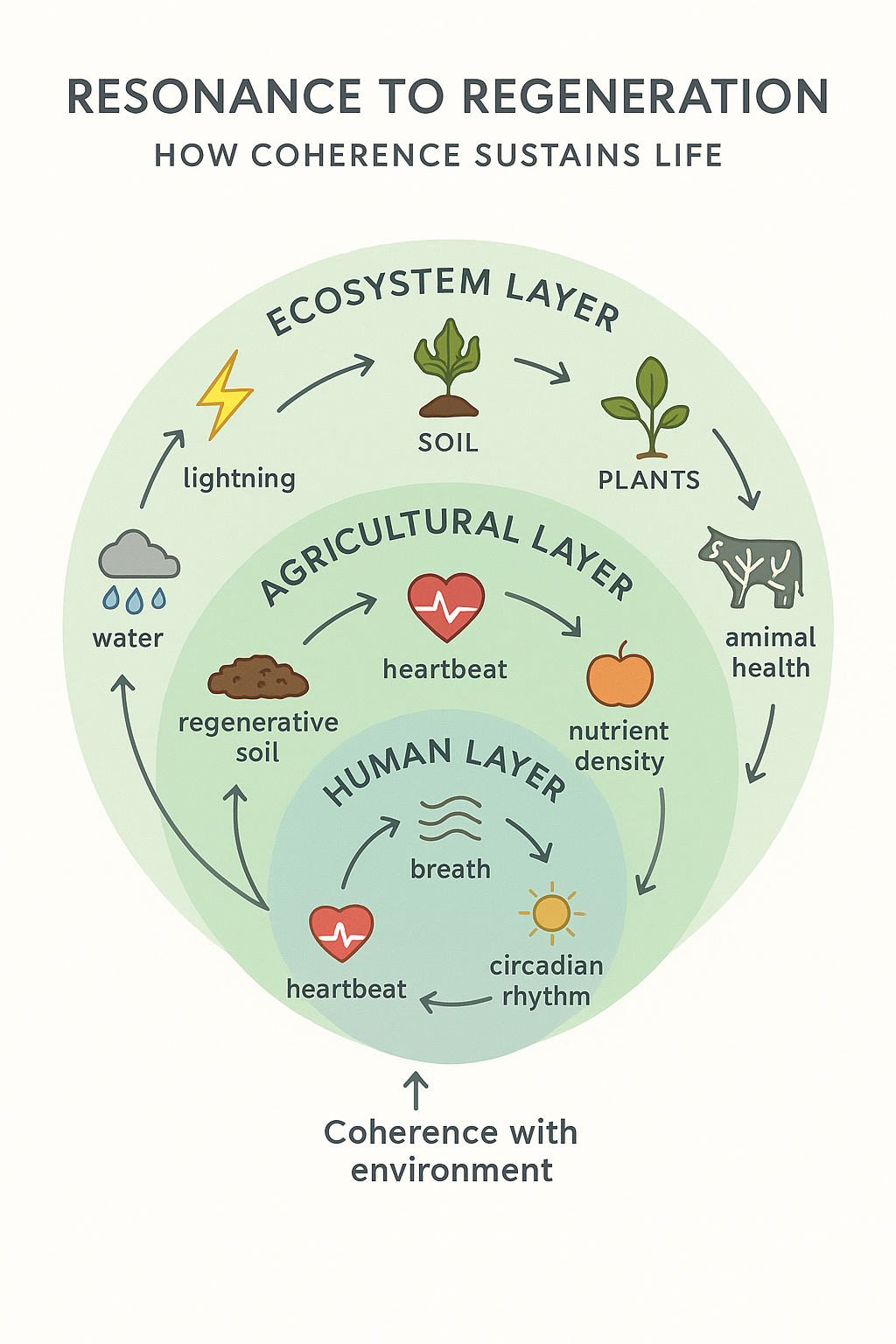
From Resonance to Regeneration — Coherence as the Foundation of Life
The same resonance that hums through trees and mycelium extends into soil fertility, animal vitality, and even human wellness. Coherence is regenerative: when the natural frequency of Earth is respected, life doesn’t just survive—it thrives. Whether in ecosystems, farms, or our own physiology, coherence sustains balance, health, and renewal.
- Ecosystem Coherence: Lightning energizes water; water structures soil; soil feeds plants; mycelium links them in resonance. A biodiverse landscape amplifies the Schumann rhythm. Learn more at Resonance — Nature’s Language of Connection.
- Agricultural Coherence: Regenerative soil practices—minimal tillage, cover crops, compost, and living roots—enhance the soil microbiome and mycorrhizal networks, improving nutrient density and vibrational integrity in food. See the Quantum Agriculture series.
- Human Coherence: Our circadian rhythms, heartbeat, and brain waves align naturally with the Earth’s 7–8 Hz field. Grounding, sunlight, and contact with living soil restore biological resonance—aligning inner and outer rhythms.
- Conservation Through Coherence: Protecting wetlands, forests, and pollinators preserves more than biodiversity—it maintains the global coherence network. A resonant ecosystem is a self-healing one.
The transition from resonance to regeneration mirrors the design of the Nature Code: every living system operates as an octave within the same symphony. When humans participate consciously—farming regeneratively, walking barefoot on wet ground, drinking living water—we become tuning forks of planetary harmony.
“Regeneration is resonance made practical. The pulse of soil, the rhythm of breath, and the beat of the heart are one continuum of coherence.”
Next, we’ll distill this continuum into a single guiding principle—the Nature Code synthesis—where light, hydrogen, water, and gravity interweave into one unified equation for life’s renewal.
The Nature Code Synthesis — One Principle, Many Scales
Pull the thread through every section and a simple truth remains: coherence carries life. Light sets the tempo; water remembers the phrase; plants translate it; mycelium conducts the orchestra; the biosphere hums at Earth’s cadence. This is the Nature Code—a unifying principle that turns resonance into regeneration across ecosystems, agriculture, and the human body.
Sky ⚡ → Water 💧 → Leaf 🍃 → Root ⇆ Mycelium 🍄 → Field (≈ 7–8 Hz) → Regeneration ♻️
Lightning tunes • Life hums • Water remembers • Mycelium conducts
- Photons (tempo): Light organizes charge and timing. See Photons — Light’s Living Thread.
- Hydrogen (coherence): The first element sets the memory potential of water. Explore Hydrogen Horizons.
- Water (memory & coupling): Interfaces record and relay patterns. Deep dive: Water — The Great Informant.
- Mycelium (conduction): Hyphae route signals and resources. See Mycelial Networks.
- Resonance (integration): The biosphere’s hum synchronizes behavior and recovery. Context: Resonance — Nature’s Language of Connection.
The Matrix Engine of my Unified Field Theory frames this as a living blueprint: tune the field and life organizes. In the final passages, we’ll bridge objections and align classical Schumann physics with the living model—not either/or, but instrument and orchestra.
Continue Your Journey
Follow the signal—from sky to soil to the stories we live by.
Resonance — Nature’s Language
How vibration organizes life across scales.
Water — The Great Informant
Hydrogen’s memory, boundary layers, and the Water Wide Web.
Photons — Light’s Living Thread
Light as tempo setter for charge, color, and timing.
Pollinators: UV, Phi & Resonance
How bees read ultraviolet guides and golden-ratio geometry.
Mycelial Networks
The underground conductor routing signals and resources.
Soil Microbiome
Why coherent soils make resilient ecosystems and food.
Unified Field Theory — Matrix Engine
Where light, water, and resonance spiral into one blueprint.
Explore Fine-Art Prints
Bring the resonance home—browse Wildlife, Landscapes, and Seascapes by National Geographic–published photographer Robbie George. See framing, editions, and care on the Collectors page.
 Landscape
  Wildlife
  Seascapes
About Robbie George
Robbie George is a National Geographic–published photographer and resonant naturalist. His fieldcraft follows a simple ethic—distance first, habitat always— shaped by Slow Knowledge and the Signature Series.
Explore calm, undisturbed behavior in the Wildlife Gallery or plan your next trip with the Seasonal Wildlife Calendar, Golden Hour & Moon, and Photography Maps.
“Attention first, image second. The shutter is the period at the end of a sentence you learned by walking.”
Frequently Asked Questions
What is the Schumann resonance in simple terms?
It’s a family of natural frequencies (around 7.8 Hz and harmonics) that arise in the Earth–ionosphere cavity. This article proposes a living layer too: life receives, sustains, and modulates the hum through leaves, water, roots, and mycelium.
Are you saying lightning doesn’t cause it?
Lightning primes the cavity and helps set the spectrum. The thesis here is that the biosphere—via water, plants, and fungi— co-shapes and sustains the resonance as a coherent, living field.
How do bees and flowers contribute?
Wingbeats and electrostatic charge perturb floral fields. Petals act like resonant plates, converting vibration to tiny voltage changes that travel through vascular tissue to roots and into the mycelial network.
Where does water fit into the picture?
Water is the courier and memory medium—from cloud droplets tuned by storms to microlayer films around roots and hyphae. See Water — The Great Informant of Nature.
Can I measure any of this at home?
Gently, yes: simple plant electrophysiology probes, soil conductivity sensors, barometers, and low-cost EM receivers can reveal patterns tied to weather, lunar phase, and hydration. Start with mindful journaling and the Golden Hour & Moon Phase Planner.