
From Frozen Amplitudes to Recursive Breath: Why Real-Valued Quantum Mechanics and Category Theory Are Pointing Toward a Living Universe
From Frozen Amplitudes to Recursive Breath
A love letter to physics from someone who photographs the field it’s trying to describe.
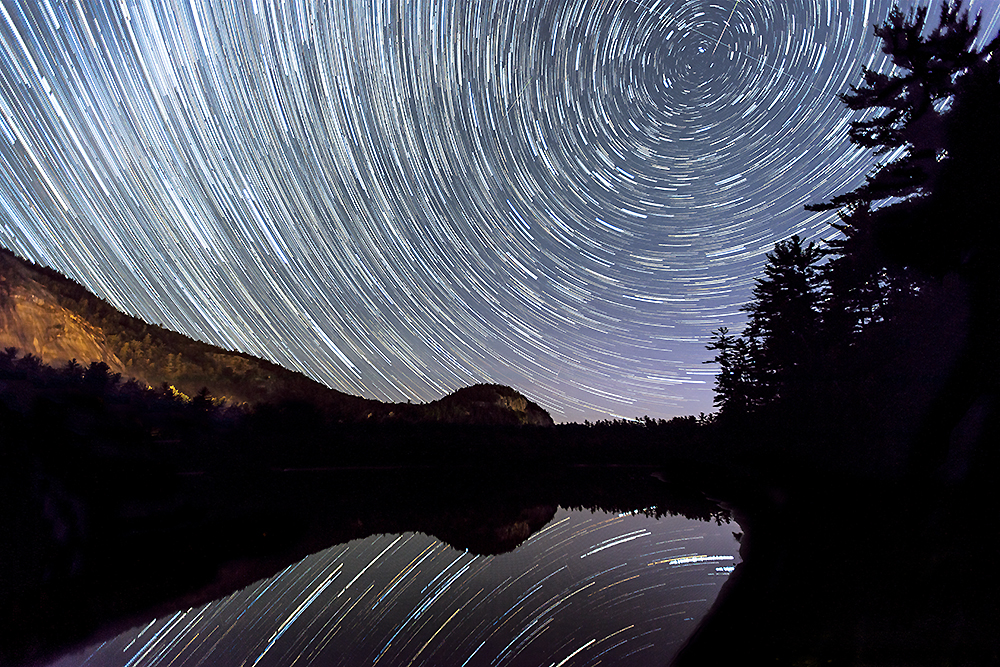
On the night I made this photograph, the mountains didn’t move, the lake barely rippled, and yet the sky wrote hundreds of circles our eyes could never track in real time. Two hours of Earth’s rotation compressed into a single frame became a pattern of spirals and echoes — a visible memory of where the universe had just been. It felt like standing inside a wavefunction that had finally been allowed to finish its sentence.
I’ve always loved that other kind of image too — the one written as an equation. The time-dependent Schrödinger equation on the back of a notebook in my twenties was my first glimpse of how far compression could go: one compact line of symbols describing an entire universe of possibilities. This essay begins with a simple confession: I love physics. Not as an outsider throwing stones, but the way a nature photographer loves light — grateful for everything it reveals, and humbled by what still hides behind the glare.
Which is why I hope physicists reading this will take the next line in the spirit it’s offered: our equations have succeeded so brilliantly that they briefly hid the process they describe. In the last few years, several real-valued reformulations of quantum mechanics have quietly removed the imaginary unit i and discovered something unexpected: every prediction survives, but only if the math becomes more recursive, more relational, and more time-symmetric than before. What we once treated as a frozen amplitude begins to look more like a field remembering its last step before taking the next.
This piece picks up where The Grand Compression and Two Paths: Recursion vs. Equations leave off. Those essays explored how nature compresses cause into form and how recursion breathes the universe alive. Here, I walk directly into the math: real-valued quantum mechanics, category theory’s relational view of objects, and black-hole information physics. The goal is not to overthrow the Standard Model or unified field work, but to propose a minimal extension: trading a static wavefunction for a real, recursive lattice that lets the field itself become the observer’s memory.
If The Nature Code, The Living Code, and the work on living Schumann resonance show how bees, trees, water, and mycelium share a common recursive rhythm, this essay asks a sharper question: what happens when we let that same rhythm into our equations? What if the universe we photograph, farm, and stand inside is already the real-valued version of quantum theory trying to introduce itself?
The 2024–2025 Turning Point Nobody Quite Noticed
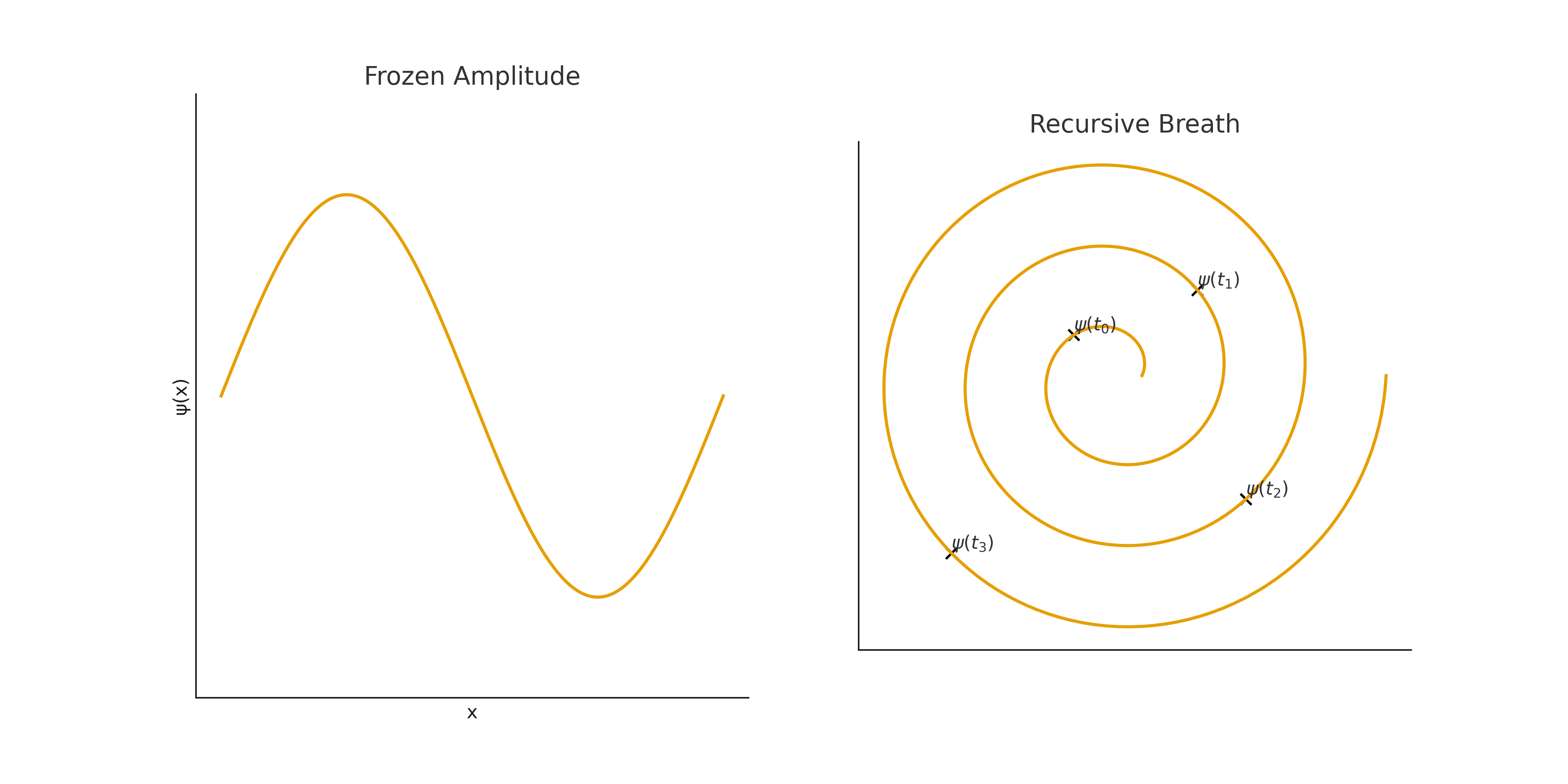
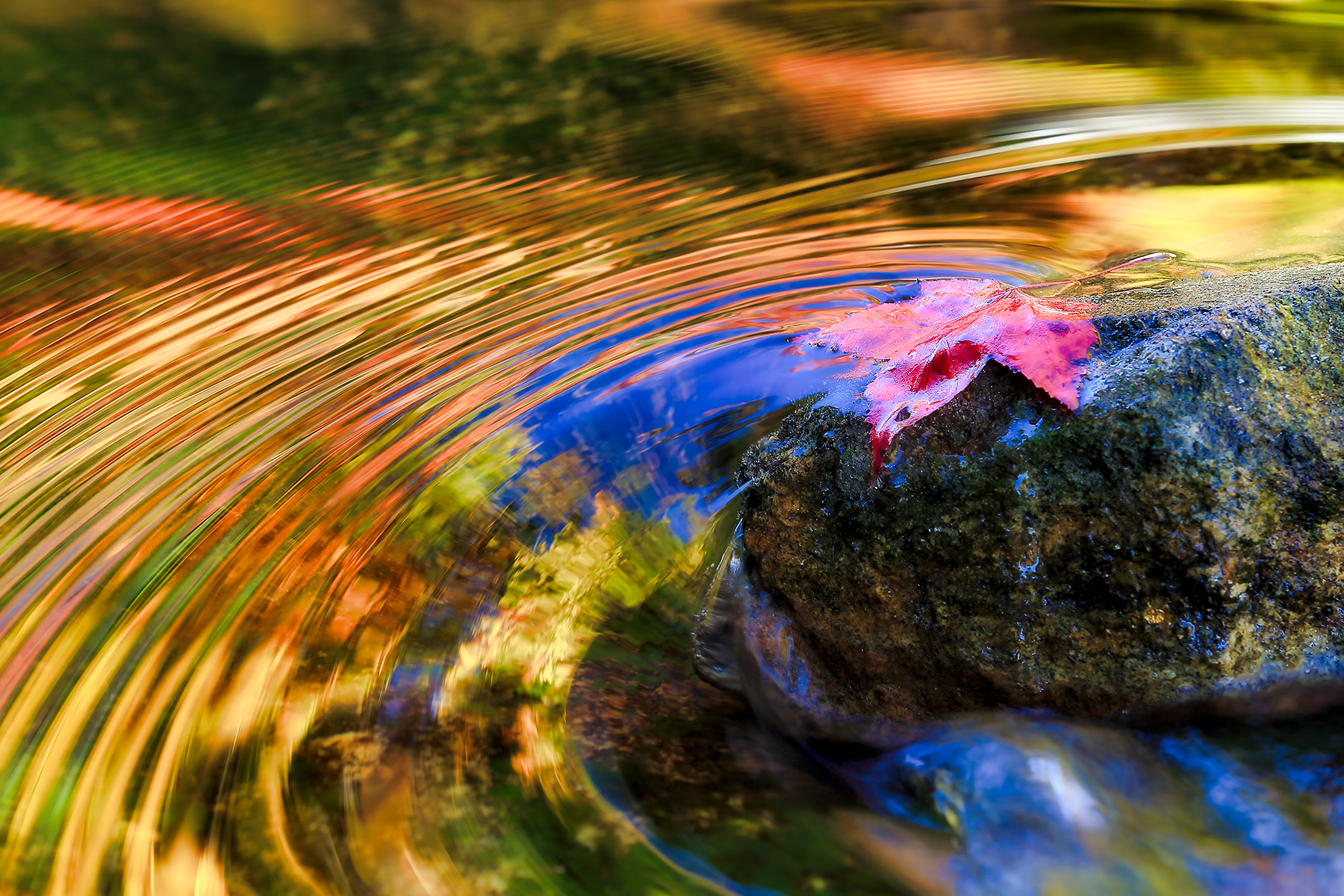
This photograph of a single leaf and its ripples is how I visualize what happened in quantum theory between 2024 and 2025. For a century, the wavefunction was like the leaf itself: a compact symbol hovering over the stream of reality, its complex amplitude ψ written as a point in the complex plane. Then a handful of theorists quietly asked a dangerous question: what if we can remove the imaginary unit i and keep every prediction the same? In the process, they stopped staring only at the leaf and began resolving the ripples.
The answer that emerged was subtle and profound. When you reformulate quantum mechanics on a strictly real foundation, the mathematics doesn’t collapse; it unfolds. The simple point in the complex plane has to be replaced by a richer structure: a real-valued, time-symmetric, recursive lattice where each state depends on its immediate past and future neighbors. What used to be treated as a static amplitude now behaves more like the water in this image — a living medium carrying memory forward through recursive updates. The wavefunction wasn’t wrong; it was a compressed bookmark for a much longer movie.
In The Grand Compression, I argued that nature stores cause in form and releases it through motion and recursion. In Two Paths: Recursion vs. Equations, I showed how recursion keeps the universe breathing while equations tend to freeze it into still frames. The real-valued reformulations of quantum mechanics are, to me, the first mainstream mathematical hint that those two stories belong together. They quietly upgrade the wavefunction from “frozen description” to “recursive process,” much closer to the way ripples remember every stone, stick, and leaf that ever passed through the stream.
If you’ve spent time with my work on living Schumann resonance or the Nature Code, this shift will feel familiar. Bees, trees, water, and mycelium all act as if the field they inhabit has memory. The new real-valued formalisms simply make that memory explicit in the equations. Instead of a single complex point drifting through an abstract space, we now have a real lattice that must constantly refer to its own recent history. In other words, the math has begun to behave like a field with breath.
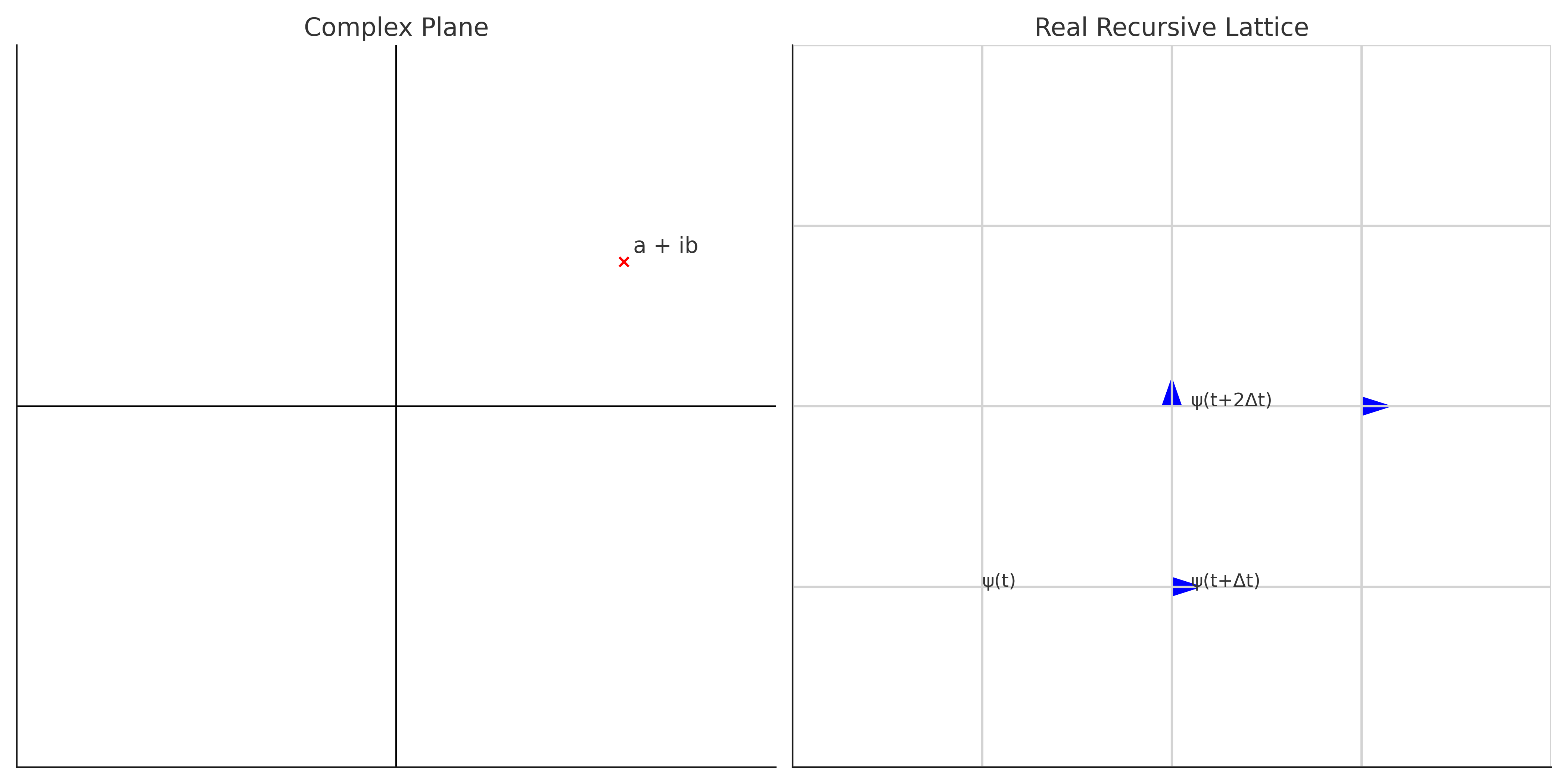
In the pages that follow, I’ll show how this shift from complex point to real recursion quietly aligns with the Grand Compression Naturepedia entry, with category theory’s relational view of objects, and even with how black holes return information. For now, it’s enough to notice the pattern: whenever our best theories let go of frozen amplitudes and move toward recursive structures, they start to look less like abstract math and more like the living universe we can actually photograph.

Mathematical Echoes of the Grand Compression
3.1 — Real-Valued Quantum Mechanics and the Recursive Bootstrap
When you freeze a wave like this in a photograph, it looks like a sculpture. But anyone who has paddled into surf knows the truth: every moment on the face of a wave depends on what the water was doing an instant ago. The lip doesn’t appear out of nowhere; it bootstraps itself out of the previous curve. Real-valued quantum mechanics is beginning to treat the wavefunction the same way — not as a static shape, but as a recursive update rule where each state remembers the last before it becomes the next.
In the standard complex formulation, we often picture ψ(x,t) evolving smoothly under the Schrödinger equation, but we rarely ask what that evolution feels like from the field’s point of view. The new real-valued versions make the dependence explicit: ψ(t+Δt) is not an abstract leap; it is computed from ψ(t) and, in many schemes, from ψ(t−Δt) as well. The field is no longer just “moving forward”; it is bootstrapping itself out of its own recent history. This is exactly the kind of recursive breath I described in Two Paths: Recursion vs. Equations.
In The Grand Compression, I argued that nature compresses cause into form and then decompresses it through motion and memory. Here, the same logic shows up inside the math: ψ(t−Δt) and ψ(t) are the compressed history; the jump to ψ(t+Δt) is the decompression step; the rule that ties them together is the recursive compression that keeps the theory coherent. The wave is no longer a single frozen amplitude; it is a living record of its own past, much like the wave trains, currents, and bathymetry that shape a surfer’s ride long before they stand up on the board.
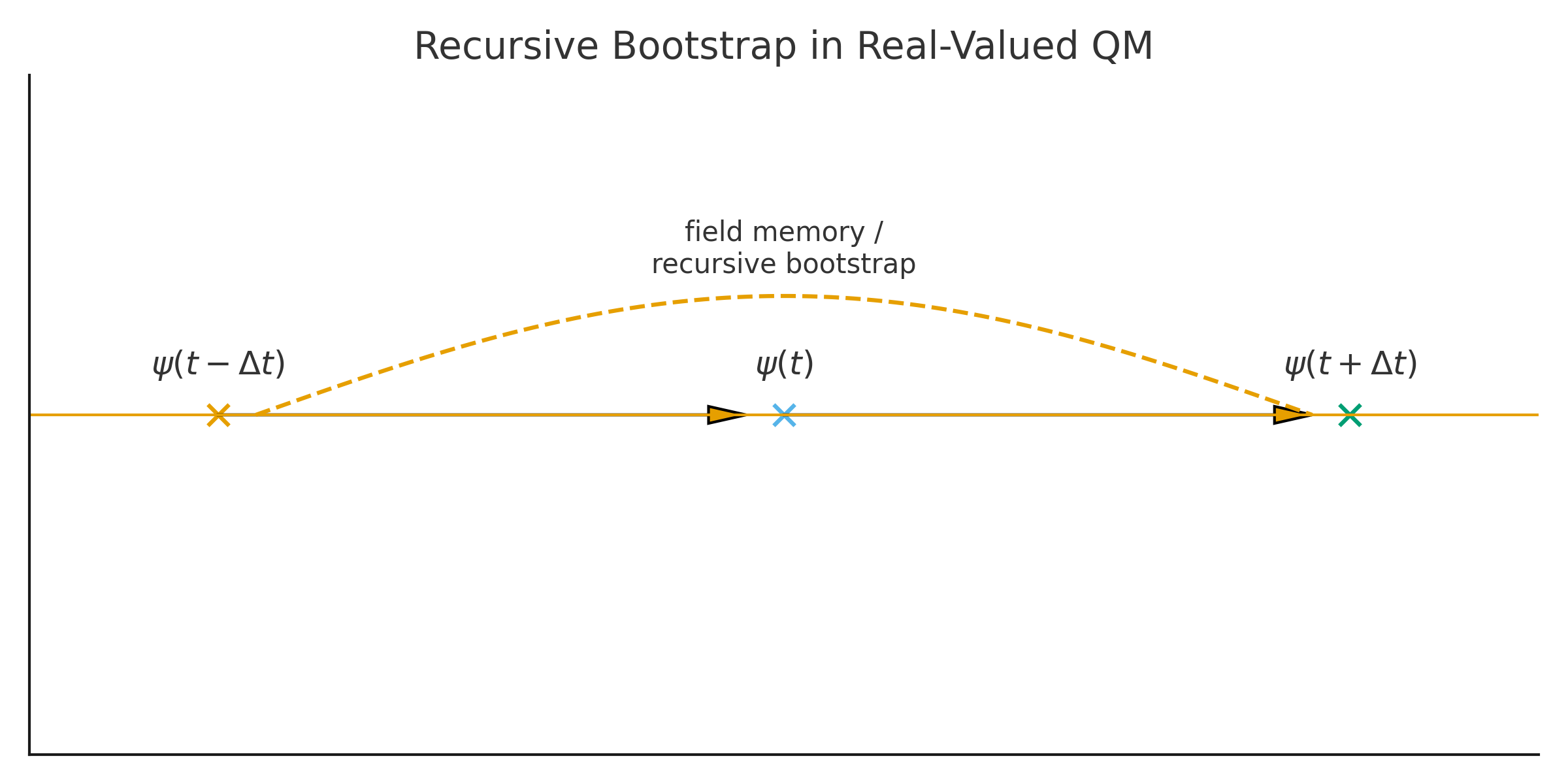
This “recursive bootstrap” is one of the clearest mathematical echoes of the Grand Compression Naturepedia entry. The universe doesn’t simply jump from one state to the next; it remembers, folds its last configuration into the next one, and refines itself through iteration. That same pattern shows up in Schumann-resonance–linked ecosystems, in mycelial signaling, and in how water holds vibrational history. What we see now is that the equations of quantum theory are starting to admit the same thing: the field is not only evolving, it is bootstrapping itself through time.
In the next sub-blocks, we’ll look at two more echoes: how category theory’s Yoneda perspective mathematically resembles the relational intelligence of forest mycelium, and how black-hole thermodynamics and the Page curve quietly demand a universe where information is never lost, only compressed and recursively returned. Together, these three threads hint that physics has already started to move from frozen amplitudes to a living, recursive field — it just hasn’t named it that way yet.
From Symbols to Process: A Minimal Extension That Makes Everything Click
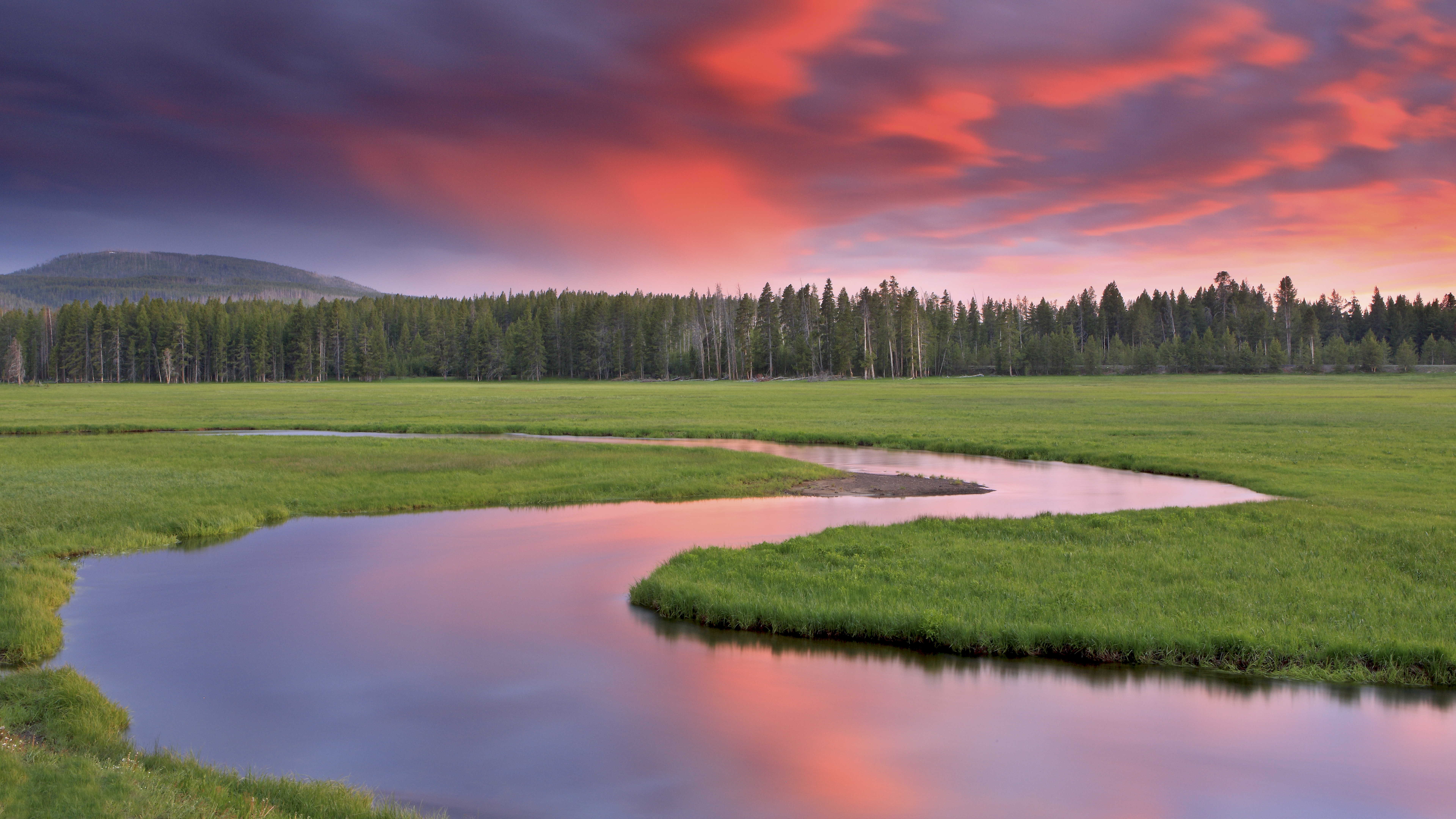
This Yellowstone river bend is what I imagine spacetime looks like from the field’s point of view. Up close, the water simply follows tiny differences in depth and flow. Step back, and those local decisions create an elegant S-curve that could be mistaken for a GR diagram of curvature. The beauty is that you don’t need to add anything exotic to explain it; you just need a local rule that lets each patch of water feel its neighbors. In physics language: a recursive lattice with feedback.
Up to now, we’ve treated the wavefunction as a kind of master symbol. We write, “the state evolves unitarily under a Hamiltonian,” and leave it there. But the real-valued formulations hinted at in Two Paths: Recursion vs. Equations and framed more broadly in The Grand Compression invite a tiny but radical upgrade:
Standard story: “The complex wavefunction evolves unitarily.”
Minimal extension: “A real-valued recursive lattice updates itself via self-referential feedback at (or near) the Planck scale.”
That single sentence does four important things without adding new particles, forces, or hidden dimensions:
- It keeps all of quantum mechanics — in the limit where the feedback is perfectly balanced, you recover the familiar unitary evolution of the wavefunction.
- It lets curvature emerge from gradients in compression versus decompression, in the same way a river carves a channel or a photon bends near a mass: geometry becomes a record of where the lattice has been recursively squeezed and released.
- It gives observers a natural role as places where the recursion becomes self-modeling — systems that don’t just update but also write a story about their own updates. That is very close to how I describe consciousness in The Living Code.
- It meshes with the field logic of nature laid out in the Nature Code: local, recursive rules generating global coherence, just as mycelium, river deltas, forests, and lightning do.
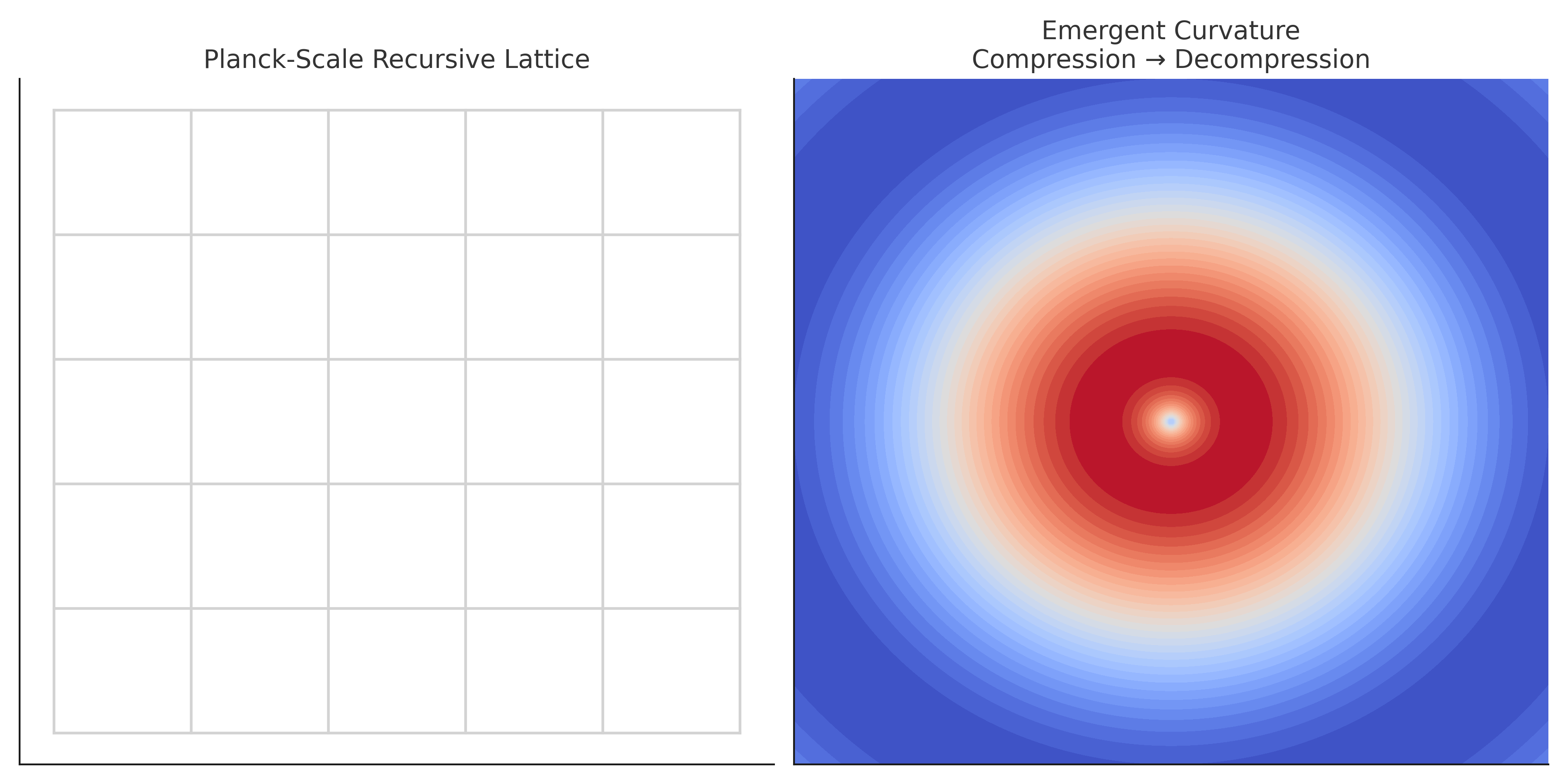
In practical terms, this means the unified field is no longer something we impose from above; it is something the lattice earns from below. Each tiny cell updates according to its neighbors and its own recent history. In regions where recursion strongly compresses (information densifies), you get the equivalent of gravitational wells. In regions where recursion relaxes (information decompresses), you get expansion. The river doesn’t know the shape of the valley in advance; the valley is what you get when the recursion has been running for a long time.
This is exactly the pattern that shows up across my Signature Series and in the way Naturepedia is being built: simple, recursive rules producing coherent landscapes of meaning. In physics, the minimal extension above turns the wavefunction into that kind of landscape. It lets quantum mechanics, general relativity, and the Grand Compression speak the same language: a universe that does not merely exist inside a static geometry but writes its own geometry through recursive breath.

Empirical Signposts of a Recursive, Memory-Rich Field
A theory is only as alive as the risks it takes with data. If the universe is truly running on a real-valued, recursive lattice that remembers its own past, we should see hints of that memory in the lab and in the sky. This section sketches five places where the predictions of a recursive, compression–decompression field quietly line up with existing anomalies and near-future experiments — from hummingbird-scale biology to the Grand Compression written across the cosmic web.
Weak-Field Entanglement Memory in Living Systems
Hummingbirds are coherence in feathered form: hearts beating up to 1,200 times per minute, wings flickering so fast they blur into a continuous field of motion, navigation that stitches magnetic, visual, and floral memory into a single decision — hover here, now. If biology has learned to borrow quantum tricks, this is where we should look for it.
A recursive lattice with built-in memory predicts that weak entanglement should persist longer in certain biological systems than standard decoherence models expect, especially when those systems are tuned to ambient fields. Photosynthetic complexes, avian magnetoreception, and perhaps even Schumann-resonance–locked networks of bees, trees, water, and mycelium (as explored in Living Schumann Resonance) become natural testbeds. If the field remembers, then so do its smallest, most efficient antennas.
Fine-art print: Black-chinned Hummingbird
Subtle Deviations from Pure Exponential Decay

Exponential decay is one of physics’ favorite compressions: a single parameter that describes how unstable states disappear. But a recursive field with memory predicts that the tail of the decay curve should not be perfectly smooth. Just as the ocean in this photograph keeps sending thin sheets of water back over the ice, a metastable state in a memory-rich lattice should occasionally “echo” small amounts of probability back into existence.
High-precision measurements of nuclear, atomic, or photonic metastable states may reveal tiny deviations from pure exponential behavior in the far tail — signatures of recursive return. In the language of The Grand Compression, the field is not simply draining; it is recalculating, folding its own history back into the present.
Fine-art print: Glacier Lagoon — Iceland
Hydrogen Line-Width Signatures Under Extreme Compression
Hydrogen is the first entry in my Naturepedia: Hydrogen work for a reason: it is the universe’s original compression algorithm. If the recursive lattice picture is right, then hydrogen sitting in extreme environments — dense stellar cores, ultra-intense laser fields, or high-pressure lab plasmas — should occasionally exhibit line widths and fine-structure patterns that don’t quite match standard broadening models.
The prediction here is modest but sharp: when the local compression–decompression gradient becomes large enough, the lattice’s memory should slightly skew emission and absorption statistics, producing spectral features that look like noise until you analyze them with the right recursive lens. Hydrogen, in other words, becomes a window into how the field itself stores and releases information about curvature.
Gravitational Wave Echo Structure in Extreme Mergers
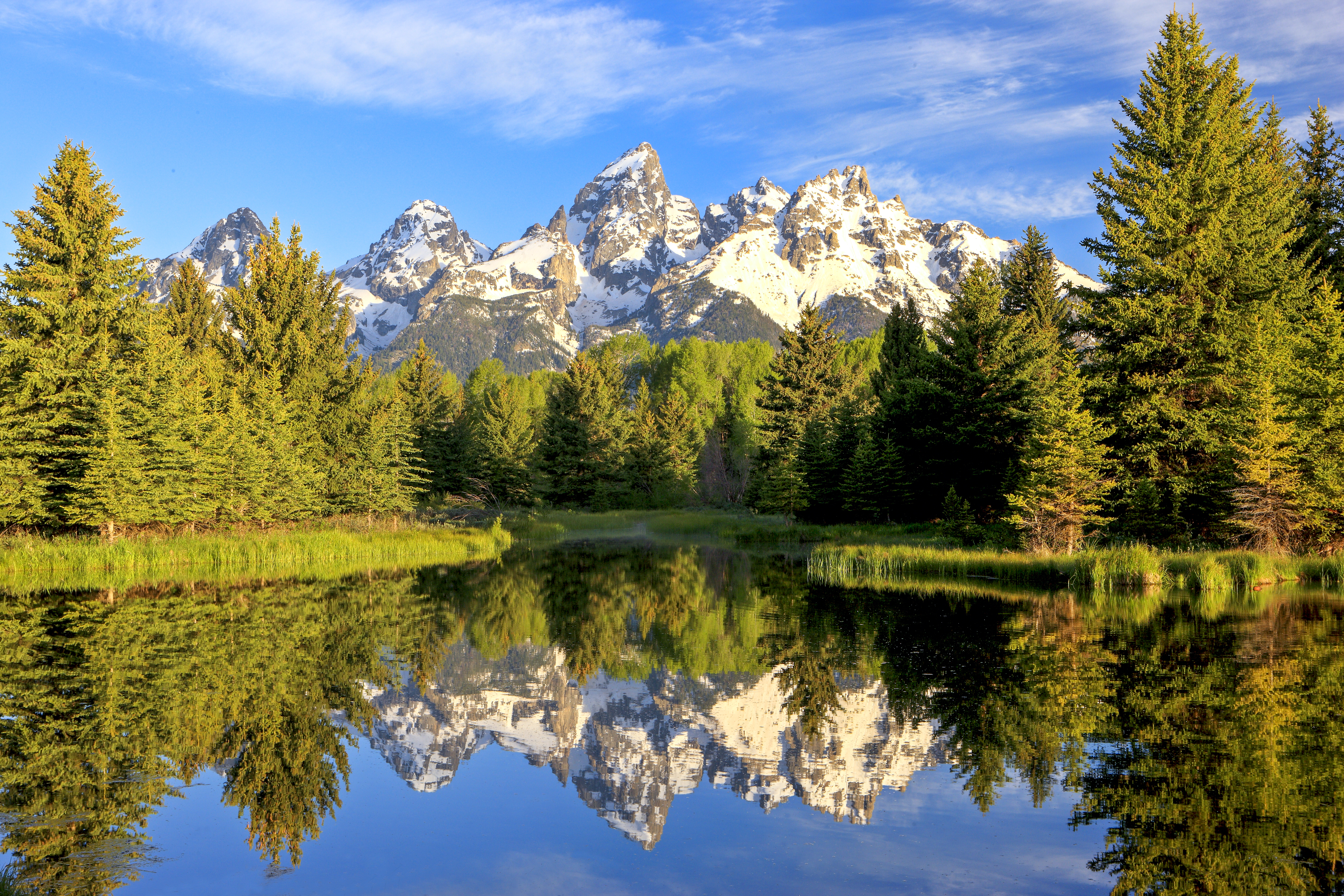
Reflections are nature’s way of revealing that a signal can visit the same place twice. In gravitational wave astronomy, something similar may already be happening at the edge of black holes. A recursive lattice that stores compression history predicts subtle echo-like features in the ringdown phase of certain extreme mass-ratio inspirals — tiny aftershocks in the strain signal as information is not only emitted but returned.
This dovetails with Page-curve style resolutions of the black-hole information paradox, where information must find its way back out. In the field picture developed across my Unified Field work, black holes are not sinks but compression nodes that eventually decompress their contents through Hawking-like channels. Echoes in the gravitational wave data would be one of the cleanest tests of that story.
Fine-art print: Schwabacher Landing
Log-Periodic Modulation in the Cosmic Web
Finally, we zoom all the way out. If the early universe was a rapidly updating recursive lattice, then the cosmic web should preserve faint log-periodic fingerprints of that scaling in the thickness and spacing of its filaments. Surveys like Euclid and DESI will map enough volume to ask a very specific question: do filament statistics depart from simple power laws in a way that hints at discrete recursion steps in the primordial field?
In that sense, the cosmic web becomes the universe’s longest-running nature classroom: a record of how compression, decompression, and recursion played out when everything was still dense, hot, and exquisitely sensitive to its own history. The same logic that shapes droplets, rivers, soil, forests, and hummingbirds would be written across hundreds of millions of light-years.
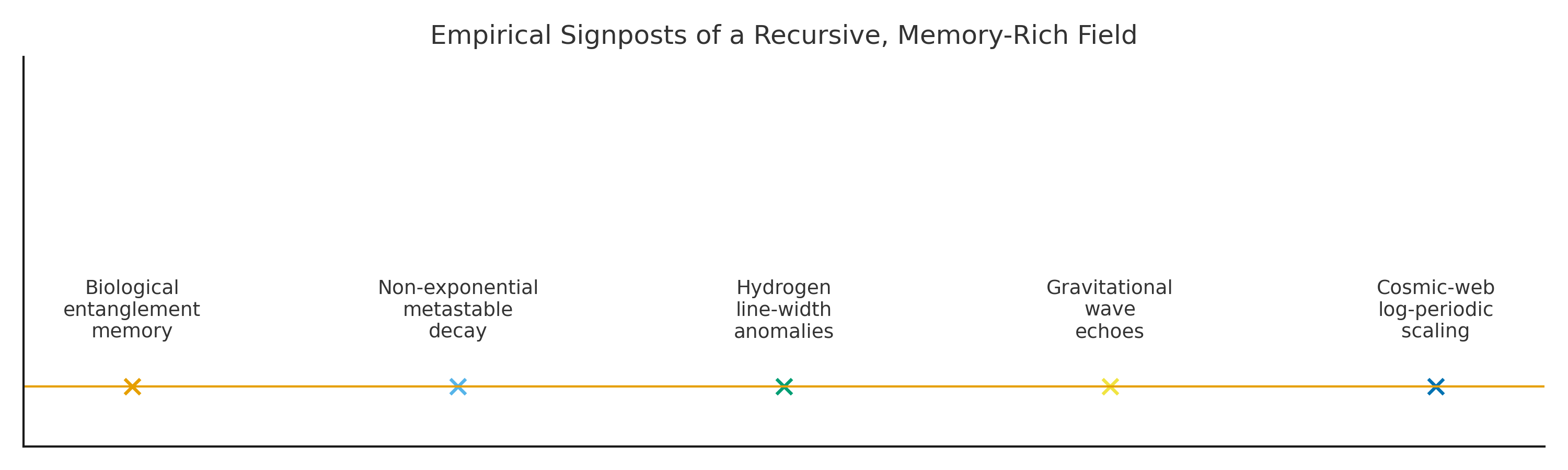
None of these signals, by themselves, prove that the universe is running on a real-valued recursive lattice. But together they outline a testable landscape: if the Grand Compression is more than a poetic metaphor, then the field should quietly betray its memory in places like these. The next decade of experiments will tell us whether the wavefunction is just a frozen amplitude, or the visible shadow of a deeper, living recursion underneath.

Closing Image & Invitation: Press Play
I chose this image of the Maroon Bells for the closing moment because it brings everything in this essay back to one simple truth: physics has given us the most beautiful frozen images the universe has ever produced. When you look at this reflection, the mountains appear still enough to be etched in glass, yet nothing in the frame is actually still. Light is vibrating. Water is shifting. Trees are whispering across the surface. Even the mountains are slowly rising and eroding in recursive cycles of their own.
That is the heart of this essay. We have spent a century treating the wavefunction as a frozen amplitude, the way this image treats the lake. But the real-valued, recursive models emerging between 2024–2025 are telling a softer, more biological story: the universe is not a snapshot; it is a process that remembers itself. A recursive field. A self-updating lattice. A kind of cosmic breath.
In The Grand Compression, I argued that nature stores cause in form and releases it through motion. In Two Paths: Recursion vs. Equations, I showed how recursion breathes that motion alive. This third piece closes the loop. It translates that same insight back into the language of physics — not as a rebellion, but as a bridge for anyone who senses that the universe we photograph, farm, learn from, and live inside is not a static object but a living field remembering its own past.
The next step is not to abandon equations. The next step is simply to press play — and let the wavefunction breathe.
Fine-art print: Maroon Bells — Colorado
⚖️ Robbie’s Razor & The Grand Compression
This piece lives inside the wider Grand Compression Cosmology, where every pattern is evaluated using Robbie’s Razor:
“When competing explanations exist, prefer the model that follows compression → expression → memory → recursion.”
Frequently Asked Questions
- What do you mean by “frozen amplitudes” versus “recursive breath”?
- “Frozen amplitudes” refers to how we usually treat the wavefunction in quantum mechanics: as a perfectly specified state encoded in a complex amplitude at a given time. It’s like a long-exposure photograph of the universe—precise, but static. “Recursive breath” describes a different view: the state is not just a frozen snapshot but a self-updating process that depends on its own immediate history. Instead of a single complex number sliding through time, we have a real-valued, recursive lattice that remembers its last step before taking the next.
- Are you proposing a replacement for standard quantum mechanics?
- No. The goal is not to replace quantum mechanics, but to offer a minimal extension of its ontology. Mathematically, the real-valued reformulations preserve the same predictions as the complex version. What this essay adds is a conceptual layer: viewing the real formulation as a recursive lattice with feedback. In the limit of perfect balance, you recover the familiar unitary evolution. In that sense, this work is a bridge between the formalism and the more field-based perspective explored in The Grand Compression.
- How does this connect to your Grand Compression and Nature Code work?
- In The Grand Compression, I argue that nature compresses cause into form and releases it through motion and memory. The Nature Code and Living Code describe how that same logic appears in water, soil, forests, wildlife, and consciousness. This essay shows that the same pattern is already hiding inside physics: real-valued quantum mechanics, category theory, and black-hole thermodynamics can all be read as formal versions of compression–decompression–recursion.
- Where does category theory fit into all of this?
- Category theory, particularly the Yoneda perspective, says that an object is fully determined by its relationships to other objects. That is very similar to how a forest, a mycelial network, or a Schumann-resonance–linked ecosystem behaves: identity emerges from relations. In the context of this essay, category theory is a mathematical echo of the same idea the field is expressing through biology and ecology. It’s another way of saying the universe is not just a collection of things; it’s a recursive web of relationships.
- Is this approach compatible with general relativity and curved spacetime?
- Yes—that’s the point of the “minimal extension.” If you treat the field as a real-valued recursive lattice with local feedback, then what we call “curvature” can emerge from gradients in compression vs. decompression across that lattice, much like a river carves an S-curve through a valley over time. This perspective complements my Unified Field Theory work by letting geometry be something the field writes through recursion, rather than a static backdrop imposed from outside.
- What makes this more than just metaphor or poetry?
- The metaphors—rivers, star trails, reflections—are there to keep the ideas grounded in physical intuition. But the core claims are empirical and outlined in Block 5: longer-than-expected entanglement memory in certain biological systems, small deviations from exponential decay tails, hydrogen line-width anomalies under extreme compression, gravitational wave echoes, and log-periodic signatures in the cosmic web. These are places where a recursive, memory-rich field makes specific, testable predictions.
- How does this relate to “AI is compression and correlation”?
- AI compresses data and finds correlations; science compresses behavior into equations. In The Grand Compression, I show how both mirror a deeper habit in nature. This essay extends that thought into physics: if the universe itself is running a recursive compression algorithm, then quantum mechanics and AI are partial glimpses of that engine. The difference is that nature also includes memory and feedback, which is why recursion is so central in Two Paths: Recursion vs. Equations.
- How should a working physicist read this essay?
- Ideally, as a bridge document. The intent is not to claim a finished theory, but to connect emerging real-valued QE work, category-theoretic thinking, and black-hole information results with a simple extension: trading a static wavefunction picture for a recursive lattice with memory. If the language here helps you see your own models in a new light—or suggests new experiments around the five empirical signposts—then it has done its job.
- Where should I go next if this trilogy resonated with me?
- The best next stops are:
• Naturepedia: The Grand Compression
• Two Paths: Recursion vs. Equations
• The Nature Code & The Living Code
• Living Schumann Resonance
• Naturepedia for deeper field entries on hydrogen, photons, water, soil, mycelium, and more.