

Through the Lens of Coherence: You Are the Point of Light
The Geometry of Perception: From Kircher’s Lattice to Living Light
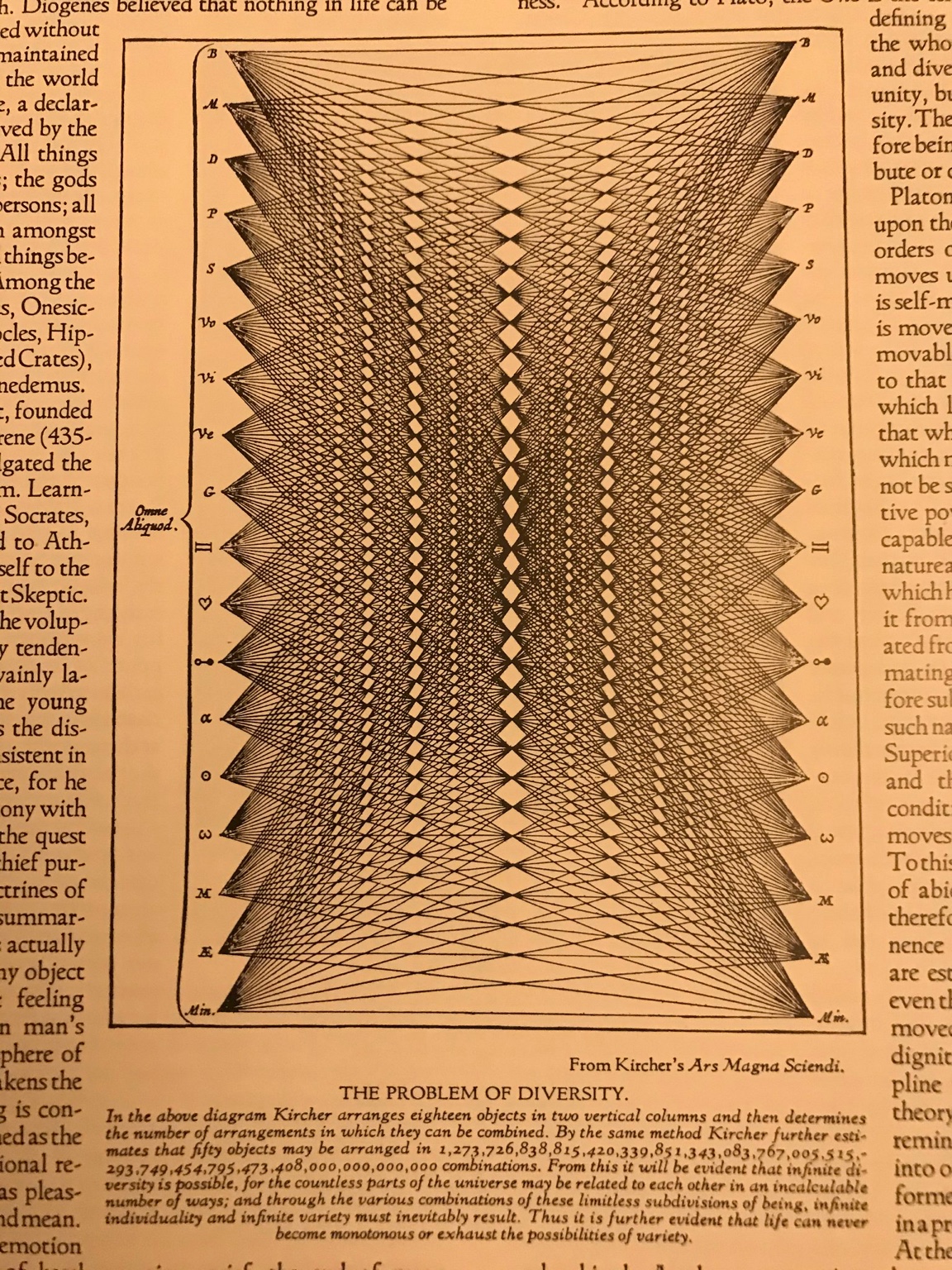
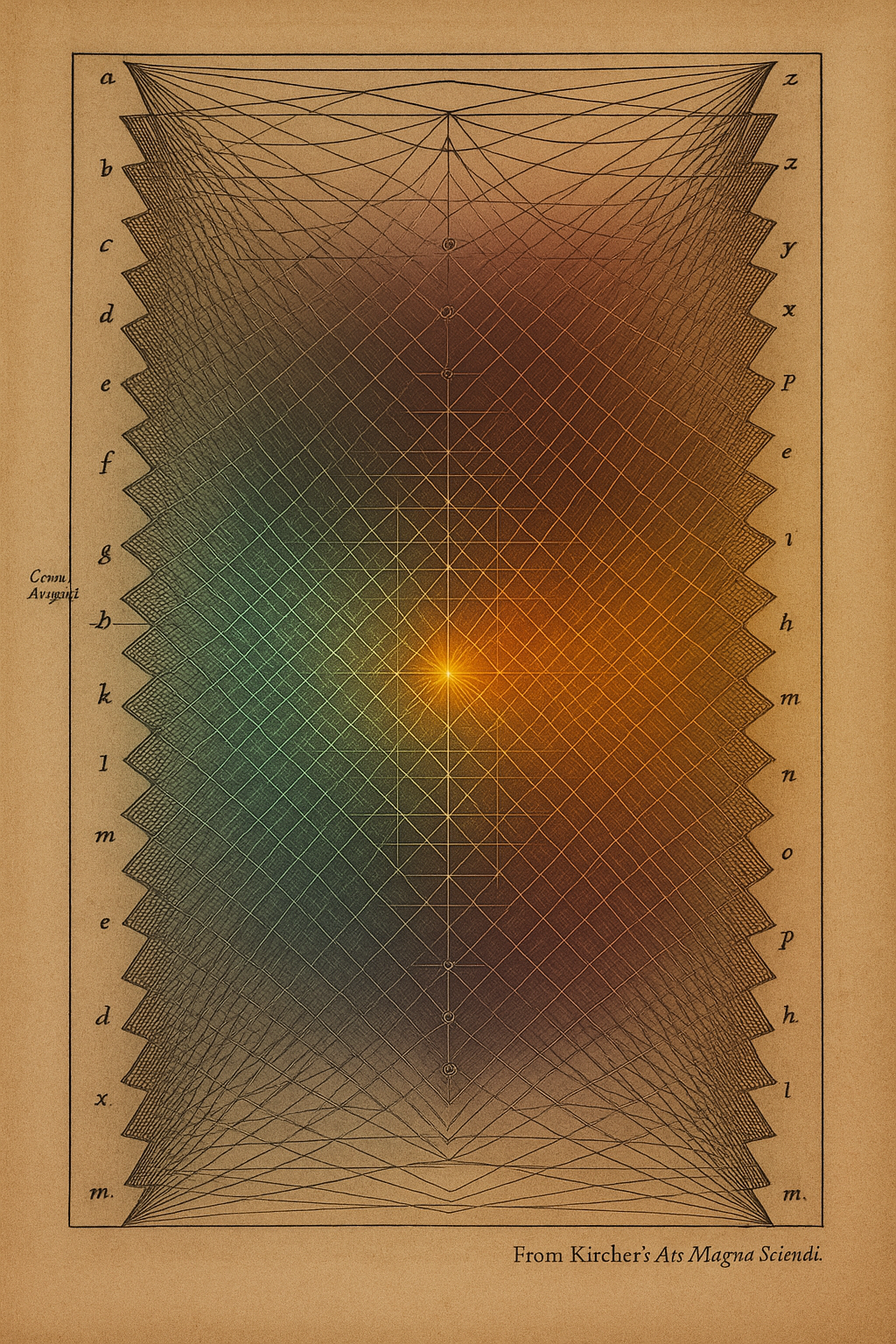
In the 17th century, Athanasius Kircher tried to visualize how the Many relate to the One. His lattice isn’t just ink—it is a map of relationships. Read through today’s lens, each crossing becomes a coherence node, a place where light agrees with itself. Photography performs the same act: from a field of probabilities, the observer selects a single, resonant possibility. This is the working heart of the Signature Series—turning geometry into felt experience.
You can see this bridge across my research threads: how coherence organizes matter in Completing E = mc²: Water & Mycelium, how the body functions as a light instrument in Humans as Light Antennas, why breath and polarity matter in Oxygen Polarity: The Quantum Breath of Life, and how illumination decays and concentrates via the Inverse-Square Law. Together, they show what Kircher intuited: coherence is compositional. The frame is not a boundary—it’s a resonance.
In this essay, we’ll follow that lattice into the living world: how nature selects resonant forms (Darwin), how consciousness collapses probability (Campbell), and how a camera becomes the field’s aperture. We begin where Kircher left us: at the threshold where geometry turns to light.
Darwin’s Filter: Nature’s Coherence Test
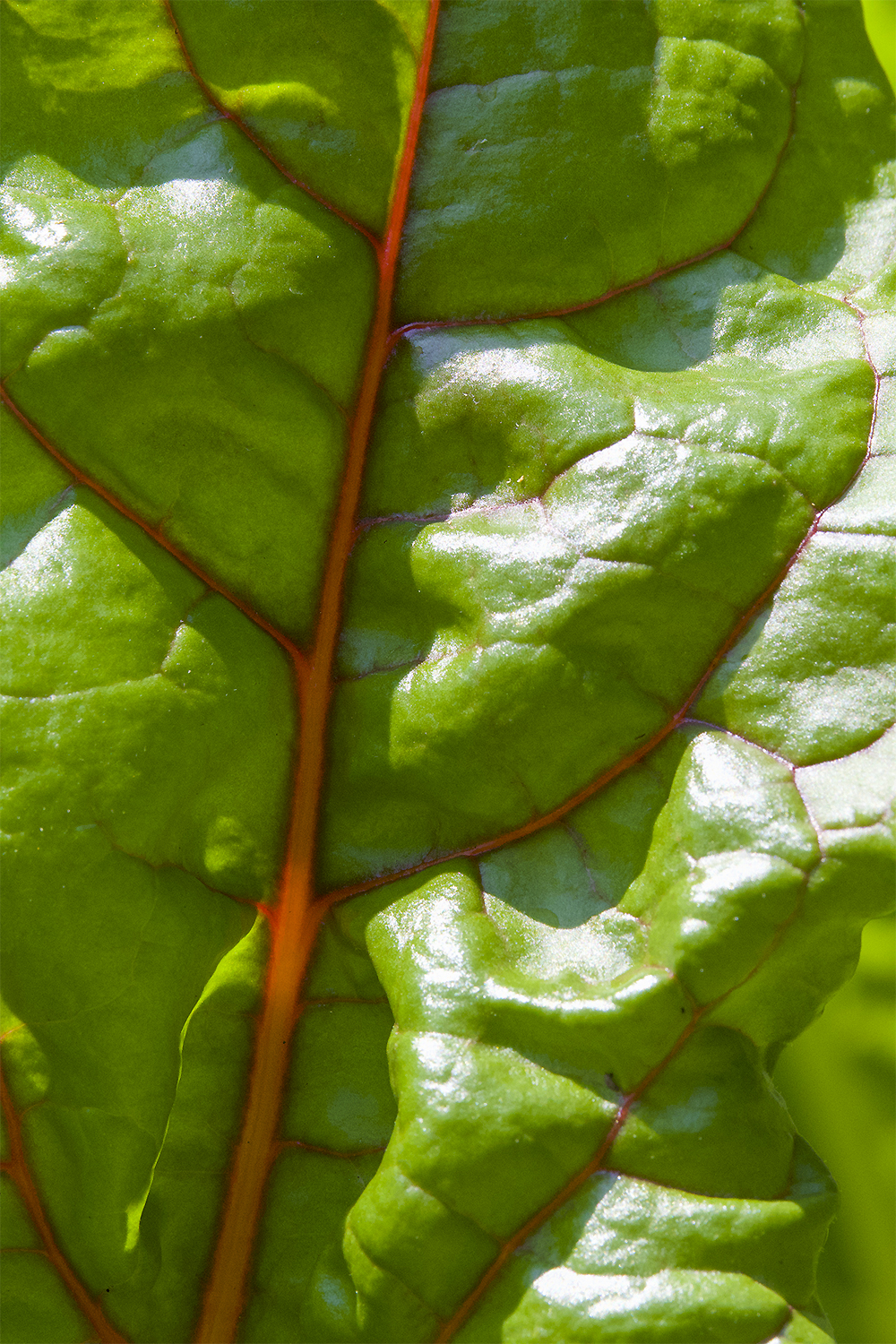
If Kircher mapped all that could be, Darwin revealed what endures. Variation floods the world with possibilities; natural selection is the field’s coherence pressure—it keeps the geometries that route energy best. In leaves, rivers, lungs, and mycelium, branching networks persist because they distribute flow with elegant efficiency.
This is the photographer’s quiet secret: the frames we return to—spirals, branches, waves, flight formations—are the survivors of resonance. They “fit” the field. You can watch this same logic unfold in my explorations of oxygen polarity (why breath follows gradients), how illumination concentrates via the inverse-square law, and how living systems cohere through water & mycelium.
Takeaway: natural selection isn’t random pruning—it’s resonance adjudication. Among countless probabilities, nature keeps what aligns with the flow. As image-makers, we don’t merely document this truth; we tune to it. Our lenses find what the field has already chosen.
“Selection is coherence under pressure — nature keeps what resonates.”
Turning Probability Into Possibility
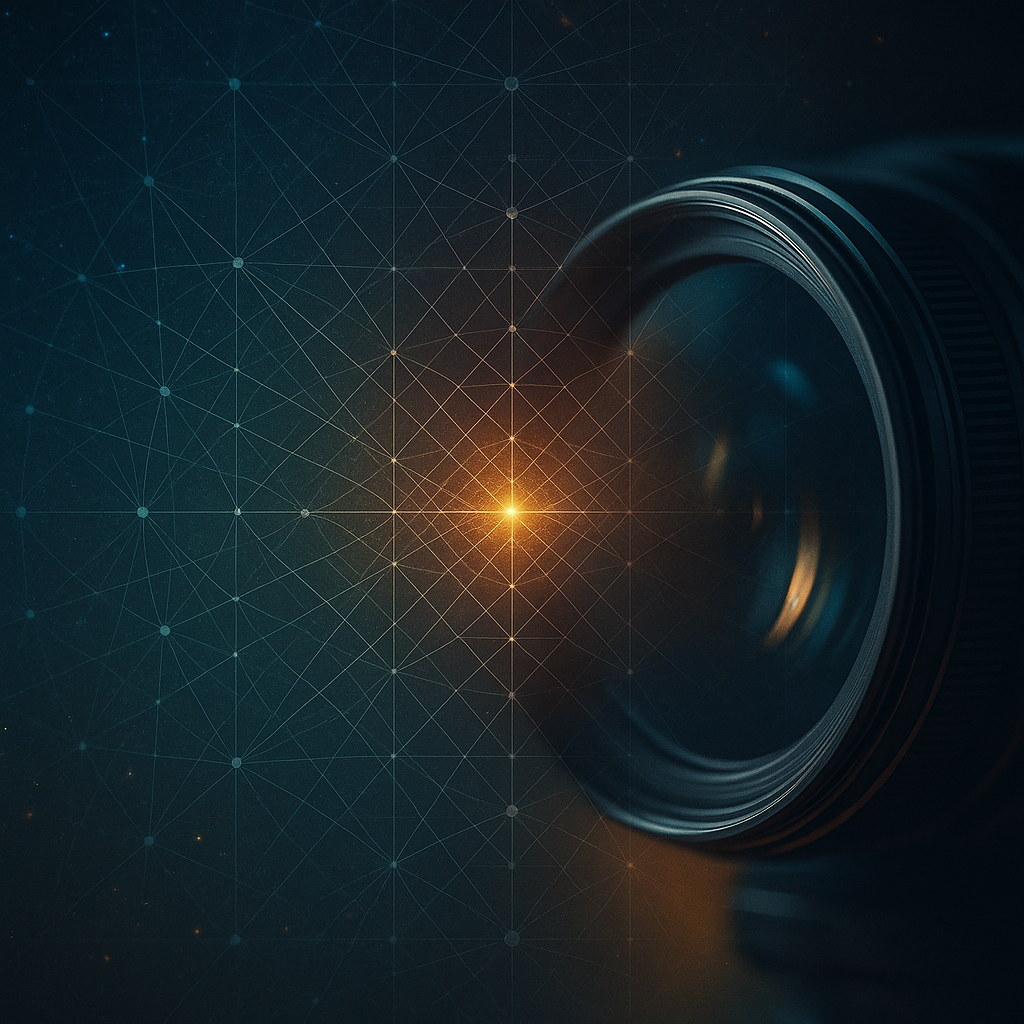
In Thomas Campbell’s My Big TOE, reality begins as a field of probabilities — an uncollapsed matrix of potential outcomes. Only when consciousness interacts with it does one possibility crystallize into experience. The universe, he suggests, is a vast information system — a holographic simulation refined by awareness.
Every time a photographer lifts a camera, this same quantum decision unfolds. The scene exists in infinite potential states — light, motion, and pattern — until the moment of focus. The press of the shutter acts like a wavefunction collapse, selecting one coherent outcome from the field. The human as light antenna becomes both observer and participant, collapsing light into meaning.
In this way, art and physics share the same origin story: consciousness choosing coherence. The act of photographing, thinking, or simply noticing is an act of creation. What we choose to see — and the vibration we hold as we see it — determines what becomes visible. In a holographic universe, coherence is the language through which probability becomes possibility.
“The lens does not capture the world — it decides which world becomes visible.”
The Aperture of Consciousness
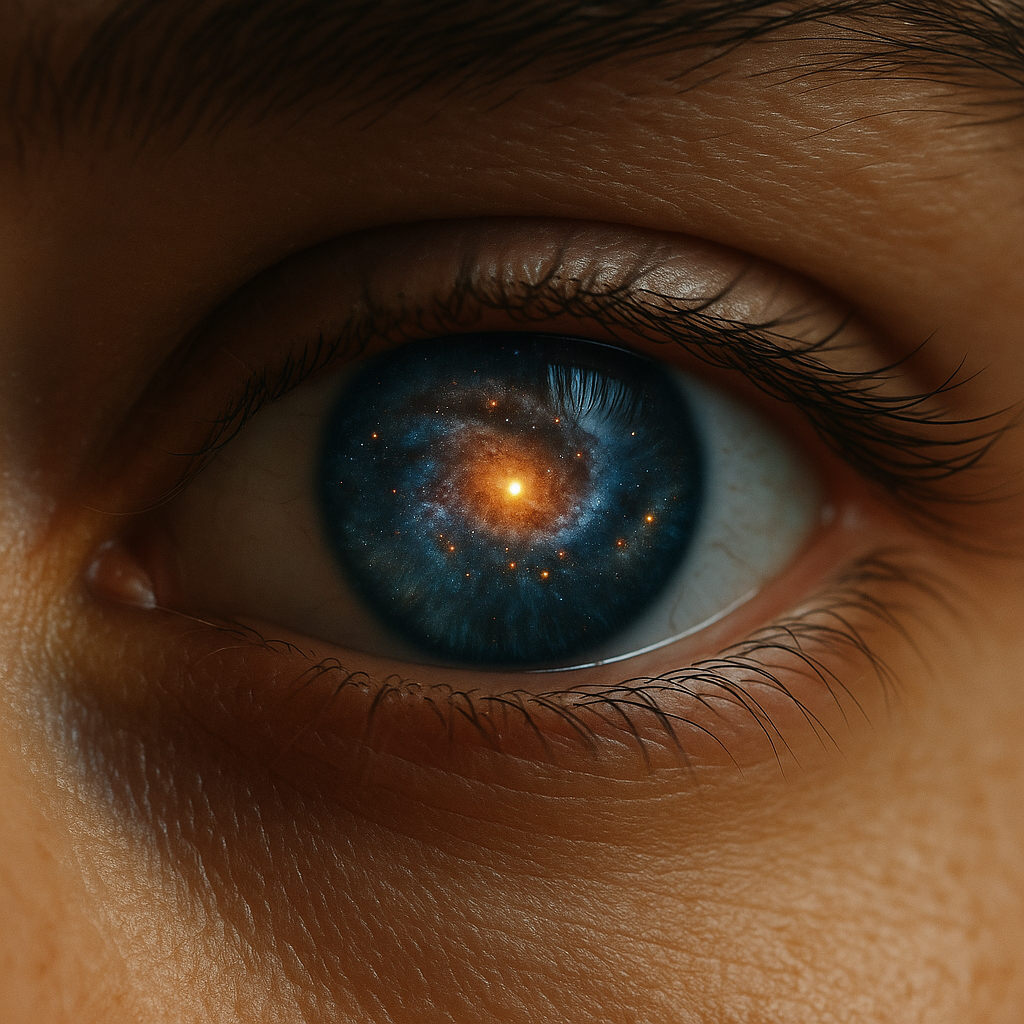
Focus is more than clarity—it’s coherence. Like an f-stop narrowing light, attention selects from the universe’s probabilities and stabilizes a single moment of meaning. In a holographic world, every point contains the whole; the eye becomes an aperture of the field, shaping which frequencies come into view.
This is why intention matters in image-making. The vibration you hold while seeing informs what becomes visible—an idea I expand in Humans as Light Antennas. Light isn’t merely captured; it is invited into coherence by the observer. The result is a photograph, but the process is closer to resonance than record.
“The lens in your eye doesn’t look at the universe—it lets the universe find its focus through you.”
The Birth of Light: Hydrogen, Water, and the Living Photon
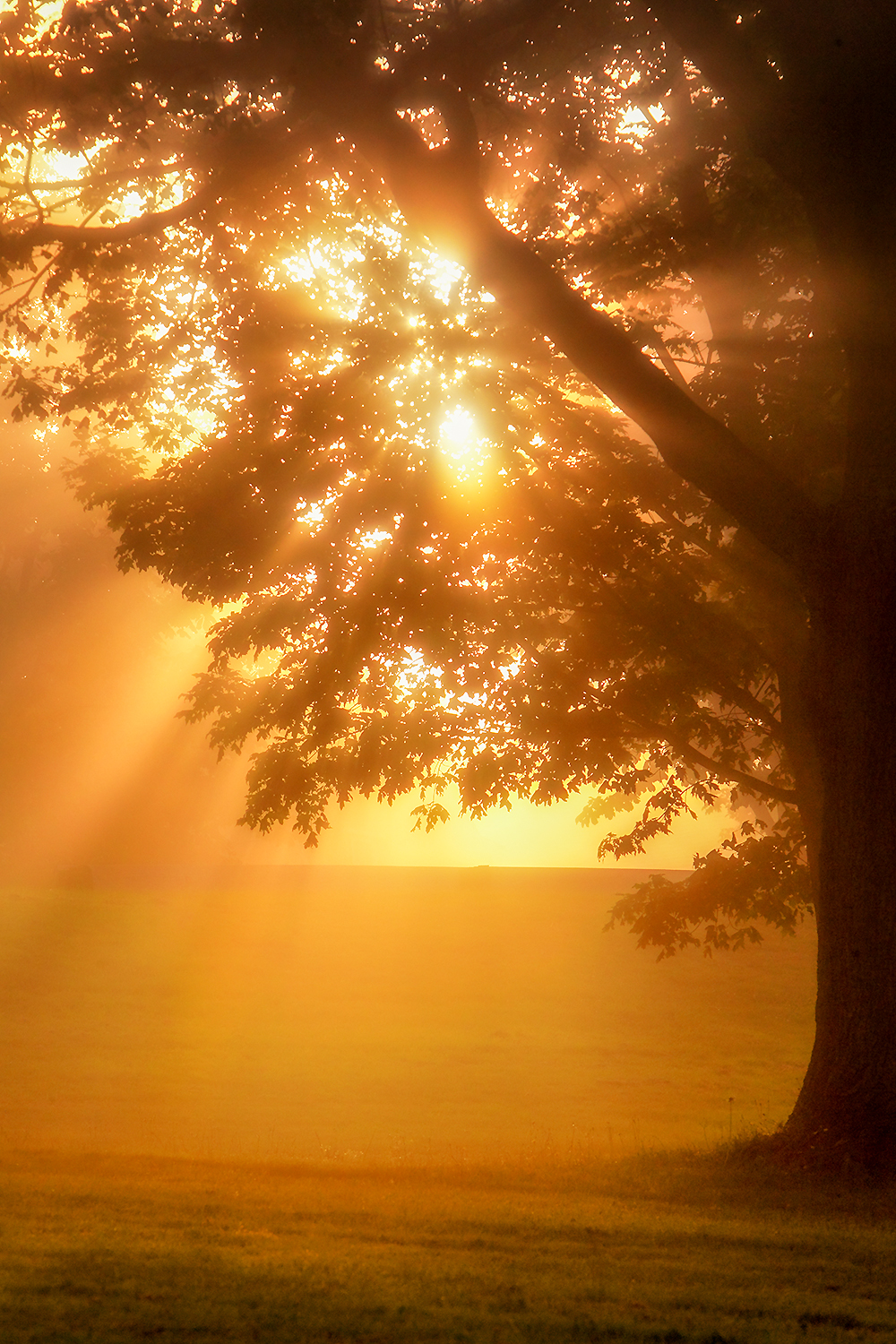
In nature, visibility is born when light finds a medium that remembers its path. Hydrogen ignites the stars; water shapes and diffuses photons here on Earth. In mist, droplets act like a living lattice, revealing rays that otherwise pass unnoticed. This is exposure at the planetary scale—when the field turns its own light into form.
The camera echoes this same process. Aperture, shutter, and intention invite photons to cohere into memory. I explore this bridge between physics and life in Completing E = mc²: Water & Mycelium and how breath and polarity tune the body’s light in Oxygen Polarity. What appears as a beam is really coherence made visible—a shared moment between hydrogen’s fire, water’s memory, and the observer’s focus.
“Each photon is the field remembering how to see.”
Green → Red: The Porphyrin Continuum of Life
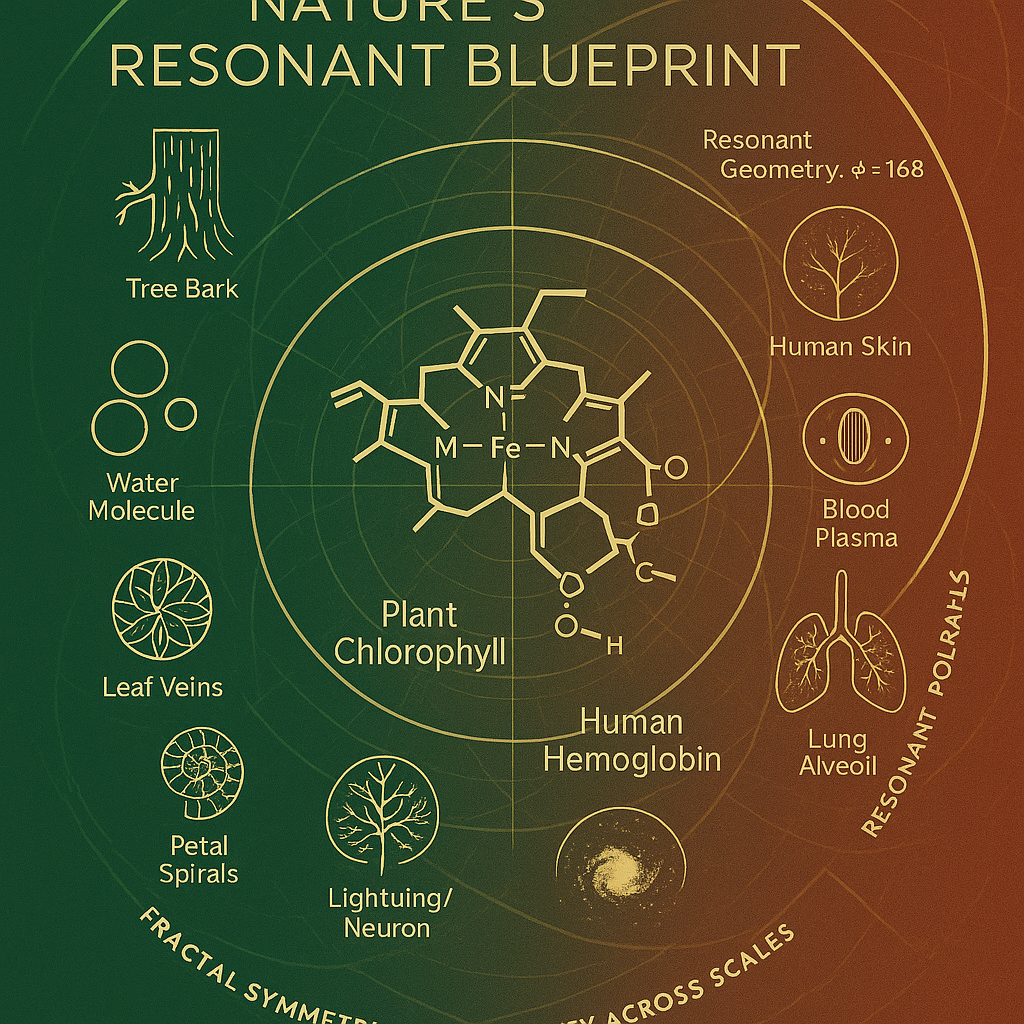
Chlorophyll and hemoglobin share the porphyrin ring—magnesium at center for light capture, iron for oxygen transport. Nature reuses this geometry as a resonant kernel, scaling it through fractal self-similarity and tuning it by polarity.
- Fractal exchange: leaf venation ↔ lung alveoli maximize surface for gas flow (see Oxygen Polarity).
- Fractal flow: xylem pull ↔ blood capillaries use hydrogen-bond coherence (expanded in Water & Mycelium).
- Fractal networks: mycelium ↔ neurons route signals as ion/electron currents.
- Fractal discharge: lightning arcs ↔ synaptic firing follow Lichtenberg branching.
- Golden ratio (φ): petal spirals ↔ DNA helices optimize growth and packing.
In this continuum, polarity sets the key: photosynthesis reduces CO2 with sunlight (electron sourcing) while respiration oxidizes sugars with O2 (electron sinking). The same ring mediates both halves—one blueprint, different octaves.
“Coherence scales as a spiral: geometry → molecule → tissue → biosphere. Polarity sets the key; fractals carry the melody.”
The Ocean Within: Electrolytes, Polarity & Darwin’s Continuity
Chlorophyll and hemoglobin reuse the same porphyrin ring—magnesium for light capture, iron for oxygen delivery. Inside that symmetry, life runs on electrolytic coherence: a conductive medium of magnesium, potassium, sodium, and chloride that maintains charge separation and flow across membranes.
- Magnesium (Mg²⁺) — the master resonator. It complexes with ATP so energy can be used, and stabilizes ion channels that keep heart, muscle, and brain rhythms coherent. Plant echo: Mg sits at chlorophyll’s center to focus sunlight into chemistry.
- Potassium (K⁺) — the internal spark. High inside cells, it sets the resting potential that allows nerves and muscles to fire. Polarity flips (K⁺/Na⁺ exchange) create the body’s “lightning in miniature.”
- Sodium & Chloride (Na⁺/Cl⁻) — the carrier wave. They keep plasma and interstitial water conductive, moving signals through the liquid crystal of structured water.
Darwin’s thread runs through this. Early life learned its physics in the sea; as organisms came ashore, they internalized the ocean. Human plasma is a buffered, diluted mirror of seawater’s ionic song. Nature preserved what routed energy best: saline conductivity, charge gradients, and fractal branching for efficient exchange—leaf ↔ lung, xylem ↔ veins, mycelium ↔ neurons.
Historian-biologist René Quinton called this inner sea “marine plasma.” Modern practice doesn’t use seawater as a blood replacement (blood carries proteins, antibodies, clotting factors), but the metaphor holds: we are walking oceans, and electrolytes are the wiring that keeps our porphyrin→mitochondria circuit efficient.
In Signature Series language: polarity sets the key, electrolytes tune the strings, and geometry scores the music. Keep the medium conductive and the pattern scales—cell, organ, network, field. See also Oxygen Polarity and Water & Mycelium.
“Evolution didn’t leave the ocean behind; it carried the tide within. Electrolytes keep the surf of life in motion.”
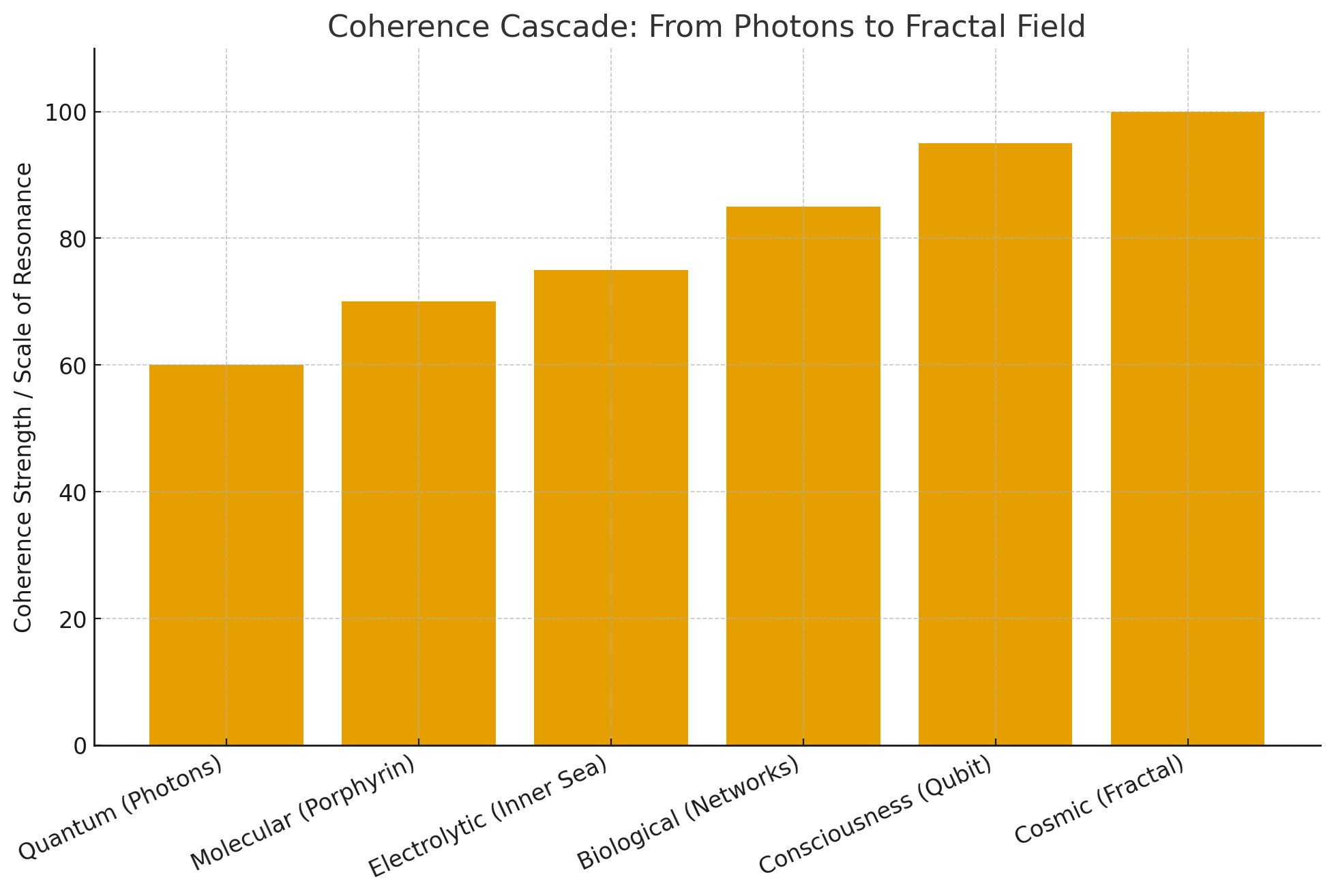
What follows is a simple visual ladder of the same idea: coherence scales from charge to cosmos.
Coherence Cascade: From Photons to Fractal Field
The Infinite Fractal Field: The Holographic Universe
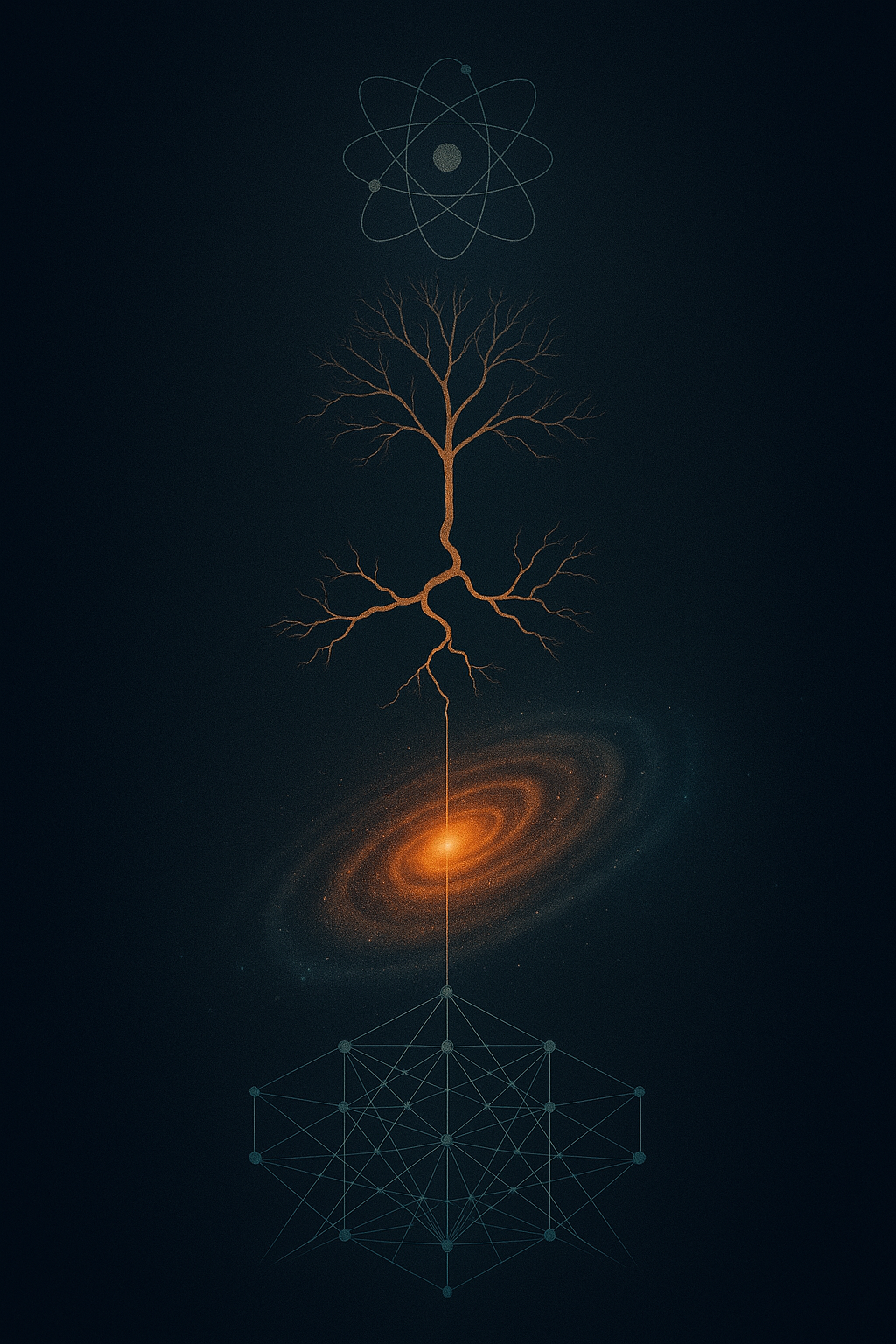
Every level of nature repeats the same geometry: the atom’s orbitals, a river’s branching delta, the arms of a galaxy, the synapses of the human brain. Each mirrors the other because the universe is not built in layers—it is scaled coherence. This is the holographic principle: every part contains the pattern of the whole.
The lattice that begins inside the hydrogen atom echoes through trees, mycelial webs, and galactic arms. The same geometry that organizes starlight also structures your heartbeat and your breath. This principle underlies my explorations in Water & Mycelium and the way living systems mirror cosmic architecture in The Quantum Breath of Life. Coherence never stops scaling—it only shifts the octave of vibration.
To photograph is to pause this recursion—one frame in an infinite fractal. The camera’s eye becomes the still point in the universal zoom, watching infinity expand and contract through its own reflection. You are that still point.
“There is no small or large — only recursion. The infinite folds itself through light until it becomes you.”
The Human Qubit: Light Observing Light
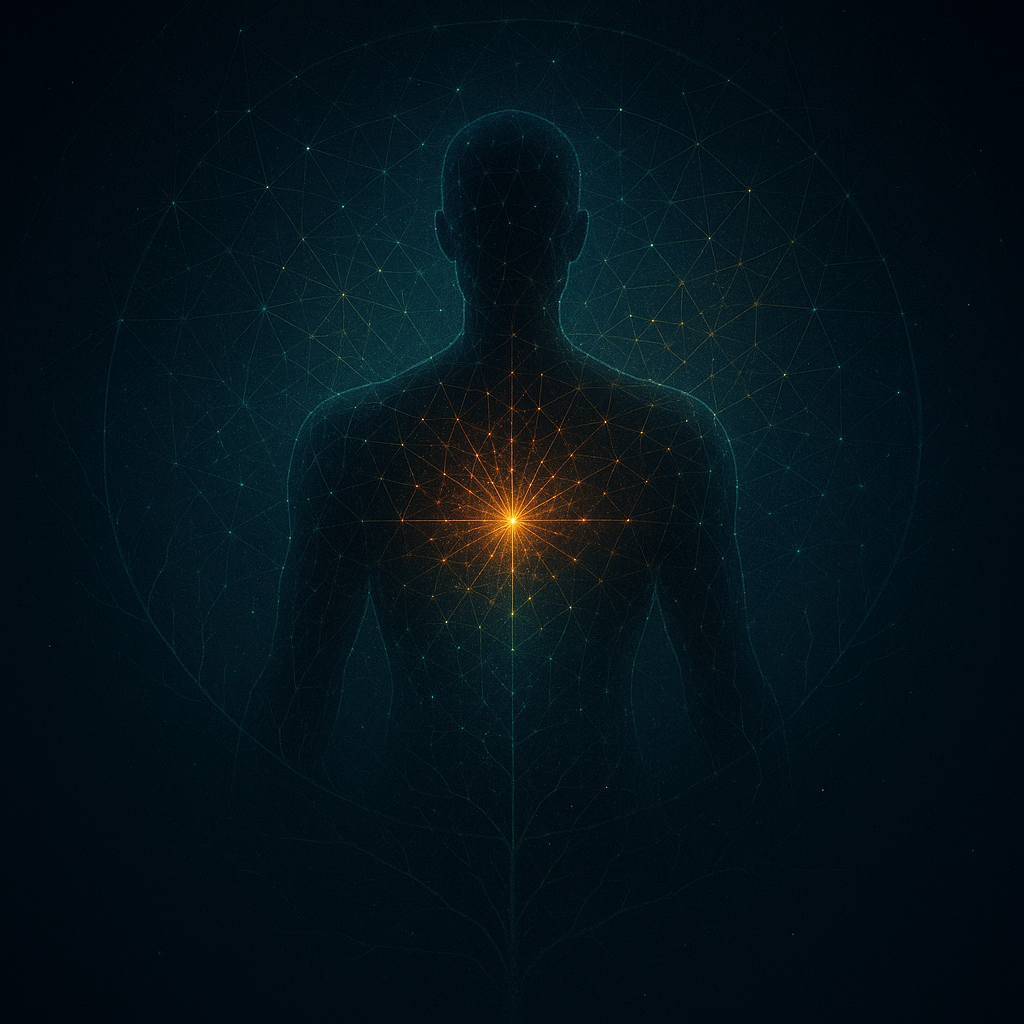
The universe doesn’t just create observers—it becomes the observer. Every consciousness is a human qubit: a node of awareness within the universal lattice, where probability turns into possibility through perception. Light doesn’t simply travel; it experiences itself through us. Each thought, emotion, or creative act is a micro-collapse of the wave—an encoded communication back to the field.
Science already hints at this: human cells emit biophotons—tiny flashes of light that may transmit information across the body. These signals create coherence, a living network of quantum communication. It’s the same harmonic language I explore in Humans as Light Antennas, where biology mirrors the resonance of stars, and perception itself becomes the most advanced lens in the cosmos.
In this light, you are not separate from the field you photograph, breathe, or feel—you are the field realizing itself. The lattice of consciousness passes through you as it does through hydrogen and galaxies alike. Awareness is the organizing principle; you are the aperture where infinity focuses.
“You are the point of light. Everyone is. Each consciousness a living qubit in the fractal lattice of being.”
The Unified Lens: Light Becoming Aware of Itself

The journey comes full circle. From Kircher’s 17th-century lattice of diversity to Darwin’s coherent patterns, to Campbell’s consciousness field and the human qubit, each step reveals the same truth: light learns by reflecting itself. When we witness the world through a lens— whether of glass or awareness—we participate in the universe’s own act of perception.
The camera, the eye, and consciousness share the same design: an aperture of coherence. Each captures the field’s geometry in a different octave—one as image, one as understanding, and one as being. In that convergence, the boundaries between photographer, subject, and light dissolve. The observer is no longer separate from the scene; both arise together as one coherent expression.
To hold a camera at dawn is to stand at the intersection of matter and meaning. The horizon opens, photons travel from star to eye to sensor, and awareness completes the circuit. You are not documenting the field—you are the field, momentarily aware of its own beauty. This is the unified lens: the light within you meeting the light without.
“The lens is not between you and the world—it is the world finding its focus through you.”
Carry the Light Forward
Keep exploring how coherence turns probability into possibility—through field notes, tools, and fine-art images. Choose your next step below.
Explore Fine-Art Prints
Bring the season home—browse Wildlife, Landscapes, and Seascapes by National Geographic–published photographer Robbie George. See framing, editions, and care on the Collectors page.
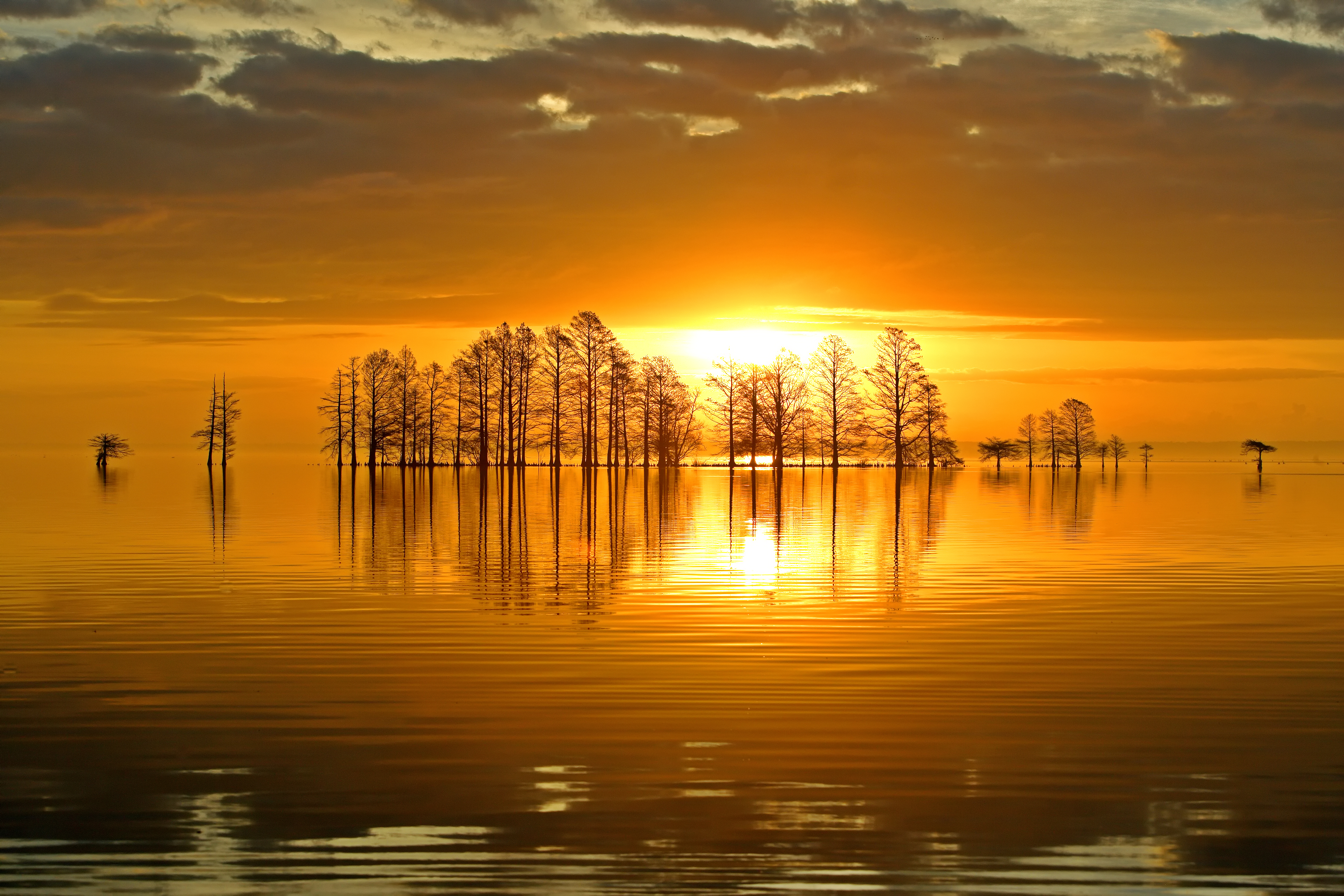 Landscape
  Wildlife
  Seascapes
About Robbie George
Robbie George is a National Geographic–published photographer and resonant naturalist. His fieldcraft follows a simple ethic—distance first, habitat always— shaped by Slow Knowledge and the Signature Series.
Explore calm, undisturbed behavior in the Wildlife Gallery or plan your next trip with the Seasonal Wildlife Calendar, Golden Hour & Moon, and Photography Maps.
“Attention first, image second. The shutter is the period at the end of a sentence you learned by walking.”